Plants & its Classification
“A backbone for human being.”
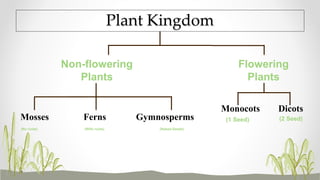
Plant Kingdom
Non-flowering
Plants
Flowering
Plants
Mosses Ferns Gymnosperms
(No roots) (With roots) (Naked Seeds)
Monocots Dicots
(1 Seed) (2 Seed)
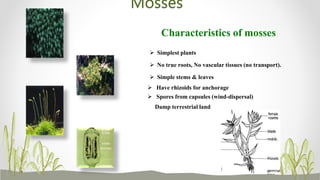
Mosses
Characteristics of mosses
 Simplest plants
 No true roots, No vascular tissues (no transport).
 Simple stems & leaves
 Have rhizoids for anchorage
 Spores from capsules (wind-dispersal)
Damp terrestrial land
Ferns
 Roots, feathery leaves & underground stems
have vascular tissues (transport & support)
 Spore-producing organ on the
underside
of leaves (reproduction)
 Damp & shady places.
Characteristics of Ferns
Spore
Producing
Organs
Circinate
Young
Leaf
Gymnosperms
 Tall evergreen trees roots,
woody stems needle-shaped
leaves.
 Vascular tissues (transport)
 Cones with reproductive
structures
 Naked seeds in female cones dry
places
Characteristics of GymnospermsMale
Cones
(In Cluster)
Female
Cones
(Scattered)
Needle
Shaped
Leaves
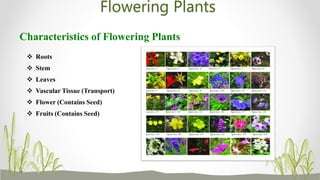
Flowering Plants
Characteristics of Flowering Plants
 Roots
 Stem
 Leaves
 Vascular Tissue (Transport)
 Flower (Contains Seed)
 Fruits (Contains Seed)
Monocotyledons
Parallel
Vein
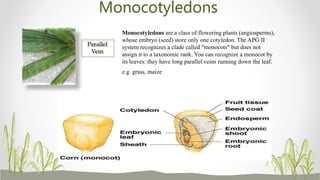
Monocotyledons are a class of flowering plants (angiosperms),
whose embryo (seed) store only one cotyledon. The APG II
system recognizes a clade called "monocots" but does not
assign it to a taxonomic rank. You can recognize a monocot by
its leaves: they have long parallel veins running down the leaf.
e.g. grass, maize
Dicotyledons
Parallel
Vein
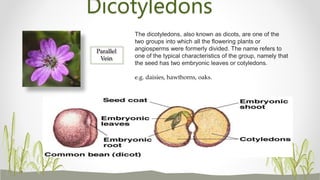
The dicotyledons, also known as dicots, are one of the
two groups into which all the flowering plants or
angiosperms were formerly divided. The name refers to
one of the typical characteristics of the group, namely that
the seed has two embryonic leaves or cotyledons.
e.g. daisies, hawthorns, oaks.

Plants & its classification

  • 1.
    Plants & itsClassification “A backbone for human being.”
  • 2.
    Plant Kingdom Non-flowering Plants Flowering Plants Mosses FernsGymnosperms (No roots) (With roots) (Naked Seeds) Monocots Dicots (1 Seed) (2 Seed)
  • 3.
    Mosses Characteristics of mosses Simplest plants  No true roots, No vascular tissues (no transport).  Simple stems & leaves  Have rhizoids for anchorage  Spores from capsules (wind-dispersal) Damp terrestrial land
  • 4.
    Ferns  Roots, featheryleaves & underground stems have vascular tissues (transport & support)  Spore-producing organ on the underside of leaves (reproduction)  Damp & shady places. Characteristics of Ferns Spore Producing Organs Circinate Young Leaf
  • 5.
    Gymnosperms  Tall evergreentrees roots, woody stems needle-shaped leaves.  Vascular tissues (transport)  Cones with reproductive structures  Naked seeds in female cones dry places Characteristics of GymnospermsMale Cones (In Cluster) Female Cones (Scattered) Needle Shaped Leaves
  • 6.
    Flowering Plants Characteristics ofFlowering Plants  Roots  Stem  Leaves  Vascular Tissue (Transport)  Flower (Contains Seed)  Fruits (Contains Seed)
  • 7.
    Monocotyledons Parallel Vein Monocotyledons are aclass of flowering plants (angiosperms), whose embryo (seed) store only one cotyledon. The APG II system recognizes a clade called "monocots" but does not assign it to a taxonomic rank. You can recognize a monocot by its leaves: they have long parallel veins running down the leaf. e.g. grass, maize
  • 8.
    Dicotyledons Parallel Vein The dicotyledons, alsoknown as dicots, are one of the two groups into which all the flowering plants or angiosperms were formerly divided. The name refers to one of the typical characteristics of the group, namely that the seed has two embryonic leaves or cotyledons. e.g. daisies, hawthorns, oaks.