GENES IN PLANTS
Basavaraj kodsa
pg16agr8100
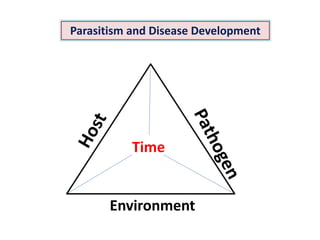
Time
Environment
Parasitism and Disease Development
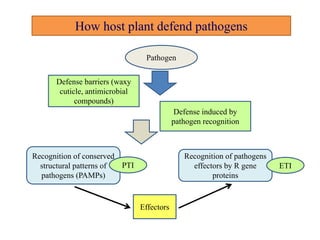
How host plant defend pathogens
Pathogen
Defense barriers (waxy
cuticle, antimicrobial
compounds)
Recognition of conserved
structural patterns of
pathogens (PAMPs)
PTI
Effectors
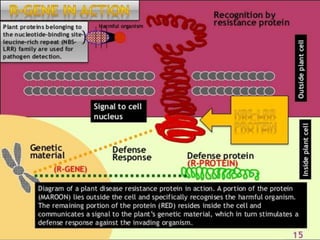
Recognition of pathogens
effectors by R gene
proteins
ETI
Defense induced by
pathogen recognition
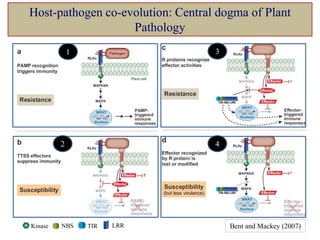
Host-pathogen co-evolution: Central dogma of Plant
Pathology
Kinase NBS TIR LRR Bent and Mackey (2007)
1
2
3
4
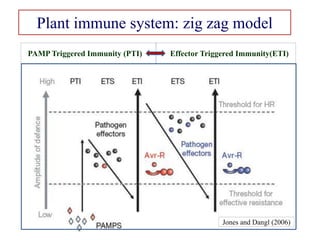
Plant immune system: zig zag model
PAMP Triggered Immunity (PTI) Effector Triggered Immunity(ETI)
Jones and Dangl (2006)
Effectors can be viewed as “Product
of parasite genes having phenotypic
expression in host bodies” (Dawkins
1999).
Specialized plant pathogens can evade or suppress this MAMP
triggered immunity (MTI) by secretion of virulence factors
called effectors.
A subset of these effectors, referred to as avirulence factors
(AVRs), which can be recognized by the resistance proteins
that trigger a second layer of host defense, referred to as
effector triggered immunity (ETI) or R-gene mediated defense.
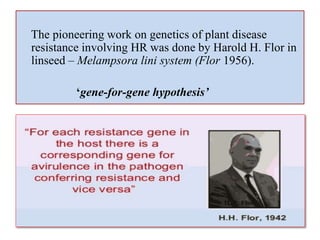
The pioneering work on genetics of plant disease
resistance involving HR was done by Harold H. Flor in
linseed – Melampsora lini system (Flor 1956).
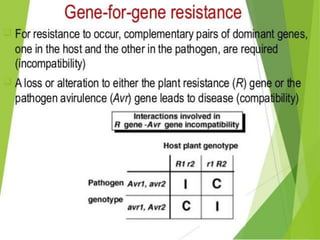
‘gene-for-gene hypothesis’
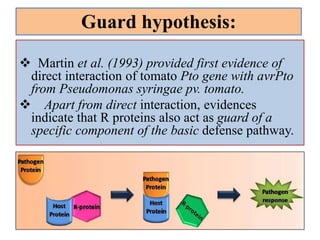
 Martin et al. (1993) provided first evidence of
direct interaction of tomato Pto gene with avrPto
from Pseudomonas syringae pv. tomato.
 Apart from direct interaction, evidences
indicate that R proteins also act as guard of a
specific component of the basic defense pathway.
Guard hypothesis:
Ex:Guard hypothesis
To date, the most convincing evidence for the guard hypothesis has
been found in Arabidopsis thaliana bacterial R-Avr systems where
RIN4 (RPM1- interacting protein 4) was identified as a cellular
protein that is required for the resistance to Pseudomonas syringae
pv. tomato mediated by RPM1 and RPS2.
The RIN4 (guardee) is modified in various ways, depending on the
Avr that it associates with, and these modifications then serve to
activate the corresponding R protein (guard).
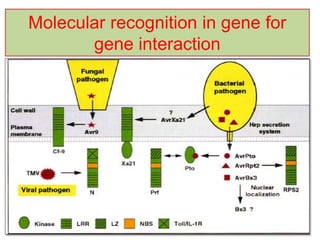
“AVR-R gene interaction provides the
molecular basis for flor hypothesis and
Receptor-Effector interaction provides
the biochemical evidences for flor
hypothesis”
Molecular recognition in gene for
gene interaction
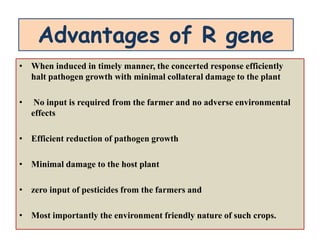
• When induced in timely manner, the concerted response efficiently
halt pathogen growth with minimal collateral damage to the plant
• No input is required from the farmer and no adverse environmental
effects
• Efficient reduction of pathogen growth
• Minimal damage to the host plant
• zero input of pesticides from the farmers and
• Most importantly the environment friendly nature of such crops.
Advantages of R gene
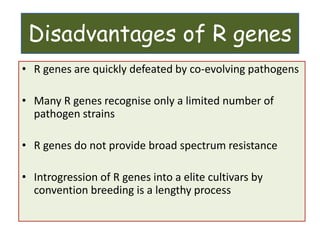
Disadvantages of R genes
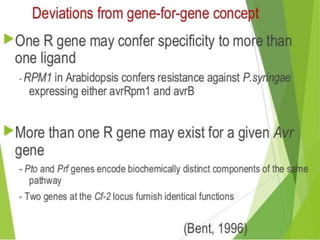
• R genes are quickly defeated by co-evolving pathogens
• Many R genes recognise only a limited number of
pathogen strains
• R genes do not provide broad spectrum resistance
• Introgression of R genes into a elite cultivars by
convention breeding is a lengthy process
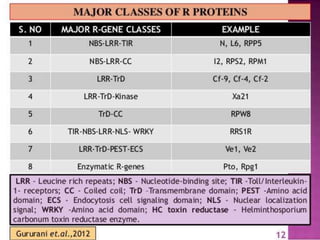
Classes of Plant Disease Resistance Genes Based on
Structural Features
Numerous R-genes identified, cloned and
characterized in different plants have been
categorized in eight classes (Table 1) based on
their amino acid organization.
(Gururani et al. 2012).
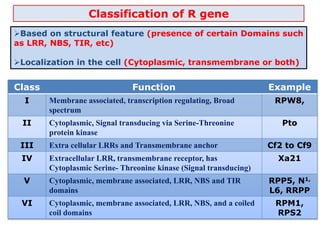
Classification of R gene
Based on structural feature (presence of certain Domains such
as LRR, NBS, TIR, etc)
Localization in the cell (Cytoplasmic, transmembrane or both)
Class Function Example
I Membrane associated, transcription regulating, Broad
spectrum
RPW8,
II Cytoplasmic, Signal transducing via Serine-Threonine
protein kinase
Pto
III Extra cellular LRRs and Transmembrane anchor Cf2 to Cf9
IV Extracellular LRR, transmembrane receptor, has
Cytoplasmic Serine- Threonine kinase (Signal transducing)
Xa21
V Cytoplasmic, membrane associated, LRR, NBS and TIR
domains
RPP5, N1,
L6, RRPP
VI Cytoplasmic, membrane associated, LRR, NBS, and a coiled
coil domains
RPM1,
RPS2
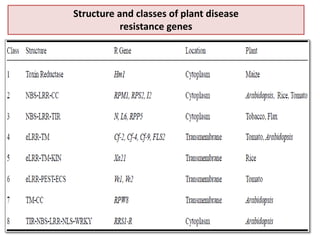
Structure and classes of plant disease
resistance genes
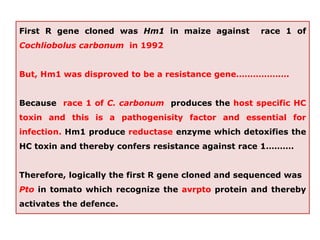
First R gene cloned was Hm1 in maize against race 1 of
Cochliobolus carbonum in 1992
But, Hm1 was disproved to be a resistance gene……………….
Because race 1 of C. carbonum produces the host specific HC
toxin and this is a pathogenisity factor and essential for
infection. Hm1 produce reductase enzyme which detoxifies the
HC toxin and thereby confers resistance against race 1……….
Therefore, logically the first R gene cloned and sequenced was
Pto in tomato which recognize the avrpto protein and thereby
activates the defence.
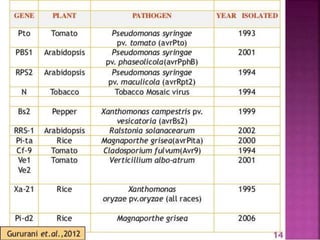
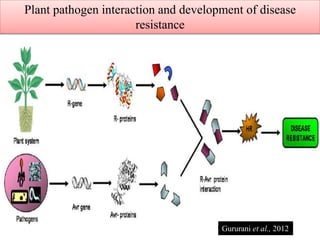
Plant pathogen interaction and development of disease
resistance
Gururani et al., 2012
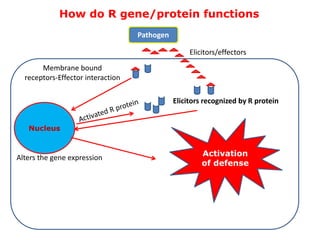
How do R gene/protein functions
Pathogen
Nucleus
Alters the gene expression
Membrane bound
receptors-Effector interaction
Elicitors/effectors
Elicitors recognized by R protein
Activation
of defense
Functions of Resistance Genes
Signaling of plant stress hormones, generation
of reactive oxygen species (ROS),ethylene
biosynthesis, defense gene activation leading
to phytoalexin biosynthesis, cell wall
strengthening by the deposition of callose and
hypersensitive response
(Dixon et al. 2001)
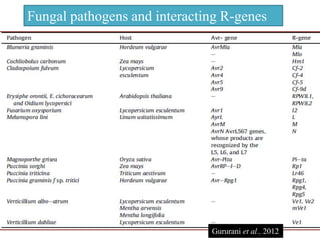
Fungal pathogens and interacting R-genes
Gururani et al., 2012
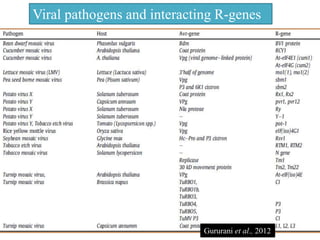
Viral pathogens and interacting R-genes
Gururani et al., 2012
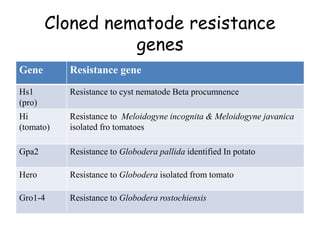
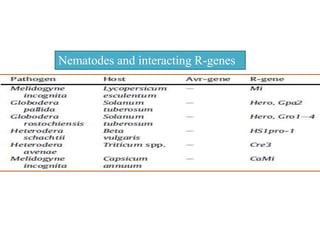
Cloned nematode resistance
genes
Gene Resistance gene
Hs1
(pro)
Resistance to cyst nematode Beta procumnence
Hi
(tomato)
Resistance to Meloidogyne incognita & Meloidogyne javanica
isolated fro tomatoes
Gpa2 Resistance to Globodera pallida identified In potato
Hero Resistance to Globodera isolated from tomato
Gro1-4 Resistance to Globodera rostochiensis
Nematodes and interacting R-genes
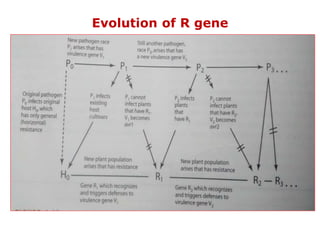
Evolution of R gene
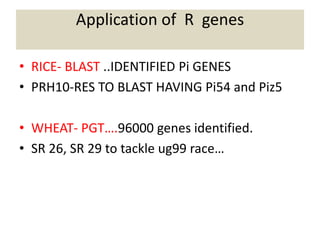
Application of R genes
• RICE- BLAST ..IDENTIFIED Pi GENES
• PRH10-RES TO BLAST HAVING Pi54 and Piz5
• WHEAT- PGT….96000 genes identified.
• SR 26, SR 29 to tackle ug99 race…
Conclusion.
R GENES

R GENES

  • 1.
    GENES IN PLANTS Basavarajkodsa pg16agr8100
  • 2.
  • 3.
    How host plantdefend pathogens Pathogen Defense barriers (waxy cuticle, antimicrobial compounds) Recognition of conserved structural patterns of pathogens (PAMPs) PTI Effectors Recognition of pathogens effectors by R gene proteins ETI Defense induced by pathogen recognition
  • 4.
    Host-pathogen co-evolution: Centraldogma of Plant Pathology Kinase NBS TIR LRR Bent and Mackey (2007) 1 2 3 4
  • 5.
    Plant immune system:zig zag model PAMP Triggered Immunity (PTI) Effector Triggered Immunity(ETI) Jones and Dangl (2006)
  • 6.
    Effectors can beviewed as “Product of parasite genes having phenotypic expression in host bodies” (Dawkins 1999).
  • 7.
    Specialized plant pathogenscan evade or suppress this MAMP triggered immunity (MTI) by secretion of virulence factors called effectors. A subset of these effectors, referred to as avirulence factors (AVRs), which can be recognized by the resistance proteins that trigger a second layer of host defense, referred to as effector triggered immunity (ETI) or R-gene mediated defense.
  • 8.
    The pioneering workon genetics of plant disease resistance involving HR was done by Harold H. Flor in linseed – Melampsora lini system (Flor 1956). ‘gene-for-gene hypothesis’
  • 11.
     Martin etal. (1993) provided first evidence of direct interaction of tomato Pto gene with avrPto from Pseudomonas syringae pv. tomato.  Apart from direct interaction, evidences indicate that R proteins also act as guard of a specific component of the basic defense pathway. Guard hypothesis:
  • 12.
    Ex:Guard hypothesis To date,the most convincing evidence for the guard hypothesis has been found in Arabidopsis thaliana bacterial R-Avr systems where RIN4 (RPM1- interacting protein 4) was identified as a cellular protein that is required for the resistance to Pseudomonas syringae pv. tomato mediated by RPM1 and RPS2. The RIN4 (guardee) is modified in various ways, depending on the Avr that it associates with, and these modifications then serve to activate the corresponding R protein (guard).
  • 13.
    “AVR-R gene interactionprovides the molecular basis for flor hypothesis and Receptor-Effector interaction provides the biochemical evidences for flor hypothesis”
  • 14.
    Molecular recognition ingene for gene interaction
  • 15.
    • When inducedin timely manner, the concerted response efficiently halt pathogen growth with minimal collateral damage to the plant • No input is required from the farmer and no adverse environmental effects • Efficient reduction of pathogen growth • Minimal damage to the host plant • zero input of pesticides from the farmers and • Most importantly the environment friendly nature of such crops. Advantages of R gene
  • 16.
    Disadvantages of Rgenes • R genes are quickly defeated by co-evolving pathogens • Many R genes recognise only a limited number of pathogen strains • R genes do not provide broad spectrum resistance • Introgression of R genes into a elite cultivars by convention breeding is a lengthy process
  • 17.
    Classes of PlantDisease Resistance Genes Based on Structural Features Numerous R-genes identified, cloned and characterized in different plants have been categorized in eight classes (Table 1) based on their amino acid organization. (Gururani et al. 2012).
  • 18.
    Classification of Rgene Based on structural feature (presence of certain Domains such as LRR, NBS, TIR, etc) Localization in the cell (Cytoplasmic, transmembrane or both) Class Function Example I Membrane associated, transcription regulating, Broad spectrum RPW8, II Cytoplasmic, Signal transducing via Serine-Threonine protein kinase Pto III Extra cellular LRRs and Transmembrane anchor Cf2 to Cf9 IV Extracellular LRR, transmembrane receptor, has Cytoplasmic Serine- Threonine kinase (Signal transducing) Xa21 V Cytoplasmic, membrane associated, LRR, NBS and TIR domains RPP5, N1, L6, RRPP VI Cytoplasmic, membrane associated, LRR, NBS, and a coiled coil domains RPM1, RPS2
  • 19.
    Structure and classesof plant disease resistance genes
  • 22.
    First R genecloned was Hm1 in maize against race 1 of Cochliobolus carbonum in 1992 But, Hm1 was disproved to be a resistance gene………………. Because race 1 of C. carbonum produces the host specific HC toxin and this is a pathogenisity factor and essential for infection. Hm1 produce reductase enzyme which detoxifies the HC toxin and thereby confers resistance against race 1………. Therefore, logically the first R gene cloned and sequenced was Pto in tomato which recognize the avrpto protein and thereby activates the defence.
  • 24.
    Plant pathogen interactionand development of disease resistance Gururani et al., 2012
  • 25.
    How do Rgene/protein functions Pathogen Nucleus Alters the gene expression Membrane bound receptors-Effector interaction Elicitors/effectors Elicitors recognized by R protein Activation of defense
  • 26.
    Functions of ResistanceGenes Signaling of plant stress hormones, generation of reactive oxygen species (ROS),ethylene biosynthesis, defense gene activation leading to phytoalexin biosynthesis, cell wall strengthening by the deposition of callose and hypersensitive response (Dixon et al. 2001)
  • 27.
    Fungal pathogens andinteracting R-genes Gururani et al., 2012
  • 28.
    Viral pathogens andinteracting R-genes Gururani et al., 2012
  • 29.
    Cloned nematode resistance genes GeneResistance gene Hs1 (pro) Resistance to cyst nematode Beta procumnence Hi (tomato) Resistance to Meloidogyne incognita & Meloidogyne javanica isolated fro tomatoes Gpa2 Resistance to Globodera pallida identified In potato Hero Resistance to Globodera isolated from tomato Gro1-4 Resistance to Globodera rostochiensis
  • 30.
  • 31.
  • 32.
    Application of Rgenes • RICE- BLAST ..IDENTIFIED Pi GENES • PRH10-RES TO BLAST HAVING Pi54 and Piz5 • WHEAT- PGT….96000 genes identified. • SR 26, SR 29 to tackle ug99 race…
  • 33.