 Genetic resistance refers to those heritable features of a host plant
that suppress or retard development of a pathogen.
 It is controlled genetically by the presence of one, a few or many
genes for resistance in the plant i.e., either nuclear or cytoplasmic or
both in nature.
 Most plants are resistant to most diseases(Non-host resistance).o
Resistance is the rule and susceptibility is an exception.
 Disease resistance is a relative trait in plants rather than
anabsolute quality.
 These terms were coined by the late J. E. Van der plank (“Plant
Diseases: Epidemics and Control” 1963), who was possibly the
most important plant pathologist who ever lived.
 The terms are derived from his classic diagrams that define the
two kinds of host resistance.
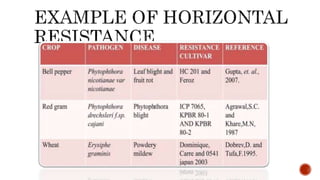
 According to J.E.van der plank (1963) when the resistance is evenly
spread against all races ofpathogen it is called "horizontal" or
"lateral" resistance.
 All plants have a certain, but not always the same level of possibly
unspecific resistance that is effective against each of their pathogen.
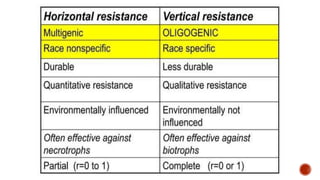
 Such resistance is sometimes called partial, race non specific,
general, quantitative, polygenic,adult-plant, field, additive, durable,
stable, non-differential Rate-reducing, minor gene,incomplete or
multigenic resistance.
 In the case of horizontal resistance, reproduction rate of pathogen is
never zero, but it is less than one, ie., r>0 but<1.
 Breeding for horizontal resistance is cumulative: A good cultivar is
replaced only with a better cultivar.
 HR is present universally in wild and domesticated plants and
operates against all races of a pathogen, including the most
pathogenic ones.
 Horizontal resistance can be domesticated just as yield and quality
have already been domesticated.
 An inadequate level of horizontal resistance can be increased by
further breeding
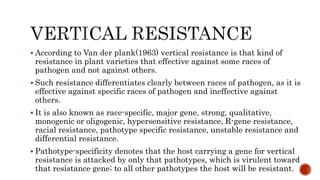
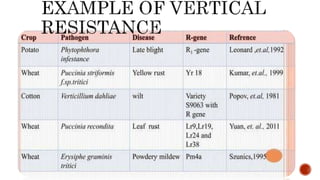
 According to Van der plank(1963) vertical resistance is that kind of
resistance in plant varieties that effective against some races of
pathogen and not against others.
 Such resistance differentiates clearly between races of pathogen, as it is
effective against specific races of pathogen and ineffective against
others.
 It is also known as race-specific, major gene, strong, qualitative,
monogenic or oligogenic, hypersensitive resistance, R-gene resistance,
racial resistance, pathotype specific resistance, unstable resistance and
differential resistance.
 Pathotype-specificity denotes that the host carrying a gene for vertical
resistance is attacked by only that pathotypes, which is virulent toward
that resistance gene; to all other pathotypes the host will be resistant.
HORIZONTAL AND VERTICAL RESISTANCE.pptx

HORIZONTAL AND VERTICAL RESISTANCE.pptx

  • 2.
     Genetic resistancerefers to those heritable features of a host plant that suppress or retard development of a pathogen.  It is controlled genetically by the presence of one, a few or many genes for resistance in the plant i.e., either nuclear or cytoplasmic or both in nature.  Most plants are resistant to most diseases(Non-host resistance).o Resistance is the rule and susceptibility is an exception.  Disease resistance is a relative trait in plants rather than anabsolute quality.
  • 3.
     These termswere coined by the late J. E. Van der plank (“Plant Diseases: Epidemics and Control” 1963), who was possibly the most important plant pathologist who ever lived.  The terms are derived from his classic diagrams that define the two kinds of host resistance.
  • 4.
     According toJ.E.van der plank (1963) when the resistance is evenly spread against all races ofpathogen it is called "horizontal" or "lateral" resistance.  All plants have a certain, but not always the same level of possibly unspecific resistance that is effective against each of their pathogen.  Such resistance is sometimes called partial, race non specific, general, quantitative, polygenic,adult-plant, field, additive, durable, stable, non-differential Rate-reducing, minor gene,incomplete or multigenic resistance.  In the case of horizontal resistance, reproduction rate of pathogen is never zero, but it is less than one, ie., r>0 but<1.
  • 5.
     Breeding forhorizontal resistance is cumulative: A good cultivar is replaced only with a better cultivar.  HR is present universally in wild and domesticated plants and operates against all races of a pathogen, including the most pathogenic ones.  Horizontal resistance can be domesticated just as yield and quality have already been domesticated.  An inadequate level of horizontal resistance can be increased by further breeding
  • 7.
     According toVan der plank(1963) vertical resistance is that kind of resistance in plant varieties that effective against some races of pathogen and not against others.  Such resistance differentiates clearly between races of pathogen, as it is effective against specific races of pathogen and ineffective against others.  It is also known as race-specific, major gene, strong, qualitative, monogenic or oligogenic, hypersensitive resistance, R-gene resistance, racial resistance, pathotype specific resistance, unstable resistance and differential resistance.  Pathotype-specificity denotes that the host carrying a gene for vertical resistance is attacked by only that pathotypes, which is virulent toward that resistance gene; to all other pathotypes the host will be resistant.