Mode of Entry and Establishment of
Virus in to Seed
K.Ramalingam
M.Sc., (Plant Pathology)
PAT 610 - Seed Health Technology (2 + 1)
TAMILNADU AGRICULTURALUNIVERSITY
overview
History
Mode Of Entry
 Contamination On Seeds
 Out Side Of Embryo
 Inside Embryo
 Direct Infection
 Indirect Infection (Ovule, Pollen)
Stage Of Infection
Genetics Of Seed Transmission
Virus Longevity In Seed.
History
Westerdijk (1910) and Allard (1914) – TMV in tomato
Annual Report Of Connecticut Agricultural Experiment Station (1915) - SMV
Stewart and Reddick (1917) – BCMV
1500 plant virus disease , 231 - virus , 24 - virus group
Alfamovirus, Bromovirus, Capillovirus, Carlavirus, Carmovirus,
Caulimovirus, Comovirus, Cryptovirus, Cucumovirus, Enamovirus, Fabavirus,
Furovirus, Hordeivirus, Ilarvirus, Necrovirus, Nepovirus, Potexvirus, Potyvirus,
Sobemovirus, Tobamovirus, Tobravirus, Tombusvirus, Tospovirus and
Tymovirus groups.
Surface of Seeds
Systemically infected plants transmit the virus as a surface contaminant of the
seed.
Very few viruses are qualify for transmission and causing disease.
1 – Stable to withstand in seed dehydration , harvest and storage .
2 – Able to enter in to seedling - transplanting , handling results in
mechanical inoculation .
way of entry :
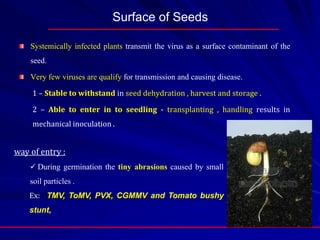
 During germination the tiny abrasions caused by small
soil particles .
Ex: TMV, ToMV, PVX, CGMMV and Tomato bushy
stunt,
TMV as contamination
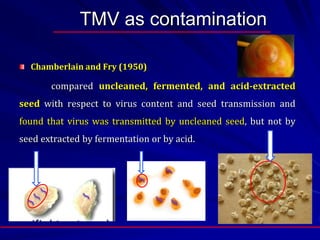
Chamberlain and Fry (1950)
compared uncleaned, fermented, and acid-extracted
seed with respect to virus content and seed transmission and
found that virus was transmitted by uncleaned seed, but not by
seed extracted by fermentation or by acid.
outside the Embryo
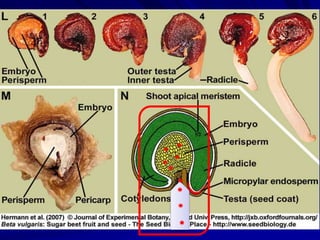
In the process of seed development, quantities of carbohydrates are
moved into the seed as a food reserve along with virus.
virus movement in the phloem is correlated with carbohydrate
transport, viruses that occur in high concentrations in the phloem
would be expected to move in considerable quantities into seeds that
have a vascular connection with the mother plant where they would
accumulate as food reserves are increased.
Ex. Sugarbeet curly top virus in perisperm
Inside The Embryo
Indirect invasion :
infection of reproductive tissue before embryogenesis.
Direct invasion :
infection of the embryo during some stage of embryogenesis.
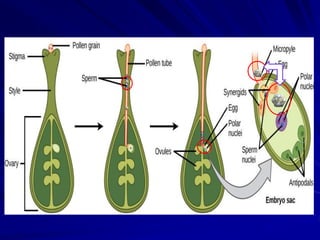
Ovule infection by virus from pollen
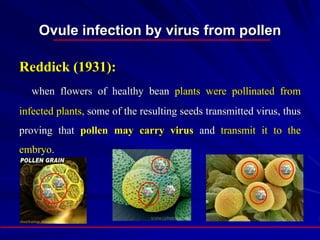
Reddick (1931):
when flowers of healthy bean plants were pollinated from
infected plants, some of the resulting seeds transmitted virus, thus
proving that pollen may carry virus and transmit it to the
embryo.
Cont…
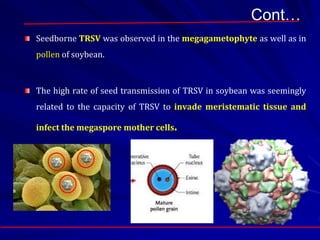
Seedborne TRSV was observed in the megagametophyte as well as in
pollen of soybean.
The high rate of seed transmission of TRSV in soybean was seemingly
related to the capacity of TRSV to invade meristematic tissue and
infect the megaspore mother cells.
Ovule Invasion by Virus from the Mother Plant
Fajardo (1928):
Reported that bean plants grown from seeds of plants infected
with bean mosaic virus gave higher percentages of infected seeds
than plants inoculated during stages of vegetative development
and that there was no virus transmission by seeds of pods set prior
to infection of the mother plant.
BSMV – Both Direction
Recording the cytological changes in the floral meristems during meiosis
and embryo formation in relation to the distribution of a seed-
transmitted strain (MI-1) and a non-seed-transmitted strain (NSP) in
the reproductive tissues.
The strain MI-1 - present in the megaspore and pollen mother cells as
well as in the egg and pollen,
the strain NSP was never found in these cells.
After fertilization, plasmodesmata were not observed between
developing embryos and the surrounding tissues.
Cont…
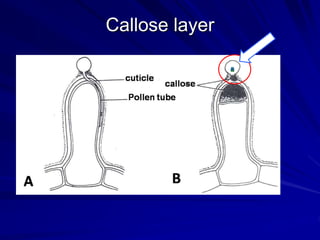
The presence of MI- l in megaspore and pollen mother cells preceded
the development of a callose layer and disappearance of
plasmodesmata separating megaspore mother cells and pollen
mother cells from parental tissues just before meiosis.
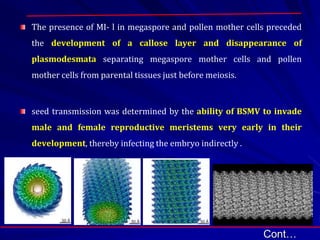
seed transmission was determined by the ability of BSMV to invade
male and female reproductive meristems very early in their
development, thereby infecting the embryo indirectly .
Callose layer
Direct Embryo Invasion
The pea cv. Vedette.
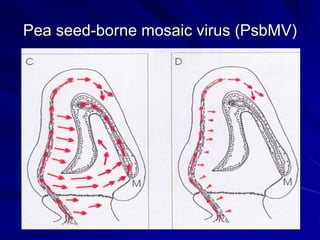
Movement of PSbMV in developing pods and seeds was monitored by
ELISA, immuno-cytochemistry, and in situ hybridization.
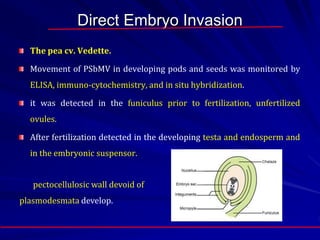
it was detected in the funiculus prior to fertilization, unfertilized
ovules.
After fertilization detected in the developing testa and endosperm and
in the embryonic suspensor.
pectocellulosic wall devoid of
plasmodesmata develop.
contact point between the testa and the suspensor was suggested as a
likely route of entry.
virus may be able to traverse the cell wall between the testa and the
suspensor by an as yet unidentified mechanism.
may be :
it may be able to induce formation of new plasmodesmata, thus
allowing direct invasion of the embryo.
The callose layer is incomplete around the newly formed embryo sac.
Pea seed-borne mosaic virus (PsbMV)
Stage of infection
Before flowering : TRSV in bean
cytoplasmic separation of the developing embryo from maternal
tissue . High transmission
Age of the plant : ULCV in urad bean
Genetics of seed transmission
Potyvirus genome-linked protein (VPg) – PsbMV.
CP and HC-Pro coding regions – PsbMV.
”b protein – BSMV.
physico–chemical properties and RNA secondary structure – TSV
(Mel 40 and Mel F).
Tripartite RNA particles – BSMV.
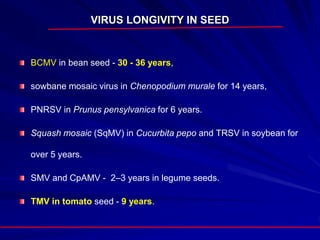
VIRUS LONGIVITY IN SEED
BCMV in bean seed - 30 - 36 years,
sowbane mosaic virus in Chenopodium murale for 14 years,
PNRSV in Prunus pensylvanica for 6 years.
Squash mosaic (SqMV) in Cucurbita pepo and TRSV in soybean for
over 5 years.
SMV and CpAMV - 2–3 years in legume seeds.
TMV in tomato seed - 9 years.
Bibliography
Subramanya Sastry (2013), Seed-borne Plant Virus Diseases,
springer,
Bennett w.c , Seed transmission of plant viruses,ars california
Elisabeth Johansen et al.,(1994) Seed transmission of viruses:
Current Perspectives, Annu. Rev. Phytopathol. 32:363—M
Paul Neergaard,(1969), seed borne disease, phytosanitory
inspection in Africa, 380-389
Yang A.F, Hamilton R.I (1974), The Mechanism of Seed
Transmission of Tobacco Ringspot Virus in Soybean, Virology 62,
26-37
Thanking you !!!

Virus entry in to seed

  • 1.
    Mode of Entryand Establishment of Virus in to Seed K.Ramalingam M.Sc., (Plant Pathology) PAT 610 - Seed Health Technology (2 + 1) TAMILNADU AGRICULTURALUNIVERSITY
  • 2.
    overview History Mode Of Entry Contamination On Seeds  Out Side Of Embryo  Inside Embryo  Direct Infection  Indirect Infection (Ovule, Pollen) Stage Of Infection Genetics Of Seed Transmission Virus Longevity In Seed.
  • 3.
    History Westerdijk (1910) andAllard (1914) – TMV in tomato Annual Report Of Connecticut Agricultural Experiment Station (1915) - SMV Stewart and Reddick (1917) – BCMV 1500 plant virus disease , 231 - virus , 24 - virus group Alfamovirus, Bromovirus, Capillovirus, Carlavirus, Carmovirus, Caulimovirus, Comovirus, Cryptovirus, Cucumovirus, Enamovirus, Fabavirus, Furovirus, Hordeivirus, Ilarvirus, Necrovirus, Nepovirus, Potexvirus, Potyvirus, Sobemovirus, Tobamovirus, Tobravirus, Tombusvirus, Tospovirus and Tymovirus groups.
  • 4.
    Surface of Seeds Systemicallyinfected plants transmit the virus as a surface contaminant of the seed. Very few viruses are qualify for transmission and causing disease. 1 – Stable to withstand in seed dehydration , harvest and storage . 2 – Able to enter in to seedling - transplanting , handling results in mechanical inoculation . way of entry :  During germination the tiny abrasions caused by small soil particles . Ex: TMV, ToMV, PVX, CGMMV and Tomato bushy stunt,
  • 5.
    TMV as contamination Chamberlainand Fry (1950) compared uncleaned, fermented, and acid-extracted seed with respect to virus content and seed transmission and found that virus was transmitted by uncleaned seed, but not by seed extracted by fermentation or by acid.
  • 6.
    outside the Embryo Inthe process of seed development, quantities of carbohydrates are moved into the seed as a food reserve along with virus. virus movement in the phloem is correlated with carbohydrate transport, viruses that occur in high concentrations in the phloem would be expected to move in considerable quantities into seeds that have a vascular connection with the mother plant where they would accumulate as food reserves are increased. Ex. Sugarbeet curly top virus in perisperm
  • 8.
    Inside The Embryo Indirectinvasion : infection of reproductive tissue before embryogenesis. Direct invasion : infection of the embryo during some stage of embryogenesis.
  • 9.
    Ovule infection byvirus from pollen Reddick (1931): when flowers of healthy bean plants were pollinated from infected plants, some of the resulting seeds transmitted virus, thus proving that pollen may carry virus and transmit it to the embryo.
  • 10.
    Cont… Seedborne TRSV wasobserved in the megagametophyte as well as in pollen of soybean. The high rate of seed transmission of TRSV in soybean was seemingly related to the capacity of TRSV to invade meristematic tissue and infect the megaspore mother cells.
  • 12.
    Ovule Invasion byVirus from the Mother Plant Fajardo (1928): Reported that bean plants grown from seeds of plants infected with bean mosaic virus gave higher percentages of infected seeds than plants inoculated during stages of vegetative development and that there was no virus transmission by seeds of pods set prior to infection of the mother plant.
  • 14.
    BSMV – BothDirection Recording the cytological changes in the floral meristems during meiosis and embryo formation in relation to the distribution of a seed- transmitted strain (MI-1) and a non-seed-transmitted strain (NSP) in the reproductive tissues. The strain MI-1 - present in the megaspore and pollen mother cells as well as in the egg and pollen, the strain NSP was never found in these cells. After fertilization, plasmodesmata were not observed between developing embryos and the surrounding tissues.
  • 15.
    Cont… The presence ofMI- l in megaspore and pollen mother cells preceded the development of a callose layer and disappearance of plasmodesmata separating megaspore mother cells and pollen mother cells from parental tissues just before meiosis. seed transmission was determined by the ability of BSMV to invade male and female reproductive meristems very early in their development, thereby infecting the embryo indirectly .
  • 16.
  • 17.
    Direct Embryo Invasion Thepea cv. Vedette. Movement of PSbMV in developing pods and seeds was monitored by ELISA, immuno-cytochemistry, and in situ hybridization. it was detected in the funiculus prior to fertilization, unfertilized ovules. After fertilization detected in the developing testa and endosperm and in the embryonic suspensor. pectocellulosic wall devoid of plasmodesmata develop.
  • 18.
    contact point betweenthe testa and the suspensor was suggested as a likely route of entry. virus may be able to traverse the cell wall between the testa and the suspensor by an as yet unidentified mechanism. may be : it may be able to induce formation of new plasmodesmata, thus allowing direct invasion of the embryo. The callose layer is incomplete around the newly formed embryo sac.
  • 19.
    Pea seed-borne mosaicvirus (PsbMV)
  • 20.
    Stage of infection Beforeflowering : TRSV in bean cytoplasmic separation of the developing embryo from maternal tissue . High transmission Age of the plant : ULCV in urad bean
  • 21.
    Genetics of seedtransmission Potyvirus genome-linked protein (VPg) – PsbMV. CP and HC-Pro coding regions – PsbMV. ”b protein – BSMV. physico–chemical properties and RNA secondary structure – TSV (Mel 40 and Mel F). Tripartite RNA particles – BSMV.
  • 22.
    VIRUS LONGIVITY INSEED BCMV in bean seed - 30 - 36 years, sowbane mosaic virus in Chenopodium murale for 14 years, PNRSV in Prunus pensylvanica for 6 years. Squash mosaic (SqMV) in Cucurbita pepo and TRSV in soybean for over 5 years. SMV and CpAMV - 2–3 years in legume seeds. TMV in tomato seed - 9 years.
  • 23.
    Bibliography Subramanya Sastry (2013),Seed-borne Plant Virus Diseases, springer, Bennett w.c , Seed transmission of plant viruses,ars california Elisabeth Johansen et al.,(1994) Seed transmission of viruses: Current Perspectives, Annu. Rev. Phytopathol. 32:363—M Paul Neergaard,(1969), seed borne disease, phytosanitory inspection in Africa, 380-389 Yang A.F, Hamilton R.I (1974), The Mechanism of Seed Transmission of Tobacco Ringspot Virus in Soybean, Virology 62, 26-37
  • 24.

Editor's Notes

  • #5 that tobacco mosaic virus can retain activity in association with tomato seeds for relatively long periods, but that retention of activity may be influenced greatly by environmental conditions, virus strains, and perhaps other factors.
  • #6 They suggested that virus was carried on the seed surface and that seedlings became infected during or shortly after emergence.
  • #7  it has been shown that sugarbeet curly top virus occurs in relatively high concentration in the perisperm of seeds of infected sugarbeet plants (Bennett and Esau, 1936). Embryos separated from the remainder of the seed after beginning germination in a moist chamber contained no virus, whereas the remainder of the seed contained a high virus content. Other viruses of this general type may occur in seed of infected plants. Several viruses that readily invade parenchyma tissue are reported to occur in parts of the seed outside the embryo. Sheffield (1941) obtained evidence from the study of inclusion bodies that severe etch virus infects the testa, but not the endosperm or embryo of seeds of Hyocyamus niger.
  • #9 It seems logical that a virus that can invade male gametes should also be able to invade female gametes. Moreover, in cases of pollen transmission, virus is undoubtedly introduced directly into the embryo sac from the pollen tube during the process of fertilization where it may persist and infect the embryo.
  • #15 They observed that the callose layer developed in premeiotic stages, and they encountered no plasmodesmata extending from the megaspore mother cell to surrounding nucellar cells.
  • #18 Movement of PSbMV in developing pods and seeds was monitored by ELISA, immuno-cytochemistry, and in situ hybridization. Although PSbMV was detected in the funiculus prior to fertilization, it could be detected only infrequently in unfertilized ovules. After fertilization, the virus was readily detected in the developing testa and endosperm and in the embryonic suspensor. Extensive spread of the virus through the testa and endosperm was seen only in a pea cultivar (Vedette) transmitting PSbMV through the seed.
  • #21 Before flowering : Infection of plants before flowering leads to embryonic infection resulting in maximum seed transmission. Ex TRSV Age of the plant : ULCV infection in urad bean seed was 68% when 10-day-old plants were inoculated. Subsequently, the rate of seed transmission declined to 46, 22 and 10% in 20-, 30- and 40-day-old inoculated plants,