CLASS – VI
LESSON PLAN
CHAPTER-7: FRACTIONS
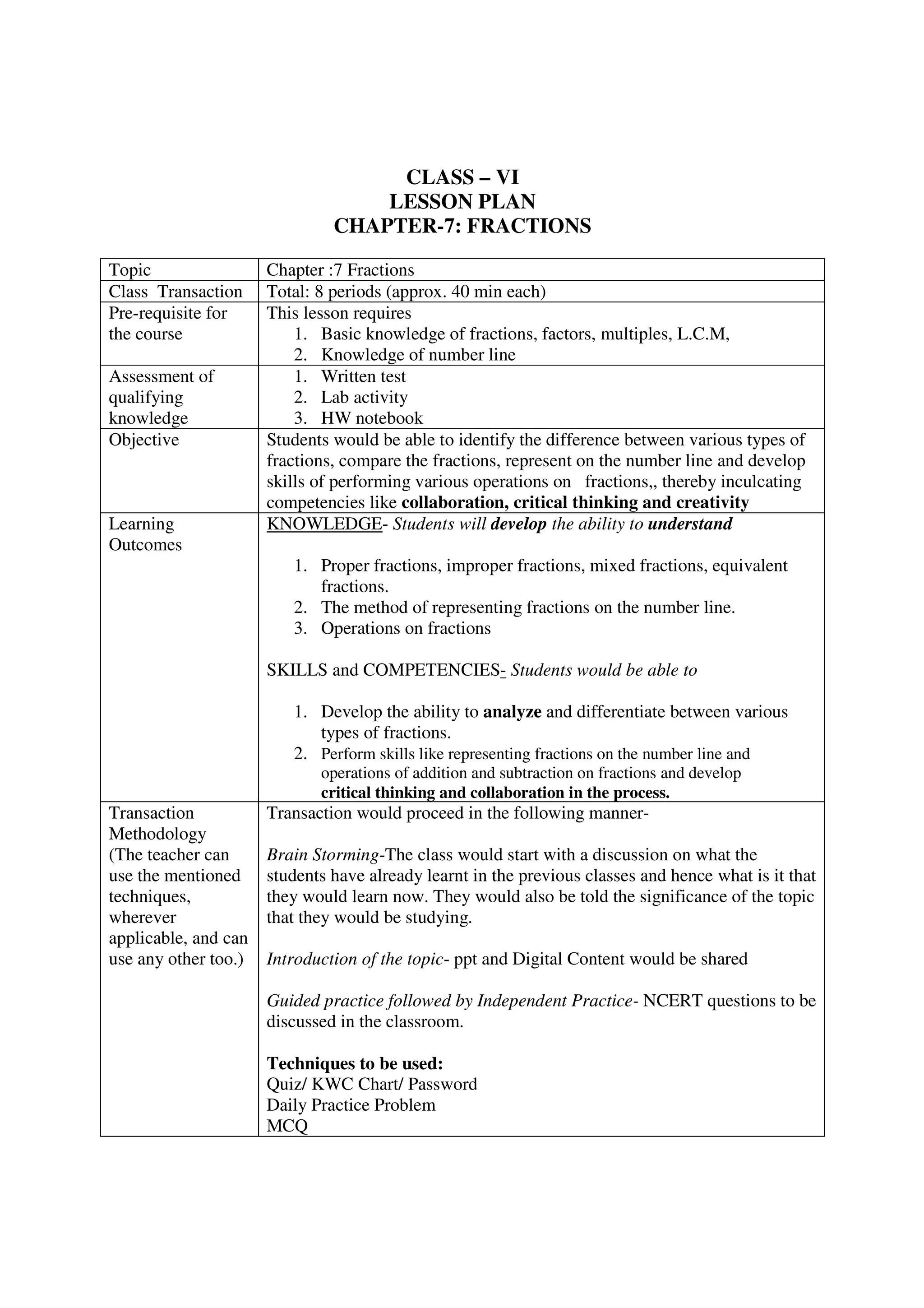
Topic Chapter :7 Fractions
Class Transaction Total: 8 periods (approx. 40 min each)
Pre-requisite for
the course
This lesson requires
1. Basic knowledge of fractions, factors, multiples, L.C.M,
2. Knowledge of number line
Assessment of
qualifying
knowledge
1. Written test
2. Lab activity
3. HW notebook
Objective Students would be able to identify the difference between various types of
fractions, compare the fractions, represent on the number line and develop
skills of performing various operations on fractions,, thereby inculcating
competencies like collaboration, critical thinking and creativity
Learning
Outcomes
KNOWLEDGE- Students will develop the ability to understand
1. Proper fractions, improper fractions, mixed fractions, equivalent
fractions.
2. The method of representing fractions on the number line.
3. Operations on fractions
SKILLS and COMPETENCIES- Students would be able to
1. Develop the ability to analyze and differentiate between various
types of fractions.
2. Perform skills like representing fractions on the number line and
operations of addition and subtraction on fractions and develop
critical thinking and collaboration in the process.
Transaction
Methodology
(The teacher can
use the mentioned
techniques,
wherever
applicable, and can
use any other too.)
Transaction would proceed in the following manner-
Brain Storming-The class would start with a discussion on what the
students have already learnt in the previous classes and hence what is it that
they would learn now. They would also be told the significance of the topic
that they would be studying.
Introduction of the topic- ppt and Digital Content would be shared
Guided practice followed by Independent Practice- NCERT questions to be
discussed in the classroom.
Techniques to be used:
Quiz/ KWC Chart/ Password
Daily Practice Problem
MCQ
Peer Assessment
Case Studies
Lab Activities
Any Other
Resources Text Book:
NCERT text book for Mathematics
Reference Book
CBSE Exemplar
Self Study, Home
Work,
Assignments
Independent Practice: Students would do the given questions in their
H.W. notebooks.
H.W. notebooks to be marked as per the given plan:
Assessment Parameters: The total marks for the activity is 5 marks
On time submission………………………………1 mark
Presentation/ Neatness……………………………1 mark
Content……….………………………………......3 marks
It is also advised that the students come to the class with proper
background knowledge of the topic under discussion. They can refer to the
resources stated above.
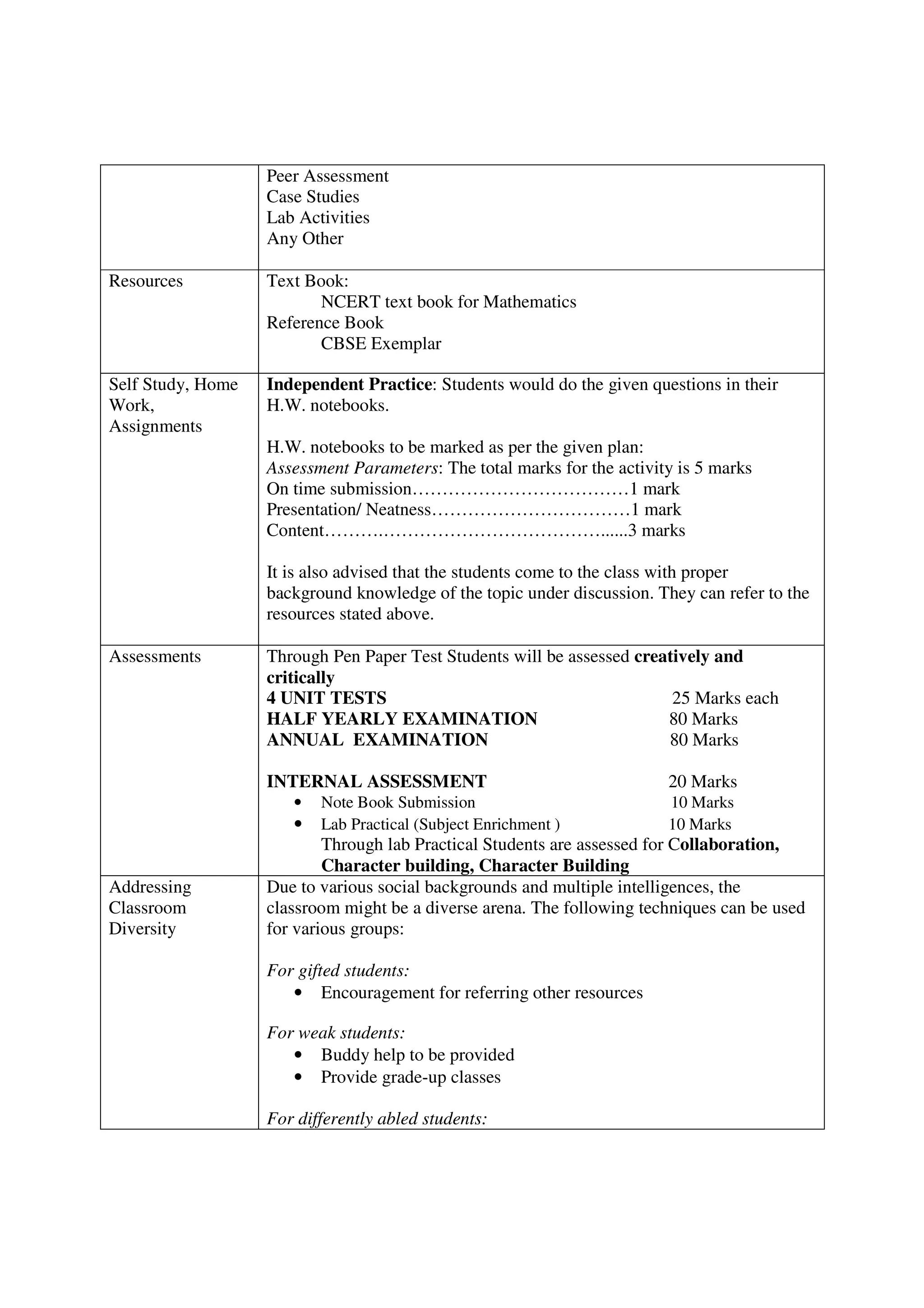
Assessments Through Pen Paper Test Students will be assessed creatively and
critically
4 UNIT TESTS 25 Marks each
HALF YEARLY EXAMINATION 80 Marks
ANNUAL EXAMINATION 80 Marks
INTERNAL ASSESSMENT 20 Marks
• Note Book Submission 10 Marks
• Lab Practical (Subject Enrichment ) 10 Marks
Through lab Practical Students are assessed for Collaboration,
Character building, Character Building
Addressing
Classroom
Diversity
Due to various social backgrounds and multiple intelligences, the
classroom might be a diverse arena. The following techniques can be used
for various groups:
For gifted students:
• Encouragement for referring other resources
For weak students:
• Buddy help to be provided
• Provide grade-up classes
For differently abled students:
• Ignore spelling mistakes and formulae, if not written
• Call parents at regular intervals
• Provide grade-up classes
• Encourage and motivate them at every level.
Marks The weightage would be given by CBSE.
ASSESSMENT
QUESTIONS
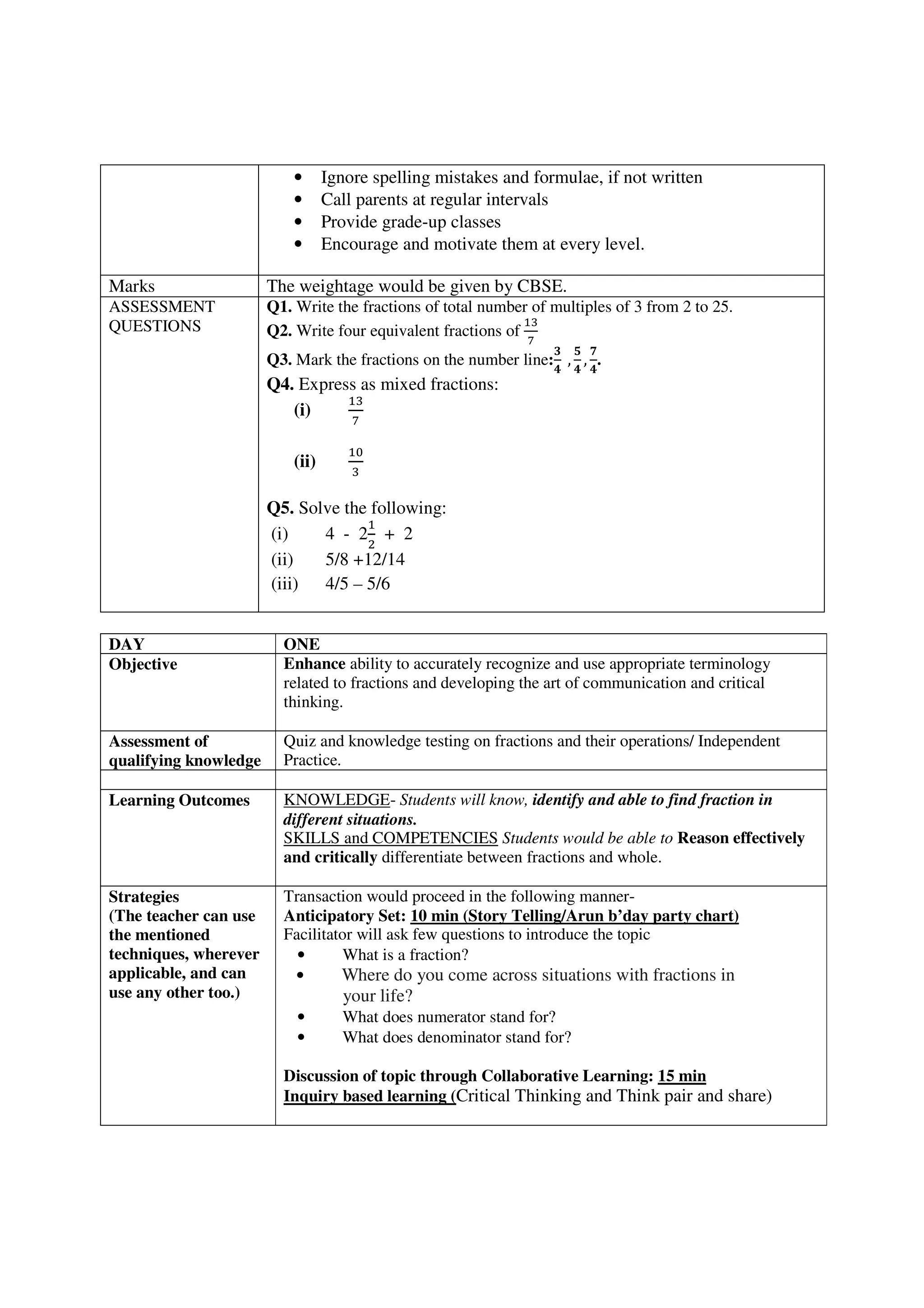
Q1. Write the fractions of total number of multiples of 3 from 2 to 25.
Q2. Write four equivalent fractions of
ଵଷ
଻
Q3. Mark the fractions on the number line:
૜
૝
,
૞
૝
,
ૠ
૝
.
Q4. Express as mixed fractions:
(i)
ଵଷ
଻
(ii)
ଵ଴
ଷ
Q5. Solve the following:
(i) 4 - 2
ଵ
ଶ
+ 2
(ii) 5/8 +12/14
(iii) 4/5 – 5/6
DAY ONE
Objective Enhance ability to accurately recognize and use appropriate terminology
related to fractions and developing the art of communication and critical
thinking.
Assessment of
qualifying knowledge
Quiz and knowledge testing on fractions and their operations/ Independent
Practice.
Learning Outcomes KNOWLEDGE- Students will know, identify and able to find fraction in
different situations.
SKILLS and COMPETENCIES Students would be able to Reason effectively
and critically differentiate between fractions and whole.
Strategies
(The teacher can use
the mentioned
techniques, wherever
applicable, and can
use any other too.)
Transaction would proceed in the following manner-
Anticipatory Set: 10 min (Story Telling/Arun b’day party chart)
Facilitator will ask few questions to introduce the topic
• What is a fraction?
• Where do you come across situations with fractions in
your life?
• What does numerator stand for?
• What does denominator stand for?
Discussion of topic through Collaborative Learning: 15 min
Inquiry based learning (Critical Thinking and Think pair and share)
Students would ask to find fractions in different cases. The facilitator would
take rounds and ensure that each learner is engaged.
Guided practice: 10 min
The students will solve the questions from NCERT book, solved examples
before Ex 7.1 in their notebook in the class with the help of their facilitator. The
facilitator would take rounds and help the students in solving the questions.
Independent Practice: Students will go through the solved examples before Ex
7.1 of NCERT text book.
Closure: 5 min
A short oral test would be taken to check proper assimilation of the topic
discussed.
Resources Text Book:
NCERT text book for Mathematics
Reference Book
CBSE Exemplar
Self Study, Home
Work, Assignments
Independent Practice: Students would do the given questions in their H.W.
notebooks.
Assessments Oral Test (5 minutes)
DAY TWO
Objective Students will be able to represent fractions them on the number line in and able
to identify proper, improper and mixed fractions in collaborative manner.
Assessment of
qualifying knowledge
Written questions on representing fractions on number line.
Learning Outcomes KNOWLEDGE- Students will know and
• Demonstrate the fractions on number line
• Able to identify different types of fractions.
SKILLS and COMPETENCIES- Students will be able to differentiate and
classify and reason various types of fractions and represent on the number line,
in collaboration with each other.
Transaction
Methodology
(The teacher can use
the mentioned
techniques, wherever
applicable, and can
use any other too.)
Transaction would proceed in the following manner-
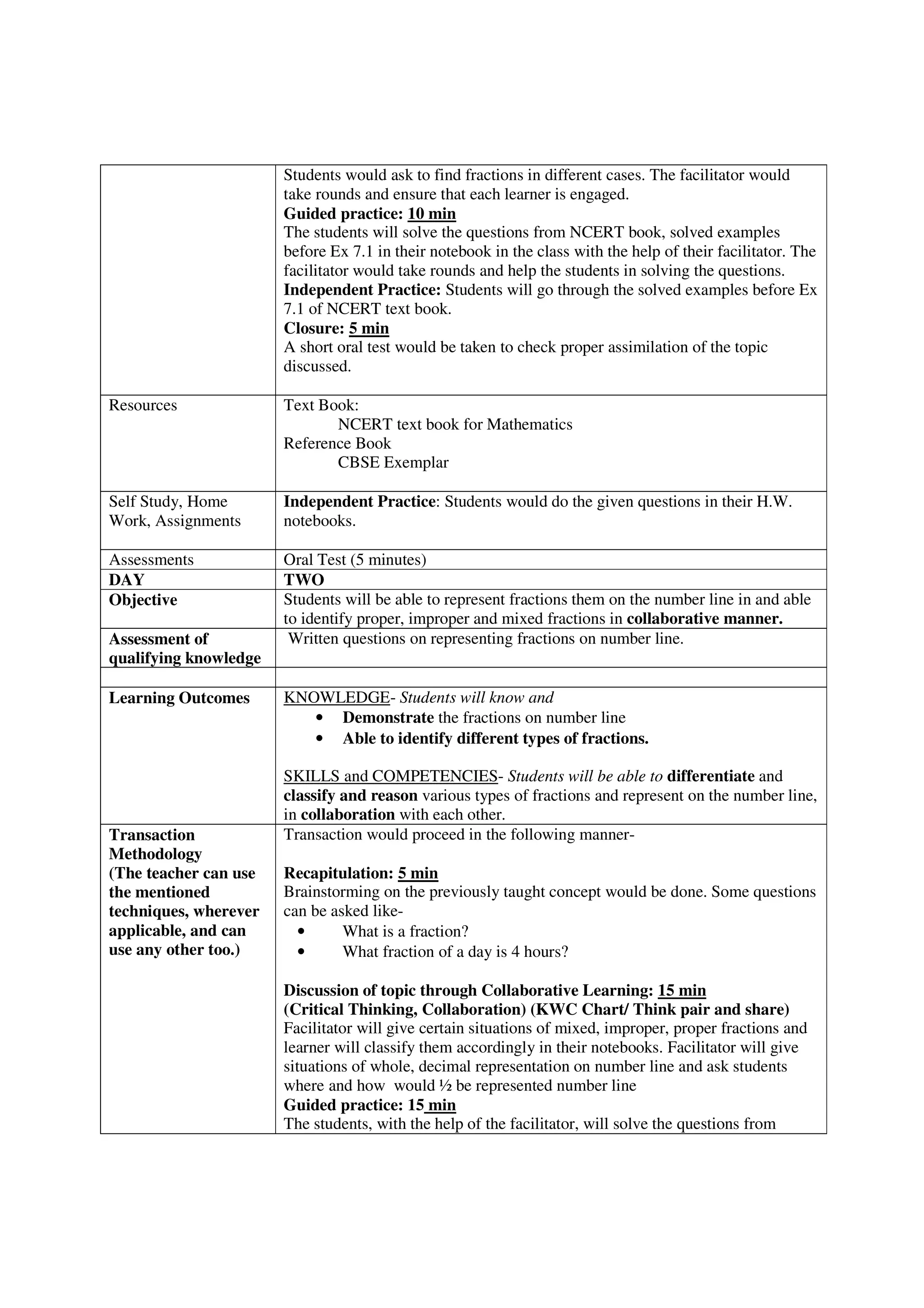
Recapitulation: 5 min
Brainstorming on the previously taught concept would be done. Some questions
can be asked like-
• What is a fraction?
• What fraction of a day is 4 hours?
Discussion of topic through Collaborative Learning: 15 min
(Critical Thinking, Collaboration) (KWC Chart/ Think pair and share)
Facilitator will give certain situations of mixed, improper, proper fractions and
learner will classify them accordingly in their notebooks. Facilitator will give
situations of whole, decimal representation on number line and ask students
where and how would ½ be represented number line
Guided practice: 15 min
The students, with the help of the facilitator, will solve the questions from
NCERT book of Exercise – 7.2 in their notebook in the class with the help of
their teacher. The teacher would ensure that each student tries to be independent
at the work as well as be under the teacher’s guidance.
Independent Practice: Students will complete the remaining HW parts of
Exercise 7.2 in their Math HW notebook.
Students who would face difficulty in solving the problem would solve with the
help of their buddies.
Closure: 5 min( Password)
A short oral test would be taken to check proper assimilation of the topic
discussed.
Resources Text Book:
NCERT text book for Mathematics
Reference Book
CBSE Exemplar
Self Study, Home
Work, Assignments
Independent Practice: Students would do the given questions in their H.W.
notebook.
Assessments Oral quiz / Independent practice.
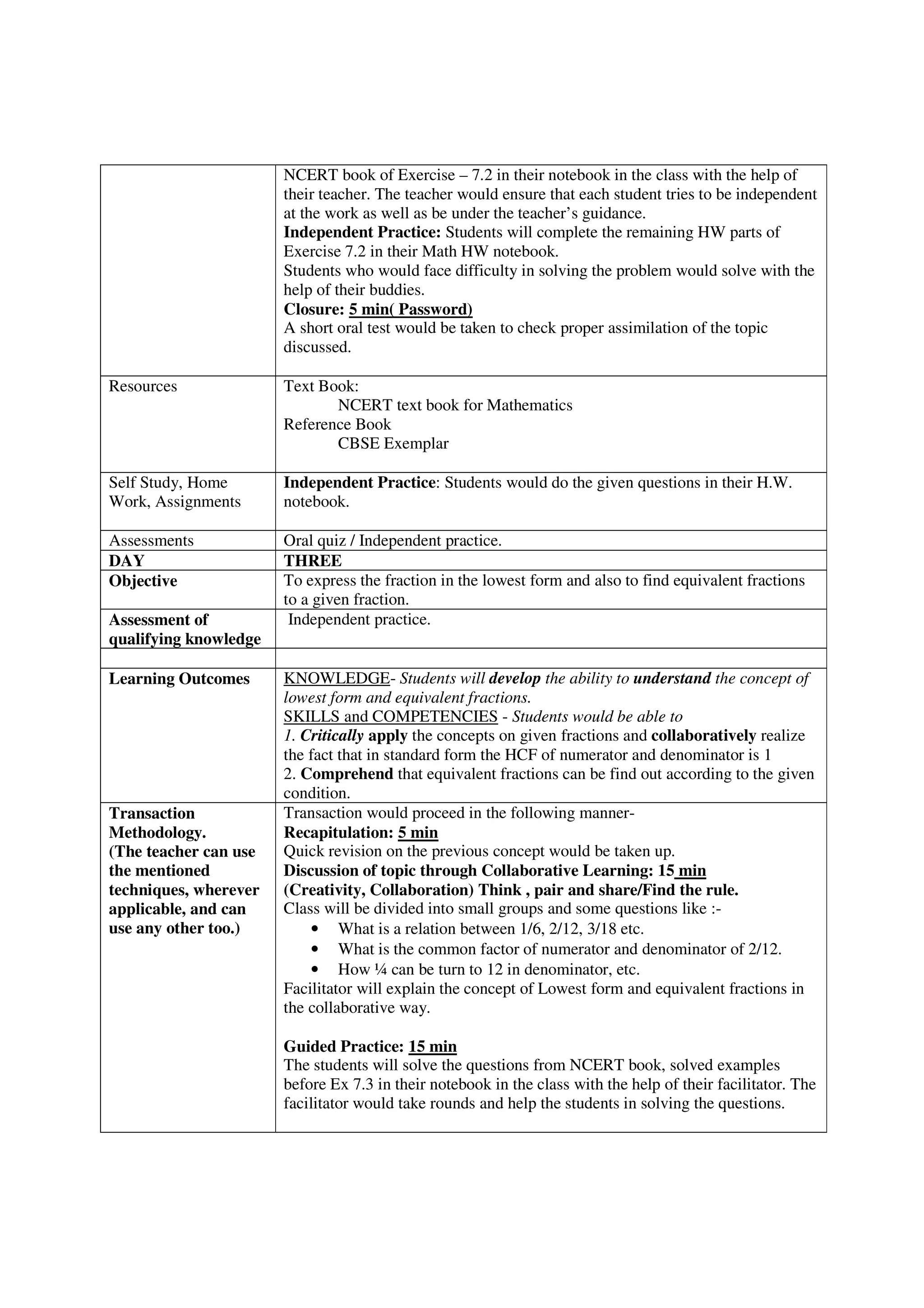
DAY THREE
Objective To express the fraction in the lowest form and also to find equivalent fractions
to a given fraction.
Assessment of
qualifying knowledge
Independent practice.
Learning Outcomes KNOWLEDGE- Students will develop the ability to understand the concept of
lowest form and equivalent fractions.
SKILLS and COMPETENCIES - Students would be able to
1. Critically apply the concepts on given fractions and collaboratively realize
the fact that in standard form the HCF of numerator and denominator is 1
2. Comprehend that equivalent fractions can be find out according to the given
condition.
Transaction
Methodology.
(The teacher can use
the mentioned
techniques, wherever
applicable, and can
use any other too.)
Transaction would proceed in the following manner-
Recapitulation: 5 min
Quick revision on the previous concept would be taken up.
Discussion of topic through Collaborative Learning: 15 min
(Creativity, Collaboration) Think , pair and share/Find the rule.
Class will be divided into small groups and some questions like :-
• What is a relation between 1/6, 2/12, 3/18 etc.
• What is the common factor of numerator and denominator of 2/12.
• How ¼ can be turn to 12 in denominator, etc.
Facilitator will explain the concept of Lowest form and equivalent fractions in
the collaborative way.
Guided Practice: 15 min
The students will solve the questions from NCERT book, solved examples
before Ex 7.3 in their notebook in the class with the help of their facilitator. The
facilitator would take rounds and help the students in solving the questions.
Independent Practice: Students will do the remaining parts of Ex7.3 in their
homework notebook.
Closure: 5 min
A short video can be shown for recapitulation.
Resources Text Book:
NCERT text book for Mathematics
Reference Book
CBSE Exemplar
Self Study, Home
Work, Assignments
Independent Practice: Students would do the given questions in their H.W.
notebooks.
Assessments Independent practice.
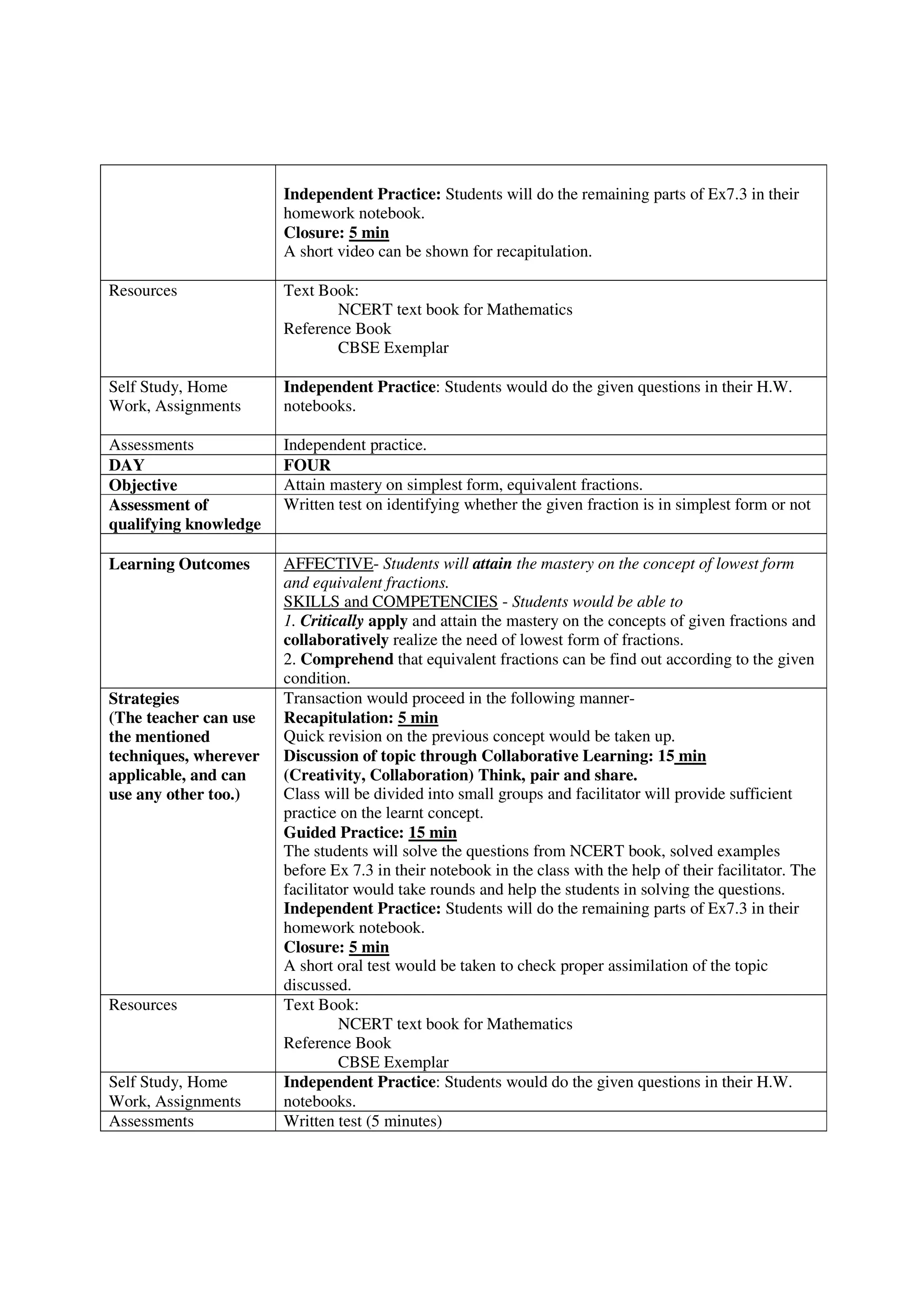
DAY FOUR
Objective Attain mastery on simplest form, equivalent fractions.
Assessment of
qualifying knowledge
Written test on identifying whether the given fraction is in simplest form or not
Learning Outcomes AFFECTIVE- Students will attain the mastery on the concept of lowest form
and equivalent fractions.
SKILLS and COMPETENCIES - Students would be able to
1. Critically apply and attain the mastery on the concepts of given fractions and
collaboratively realize the need of lowest form of fractions.
2. Comprehend that equivalent fractions can be find out according to the given
condition.
Strategies
(The teacher can use
the mentioned
techniques, wherever
applicable, and can
use any other too.)
Transaction would proceed in the following manner-
Recapitulation: 5 min
Quick revision on the previous concept would be taken up.
Discussion of topic through Collaborative Learning: 15 min
(Creativity, Collaboration) Think, pair and share.
Class will be divided into small groups and facilitator will provide sufficient
practice on the learnt concept.
Guided Practice: 15 min
The students will solve the questions from NCERT book, solved examples
before Ex 7.3 in their notebook in the class with the help of their facilitator. The
facilitator would take rounds and help the students in solving the questions.
Independent Practice: Students will do the remaining parts of Ex7.3 in their
homework notebook.
Closure: 5 min
A short oral test would be taken to check proper assimilation of the topic
discussed.
Resources Text Book:
NCERT text book for Mathematics
Reference Book
CBSE Exemplar
Self Study, Home
Work, Assignments
Independent Practice: Students would do the given questions in their H.W.
notebooks.
Assessments Written test (5 minutes)
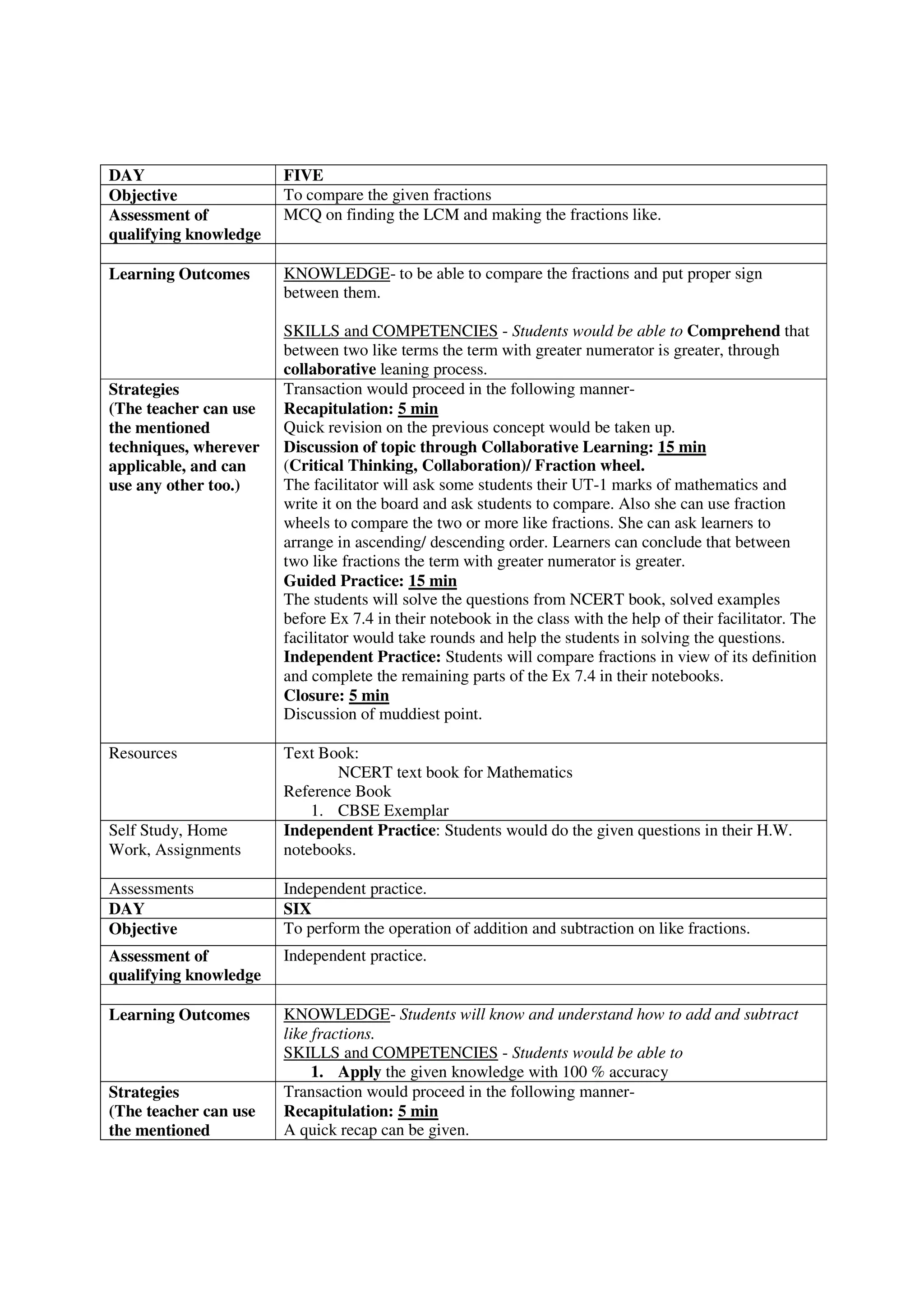
DAY FIVE
Objective To compare the given fractions
Assessment of
qualifying knowledge
MCQ on finding the LCM and making the fractions like.
Learning Outcomes KNOWLEDGE- to be able to compare the fractions and put proper sign
between them.
SKILLS and COMPETENCIES - Students would be able to Comprehend that
between two like terms the term with greater numerator is greater, through
collaborative leaning process.
Strategies
(The teacher can use
the mentioned
techniques, wherever
applicable, and can
use any other too.)
Transaction would proceed in the following manner-
Recapitulation: 5 min
Quick revision on the previous concept would be taken up.
Discussion of topic through Collaborative Learning: 15 min
(Critical Thinking, Collaboration)/ Fraction wheel.
The facilitator will ask some students their UT-1 marks of mathematics and
write it on the board and ask students to compare. Also she can use fraction
wheels to compare the two or more like fractions. She can ask learners to
arrange in ascending/ descending order. Learners can conclude that between
two like fractions the term with greater numerator is greater.
Guided Practice: 15 min
The students will solve the questions from NCERT book, solved examples
before Ex 7.4 in their notebook in the class with the help of their facilitator. The
facilitator would take rounds and help the students in solving the questions.
Independent Practice: Students will compare fractions in view of its definition
and complete the remaining parts of the Ex 7.4 in their notebooks.
Closure: 5 min
Discussion of muddiest point.
Resources Text Book:
NCERT text book for Mathematics
Reference Book
1. CBSE Exemplar
Self Study, Home
Work, Assignments
Independent Practice: Students would do the given questions in their H.W.
notebooks.
Assessments Independent practice.
DAY SIX
Objective To perform the operation of addition and subtraction on like fractions.
Assessment of
qualifying knowledge
Independent practice.
Learning Outcomes KNOWLEDGE- Students will know and understand how to add and subtract
like fractions.
SKILLS and COMPETENCIES - Students would be able to
1. Apply the given knowledge with 100 % accuracy
Strategies
(The teacher can use
the mentioned
Transaction would proceed in the following manner-
Recapitulation: 5 min
A quick recap can be given.
techniques, wherever
applicable, and can
use any other too.)
Discussion of topic through Collaborative Learning: 15 min
(Critical Thinking, Fraction Wheel)
Facilitator will use fraction wheel to explain the addition and subtraction of like
fractions.
Guided Practice:15 min
The students will solve the questions from NCERT book of Exercise – 7.5 in
their notebook in the class with the help of their facilitator.
Independent Practice: Students will complete the remaining HW parts of
Exercise 7.5 in their Math HW notebook.
Closure: 5 min
Summarization, preferably by a student, would be taken to check proper
assimilation of the topic discussed.
Resources Text Book:
NCERT text book for Mathematics
Reference Book
CBSE Exemplar
Self Study, Home
Work, Assignments
Independent Practice: Students would do the given questions in their H.W.
notebooks.
Assessments Independent practice.
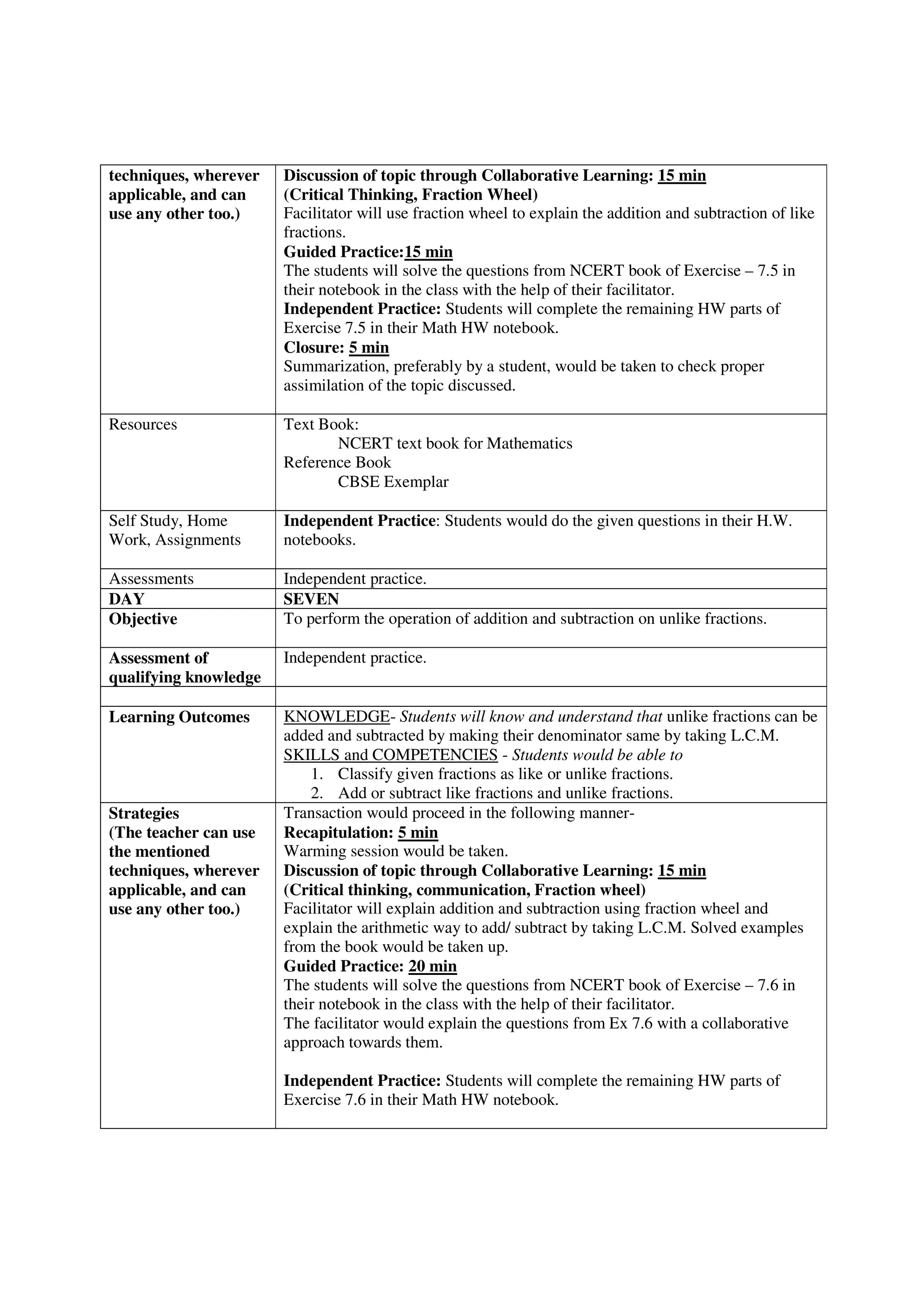
DAY SEVEN
Objective To perform the operation of addition and subtraction on unlike fractions.
Assessment of
qualifying knowledge
Independent practice.
Learning Outcomes KNOWLEDGE- Students will know and understand that unlike fractions can be
added and subtracted by making their denominator same by taking L.C.M.
SKILLS and COMPETENCIES - Students would be able to
1. Classify given fractions as like or unlike fractions.
2. Add or subtract like fractions and unlike fractions.
Strategies
(The teacher can use
the mentioned
techniques, wherever
applicable, and can
use any other too.)
Transaction would proceed in the following manner-
Recapitulation: 5 min
Warming session would be taken.
Discussion of topic through Collaborative Learning: 15 min
(Critical thinking, communication, Fraction wheel)
Facilitator will explain addition and subtraction using fraction wheel and
explain the arithmetic way to add/ subtract by taking L.C.M. Solved examples
from the book would be taken up.
Guided Practice: 20 min
The students will solve the questions from NCERT book of Exercise – 7.6 in
their notebook in the class with the help of their facilitator.
The facilitator would explain the questions from Ex 7.6 with a collaborative
approach towards them.
Independent Practice: Students will complete the remaining HW parts of
Exercise 7.6 in their Math HW notebook.
Closure: 5 min
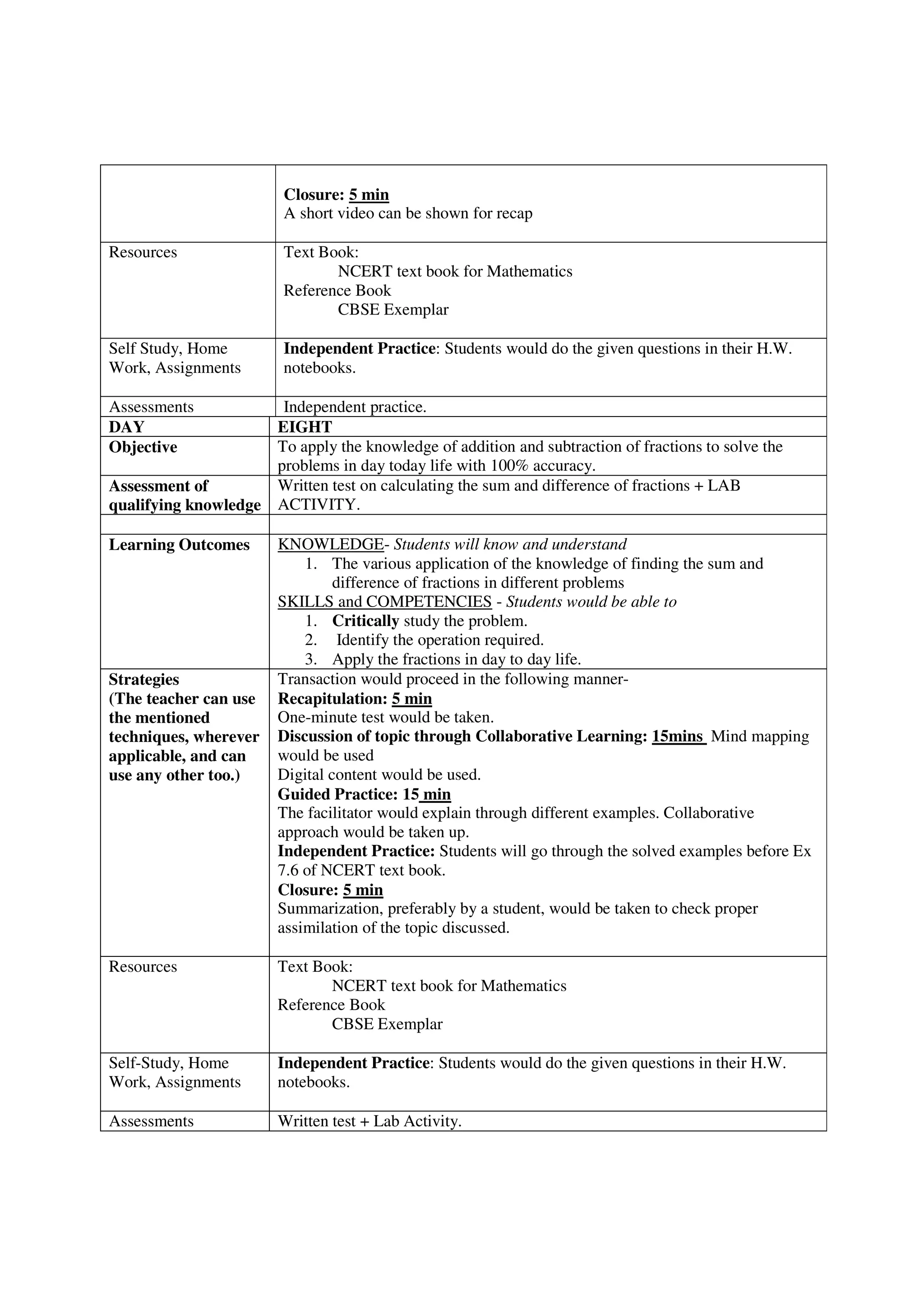
A short video can be shown for recap
Resources Text Book:
NCERT text book for Mathematics
Reference Book
CBSE Exemplar
Self Study, Home
Work, Assignments
Independent Practice: Students would do the given questions in their H.W.
notebooks.
Assessments Independent practice.
DAY EIGHT
Objective To apply the knowledge of addition and subtraction of fractions to solve the
problems in day today life with 100% accuracy.
Assessment of
qualifying knowledge
Written test on calculating the sum and difference of fractions + LAB
ACTIVITY.
Learning Outcomes KNOWLEDGE- Students will know and understand
1. The various application of the knowledge of finding the sum and
difference of fractions in different problems
SKILLS and COMPETENCIES - Students would be able to
1. Critically study the problem.
2. Identify the operation required.
3. Apply the fractions in day to day life.
Strategies
(The teacher can use
the mentioned
techniques, wherever
applicable, and can
use any other too.)
Transaction would proceed in the following manner-
Recapitulation: 5 min
One-minute test would be taken.
Discussion of topic through Collaborative Learning: 15mins Mind mapping
would be used
Digital content would be used.
Guided Practice: 15 min
The facilitator would explain through different examples. Collaborative
approach would be taken up.
Independent Practice: Students will go through the solved examples before Ex
7.6 of NCERT text book.
Closure: 5 min
Summarization, preferably by a student, would be taken to check proper
assimilation of the topic discussed.
Resources Text Book:
NCERT text book for Mathematics
Reference Book
CBSE Exemplar
Self-Study, Home
Work, Assignments
Independent Practice: Students would do the given questions in their H.W.
notebooks.
Assessments Written test + Lab Activity.
Ch 7 fractions_lesson pla_npdf

Ch 7 fractions_lesson pla_npdf

  • 1.
    CLASS – VI LESSONPLAN CHAPTER-7: FRACTIONS Topic Chapter :7 Fractions Class Transaction Total: 8 periods (approx. 40 min each) Pre-requisite for the course This lesson requires 1. Basic knowledge of fractions, factors, multiples, L.C.M, 2. Knowledge of number line Assessment of qualifying knowledge 1. Written test 2. Lab activity 3. HW notebook Objective Students would be able to identify the difference between various types of fractions, compare the fractions, represent on the number line and develop skills of performing various operations on fractions,, thereby inculcating competencies like collaboration, critical thinking and creativity Learning Outcomes KNOWLEDGE- Students will develop the ability to understand 1. Proper fractions, improper fractions, mixed fractions, equivalent fractions. 2. The method of representing fractions on the number line. 3. Operations on fractions SKILLS and COMPETENCIES- Students would be able to 1. Develop the ability to analyze and differentiate between various types of fractions. 2. Perform skills like representing fractions on the number line and operations of addition and subtraction on fractions and develop critical thinking and collaboration in the process. Transaction Methodology (The teacher can use the mentioned techniques, wherever applicable, and can use any other too.) Transaction would proceed in the following manner- Brain Storming-The class would start with a discussion on what the students have already learnt in the previous classes and hence what is it that they would learn now. They would also be told the significance of the topic that they would be studying. Introduction of the topic- ppt and Digital Content would be shared Guided practice followed by Independent Practice- NCERT questions to be discussed in the classroom. Techniques to be used: Quiz/ KWC Chart/ Password Daily Practice Problem MCQ
  • 2.
    Peer Assessment Case Studies LabActivities Any Other Resources Text Book: NCERT text book for Mathematics Reference Book CBSE Exemplar Self Study, Home Work, Assignments Independent Practice: Students would do the given questions in their H.W. notebooks. H.W. notebooks to be marked as per the given plan: Assessment Parameters: The total marks for the activity is 5 marks On time submission………………………………1 mark Presentation/ Neatness……………………………1 mark Content……….………………………………......3 marks It is also advised that the students come to the class with proper background knowledge of the topic under discussion. They can refer to the resources stated above. Assessments Through Pen Paper Test Students will be assessed creatively and critically 4 UNIT TESTS 25 Marks each HALF YEARLY EXAMINATION 80 Marks ANNUAL EXAMINATION 80 Marks INTERNAL ASSESSMENT 20 Marks • Note Book Submission 10 Marks • Lab Practical (Subject Enrichment ) 10 Marks Through lab Practical Students are assessed for Collaboration, Character building, Character Building Addressing Classroom Diversity Due to various social backgrounds and multiple intelligences, the classroom might be a diverse arena. The following techniques can be used for various groups: For gifted students: • Encouragement for referring other resources For weak students: • Buddy help to be provided • Provide grade-up classes For differently abled students:
  • 3.
    • Ignore spellingmistakes and formulae, if not written • Call parents at regular intervals • Provide grade-up classes • Encourage and motivate them at every level. Marks The weightage would be given by CBSE. ASSESSMENT QUESTIONS Q1. Write the fractions of total number of multiples of 3 from 2 to 25. Q2. Write four equivalent fractions of ଵଷ ଻ Q3. Mark the fractions on the number line: ૜ ૝ , ૞ ૝ , ૠ ૝ . Q4. Express as mixed fractions: (i) ଵଷ ଻ (ii) ଵ଴ ଷ Q5. Solve the following: (i) 4 - 2 ଵ ଶ + 2 (ii) 5/8 +12/14 (iii) 4/5 – 5/6 DAY ONE Objective Enhance ability to accurately recognize and use appropriate terminology related to fractions and developing the art of communication and critical thinking. Assessment of qualifying knowledge Quiz and knowledge testing on fractions and their operations/ Independent Practice. Learning Outcomes KNOWLEDGE- Students will know, identify and able to find fraction in different situations. SKILLS and COMPETENCIES Students would be able to Reason effectively and critically differentiate between fractions and whole. Strategies (The teacher can use the mentioned techniques, wherever applicable, and can use any other too.) Transaction would proceed in the following manner- Anticipatory Set: 10 min (Story Telling/Arun b’day party chart) Facilitator will ask few questions to introduce the topic • What is a fraction? • Where do you come across situations with fractions in your life? • What does numerator stand for? • What does denominator stand for? Discussion of topic through Collaborative Learning: 15 min Inquiry based learning (Critical Thinking and Think pair and share)
  • 4.
    Students would askto find fractions in different cases. The facilitator would take rounds and ensure that each learner is engaged. Guided practice: 10 min The students will solve the questions from NCERT book, solved examples before Ex 7.1 in their notebook in the class with the help of their facilitator. The facilitator would take rounds and help the students in solving the questions. Independent Practice: Students will go through the solved examples before Ex 7.1 of NCERT text book. Closure: 5 min A short oral test would be taken to check proper assimilation of the topic discussed. Resources Text Book: NCERT text book for Mathematics Reference Book CBSE Exemplar Self Study, Home Work, Assignments Independent Practice: Students would do the given questions in their H.W. notebooks. Assessments Oral Test (5 minutes) DAY TWO Objective Students will be able to represent fractions them on the number line in and able to identify proper, improper and mixed fractions in collaborative manner. Assessment of qualifying knowledge Written questions on representing fractions on number line. Learning Outcomes KNOWLEDGE- Students will know and • Demonstrate the fractions on number line • Able to identify different types of fractions. SKILLS and COMPETENCIES- Students will be able to differentiate and classify and reason various types of fractions and represent on the number line, in collaboration with each other. Transaction Methodology (The teacher can use the mentioned techniques, wherever applicable, and can use any other too.) Transaction would proceed in the following manner- Recapitulation: 5 min Brainstorming on the previously taught concept would be done. Some questions can be asked like- • What is a fraction? • What fraction of a day is 4 hours? Discussion of topic through Collaborative Learning: 15 min (Critical Thinking, Collaboration) (KWC Chart/ Think pair and share) Facilitator will give certain situations of mixed, improper, proper fractions and learner will classify them accordingly in their notebooks. Facilitator will give situations of whole, decimal representation on number line and ask students where and how would ½ be represented number line Guided practice: 15 min The students, with the help of the facilitator, will solve the questions from
  • 5.
    NCERT book ofExercise – 7.2 in their notebook in the class with the help of their teacher. The teacher would ensure that each student tries to be independent at the work as well as be under the teacher’s guidance. Independent Practice: Students will complete the remaining HW parts of Exercise 7.2 in their Math HW notebook. Students who would face difficulty in solving the problem would solve with the help of their buddies. Closure: 5 min( Password) A short oral test would be taken to check proper assimilation of the topic discussed. Resources Text Book: NCERT text book for Mathematics Reference Book CBSE Exemplar Self Study, Home Work, Assignments Independent Practice: Students would do the given questions in their H.W. notebook. Assessments Oral quiz / Independent practice. DAY THREE Objective To express the fraction in the lowest form and also to find equivalent fractions to a given fraction. Assessment of qualifying knowledge Independent practice. Learning Outcomes KNOWLEDGE- Students will develop the ability to understand the concept of lowest form and equivalent fractions. SKILLS and COMPETENCIES - Students would be able to 1. Critically apply the concepts on given fractions and collaboratively realize the fact that in standard form the HCF of numerator and denominator is 1 2. Comprehend that equivalent fractions can be find out according to the given condition. Transaction Methodology. (The teacher can use the mentioned techniques, wherever applicable, and can use any other too.) Transaction would proceed in the following manner- Recapitulation: 5 min Quick revision on the previous concept would be taken up. Discussion of topic through Collaborative Learning: 15 min (Creativity, Collaboration) Think , pair and share/Find the rule. Class will be divided into small groups and some questions like :- • What is a relation between 1/6, 2/12, 3/18 etc. • What is the common factor of numerator and denominator of 2/12. • How ¼ can be turn to 12 in denominator, etc. Facilitator will explain the concept of Lowest form and equivalent fractions in the collaborative way. Guided Practice: 15 min The students will solve the questions from NCERT book, solved examples before Ex 7.3 in their notebook in the class with the help of their facilitator. The facilitator would take rounds and help the students in solving the questions.
  • 6.
    Independent Practice: Studentswill do the remaining parts of Ex7.3 in their homework notebook. Closure: 5 min A short video can be shown for recapitulation. Resources Text Book: NCERT text book for Mathematics Reference Book CBSE Exemplar Self Study, Home Work, Assignments Independent Practice: Students would do the given questions in their H.W. notebooks. Assessments Independent practice. DAY FOUR Objective Attain mastery on simplest form, equivalent fractions. Assessment of qualifying knowledge Written test on identifying whether the given fraction is in simplest form or not Learning Outcomes AFFECTIVE- Students will attain the mastery on the concept of lowest form and equivalent fractions. SKILLS and COMPETENCIES - Students would be able to 1. Critically apply and attain the mastery on the concepts of given fractions and collaboratively realize the need of lowest form of fractions. 2. Comprehend that equivalent fractions can be find out according to the given condition. Strategies (The teacher can use the mentioned techniques, wherever applicable, and can use any other too.) Transaction would proceed in the following manner- Recapitulation: 5 min Quick revision on the previous concept would be taken up. Discussion of topic through Collaborative Learning: 15 min (Creativity, Collaboration) Think, pair and share. Class will be divided into small groups and facilitator will provide sufficient practice on the learnt concept. Guided Practice: 15 min The students will solve the questions from NCERT book, solved examples before Ex 7.3 in their notebook in the class with the help of their facilitator. The facilitator would take rounds and help the students in solving the questions. Independent Practice: Students will do the remaining parts of Ex7.3 in their homework notebook. Closure: 5 min A short oral test would be taken to check proper assimilation of the topic discussed. Resources Text Book: NCERT text book for Mathematics Reference Book CBSE Exemplar Self Study, Home Work, Assignments Independent Practice: Students would do the given questions in their H.W. notebooks. Assessments Written test (5 minutes)
  • 7.
    DAY FIVE Objective Tocompare the given fractions Assessment of qualifying knowledge MCQ on finding the LCM and making the fractions like. Learning Outcomes KNOWLEDGE- to be able to compare the fractions and put proper sign between them. SKILLS and COMPETENCIES - Students would be able to Comprehend that between two like terms the term with greater numerator is greater, through collaborative leaning process. Strategies (The teacher can use the mentioned techniques, wherever applicable, and can use any other too.) Transaction would proceed in the following manner- Recapitulation: 5 min Quick revision on the previous concept would be taken up. Discussion of topic through Collaborative Learning: 15 min (Critical Thinking, Collaboration)/ Fraction wheel. The facilitator will ask some students their UT-1 marks of mathematics and write it on the board and ask students to compare. Also she can use fraction wheels to compare the two or more like fractions. She can ask learners to arrange in ascending/ descending order. Learners can conclude that between two like fractions the term with greater numerator is greater. Guided Practice: 15 min The students will solve the questions from NCERT book, solved examples before Ex 7.4 in their notebook in the class with the help of their facilitator. The facilitator would take rounds and help the students in solving the questions. Independent Practice: Students will compare fractions in view of its definition and complete the remaining parts of the Ex 7.4 in their notebooks. Closure: 5 min Discussion of muddiest point. Resources Text Book: NCERT text book for Mathematics Reference Book 1. CBSE Exemplar Self Study, Home Work, Assignments Independent Practice: Students would do the given questions in their H.W. notebooks. Assessments Independent practice. DAY SIX Objective To perform the operation of addition and subtraction on like fractions. Assessment of qualifying knowledge Independent practice. Learning Outcomes KNOWLEDGE- Students will know and understand how to add and subtract like fractions. SKILLS and COMPETENCIES - Students would be able to 1. Apply the given knowledge with 100 % accuracy Strategies (The teacher can use the mentioned Transaction would proceed in the following manner- Recapitulation: 5 min A quick recap can be given.
  • 8.
    techniques, wherever applicable, andcan use any other too.) Discussion of topic through Collaborative Learning: 15 min (Critical Thinking, Fraction Wheel) Facilitator will use fraction wheel to explain the addition and subtraction of like fractions. Guided Practice:15 min The students will solve the questions from NCERT book of Exercise – 7.5 in their notebook in the class with the help of their facilitator. Independent Practice: Students will complete the remaining HW parts of Exercise 7.5 in their Math HW notebook. Closure: 5 min Summarization, preferably by a student, would be taken to check proper assimilation of the topic discussed. Resources Text Book: NCERT text book for Mathematics Reference Book CBSE Exemplar Self Study, Home Work, Assignments Independent Practice: Students would do the given questions in their H.W. notebooks. Assessments Independent practice. DAY SEVEN Objective To perform the operation of addition and subtraction on unlike fractions. Assessment of qualifying knowledge Independent practice. Learning Outcomes KNOWLEDGE- Students will know and understand that unlike fractions can be added and subtracted by making their denominator same by taking L.C.M. SKILLS and COMPETENCIES - Students would be able to 1. Classify given fractions as like or unlike fractions. 2. Add or subtract like fractions and unlike fractions. Strategies (The teacher can use the mentioned techniques, wherever applicable, and can use any other too.) Transaction would proceed in the following manner- Recapitulation: 5 min Warming session would be taken. Discussion of topic through Collaborative Learning: 15 min (Critical thinking, communication, Fraction wheel) Facilitator will explain addition and subtraction using fraction wheel and explain the arithmetic way to add/ subtract by taking L.C.M. Solved examples from the book would be taken up. Guided Practice: 20 min The students will solve the questions from NCERT book of Exercise – 7.6 in their notebook in the class with the help of their facilitator. The facilitator would explain the questions from Ex 7.6 with a collaborative approach towards them. Independent Practice: Students will complete the remaining HW parts of Exercise 7.6 in their Math HW notebook.
  • 9.
    Closure: 5 min Ashort video can be shown for recap Resources Text Book: NCERT text book for Mathematics Reference Book CBSE Exemplar Self Study, Home Work, Assignments Independent Practice: Students would do the given questions in their H.W. notebooks. Assessments Independent practice. DAY EIGHT Objective To apply the knowledge of addition and subtraction of fractions to solve the problems in day today life with 100% accuracy. Assessment of qualifying knowledge Written test on calculating the sum and difference of fractions + LAB ACTIVITY. Learning Outcomes KNOWLEDGE- Students will know and understand 1. The various application of the knowledge of finding the sum and difference of fractions in different problems SKILLS and COMPETENCIES - Students would be able to 1. Critically study the problem. 2. Identify the operation required. 3. Apply the fractions in day to day life. Strategies (The teacher can use the mentioned techniques, wherever applicable, and can use any other too.) Transaction would proceed in the following manner- Recapitulation: 5 min One-minute test would be taken. Discussion of topic through Collaborative Learning: 15mins Mind mapping would be used Digital content would be used. Guided Practice: 15 min The facilitator would explain through different examples. Collaborative approach would be taken up. Independent Practice: Students will go through the solved examples before Ex 7.6 of NCERT text book. Closure: 5 min Summarization, preferably by a student, would be taken to check proper assimilation of the topic discussed. Resources Text Book: NCERT text book for Mathematics Reference Book CBSE Exemplar Self-Study, Home Work, Assignments Independent Practice: Students would do the given questions in their H.W. notebooks. Assessments Written test + Lab Activity.