
Pharmacokinetics
Pharmacodynamics
Dr. S. Parasuraman
Associate Professor, Faculty of Pharmacy,
AIMST University, Malaysia.
Introduction to Pharmacology - for allied health sciences
Pharmacokinetics
• Pharmacokinetics refers to what the body does to a
drug, whereas pharmacodynamics describes what the
drug does to the body.
• Four pharmacokinetic properties determine the onset,
intensity, and the duration of drug action.
– Absorption
– Distribution
– Metabolism
– Elimination
• All pharmacokinetic processes involve transport of the
drug across biological membranes.
Academic session: 2020-21 (Nursing) 2
Academic session: 2020-21 (Nursing) 3
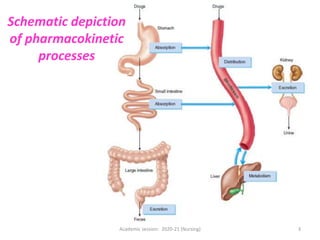
Schematic depiction
of pharmacokinetic
processes
Pharmacokinetics - Absorption
• Absorption is movement of the drug from its site of
administration into the circulation.
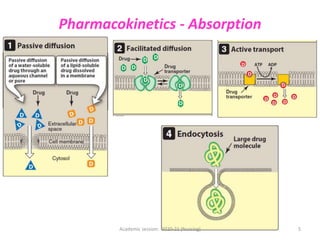
• Mechanisms of absorption of drugs from the GI tract
– Passive diffusion
– Facilitated diffusion
– Active transport
– Endocytosis and exocytosis
Academic session: 2020-21 (Nursing) 4
Pharmacokinetics - Absorption
Academic session: 2020-21 (Nursing) 5
Pharmacokinetics - Absorption
• Factors affecting absorption
– Solubility
– Concentration
– Area of absorbing surface
– Vascularity of the absorbing surface
– Route of administration
Academic session: 2020-21 (Nursing) 6
Pharmacokinetics - Absorption
• Bioavailability (F): Bioavailability refers to the rate and
extent of absorption of a drug from a dosage form.
• Bioavailability of drug injected i.v. is 100%, but is
frequently lower after oral ingestion because
– the drug may be incompletely absorbed
– the absorbed drug may undergo first pass metabolism in
the intestinal wall/liver or be excreted in bile
Academic session: 2020-21 (Nursing) 7
Pharmacokinetics - distribution
• Drug distribution is the process by which a drug
reversibly leaves the bloodstream and enters the
interstitium (extracellular fluid) and the tissues.
• The distribution of a drug from the plasma to the
interstitium depends on
– cardiac output
– local blood flow
– capillary permeability
– tissue volume
– degree of binding of the drug to plasma and tissue proteins &
– the relative lipophilicity of the drug.
Academic session: 2020-21 (Nursing) 8
Pharmacokinetics - distribution
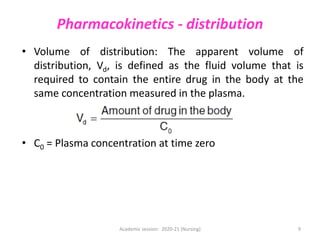
• Volume of distribution: The apparent volume of
distribution, Vd, is defined as the fluid volume that is
required to contain the entire drug in the body at the
same concentration measured in the plasma.
• C0 = Plasma concentration at time zero
Academic session: 2020-21 (Nursing) 9
Pharmacokinetics - distribution
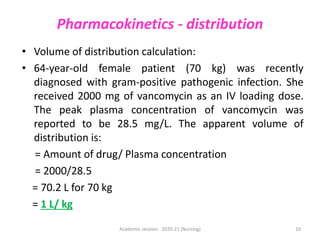
• Volume of distribution calculation:
• 64-year-old female patient (70 kg) was recently
diagnosed with gram-positive pathogenic infection. She
received 2000 mg of vancomycin as an IV loading dose.
The peak plasma concentration of vancomycin was
reported to be 28.5 mg/L. The apparent volume of
distribution is:
= Amount of drug/ Plasma concentration
= 2000/28.5
= 70.2 L for 70 kg
= 1 L/ kg
Academic session: 2020-21 (Nursing) 10
Pharmacokinetics - biotransformation
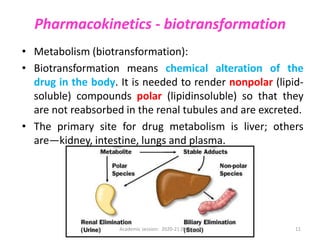
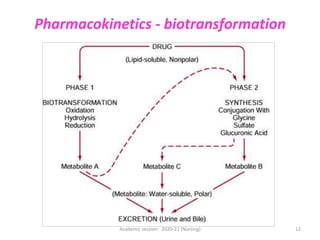
• Metabolism (biotransformation):
• Biotransformation means chemical alteration of the
drug in the body. It is needed to render nonpolar (lipid-
soluble) compounds polar (lipidinsoluble) so that they
are not reabsorbed in the renal tubules and are excreted.
• The primary site for drug metabolism is liver; others
are—kidney, intestine, lungs and plasma.
Academic session: 2020-21 (Nursing) 11
Pharmacokinetics - biotransformation
Academic session: 2020-21 (Nursing) 12
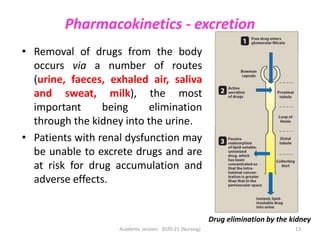
Pharmacokinetics - excretion
• Removal of drugs from the body
occurs via a number of routes
(urine, faeces, exhaled air, saliva
and sweat, milk), the most
important being elimination
through the kidney into the urine.
• Patients with renal dysfunction may
be unable to excrete drugs and are
at risk for drug accumulation and
adverse effects.
Drug elimination by the kidney
Academic session: 2020-21 (Nursing) 13
Pharmacokinetics - kinetics of elimination
• Removal of drugs from the body occurs via a number of
routes, the most important being elimination through
the kidney into the urine.
• Patients with renal dysfunction may be unable to excrete
drugs and are at risk for drug accumulation and adverse
effects.
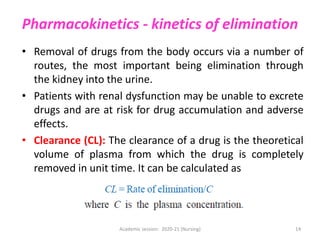
• Clearance (CL): The clearance of a drug is the theoretical
volume of plasma from which the drug is completely
removed in unit time. It can be calculated as
Academic session: 2020-21 (Nursing) 14
Pharmacokinetics - kinetics of elimination
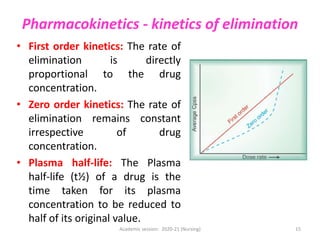
• First order kinetics: The rate of
elimination is directly
proportional to the drug
concentration.
• Zero order kinetics: The rate of
elimination remains constant
irrespective of drug
concentration.
• Plasma half-life: The Plasma
half-life (t½) of a drug is the
time taken for its plasma
concentration to be reduced to
half of its original value.
Academic session: 2020-21 (Nursing) 15
Pharmacokinetics
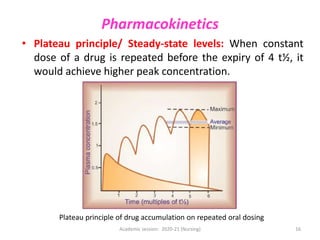
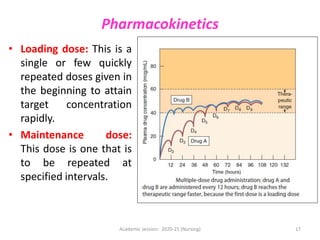
• Plateau principle/ Steady-state levels: When constant
dose of a drug is repeated before the expiry of 4 t½, it
would achieve higher peak concentration.
Plateau principle of drug accumulation on repeated oral dosing
Academic session: 2020-21 (Nursing) 16
Pharmacokinetics
• Loading dose: This is a
single or few quickly
repeated doses given in
the beginning to attain
target concentration
rapidly.
• Maintenance dose:
This dose is one that is
to be repeated at
specified intervals.
Academic session: 2020-21 (Nursing) 17
Pharmacodynamics
• Pharmacodynamics describes what the drug does to the
body.
• Drug action: It is the initial combination of the drug with
its receptor resulting in a conformational change in the
latter (in case of agonists), or prevention of
conformational change through exclusion of the agonist
(in case of antagonists).
• Drug effect: It is the ultimate change in biological
function brought about as a consequence of drug action,
through a series of intermediate steps (transducer).
Academic session: 2020-21 (Nursing) 18
Pharmacodynamics - Transducer mechanisms
• Drugs act as signals, and their receptors act as signal
detectors. Receptors belong to one super-family of
receptors.
– G-protein coupled receptors (GPCRs)
– Ion channel receptor
– Transmembrane enzyme-linked receptors
– Transmembrane JAK-STAT binding receptors
– Receptors regulating gene expression (Transcription
factors, Nuclear receptors)
Academic session: 2020-21 (Nursing) 19
Pharmacodynamics - Transducer mechanisms
• Functions of receptors.
– To propagate regulatory signals from outside to inside the
effector cell when the molecular species carrying the
signal cannot itself penetrate the cell membrane.
– To amplify the signal.
– To integrate various extracellular and intracellular
regulatory signals.
– To adapt to short term and long term changes in the
regulatory melieu.
– To maintain homeostasis.
Academic session: 2020-21 (Nursing) 20
Pharmacodynamics - Dose-response
relationship
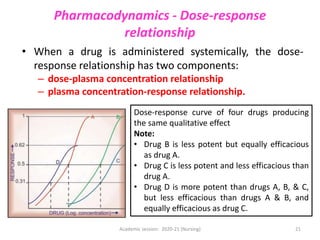
• When a drug is administered systemically, the dose-
response relationship has two components:
– dose-plasma concentration relationship
– plasma concentration-response relationship.
Dose-response curve of four drugs producing
the same qualitative effect
Note:
• Drug B is less potent but equally efficacious
as drug A.
• Drug C is less potent and less efficacious than
drug A.
• Drug D is more potent than drugs A, B, & C,
but less efficacious than drugs A & B, and
equally efficacious as drug C.
Academic session: 2020-21 (Nursing) 21
Pharmacodynamics - Dose-response
relationship
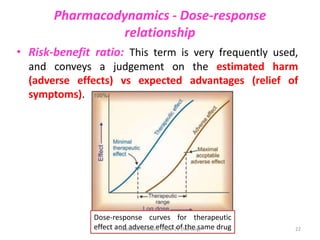
• Risk-benefit ratio: This term is very frequently used,
and conveys a judgement on the estimated harm
(adverse effects) vs expected advantages (relief of
symptoms).
Dose-response curves for therapeutic
effect and adverse effect of the same drug
Academic session: 2020-21 (Nursing) 22
Pharmacodynamics - Dose-response
relationship
• Risk-benefit ratio: This term is very frequently used,
and conveys a judgement on the estimated harm
(adverse effects) vs expected advantages (relief of
symptoms).
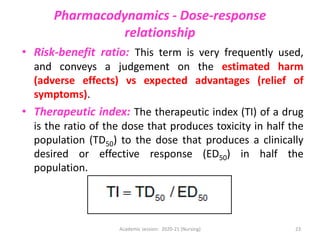
• Therapeutic index: The therapeutic index (TI) of a drug
is the ratio of the dose that produces toxicity in half the
population (TD50) to the dose that produces a clinically
desired or effective response (ED50) in half the
population.
Academic session: 2020-21 (Nursing) 23
Pharmacodynamics - Combined effect of drugs
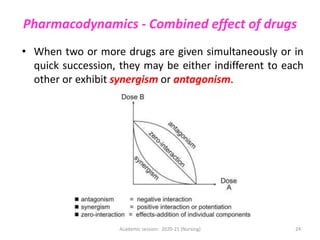
• When two or more drugs are given simultaneously or in
quick succession, they may be either indifferent to each
other or exhibit synergism or antagonism.
Academic session: 2020-21 (Nursing) 24
Adverse Drug Effects
• Adverse effect: Adverse effect is ‘any undesirable or
unintended consequence of drug administration’.
• Adverse Event : Any untoward medical occurrence in a
patient administered a pharmaceutical product and
which does not necessarily have a causal relationship
with this treatment.
Academic session: 2020-21 (Nursing) 25
Adverse Drug Effects - classification
• Adverse effects have been classified as
– Predictable (Type A or Augmented) reactions: Dose
dependent and predictable. They are more common, and
mostly preventable and reversible.
– Unpredictable (Type B or Bizarre) reactions: Idiosyncratic.
They are less common, often non-dose related, generally
more serious and require withdrawal of the drug.
Academic session: 2020-21 (Nursing) 26
Adverse Drug Effects - category
• Side effects
• Secondary effects
• Toxic effects
• Intolerance
• Idiosyncrasy
• Drug allergy
• Photosensitivity
• Drug dependence (Psychological and Physical dependence)
• Drug withdrawal reactions
• Teratogenicity
• Mutagenicity and Carcinogenicity
• Drug induced diseases
Academic session: 2020-21 (Nursing) 27
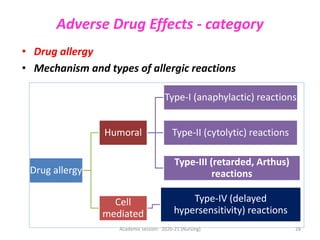
Adverse Drug Effects - category
• Drug allergy
• Mechanism and types of allergic reactions
Drug allergy
Humoral
Type-I (anaphylactic) reactions
Type-II (cytolytic) reactions
Type-III (retarded, Arthus)
reactions
Cell
mediated
Type-IV (delayed
hypersensitivity) reactions
Academic session: 2020-21 (Nursing) 28
Adverse Drug Effects - Severity
• Severity of adverse drug reactions
– Minor: No therapy, antidote or prolongation of
hospitalization is required.
– Moderate: Requires change in drug therapy. May prolong
of hospitalization.
– Severe: Potentially life-threatening, causes permanent
damage or requires intensive medical treatment.
– Lethal: Directly or indirectly contributes to death of the
patient.
Academic session: 2020-21 (Nursing) 29
Adverse Drug Effects
• Prevention of adverse effects to drugs
– Avoid all inappropriate use of drugs in the context of
patient’s clinical condition.
– Use appropriate dose, route and frequency of drug
administration based on patient’s specific variables.
– Consider previous history of drug reactions.
– Elicit history of allergic diseases.
– Rule out possibility of drug interactions when more
than one drug is prescribed.
– Adopt correct drug administration technique.
– Carry out appropriate laboratory monitoring
Academic session: 2020-21 (Nursing) 30
Drug interactions
• Drug interaction refers to modification of response to
one drug by another when they are administered
simultaneously or in quick succession.
• The modification is mostly quantitative (either increased
or decreased in intensity), but some time qualitative (an
abnormal or a different type of response).
• Drug–drug interactions play an important role in patient
safety. The risk of drug–drug interactions increases with
age and the number of drugs used. Most often drug–
drug interactions are preventable.
• The severity of drug interactions in most cases is highly
unpredictable.
Academic session: 2020-21 (Nursing) 31
Drug interactions
• Regular medication drugs (Likely to be involved in drug
interactions)
– Antidiabetics
– Antihypertensives
– Antianginal drugs
– Antiarthritic drugs
– Antiepileptic drugs
– Antiparkinsonian drugs
– Oral contraceptives
– Anticoagulants
– Antiasthmatic drugs
– Psychopharmacological agents
– Antipeptic ulcer/reflux drugs
– Corticosteroids
– Antitubercular drugs
– Anti-HIV drugs Academic session: 2020-21 (Nursing) 32
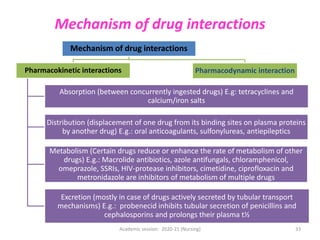
Mechanism of drug interactions
Pharmacokinetic interactions
Absorption (between concurrently ingested drugs) E.g: tetracyclines and
calcium/iron salts
Distribution (displacement of one drug from its binding sites on plasma proteins
by another drug) E.g.: oral anticoagulants, sulfonylureas, antiepileptics
Metabolism (Certain drugs reduce or enhance the rate of metabolism of other
drugs) E.g.: Macrolide antibiotics, azole antifungals, chloramphenicol,
omeprazole, SSRIs, HIV-protease inhibitors, cimetidine, ciprofloxacin and
metronidazole are inhibitors of metabolism of multiple drugs
Excretion (mostly in case of drugs actively secreted by tubular transport
mechanisms) E.g.: probenecid inhibits tubular secretion of penicillins and
cephalosporins and prolongs their plasma t½
Pharmacodynamic interaction
Academic session: 2020-21 (Nursing) 33
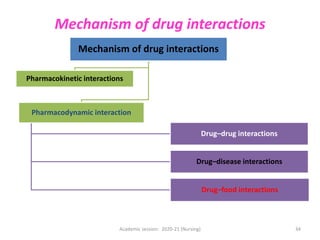
Mechanism of drug interactions
Pharmacokinetic interactions
Pharmacodynamic interaction
Drug–drug interactions
Drug–disease interactions
Drug–food interactions
Academic session: 2020-21 (Nursing) 34
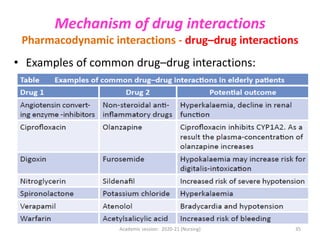
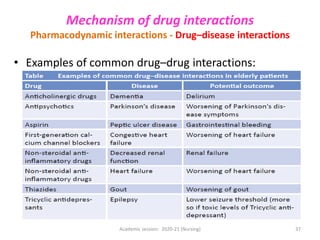
• Examples of common drug–drug interactions:
Mechanism of drug interactions
Pharmacodynamic interactions - drug–drug interactions
Academic session: 2020-21 (Nursing) 35
• The inter-individual variability in susceptibility to drugs is at
least partly explained by differences in multi-morbidity.
• Diseases that affect the kidneys make the elderly patient
more susceptible to ADR due to reduction in renal
elimination.
• Liver diseases as well as cardiac diseases that affect hepatic
blood flow may affect drug metabolism. In the same way,
diseases that affect other organ systems may make elderly
patients even more susceptible to drugs.
Mechanism of drug interactions
Pharmacodynamic interactions - Drug–disease interactions
Academic session: 2020-21 (Nursing) 36
• Examples of common drug–drug interactions:
Mechanism of drug interactions
Pharmacodynamic interactions - Drug–disease interactions
Academic session: 2020-21 (Nursing) 37
• Drug–food interaction adds variability to effects and
adverse effects of drugs.
• For example, warfarin is known for its drug–food
interactions. Warfarin has a narrow therapeutic interval
and food with a high K-vitamin content counteract the
effects of warfarin.
Mechanism of drug interactions
Pharmacodynamic interactions - Drug–food interactions
Academic session: 2020-21 (Nursing) 38
• Other examples are grapefruit juice that inhibits the
metabolism of cyclosporine and non-selective monoamine
oxidase (MAO) inhibitor with food rich in tyramine. Some
fermented and stored products (e.g. some cheese,
sausages, red wine) contain tyramine that is metabolised
to noradrenaline, which in conjunction with MAO
inhibitors may block MAO and cause a hypertensive crisis.
Seligiline and moclobemide are examples of MAO
inhibitors.
Mechanism of drug interactions
Pharmacodynamic interactions - Drug–food interactions
Academic session: 2020-21 (Nursing) 39
Academic session: 2020-21 (Nursing) 40

PK and PD - Introduction

  • 1.
    Pharmacokinetics Pharmacodynamics Dr. S. Parasuraman AssociateProfessor, Faculty of Pharmacy, AIMST University, Malaysia. Introduction to Pharmacology - for allied health sciences
  • 2.
    Pharmacokinetics • Pharmacokinetics refersto what the body does to a drug, whereas pharmacodynamics describes what the drug does to the body. • Four pharmacokinetic properties determine the onset, intensity, and the duration of drug action. – Absorption – Distribution – Metabolism – Elimination • All pharmacokinetic processes involve transport of the drug across biological membranes. Academic session: 2020-21 (Nursing) 2
  • 3.
    Academic session: 2020-21(Nursing) 3 Schematic depiction of pharmacokinetic processes
  • 4.
    Pharmacokinetics - Absorption •Absorption is movement of the drug from its site of administration into the circulation. • Mechanisms of absorption of drugs from the GI tract – Passive diffusion – Facilitated diffusion – Active transport – Endocytosis and exocytosis Academic session: 2020-21 (Nursing) 4
  • 5.
    Pharmacokinetics - Absorption Academicsession: 2020-21 (Nursing) 5
  • 6.
    Pharmacokinetics - Absorption •Factors affecting absorption – Solubility – Concentration – Area of absorbing surface – Vascularity of the absorbing surface – Route of administration Academic session: 2020-21 (Nursing) 6
  • 7.
    Pharmacokinetics - Absorption •Bioavailability (F): Bioavailability refers to the rate and extent of absorption of a drug from a dosage form. • Bioavailability of drug injected i.v. is 100%, but is frequently lower after oral ingestion because – the drug may be incompletely absorbed – the absorbed drug may undergo first pass metabolism in the intestinal wall/liver or be excreted in bile Academic session: 2020-21 (Nursing) 7
  • 8.
    Pharmacokinetics - distribution •Drug distribution is the process by which a drug reversibly leaves the bloodstream and enters the interstitium (extracellular fluid) and the tissues. • The distribution of a drug from the plasma to the interstitium depends on – cardiac output – local blood flow – capillary permeability – tissue volume – degree of binding of the drug to plasma and tissue proteins & – the relative lipophilicity of the drug. Academic session: 2020-21 (Nursing) 8
  • 9.
    Pharmacokinetics - distribution •Volume of distribution: The apparent volume of distribution, Vd, is defined as the fluid volume that is required to contain the entire drug in the body at the same concentration measured in the plasma. • C0 = Plasma concentration at time zero Academic session: 2020-21 (Nursing) 9
  • 10.
    Pharmacokinetics - distribution •Volume of distribution calculation: • 64-year-old female patient (70 kg) was recently diagnosed with gram-positive pathogenic infection. She received 2000 mg of vancomycin as an IV loading dose. The peak plasma concentration of vancomycin was reported to be 28.5 mg/L. The apparent volume of distribution is: = Amount of drug/ Plasma concentration = 2000/28.5 = 70.2 L for 70 kg = 1 L/ kg Academic session: 2020-21 (Nursing) 10
  • 11.
    Pharmacokinetics - biotransformation •Metabolism (biotransformation): • Biotransformation means chemical alteration of the drug in the body. It is needed to render nonpolar (lipid- soluble) compounds polar (lipidinsoluble) so that they are not reabsorbed in the renal tubules and are excreted. • The primary site for drug metabolism is liver; others are—kidney, intestine, lungs and plasma. Academic session: 2020-21 (Nursing) 11
  • 12.
    Pharmacokinetics - biotransformation Academicsession: 2020-21 (Nursing) 12
  • 13.
    Pharmacokinetics - excretion •Removal of drugs from the body occurs via a number of routes (urine, faeces, exhaled air, saliva and sweat, milk), the most important being elimination through the kidney into the urine. • Patients with renal dysfunction may be unable to excrete drugs and are at risk for drug accumulation and adverse effects. Drug elimination by the kidney Academic session: 2020-21 (Nursing) 13
  • 14.
    Pharmacokinetics - kineticsof elimination • Removal of drugs from the body occurs via a number of routes, the most important being elimination through the kidney into the urine. • Patients with renal dysfunction may be unable to excrete drugs and are at risk for drug accumulation and adverse effects. • Clearance (CL): The clearance of a drug is the theoretical volume of plasma from which the drug is completely removed in unit time. It can be calculated as Academic session: 2020-21 (Nursing) 14
  • 15.
    Pharmacokinetics - kineticsof elimination • First order kinetics: The rate of elimination is directly proportional to the drug concentration. • Zero order kinetics: The rate of elimination remains constant irrespective of drug concentration. • Plasma half-life: The Plasma half-life (t½) of a drug is the time taken for its plasma concentration to be reduced to half of its original value. Academic session: 2020-21 (Nursing) 15
  • 16.
    Pharmacokinetics • Plateau principle/Steady-state levels: When constant dose of a drug is repeated before the expiry of 4 t½, it would achieve higher peak concentration. Plateau principle of drug accumulation on repeated oral dosing Academic session: 2020-21 (Nursing) 16
  • 17.
    Pharmacokinetics • Loading dose:This is a single or few quickly repeated doses given in the beginning to attain target concentration rapidly. • Maintenance dose: This dose is one that is to be repeated at specified intervals. Academic session: 2020-21 (Nursing) 17
  • 18.
    Pharmacodynamics • Pharmacodynamics describeswhat the drug does to the body. • Drug action: It is the initial combination of the drug with its receptor resulting in a conformational change in the latter (in case of agonists), or prevention of conformational change through exclusion of the agonist (in case of antagonists). • Drug effect: It is the ultimate change in biological function brought about as a consequence of drug action, through a series of intermediate steps (transducer). Academic session: 2020-21 (Nursing) 18
  • 19.
    Pharmacodynamics - Transducermechanisms • Drugs act as signals, and their receptors act as signal detectors. Receptors belong to one super-family of receptors. – G-protein coupled receptors (GPCRs) – Ion channel receptor – Transmembrane enzyme-linked receptors – Transmembrane JAK-STAT binding receptors – Receptors regulating gene expression (Transcription factors, Nuclear receptors) Academic session: 2020-21 (Nursing) 19
  • 20.
    Pharmacodynamics - Transducermechanisms • Functions of receptors. – To propagate regulatory signals from outside to inside the effector cell when the molecular species carrying the signal cannot itself penetrate the cell membrane. – To amplify the signal. – To integrate various extracellular and intracellular regulatory signals. – To adapt to short term and long term changes in the regulatory melieu. – To maintain homeostasis. Academic session: 2020-21 (Nursing) 20
  • 21.
    Pharmacodynamics - Dose-response relationship •When a drug is administered systemically, the dose- response relationship has two components: – dose-plasma concentration relationship – plasma concentration-response relationship. Dose-response curve of four drugs producing the same qualitative effect Note: • Drug B is less potent but equally efficacious as drug A. • Drug C is less potent and less efficacious than drug A. • Drug D is more potent than drugs A, B, & C, but less efficacious than drugs A & B, and equally efficacious as drug C. Academic session: 2020-21 (Nursing) 21
  • 22.
    Pharmacodynamics - Dose-response relationship •Risk-benefit ratio: This term is very frequently used, and conveys a judgement on the estimated harm (adverse effects) vs expected advantages (relief of symptoms). Dose-response curves for therapeutic effect and adverse effect of the same drug Academic session: 2020-21 (Nursing) 22
  • 23.
    Pharmacodynamics - Dose-response relationship •Risk-benefit ratio: This term is very frequently used, and conveys a judgement on the estimated harm (adverse effects) vs expected advantages (relief of symptoms). • Therapeutic index: The therapeutic index (TI) of a drug is the ratio of the dose that produces toxicity in half the population (TD50) to the dose that produces a clinically desired or effective response (ED50) in half the population. Academic session: 2020-21 (Nursing) 23
  • 24.
    Pharmacodynamics - Combinedeffect of drugs • When two or more drugs are given simultaneously or in quick succession, they may be either indifferent to each other or exhibit synergism or antagonism. Academic session: 2020-21 (Nursing) 24
  • 25.
    Adverse Drug Effects •Adverse effect: Adverse effect is ‘any undesirable or unintended consequence of drug administration’. • Adverse Event : Any untoward medical occurrence in a patient administered a pharmaceutical product and which does not necessarily have a causal relationship with this treatment. Academic session: 2020-21 (Nursing) 25
  • 26.
    Adverse Drug Effects- classification • Adverse effects have been classified as – Predictable (Type A or Augmented) reactions: Dose dependent and predictable. They are more common, and mostly preventable and reversible. – Unpredictable (Type B or Bizarre) reactions: Idiosyncratic. They are less common, often non-dose related, generally more serious and require withdrawal of the drug. Academic session: 2020-21 (Nursing) 26
  • 27.
    Adverse Drug Effects- category • Side effects • Secondary effects • Toxic effects • Intolerance • Idiosyncrasy • Drug allergy • Photosensitivity • Drug dependence (Psychological and Physical dependence) • Drug withdrawal reactions • Teratogenicity • Mutagenicity and Carcinogenicity • Drug induced diseases Academic session: 2020-21 (Nursing) 27
  • 28.
    Adverse Drug Effects- category • Drug allergy • Mechanism and types of allergic reactions Drug allergy Humoral Type-I (anaphylactic) reactions Type-II (cytolytic) reactions Type-III (retarded, Arthus) reactions Cell mediated Type-IV (delayed hypersensitivity) reactions Academic session: 2020-21 (Nursing) 28
  • 29.
    Adverse Drug Effects- Severity • Severity of adverse drug reactions – Minor: No therapy, antidote or prolongation of hospitalization is required. – Moderate: Requires change in drug therapy. May prolong of hospitalization. – Severe: Potentially life-threatening, causes permanent damage or requires intensive medical treatment. – Lethal: Directly or indirectly contributes to death of the patient. Academic session: 2020-21 (Nursing) 29
  • 30.
    Adverse Drug Effects •Prevention of adverse effects to drugs – Avoid all inappropriate use of drugs in the context of patient’s clinical condition. – Use appropriate dose, route and frequency of drug administration based on patient’s specific variables. – Consider previous history of drug reactions. – Elicit history of allergic diseases. – Rule out possibility of drug interactions when more than one drug is prescribed. – Adopt correct drug administration technique. – Carry out appropriate laboratory monitoring Academic session: 2020-21 (Nursing) 30
  • 31.
    Drug interactions • Druginteraction refers to modification of response to one drug by another when they are administered simultaneously or in quick succession. • The modification is mostly quantitative (either increased or decreased in intensity), but some time qualitative (an abnormal or a different type of response). • Drug–drug interactions play an important role in patient safety. The risk of drug–drug interactions increases with age and the number of drugs used. Most often drug– drug interactions are preventable. • The severity of drug interactions in most cases is highly unpredictable. Academic session: 2020-21 (Nursing) 31
  • 32.
    Drug interactions • Regularmedication drugs (Likely to be involved in drug interactions) – Antidiabetics – Antihypertensives – Antianginal drugs – Antiarthritic drugs – Antiepileptic drugs – Antiparkinsonian drugs – Oral contraceptives – Anticoagulants – Antiasthmatic drugs – Psychopharmacological agents – Antipeptic ulcer/reflux drugs – Corticosteroids – Antitubercular drugs – Anti-HIV drugs Academic session: 2020-21 (Nursing) 32
  • 33.
    Mechanism of druginteractions Mechanism of drug interactions Pharmacokinetic interactions Absorption (between concurrently ingested drugs) E.g: tetracyclines and calcium/iron salts Distribution (displacement of one drug from its binding sites on plasma proteins by another drug) E.g.: oral anticoagulants, sulfonylureas, antiepileptics Metabolism (Certain drugs reduce or enhance the rate of metabolism of other drugs) E.g.: Macrolide antibiotics, azole antifungals, chloramphenicol, omeprazole, SSRIs, HIV-protease inhibitors, cimetidine, ciprofloxacin and metronidazole are inhibitors of metabolism of multiple drugs Excretion (mostly in case of drugs actively secreted by tubular transport mechanisms) E.g.: probenecid inhibits tubular secretion of penicillins and cephalosporins and prolongs their plasma t½ Pharmacodynamic interaction Academic session: 2020-21 (Nursing) 33
  • 34.
    Mechanism of druginteractions Mechanism of drug interactions Pharmacokinetic interactions Pharmacodynamic interaction Drug–drug interactions Drug–disease interactions Drug–food interactions Academic session: 2020-21 (Nursing) 34
  • 35.
    • Examples ofcommon drug–drug interactions: Mechanism of drug interactions Pharmacodynamic interactions - drug–drug interactions Academic session: 2020-21 (Nursing) 35
  • 36.
    • The inter-individualvariability in susceptibility to drugs is at least partly explained by differences in multi-morbidity. • Diseases that affect the kidneys make the elderly patient more susceptible to ADR due to reduction in renal elimination. • Liver diseases as well as cardiac diseases that affect hepatic blood flow may affect drug metabolism. In the same way, diseases that affect other organ systems may make elderly patients even more susceptible to drugs. Mechanism of drug interactions Pharmacodynamic interactions - Drug–disease interactions Academic session: 2020-21 (Nursing) 36
  • 37.
    • Examples ofcommon drug–drug interactions: Mechanism of drug interactions Pharmacodynamic interactions - Drug–disease interactions Academic session: 2020-21 (Nursing) 37
  • 38.
    • Drug–food interactionadds variability to effects and adverse effects of drugs. • For example, warfarin is known for its drug–food interactions. Warfarin has a narrow therapeutic interval and food with a high K-vitamin content counteract the effects of warfarin. Mechanism of drug interactions Pharmacodynamic interactions - Drug–food interactions Academic session: 2020-21 (Nursing) 38
  • 39.
    • Other examplesare grapefruit juice that inhibits the metabolism of cyclosporine and non-selective monoamine oxidase (MAO) inhibitor with food rich in tyramine. Some fermented and stored products (e.g. some cheese, sausages, red wine) contain tyramine that is metabolised to noradrenaline, which in conjunction with MAO inhibitors may block MAO and cause a hypertensive crisis. Seligiline and moclobemide are examples of MAO inhibitors. Mechanism of drug interactions Pharmacodynamic interactions - Drug–food interactions Academic session: 2020-21 (Nursing) 39
  • 40.