Presentation Topic: Synthetic dyes
Department: Chemistry
Presented by: Muhammad Ahsan
INTRODUCTION
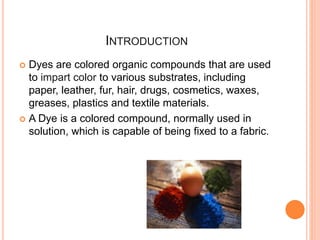
 Dyes are colored organic compounds that are used
to impart color to various substrates, including
paper, leather, fur, hair, drugs, cosmetics, waxes,
greases, plastics and textile materials.
 A Dye is a colored compound, normally used in
solution, which is capable of being fixed to a fabric.
EVOLUTION OF DYES:-
The preparation and application of dyestuffs is one
of the oldest forms of human activities.
There is also mention of it in the Bible and other
works of classical antiquity. It was in 2600 BC when
earliest written records of the use of dyestuffs were
found in China.
First humanmade organic dye that was discovered
by William Henry Perkin in the year 1856.
The first synthetic dye, picric acid, was prepared
in the year 1771 from the natural pigment, indigo.
William Perkin an 18 years old student was working on
chemical synthesis of natural products. In a classic case of
serendipity, the young William Perkin chanced upon his
now famous 'Aniline Mauve' dye while he
was attempting to synthesize quinine, the only cure for
malaria. Perkin named his colour Mauveine, after the
French name of nonfast
colour which was made of natural dyes. So "Mauve" (a
basic dye) was the first synthetic dye stuff. Mauve was a
derivative of coal tar. It was the first mass produced dye,
that was commercially available and the idea was born that
a colour could be made in the factory. It was indeed a
revolution.
Properties of good dye:-
Dyes must possess the following four properties:
 1. Colour
 2. Solubility in water
 3. Ability to be absorbed and retained by fibre
(substantivity) or to be
chemically combined with it (reactivity).
 4. Ability to withstand washing,
dry cleaning and exposure to light.
CLASSIFICATION
 There are several ways for classification of dyes.
 Each class of dye has a very unique chemistry,
structure and particular way of bonding. While
some dyes can react chemically with the substrates
forming strong bonds in the process, others can be
held by physical forces. Some of the prominent
ways of classification are:
 Classification based on the source of materials
 classification of the Dyes- Based on the nature of
their respective chromophores.
 Classification by methods of application.
CLASSIFICATION BASED ON THE
SOURCE OF MATERIALS
 A very common classification of the dyestuff is based
on the source from which it is made. Accordingly the
classification could be:
 Natural Dyes
 Synthetic Dyes
NATURAL DYE
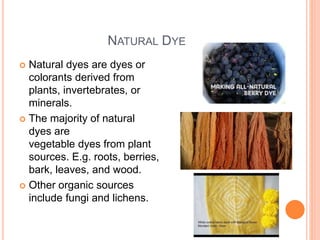
 Natural dyes are dyes or
colorants derived from
plants, invertebrates, or
minerals.
 The majority of natural
dyes are
vegetable dyes from plant
sources. E.g. roots, berries,
bark, leaves, and wood.
 Other organic sources
include fungi and lichens.
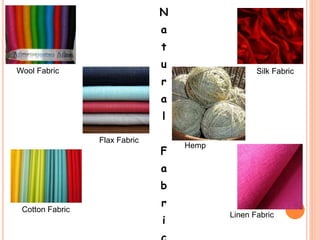
Wool Fabric
N
a
t
u
r
a
l
F
a
b
r
i
Silk Fabric
Flax Fabric
Cotton Fabric
Linen Fabric
Hemp
SYNTHETIC DYES
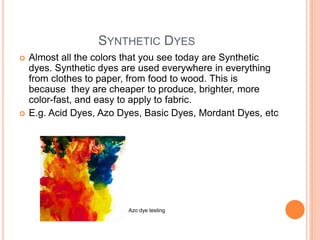
 Almost all the colors that you see today are Synthetic
dyes. Synthetic dyes are used everywhere in everything
from clothes to paper, from food to wood. This is
because they are cheaper to produce, brighter, more
color-fast, and easy to apply to fabric.
 E.g. Acid Dyes, Azo Dyes, Basic Dyes, Mordant Dyes, etc
Azo dye testing
CLASSIFICATION BASED ON THE
CHROMOPHORE PRESENT
 Dyes may be classified according to the type of
chromophores present in their structures.
1. Nitro and Nitroso Dyes
2. Azo Dyes
3. Triarylmethane Dyes
4. Anthraquinone Dyes
5. Indigo dyes
AZO DYES
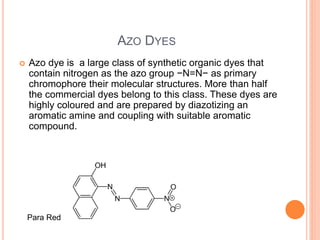
 Azo dye is a large class of synthetic organic dyes that
contain nitrogen as the azo group −N=N− as primary
chromophore their molecular structures. More than half
the commercial dyes belong to this class. These dyes are
highly coloured and are prepared by diazotizing an
aromatic amine and coupling with suitable aromatic
compound.
Para Red
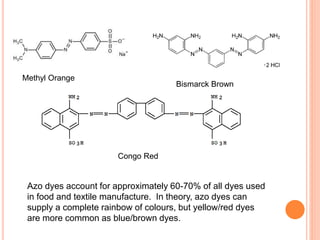
Methyl Orange
Congo Red
Bismarck Brown
Azo dyes account for approximately 60-70% of all dyes used
in food and textile manufacture. In theory, azo dyes can
supply a complete rainbow of colours, but yellow/red dyes
are more common as blue/brown dyes.
TRIARYLMETHANE DYES
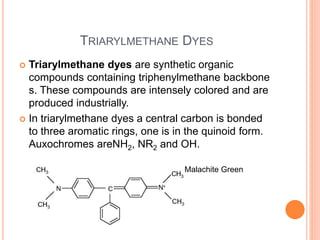
 Triarylmethane dyes are synthetic organic
compounds containing triphenylmethane backbone
s. These compounds are intensely colored and are
produced industrially.
 In triarylmethane dyes a central carbon is bonded
to three aromatic rings, one is in the quinoid form.
Auxochromes areNH2, NR2 and OH.
Malachite Green
 Malachite Green is used as a direct dye for wool and
silk.
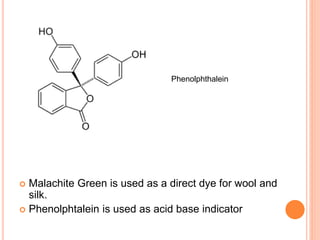
 Phenolphtalein is used as acid base indicator
Phenolphthalein
ANTHRAQUINONE DYES
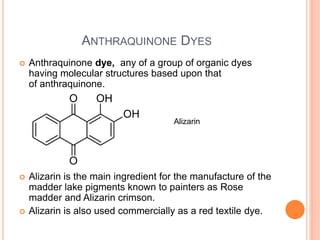
 Anthraquinone dye, any of a group of organic dyes
having molecular structures based upon that
of anthraquinone.
 Alizarin is the main ingredient for the manufacture of the
madder lake pigments known to painters as Rose
madder and Alizarin crimson.
 Alizarin is also used commercially as a red textile dye.
Alizarin
INDIGO DYES
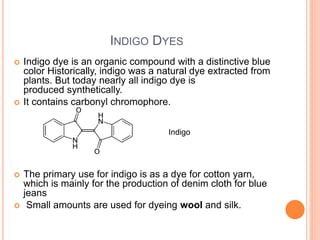
 Indigo dye is an organic compound with a distinctive blue
color Historically, indigo was a natural dye extracted from
plants. But today nearly all indigo dye is
produced synthetically.
 It contains carbonyl chromophore.
 The primary use for indigo is as a dye for cotton yarn,
which is mainly for the production of denim cloth for blue
jeans
 Small amounts are used for dyeing wool and silk.
Indigo
CLASSIFICATION BASED ON THE DYEING
METHOD:-
 According to the dyeing methods , there are
following types.
 Cationic (Basic) Dyes:
 Anionic (Acid) Dyes:
 Direct Dyes.
 Disperse Dyes:
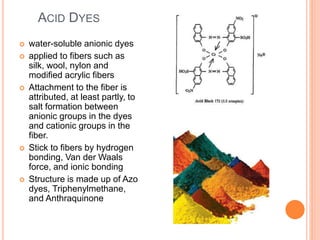
ACID DYES
 water-soluble anionic dyes
 applied to fibers such as
silk, wool, nylon and
modified acrylic fibers
 Attachment to the fiber is
attributed, at least partly, to
salt formation between
anionic groups in the dyes
and cationic groups in the
fiber.
 Stick to fibers by hydrogen
bonding, Van der Waals
force, and ionic bonding
 Structure is made up of Azo
dyes, Triphenylmethane,
and Anthraquinone
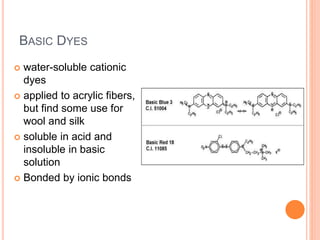
BASIC DYES
 water-soluble cationic
dyes
 applied to acrylic fibers,
but find some use for
wool and silk
 soluble in acid and
insoluble in basic
solution
 Bonded by ionic bonds
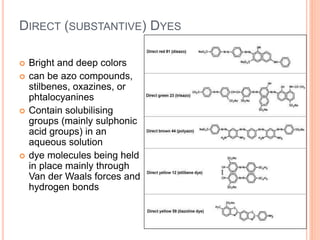
DIRECT (SUBSTANTIVE) DYES
 Bright and deep colors
 can be azo compounds,
stilbenes, oxazines, or
phtalocyanines
 Contain solubilising
groups (mainly sulphonic
acid groups) in an
aqueous solution
 dye molecules being held
in place mainly through
Van der Waals forces and
hydrogen bonds
Disperse Dyes:
Water-insoluble non-ionic dyes for application to hydrophobic
fibers from aqueous dispersion.
Used predominantly on polyester and to a lesser extent on
nylon, cellulose, cellulose acetate, and acrylic fibers.
Used in Thermal transfer printing and dye diffusion thermal
transfer processes for electronic photography.
A number of other classes of dyes have also been
established, that includes the following:
Fluorescent Dyes - A very innovative dye. Used for
application in sports good etc.
Fuel Dyes - Used in fuels.
Leather Dyes - Used for leather.
Leuco Dyes - Has a wide variety of applications
including electronic industries and papers.
Other important dyes:-
Inkjet Dyes - Writing industry including the inkjet
printers.
Oxidation Dyes - Used mainly for hair.
Optical Brighteners - Used primarily for textile fibres
and paper.
Smoke Dyes - Used in military activities.
Sublimation Dyes - For application in textile printing.
WHAT MAKES THE DYES COLOURED?
 which is explained by the presence of a substance called
Chromophore in the dyes. By definition dyes are
basically aromatic compounds. Their structures have
aryl rings that has delocalised electron systems. These
structures are said to be responsible for the absorption
of electromagnetic radiation that has varying
wavelengths, based upon the energy of the electron
clouds. It is actually because of this reason that
chromophores do not make dyes coloured. Rather it
makes the dyes proficient in their ability to absorb
radiation. Chromophores acts by making energy
changes in the delocalised electron cloud of the dye.
 This alteration invariably results in the compound
absorbing radiation within the visible range of colours
and not outside it. Human eyes detects this absorption,
and responds to the colours.
HOW CAN THE COLOUR OF THE DYES BE
ALTERED?
 The Modifiers. Colour modifiers like methyl or ethyl
groups can actually alter the colour of dyes. They
do so by altering the energy in the delocalised
electrons. It has been found that by addition of a
particular modifier there is a progressive alteration
of colour.
 An example can be given for methyl violet series.
 The following diagram explains what happens to
the colour of the dyes when modifiers are added.
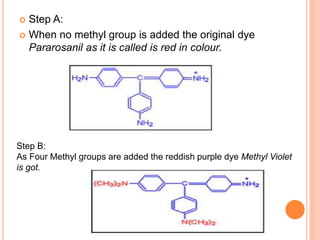
 Step A:
 When no methyl group is added the original dye
Pararosanil as it is called is red in colour.
Step B:
As Four Methyl groups are added the reddish purple dye Methyl Violet
is got.
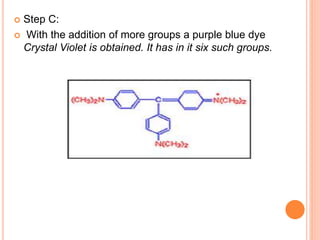
 Step C:
 With the addition of more groups a purple blue dye
Crystal Violet is obtained. It has in it six such groups.
DISADVANTAGE OF SYNTHETIC DYES:-
 synthetic dyes have harmful effects on the
environment and human beings.
 First off ,synthetic dyes are made up of chemical
compounds that can be harmful to humans,
especially those who work in their production.
 Some of the chemicals found in synthetic dyes are
mercury, lead, chromium,copper, sodium chloride,
toluene, and benzene. Exposure to large doses of
these substances can be toxic and can have severe
effects in the human body.
 Water pollution can also result from manufacturing
synthetic dyes when untreated dye effluent is
dumped directly on bodies of water.
 Hair dye or hair colouring is the practice of
changing the hair colour.
 The main reason for this are cosmetic : To
cover gray hairs or to change the colour of
hair which is regarded as more fashionable
or desrablein todays world.
HISTORY:-
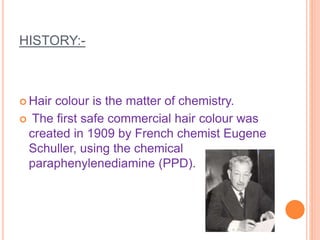
 Hair colour is the matter of chemistry.
 The first safe commercial hair colour was
created in 1909 by French chemist Eugene
Schuller, using the chemical
paraphenylenediamine (PPD).
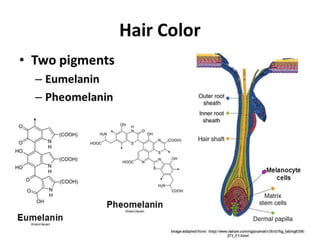
 Hair is mainly Keratin. The same protein
found in skin and fingernails. The natural
colour of hair depends on the ratio and
quantities of two other proteins, Eumelanin
and Phaeomelanin.
 Eumelanin is responsible for brown to black
hair shade while Phaeomelanin is
responsible for goldenblond, ginger and red
colour.
 The absence of either type of melanin
produces white/grey hair.
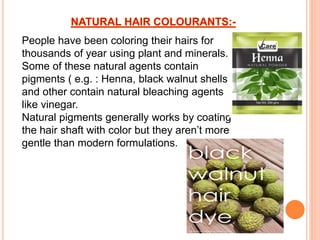
People have been coloring their hairs for
thousands of year using plant and minerals.
Some of these natural agents contain
pigments ( e.g. : Henna, black walnut shells )
and other contain natural bleaching agents
like vinegar.
Natural pigments generally works by coating
the hair shaft with color but they aren’t more
gentle than modern formulations.
 Depending upon the deposition of various Dyes for
suitable time limit, the dyes are classified into four
categories. They are :
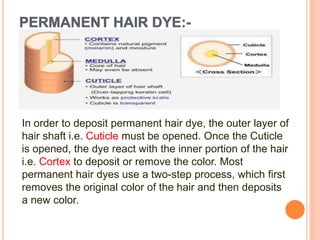
In order to deposit permanent hair dye, the outer layer of
hair shaft i.e. Cuticle must be opened. Once the Cuticle
is opened, the dye react with the inner portion of the hair
i.e. Cortex to deposit or remove the color. Most
permanent hair dyes use a two-step process, which first
removes the original color of the hair and then deposits
a new color.
Ammonia is the alkaline chemical that open the cuticle
and allows the hair color to penetrate the Cortex of the
hair. It also acts as a catalyst when the permanent hair
color comes together with the peroxide.
Peroxide is used as a developer or oxidizing agent. The
developer removes pre-existing color. Peroxide breaks
chemical bonds in hair, releasing sulfur, which accounts
for the characterstic odor of hair color. As the melanin is
decolorized, a new permanent color is bounded to the
hair cortex. Various types of alcohols and conditioners
may also be present in hair dye. The conditioners close
the cuticle after coloring to seal in and protect the new
color.
 Demi-permanent hair dye are those which contains
an alkaline agent other than ammonia (e.g.
Ethanolamine, Sodium Carbonate etc. ) and always
employed with a developer, the concentration of
hydrogen peroxide in that developer may be lower
than used with a permanent hair dye.
 Demi-permanent are much more effective at
covering Grey Hair than Semi-permanent dye
but less than permanent hair dye .
 Semi-permanent hair dye may deposit acidic dye
onto the hair shaft or may consists of small pigment
molecules that can slip inside the hair shaft, using a
small amount of peroxide.
 In some cases, a collection of several colorant
molecules enter the hair to form a larger complex
inside the hair shaft. Generally these products
doesn’t contain ammonia and if contain then in very
negligible amount.
 This dye is available in various forms
including shampoos, gels, sprays and
foams. Temporary hair dye is typically
brighter and more vibrant than Semi-
permanent and Permanent hair dye.
 The pigment molecules in temporary hair
dye are large and can’t penetrate the
Cuticle layer. The colour particles remain
adsorbed to the hair shaft and are easily
removed with a single shampooing.
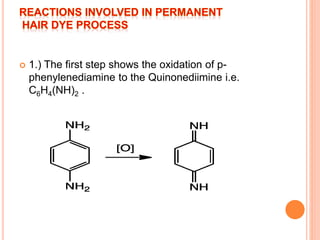
 1.) The first step shows the oxidation of p-
phenylenediamine to the Quinonediimine i.e.
C6H4(NH)2 .
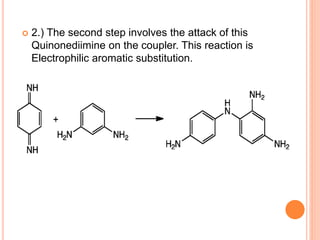
 2.) The second step involves the attack of this
Quinonediimine on the coupler. This reaction is
Electrophilic aromatic substitution.
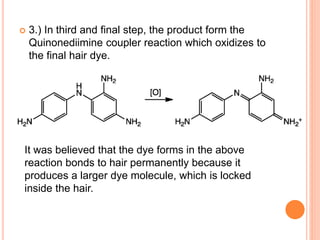
 3.) In third and final step, the product form the
Quinonediimine coupler reaction which oxidizes to
the final hair dye.
It was believed that the dye forms in the above
reaction bonds to hair permanently because it
produces a larger dye molecule, which is locked
inside the hair.
ADVERSE EFFECT:-
 Hair dye or hair coloring involves the use of
Chemicals that are capable of removing,
replacing or covering up pigments naturally
found inside the hair shaft. Use of these
Chemicals can result in a range of adverse
effects including temporary skin irritation or
allergy, hair breakage, skin discoloration etc.
Synthetic dye

Synthetic dye

  • 2.
    Presentation Topic: Syntheticdyes Department: Chemistry Presented by: Muhammad Ahsan
  • 3.
    INTRODUCTION  Dyes arecolored organic compounds that are used to impart color to various substrates, including paper, leather, fur, hair, drugs, cosmetics, waxes, greases, plastics and textile materials.  A Dye is a colored compound, normally used in solution, which is capable of being fixed to a fabric.
  • 4.
    EVOLUTION OF DYES:- Thepreparation and application of dyestuffs is one of the oldest forms of human activities. There is also mention of it in the Bible and other works of classical antiquity. It was in 2600 BC when earliest written records of the use of dyestuffs were found in China. First humanmade organic dye that was discovered by William Henry Perkin in the year 1856. The first synthetic dye, picric acid, was prepared in the year 1771 from the natural pigment, indigo.
  • 5.
    William Perkin an18 years old student was working on chemical synthesis of natural products. In a classic case of serendipity, the young William Perkin chanced upon his now famous 'Aniline Mauve' dye while he was attempting to synthesize quinine, the only cure for malaria. Perkin named his colour Mauveine, after the French name of nonfast colour which was made of natural dyes. So "Mauve" (a basic dye) was the first synthetic dye stuff. Mauve was a derivative of coal tar. It was the first mass produced dye, that was commercially available and the idea was born that a colour could be made in the factory. It was indeed a revolution.
  • 6.
    Properties of gooddye:- Dyes must possess the following four properties:  1. Colour  2. Solubility in water  3. Ability to be absorbed and retained by fibre (substantivity) or to be chemically combined with it (reactivity).  4. Ability to withstand washing, dry cleaning and exposure to light.
  • 7.
    CLASSIFICATION  There areseveral ways for classification of dyes.  Each class of dye has a very unique chemistry, structure and particular way of bonding. While some dyes can react chemically with the substrates forming strong bonds in the process, others can be held by physical forces. Some of the prominent ways of classification are:  Classification based on the source of materials  classification of the Dyes- Based on the nature of their respective chromophores.  Classification by methods of application.
  • 8.
    CLASSIFICATION BASED ONTHE SOURCE OF MATERIALS  A very common classification of the dyestuff is based on the source from which it is made. Accordingly the classification could be:  Natural Dyes  Synthetic Dyes
  • 9.
    NATURAL DYE  Naturaldyes are dyes or colorants derived from plants, invertebrates, or minerals.  The majority of natural dyes are vegetable dyes from plant sources. E.g. roots, berries, bark, leaves, and wood.  Other organic sources include fungi and lichens.
  • 10.
    Wool Fabric N a t u r a l F a b r i Silk Fabric FlaxFabric Cotton Fabric Linen Fabric Hemp
  • 11.
    SYNTHETIC DYES  Almostall the colors that you see today are Synthetic dyes. Synthetic dyes are used everywhere in everything from clothes to paper, from food to wood. This is because they are cheaper to produce, brighter, more color-fast, and easy to apply to fabric.  E.g. Acid Dyes, Azo Dyes, Basic Dyes, Mordant Dyes, etc Azo dye testing
  • 12.
    CLASSIFICATION BASED ONTHE CHROMOPHORE PRESENT  Dyes may be classified according to the type of chromophores present in their structures. 1. Nitro and Nitroso Dyes 2. Azo Dyes 3. Triarylmethane Dyes 4. Anthraquinone Dyes 5. Indigo dyes
  • 13.
    AZO DYES  Azodye is a large class of synthetic organic dyes that contain nitrogen as the azo group −N=N− as primary chromophore their molecular structures. More than half the commercial dyes belong to this class. These dyes are highly coloured and are prepared by diazotizing an aromatic amine and coupling with suitable aromatic compound. Para Red
  • 14.
    Methyl Orange Congo Red BismarckBrown Azo dyes account for approximately 60-70% of all dyes used in food and textile manufacture. In theory, azo dyes can supply a complete rainbow of colours, but yellow/red dyes are more common as blue/brown dyes.
  • 15.
    TRIARYLMETHANE DYES  Triarylmethanedyes are synthetic organic compounds containing triphenylmethane backbone s. These compounds are intensely colored and are produced industrially.  In triarylmethane dyes a central carbon is bonded to three aromatic rings, one is in the quinoid form. Auxochromes areNH2, NR2 and OH. Malachite Green
  • 16.
     Malachite Greenis used as a direct dye for wool and silk.  Phenolphtalein is used as acid base indicator Phenolphthalein
  • 17.
    ANTHRAQUINONE DYES  Anthraquinonedye, any of a group of organic dyes having molecular structures based upon that of anthraquinone.  Alizarin is the main ingredient for the manufacture of the madder lake pigments known to painters as Rose madder and Alizarin crimson.  Alizarin is also used commercially as a red textile dye. Alizarin
  • 18.
    INDIGO DYES  Indigodye is an organic compound with a distinctive blue color Historically, indigo was a natural dye extracted from plants. But today nearly all indigo dye is produced synthetically.  It contains carbonyl chromophore.  The primary use for indigo is as a dye for cotton yarn, which is mainly for the production of denim cloth for blue jeans  Small amounts are used for dyeing wool and silk. Indigo
  • 19.
    CLASSIFICATION BASED ONTHE DYEING METHOD:-  According to the dyeing methods , there are following types.  Cationic (Basic) Dyes:  Anionic (Acid) Dyes:  Direct Dyes.  Disperse Dyes:
  • 20.
    ACID DYES  water-solubleanionic dyes  applied to fibers such as silk, wool, nylon and modified acrylic fibers  Attachment to the fiber is attributed, at least partly, to salt formation between anionic groups in the dyes and cationic groups in the fiber.  Stick to fibers by hydrogen bonding, Van der Waals force, and ionic bonding  Structure is made up of Azo dyes, Triphenylmethane, and Anthraquinone
  • 21.
    BASIC DYES  water-solublecationic dyes  applied to acrylic fibers, but find some use for wool and silk  soluble in acid and insoluble in basic solution  Bonded by ionic bonds
  • 22.
    DIRECT (SUBSTANTIVE) DYES Bright and deep colors  can be azo compounds, stilbenes, oxazines, or phtalocyanines  Contain solubilising groups (mainly sulphonic acid groups) in an aqueous solution  dye molecules being held in place mainly through Van der Waals forces and hydrogen bonds
  • 23.
    Disperse Dyes: Water-insoluble non-ionicdyes for application to hydrophobic fibers from aqueous dispersion. Used predominantly on polyester and to a lesser extent on nylon, cellulose, cellulose acetate, and acrylic fibers. Used in Thermal transfer printing and dye diffusion thermal transfer processes for electronic photography.
  • 24.
    A number ofother classes of dyes have also been established, that includes the following: Fluorescent Dyes - A very innovative dye. Used for application in sports good etc. Fuel Dyes - Used in fuels. Leather Dyes - Used for leather. Leuco Dyes - Has a wide variety of applications including electronic industries and papers. Other important dyes:-
  • 25.
    Other important dyes:- InkjetDyes - Writing industry including the inkjet printers. Oxidation Dyes - Used mainly for hair. Optical Brighteners - Used primarily for textile fibres and paper. Smoke Dyes - Used in military activities. Sublimation Dyes - For application in textile printing.
  • 26.
    WHAT MAKES THEDYES COLOURED?  which is explained by the presence of a substance called Chromophore in the dyes. By definition dyes are basically aromatic compounds. Their structures have aryl rings that has delocalised electron systems. These structures are said to be responsible for the absorption of electromagnetic radiation that has varying wavelengths, based upon the energy of the electron clouds. It is actually because of this reason that chromophores do not make dyes coloured. Rather it makes the dyes proficient in their ability to absorb radiation. Chromophores acts by making energy changes in the delocalised electron cloud of the dye.  This alteration invariably results in the compound absorbing radiation within the visible range of colours and not outside it. Human eyes detects this absorption, and responds to the colours.
  • 27.
    HOW CAN THECOLOUR OF THE DYES BE ALTERED?  The Modifiers. Colour modifiers like methyl or ethyl groups can actually alter the colour of dyes. They do so by altering the energy in the delocalised electrons. It has been found that by addition of a particular modifier there is a progressive alteration of colour.  An example can be given for methyl violet series.  The following diagram explains what happens to the colour of the dyes when modifiers are added.
  • 28.
     Step A: When no methyl group is added the original dye Pararosanil as it is called is red in colour. Step B: As Four Methyl groups are added the reddish purple dye Methyl Violet is got.
  • 29.
     Step C: With the addition of more groups a purple blue dye Crystal Violet is obtained. It has in it six such groups.
  • 30.
    DISADVANTAGE OF SYNTHETICDYES:-  synthetic dyes have harmful effects on the environment and human beings.  First off ,synthetic dyes are made up of chemical compounds that can be harmful to humans, especially those who work in their production.  Some of the chemicals found in synthetic dyes are mercury, lead, chromium,copper, sodium chloride, toluene, and benzene. Exposure to large doses of these substances can be toxic and can have severe effects in the human body.
  • 31.
     Water pollutioncan also result from manufacturing synthetic dyes when untreated dye effluent is dumped directly on bodies of water.
  • 33.
     Hair dyeor hair colouring is the practice of changing the hair colour.  The main reason for this are cosmetic : To cover gray hairs or to change the colour of hair which is regarded as more fashionable or desrablein todays world.
  • 34.
    HISTORY:-  Hair colouris the matter of chemistry.  The first safe commercial hair colour was created in 1909 by French chemist Eugene Schuller, using the chemical paraphenylenediamine (PPD).
  • 35.
     Hair ismainly Keratin. The same protein found in skin and fingernails. The natural colour of hair depends on the ratio and quantities of two other proteins, Eumelanin and Phaeomelanin.  Eumelanin is responsible for brown to black hair shade while Phaeomelanin is responsible for goldenblond, ginger and red colour.  The absence of either type of melanin produces white/grey hair.
  • 37.
    People have beencoloring their hairs for thousands of year using plant and minerals. Some of these natural agents contain pigments ( e.g. : Henna, black walnut shells ) and other contain natural bleaching agents like vinegar. Natural pigments generally works by coating the hair shaft with color but they aren’t more gentle than modern formulations.
  • 38.
     Depending uponthe deposition of various Dyes for suitable time limit, the dyes are classified into four categories. They are :
  • 39.
    In order todeposit permanent hair dye, the outer layer of hair shaft i.e. Cuticle must be opened. Once the Cuticle is opened, the dye react with the inner portion of the hair i.e. Cortex to deposit or remove the color. Most permanent hair dyes use a two-step process, which first removes the original color of the hair and then deposits a new color.
  • 40.
    Ammonia is thealkaline chemical that open the cuticle and allows the hair color to penetrate the Cortex of the hair. It also acts as a catalyst when the permanent hair color comes together with the peroxide. Peroxide is used as a developer or oxidizing agent. The developer removes pre-existing color. Peroxide breaks chemical bonds in hair, releasing sulfur, which accounts for the characterstic odor of hair color. As the melanin is decolorized, a new permanent color is bounded to the hair cortex. Various types of alcohols and conditioners may also be present in hair dye. The conditioners close the cuticle after coloring to seal in and protect the new color.
  • 41.
     Demi-permanent hairdye are those which contains an alkaline agent other than ammonia (e.g. Ethanolamine, Sodium Carbonate etc. ) and always employed with a developer, the concentration of hydrogen peroxide in that developer may be lower than used with a permanent hair dye.  Demi-permanent are much more effective at covering Grey Hair than Semi-permanent dye but less than permanent hair dye .
  • 42.
     Semi-permanent hairdye may deposit acidic dye onto the hair shaft or may consists of small pigment molecules that can slip inside the hair shaft, using a small amount of peroxide.  In some cases, a collection of several colorant molecules enter the hair to form a larger complex inside the hair shaft. Generally these products doesn’t contain ammonia and if contain then in very negligible amount.
  • 43.
     This dyeis available in various forms including shampoos, gels, sprays and foams. Temporary hair dye is typically brighter and more vibrant than Semi- permanent and Permanent hair dye.  The pigment molecules in temporary hair dye are large and can’t penetrate the Cuticle layer. The colour particles remain adsorbed to the hair shaft and are easily removed with a single shampooing.
  • 44.
     1.) Thefirst step shows the oxidation of p- phenylenediamine to the Quinonediimine i.e. C6H4(NH)2 .
  • 45.
     2.) Thesecond step involves the attack of this Quinonediimine on the coupler. This reaction is Electrophilic aromatic substitution.
  • 46.
     3.) Inthird and final step, the product form the Quinonediimine coupler reaction which oxidizes to the final hair dye. It was believed that the dye forms in the above reaction bonds to hair permanently because it produces a larger dye molecule, which is locked inside the hair.
  • 47.
    ADVERSE EFFECT:-  Hairdye or hair coloring involves the use of Chemicals that are capable of removing, replacing or covering up pigments naturally found inside the hair shaft. Use of these Chemicals can result in a range of adverse effects including temporary skin irritation or allergy, hair breakage, skin discoloration etc.