Paints and Pigments
FillingColors into the World
-by
Kshitij Mohan Agarwal
Guided by
Dr. Gaurav Manik
What are Paints?
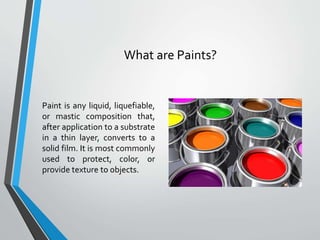
Paint is any liquid, liquefiable,
or mastic composition that,
after application to a substrate
in a thin layer, converts to a
solid film. It is most commonly
used to protect, color, or
provide texture to objects.
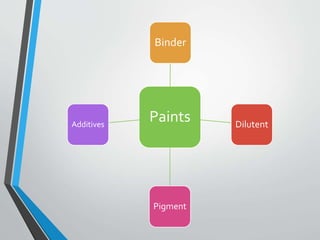
Paints
Binder
Dilutent
Pigment
Additives
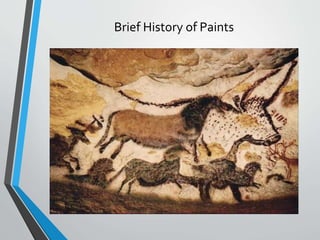
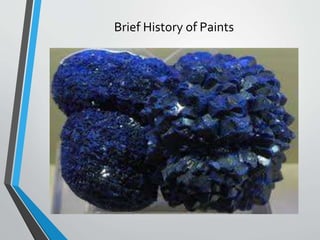
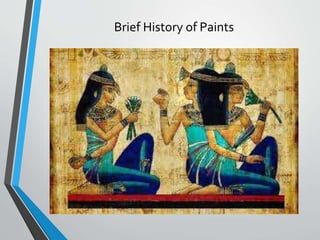
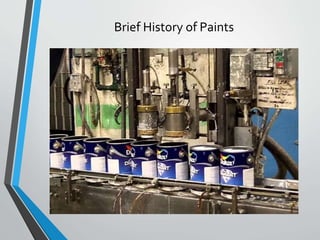
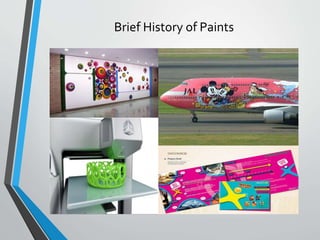
Brief History of Paints
Hmm!! Paints were Interesting!!!
Here comes the role of
PIGMENTS
But how something like paints or polymers get different
colours???
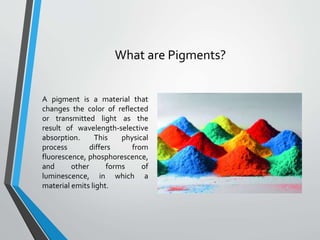
What are Pigments?
A pigment is a material that
changes the color of reflected
or transmitted light as the
result of wavelength-selective
absorption. This physical
process differs from
fluorescence, phosphorescence,
and other forms of
luminescence, in which a
material emits light.
Pigments for Polymers
• A pigment is a finely-divided solid which is essentially insoluble in
its polymeric application medium.
• Pigments are incorporated by a dispersion process into the polymer
while it is in a liquid phase
• After the polymer solidifies, the dispersed pigment particles are
retained physically within the solid polymer matrix
Why Pigments?
• Main reason to incorporate pigments into polymers is to introduce
colour
• The introduction of colour might be for aesthetic reasons, market
appeal or because of functional demand
• Pigments also control optical properties of polymers which include
transparency, opacity, reflectance etc.
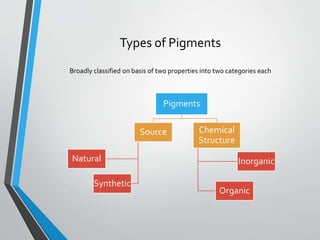
Types of Pigments
Broadly classified on basis of two properties into two categories each
Pigments
Source
Natural
Synthetic
Chemical
Structure
Organic
Inorganic
Properties to be taken care of while selecting
Pigments for Polymers
• ProcessingTemperature
• Dispersion method
• Resin type
• Dimensional stability
• Heat stability:A careful choice of inorganic and organic pigments from
the view point of temperature is vital for maximizing color and
performance
• Gloss
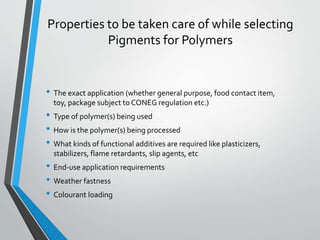
Properties to be taken care of while selecting
Pigments for Polymers
• The exact application (whether general purpose, food contact item,
toy, package subject to CONEG regulation etc.)
• Type of polymer(s) being used
• How is the polymer(s) being processed
• What kinds of functional additives are required like plasticizers,
stabilizers, flame retardants, slip agents, etc
• End-use application requirements
• Weather fastness
• Colourant loading
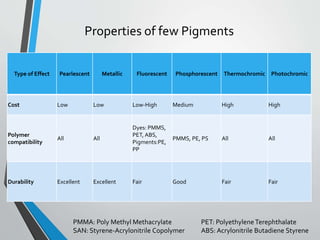
Properties of few Pigments
Type of Effect Pearlescent Metallic Fluorescent Phosphorescent Thermochromic Photochromic
Cost Low Low Low-High Medium High High
Polymer
compatibility
All All
Dyes: PMMS,
PET, ABS,
Pigments:PE,
PP
PMMS, PE, PS All All
Durability Excellent Excellent Fair Good Fair Fair
PMMA: Poly Methyl Methacrylate PET: PolyethyleneTerephthalate
SAN: Styrene-Acrylonitrile Copolymer ABS: Acrylonitrile Butadiene Styrene
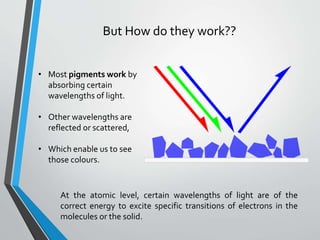
But How do they work??
• Most pigments work by
absorbing certain
wavelengths of light.
• Other wavelengths are
reflected or scattered,
• Which enable us to see
those colours.
At the atomic level, certain wavelengths of light are of the
correct energy to excite specific transitions of electrons in the
molecules or the solid.
CASE STUDY
Organic pigments encapsulated with
VinylPyrrolidone Polymer
n-Vinylpyrrolidone
11] 3,904,562 ORGANIC PIGMENTS ENCAPSULATEDWITHVINYLPYRROLIDONE POLYMER
[75] Inventors: Harold B. Hopfenberg, Raleigh,NC;Thomas C. Rees, Park Forest South, 111.[73]
Assignee:TheSherwin-Williams Company,Cleveland, Ohio [22] Filed: [21]App]. No.: 328,201
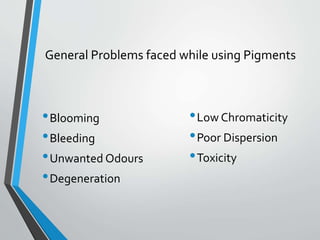
General Problems faced while using Pigments
•Blooming
•Bleeding
•Unwanted Odours
•Degeneration
•Low Chromaticity
•Poor Dispersion
•Toxicity
These kind of surface generated problems
can be solved using techniques like coating
the surface with some organic polymer of
desirable properties.
SOLUTION??
Summary of Invention
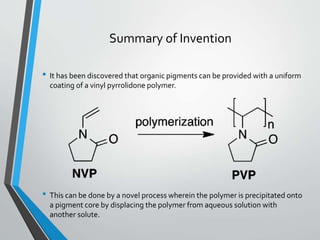
• It has been discovered that organic pigments can be provided with a uniform
coating of a vinyl pyrrolidone polymer.
• This can be done by a novel process wherein the polymer is precipitated onto
a pigment core by displacing the polymer from aqueous solution with
another solute.
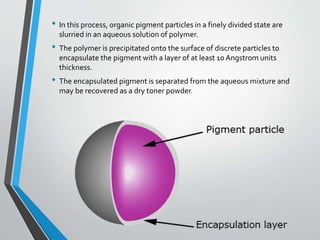
• In this process, organic pigment particles in a finely divided state are
slurried in an aqueous solution of polymer.
• The polymer is precipitated onto the surface of discrete particles to
encapsulate the pigment with a layer of at least 10 Angstrom units
thickness.
• The encapsulated pigment is separated from the aqueous mixture and
may be recovered as a dry toner powder.
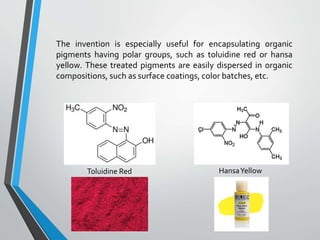
The invention is especially useful for encapsulating organic
pigments having polar groups, such as toluidine red or hansa
yellow. These treated pigments are easily dispersed in organic
compositions, such as surface coatings, color batches, etc.
Toluidine Red HansaYellow
• An encapsulated pigment is prepared which consists essentially of a solid
core or colored organic pigment and an outer layer of a transparent vinyl
pyrrolidone polymer deposited on the core.
• The pigment core particle size ~ 0.1 to 10 microns
• The outer layer thickness < 0.1
• Average thickness ~ 1.6 microns
• On a weight ratio basis, the amount of polymer may be from about 5 to
parts per 100 parts core pigment.
• For most purposes an outer layer of polymer of about 20 to 50% by weight
of the pigment core is suitable.
• In general, the vinyl pyrrolidone polymers used in the precipitation process
are those water soluble linear addition polymers containing at least 90
percent repeating units of the structure
• The vinyl pyrrolidone monomer may be copolymerized with a minor
amount of an ethylenically unsaturated compound, in particular, the acrylic
esters, such as stearyl acrylate or hydroxy-substituted alkyl esters of acrylic
acids.
• Best results are obtained when the molecular weight of the polymer is at
least about 300,000.
• The vinyl pyrrolidone polymers are highly impermeable to and substantially
insoluble in organic solvents used in protective and decorative coatings,
such as aromatic, aliphatic and alicyclic hydrocarbons.
• Most organic coating vehicles have a refractive index of about 1.5, which is
closely matched by the colorless polymer coating.This preserves the color
value of the pigment core.
Why vinyl pyrrolidone??
Experiment withToluidine Red
• Weight of toluidine red pigment = 25 grams
• Weight of water = 58.9 grams
• Dispersed with a high shear blender in a solution of 25 grams poly (N-vinyl-
Z pyrrolidone) in 600 grams of water.
• Average molecular weight of polymer = 360,000.
• To the dispersed mixture is added 200 ml. aqueous sodium sulphate
solution 17% at a rate of about 5 mL/minute for the first ml. and 2
mL/minute for the last ml.
• The resulting dispersion is stirred for 10 minutes and permitted to settle
before separating the water by decanting.
• The product is dispersed in 200 grams of acetone, filtered and dried.
• After light grinding or crushing, the product is a free-flowing powder of
discrete particles having a continuous coating of polymer on the pigment
core.
• The toluidine red pigment core is about 45% of the composite pigment.
Result
•The encapsulated pigment is compared with
untreated toluidine red for solvent resistance.
•The untreated pigment dissolves completely in
excess xylene; however, the encapsulated pigment,
when placed in the same excess of xylene, colored
the solvent, but undissolved particles remained after
more than months in contact with the larger
amount of xylene.
Conclusion
• Pigments play very important role all around us.
• They fill colours in our world, form green colour of leaves to red colours of
precious rubies.
• There is lot of advancement in pigment and polymer technology and a lot is
yet to come.
Sources
• http://www.google.com/patents/US3904562
• Paints and Pigments : http://nzic.org.nz/ChemProcesses/polymers/10D.pdf
• https://scholar.google.co.in/
• https://en.wikipedia.org/wiki/Pigment
• Polymer Additive Analytics:
https://books.google.co.in/books?isbn=8884533791
Thank you
Any Question??

Paints and pigments

  • 1.
    Paints and Pigments FillingColorsinto the World -by Kshitij Mohan Agarwal
  • 2.
  • 3.
    What are Paints? Paintis any liquid, liquefiable, or mastic composition that, after application to a substrate in a thin layer, converts to a solid film. It is most commonly used to protect, color, or provide texture to objects.
  • 4.
  • 5.
  • 6.
  • 7.
  • 8.
  • 9.
  • 10.
  • 12.
    Hmm!! Paints wereInteresting!!! Here comes the role of PIGMENTS But how something like paints or polymers get different colours???
  • 13.
    What are Pigments? Apigment is a material that changes the color of reflected or transmitted light as the result of wavelength-selective absorption. This physical process differs from fluorescence, phosphorescence, and other forms of luminescence, in which a material emits light.
  • 14.
    Pigments for Polymers •A pigment is a finely-divided solid which is essentially insoluble in its polymeric application medium. • Pigments are incorporated by a dispersion process into the polymer while it is in a liquid phase • After the polymer solidifies, the dispersed pigment particles are retained physically within the solid polymer matrix
  • 15.
    Why Pigments? • Mainreason to incorporate pigments into polymers is to introduce colour • The introduction of colour might be for aesthetic reasons, market appeal or because of functional demand • Pigments also control optical properties of polymers which include transparency, opacity, reflectance etc.
  • 16.
    Types of Pigments Broadlyclassified on basis of two properties into two categories each Pigments Source Natural Synthetic Chemical Structure Organic Inorganic
  • 17.
    Properties to betaken care of while selecting Pigments for Polymers • ProcessingTemperature • Dispersion method • Resin type • Dimensional stability • Heat stability:A careful choice of inorganic and organic pigments from the view point of temperature is vital for maximizing color and performance • Gloss
  • 18.
    Properties to betaken care of while selecting Pigments for Polymers • The exact application (whether general purpose, food contact item, toy, package subject to CONEG regulation etc.) • Type of polymer(s) being used • How is the polymer(s) being processed • What kinds of functional additives are required like plasticizers, stabilizers, flame retardants, slip agents, etc • End-use application requirements • Weather fastness • Colourant loading
  • 19.
    Properties of fewPigments Type of Effect Pearlescent Metallic Fluorescent Phosphorescent Thermochromic Photochromic Cost Low Low Low-High Medium High High Polymer compatibility All All Dyes: PMMS, PET, ABS, Pigments:PE, PP PMMS, PE, PS All All Durability Excellent Excellent Fair Good Fair Fair PMMA: Poly Methyl Methacrylate PET: PolyethyleneTerephthalate SAN: Styrene-Acrylonitrile Copolymer ABS: Acrylonitrile Butadiene Styrene
  • 20.
    But How dothey work?? • Most pigments work by absorbing certain wavelengths of light. • Other wavelengths are reflected or scattered, • Which enable us to see those colours. At the atomic level, certain wavelengths of light are of the correct energy to excite specific transitions of electrons in the molecules or the solid.
  • 21.
    CASE STUDY Organic pigmentsencapsulated with VinylPyrrolidone Polymer n-Vinylpyrrolidone 11] 3,904,562 ORGANIC PIGMENTS ENCAPSULATEDWITHVINYLPYRROLIDONE POLYMER [75] Inventors: Harold B. Hopfenberg, Raleigh,NC;Thomas C. Rees, Park Forest South, 111.[73] Assignee:TheSherwin-Williams Company,Cleveland, Ohio [22] Filed: [21]App]. No.: 328,201
  • 22.
    General Problems facedwhile using Pigments •Blooming •Bleeding •Unwanted Odours •Degeneration •Low Chromaticity •Poor Dispersion •Toxicity
  • 23.
    These kind ofsurface generated problems can be solved using techniques like coating the surface with some organic polymer of desirable properties. SOLUTION??
  • 24.
    Summary of Invention •It has been discovered that organic pigments can be provided with a uniform coating of a vinyl pyrrolidone polymer. • This can be done by a novel process wherein the polymer is precipitated onto a pigment core by displacing the polymer from aqueous solution with another solute.
  • 25.
    • In thisprocess, organic pigment particles in a finely divided state are slurried in an aqueous solution of polymer. • The polymer is precipitated onto the surface of discrete particles to encapsulate the pigment with a layer of at least 10 Angstrom units thickness. • The encapsulated pigment is separated from the aqueous mixture and may be recovered as a dry toner powder.
  • 26.
    The invention isespecially useful for encapsulating organic pigments having polar groups, such as toluidine red or hansa yellow. These treated pigments are easily dispersed in organic compositions, such as surface coatings, color batches, etc. Toluidine Red HansaYellow
  • 27.
    • An encapsulatedpigment is prepared which consists essentially of a solid core or colored organic pigment and an outer layer of a transparent vinyl pyrrolidone polymer deposited on the core. • The pigment core particle size ~ 0.1 to 10 microns • The outer layer thickness < 0.1 • Average thickness ~ 1.6 microns • On a weight ratio basis, the amount of polymer may be from about 5 to parts per 100 parts core pigment. • For most purposes an outer layer of polymer of about 20 to 50% by weight of the pigment core is suitable.
  • 28.
    • In general,the vinyl pyrrolidone polymers used in the precipitation process are those water soluble linear addition polymers containing at least 90 percent repeating units of the structure • The vinyl pyrrolidone monomer may be copolymerized with a minor amount of an ethylenically unsaturated compound, in particular, the acrylic esters, such as stearyl acrylate or hydroxy-substituted alkyl esters of acrylic acids. • Best results are obtained when the molecular weight of the polymer is at least about 300,000. • The vinyl pyrrolidone polymers are highly impermeable to and substantially insoluble in organic solvents used in protective and decorative coatings, such as aromatic, aliphatic and alicyclic hydrocarbons. • Most organic coating vehicles have a refractive index of about 1.5, which is closely matched by the colorless polymer coating.This preserves the color value of the pigment core. Why vinyl pyrrolidone??
  • 29.
    Experiment withToluidine Red •Weight of toluidine red pigment = 25 grams • Weight of water = 58.9 grams • Dispersed with a high shear blender in a solution of 25 grams poly (N-vinyl- Z pyrrolidone) in 600 grams of water. • Average molecular weight of polymer = 360,000. • To the dispersed mixture is added 200 ml. aqueous sodium sulphate solution 17% at a rate of about 5 mL/minute for the first ml. and 2 mL/minute for the last ml. • The resulting dispersion is stirred for 10 minutes and permitted to settle before separating the water by decanting. • The product is dispersed in 200 grams of acetone, filtered and dried. • After light grinding or crushing, the product is a free-flowing powder of discrete particles having a continuous coating of polymer on the pigment core. • The toluidine red pigment core is about 45% of the composite pigment.
  • 30.
    Result •The encapsulated pigmentis compared with untreated toluidine red for solvent resistance. •The untreated pigment dissolves completely in excess xylene; however, the encapsulated pigment, when placed in the same excess of xylene, colored the solvent, but undissolved particles remained after more than months in contact with the larger amount of xylene.
  • 31.
    Conclusion • Pigments playvery important role all around us. • They fill colours in our world, form green colour of leaves to red colours of precious rubies. • There is lot of advancement in pigment and polymer technology and a lot is yet to come.
  • 32.
    Sources • http://www.google.com/patents/US3904562 • Paintsand Pigments : http://nzic.org.nz/ChemProcesses/polymers/10D.pdf • https://scholar.google.co.in/ • https://en.wikipedia.org/wiki/Pigment • Polymer Additive Analytics: https://books.google.co.in/books?isbn=8884533791
  • 33.