

ED/ECE 236 Music & Movement Chapter 3 Pica Chapter 3 Edwards
Pica Chapter 3 Child Development Characteristics and their Impact on the Movement Program   Developmental Appropriateness – DAP  Age appropriate Individually appropriate Also: Culturally appropriate
Child Development- Infants Early movement experiences optimize brain development Prime time/window of opportunity is prenatal to age 5 Infant’s movement capabilities change rapidly Need the basics:  Domains IMPLICATIONS? Cognitive Affective Motor
Child Development - Toddlers More mobile, motor skills rapidly emerging, but limited in ability Short attention spans, constant motion, high energy levels Move quickly, make adjustments during motor activities, no more than 20-30 minutes long Moves from solitary to parallel play Domains IMPLICATIONS? Cognitive Affective Motor
Child Development - Preschoolers Control over body develops head to toe Attention span increases, interested in academics, still not ready to sit and learn Associative play at age 3 Cooperative play at age 4-5 Domains IMPLICATIONS? Cognitive Affective Motor
Motor Development Ages/stages Chart – pg 77
Early Elementary Development Often all elementary children are treated similarly in public schools Active learning is less available Opportunities for social development are lessened Learning depth perception Hand-eye/foot-eye coordination not developed Tire suddenly, recover quickly Girls are ahead of boys  Boys and girls share interests, but diverge in later elementary school Self-consciousness becomes a factor
Early Elementary Development Cognitive Development Affective Development Motor Development IMPLICATIONS?
Children with Special Needs Additional challenges Help self-concept Be part of a group Be sure all can participate in some way Adapt activities if needed  IEP
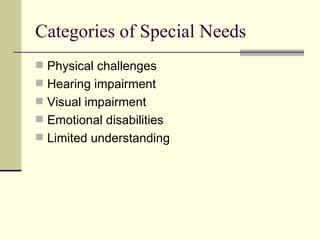
Categories of Special Needs Physical challenges Hearing impairment Visual impairment Emotional disabilities Limited understanding

Pica Chapter 3

  • 1.
    ED/ECE 236 Music& Movement Chapter 3 Pica Chapter 3 Edwards
  • 2.
    Pica Chapter 3Child Development Characteristics and their Impact on the Movement Program Developmental Appropriateness – DAP Age appropriate Individually appropriate Also: Culturally appropriate
  • 3.
    Child Development- InfantsEarly movement experiences optimize brain development Prime time/window of opportunity is prenatal to age 5 Infant’s movement capabilities change rapidly Need the basics: Domains IMPLICATIONS? Cognitive Affective Motor
  • 4.
    Child Development -Toddlers More mobile, motor skills rapidly emerging, but limited in ability Short attention spans, constant motion, high energy levels Move quickly, make adjustments during motor activities, no more than 20-30 minutes long Moves from solitary to parallel play Domains IMPLICATIONS? Cognitive Affective Motor
  • 5.
    Child Development -Preschoolers Control over body develops head to toe Attention span increases, interested in academics, still not ready to sit and learn Associative play at age 3 Cooperative play at age 4-5 Domains IMPLICATIONS? Cognitive Affective Motor
  • 6.
  • 7.
    Early Elementary DevelopmentOften all elementary children are treated similarly in public schools Active learning is less available Opportunities for social development are lessened Learning depth perception Hand-eye/foot-eye coordination not developed Tire suddenly, recover quickly Girls are ahead of boys Boys and girls share interests, but diverge in later elementary school Self-consciousness becomes a factor
  • 8.
    Early Elementary DevelopmentCognitive Development Affective Development Motor Development IMPLICATIONS?
  • 9.
    Children with SpecialNeeds Additional challenges Help self-concept Be part of a group Be sure all can participate in some way Adapt activities if needed IEP
  • 10.
    Categories of SpecialNeeds Physical challenges Hearing impairment Visual impairment Emotional disabilities Limited understanding