Old Enough to
    Discriminate
When Differences and Sameness
           Matter
        Toniea Harrison
       SP D 6263/
         E      6268
What is this developmental outcome?

    Following Piagetian theory, children gain the ability to group
    objects in a simple fashion, according to similarities and exclude
    objects not fitting the group. 13


 Click me!
What is this developmental outcome?

    Following Piagetian theory, children gain the ability to group
    objects according to similarities and exclude objects not fitting the
    group


 Look here!


                                                     11
What is this developmental outcome?
           Concrete (“J the facts”) Grouping
                       ust
 ~ Ages 7 -11
 
     During the concrete operational stage, logical reasoning
     replaces the intuitive, child-centered (egocentric) thinking of
     the preoperational stage.
 
     Categorization is according to concrete details only (not
     philosophical concepts like good or bad). 16
What is this developmental outcome?
 
     Inductive reasoning is in action, pulling information from the
     environment to build one's own understanding.
 
     Children are able to see objectively, and, noticing facets of
     objects, learn basic ways of grouping them together according
     to discriminatory properties (e.g. red vs. blue, two legs vs. four
     legs). 12
What is this developmental outcome?
 
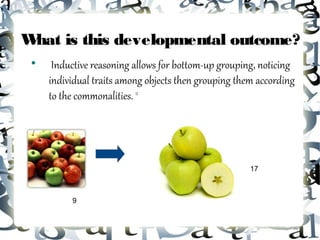
      Inductive reasoning allows for bottom-up grouping, noticing
     individual traits among objects then grouping them according
     to the commonalities. 12


                                                      17


          9
What is this developmental outcome?
 
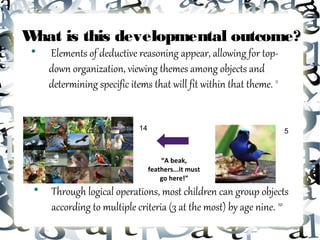
     Elements of deductive reasoning appear, allowing for top-
     down organization, viewing themes among objects and
     determining specific items that will fit within that theme. 12


                             14                                       5


                                      “A beak,
                                  feathers...it must
                                      go here!”
 
     Through logical operations, most children can group objects
     according to multiple criteria (3 at the most) by age nine. 10
H Does T H
                 ow     his elp?

    Developmentally, acquiring this ability allows a child to better
    understand his or her environment.

    Cognitively, discrimination of objects within the environment sets
    the stage for organizing information that is more abstract in
    nature.

    The ability to separate a dog from a wolf or, eventually, good from
    evil, is not only a cognitive exercise but a matter of safety or a factor
    in determining one's social group. 2
Typical Developmental Trajectory:
                Variability and Influences

     The ability to discriminate is theorized to occur within a particular
    period of development, though biological and situational influences
    can cause this ability to arise sooner or later than predicted. 2
Typical Developmental Trajectory:
                   Variability and Influences

    As cognition and environmental exposure are key facets to attaining
    this achievement, quality of education and parental intellectual
    background are relevant to its development. 2

    As is the caregiver's tolerance for a child's exploration of his or her
    surroundings. Societies premised on living reclusively would expose
    their children to different or less varied experiences than groups
    outside of this culture. 7
Typical Developmental Trajectory:
                   Variability and Influences
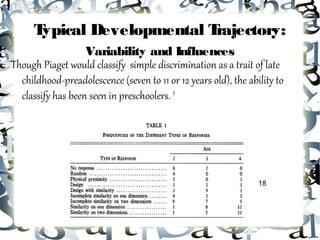
Though Piaget would classify simple discrimination as a trait of late
  childhood-preadolescence (seven to 11 or 12 years old), the ability to
  classify has been seen in preschoolers. 8


                                                                 18
Typical Developmental Trajectory:
                        Variability and Influences

    Though categorizing according to abstract rationales is not a skill
    Piaget considers to be accessible prior to the Formal Operations stage
    of thinking, age 12 and beyond, the capacity to do so can emerge in the
    fourth grade. 1, 13

    Even starting in second grade, children may group objects according to
    symbolic meaning more so than by superficial data, such as shape and
    color. 13
In the Atypically Developing Child...

    It must be noted that skills of cognition, including language, and
    perception are vital to discrimination. 15
          −    So, impairments in these and other areas will impact a child's
               capacity to categorize.

    For similar, even more foundational skills along Piaget's timeline of
    cognitive development, youth with intellectual or physical disabilities
    including blindness, and autism progress at a slower rate than children
    without a disability. The case is the same for discrimination. 4
In the Atypically Developing Child...

    Sensory impairments, such as Usher syndrome, can impact the
    ability to take in information from one's surroundings.
      −   Interestingly, sensory impairments have been found to occur
          more often in people with intellectual disability.

    Psychiatric impairments can inhibit an accurate perspective of the
    environment due to interference from mood, emotional and
    behavioral dysregulation, or psychotic features. 6
In the Atypically Developing Child...

     Youth with low intelligence and poor expressive or receptive language,
     also likely associated with having a psychiatric disorder.

     Visual and hearing impairments commonly occur among persons with
     psychiatric disorders that distort perception of the environment. 6

     Cerebral palsy, for example, is a disorder that can contain all of the
     above impairments, being a cluster of disorders affecting movement and
     posture, but also sensory input, perception, cognitive impairment,
     communication, and behavior. 3
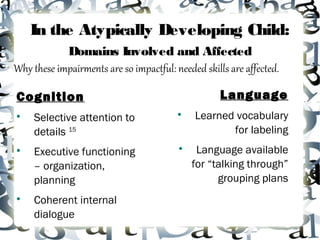
In the Atypically Developing Child:
            Domains Involved and Affected
Why these impairments are so impactful: needed skills are affected.

Cognition                                           Language

     Selective attention to              
                                             Learned vocabulary
     details 15                                     for labeling

     Executive functioning               
                                              Language available
     – organization,                         for “talking through”
     planning                                      grouping plans

     Coherent internal
     dialogue
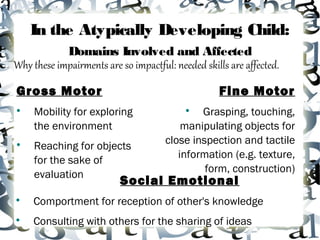
In the Atypically Developing Child:
            Domains Involved and Affected
Why these impairments are so impactful: needed skills are affected.

Gross Motor                                        Fine Motor

     Mobility for exploring                
                                              Grasping, touching,
     the environment                      manipulating objects for
                                      close inspection and tactile

     Reaching for objects
                                         information (e.g. texture,
     for the sake of
                                               form, construction)
     evaluation
                          Social Emotional

    Comportment for reception of other's knowledge

    Consulting with others for the sharing of ideas
Helping the Atypically Developing
Interventions at home and at school...
                              Child
                             Cognitive & Language
                 To enhance perceptual, organization and verbal skills
 
     Repeated and regular instruction w/ naming and grouping exercises 4
 
     Encourage visual attention
 
     Reinforcement to encourage skills training
 
     Hearing aids, glasses
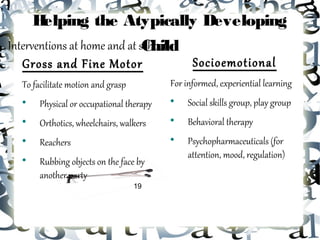
Helping the Atypically Developing
Interventions at home and at school...
                              Child
   Gross and Fine Motor                Socioemotional
  To facilitate motion and grasp          For informed, experiential learning
  
       Physical or occupational therapy   
                                               Social skills group, play group
  
       Orthotics, wheelchairs, walkers    
                                               Behavioral therapy
  
       Reachers                           
                                               Psychopharmaceuticals (for
                                               attention, mood, regulation)
  
       Rubbing objects on the face by
       another party
                                   19
Consider cross-application!
    These tools are not cure-alls and can be
 implemented for causes other than prescribed
(e.g. assisting the visually impaired with tactile
exploration, not just the motorically impaired).

               B creative!
                e
References
1. Abkarian, G. G. (1987). Object grouping in children: A revised look at the iconic-symbolic approach.
         Journal of Psychoeducational Assessment, 5(2), 166-177.
2. Berk, L.E. (2008). Infants and children: Prenatal through middle childhood (6th ed.). Boston, MA:
         Pearson Education, Inc.
3. Bottcher, L. (2010). Children with spastic cerebral palsy, their cognitive functioning, and social
         participation: A review. Child Neuropsychology: A Journal on Normal and Abnormal Development
in
      Childhood and Adolescence, 16(3), 209-228.
4. Bruce, S., & Muhammad, Z. (2009). The development of object permanence in children with
         intellectual disability, physical disability, autism, and blindness. International Journal Of
Disability,
      Development & Education, 56(3), 229-246.
5. Calderón-Franco, D. (2010). Red-legged-honeycreeper [Photograph]. Retrieved December 1, 2012
         from http://www.colombiabirding.com/pacificchocolowlands.php
6. Carvill, S. (2001). Sensory impairments, intellectual disability and psychiatry. Journal of Intellectual
         Disability Research, 45(6), 467-483.
7. Chikova, L. (2010, March 7). Ways of a reclusive people. The Herald. Retrieved from
         http://www.herald.co.zw/
8. Denney, N.W. (1972). Free classification in preschool children. Child Development, 43(4), 1161-1170.
9. DiIorio Farms & Roadside Market. (2012). [Untitled photograph of a bushel of apples]. Retrieved
         December 1, 2012 from http://www.diioriofarms.com/whats-in-season.html
10. Fogelman, K.R. (1970). Piagetian tests for the primary school. London: National Foundation for
         Educational Research.
11. freetutorinfo. (2010, April 13). How can objects be sorted? K2 math education kids educational video
         [Video file]. Retrieved from http://www.youtube.com/watch?v=xfO1YIyh0o0&feature
         =share&list=PLC4C229BBC94A50C0
12. Gyr, J.W., Brown, J.S., & Cafagna, A.C. (1967). Quasi-formal models of inductive behavior and their
         relation to piaget's theory of cognitive stages. Psychological Review, 74(4), 272-289.
References
13. Mooney, C.G. (2000b). Chapter 5: Jean Piaget. In Theories of childhood: An introduction to Dewey,
         Montessori, Erikson, Piaget & Vygotsky (pp. 59-80). St. Paul, MN: Redleaf Press.
14. Photo Screensavers. (n.d.). Birds photo screensaver 2.0 [Computerized image]. Retrieved
         December 1, 2012 from
         http://www.handyarchive.com/Desktop/Screensavers/76673-Birds-Photo-Screensaver.html
15. Riley, N. (1989). Piagetian cognitive functioning in students with learning disabilities. Journal Of
         Learning Disabilities, 22(7), 444-451.
16. Santrock, J.W. (2005). Chapter 4: Cognitive development. In Adolescence (10th ed.) (pp. 104-143).
         Boston, MA: McGraw-Hill Companies.
17. Specialty Produce. (2012). [Untitled photograph of a golden delicious apples]. Retrieved

         December 1, 2012 from
         http://www.specialtyproduce.com/produce/Golden_Delicious_Apples_120.php
18. Table 1: Frequencies of the different types of responses. Reprinted from “Free classification
         in preschool children,” by N.W. Denney, 1972, Child Development, 43(4), 1164. Copyright

        1972 by Nancy Wadsworth Denney.
19. The New Professional Series [Photograph]. (2006). Retrieved December 1, 2012 from
        http://www.prweb.com/releases/2006/06/prweb389125.htm


                                T end
                                 he
DO Pres

DO Pres

  • 1.
    Old Enough to Discriminate When Differences and Sameness Matter Toniea Harrison SP D 6263/ E 6268
  • 2.
    What is thisdevelopmental outcome?  Following Piagetian theory, children gain the ability to group objects in a simple fashion, according to similarities and exclude objects not fitting the group. 13 Click me!
  • 3.
    What is thisdevelopmental outcome?  Following Piagetian theory, children gain the ability to group objects according to similarities and exclude objects not fitting the group Look here! 11
  • 4.
    What is thisdevelopmental outcome? Concrete (“J the facts”) Grouping ust ~ Ages 7 -11  During the concrete operational stage, logical reasoning replaces the intuitive, child-centered (egocentric) thinking of the preoperational stage.  Categorization is according to concrete details only (not philosophical concepts like good or bad). 16
  • 5.
    What is thisdevelopmental outcome?  Inductive reasoning is in action, pulling information from the environment to build one's own understanding.  Children are able to see objectively, and, noticing facets of objects, learn basic ways of grouping them together according to discriminatory properties (e.g. red vs. blue, two legs vs. four legs). 12
  • 6.
    What is thisdevelopmental outcome?  Inductive reasoning allows for bottom-up grouping, noticing individual traits among objects then grouping them according to the commonalities. 12 17 9
  • 7.
    What is thisdevelopmental outcome?  Elements of deductive reasoning appear, allowing for top- down organization, viewing themes among objects and determining specific items that will fit within that theme. 12 14 5 “A beak, feathers...it must go here!”  Through logical operations, most children can group objects according to multiple criteria (3 at the most) by age nine. 10
  • 8.
    H Does TH ow his elp?  Developmentally, acquiring this ability allows a child to better understand his or her environment.  Cognitively, discrimination of objects within the environment sets the stage for organizing information that is more abstract in nature.  The ability to separate a dog from a wolf or, eventually, good from evil, is not only a cognitive exercise but a matter of safety or a factor in determining one's social group. 2
  • 9.
    Typical Developmental Trajectory: Variability and Influences  The ability to discriminate is theorized to occur within a particular period of development, though biological and situational influences can cause this ability to arise sooner or later than predicted. 2
  • 10.
    Typical Developmental Trajectory: Variability and Influences  As cognition and environmental exposure are key facets to attaining this achievement, quality of education and parental intellectual background are relevant to its development. 2  As is the caregiver's tolerance for a child's exploration of his or her surroundings. Societies premised on living reclusively would expose their children to different or less varied experiences than groups outside of this culture. 7
  • 11.
    Typical Developmental Trajectory: Variability and Influences Though Piaget would classify simple discrimination as a trait of late childhood-preadolescence (seven to 11 or 12 years old), the ability to classify has been seen in preschoolers. 8 18
  • 12.
    Typical Developmental Trajectory: Variability and Influences  Though categorizing according to abstract rationales is not a skill Piaget considers to be accessible prior to the Formal Operations stage of thinking, age 12 and beyond, the capacity to do so can emerge in the fourth grade. 1, 13  Even starting in second grade, children may group objects according to symbolic meaning more so than by superficial data, such as shape and color. 13
  • 13.
    In the AtypicallyDeveloping Child...  It must be noted that skills of cognition, including language, and perception are vital to discrimination. 15 − So, impairments in these and other areas will impact a child's capacity to categorize.  For similar, even more foundational skills along Piaget's timeline of cognitive development, youth with intellectual or physical disabilities including blindness, and autism progress at a slower rate than children without a disability. The case is the same for discrimination. 4
  • 14.
    In the AtypicallyDeveloping Child...  Sensory impairments, such as Usher syndrome, can impact the ability to take in information from one's surroundings. − Interestingly, sensory impairments have been found to occur more often in people with intellectual disability.  Psychiatric impairments can inhibit an accurate perspective of the environment due to interference from mood, emotional and behavioral dysregulation, or psychotic features. 6
  • 15.
    In the AtypicallyDeveloping Child...  Youth with low intelligence and poor expressive or receptive language, also likely associated with having a psychiatric disorder.  Visual and hearing impairments commonly occur among persons with psychiatric disorders that distort perception of the environment. 6  Cerebral palsy, for example, is a disorder that can contain all of the above impairments, being a cluster of disorders affecting movement and posture, but also sensory input, perception, cognitive impairment, communication, and behavior. 3
  • 16.
    In the AtypicallyDeveloping Child: Domains Involved and Affected Why these impairments are so impactful: needed skills are affected. Cognition Language  Selective attention to  Learned vocabulary details 15 for labeling  Executive functioning  Language available – organization, for “talking through” planning grouping plans  Coherent internal dialogue
  • 17.
    In the AtypicallyDeveloping Child: Domains Involved and Affected Why these impairments are so impactful: needed skills are affected. Gross Motor Fine Motor  Mobility for exploring  Grasping, touching, the environment manipulating objects for close inspection and tactile  Reaching for objects information (e.g. texture, for the sake of form, construction) evaluation Social Emotional  Comportment for reception of other's knowledge  Consulting with others for the sharing of ideas
  • 18.
    Helping the AtypicallyDeveloping Interventions at home and at school... Child Cognitive & Language To enhance perceptual, organization and verbal skills  Repeated and regular instruction w/ naming and grouping exercises 4  Encourage visual attention  Reinforcement to encourage skills training  Hearing aids, glasses
  • 19.
    Helping the AtypicallyDeveloping Interventions at home and at school... Child Gross and Fine Motor Socioemotional To facilitate motion and grasp For informed, experiential learning  Physical or occupational therapy  Social skills group, play group  Orthotics, wheelchairs, walkers  Behavioral therapy  Reachers  Psychopharmaceuticals (for attention, mood, regulation)  Rubbing objects on the face by another party 19
  • 20.
    Consider cross-application! These tools are not cure-alls and can be implemented for causes other than prescribed (e.g. assisting the visually impaired with tactile exploration, not just the motorically impaired). B creative! e
  • 21.
    References 1. Abkarian, G.G. (1987). Object grouping in children: A revised look at the iconic-symbolic approach. Journal of Psychoeducational Assessment, 5(2), 166-177. 2. Berk, L.E. (2008). Infants and children: Prenatal through middle childhood (6th ed.). Boston, MA: Pearson Education, Inc. 3. Bottcher, L. (2010). Children with spastic cerebral palsy, their cognitive functioning, and social participation: A review. Child Neuropsychology: A Journal on Normal and Abnormal Development in Childhood and Adolescence, 16(3), 209-228. 4. Bruce, S., & Muhammad, Z. (2009). The development of object permanence in children with intellectual disability, physical disability, autism, and blindness. International Journal Of Disability, Development & Education, 56(3), 229-246. 5. Calderón-Franco, D. (2010). Red-legged-honeycreeper [Photograph]. Retrieved December 1, 2012 from http://www.colombiabirding.com/pacificchocolowlands.php 6. Carvill, S. (2001). Sensory impairments, intellectual disability and psychiatry. Journal of Intellectual Disability Research, 45(6), 467-483. 7. Chikova, L. (2010, March 7). Ways of a reclusive people. The Herald. Retrieved from http://www.herald.co.zw/ 8. Denney, N.W. (1972). Free classification in preschool children. Child Development, 43(4), 1161-1170. 9. DiIorio Farms & Roadside Market. (2012). [Untitled photograph of a bushel of apples]. Retrieved December 1, 2012 from http://www.diioriofarms.com/whats-in-season.html 10. Fogelman, K.R. (1970). Piagetian tests for the primary school. London: National Foundation for Educational Research. 11. freetutorinfo. (2010, April 13). How can objects be sorted? K2 math education kids educational video [Video file]. Retrieved from http://www.youtube.com/watch?v=xfO1YIyh0o0&feature =share&list=PLC4C229BBC94A50C0 12. Gyr, J.W., Brown, J.S., & Cafagna, A.C. (1967). Quasi-formal models of inductive behavior and their relation to piaget's theory of cognitive stages. Psychological Review, 74(4), 272-289.
  • 22.
    References 13. Mooney, C.G.(2000b). Chapter 5: Jean Piaget. In Theories of childhood: An introduction to Dewey, Montessori, Erikson, Piaget & Vygotsky (pp. 59-80). St. Paul, MN: Redleaf Press. 14. Photo Screensavers. (n.d.). Birds photo screensaver 2.0 [Computerized image]. Retrieved December 1, 2012 from http://www.handyarchive.com/Desktop/Screensavers/76673-Birds-Photo-Screensaver.html 15. Riley, N. (1989). Piagetian cognitive functioning in students with learning disabilities. Journal Of Learning Disabilities, 22(7), 444-451. 16. Santrock, J.W. (2005). Chapter 4: Cognitive development. In Adolescence (10th ed.) (pp. 104-143). Boston, MA: McGraw-Hill Companies. 17. Specialty Produce. (2012). [Untitled photograph of a golden delicious apples]. Retrieved December 1, 2012 from http://www.specialtyproduce.com/produce/Golden_Delicious_Apples_120.php 18. Table 1: Frequencies of the different types of responses. Reprinted from “Free classification in preschool children,” by N.W. Denney, 1972, Child Development, 43(4), 1164. Copyright 1972 by Nancy Wadsworth Denney. 19. The New Professional Series [Photograph]. (2006). Retrieved December 1, 2012 from http://www.prweb.com/releases/2006/06/prweb389125.htm T end he