Discovering what are the common mistakes about the behavior of a kid during this stage and to avoid the wrong perspective about the actions they make and also to help them to avoid getting a fixations
Piaget's Stages of
CognitiveDevelopment: A
Comprehensive Overview
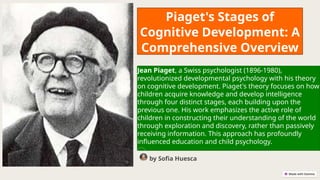
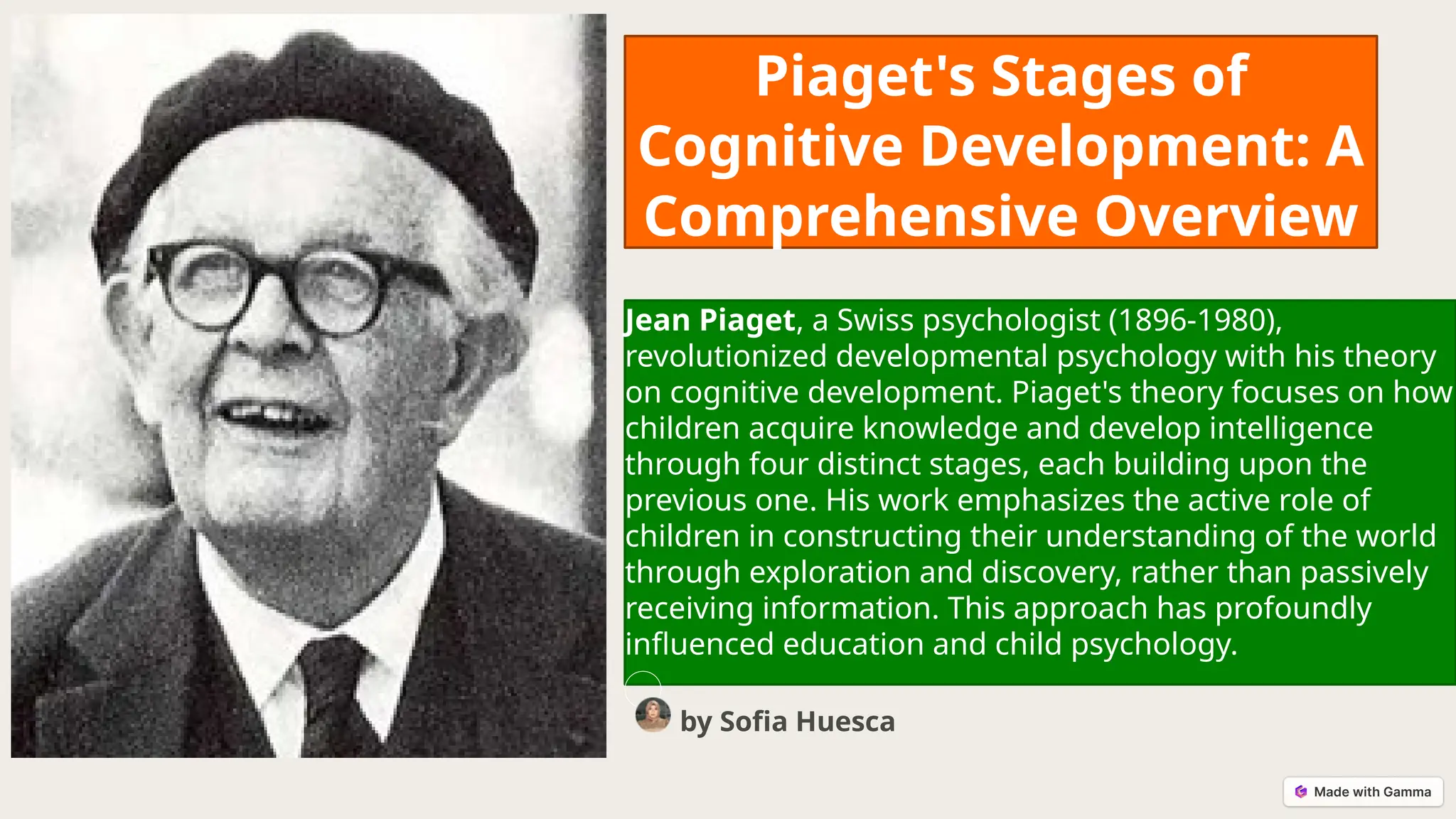
Jean Piaget, a Swiss psychologist (1896-1980),
revolutionized developmental psychology with his theory
on cognitive development. Piaget's theory focuses on how
children acquire knowledge and develop intelligence
through four distinct stages, each building upon the
previous one. His work emphasizes the active role of
children in constructing their understanding of the world
through exploration and discovery, rather than passively
receiving information. This approach has profoundly
influenced education and child psychology.
by Sofia Huesca
2.
Core Concepts: Schemas,Assimilation, and
Accommodation
Piaget's theory is built on several core concepts that explain how children adapt to the
world around them.
Schemas are mental frameworks individuals use to organize and interpret information.
For example, a child's schema for a dog might include four legs, fur, and a tail.
Assimilation involves incorporating new information into existing schemas, like seeing a
new breed of dog and adding it to the dog schema.
Accommodation, on the other hand, requires modifying existing schemas or creating new
ones to fit new information, such as learning that a cat is different from a dog and creating
a new schema for cats.
The process of equilibration involves balancing assimilation and accommodation to
maintain cognitive stability.
3.
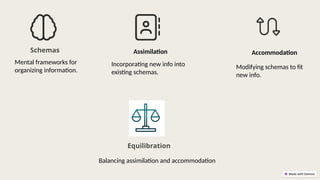
Schemas
Mental frameworks for
organizinginformation.
Assimilation
Incorporating new info into
existing schemas.
Accommodation
Modifying schemas to fit
new info.
Equilibration
Balancing assimilation and accommodation
4.
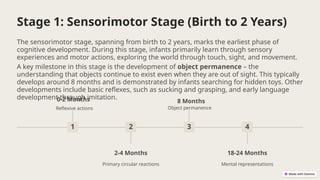
Stage 1: SensorimotorStage (Birth to 2 Years)
The sensorimotor stage, spanning from birth to 2 years, marks the earliest phase of
cognitive development. During this stage, infants primarily learn through sensory
experiences and motor actions, exploring the world through touch, sight, and movement.
A key milestone in this stage is the development of object permanence – the
understanding that objects continue to exist even when they are out of sight. This typically
develops around 8 months and is demonstrated by infants searching for hidden toys. Other
developments include basic reflexes, such as sucking and grasping, and early language
development through imitation.
1
0-2 Months
Reflexive actions
2
2-4 Months
Primary circular reactions
3
8 Months
Object permanence
4
18-24 Months
Mental representations
5.
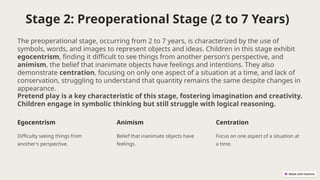
Stage 2: PreoperationalStage (2 to 7 Years)
The preoperational stage, occurring from 2 to 7 years, is characterized by the use of
symbols, words, and images to represent objects and ideas. Children in this stage exhibit
egocentrism, finding it difficult to see things from another person's perspective, and
animism, the belief that inanimate objects have feelings and intentions. They also
demonstrate centration, focusing on only one aspect of a situation at a time, and lack of
conservation, struggling to understand that quantity remains the same despite changes in
appearance.
Pretend play is a key characteristic of this stage, fostering imagination and creativity.
Children engage in symbolic thinking but still struggle with logical reasoning.
Egocentrism
Difficulty seeing things from
another's perspective.
Animism
Belief that inanimate objects have
feelings.
Centration
Focus on one aspect of a situation at
a time.
6.
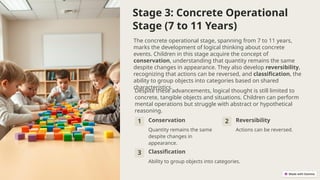
Stage 3: ConcreteOperational
Stage (7 to 11 Years)
The concrete operational stage, spanning from 7 to 11 years,
marks the development of logical thinking about concrete
events. Children in this stage acquire the concept of
conservation, understanding that quantity remains the same
despite changes in appearance. They also develop reversibility,
recognizing that actions can be reversed, and classification, the
ability to group objects into categories based on shared
characteristics.
Despite these advancements, logical thought is still limited to
concrete, tangible objects and situations. Children can perform
mental operations but struggle with abstract or hypothetical
reasoning.
1 Conservation
Quantity remains the same
despite changes in
appearance.
2 Reversibility
Actions can be reversed.
3 Classification
Ability to group objects into categories.
7.
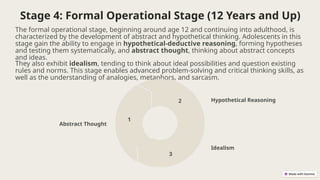
Stage 4: FormalOperational Stage (12 Years and Up)
The formal operational stage, beginning around age 12 and continuing into adulthood, is
characterized by the development of abstract and hypothetical thinking. Adolescents in this
stage gain the ability to engage in hypothetical-deductive reasoning, forming hypotheses
and testing them systematically, and abstract thought, thinking about abstract concepts
and ideas.
They also exhibit idealism, tending to think about ideal possibilities and question existing
rules and norms. This stage enables advanced problem-solving and critical thinking skills, as
well as the understanding of analogies, metaphors, and sarcasm.
Abstract Thought
1
Hypothetical Reasoning
2
Idealism
3
8.
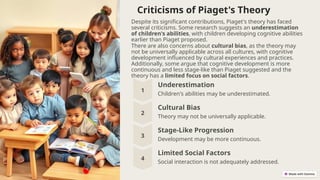
Criticisms of Piaget'sTheory
Despite its significant contributions, Piaget's theory has faced
several criticisms. Some research suggests an underestimation
of children's abilities, with children developing cognitive abilities
earlier than Piaget proposed.
There are also concerns about cultural bias, as the theory may
not be universally applicable across all cultures, with cognitive
development influenced by cultural experiences and practices.
Additionally, some argue that cognitive development is more
continuous and less stage-like than Piaget suggested and the
theory has a limited focus on social factors.
Underestimation
Children's abilities may be underestimated.
Cultural Bias
Theory may not be universally applicable.
Stage-Like Progression
Development may be more continuous.
Limited Social Factors
Social interaction is not adequately addressed.
9.
Impact and Legacyof Piaget's
Theory
Despite its criticisms, Piaget's theory has had a profound impact and
lasting legacy. It provided a foundational framework for understanding
cognitive development, influencing educational practices by
emphasizing active learning and discovery. The theory inspired further
research in developmental psychology and cognitive science,
contributing to our understanding of how children learn and develop.
Piaget's work continues to be a valuable tool for educators and
parents in understanding the cognitive processes of children. His
emphasis on exploration and discovery has shaped modern
educational approaches.
Foundational Framework
Provided a basis for understanding
cognitive development.
Educational Influence
Emphasized active learning and
discovery.
Research Inspiration
Inspired further research in developmental psychology.



![谷歌留痕技术 [ 𝙩𝙤𝙥 𝟮𝟯𝟯. 𝙘 𝙤𝙢 ]](https://cdn.slidesharecdn.com/ss_thumbnails/top233-260130174328-3833018c-thumbnail.jpg?width=640&height=640&fit=bounds)


