Menatalla M. Elhindawy
Physiologic tooth form
protecting
Periodontium
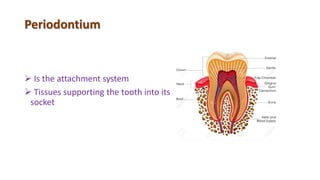
Periodontium
 Is the attachment system
 Tissues supporting the tooth into its
socket
Physiologic tooth form protecting Periodontium
Direct factors
I. Proximal contact relation.
II. Interproximal spaces.
III. Embrasures or spill ways.
IV. Facial and lingual contours
of the crown.
V. Curvature of cervical line.
Indirect factors
I. Crown form
II. Roof form
III. Angulation of crown and root
IV. The self-cleansing ability of the tooth.
V. Occlusal anatomy.
VI. Continuity of marginal ridges.
VII. Continuity of central grooves of post.
Teeth.
VIII. Facial line angles.
Physiologic tooth form protecting Periodontium
Indirect factors
I. Crown from
Proximal contact area
Physiologic tooth form protecting Periodontium
Indirect factors
I. Crown from
Proximal contact area
Facial & lingual contour
Physiologic tooth form protecting Periodontium
Indirect factors
I. Crown from
Proximal contact area
Facial & lingual contour
Geometric outline of the crown
Physiologic tooth form protecting Periodontium
Indirect factors
II. Root from
 Single
 Multi-rooted.
 Facial…. Cone shaped
 Proximal …. Broad
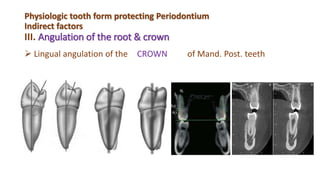
 Lingual angulation of the
Physiologic tooth form protecting Periodontium
Indirect factors
III. Angulation of the root & crown
of Mand. Post. teethCROWN
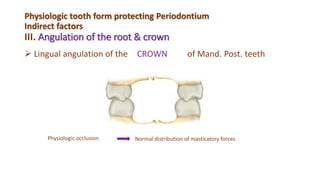
 Lingual angulation of the
Physiologic tooth form protecting Periodontium
Indirect factors
III. Angulation of the root & crown
of Mand. Post. teethCROWN
Physiologic occlusion Normal distribution of masticatory forces
Physiologic tooth form protecting Periodontium
Indirect factors
III. Angulation of the root & crown
 Distal angulation of the of permanent molars
CROWN
&
ROOT
Mesial drift of teeth
Maintenance of the proximal contact area
Physiologic tooth form protecting Periodontium
Indirect factors
IV. Self cleansing ability
 Proper form of the teeth with smooth
rounded surfaces.
 Proper alignment of the teeth in the
dental arches.
 Normal gingival attachments
 Brushing activity of the tongue, lips
and cheeks.
 The washing effect of the saliva and
fluid intake.
 The friction of the food material during
mastication and the usual home care
of the teeth.
Physiologic tooth form protecting Periodontium
Indirect factors
V. Occlusal anatomy
Physiologic tooth form protecting Periodontium
Indirect factors
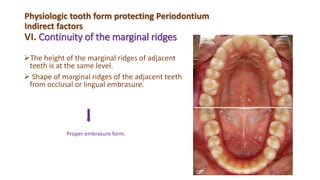
VI. Continuity of the marginal ridges
The height of the marginal ridges of adjacent
teeth is at the same level.
 Shape of marginal ridges of the adjacent teeth
from occlusal or lingual embrasure.
Proper embrasure form.
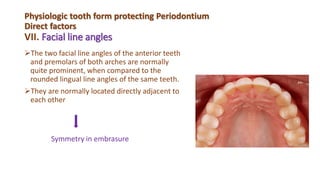
The two facial line angles of the anterior teeth
and premolars of both arches are normally
quite prominent, when compared to the
rounded lingual line angles of the same teeth.
They are normally located directly adjacent to
each other
Physiologic tooth form protecting Periodontium
Direct factors
VII. Facial line angles
Symmetry in embrasure
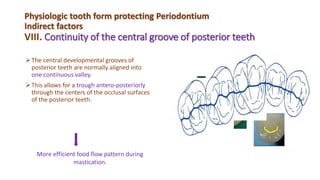
The central developmental grooves of
posterior teeth are normally aligned into
one continuous valley.
This allows for a trough antero-posteriorly
through the centers of the occlusal surfaces
of the posterior teeth.
Physiologic tooth form protecting Periodontium
Indirect factors
VIII. Continuity of the central groove of posterior teeth
More efficient food flow pattern during
mastication.
Any questions??
Thank you..

Physiologic tooth from ii

  • 1.
  • 2.
  • 3.
    Periodontium  Is theattachment system  Tissues supporting the tooth into its socket
  • 4.
    Physiologic tooth formprotecting Periodontium Direct factors I. Proximal contact relation. II. Interproximal spaces. III. Embrasures or spill ways. IV. Facial and lingual contours of the crown. V. Curvature of cervical line. Indirect factors I. Crown form II. Roof form III. Angulation of crown and root IV. The self-cleansing ability of the tooth. V. Occlusal anatomy. VI. Continuity of marginal ridges. VII. Continuity of central grooves of post. Teeth. VIII. Facial line angles.
  • 5.
    Physiologic tooth formprotecting Periodontium Indirect factors I. Crown from Proximal contact area
  • 6.
    Physiologic tooth formprotecting Periodontium Indirect factors I. Crown from Proximal contact area Facial & lingual contour
  • 7.
    Physiologic tooth formprotecting Periodontium Indirect factors I. Crown from Proximal contact area Facial & lingual contour Geometric outline of the crown
  • 8.
    Physiologic tooth formprotecting Periodontium Indirect factors II. Root from  Single  Multi-rooted.  Facial…. Cone shaped  Proximal …. Broad
  • 9.
     Lingual angulationof the Physiologic tooth form protecting Periodontium Indirect factors III. Angulation of the root & crown of Mand. Post. teethCROWN
  • 10.
     Lingual angulationof the Physiologic tooth form protecting Periodontium Indirect factors III. Angulation of the root & crown of Mand. Post. teethCROWN Physiologic occlusion Normal distribution of masticatory forces
  • 11.
    Physiologic tooth formprotecting Periodontium Indirect factors III. Angulation of the root & crown  Distal angulation of the of permanent molars CROWN & ROOT Mesial drift of teeth Maintenance of the proximal contact area
  • 12.
    Physiologic tooth formprotecting Periodontium Indirect factors IV. Self cleansing ability  Proper form of the teeth with smooth rounded surfaces.  Proper alignment of the teeth in the dental arches.  Normal gingival attachments  Brushing activity of the tongue, lips and cheeks.  The washing effect of the saliva and fluid intake.  The friction of the food material during mastication and the usual home care of the teeth.
  • 13.
    Physiologic tooth formprotecting Periodontium Indirect factors V. Occlusal anatomy
  • 14.
    Physiologic tooth formprotecting Periodontium Indirect factors VI. Continuity of the marginal ridges The height of the marginal ridges of adjacent teeth is at the same level.  Shape of marginal ridges of the adjacent teeth from occlusal or lingual embrasure. Proper embrasure form.
  • 15.
    The two facialline angles of the anterior teeth and premolars of both arches are normally quite prominent, when compared to the rounded lingual line angles of the same teeth. They are normally located directly adjacent to each other Physiologic tooth form protecting Periodontium Direct factors VII. Facial line angles Symmetry in embrasure
  • 16.
    The central developmentalgrooves of posterior teeth are normally aligned into one continuous valley. This allows for a trough antero-posteriorly through the centers of the occlusal surfaces of the posterior teeth. Physiologic tooth form protecting Periodontium Indirect factors VIII. Continuity of the central groove of posterior teeth More efficient food flow pattern during mastication.
  • 17.
  • 18.