MOMENTUM &IMPULSE
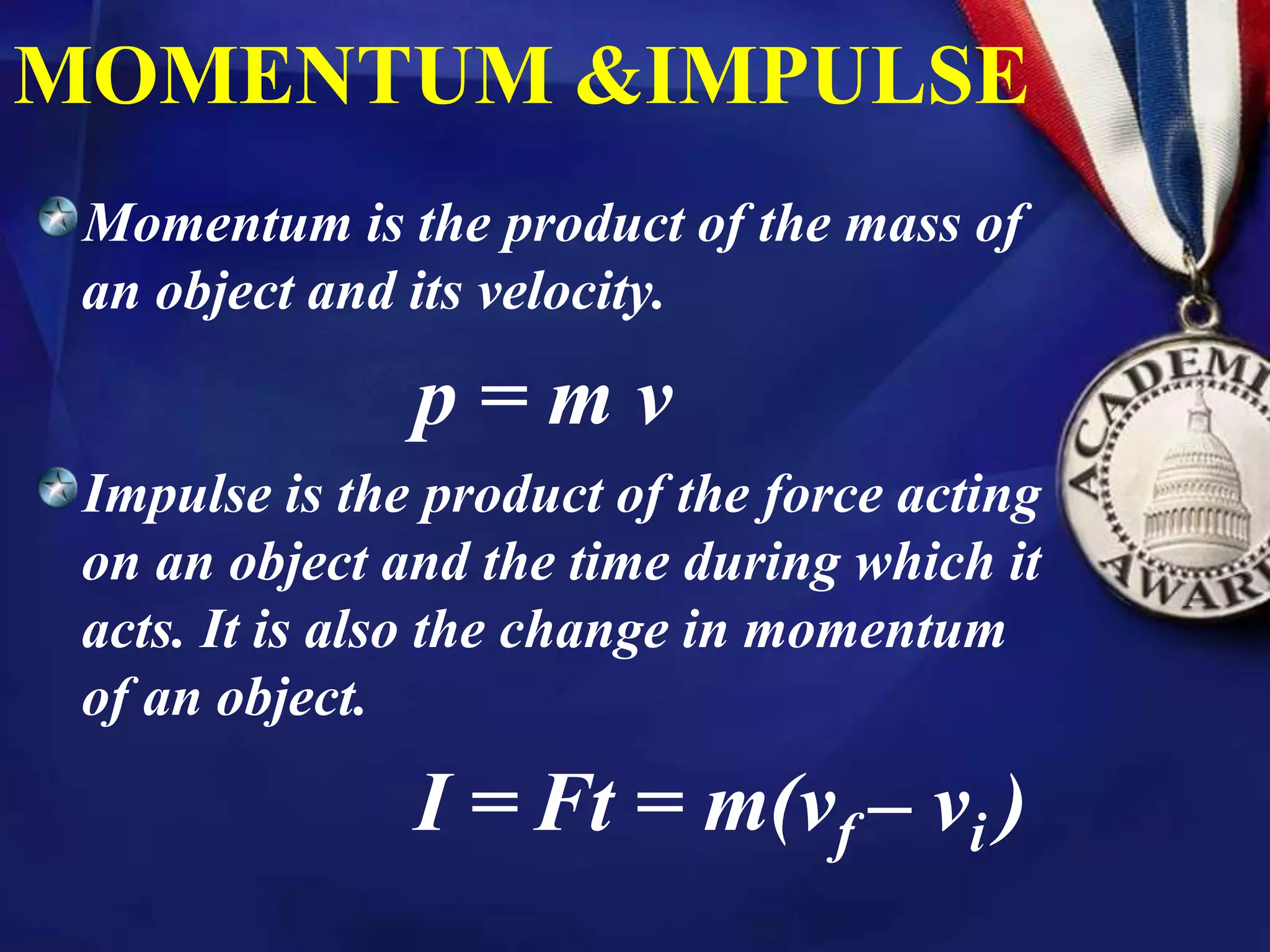
Momentum is the product of the mass of
an object and its velocity.
p = m v
Impulse is the product of the force acting
on an object and the time during which it
acts. It is also the change in momentum
of an object.
I = Ft = m(vf – vi )
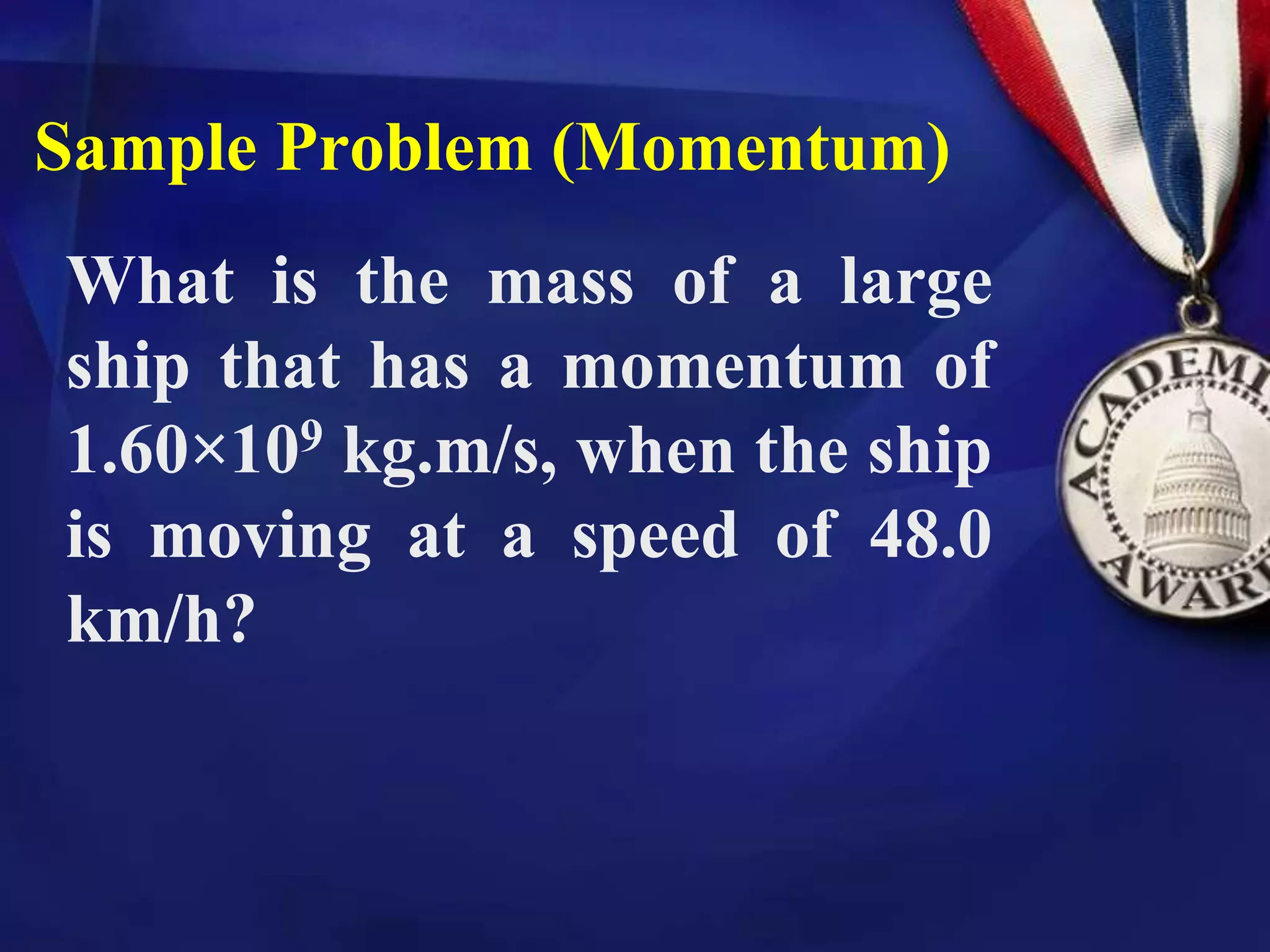
What is the mass of a large
ship that has a momentum of
1.60×10⁹ kg.m/s, when the ship
is moving at a speed of 48.0
km/h?
Sample Problem (Momentum)
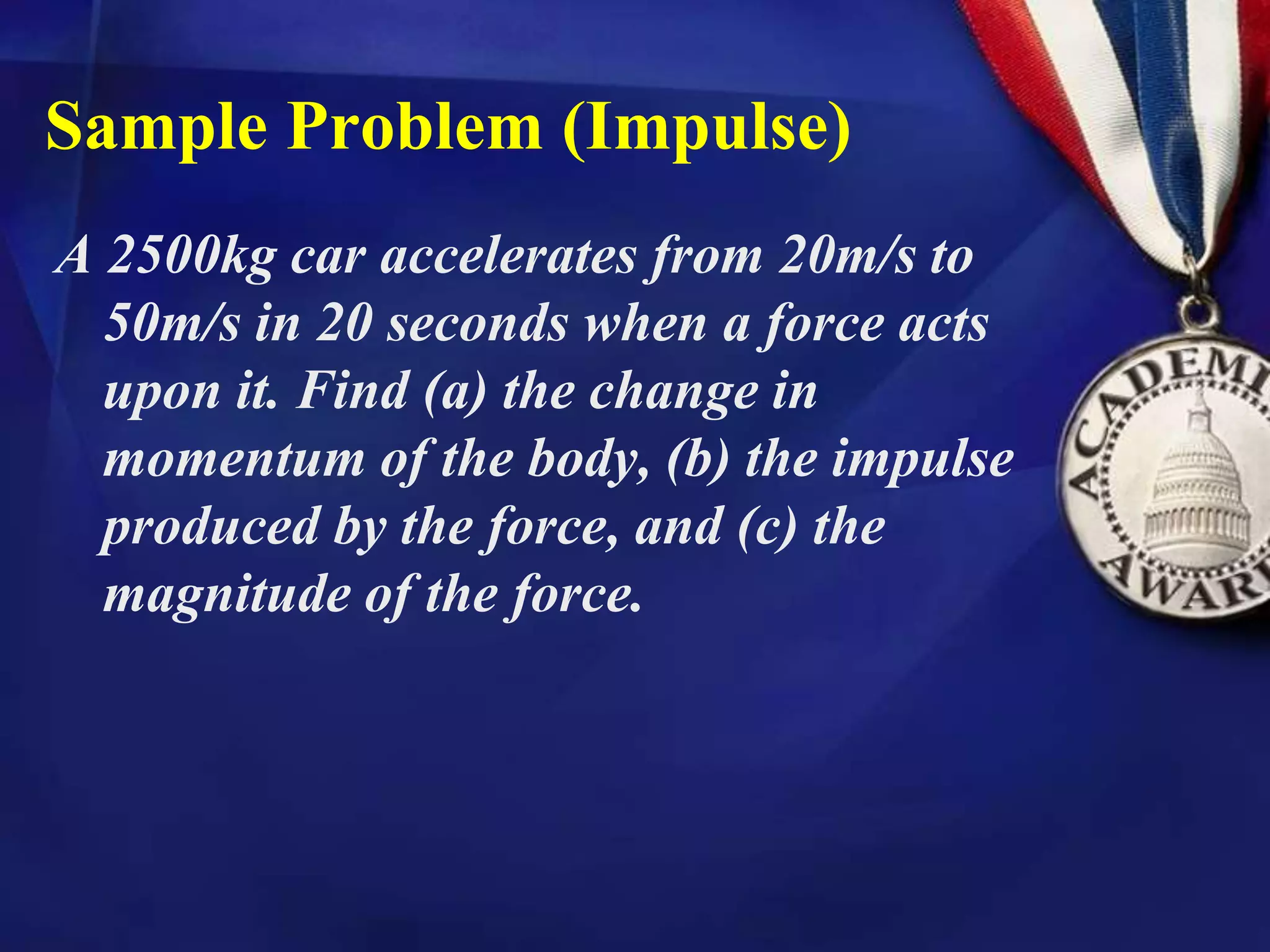
Sample Problem (Impulse)
A 2500kg car accelerates from 20m/s to
50m/s in 20 seconds when a force acts
upon it. Find (a) the change in
momentum of the body, (b) the impulse
produced by the force, and (c) the
magnitude of the force.
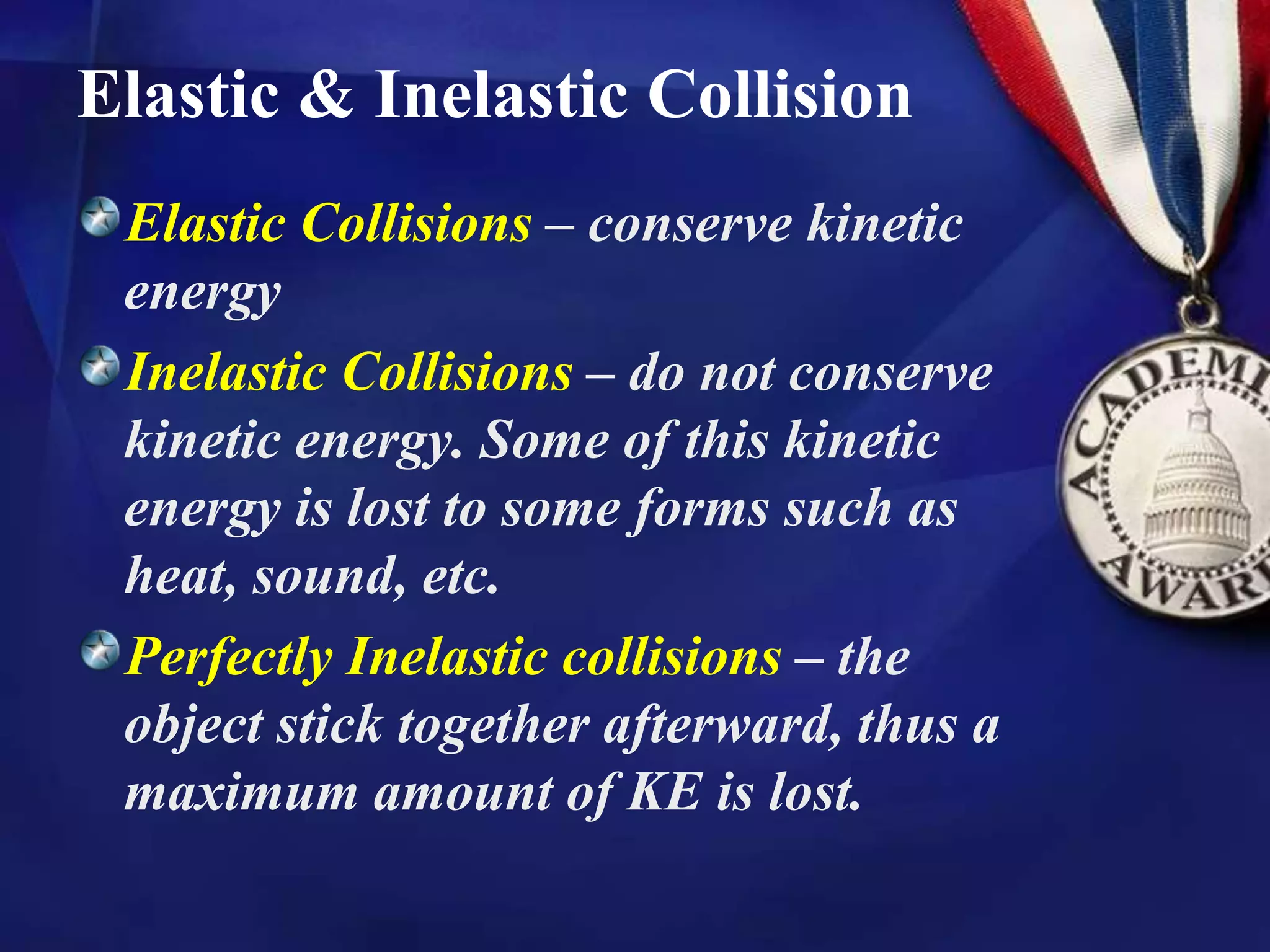
Elastic & Inelastic Collision
Elastic Collisions – conserve kinetic
energy
Inelastic Collisions – do not conserve
kinetic energy. Some of this kinetic
energy is lost to some forms such as
heat, sound, etc.
Perfectly Inelastic collisions – the
object stick together afterward, thus a
maximum amount of KE is lost.
LAW OF CONSERVATION OF
MOMENTUM
STATES that the total momentum of
an isolated system remains constant.
The momentum before an event
involving only internal forces is equal
to the momentum after the event.
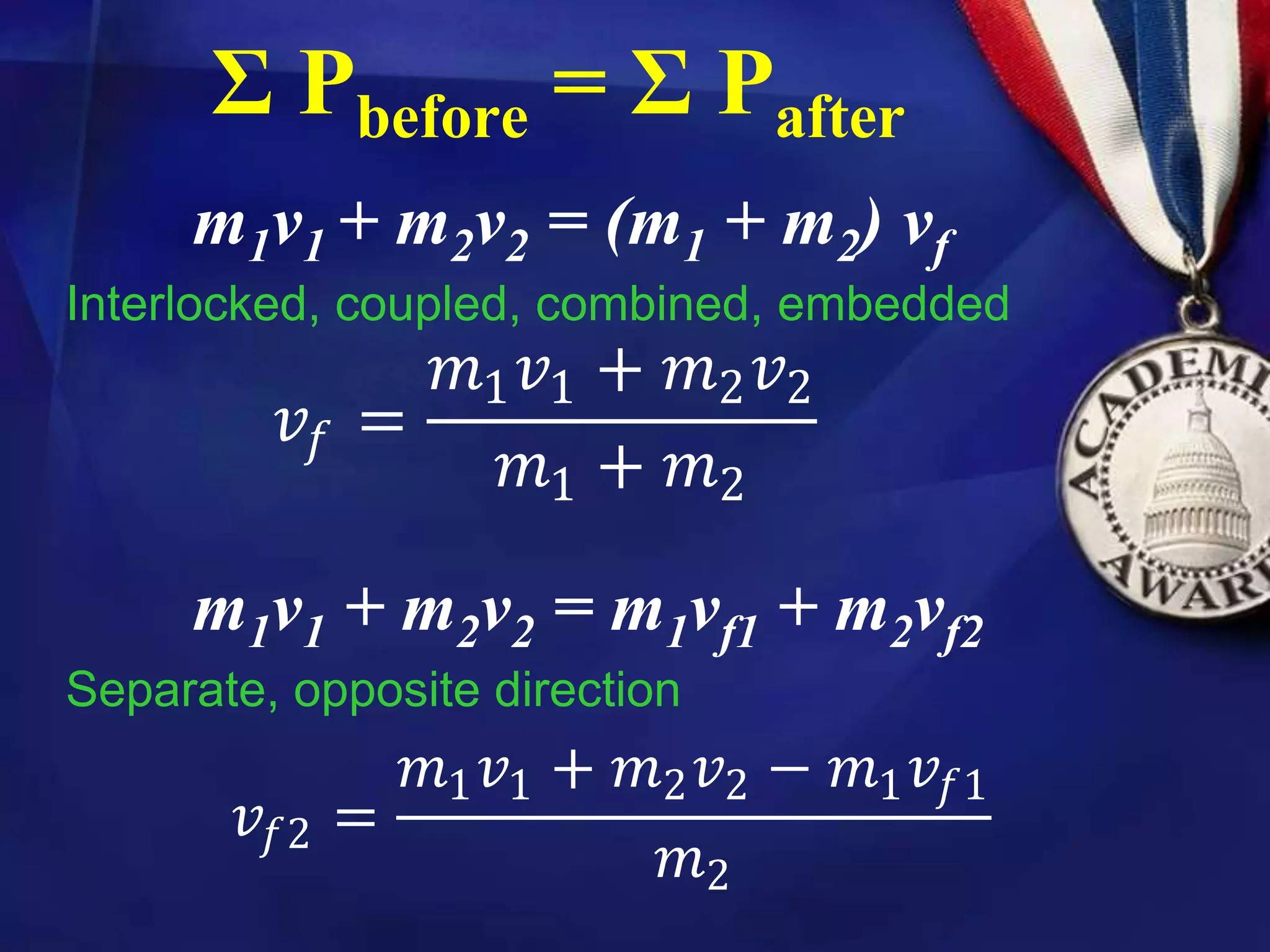
Σ Pbefore = Σ Pafter
m1v1 + m2v2 = (m1 + m2) vf
Interlocked, coupled, combined, embedded
m1v1 + m2v2 = m1vf1 + m2vf2
Separate, opposite direction
𝑣𝑓 =
𝑚1𝑣1 + 𝑚2𝑣2
𝑚1 + 𝑚2
𝑣𝑓2 =
𝑚1𝑣1 + 𝑚2𝑣2 − 𝑚1𝑣𝑓1
𝑚2
SAMPLE PROBLEMS
1. A freight car weighing 2500kg runs into another freight
car of the same weight. The first was moving at 60 m/s
and the second was at rest. If the cars are coupled
together after the collision, what is the final speed?
SAMPLE PROBLEMS
A body has a mass 2kg moves with a velocity of
20m/s to the right. It hits head-on another body
of mass 5kg, which is initially at rest. The lighter
body rebounds with a velocity of 5m/s. What is
the velocity of the other body after collision?
A 0.025kg bullet travelling at 800m/s hits a
1.0kg block that is at rest on a smooth
horizontal surface. The bullet is embedded in
the block. Find the speed imparted to the
block.

Momentum and Impulse.pptx

  • 1.
    MOMENTUM &IMPULSE Momentum isthe product of the mass of an object and its velocity. p = m v Impulse is the product of the force acting on an object and the time during which it acts. It is also the change in momentum of an object. I = Ft = m(vf – vi )
  • 2.
    What is themass of a large ship that has a momentum of 1.60×10⁹ kg.m/s, when the ship is moving at a speed of 48.0 km/h? Sample Problem (Momentum)
  • 3.
    Sample Problem (Impulse) A2500kg car accelerates from 20m/s to 50m/s in 20 seconds when a force acts upon it. Find (a) the change in momentum of the body, (b) the impulse produced by the force, and (c) the magnitude of the force.
  • 4.
    Elastic & InelasticCollision Elastic Collisions – conserve kinetic energy Inelastic Collisions – do not conserve kinetic energy. Some of this kinetic energy is lost to some forms such as heat, sound, etc. Perfectly Inelastic collisions – the object stick together afterward, thus a maximum amount of KE is lost.
  • 5.
    LAW OF CONSERVATIONOF MOMENTUM STATES that the total momentum of an isolated system remains constant. The momentum before an event involving only internal forces is equal to the momentum after the event.
  • 6.
    Σ Pbefore =Σ Pafter m1v1 + m2v2 = (m1 + m2) vf Interlocked, coupled, combined, embedded m1v1 + m2v2 = m1vf1 + m2vf2 Separate, opposite direction 𝑣𝑓 = 𝑚1𝑣1 + 𝑚2𝑣2 𝑚1 + 𝑚2 𝑣𝑓2 = 𝑚1𝑣1 + 𝑚2𝑣2 − 𝑚1𝑣𝑓1 𝑚2
  • 7.
    SAMPLE PROBLEMS 1. Afreight car weighing 2500kg runs into another freight car of the same weight. The first was moving at 60 m/s and the second was at rest. If the cars are coupled together after the collision, what is the final speed?
  • 8.
    SAMPLE PROBLEMS A bodyhas a mass 2kg moves with a velocity of 20m/s to the right. It hits head-on another body of mass 5kg, which is initially at rest. The lighter body rebounds with a velocity of 5m/s. What is the velocity of the other body after collision?
  • 9.
    A 0.025kg bullettravelling at 800m/s hits a 1.0kg block that is at rest on a smooth horizontal surface. The bullet is embedded in the block. Find the speed imparted to the block.