Book Reference : Pages 22-23

1.

To summarise the relationship between
degrees and radians

2.

To understand the term angular
displacement

3.

To define angular velocity

4.

To connect angular velocity to the period
and frequency of rotation

5.

To connect angular velocity to linear speed
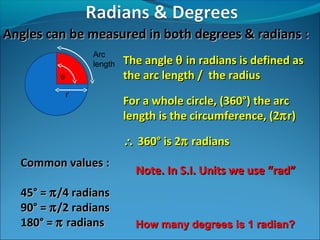
Angles can be measured in both degrees & radians :
Arc
length
θ
r

The angle θ in radians is defined as
the arc length / the radius
For a whole circle, (360°) the arc
length is the circumference, (2π r)
∴ 360° is 2π radians

Common values :
45° = π /4 radians
90° = π /2 radians
180° = π radians

Note. In S.I. Units we use “rad”

How many degrees is 1 radian?
Angular velocity, for circular motion, has
counterparts which can be compared with linear
speed s=d/t.
Time (t) remains unchanged, but linear distance
(d) is replaced with angular displacement θ
measured in radians.
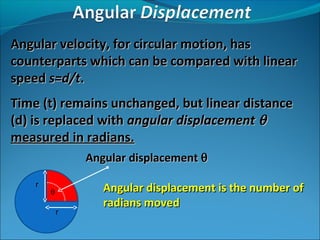
Angular displacement θ
r

θ
r

Angular displacement is the number of
radians moved
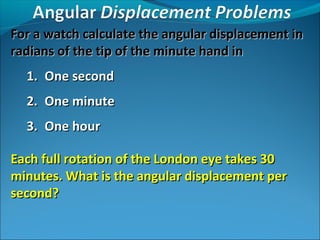
For a watch calculate the angular displacement in
radians of the tip of the minute hand in
1. One second
2. One minute
3. One hour
Each full rotation of the London eye takes 30
minutes. What is the angular displacement per
second?
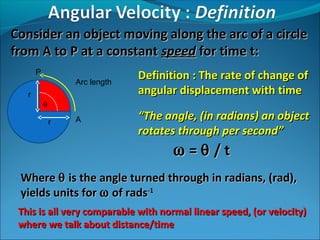
Consider an object moving along the arc of a circle
from A to P at a constant speed for time t:
Arc length

Definition : The rate of change of
angular displacement with time

A

“The angle, (in radians) an object
rotates through per second”

P
r
θ
r

ω =θ /t
Where θ is the angle turned through in radians, (rad),
yields units for ω of rads-1
This is all very comparable with normal linear speed, (or velocity)
where we talk about distance/time
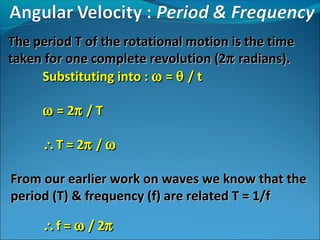
The period T of the rotational motion is the time
taken for one complete revolution (2π radians).
Substituting into : ω = θ / t
ω = 2π / T
∴ T = 2π / ω
From our earlier work on waves we know that the
period (T) & frequency (f) are related T = 1/f
∴ f = ω / 2π
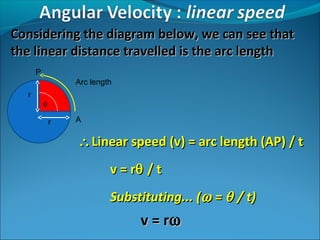
Considering the diagram below, we can see that
the linear distance travelled is the arc length
P
Arc length
r
θ
r

A

∴ Linear speed (v) = arc length (AP) / t
v = rθ / t
Substituting... (ω = θ / t)

v = rω
A cyclist travels at a speed of 12ms-1 on a bike
with wheels which have a radius of 40cm.
Calculate:
a. The frequency of rotation for the wheels
b. The angular velocity for the wheels
c. The angle the wheel turns through in 0.1s in
i radians ii degrees
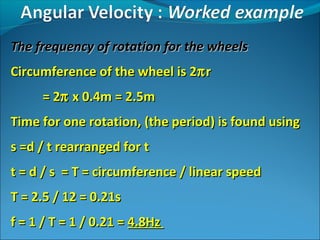
The frequency of rotation for the wheels
Circumference of the wheel is 2π r
= 2π x 0.4m = 2.5m
Time for one rotation, (the period) is found using
s =d / t rearranged for t
t = d / s = T = circumference / linear speed
T = 2.5 / 12 = 0.21s
f = 1 / T = 1 / 0.21 = 4.8Hz
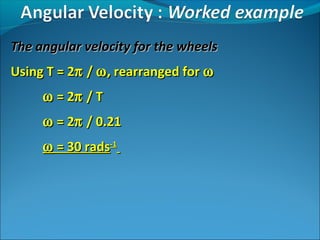
The angular velocity for the wheels
Using T = 2π / ω , rearranged for ω
ω = 2π / T
ω = 2π / 0.21
ω = 30 rads-1
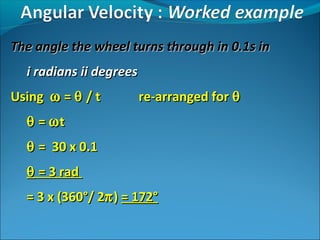
The angle the wheel turns through in 0.1s in
i radians ii degrees
Using ω = θ / t

re-arranged for θ

θ = ωt
θ = 30 x 0.1
θ = 3 rad
= 3 x (360°/ 2π ) = 172°

Physics a2 unit4_05_circular_motion_01- circular motion

  • 2.
    Book Reference :Pages 22-23 1. To summarise the relationship between degrees and radians 2. To understand the term angular displacement 3. To define angular velocity 4. To connect angular velocity to the period and frequency of rotation 5. To connect angular velocity to linear speed
  • 3.
    Angles can bemeasured in both degrees & radians : Arc length θ r The angle θ in radians is defined as the arc length / the radius For a whole circle, (360°) the arc length is the circumference, (2π r) ∴ 360° is 2π radians Common values : 45° = π /4 radians 90° = π /2 radians 180° = π radians Note. In S.I. Units we use “rad” How many degrees is 1 radian?
  • 4.
    Angular velocity, forcircular motion, has counterparts which can be compared with linear speed s=d/t. Time (t) remains unchanged, but linear distance (d) is replaced with angular displacement θ measured in radians. Angular displacement θ r θ r Angular displacement is the number of radians moved
  • 5.
    For a watchcalculate the angular displacement in radians of the tip of the minute hand in 1. One second 2. One minute 3. One hour Each full rotation of the London eye takes 30 minutes. What is the angular displacement per second?
  • 6.
    Consider an objectmoving along the arc of a circle from A to P at a constant speed for time t: Arc length Definition : The rate of change of angular displacement with time A “The angle, (in radians) an object rotates through per second” P r θ r ω =θ /t Where θ is the angle turned through in radians, (rad), yields units for ω of rads-1 This is all very comparable with normal linear speed, (or velocity) where we talk about distance/time
  • 7.
    The period Tof the rotational motion is the time taken for one complete revolution (2π radians). Substituting into : ω = θ / t ω = 2π / T ∴ T = 2π / ω From our earlier work on waves we know that the period (T) & frequency (f) are related T = 1/f ∴ f = ω / 2π
  • 8.
    Considering the diagrambelow, we can see that the linear distance travelled is the arc length P Arc length r θ r A ∴ Linear speed (v) = arc length (AP) / t v = rθ / t Substituting... (ω = θ / t) v = rω
  • 9.
    A cyclist travelsat a speed of 12ms-1 on a bike with wheels which have a radius of 40cm. Calculate: a. The frequency of rotation for the wheels b. The angular velocity for the wheels c. The angle the wheel turns through in 0.1s in i radians ii degrees
  • 10.
    The frequency ofrotation for the wheels Circumference of the wheel is 2π r = 2π x 0.4m = 2.5m Time for one rotation, (the period) is found using s =d / t rearranged for t t = d / s = T = circumference / linear speed T = 2.5 / 12 = 0.21s f = 1 / T = 1 / 0.21 = 4.8Hz
  • 11.
    The angular velocityfor the wheels Using T = 2π / ω , rearranged for ω ω = 2π / T ω = 2π / 0.21 ω = 30 rads-1
  • 12.
    The angle thewheel turns through in 0.1s in i radians ii degrees Using ω = θ / t re-arranged for θ θ = ωt θ = 30 x 0.1 θ = 3 rad = 3 x (360°/ 2π ) = 172°