

flipperworks.com
flipperworks.com
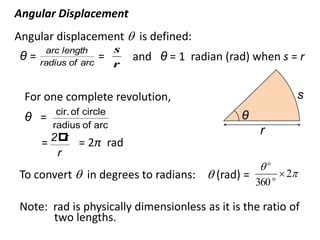
Angular Displacement
Angular displacement  is defined:
       arc length       s
 θ=   radius of arc
                      =     and θ = 1 radian (rad) when s = r
                        r


 For one complete revolution,                                     s
          cir. of circle                        θ
 θ =
         radius of arc
                                                    r
      = 2 = 2π rad
          r
          r
                                                    o
To convert  in degrees to radians:  (rad) =             o
                                                               2
                                                    360

Note: rad is physically dimensionless as it is the ratio of
      two lengths.
flipperworks.com
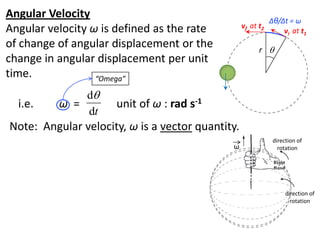
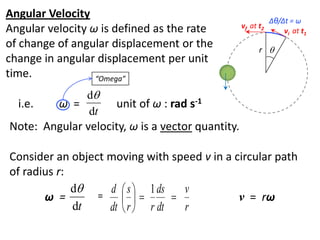
Angular Velocity                                             Δθ/Δt = ω
Angular velocity ω is defined as the rate         vf at t2
                                                                 vi at t1
of change of angular displacement or the                r 
change in angular displacement per unit
time.             “Omega”

              d
  i.e.    ω =        unit of ω : rad s-1
              dt
Note: Angular velocity, ω is a vector quantity.
                                                              direction of
                                             ω                  rotation


                                                                   direction of
                                                                     rotation
flipperworks.com
Angular Velocity                                             Δθ/Δt = ω
Angular velocity ω is defined as the rate         vf at t2
                                                                 vi at t1
of change of angular displacement or the                r 
change in angular displacement per unit
time.             “Omega”

              d
  i.e.    ω =        unit of ω : rad s-1
              dt
Note: Angular velocity, ω is a vector quantity.

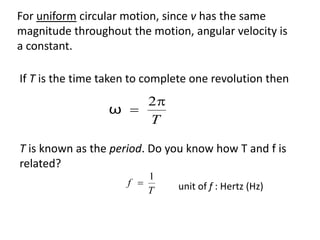
Consider an object moving with speed v in a circular path
of radius r:
             d    d  s  1 ds    v
       ω =       =                       v = rω
             dt    dt  r  r dt   r
flipperworks.com
For uniform circular motion, since v has the same
magnitude throughout the motion, angular velocity is
a constant.

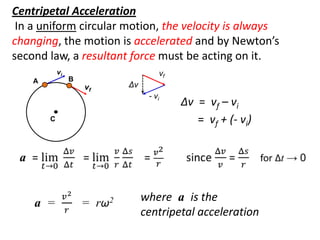
If T is the time taken to complete one revolution then
                     2
                 ω 
                     T

T is known as the period. Do you know how T and f is
related?
                         1
                     f        unit of f : Hertz (Hz)
                         T
flipperworks.com
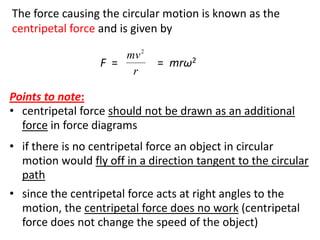
Centripetal Acceleration
 In a uniform circular motion, the velocity is always
changing, the motion is accelerated and by Newton’s
second law, a resultant force must be acting on it.
            vi                     vf
    A            B
                     vf   Δv
                                - vi
                                        Δv = vf – vi
        C                                  = vf + (- vi)


                               where a is the
                               centripetal acceleration
flipperworks.com

The force causing the circular motion is known as the
centripetal force and is given by
                      mv 2
                  F =         = mrω2
                       r

Points to note:
• centripetal force should not be drawn as an additional
  force in force diagrams
• if there is no centripetal force an object in circular
  motion would fly off in a direction tangent to the circular
  path
• since the centripetal force acts at right angles to the
  motion, the centripetal force does no work (centripetal
  force does not change the speed of the object)
flipperworks.com
flipperworks.com

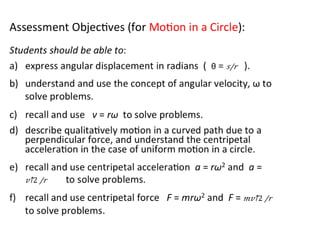
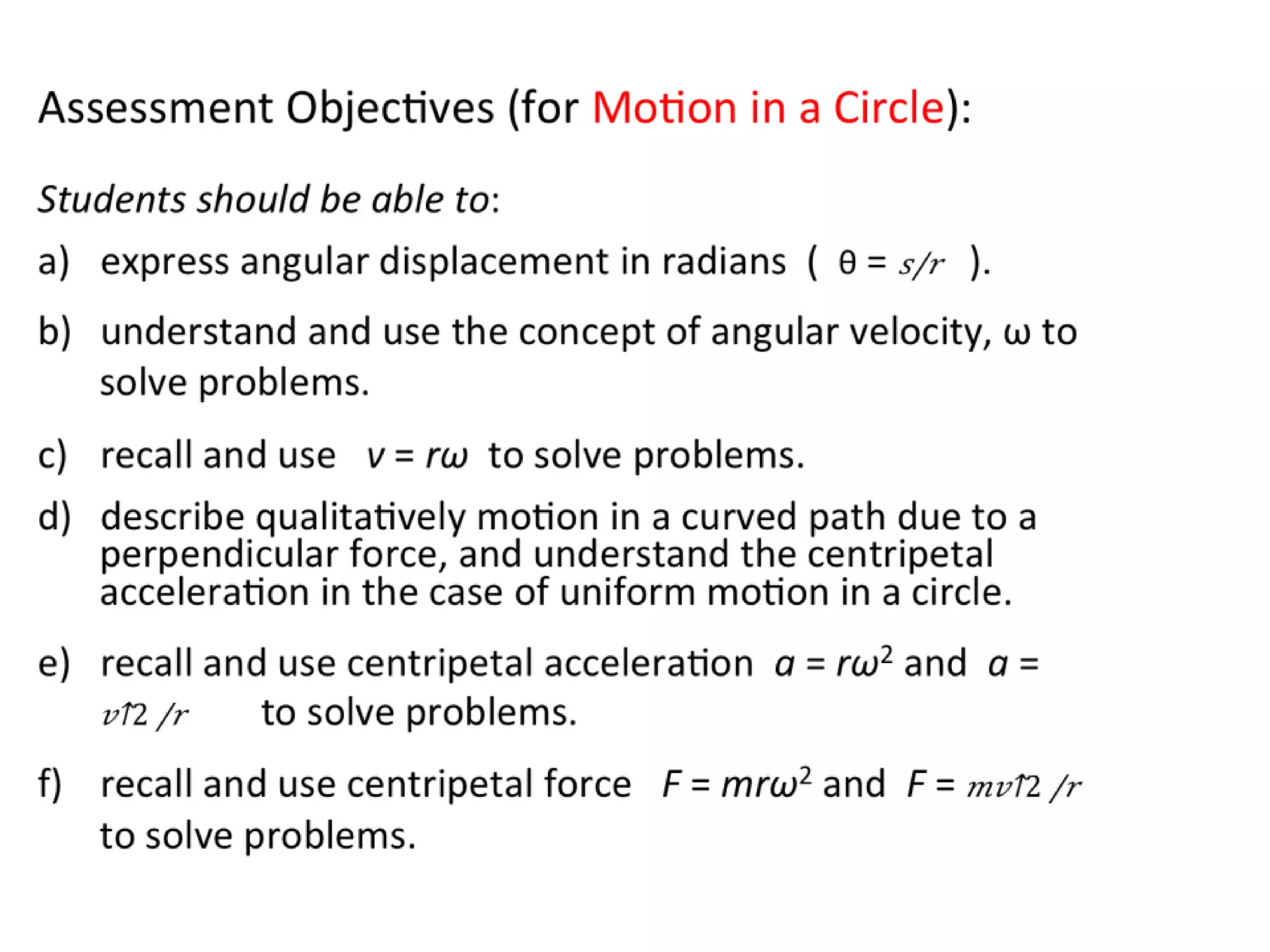
Motion in a circle

  • 1.
  • 2.
    flipperworks.com Angular Displacement Angular displacement is defined: arc length s θ= radius of arc = and θ = 1 radian (rad) when s = r r For one complete revolution, s cir. of circle θ θ = radius of arc r = 2 = 2π rad r r o To convert  in degrees to radians:  (rad) = o  2 360 Note: rad is physically dimensionless as it is the ratio of two lengths.
  • 3.
    flipperworks.com Angular Velocity Δθ/Δt = ω Angular velocity ω is defined as the rate vf at t2 vi at t1 of change of angular displacement or the r  change in angular displacement per unit time. “Omega” d i.e. ω = unit of ω : rad s-1 dt Note: Angular velocity, ω is a vector quantity. direction of ω rotation direction of rotation
  • 4.
    flipperworks.com Angular Velocity Δθ/Δt = ω Angular velocity ω is defined as the rate vf at t2 vi at t1 of change of angular displacement or the r  change in angular displacement per unit time. “Omega” d i.e. ω = unit of ω : rad s-1 dt Note: Angular velocity, ω is a vector quantity. Consider an object moving with speed v in a circular path of radius r: d d  s  1 ds v ω = =    v = rω dt dt  r  r dt r
  • 5.
    flipperworks.com For uniform circularmotion, since v has the same magnitude throughout the motion, angular velocity is a constant. If T is the time taken to complete one revolution then 2 ω  T T is known as the period. Do you know how T and f is related? 1 f  unit of f : Hertz (Hz) T
  • 6.
    flipperworks.com Centripetal Acceleration Ina uniform circular motion, the velocity is always changing, the motion is accelerated and by Newton’s second law, a resultant force must be acting on it. vi vf A B vf Δv - vi Δv = vf – vi C = vf + (- vi) where a is the centripetal acceleration
  • 7.
    flipperworks.com The force causingthe circular motion is known as the centripetal force and is given by mv 2 F = = mrω2 r Points to note: • centripetal force should not be drawn as an additional force in force diagrams • if there is no centripetal force an object in circular motion would fly off in a direction tangent to the circular path • since the centripetal force acts at right angles to the motion, the centripetal force does no work (centripetal force does not change the speed of the object)
  • 8.
  • 9.