1.

To consider speed & velocity around a circle

2.

To consider acceleration as a change in
velocity

3.

To define an equation for acceleration when
an object moves in a circular path

4.

To define an equation for resultant force
when an object moves in a circular path
Velocity v

n
atio
er
cel
ac

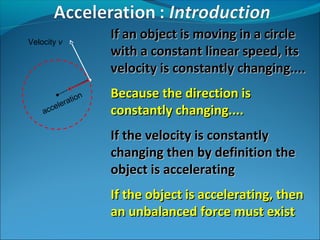
If an object is moving in a circle
with a constant linear speed, its
velocity is constantly changing....
Because the direction is
constantly changing....
If the velocity is constantly
changing then by definition the
object is accelerating
If the object is accelerating, then
an unbalanced force must exist
Velocity vB
B
δθ
C

δv

Velocity vB δθ

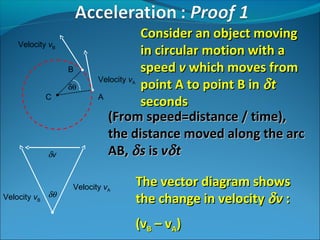
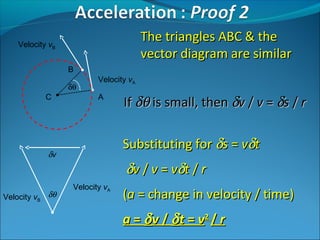
Consider an object moving
in circular motion with a
speed v which moves from
Velocity v
point A to point B in δ t
A
seconds
(From speed=distance / time),
the distance moved along the arc
AB, δ s is vδ t

Velocity vA

A

The vector diagram shows
the change in velocity δ v :
(vB – vA)
The triangles ABC & the
vector diagram are similar

Velocity vB
B
δθ
C

Velocity vA
A

Substituting for δs = vδt

δv

Velocity vB δθ

If δθ is small, then δv / v = δs / r

δv / v = vδt / r
Velocity vA

(a = change in velocity / time)
a = δ v / δ t = v2 / r
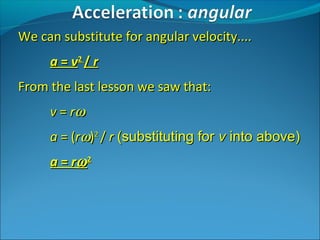
We can substitute for angular velocity....
a = v2 / r
From the last lesson we saw that:
v = rω
a = (rω)2 / r (substituting for v into above)
a = rω 2
Velocity v

n
atio
er
cel
ac

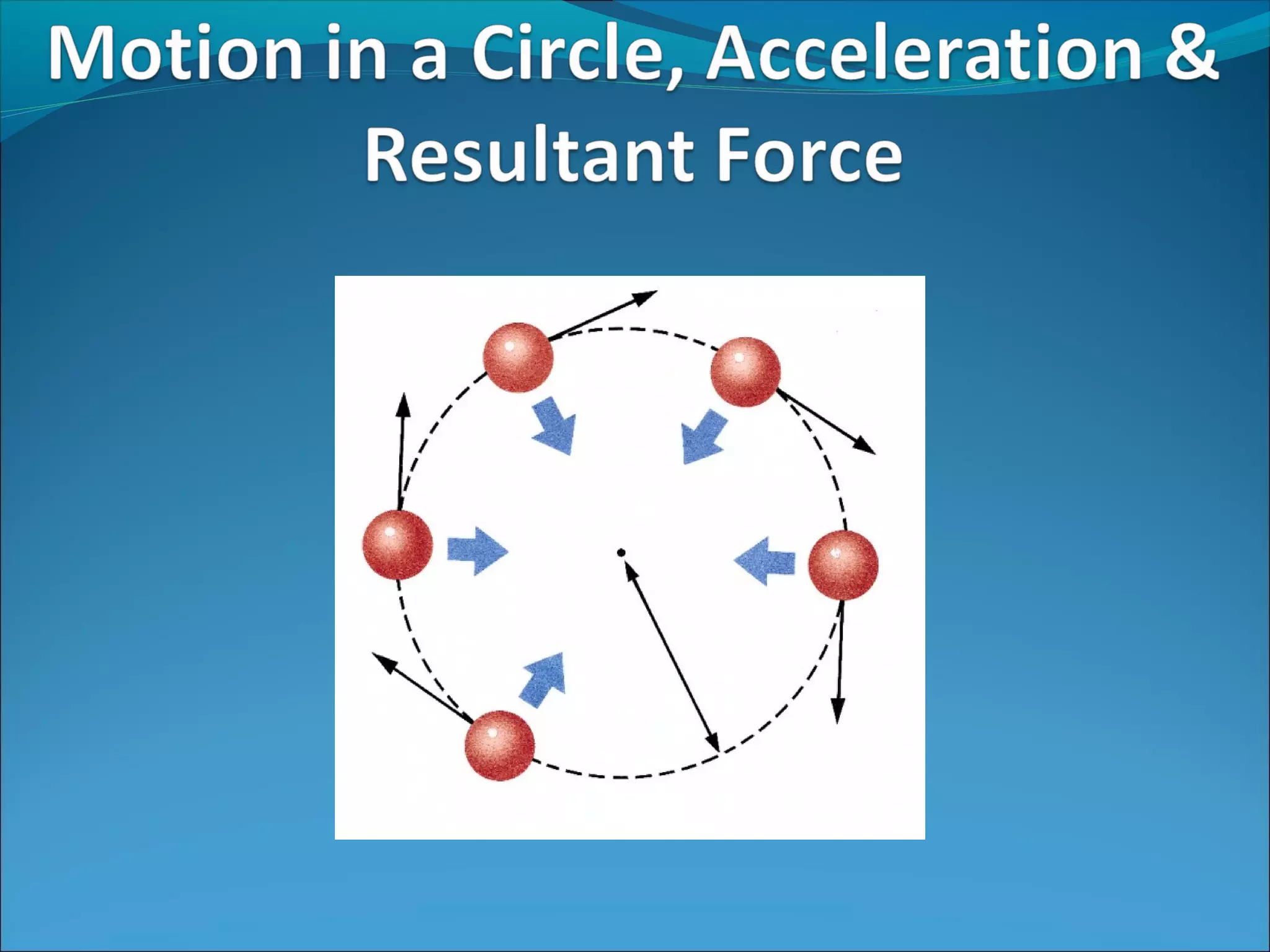
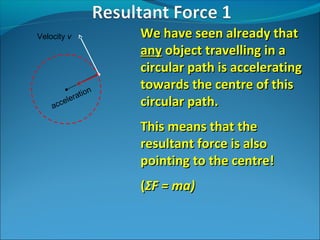
We have seen already that
any object travelling in a
circular path is accelerating
towards the centre of this
circular path.
This means that the
resultant force is also
pointing to the centre!
(ΣF = ma)
Velocity v

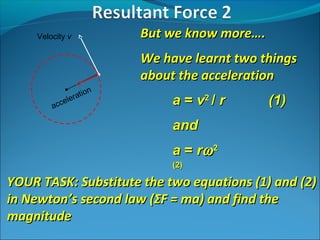
But we know more….
We have learnt two things
about the acceleration

n
atio
er
cel
ac

a = v2 / r

(1)

and
a = rω 2
(2)

YOUR TASK: Substitute the two equations (1) and (2)
in Newton’s second law (ΣF = ma) and find the
magnitude
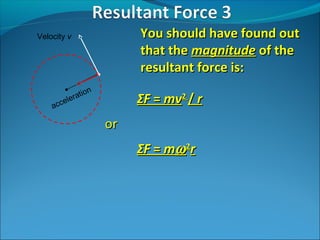
You should have found out
that the magnitude of the
resultant force is:

Velocity v

n
atio
er
cel
ac

ΣF = mv2 / r
or
ΣF = mω 2r
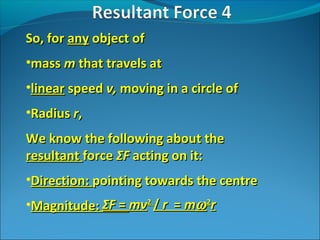
So, for any object of
•mass m that travels at
•linear speed v, moving in a circle of
•Radius r,
We know the following about the
resultant force ΣF acting on it:
•Direction: pointing towards the centre
•Magnitude: ΣF = mv2 / r = mω 2r
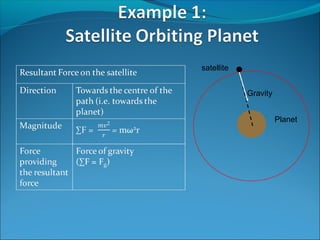
satellite
Gravity
Planet
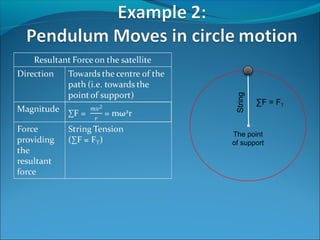
String

∑F = FT

The point
of support
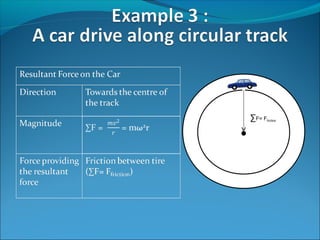
∑F= F

friction
The wheel of the London Eye has a diameter of
130 m and takes 30 min for 1 revolution.
Calculate:
a. The linear speed of the capsule
b. The linear acceleration
c. The resultant force acting on a person with a
mass of 65 kg
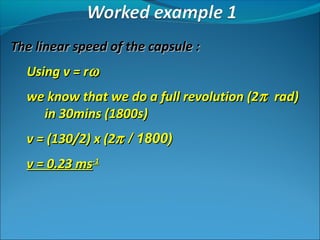
The linear speed of the capsule :
Using v = rω
we know that we do a full revolution (2π rad)
in 30mins (1800s)
v = (130/2) x (2π / 1800)
v = 0.23 ms-1
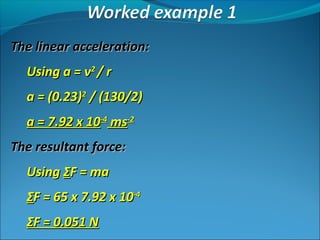
The linear acceleration:
Using a = v2 / r
a = (0.23)2 / (130/2)
a = 7.92 x 10⁻⁴ ms-2
The resultant force:
Using ΣF = ma
ΣF = 65 x 7.92 x 10-4
ΣF = 0.051 N
An object of mass 0.150 kg moves around a
circular path which has a radius of 0.420 m once
every 5.00 s at a steady rate. Calculate:
a. The speed and acceleration of the object
b. The resultant force on the object
[.528 ms-1, 0.663ms-2, 0.100N]

Physics a2 unit4_06_centripetal_force fb1 patrick (21-02-14) edited

  • 2.
    1. To consider speed& velocity around a circle 2. To consider acceleration as a change in velocity 3. To define an equation for acceleration when an object moves in a circular path 4. To define an equation for resultant force when an object moves in a circular path
  • 3.
    Velocity v n atio er cel ac If anobject is moving in a circle with a constant linear speed, its velocity is constantly changing.... Because the direction is constantly changing.... If the velocity is constantly changing then by definition the object is accelerating If the object is accelerating, then an unbalanced force must exist
  • 4.
    Velocity vB B δθ C δv Velocity vBδθ Consider an object moving in circular motion with a speed v which moves from Velocity v point A to point B in δ t A seconds (From speed=distance / time), the distance moved along the arc AB, δ s is vδ t Velocity vA A The vector diagram shows the change in velocity δ v : (vB – vA)
  • 5.
    The triangles ABC& the vector diagram are similar Velocity vB B δθ C Velocity vA A Substituting for δs = vδt δv Velocity vB δθ If δθ is small, then δv / v = δs / r δv / v = vδt / r Velocity vA (a = change in velocity / time) a = δ v / δ t = v2 / r
  • 6.
    We can substitutefor angular velocity.... a = v2 / r From the last lesson we saw that: v = rω a = (rω)2 / r (substituting for v into above) a = rω 2
  • 7.
    Velocity v n atio er cel ac We haveseen already that any object travelling in a circular path is accelerating towards the centre of this circular path. This means that the resultant force is also pointing to the centre! (ΣF = ma)
  • 8.
    Velocity v But weknow more…. We have learnt two things about the acceleration n atio er cel ac a = v2 / r (1) and a = rω 2 (2) YOUR TASK: Substitute the two equations (1) and (2) in Newton’s second law (ΣF = ma) and find the magnitude
  • 9.
    You should havefound out that the magnitude of the resultant force is: Velocity v n atio er cel ac ΣF = mv2 / r or ΣF = mω 2r
  • 10.
    So, for anyobject of •mass m that travels at •linear speed v, moving in a circle of •Radius r, We know the following about the resultant force ΣF acting on it: •Direction: pointing towards the centre •Magnitude: ΣF = mv2 / r = mω 2r
  • 11.
  • 12.
    String ∑F = FT Thepoint of support
  • 13.
  • 14.
    The wheel ofthe London Eye has a diameter of 130 m and takes 30 min for 1 revolution. Calculate: a. The linear speed of the capsule b. The linear acceleration c. The resultant force acting on a person with a mass of 65 kg
  • 15.
    The linear speedof the capsule : Using v = rω we know that we do a full revolution (2π rad) in 30mins (1800s) v = (130/2) x (2π / 1800) v = 0.23 ms-1
  • 16.
    The linear acceleration: Usinga = v2 / r a = (0.23)2 / (130/2) a = 7.92 x 10⁻⁴ ms-2 The resultant force: Using ΣF = ma ΣF = 65 x 7.92 x 10-4 ΣF = 0.051 N
  • 17.
    An object ofmass 0.150 kg moves around a circular path which has a radius of 0.420 m once every 5.00 s at a steady rate. Calculate: a. The speed and acceleration of the object b. The resultant force on the object [.528 ms-1, 0.663ms-2, 0.100N]