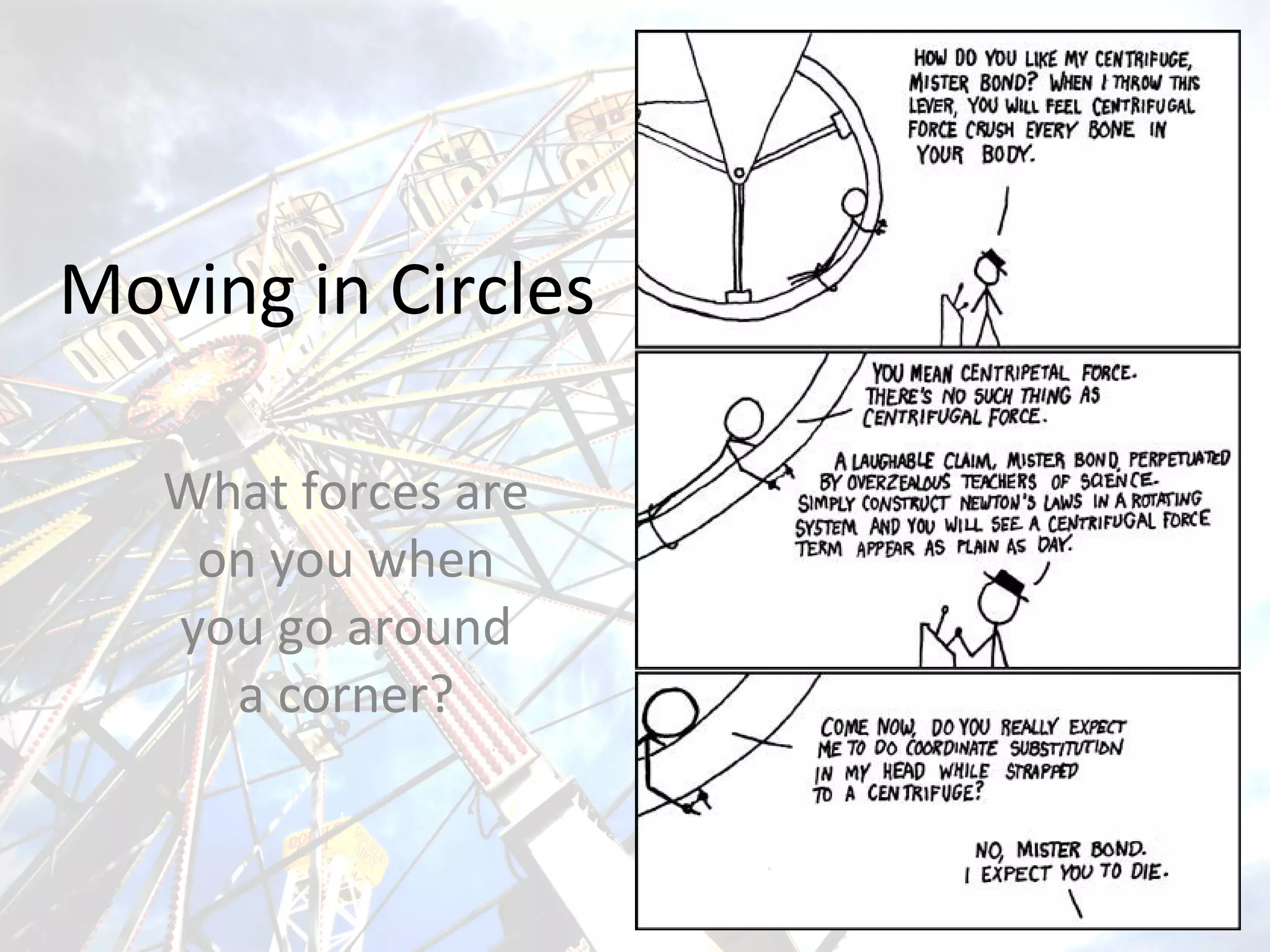
Moving in Circles
What forces are
on you when
you go around
a corner?
Task
• Try and explain why a car skids when it goes
around a corner too quickly.
Learning objectives
• How can we recognise uniform motion in a
circle?
• What do we need to measure to find the
speed of an object moving in uniform
circular motion?
• What is meant by angular displacement
and angular speed?
Objects which move in a circular path
any suggestions?
The hammer swung by a hammer thrower
Clothes being dried in a spin drier
Chemicals being separated in a centrifuge
Cornering in a car or on a bike
A stone being whirled round on a string
A plane looping the loop
A DVD, CD or record spinning on its turntable
Satellites moving in orbits around the Earth
A planet orbiting the Sun (almost circular orbit for many)
Many fairground rides
An electron in orbit about a nucleus
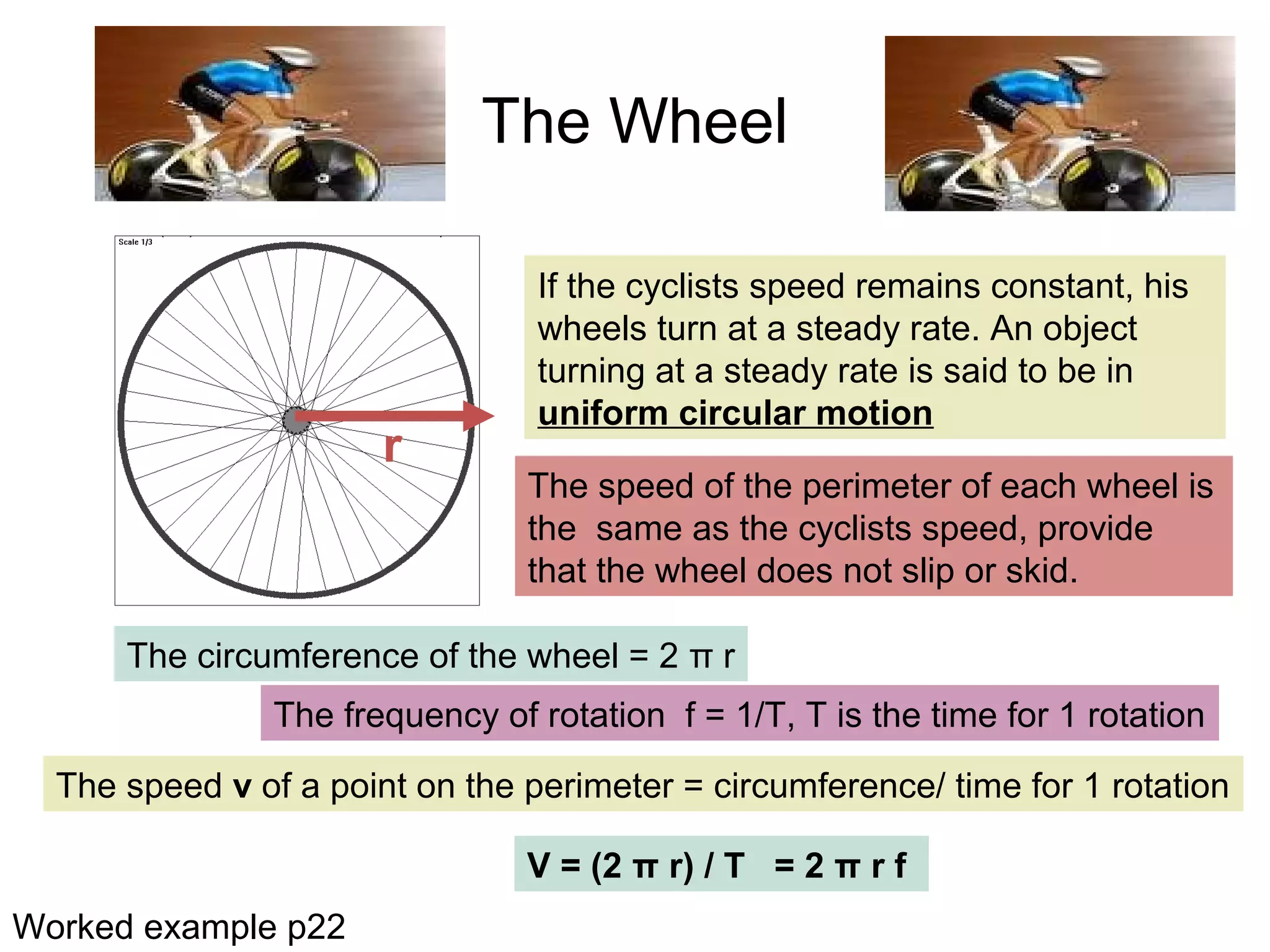
The Wheel
The speed of the perimeter of each wheel is
the same as the cyclists speed, provide
that the wheel does not slip or skid.
r
If the cyclists speed remains constant, his
wheels turn at a steady rate. An object
turning at a steady rate is said to be in
uniform circular motion
The circumference of the wheel = 2 π r
The frequency of rotation f = 1/T, T is the time for 1 rotation
The speed v of a point on the perimeter = circumference/ time for 1 rotation
V = (2 π r) / T = 2 π r f
Worked example p22
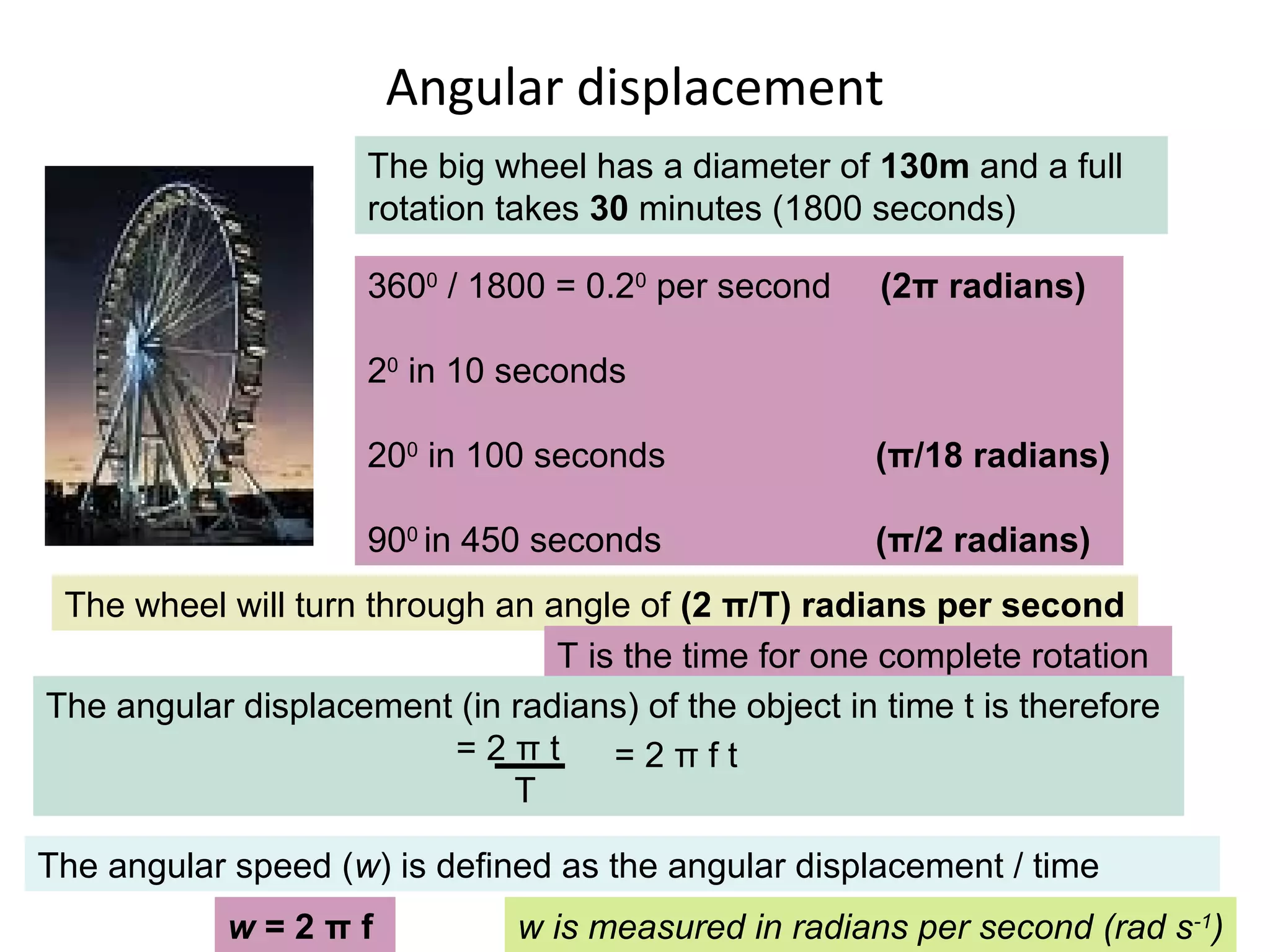
Angular displacement
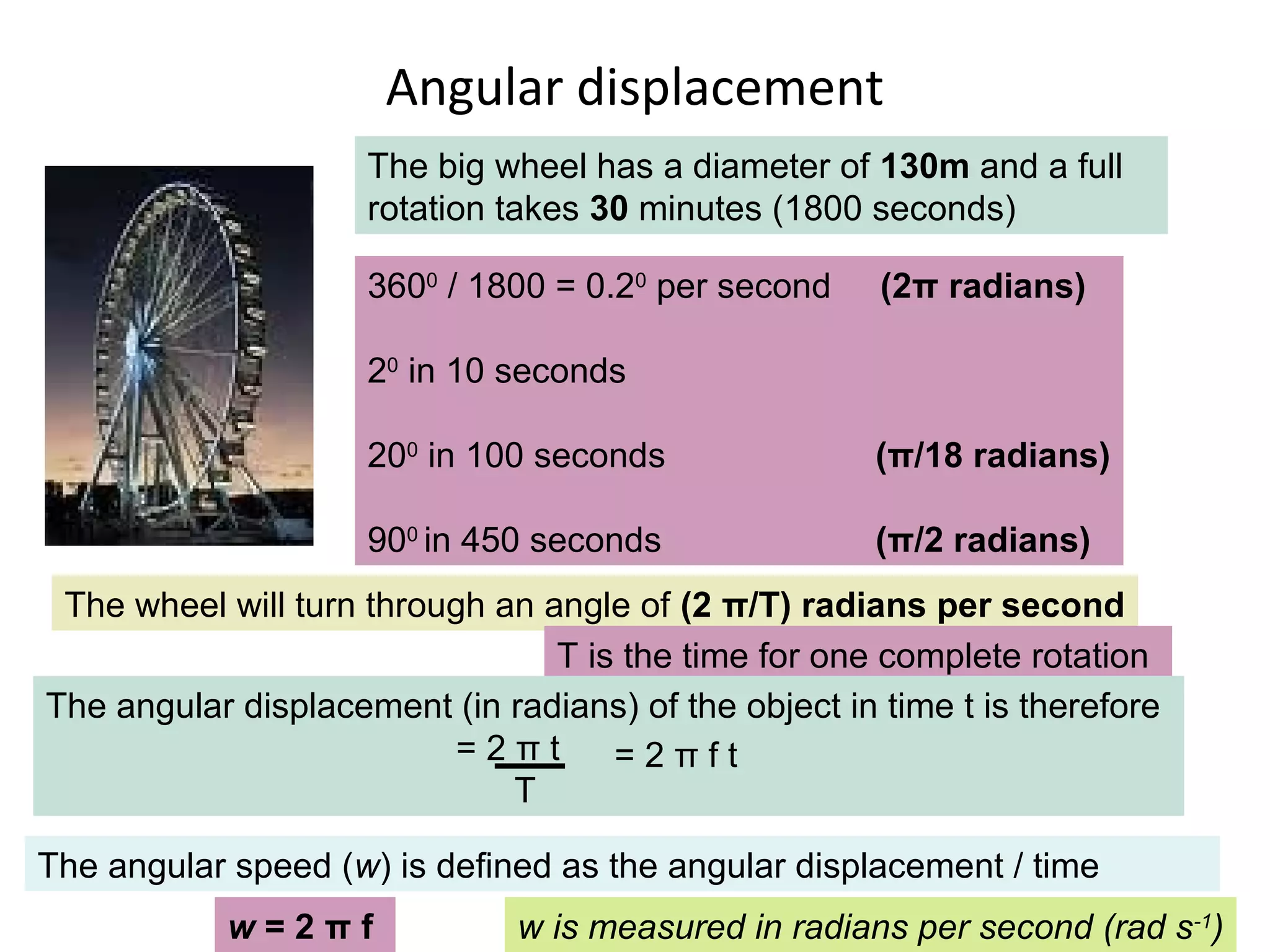
The big wheel has a diameter of 130m and a full
rotation takes 30 minutes (1800 seconds)
3600
/ 1800 = 0.20
per second (2π radians)
20
in 10 seconds
200
in 100 seconds (π/18 radians)
900
in 450 seconds (π/2 radians)
The wheel will turn through an angle of (2 π/T) radians per second
T is the time for one complete rotation
The angular displacement (in radians) of the object in time t is therefore
= 2 π t
T
= 2 π f t
The angular speed (w) is defined as the angular displacement / time
w = 2 π f w is measured in radians per second (rad s-1
)
Angular displacement
The big wheel has a diameter of 130m and a full
rotation takes 30 minutes (1800 seconds)
3600
/ 1800 = 0.20
per second (2π radians)
20
in 10 seconds
200
in 100 seconds (π/18 radians)
900
in 450 seconds (π/2 radians)
The wheel will turn through an angle of (2 π/T) radians per second
T is the time for one complete rotation
The angular displacement (in radians) of the object in time t is therefore
= 2 π t
T
= 2 π f t
The angular speed (w) is defined as the angular displacement / time
w = 2 π f w is measured in radians per second (rad s-1
)

Moving in circles

  • 1.
    Moving in Circles Whatforces are on you when you go around a corner?
  • 2.
    Task • Try andexplain why a car skids when it goes around a corner too quickly.
  • 3.
    Learning objectives • Howcan we recognise uniform motion in a circle? • What do we need to measure to find the speed of an object moving in uniform circular motion? • What is meant by angular displacement and angular speed?
  • 4.
    Objects which movein a circular path any suggestions? The hammer swung by a hammer thrower Clothes being dried in a spin drier Chemicals being separated in a centrifuge Cornering in a car or on a bike A stone being whirled round on a string A plane looping the loop A DVD, CD or record spinning on its turntable Satellites moving in orbits around the Earth A planet orbiting the Sun (almost circular orbit for many) Many fairground rides An electron in orbit about a nucleus
  • 5.
    The Wheel The speedof the perimeter of each wheel is the same as the cyclists speed, provide that the wheel does not slip or skid. r If the cyclists speed remains constant, his wheels turn at a steady rate. An object turning at a steady rate is said to be in uniform circular motion The circumference of the wheel = 2 π r The frequency of rotation f = 1/T, T is the time for 1 rotation The speed v of a point on the perimeter = circumference/ time for 1 rotation V = (2 π r) / T = 2 π r f Worked example p22
  • 6.
    Angular displacement The bigwheel has a diameter of 130m and a full rotation takes 30 minutes (1800 seconds) 3600 / 1800 = 0.20 per second (2π radians) 20 in 10 seconds 200 in 100 seconds (π/18 radians) 900 in 450 seconds (π/2 radians) The wheel will turn through an angle of (2 π/T) radians per second T is the time for one complete rotation The angular displacement (in radians) of the object in time t is therefore = 2 π t T = 2 π f t The angular speed (w) is defined as the angular displacement / time w = 2 π f w is measured in radians per second (rad s-1 )
  • 7.
    Angular displacement The bigwheel has a diameter of 130m and a full rotation takes 30 minutes (1800 seconds) 3600 / 1800 = 0.20 per second (2π radians) 20 in 10 seconds 200 in 100 seconds (π/18 radians) 900 in 450 seconds (π/2 radians) The wheel will turn through an angle of (2 π/T) radians per second T is the time for one complete rotation The angular displacement (in radians) of the object in time t is therefore = 2 π t T = 2 π f t The angular speed (w) is defined as the angular displacement / time w = 2 π f w is measured in radians per second (rad s-1 )