CENTRE OF MASSBy Yağız Kumtepe
HISTORYThe concept of center of mass was first introduced by the ancient Greek mathematician, physicist, and engineer Archimedes.Archimedes showed that the torque exerted on a lever by weights resting at various points along the lever is the same as what it would be if all of the weights were moved to a single point their center of mass.Inthe Middle Ages, theories on the center of mass were further developed by AbūRayhānBīrūnī, ZakariaRazi, Omar Khayyám, and al-Khazini.
CENTRE OF MASSThe center of mass is the point where all of the mass of the object is concentrated.The center of mass is a function only of the positions and masses of the particles that compose the system.The center of mass is often called the center of gravity but this is only true in a system where the gravitational forces are uniform.
BASIC INFORMATIONS The center of mass of a two-particle system lies on the line connecting the particles. The center of mass is closer to the more massive object.If the center of mass is a point within the object's actual structure, then the object can be balanced at that point.The center of mass of a rectangle is at the intersection of the two diagonals.If a rigid body is projected through the air, its center of mass will follow a natural parabolic arc.
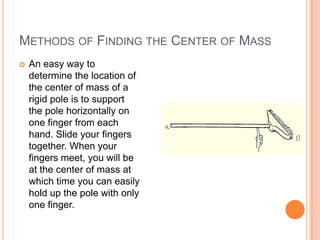
Methods of Finding the Center of Mass An easy way to determine the location of the center of mass of a rigid pole is to support the pole horizontally on one finger from each hand. Slide your fingers together. When your fingers meet, you will be at the center of mass at which time you can easily hold up the pole with only one finger.
Another method of finding the center of mass of an planar object is through the use of a plumb line. Suspend the mass from each vertex and trace the plumb line's location. Since the center of mass will fall below the suspension pointthe center of mass will be at the intersection of all of the plumb lines.
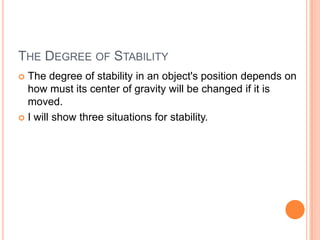
The Degree of StabilityThe degree of stability in an object's position depends on how must its center of gravity will be changed if it is moved.I will show three situations for stability.
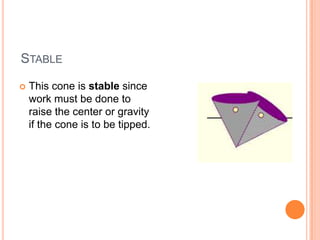
StableThis cone is stable since work must be done to raise the center or gravity if the cone is to be tipped.
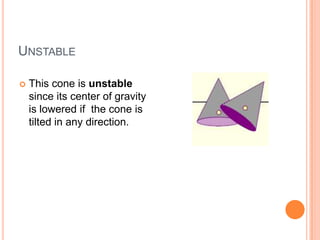
UnstableThis cone is unstable since its center of gravity is lowered if  the cone is tilted in any direction.
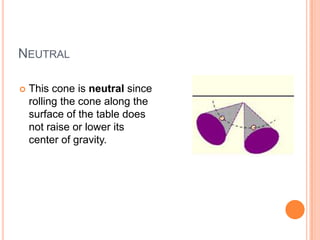
Neutral This cone is neutral since rolling the cone along the surface of the table does not raise or lower its center of gravity.
REFERENCEShttp://en.wikipedia.org/wiki/Center_of_masshttp://dev.physicslab.org/Document.aspx?doctype=3&filename=RotaryMotion_CenterMass.xmlhttp://hyperphysics.phy-astr.gsu.edu/HBASE/cm.htmlhttp://www.mathsrevision.net/alevel/pages.php?page=78http://www.surendranath.org/Applets/Dynamics/CM/CMApplet.html

Centre Of Mass

  • 1.
    CENTRE OF MASSByYağız Kumtepe
  • 2.
    HISTORYThe concept ofcenter of mass was first introduced by the ancient Greek mathematician, physicist, and engineer Archimedes.Archimedes showed that the torque exerted on a lever by weights resting at various points along the lever is the same as what it would be if all of the weights were moved to a single point their center of mass.Inthe Middle Ages, theories on the center of mass were further developed by AbūRayhānBīrūnī, ZakariaRazi, Omar Khayyám, and al-Khazini.
  • 3.
    CENTRE OF MASSThecenter of mass is the point where all of the mass of the object is concentrated.The center of mass is a function only of the positions and masses of the particles that compose the system.The center of mass is often called the center of gravity but this is only true in a system where the gravitational forces are uniform.
  • 4.
    BASIC INFORMATIONS Thecenter of mass of a two-particle system lies on the line connecting the particles. The center of mass is closer to the more massive object.If the center of mass is a point within the object's actual structure, then the object can be balanced at that point.The center of mass of a rectangle is at the intersection of the two diagonals.If a rigid body is projected through the air, its center of mass will follow a natural parabolic arc.
  • 5.
    Methods of Findingthe Center of Mass An easy way to determine the location of the center of mass of a rigid pole is to support the pole horizontally on one finger from each hand. Slide your fingers together. When your fingers meet, you will be at the center of mass at which time you can easily hold up the pole with only one finger.
  • 6.
    Another method offinding the center of mass of an planar object is through the use of a plumb line. Suspend the mass from each vertex and trace the plumb line's location. Since the center of mass will fall below the suspension pointthe center of mass will be at the intersection of all of the plumb lines.
  • 7.
    The Degree ofStabilityThe degree of stability in an object's position depends on how must its center of gravity will be changed if it is moved.I will show three situations for stability.
  • 8.
    StableThis cone isstable since work must be done to raise the center or gravity if the cone is to be tipped.
  • 9.
    UnstableThis cone isunstable since its center of gravity is lowered if  the cone is tilted in any direction.
  • 10.
    Neutral This coneis neutral since rolling the cone along the surface of the table does not raise or lower its center of gravity.
  • 11.