Interference and Beats
— Shiyue Ma
Interference of
one-dimensional waves
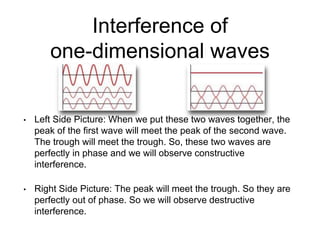
• Left Side Picture: When we put these two waves together, the
peak of the first wave will meet the peak of the second wave.
The trough will meet the trough. So, these two waves are
perfectly in phase and we will observe constructive
interference.
• Right Side Picture: The peak will meet the trough. So they are
perfectly out of phase. So we will observe destructive
interference.
Interference of
two plane waves
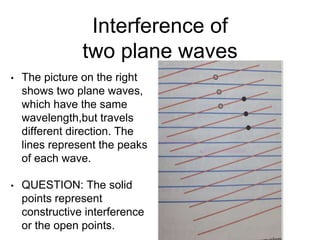
• The picture on the right
shows two plane waves,
which have the same
wavelength,but travels
different direction. The
lines represent the peaks
of each wave.
• QUESTION: The solid
points represent
constructive interference
or the open points.
Interference of
two plane waves
(Answer)
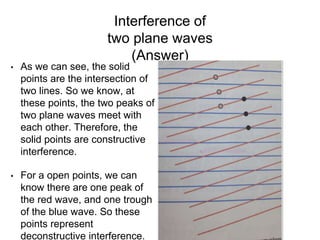
• As we can see, the solid
points are the intersection of
two lines. So we know, at
these points, the two peaks of
two plane waves meet with
each other. Therefore, the
solid points are constructive
interference.
• For a open points, we can
know there are one peak of
the red wave, and one trough
of the blue wave. So these
points represent
deconstructive interference.
Practise Question
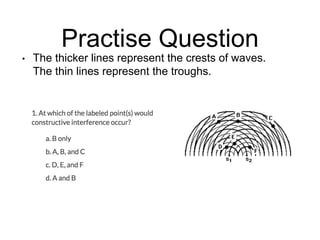
• The thicker lines represent the crests of waves.
The thin lines represent the troughs.
Answer
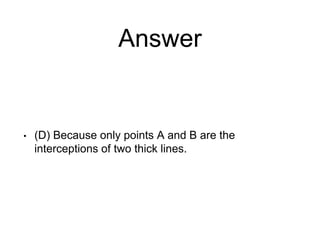
• (D) Because only points A and B are the
interceptions of two thick lines.
Path Difference
**We only path difference when the two waves have the same wavelength.
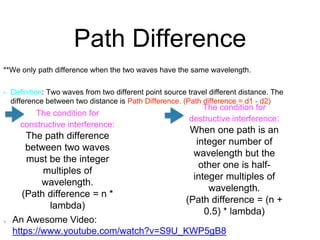
• Definition: Two waves from two different point source travel different distance. The
difference between two distance is Path Difference. (Path difference = d1 - d2)
An Awesome Video:
https://www.youtube.com/watch?v=S9U_KWP5gB8
The condition for
constructive interference:
The path difference
between two waves
must be the integer
multiples of
wavelength.
(Path difference = n *
lambda)
The condition for
destructive interference:
When one path is an
integer number of
wavelength but the
other one is half-
integer multiples of
wavelength.
(Path difference = (n +
0.5) * lambda)
Question
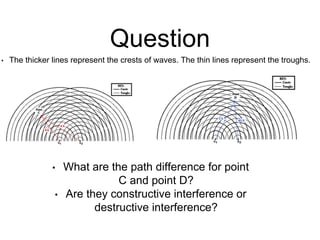
• The thicker lines represent the crests of waves. The thin lines represent the troughs.
• What are the path difference for point
C and point D?
• Are they constructive interference or
destructive interference?
Answer
• Point C: 6 λ — 4 λ = 2 λ
• Point D: 5 λ — 4.5 λ = 0.5 λ
• Because the path difference for point C is a integer
multiple of wavelength. So it is a constructive
interference.
• Because the path difference for point D is a half-
integer multiple of wavelength. So it is a destructive
interference.
Beats
• When there are two waves and the frequencies of
these two waves are slightly different from each
other. We can detect the increasing and decreasing
amplitude as a function of time. The variation of
amplitude is Beats.
• Demonstration Video:
https://www.youtube.com/watch?v=IYeV2Wq82fw
Formulas about beats
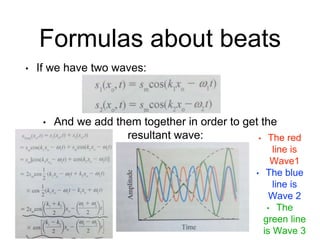
• If we have two waves:
• And we add them together in order to get the
resultant wave: • The red
line is
Wave1
• The blue
line is
Wave 2
• The
green line
is Wave 3
Tune
• Sometimes beats will make instruments out of tune.
In order to provide better musics to audience,
musicians need to adjust the frequency of its notes
until the beats disappear.
• This is a video that musicians are tuning their
instruments:
https://www.youtube.com/watch?v=KfSH1ezevjM
Thank you!!!!

Physics lo7

  • 1.
  • 2.
    Interference of one-dimensional waves •Left Side Picture: When we put these two waves together, the peak of the first wave will meet the peak of the second wave. The trough will meet the trough. So, these two waves are perfectly in phase and we will observe constructive interference. • Right Side Picture: The peak will meet the trough. So they are perfectly out of phase. So we will observe destructive interference.
  • 3.
    Interference of two planewaves • The picture on the right shows two plane waves, which have the same wavelength,but travels different direction. The lines represent the peaks of each wave. • QUESTION: The solid points represent constructive interference or the open points.
  • 4.
    Interference of two planewaves (Answer) • As we can see, the solid points are the intersection of two lines. So we know, at these points, the two peaks of two plane waves meet with each other. Therefore, the solid points are constructive interference. • For a open points, we can know there are one peak of the red wave, and one trough of the blue wave. So these points represent deconstructive interference.
  • 5.
    Practise Question • Thethicker lines represent the crests of waves. The thin lines represent the troughs.
  • 6.
    Answer • (D) Becauseonly points A and B are the interceptions of two thick lines.
  • 7.
    Path Difference **We onlypath difference when the two waves have the same wavelength. • Definition: Two waves from two different point source travel different distance. The difference between two distance is Path Difference. (Path difference = d1 - d2) An Awesome Video: https://www.youtube.com/watch?v=S9U_KWP5gB8 The condition for constructive interference: The path difference between two waves must be the integer multiples of wavelength. (Path difference = n * lambda) The condition for destructive interference: When one path is an integer number of wavelength but the other one is half- integer multiples of wavelength. (Path difference = (n + 0.5) * lambda)
  • 8.
    Question • The thickerlines represent the crests of waves. The thin lines represent the troughs. • What are the path difference for point C and point D? • Are they constructive interference or destructive interference?
  • 9.
    Answer • Point C:6 λ — 4 λ = 2 λ • Point D: 5 λ — 4.5 λ = 0.5 λ • Because the path difference for point C is a integer multiple of wavelength. So it is a constructive interference. • Because the path difference for point D is a half- integer multiple of wavelength. So it is a destructive interference.
  • 10.
    Beats • When thereare two waves and the frequencies of these two waves are slightly different from each other. We can detect the increasing and decreasing amplitude as a function of time. The variation of amplitude is Beats. • Demonstration Video: https://www.youtube.com/watch?v=IYeV2Wq82fw
  • 11.
    Formulas about beats •If we have two waves: • And we add them together in order to get the resultant wave: • The red line is Wave1 • The blue line is Wave 2 • The green line is Wave 3
  • 12.
    Tune • Sometimes beatswill make instruments out of tune. In order to provide better musics to audience, musicians need to adjust the frequency of its notes until the beats disappear. • This is a video that musicians are tuning their instruments: https://www.youtube.com/watch?v=KfSH1ezevjM
  • 13.