Hafez ahmad1
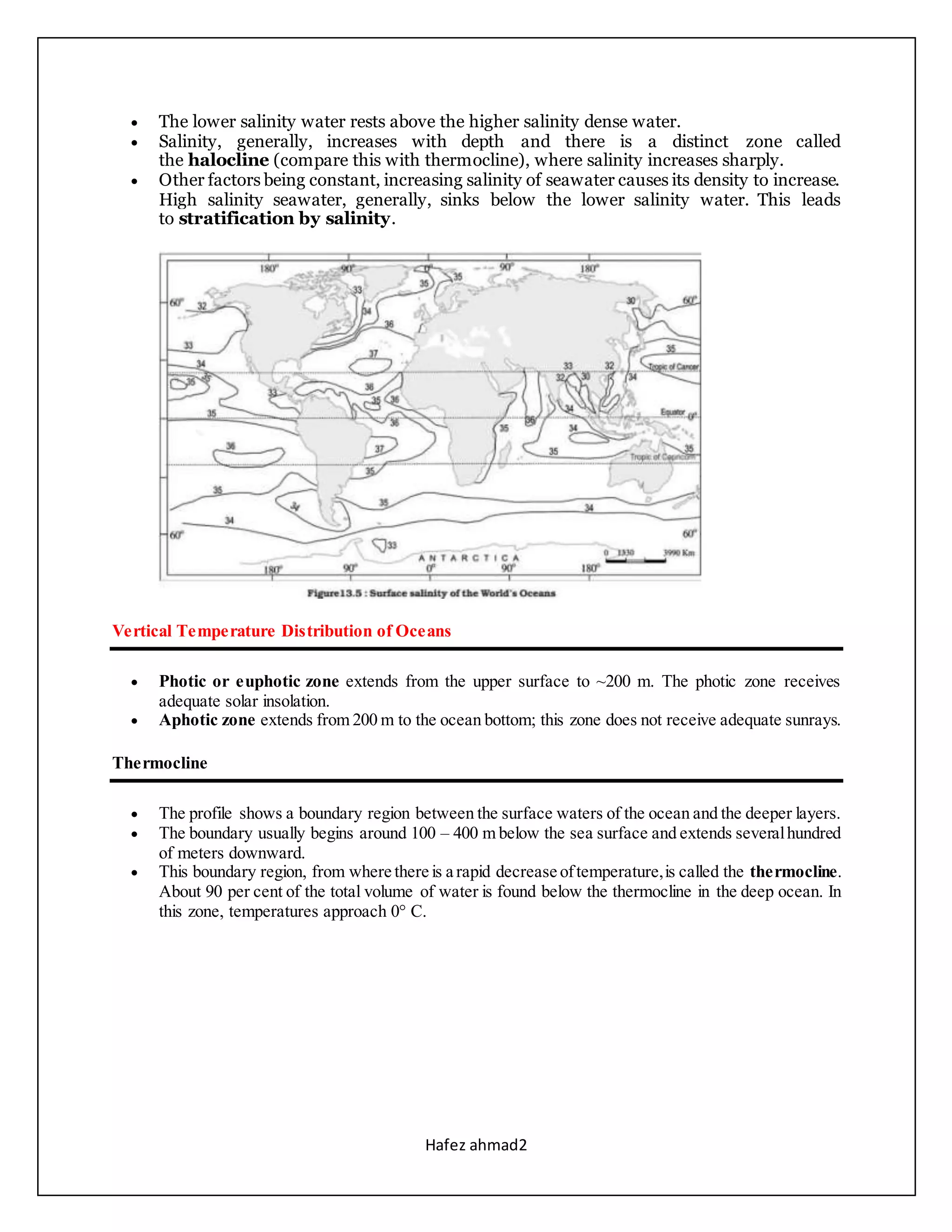
Horizontal distribution of salinity
 Polar regions: salinity lower, lots of rain/snow and runoff
 Mid-latitudes: salinity higher, high rate of evaporation
 Equator: salinity lower, lots of rain
 Thus, salinity at surface varies primarily with latitude
 The salinity for normal open ocean ranges between 33 and 37.
High salinity regions
 In the land locked Red Sea (Dead Sea which has much greater salinity), it is as high as 41.
 In hot and dry regions, where evaporation is high, the salinity sometimes reaches to 70.
Comparatively Low salinity regions
 In the estuaries (enclosed mouth of a river where fresh and saline water get mixed) and the Arctic,
the salinity fluctuates from 0 – 35, seasonally (fresh water coming from ice caps).
Pacific Ocean
 The salinity variation in the Pacific Ocean is mainly due to its shape and larger areal extent.
Atlantic Ocean
 The average salinity of the Atlantic Ocean is around 36-37.
 The equatorial region of the Atlantic Ocean has a salinity of about 35.
 Near the equator, there is heavy rainfall, high relative humidity, cloudiness and calm air of the
doldrums.
 The polar areas experience very little evaporation and receive large amounts of fresh water from the
melting of ice. This leads to low levels of salinity, ranging between 20 and 32.
Indian Ocean Ocean
 The average salinity of the Indian Ocean is 35.
 The low salinity trend is observed in the Bay of Bengal due to influx of river water by the river
Ganga.
Vertical Distribution of Salinity
 Salinity changes with depth, but the way it changes depends upon the location of the sea.
 Salinity at the surface increases by the loss of water to ice or evaporation, or decreased by
the input of fresh waters, such as from the rivers.
 Salinity at depth is very much fixed, because there is no way that water is ‘lost’, or the salt
is ‘added.’ There is a marked difference in the salinity between the surface zones and the
deep zones of the oceans.
Hafez ahmad2
 The lower salinity water rests above the higher salinity dense water.
 Salinity, generally, increases with depth and there is a distinct zone called
the halocline (compare this with thermocline), where salinity increases sharply.
 Other factors being constant, increasing salinity of seawater causes its density to increase.
High salinity seawater, generally, sinks below the lower salinity water. This leads
to stratification by salinity.
Vertical Temperature Distribution of Oceans
 Photic or euphotic zone extends from the upper surface to ~200 m. The photic zone receives
adequate solar insolation.
 Aphotic zone extends from 200 m to the ocean bottom; this zone does not receive adequate sunrays.
Thermocline
 The profile shows a boundary region between the surface waters of the ocean and the deeper layers.
 The boundary usually begins around 100 – 400 m below the sea surface and extends severalhundred
of meters downward.
 This boundary region, from where there is a rapid decrease oftemperature,is called the thermocline.
About 90 per cent of the total volume of water is found below the thermocline in the deep ocean. In
this zone, temperatures approach 0° C.
Hafez ahmad3
Three-Layer System
 The temperature structure of oceans over middle and low latitudes can be described as a
three-layer system from surface to the bottom.
 The first layer represents the top layer of warm oceanic water and it is about 500m thick
with temperatures ranging between 20° and 25° C. This layer, within the tropical region, is
present throughout the year but in mid-latitudes it develops only during summer.
 The second layer called the thermocline layer lies below the first layer and is characterized
by rapid decrease in temperature with increasing depth. The thermocline is 500 -1,000 m
thick.
 The third layer is very cold and extends up to the deep ocean floor. Here the temperature
becomes almost stagnant.
Horizontal Temperature Distribution of Oceans
 The average temperature of surface water of the oceans is about 27°C and it gradually
decreases from the equator towards the poles.
 The rate of decrease of temperature with increasing latitude is generally 0.5°C per latitude.
 The horizontal temperature distribution is shown by isothermal lines, i.e., lines joining
places of equal temperature.
 Isotherms are closely spaced when the temperature difference is high and vice versa.
 For example, in February, isothermal lines are closely spaced in the south of Newfoundland,
near the west coast of Europe and North Sea and then isotherms widen out to make; a bulge
towards north near the coast of Norway. The cause of this phenomenon lies in the cold
Hafez ahmad4
Labrador Current flowing southward along the north American coast which reduces the
temperature of the region more sharply than in other places in the same latitude; at the same
time the warm Gulf Stream proceeds towards the western coast of Europe and raises the
temperature of the west coast of Europe.
Surface seawater salinities largely reflect the local balance between evaporation and precipitation.
a. Low salinities occur near the equator due to rain from rising atmospheric circulation.
b. High salinities are typical of the hot dry gyres flanking the equator (+-20-30 degrees
latitude) where atmospheric circulation cells descend.
c. Salinity can also be affected by sea ice formation/melting (e.g. around Antarctica)
d. The surface N. Atlantic is saltier than the surface N. Pacific, making surface water
denser in the N. Atlantic at the same temperature and leading to down-welling of water
in this region this difference is because on average N. Atlantic is warmer (10.0 °C) than
N. Pacific (6.7 C). This is mostly because of the greater local heating effect of the Gulf
Stream, as compared to the Kuroshio Current. Warmer water evaporates more rapidly,
creating a higher residual salt content.
The influence of surface fluctuations in salinity due to changes in evaporation and
precipitation is generally small below 1000 m, where salinities are mostly between about
34.5 and 35.0 at all latitudes. Zones where salinity decreases with depth are typically
found occur at low latitudes and mid latitudes, between the mixed surface layer and the
deep ocean. These zones are known as haloclines.
Force: force is an action of one body on another. It is a vector quantity since its effect depends on
the direction as well as on the magnitude of the action.
The four fundamental forces which exist in nature are:
1. Force of gravitation: In this universe everybody attracts each other by a force towards them. The
mutual attraction between any two bodies of the universe is called gravitation. This attraction
occurs due to mass of the bodies. The force of gravitation is comparatively weak among
the fundamental forces.
2. Electromagnetic force: The electromagnetic force is defined as the force exerted by two charged
particles or bodies on each other due to their charges. This force may be of both types- attractive
or repulsive.
Hafez ahmad5
3. Weak nuclear force: The short range and small magnitude force that exists between the
fundamental particles within the nucleus is called weak nuclear force. Due to this force the nucleus
becomes unstable and beta decay occurs. Most of the radioactive disintegration occurs due to
weak nuclear force. The range of this force is less than 10-16
m.
4. Strong nuclear force: It is known that there are two particles namely proton and neutron within
the nucleus of an atom. These particles are called nucleon. The strong force that exists betweentwo
nucleons within the nucleus of an atom is called strong nuclear force. This force bounds
the nucleons together. The strong nuclear force is responsible for the stability of the
nucleus. This force is very short range and attractive. The range of this force is 10-15 m
which is the radius of the nucleus. This force is the strongest among the fundamental forces.
Radiance : radiance is the radiant flux emitted, reflected,transmitted or receivedby a given surface,
per unit solid angle per unit projected area. The SI unit of radiance is the watt per steradian per
square metre (W·sr−1·m−2)
Irradiance: Solar irradiance is the power per unit area received from the Sun in the form of
electromagnetic radiation in the wavelength range of the measuring instrument.
Color of the ocean /Why is ocean color important?
Roughly 70% of the Earth’s surface is covered by ocean. About half of the global primary
production (photosynthesis) occurs in the ocean. Most of the primary producers in the ocean
comprise microscopic plants and some bacteria; these photosynthetic organisms called
phytoplankton form the base of the ocean’s food web. Changes in phytoplankton biomass would
have major implications for the ocean’s ability to take up atmospheric CO2 and support current
rates of fish production, as well as the overall health of the ocean, which is currently threatened by
multiple stresses such as increased temperature and ocean acidification (both due to anthropogenic
CO2 emissions), marine pollution, and overfishing. The conversion of carbon dioxide and water
into carbohydratesand oxygen in the presence of light representsthe energy supply to single-celled
organisms (for example, phytoplankton), the base of marine food webs.Oceancolor measurements
are used to learn about the composition of phytoplankton, microscopic organisms that live in the
sunlit, or photic, zone of the ocean and create energy through photosynthesis. These organisms
make up half of all photosynthetic activity on the planet and provide half of the oxygen in the
Earth’s atmosphere. Ocean color measurements reveal a wealth of ecologically important
characteristics that many scientists and operational users rely on for research, ecosystem
monitoring, and resource management. These characteristics include:
1.chlorophyll concentration (a proxy for the biomass of marine plants or phytoplankton)
2.the rate of phytoplankton photosynthesis
3.sediment transport
4.dispersion of pollutants
5.responses of oceanic biota to long-term climate changes (IOCCG, 2008).
In addition, related parameters derived from ocean color satellites can be used to monitor oil spills,
harmful algal blooms, and the health of important fisheries’ habitat.
Scattering :Light scattering is a form of scattering in which light in the form of propagating energy
is scattered. Light scattering can be thought of as the deflection of a ray from a straight path, for
example by irregularities in the propagation medium, particles, or in the interface between two
media.
Attenuation: The intensity of visible light transmitted through water decreases rapidly with
increasing depth. This decrease inintensity with depth is called attenuation. The attenuation of light
is due to absorption and scattering by particles in the water.
Radiation: Radiation is a direct transfer of heat to a body from the heat source. The obvious
example of this is the solar radiation that heats Earth. Incoming solar radiation warms the surface
Hafez ahmad6
waters of the oceans, decreasing the density of the water so that it "floats" on the colder, denser
water below.
Refraction is the bending of waves,which occurs when waves travelfrom one medium to another.
Refraction can bend the paths of light and sound through Water.
Fluid: a fluid is a substance that continually deforms (flows) under an applied shear stress. Fluids
are a subset of the phases of matter and include liquids, gases, plasmas, and to some extent, plastic
solids.
Properties of light : Light is a type of energy. It is a form of electromagnetic radiation of a
wavelength which can be detected by the human eye.
1. Light always travels in straight lines
2. Light always travels at 2.98 x 10 8 ms -1 in air or a vacuum
3. WAVES This is a transverse wave where the oscillations are perpendicular
4. Light behaves as wave in some cases and also as particle in some incidents
5. Reflection, refraction, interference, diffraction, dispersion and polarization of light
6. take place.
Space Oceanography
Space Oceanography encompassesoceanographic researchand technological development resulting
from manned and unmanned systems in Earth’s orbit. These systems observe and measure
oceanographic parameterssuchasseassurface winds,sea surface temperature,waves,ocean currents
and frontal regions. The scope of oceanographic research embraces the sciences of physics
(including acoustics),geology, biology and chemistry. The technological developments include new
sensing methods and sensor systems to acquire oceanographic data with specified degrees of
resolution, accuracy,coverage and timeliness. Some oceanographic phenomena were first observed
and photographed by astronauts in space. Sensor technology then evolved to observe the same
phenomena from unmanned spacecraft. Asourscientific knowledge of the world’s oceansincreases,
and as a consequence the accuracy of the physics in oceanographic forecasting models improves,
there arises a need for real-time, global (encompassing all ocean basins), daily oceanographic
observation systems.
Monsoon
Monsoon the wind system that dominates the climate of South Asia and the area around the indian ocean
with seasonalreversals of direction caused by the differential heating and cooling of landmass and oceans
between summer and winter. The wind blows from the northeast (towards the sea) in winter (the dry-
monsoon) and from the southwest (towards the land) in summer (the wet-monsoon). The South-West
Monsoon are rain-bearing on-shore winds, blowing from sea to land, and bring rains to most parts of the
subcontinent. The Monsoon winds are eagerly awaited in most parts of India for their agricultural and
economic importance.
Subsequently later in the year, around October, these winds reverse direction and start blowing from north
direction. The North-East Monsoon are off-shore winds. Given their land to sea flow, from subcontinent
onto the Indian Ocean,they have less moisture and bring rain to only limited parts of India. This is known
as the North-East Monsoon.
The word 'monsoon' is derived from the Arabic word 'mawsim' which means seasons. The monsoon
cycle is believed to have started about 12 million years ago with the uplift of the himalayas.
During the summer season,a centre of low pressure develops over the western part of India because of
the intense heating of the landmass, while high pressure develops over the relatively cooler Indian Ocean.
This pressure difference causes the winds to flow from the high-pressure area to the low-pressure area,
which is from ocean to land in this case. This flow pattern is known as the summer monsoon circulation.
Hafez ahmad7
As a result, the summer monsoon winds bring in enormous amount of moisture, causing heavy rainfall in
the subcontinent, especially in Bangladesh and the neighbouring states of India.The summer monsoon
flow of the Indian Ocean has two branches - the Arabian Sea branch and the bay of bengal branch. The
Arabian Sea branch dominates the weather scenes in central and peninsular India, while the Bay of
Bengal branch dominates the scenes in Bangladesh, northeastern India, Gangetic Plain and the southern
slopes of the Himalayas. It enters Bangladesh in late May or early June, and continues to flow toward the
centre of low pressure that lies over the west-centralpart of India.
During the winter season,the landmass of India cools at a faster rate than the adjacent watermass (ie, the
Indian Ocean). Consequently, a centre of high pressure develops over the northwestern part of India,
while low pressure develops over the relatively warmer Indian Ocean. As a result of this pressure
distribution, winds flow from the interior of India toward the Indian Ocean,which is known as the winter
monsoon circulation. A stream of this circulation flows down the Gangetic Plain toward Bangladesh, and
then to the Bay of Bengal. Since the wind in this season is characterised by the land-to-ocean flow, nearly
dry conditions prevail during this season with a meagre rainfall distribution.
Hafez ahmad8
Hafez ahmad9

Physical oceanography

  • 1.
    Hafez ahmad1 Horizontal distributionof salinity  Polar regions: salinity lower, lots of rain/snow and runoff  Mid-latitudes: salinity higher, high rate of evaporation  Equator: salinity lower, lots of rain  Thus, salinity at surface varies primarily with latitude  The salinity for normal open ocean ranges between 33 and 37. High salinity regions  In the land locked Red Sea (Dead Sea which has much greater salinity), it is as high as 41.  In hot and dry regions, where evaporation is high, the salinity sometimes reaches to 70. Comparatively Low salinity regions  In the estuaries (enclosed mouth of a river where fresh and saline water get mixed) and the Arctic, the salinity fluctuates from 0 – 35, seasonally (fresh water coming from ice caps). Pacific Ocean  The salinity variation in the Pacific Ocean is mainly due to its shape and larger areal extent. Atlantic Ocean  The average salinity of the Atlantic Ocean is around 36-37.  The equatorial region of the Atlantic Ocean has a salinity of about 35.  Near the equator, there is heavy rainfall, high relative humidity, cloudiness and calm air of the doldrums.  The polar areas experience very little evaporation and receive large amounts of fresh water from the melting of ice. This leads to low levels of salinity, ranging between 20 and 32. Indian Ocean Ocean  The average salinity of the Indian Ocean is 35.  The low salinity trend is observed in the Bay of Bengal due to influx of river water by the river Ganga. Vertical Distribution of Salinity  Salinity changes with depth, but the way it changes depends upon the location of the sea.  Salinity at the surface increases by the loss of water to ice or evaporation, or decreased by the input of fresh waters, such as from the rivers.  Salinity at depth is very much fixed, because there is no way that water is ‘lost’, or the salt is ‘added.’ There is a marked difference in the salinity between the surface zones and the deep zones of the oceans.
  • 2.
    Hafez ahmad2  Thelower salinity water rests above the higher salinity dense water.  Salinity, generally, increases with depth and there is a distinct zone called the halocline (compare this with thermocline), where salinity increases sharply.  Other factors being constant, increasing salinity of seawater causes its density to increase. High salinity seawater, generally, sinks below the lower salinity water. This leads to stratification by salinity. Vertical Temperature Distribution of Oceans  Photic or euphotic zone extends from the upper surface to ~200 m. The photic zone receives adequate solar insolation.  Aphotic zone extends from 200 m to the ocean bottom; this zone does not receive adequate sunrays. Thermocline  The profile shows a boundary region between the surface waters of the ocean and the deeper layers.  The boundary usually begins around 100 – 400 m below the sea surface and extends severalhundred of meters downward.  This boundary region, from where there is a rapid decrease oftemperature,is called the thermocline. About 90 per cent of the total volume of water is found below the thermocline in the deep ocean. In this zone, temperatures approach 0° C.
  • 3.
    Hafez ahmad3 Three-Layer System The temperature structure of oceans over middle and low latitudes can be described as a three-layer system from surface to the bottom.  The first layer represents the top layer of warm oceanic water and it is about 500m thick with temperatures ranging between 20° and 25° C. This layer, within the tropical region, is present throughout the year but in mid-latitudes it develops only during summer.  The second layer called the thermocline layer lies below the first layer and is characterized by rapid decrease in temperature with increasing depth. The thermocline is 500 -1,000 m thick.  The third layer is very cold and extends up to the deep ocean floor. Here the temperature becomes almost stagnant. Horizontal Temperature Distribution of Oceans  The average temperature of surface water of the oceans is about 27°C and it gradually decreases from the equator towards the poles.  The rate of decrease of temperature with increasing latitude is generally 0.5°C per latitude.  The horizontal temperature distribution is shown by isothermal lines, i.e., lines joining places of equal temperature.  Isotherms are closely spaced when the temperature difference is high and vice versa.  For example, in February, isothermal lines are closely spaced in the south of Newfoundland, near the west coast of Europe and North Sea and then isotherms widen out to make; a bulge towards north near the coast of Norway. The cause of this phenomenon lies in the cold
  • 4.
    Hafez ahmad4 Labrador Currentflowing southward along the north American coast which reduces the temperature of the region more sharply than in other places in the same latitude; at the same time the warm Gulf Stream proceeds towards the western coast of Europe and raises the temperature of the west coast of Europe. Surface seawater salinities largely reflect the local balance between evaporation and precipitation. a. Low salinities occur near the equator due to rain from rising atmospheric circulation. b. High salinities are typical of the hot dry gyres flanking the equator (+-20-30 degrees latitude) where atmospheric circulation cells descend. c. Salinity can also be affected by sea ice formation/melting (e.g. around Antarctica) d. The surface N. Atlantic is saltier than the surface N. Pacific, making surface water denser in the N. Atlantic at the same temperature and leading to down-welling of water in this region this difference is because on average N. Atlantic is warmer (10.0 °C) than N. Pacific (6.7 C). This is mostly because of the greater local heating effect of the Gulf Stream, as compared to the Kuroshio Current. Warmer water evaporates more rapidly, creating a higher residual salt content. The influence of surface fluctuations in salinity due to changes in evaporation and precipitation is generally small below 1000 m, where salinities are mostly between about 34.5 and 35.0 at all latitudes. Zones where salinity decreases with depth are typically found occur at low latitudes and mid latitudes, between the mixed surface layer and the deep ocean. These zones are known as haloclines. Force: force is an action of one body on another. It is a vector quantity since its effect depends on the direction as well as on the magnitude of the action. The four fundamental forces which exist in nature are: 1. Force of gravitation: In this universe everybody attracts each other by a force towards them. The mutual attraction between any two bodies of the universe is called gravitation. This attraction occurs due to mass of the bodies. The force of gravitation is comparatively weak among the fundamental forces. 2. Electromagnetic force: The electromagnetic force is defined as the force exerted by two charged particles or bodies on each other due to their charges. This force may be of both types- attractive or repulsive.
  • 5.
    Hafez ahmad5 3. Weaknuclear force: The short range and small magnitude force that exists between the fundamental particles within the nucleus is called weak nuclear force. Due to this force the nucleus becomes unstable and beta decay occurs. Most of the radioactive disintegration occurs due to weak nuclear force. The range of this force is less than 10-16 m. 4. Strong nuclear force: It is known that there are two particles namely proton and neutron within the nucleus of an atom. These particles are called nucleon. The strong force that exists betweentwo nucleons within the nucleus of an atom is called strong nuclear force. This force bounds the nucleons together. The strong nuclear force is responsible for the stability of the nucleus. This force is very short range and attractive. The range of this force is 10-15 m which is the radius of the nucleus. This force is the strongest among the fundamental forces. Radiance : radiance is the radiant flux emitted, reflected,transmitted or receivedby a given surface, per unit solid angle per unit projected area. The SI unit of radiance is the watt per steradian per square metre (W·sr−1·m−2) Irradiance: Solar irradiance is the power per unit area received from the Sun in the form of electromagnetic radiation in the wavelength range of the measuring instrument. Color of the ocean /Why is ocean color important? Roughly 70% of the Earth’s surface is covered by ocean. About half of the global primary production (photosynthesis) occurs in the ocean. Most of the primary producers in the ocean comprise microscopic plants and some bacteria; these photosynthetic organisms called phytoplankton form the base of the ocean’s food web. Changes in phytoplankton biomass would have major implications for the ocean’s ability to take up atmospheric CO2 and support current rates of fish production, as well as the overall health of the ocean, which is currently threatened by multiple stresses such as increased temperature and ocean acidification (both due to anthropogenic CO2 emissions), marine pollution, and overfishing. The conversion of carbon dioxide and water into carbohydratesand oxygen in the presence of light representsthe energy supply to single-celled organisms (for example, phytoplankton), the base of marine food webs.Oceancolor measurements are used to learn about the composition of phytoplankton, microscopic organisms that live in the sunlit, or photic, zone of the ocean and create energy through photosynthesis. These organisms make up half of all photosynthetic activity on the planet and provide half of the oxygen in the Earth’s atmosphere. Ocean color measurements reveal a wealth of ecologically important characteristics that many scientists and operational users rely on for research, ecosystem monitoring, and resource management. These characteristics include: 1.chlorophyll concentration (a proxy for the biomass of marine plants or phytoplankton) 2.the rate of phytoplankton photosynthesis 3.sediment transport 4.dispersion of pollutants 5.responses of oceanic biota to long-term climate changes (IOCCG, 2008). In addition, related parameters derived from ocean color satellites can be used to monitor oil spills, harmful algal blooms, and the health of important fisheries’ habitat. Scattering :Light scattering is a form of scattering in which light in the form of propagating energy is scattered. Light scattering can be thought of as the deflection of a ray from a straight path, for example by irregularities in the propagation medium, particles, or in the interface between two media. Attenuation: The intensity of visible light transmitted through water decreases rapidly with increasing depth. This decrease inintensity with depth is called attenuation. The attenuation of light is due to absorption and scattering by particles in the water. Radiation: Radiation is a direct transfer of heat to a body from the heat source. The obvious example of this is the solar radiation that heats Earth. Incoming solar radiation warms the surface
  • 6.
    Hafez ahmad6 waters ofthe oceans, decreasing the density of the water so that it "floats" on the colder, denser water below. Refraction is the bending of waves,which occurs when waves travelfrom one medium to another. Refraction can bend the paths of light and sound through Water. Fluid: a fluid is a substance that continually deforms (flows) under an applied shear stress. Fluids are a subset of the phases of matter and include liquids, gases, plasmas, and to some extent, plastic solids. Properties of light : Light is a type of energy. It is a form of electromagnetic radiation of a wavelength which can be detected by the human eye. 1. Light always travels in straight lines 2. Light always travels at 2.98 x 10 8 ms -1 in air or a vacuum 3. WAVES This is a transverse wave where the oscillations are perpendicular 4. Light behaves as wave in some cases and also as particle in some incidents 5. Reflection, refraction, interference, diffraction, dispersion and polarization of light 6. take place. Space Oceanography Space Oceanography encompassesoceanographic researchand technological development resulting from manned and unmanned systems in Earth’s orbit. These systems observe and measure oceanographic parameterssuchasseassurface winds,sea surface temperature,waves,ocean currents and frontal regions. The scope of oceanographic research embraces the sciences of physics (including acoustics),geology, biology and chemistry. The technological developments include new sensing methods and sensor systems to acquire oceanographic data with specified degrees of resolution, accuracy,coverage and timeliness. Some oceanographic phenomena were first observed and photographed by astronauts in space. Sensor technology then evolved to observe the same phenomena from unmanned spacecraft. Asourscientific knowledge of the world’s oceansincreases, and as a consequence the accuracy of the physics in oceanographic forecasting models improves, there arises a need for real-time, global (encompassing all ocean basins), daily oceanographic observation systems. Monsoon Monsoon the wind system that dominates the climate of South Asia and the area around the indian ocean with seasonalreversals of direction caused by the differential heating and cooling of landmass and oceans between summer and winter. The wind blows from the northeast (towards the sea) in winter (the dry- monsoon) and from the southwest (towards the land) in summer (the wet-monsoon). The South-West Monsoon are rain-bearing on-shore winds, blowing from sea to land, and bring rains to most parts of the subcontinent. The Monsoon winds are eagerly awaited in most parts of India for their agricultural and economic importance. Subsequently later in the year, around October, these winds reverse direction and start blowing from north direction. The North-East Monsoon are off-shore winds. Given their land to sea flow, from subcontinent onto the Indian Ocean,they have less moisture and bring rain to only limited parts of India. This is known as the North-East Monsoon. The word 'monsoon' is derived from the Arabic word 'mawsim' which means seasons. The monsoon cycle is believed to have started about 12 million years ago with the uplift of the himalayas. During the summer season,a centre of low pressure develops over the western part of India because of the intense heating of the landmass, while high pressure develops over the relatively cooler Indian Ocean. This pressure difference causes the winds to flow from the high-pressure area to the low-pressure area, which is from ocean to land in this case. This flow pattern is known as the summer monsoon circulation.
  • 7.
    Hafez ahmad7 As aresult, the summer monsoon winds bring in enormous amount of moisture, causing heavy rainfall in the subcontinent, especially in Bangladesh and the neighbouring states of India.The summer monsoon flow of the Indian Ocean has two branches - the Arabian Sea branch and the bay of bengal branch. The Arabian Sea branch dominates the weather scenes in central and peninsular India, while the Bay of Bengal branch dominates the scenes in Bangladesh, northeastern India, Gangetic Plain and the southern slopes of the Himalayas. It enters Bangladesh in late May or early June, and continues to flow toward the centre of low pressure that lies over the west-centralpart of India. During the winter season,the landmass of India cools at a faster rate than the adjacent watermass (ie, the Indian Ocean). Consequently, a centre of high pressure develops over the northwestern part of India, while low pressure develops over the relatively warmer Indian Ocean. As a result of this pressure distribution, winds flow from the interior of India toward the Indian Ocean,which is known as the winter monsoon circulation. A stream of this circulation flows down the Gangetic Plain toward Bangladesh, and then to the Bay of Bengal. Since the wind in this season is characterised by the land-to-ocean flow, nearly dry conditions prevail during this season with a meagre rainfall distribution.
  • 8.
  • 9.