PHYSICAL ASSESSMENT
Nuzhata Nazir
Tutor/Demonstrator
GMC Anantnag
Physical assessment
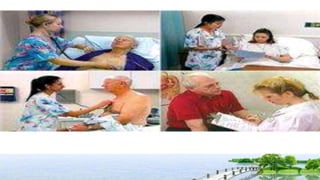
 It is the systematic collection of objective information that is directly observed
or is elicited through examination techniques.
 Physical examination involves the use of ones senses to obtain information
about the structure and function of an area being observed or manipulated.
 It the thorough inspection or a detailed study of the entire body or some parts
of the body to determine the general physical or mental conditions of the body.
Purpose
 To understand the physical and mental well-being of the clients.
 To detect disease in its early stage.
 To determine the cause and extent of disease.
 To understand any change in the condition of diseases, any improvement or regression.
 To determine the nature of the treatment or nursing care needed for the client.
 To safeguard the client and his family by noting the early signs especially in case of a
communicable disease.
 To contribute to the medical research.
 To find out whether the person is medically fit or not for a particular task.
Indication of phisical examination
 Inspection
 Palpation
 Percussion
 Auscultation
 olfaction
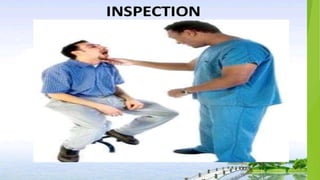
Inspection
 Systematic Visual examination of the patient or it is a process of performing deliberate purposeful observations in a
systematic manner.
 It involves observation of the colour, shape, size, symmetry, position and movements.
 Findings that may be significant
1. overall appearance of health or illness
2. Grooming and personal hygiene
3. Signs of distress
4. Facial expression and mood
5. Eye gaze
6. Body language
7. Body position
8. Skin color
9. Odor
 Inspection is the first method used in examination of specific area. The chest and abdomen are inspected before
palpation and auscultation.
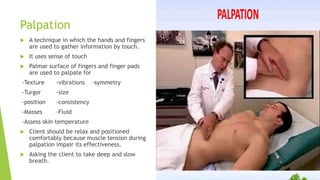
Palpation
 A technique in which the hands and fingers
are used to gather information by touch.
 It uses sense of touch
 Palmar surface of fingers and finger pads
are used to palpate for
-Texture -vibrations -symmetry
-Turgor -size
-position -consistency
-Masses -Fluid
-Assess skin temperature
 Client should be relax and positioned
comfortably because muscle tension during
palpation impair its effectiveness.
 Asking the client to take deep and slow
breath.
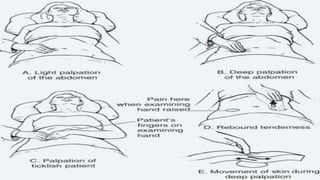
Types of palpation
 Light palpation
 Deep palpatipn
 Bimanual palpation
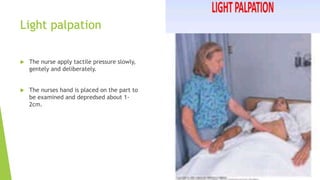
Light palpation
 The nurse apply tactile pressure slowly,
gentely and deliberately.
 The nurses hand is placed on the part to
be examined and depredsed about 1-
2cm.
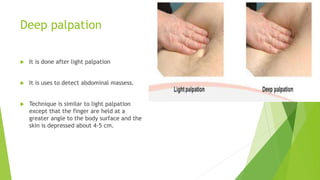
Deep palpation
 It is done after light palpation
 It is uses to detect abdominal massess.
 Technique is similar to light palpation
except that the finger are held at a
greater angle to the body surface and the
skin is depressed about 4-5 cm.
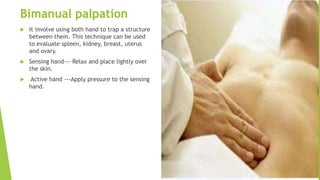
Bimanual palpation
 It involve using both hand to trap a structure
between them. This technique can be used
to evaluate spleen, kidney, breast, uterus
and ovary.
 Sensing hand--- Relax and place lightly over
the skin.
 Active hand ---Apply pressure to the sensing
hand.
Palpation Cont.
.
 The dorsum (back) surfaces of the hand and fingers are used to measure temperature.
 The palmar (front) surfaces of fingers and finger pads are used to assess texture, shape,
fluid, size, consistency and pulsation.
 Vibration is palpated best with the palm of the hand. (Tactile fremitus)
 Symmetry-Grab the lower hemithorax on either side of axilla and gently bring your thumbs
to the midline.
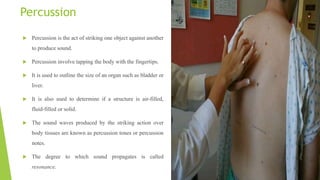
Percussion
 Percussion is the act of striking one object against another
to produce sound.
 Percussion involve tapping the body with the fingertips.
 It is used to outline the size of an organ such as bladder or
liver.
 It is also used to determine if a structure is air-filled,
fluid-filled or solid.
 The sound waves produced by the striking action over
body tissues are known as percussion tones or percussion
notes.
 The degree to which sound propagates is called
resonance.
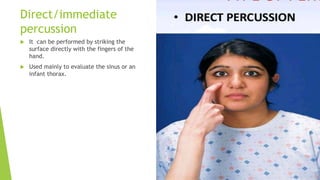
Direct/immediate
percussion
 It can be performed by striking the
surface directly with the fingers of the
hand.
 Used mainly to evaluate the sinus or an
infant thorax.
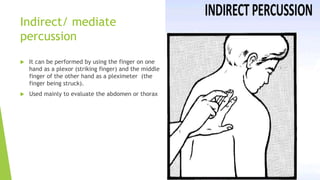
Indirect/ mediate
percussion
 It can be performed by using the finger on one
hand as a plexor (striking finger) and the middle
finger of the other hand as a pleximeter (the
finger being struck).
 Used mainly to evaluate the abdomen or thorax
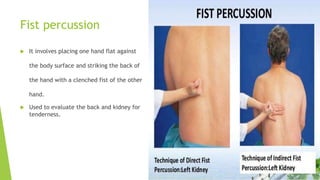
Fist percussion
 It involves placing one hand flat against
the body surface and striking the back of
the hand with a clenched fist of the other
hand.
 Used to evaluate the back and kidney for
tenderness.
Percussion tones/notes
 Percussion produce five characteristic tones:
1. Tympanic (abdomen)
2. hyper-resonant (hyper-inflated lung tissue)
3. Resonant (normal lung)
4. Dull (liver)
5. Flat (flat)
Sounds produced by percussion
 Sound: Tympany
 Intensity: Loud
 Pitch: High
 Duration: Moderate
 Quality: Drum-like
 Common location: Air containing space, enclosed area, gastric air bubble,
puffed out cheek.
Sounds produced by percussion
 Sound: Resonance
 Intensity: Moderate to loud
 Pitch: Low
 Duration: Long
 Quality: Hollow
 Common location: Normal lungs
Sounds produced by percussion
 Sound: Dull
 Intensity: soft to moderate
 Pitch: High
 Duration: Moderate
 Quality: thudlike
 Common location: Liver
Sounds produced by percussion
 Sound: Flatness
 Intensity: soft
 Pitch: High
 Duration: short
 Quality: Flat
 Common location: bones
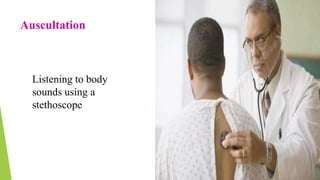
Auscultation
Listening to body
sounds using a
stethoscope
Auscultation
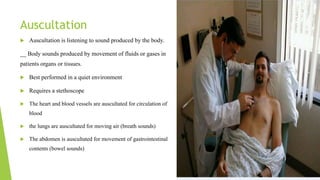
 Auscultation is listening to sound produced by the body.
__ Body sounds produced by movement of fluids or gases in
patients organs or tissues.
 Best performed in a quiet environment
 Requires a stethoscope
 The heart and blood vessels are auscultated for circulation of
blood
 the lungs are auscultated for moving air (breath sounds)
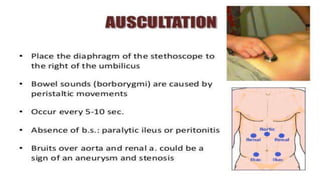
 The abdomen is auscultated for movement of gastrointestinal
contents (bowel sounds)
Auscultation sounds
 Through auscultation the nurse note the following characteristics of sound.
1. Pitch/Frequency or the number of oscillation generated per second by a vibrating object-
ranging from high to low.
2. loudness- Ranging from Soft to loud
3. Quality- Blowing or Gurgling
4. Duration –Length of time that sound vibration last-Short/medium/ long.
olfaction
 While assessing a client the nurse should be
familiar with the nature and source of body
odors.
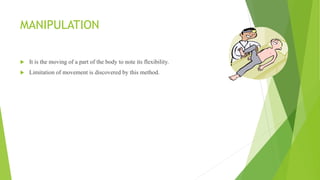
MANIPULATION
 It is the moving of a part of the body to note its flexibility.
 Limitation of movement is discovered by this method.
TESTING OF THE REFLEXES
 The response of the tissues to external stimuli is tested by means of a
 Percussion hammer
 Safety pin
 Wisp of cotton
 Hot and cold water
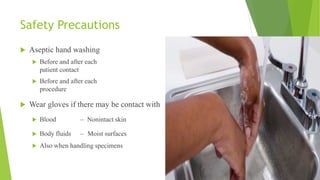
Safety Precautions
 Aseptic hand washing
 Before and after each
patient contact
 Before and after each
procedure
 Wear gloves if there may be contact with
 Blood – Nonintact skin
 Body fluids – Moist surfaces
 Also when handling specimens
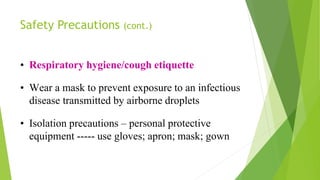
Safety Precautions (cont.)
‱ Respiratory hygiene/cough etiquette
‱ Wear a mask to prevent exposure to an infectious
disease transmitted by airborne droplets
‱ Isolation precautions – personal protective
equipment ----- use gloves; apron; mask; gown
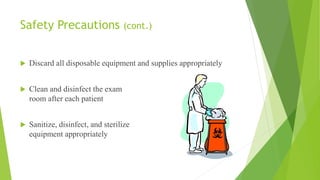
Safety Precautions (cont.)
 Discard all disposable equipment and supplies appropriately
 Clean and disinfect the exam
room after each patient
 Sanitize, disinfect, and sterilize
equipment appropriately
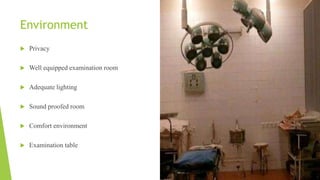
Environment
 Privacy
 Well equipped examination room
 Adequate lighting
 Sound proofed room
 Comfort environment
 Examination table
Positioning and Draping
 Proper patient position facilitates the examination
 Assist the patient to appropriate position
 Make as comfortable as possible
 Cover with appropriate drape
 Keep patient warm
 Maintain privacy/modesty
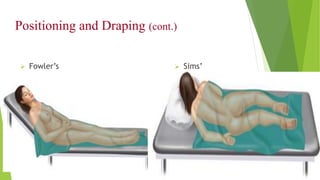
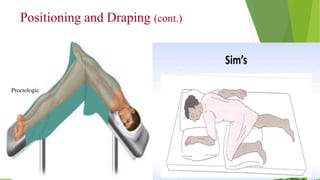
Positioning and Draping
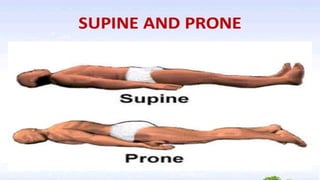
Positions used during nursing assessment, medical examinations, and during diagnostic
procedures:
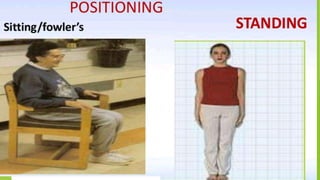
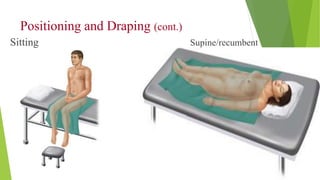
1. Sitting
2. Standing
3. Supine
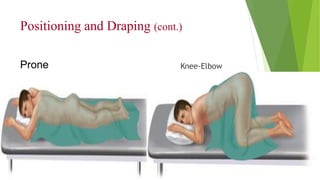
4. Prone
5. Sims
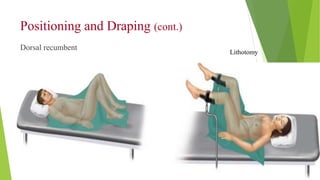
6. Lithotomy
7. Dorsal recumbent
8. Knee-chest
9. Fowlers
10. proctologic
Positioning and Draping (cont.)
Sitting Supine/recumbent
Dorsal recumbent
Lithotomy
Positioning and Draping (cont.)
Prone Knee-Elbow
 Fowler’s  Sims’
Positioning and Draping (cont.)
Proctologic
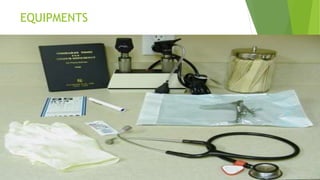
EQUIPMENTS
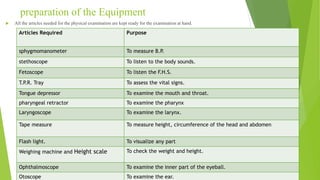
preparation of the Equipment
 All the articles needed for the physical examination are kept ready for the examination at hand.
Articles Required Purpose
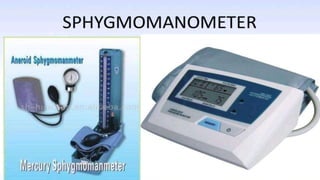
sphygmomanometer To measure B.P.
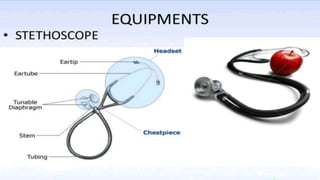
stethoscope To listen to the body sounds.
Fetoscope To listen the F.H.S.
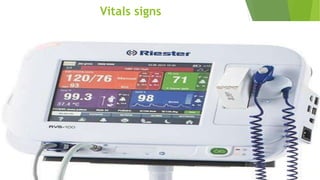
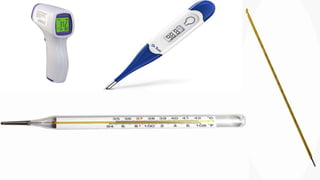
T.P.R. Tray To assess the vital signs.
Tongue depressor To examine the mouth and throat.
pharyngeal retractor To examine the pharynx
Laryngoscope To examine the larynx.
Tape measure To measure height, circumference of the head and abdomen
Flash light. To visualize any part
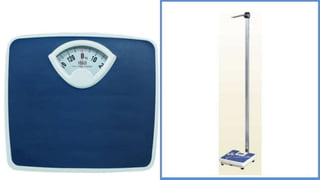
Weighing machine and Height scale To check the weight and height.
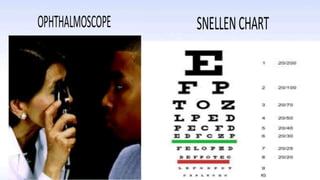
Ophthalmoscope To examine the inner part of the eyeball.
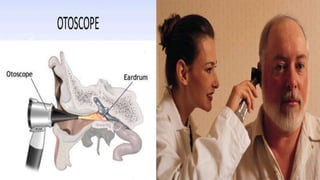
Otoscope To examine the ear.
Articles Required Purpose
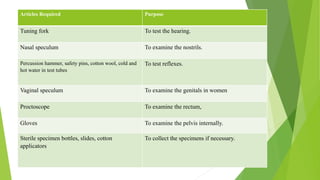
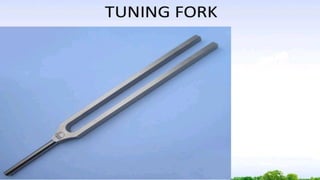
Tuning fork To test the hearing.
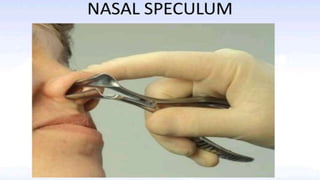
Nasal speculum To examine the nostrils.
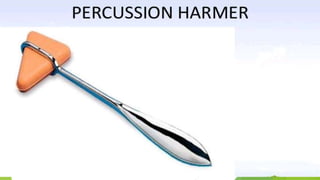
Percussion hammer, safety pins, cotton wool, cold and
hot water in test tubes
To test reflexes.
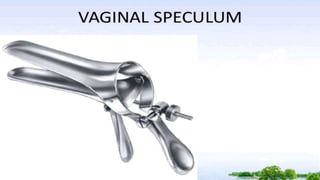
Vaginal speculum To examine the genitals in women
Proctoscope To examine the rectum,
Gloves To examine the pelvis internally.
Sterile specimen bottles, slides, cotton
applicators
To collect the specimens if necessary.
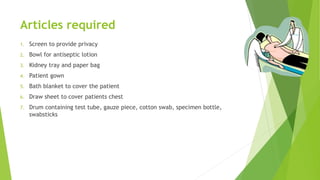
Articles required
1. Screen to provide privacy
2. Bowl for antiseptic lotion
3. Kidney tray and paper bag
4. Patient gown
5. Bath blanket to cover the patient
6. Draw sheet to cover patients chest
7. Drum containing test tube, gauze piece, cotton swab, specimen bottle,
swabsticks
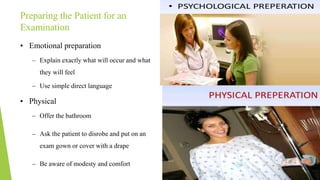
Preparing the Patient for an
Examination
‱ Emotional preparation
– Explain exactly what will occur and what
they will feel
– Use simple direct language
‱ Physical
– Offer the bathroom
– Ask the patient to disrobe and put on an
exam gown or cover with a drape
– Be aware of modesty and comfort
Vitals signs
General Examination or Head to Toe Examination
 The examination is carried out in an orderly manner focussing upon one area of the body at a time.
 The observation of the client starts as the client walks into the examination room, e.g.. a limp may be
noted as the client walks in.
 The following observations are made:
BASELINE DATA
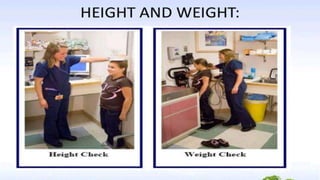
 Weight
 Height
 Abdominal girth
 Temperature
 Pulse
 Respiration
 Blood pressure
General Appearance
Nourishment: Well nourished or under nourished
Body build: Thin or obese.
Health: Healthy or unhealthy
Activity: Active or dull (tired).
Mental Status
Consciousness: Conscious, unconscious, delirious,
talking, incoherently.
Look: Anxious or worried, depressed etc.
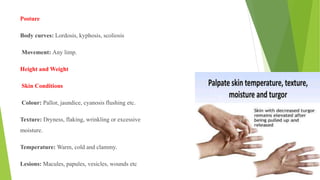
Posture
Body curves: Lordosis, kyphosis, scoliosis
Movement: Any limp.
Height and Weight
Skin Conditions
Colour: Pallor, jaundice, cyanosis flushing etc.
Texture: Dryness, flaking, wrinkling or excessive
moisture.
Temperature: Warm, cold and clammy.
Lesions: Macules, papules, vesicles, wounds etc
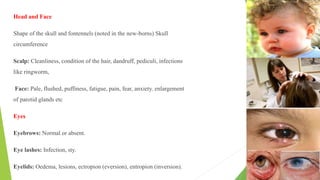
Head and Face
Shape of the skull and fontennels (noted in the new-borns) Skull
circumference
Scalp: Cleanliness, condition of the hair, dandruff, pediculi, infections
like ringworm,
Face: Pale, flushed, puffiness, fatigue, pain, fear, anxiety. enlargement
of parotid glands etc
Eyes
Eyebrows: Normal or absent.
Eye lashes: Infection, sty.
Eyelids: Oedema, lesions, ectropion (eversion), entropion (inversion).
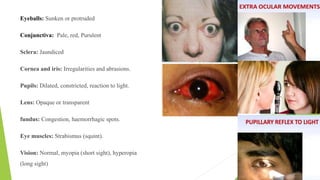
Eyeballs: Sunken or protruded
Conjunctiva: Pale, red, Purulent
Sclera: Jaundiced
Cornea and iris: Irregularities and abrasions.
Pupils: Dilated, constricted, reaction to light.
Lens: Opaque or transparent
fundus: Congestion, haemorrhagic spots.
Eye muscles: Strabismus (squint).
Vision: Normal, myopia (short sight), hyperopia
(long sight)
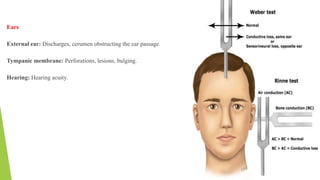
Ears
External ear: Discharges, cerumen obstructing the ear passage.
Tympanic membrane: Perforations, lesions, bulging.
Hearing: Hearing acuity.
Rinne test
 The Rinne test is conducted by placing a tuning fork on the
mastoid bone and then adjacent to the outer ear.
 Air conduction is better than bone conduction. The patient
should be able to hear the sound of the tuning fork adjacent to
their ear, persist for approximately twice as long as the sound
they heard over their mastoid process. This is considered a
"positive test.
Weber’s test
 Weber's test is performed by striking the
tuning fork and placing it against the middle
of the forehead. Ask the patient if the tone
is equal in both ears. Diminution in the
affected ear indicates sensorineural hearing
loss.
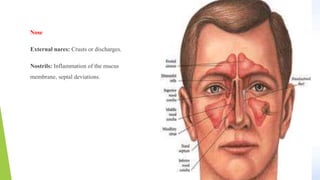
Nose
External nares: Crusts or discharges.
Nostrils: Inflammation of the mucus
membrane, septal deviations.
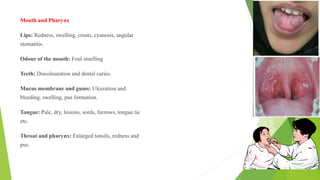
Mouth and Pharynx
Lips: Redness, swelling, crusts, cyanosis, angular
stomatitis.
Odour of the mouth: Foul smelling
Teeth: Discolouration and dental caries.
Mucus membrane and gums: Ulceration and
bleeding, swelling, pus formation.
Tongue: Pale, dry, lesions, sords, furrows, tongue tie
etc.
Throat and pharynx: Enlarged tonsils, redness and
pus.
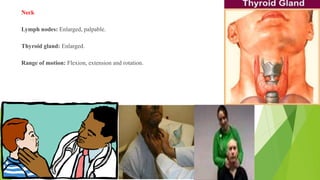
Neck
Lymph nodes: Enlarged, palpable.
Thyroid gland: Enlarged.
Range of motion: Flexion, extension and rotation.
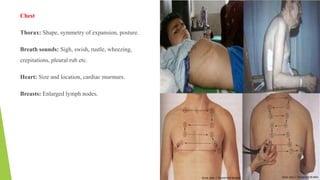
Chest
Thorax: Shape, symmetry of expansion, posture.
Breath sounds: Sigh, swish, rustle, wheezing,
crepitations, pleural rub etc.
Heart: Size and location, cardiac murmurs.
Breasts: Enlarged lymph nodes.
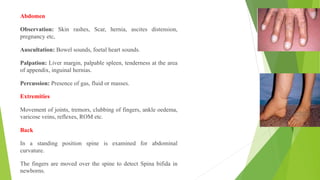
Abdomen
Observation: Skin rashes, Scar, hernia, ascites distension,
pregnancy etc,
Auscultation: Bowel sounds, foetal heart sounds.
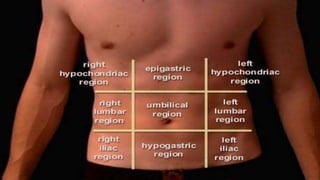
Palpation: Liver margin, palpable spleen, tenderness at the area
of appendix, inguinal hernias.
Percussion: Presence of gas, fluid or masses.
Extremities
Movement of joints, tremors, clubbing of fingers, ankle oedema,
varicose veins, reflexes, ROM etc.
Back
In a standing position spine is examined for abdominal
curvature.
The fingers are moved over the spine to detect Spina bifida in
newborns.
Genitals and Rectum
Genitalia is examined for any abnormality
Inguinal lymph glands - enlarged, palpable.
Patency of urinary meatus and rectum (in infants)
Descent of the testes (in infants).
Vaginal discharges.
Presence of sexually transmitted diseases.
Anus is observed for Haemorrhoids, fissures or cracks.
The rectum is palpated for the presence of masses on anterior or posterior wall.
Enlargement of the prostate gland.
Pelvic masses.
Neurological assessment
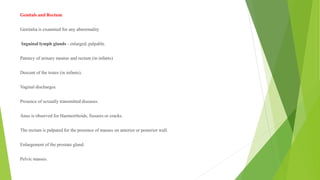
Reflexes
A reflex is an automatic response of the body to a stimulus. Percussion hammer and pin is used in testing reflexes.
 Biceps reflex
 Triceps reflex
 brachioradialis
 Patellar reflex
 Achilles reflex
 Plantar reflex
Coordination tests
 Finger to nose test
 Heel to shin test
Neurological assessment
Equilibrium tests
 Stand with eyes open and feet together
 Stand with eyes close and feet together
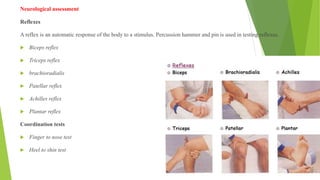
Tests for sensation:
 Touch: Test with the wisp of cotton
 Vibrations: Test with tuning fork
 Temperature discrimination: Tested with test tubes filled with hot and cold water.
Muscle strength: Tonicity and movement of the muscles.
physical assessment By Nuzhata.pptx

physical assessment By Nuzhata.pptx

  • 1.
  • 3.
    Physical assessment  Itis the systematic collection of objective information that is directly observed or is elicited through examination techniques.  Physical examination involves the use of ones senses to obtain information about the structure and function of an area being observed or manipulated.  It the thorough inspection or a detailed study of the entire body or some parts of the body to determine the general physical or mental conditions of the body.
  • 4.
    Purpose  To understandthe physical and mental well-being of the clients.  To detect disease in its early stage.  To determine the cause and extent of disease.  To understand any change in the condition of diseases, any improvement or regression.  To determine the nature of the treatment or nursing care needed for the client.  To safeguard the client and his family by noting the early signs especially in case of a communicable disease.  To contribute to the medical research.  To find out whether the person is medically fit or not for a particular task.
  • 5.
  • 6.
     Inspection  Palpation Percussion  Auscultation  olfaction
  • 8.
    Inspection  Systematic Visualexamination of the patient or it is a process of performing deliberate purposeful observations in a systematic manner.  It involves observation of the colour, shape, size, symmetry, position and movements.  Findings that may be significant 1. overall appearance of health or illness 2. Grooming and personal hygiene 3. Signs of distress 4. Facial expression and mood 5. Eye gaze 6. Body language 7. Body position 8. Skin color 9. Odor  Inspection is the first method used in examination of specific area. The chest and abdomen are inspected before palpation and auscultation.
  • 9.
    Palpation  A techniquein which the hands and fingers are used to gather information by touch.  It uses sense of touch  Palmar surface of fingers and finger pads are used to palpate for -Texture -vibrations -symmetry -Turgor -size -position -consistency -Masses -Fluid -Assess skin temperature  Client should be relax and positioned comfortably because muscle tension during palpation impair its effectiveness.  Asking the client to take deep and slow breath.
  • 12.
    Types of palpation Light palpation  Deep palpatipn  Bimanual palpation
  • 13.
    Light palpation  Thenurse apply tactile pressure slowly, gentely and deliberately.  The nurses hand is placed on the part to be examined and depredsed about 1- 2cm.
  • 14.
    Deep palpation  Itis done after light palpation  It is uses to detect abdominal massess.  Technique is similar to light palpation except that the finger are held at a greater angle to the body surface and the skin is depressed about 4-5 cm.
  • 15.
    Bimanual palpation  Itinvolve using both hand to trap a structure between them. This technique can be used to evaluate spleen, kidney, breast, uterus and ovary.  Sensing hand--- Relax and place lightly over the skin.  Active hand ---Apply pressure to the sensing hand.
  • 17.
    Palpation Cont.
.  Thedorsum (back) surfaces of the hand and fingers are used to measure temperature.  The palmar (front) surfaces of fingers and finger pads are used to assess texture, shape, fluid, size, consistency and pulsation.  Vibration is palpated best with the palm of the hand. (Tactile fremitus)  Symmetry-Grab the lower hemithorax on either side of axilla and gently bring your thumbs to the midline.
  • 19.
    Percussion  Percussion isthe act of striking one object against another to produce sound.  Percussion involve tapping the body with the fingertips.  It is used to outline the size of an organ such as bladder or liver.  It is also used to determine if a structure is air-filled, fluid-filled or solid.  The sound waves produced by the striking action over body tissues are known as percussion tones or percussion notes.  The degree to which sound propagates is called resonance.
  • 20.
    Direct/immediate percussion  It canbe performed by striking the surface directly with the fingers of the hand.  Used mainly to evaluate the sinus or an infant thorax.
  • 21.
    Indirect/ mediate percussion  Itcan be performed by using the finger on one hand as a plexor (striking finger) and the middle finger of the other hand as a pleximeter (the finger being struck).  Used mainly to evaluate the abdomen or thorax
  • 22.
    Fist percussion  Itinvolves placing one hand flat against the body surface and striking the back of the hand with a clenched fist of the other hand.  Used to evaluate the back and kidney for tenderness.
  • 23.
    Percussion tones/notes  Percussionproduce five characteristic tones: 1. Tympanic (abdomen) 2. hyper-resonant (hyper-inflated lung tissue) 3. Resonant (normal lung) 4. Dull (liver) 5. Flat (flat)
  • 24.
    Sounds produced bypercussion  Sound: Tympany  Intensity: Loud  Pitch: High  Duration: Moderate  Quality: Drum-like  Common location: Air containing space, enclosed area, gastric air bubble, puffed out cheek.
  • 25.
    Sounds produced bypercussion  Sound: Resonance  Intensity: Moderate to loud  Pitch: Low  Duration: Long  Quality: Hollow  Common location: Normal lungs
  • 26.
    Sounds produced bypercussion  Sound: Dull  Intensity: soft to moderate  Pitch: High  Duration: Moderate  Quality: thudlike  Common location: Liver
  • 27.
    Sounds produced bypercussion  Sound: Flatness  Intensity: soft  Pitch: High  Duration: short  Quality: Flat  Common location: bones
  • 28.
  • 29.
    Auscultation  Auscultation islistening to sound produced by the body. __ Body sounds produced by movement of fluids or gases in patients organs or tissues.  Best performed in a quiet environment  Requires a stethoscope  The heart and blood vessels are auscultated for circulation of blood  the lungs are auscultated for moving air (breath sounds)  The abdomen is auscultated for movement of gastrointestinal contents (bowel sounds)
  • 30.
    Auscultation sounds  Throughauscultation the nurse note the following characteristics of sound. 1. Pitch/Frequency or the number of oscillation generated per second by a vibrating object- ranging from high to low. 2. loudness- Ranging from Soft to loud 3. Quality- Blowing or Gurgling 4. Duration –Length of time that sound vibration last-Short/medium/ long.
  • 32.
    olfaction  While assessinga client the nurse should be familiar with the nature and source of body odors.
  • 33.
    MANIPULATION  It isthe moving of a part of the body to note its flexibility.  Limitation of movement is discovered by this method.
  • 34.
    TESTING OF THEREFLEXES  The response of the tissues to external stimuli is tested by means of a  Percussion hammer  Safety pin  Wisp of cotton  Hot and cold water
  • 35.
    Safety Precautions  Aseptichand washing  Before and after each patient contact  Before and after each procedure  Wear gloves if there may be contact with  Blood – Nonintact skin  Body fluids – Moist surfaces  Also when handling specimens
  • 36.
    Safety Precautions (cont.) ‱Respiratory hygiene/cough etiquette ‱ Wear a mask to prevent exposure to an infectious disease transmitted by airborne droplets ‱ Isolation precautions – personal protective equipment ----- use gloves; apron; mask; gown
  • 37.
    Safety Precautions (cont.) Discard all disposable equipment and supplies appropriately  Clean and disinfect the exam room after each patient  Sanitize, disinfect, and sterilize equipment appropriately
  • 38.
    Environment  Privacy  Wellequipped examination room  Adequate lighting  Sound proofed room  Comfort environment  Examination table
  • 39.
    Positioning and Draping Proper patient position facilitates the examination  Assist the patient to appropriate position  Make as comfortable as possible  Cover with appropriate drape  Keep patient warm  Maintain privacy/modesty
  • 40.
    Positioning and Draping Positionsused during nursing assessment, medical examinations, and during diagnostic procedures: 1. Sitting 2. Standing 3. Supine 4. Prone 5. Sims 6. Lithotomy 7. Dorsal recumbent 8. Knee-chest 9. Fowlers 10. proctologic
  • 43.
    Positioning and Draping(cont.) Sitting Supine/recumbent
  • 44.
  • 45.
    Positioning and Draping(cont.) Prone Knee-Elbow
  • 46.
     Fowler’s Sims’ Positioning and Draping (cont.)
  • 47.
    Positioning and Draping(cont.) Proctologic
  • 48.
  • 49.
    preparation of theEquipment  All the articles needed for the physical examination are kept ready for the examination at hand. Articles Required Purpose sphygmomanometer To measure B.P. stethoscope To listen to the body sounds. Fetoscope To listen the F.H.S. T.P.R. Tray To assess the vital signs. Tongue depressor To examine the mouth and throat. pharyngeal retractor To examine the pharynx Laryngoscope To examine the larynx. Tape measure To measure height, circumference of the head and abdomen Flash light. To visualize any part Weighing machine and Height scale To check the weight and height. Ophthalmoscope To examine the inner part of the eyeball. Otoscope To examine the ear.
  • 50.
    Articles Required Purpose Tuningfork To test the hearing. Nasal speculum To examine the nostrils. Percussion hammer, safety pins, cotton wool, cold and hot water in test tubes To test reflexes. Vaginal speculum To examine the genitals in women Proctoscope To examine the rectum, Gloves To examine the pelvis internally. Sterile specimen bottles, slides, cotton applicators To collect the specimens if necessary.
  • 51.
    Articles required 1. Screento provide privacy 2. Bowl for antiseptic lotion 3. Kidney tray and paper bag 4. Patient gown 5. Bath blanket to cover the patient 6. Draw sheet to cover patients chest 7. Drum containing test tube, gauze piece, cotton swab, specimen bottle, swabsticks
  • 53.
    Preparing the Patientfor an Examination ‱ Emotional preparation – Explain exactly what will occur and what they will feel – Use simple direct language ‱ Physical – Offer the bathroom – Ask the patient to disrobe and put on an exam gown or cover with a drape – Be aware of modesty and comfort
  • 56.
  • 65.
    General Examination orHead to Toe Examination  The examination is carried out in an orderly manner focussing upon one area of the body at a time.  The observation of the client starts as the client walks into the examination room, e.g.. a limp may be noted as the client walks in.  The following observations are made: BASELINE DATA  Weight  Height  Abdominal girth  Temperature  Pulse  Respiration  Blood pressure
  • 66.
    General Appearance Nourishment: Wellnourished or under nourished Body build: Thin or obese. Health: Healthy or unhealthy Activity: Active or dull (tired). Mental Status Consciousness: Conscious, unconscious, delirious, talking, incoherently. Look: Anxious or worried, depressed etc.
  • 67.
    Posture Body curves: Lordosis,kyphosis, scoliosis Movement: Any limp. Height and Weight Skin Conditions Colour: Pallor, jaundice, cyanosis flushing etc. Texture: Dryness, flaking, wrinkling or excessive moisture. Temperature: Warm, cold and clammy. Lesions: Macules, papules, vesicles, wounds etc
  • 68.
    Head and Face Shapeof the skull and fontennels (noted in the new-borns) Skull circumference Scalp: Cleanliness, condition of the hair, dandruff, pediculi, infections like ringworm, Face: Pale, flushed, puffiness, fatigue, pain, fear, anxiety. enlargement of parotid glands etc Eyes Eyebrows: Normal or absent. Eye lashes: Infection, sty. Eyelids: Oedema, lesions, ectropion (eversion), entropion (inversion).
  • 69.
    Eyeballs: Sunken orprotruded Conjunctiva: Pale, red, Purulent Sclera: Jaundiced Cornea and iris: Irregularities and abrasions. Pupils: Dilated, constricted, reaction to light. Lens: Opaque or transparent fundus: Congestion, haemorrhagic spots. Eye muscles: Strabismus (squint). Vision: Normal, myopia (short sight), hyperopia (long sight)
  • 70.
    Ears External ear: Discharges,cerumen obstructing the ear passage. Tympanic membrane: Perforations, lesions, bulging. Hearing: Hearing acuity.
  • 71.
    Rinne test  TheRinne test is conducted by placing a tuning fork on the mastoid bone and then adjacent to the outer ear.  Air conduction is better than bone conduction. The patient should be able to hear the sound of the tuning fork adjacent to their ear, persist for approximately twice as long as the sound they heard over their mastoid process. This is considered a "positive test. Weber’s test  Weber's test is performed by striking the tuning fork and placing it against the middle of the forehead. Ask the patient if the tone is equal in both ears. Diminution in the affected ear indicates sensorineural hearing loss.
  • 72.
    Nose External nares: Crustsor discharges. Nostrils: Inflammation of the mucus membrane, septal deviations.
  • 73.
    Mouth and Pharynx Lips:Redness, swelling, crusts, cyanosis, angular stomatitis. Odour of the mouth: Foul smelling Teeth: Discolouration and dental caries. Mucus membrane and gums: Ulceration and bleeding, swelling, pus formation. Tongue: Pale, dry, lesions, sords, furrows, tongue tie etc. Throat and pharynx: Enlarged tonsils, redness and pus.
  • 74.
    Neck Lymph nodes: Enlarged,palpable. Thyroid gland: Enlarged. Range of motion: Flexion, extension and rotation.
  • 75.
    Chest Thorax: Shape, symmetryof expansion, posture. Breath sounds: Sigh, swish, rustle, wheezing, crepitations, pleural rub etc. Heart: Size and location, cardiac murmurs. Breasts: Enlarged lymph nodes.
  • 76.
    Abdomen Observation: Skin rashes,Scar, hernia, ascites distension, pregnancy etc, Auscultation: Bowel sounds, foetal heart sounds. Palpation: Liver margin, palpable spleen, tenderness at the area of appendix, inguinal hernias. Percussion: Presence of gas, fluid or masses. Extremities Movement of joints, tremors, clubbing of fingers, ankle oedema, varicose veins, reflexes, ROM etc. Back In a standing position spine is examined for abdominal curvature. The fingers are moved over the spine to detect Spina bifida in newborns.
  • 78.
    Genitals and Rectum Genitaliais examined for any abnormality Inguinal lymph glands - enlarged, palpable. Patency of urinary meatus and rectum (in infants) Descent of the testes (in infants). Vaginal discharges. Presence of sexually transmitted diseases. Anus is observed for Haemorrhoids, fissures or cracks. The rectum is palpated for the presence of masses on anterior or posterior wall. Enlargement of the prostate gland. Pelvic masses.
  • 79.
    Neurological assessment Reflexes A reflexis an automatic response of the body to a stimulus. Percussion hammer and pin is used in testing reflexes.  Biceps reflex  Triceps reflex  brachioradialis  Patellar reflex  Achilles reflex  Plantar reflex Coordination tests  Finger to nose test  Heel to shin test
  • 80.
    Neurological assessment Equilibrium tests Stand with eyes open and feet together  Stand with eyes close and feet together Tests for sensation:  Touch: Test with the wisp of cotton  Vibrations: Test with tuning fork  Temperature discrimination: Tested with test tubes filled with hot and cold water. Muscle strength: Tonicity and movement of the muscles.