NEWBORN
ASSESSMENT/EXAMINATION
AMRITA A.S
ASSISTANT PROFESSOR
NEWBORN EXAMINATION
• DEFINITION: it is systematic examination
(physical and neurological) of newborn.
• OBJECTIVES
1. To provide an assessment of infant’s state
of development of wellbeing.
2. To detect any deviation from normal.
3. To assess the progress of the child.
INDICATIONS
• First examination: a detailed one in labor
room within 2 hours of birth.
• Second examination; Before discharge.
• Third examination: After 6-8 weeks of
neonatal life.
TERMONOLOGIES
• Small for gestational age (SGA)is less
than 10% for weight at the time of birth
• Large for gestational age (LGA) is more
than 90% for weight at the time of birth
• Appropriate for gestational age( AGA)
is the birth weight between 10-90%
• FULL TERM: 37 to 42 weeks or 259 to
294 days.
• PRE-TERM: after 28 weeks and before 37
weeks.
• POST- TERM: after 42 weeks.
ARTICLES REQUIRED
TPR Tray
A tray containing:
1. Hand washing articles
2. Apron
3. Stethoscope
4. Inch tape
5. Torch
6. Bowl containing cotton wisp
7. Weighing machine
8. Bowl with extra cotton
9. Mackintosh
10. Kidney tray
11. Paper bag
INITIAL ASSESSMENT OF
NEWBORN
1. IDENTIFICATION
Check and identify the sex of the
infant and verify the records with the
correct name, sex and registration
number.
2. GESTATIONAL AGE
FULL TERM/ PRE-TERM/ POST-
TERM
VITAL SIGNS
Check the vital signs in the following
order:
a) RESPIRATION: normal value of
respiration is 40-60 breaths/min.
b) HEART RATE: normal value of heart
rate is 120-140 beats/min.
c) TEMPERATURE: normal value of
temperature is 36.5-37.5 degree
Celsius.
PHYSICAL EXAMINATION
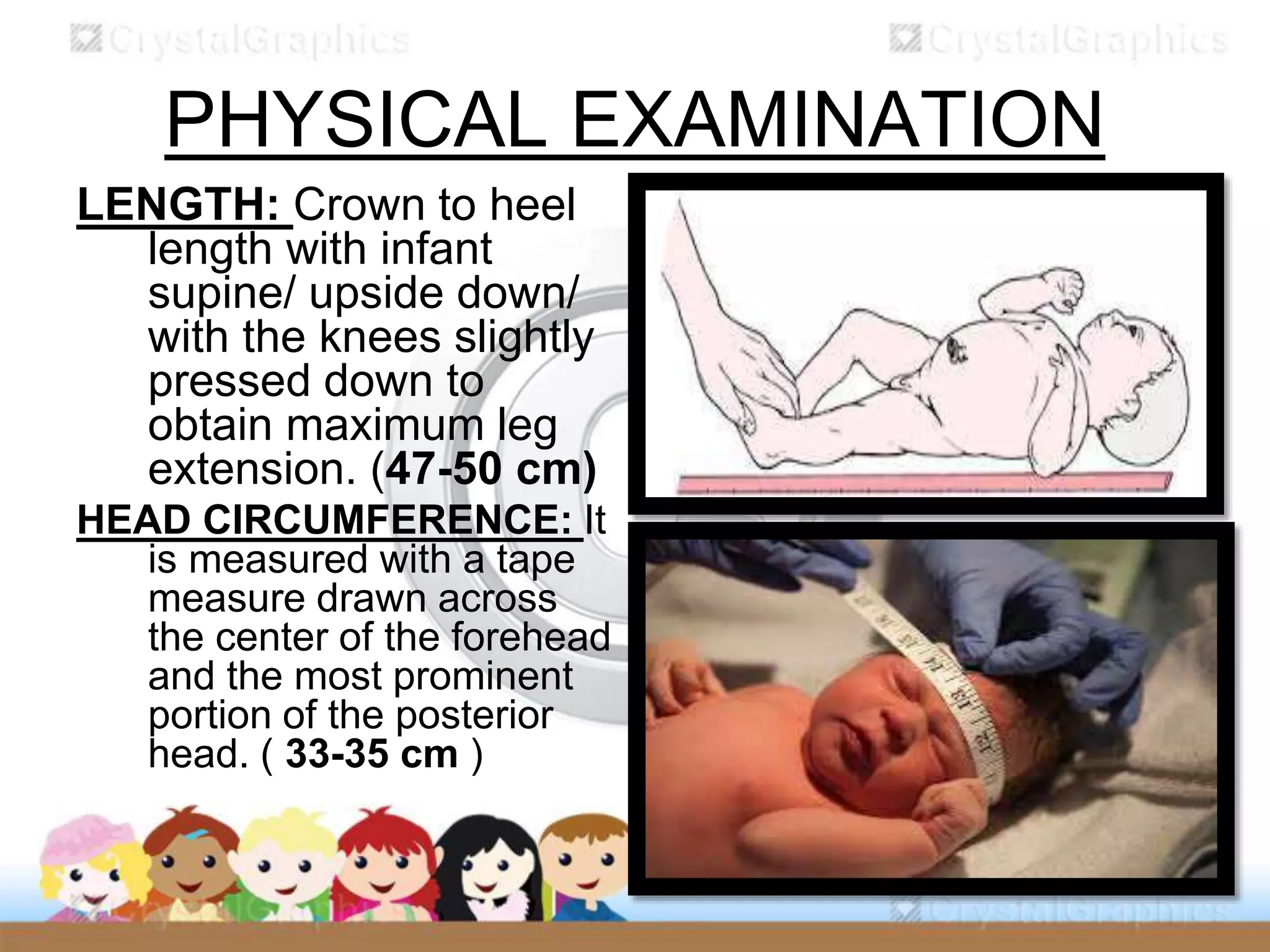
LENGTH: Crown to heel
length with infant
supine/ upside down/
with the knees slightly
pressed down to
obtain maximum leg
extension. (47-50 cm)
HEAD CIRCUMFERENCE: It
is measured with a tape
measure drawn across
the center of the forehead
and the most prominent
portion of the posterior
head. ( 33-35 cm )
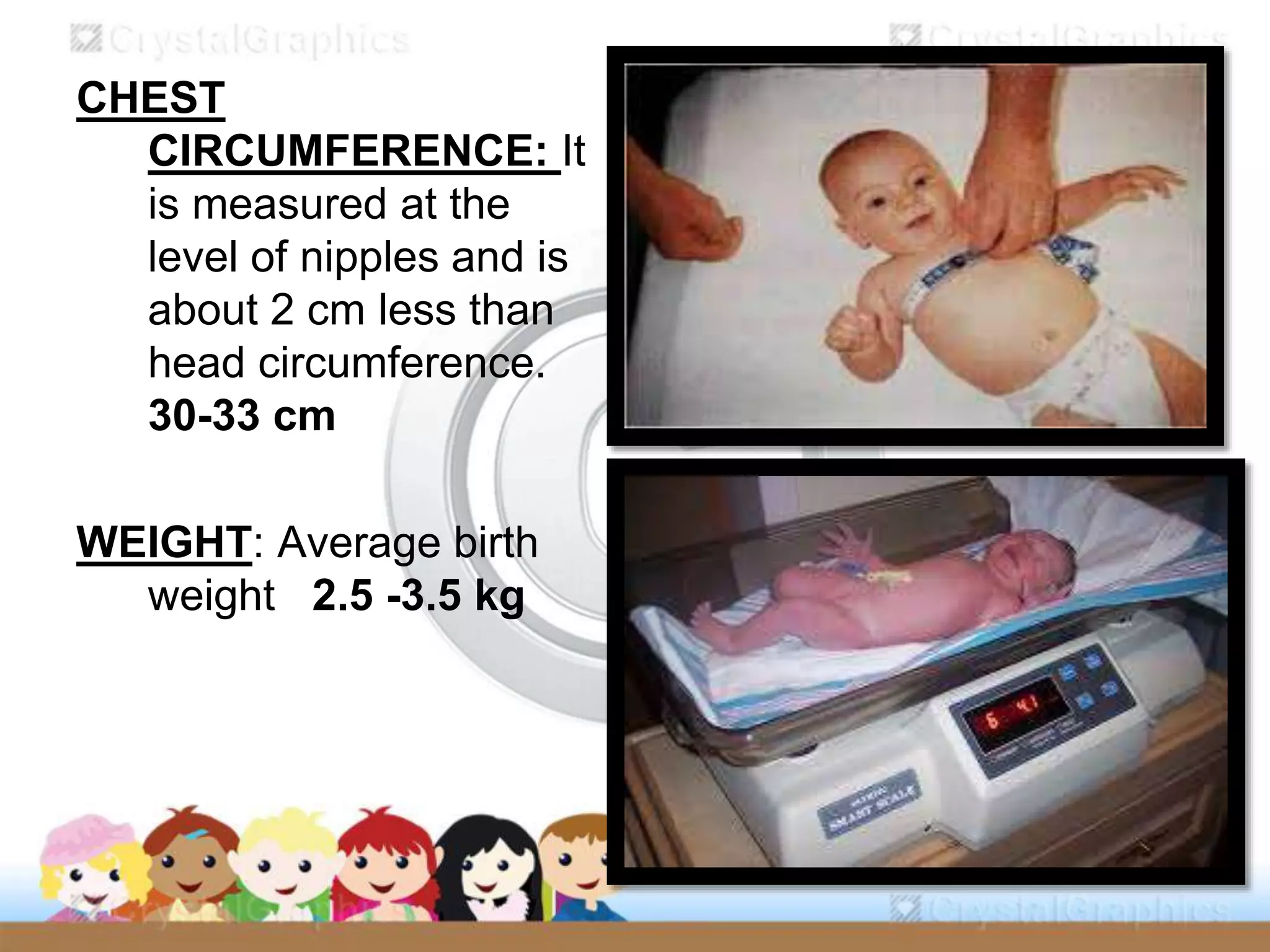
CHEST
CIRCUMFERENCE: It
is measured at the
level of nipples and is
about 2 cm less than
head circumference.
30-33 cm
WEIGHT: Average birth
weight 2.5 -3.5 kg
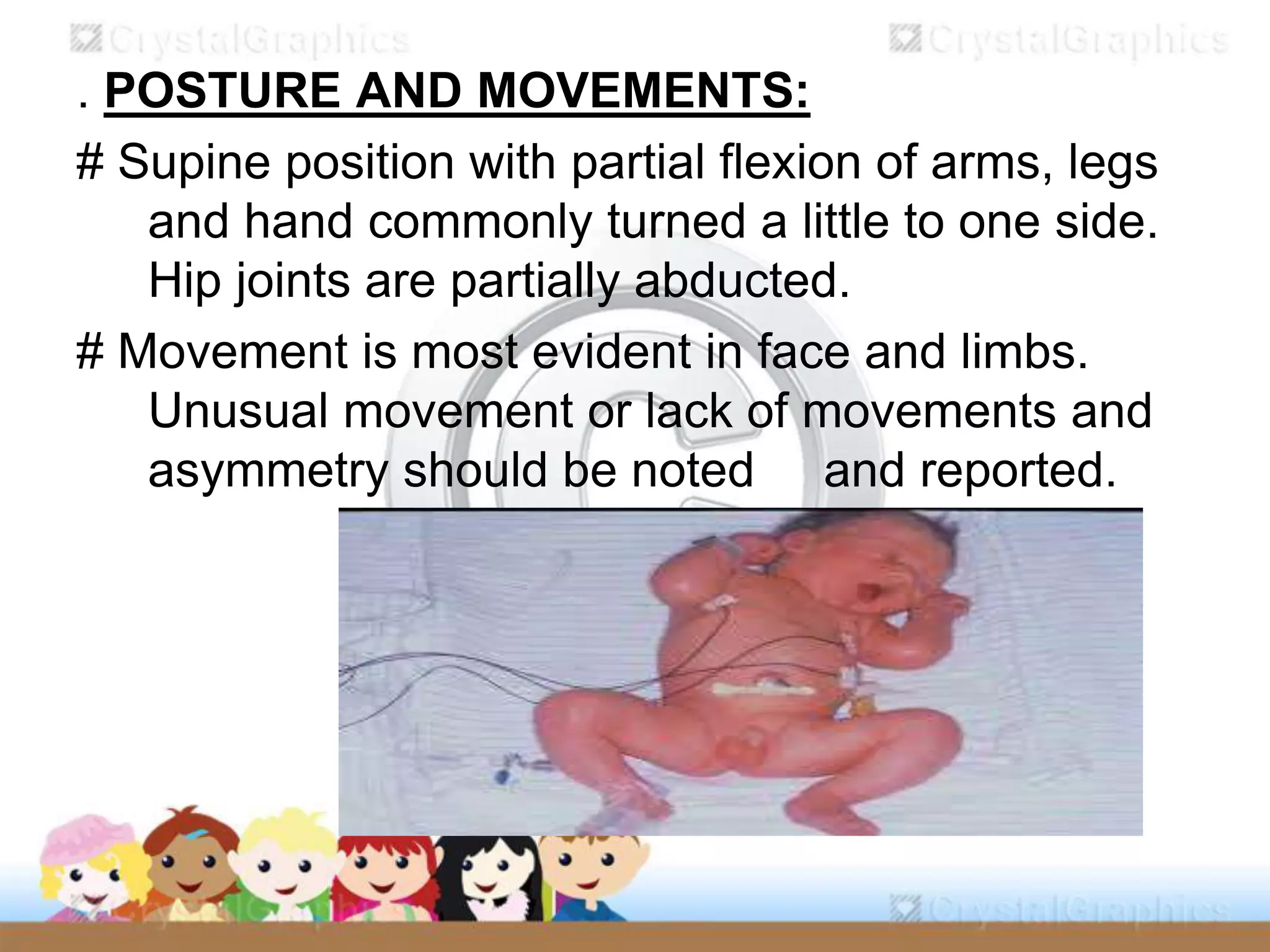
. POSTURE AND MOVEMENTS:
# Supine position with partial flexion of arms, legs
and hand commonly turned a little to one side.
Hip joints are partially abducted.
# Movement is most evident in face and limbs.
Unusual movement or lack of movements and
asymmetry should be noted and reported.
2.SKIN
a) Colour:
# Most term newborns have a ruddy complexion
because of the increased concentration of red blood cells
in the blood vessels and a decrease in the amount of
subcutaneous fat. This ruddiness fades slightly over the
1st month.
.
# Peripheral cyanosis appear due to
immature peripheral circulation. This is a
normal phenomenon in the first 24 to 48
hour after birth.
# Central cyanosis indicates decreased
oxygenation. It may be the result of
temporary respiratory obstruction or an
underlying disease
Cyanosis:
b) VERNIX CASEOSA: It is a white,
cream cheese-like substance that
serves as a lubricant, is secreted by
the fetal sebaceous glands and which
disappear within a few days.
c) LANUGO: is the fine, downy hair that covers a
newborn’s shoulder, back and upper arms. It
may be found also on the forehead and ears.
# Pre-term newborns has more lanugo then
post-term.
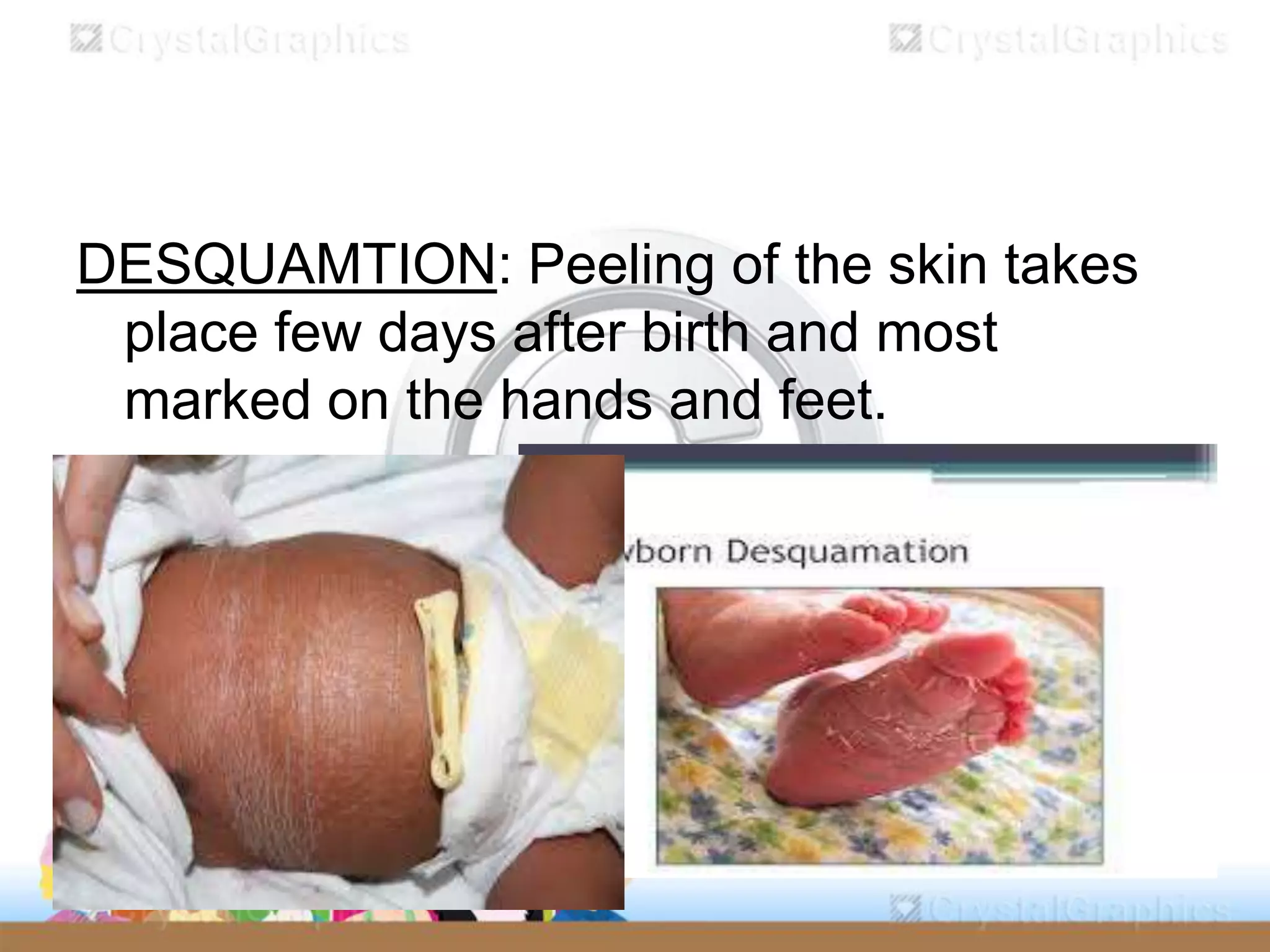
DESQUAMTION: Peeling of the skin takes
place few days after birth and most
marked on the hands and feet.
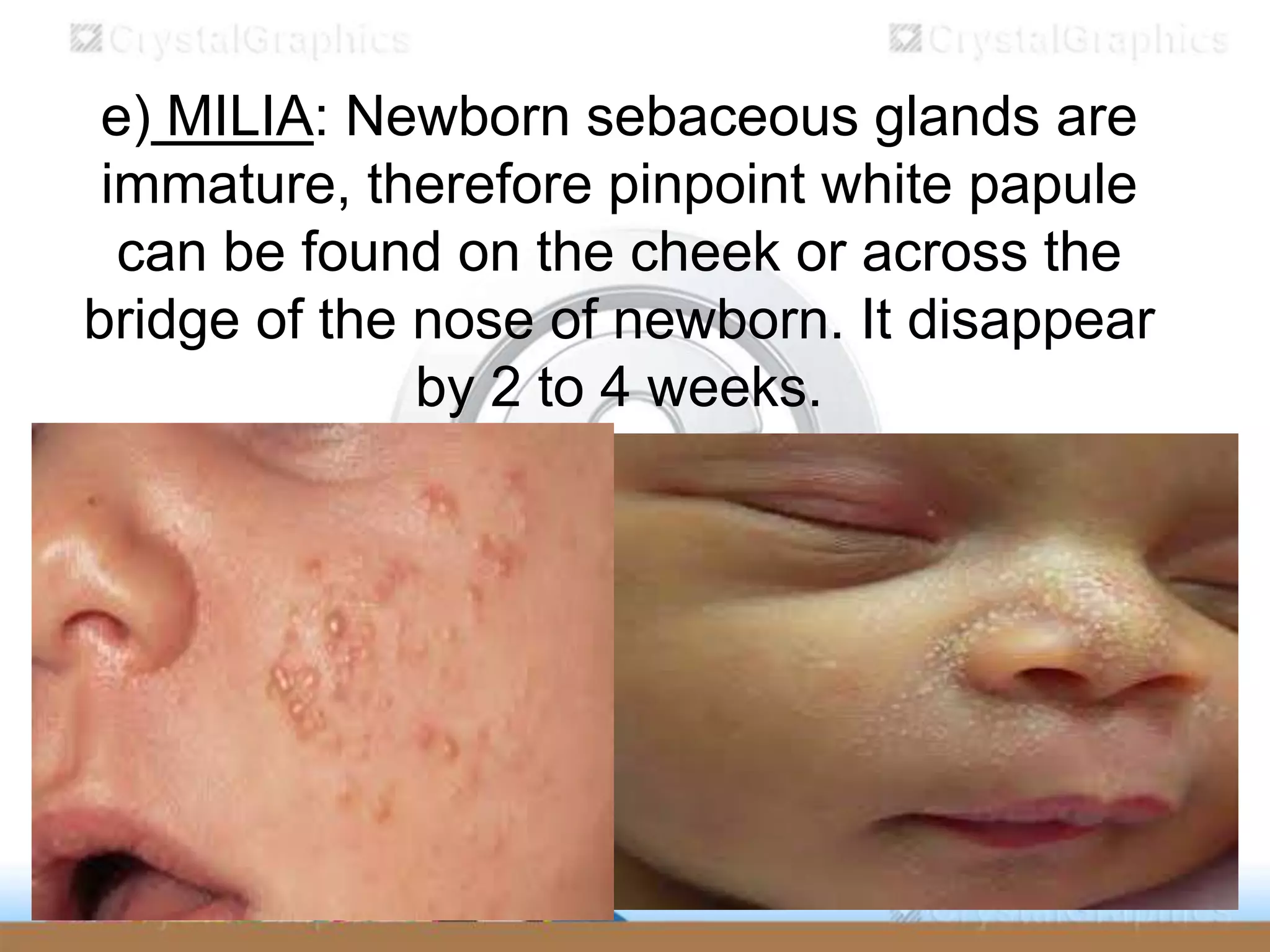
e) MILIA: Newborn sebaceous glands are
immature, therefore pinpoint white papule
can be found on the cheek or across the
bridge of the nose of newborn. It disappear
by 2 to 4 weeks.
f) Erythema toxicum: It begin as a
papule, increasing in severity to
become erythema by the 2nd day
and then disappearing by the 3rd
day.
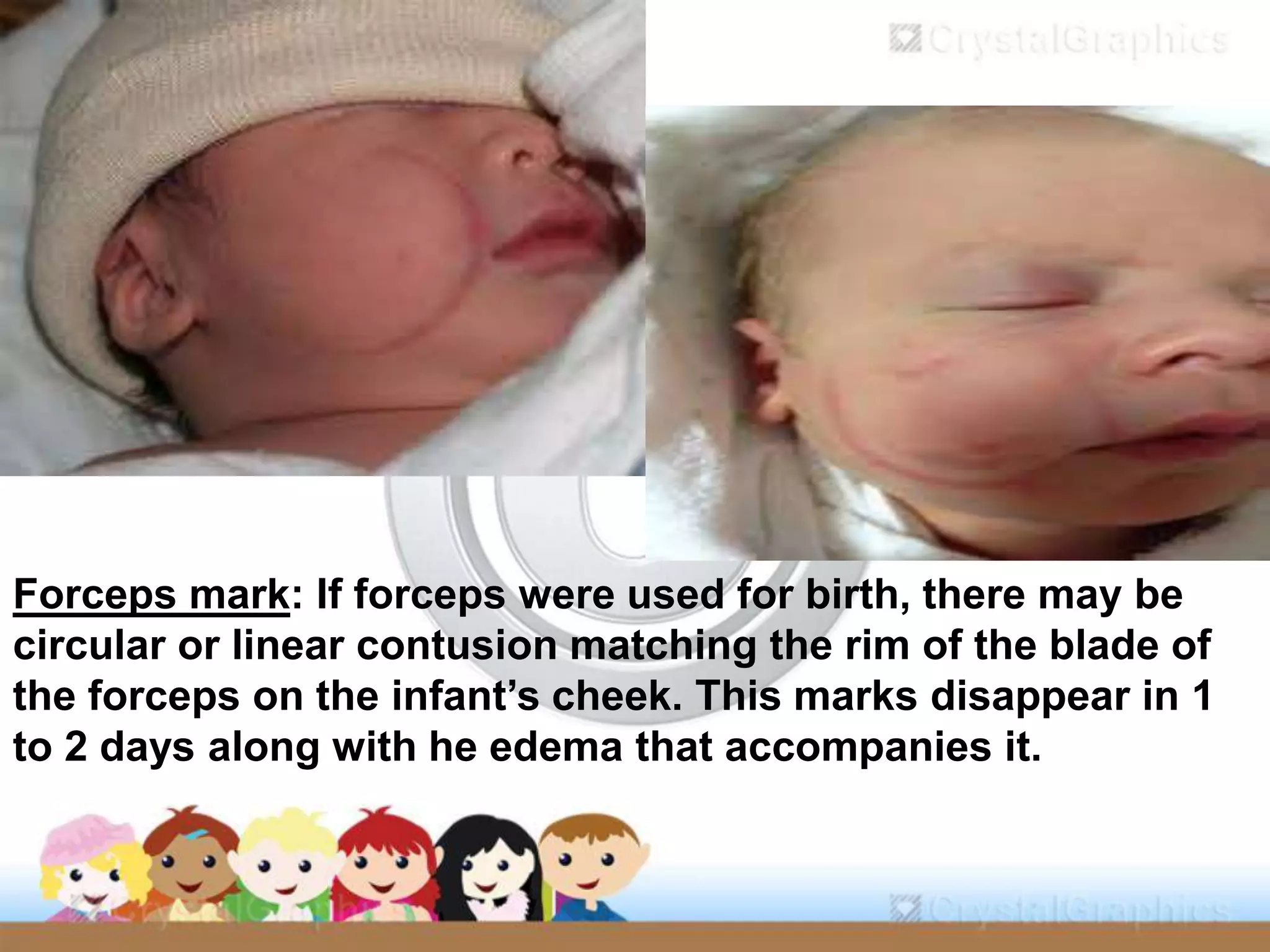
Forceps mark: If forceps were used for birth, there may be
circular or linear contusion matching the rim of the blade of
the forceps on the infant’s cheek. This marks disappear in 1
to 2 days along with he edema that accompanies it.
• Skin turgor: If a fold of skin is grasped
between the thumb and fingers, it should
feel elastic. When it is released it should
fall back to form a smooth surface. If
severe dehydration is present, the skin will
not smooth out again and will remain in an
elevated ridge.
i) Mongolian spots:
• Slate-gray to blue-
black lesions Usually
over lumbo sacral
area and buttocks
Accumulation of
melanocytes within
the dermis. Generally
fade by age 7 years
3. HEAD
a) A newborn’s head appears
disproportionately large because it is
one fourth of the total length.
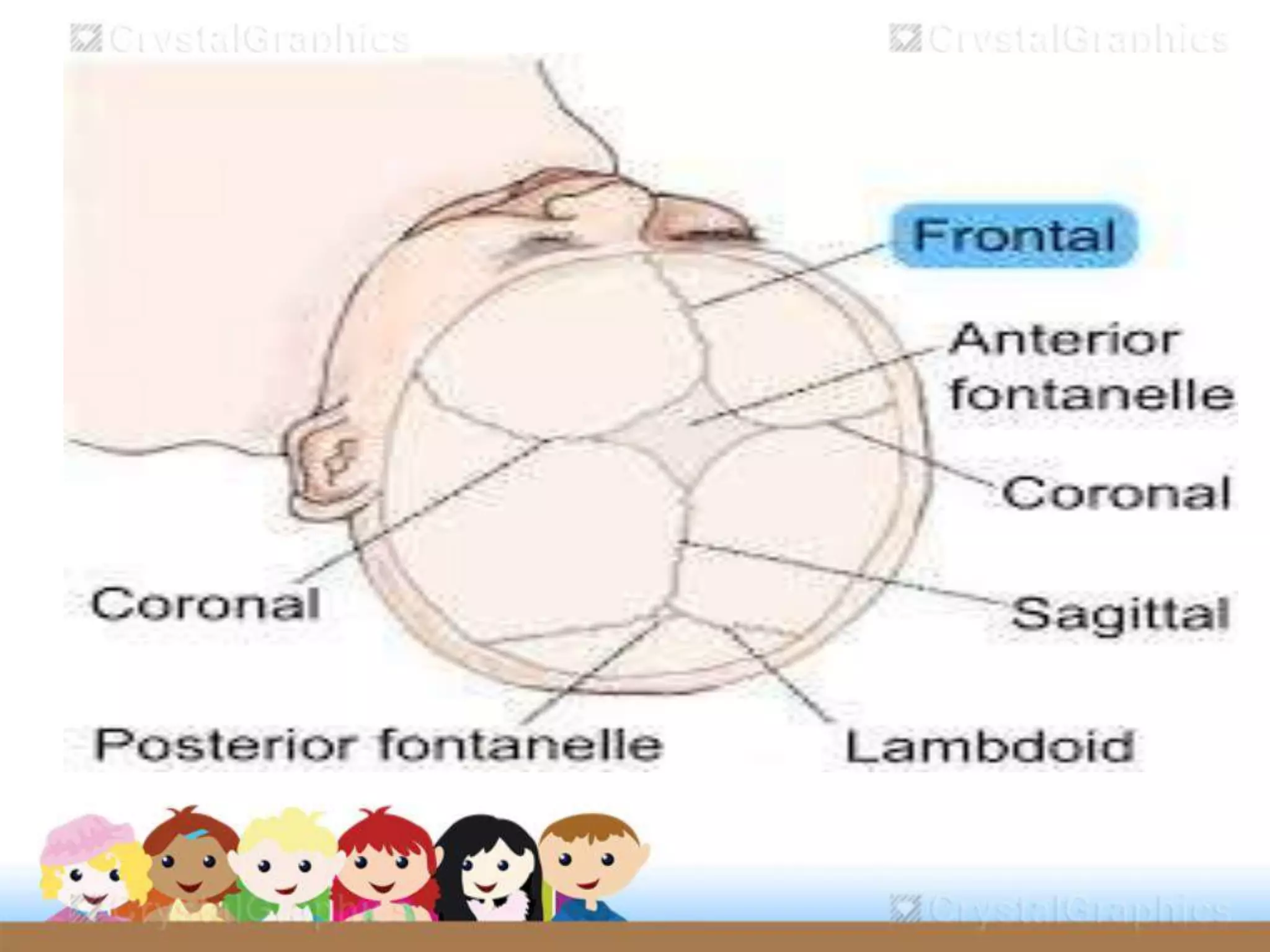
b) Fontanelles: The anterior fontanelle
will be felt as a soft spot. The
posterior fontanelle is so small that it
cannot be palpated readily.
• Sutures: Suture lines should never appear
widely separated in newborns. Separation
denotes increased intracranial pressure
from either abnormal brain formation,
abnormal accumulation of CSF in the
cranium (hydrocephalus), or an
accumulation of blood from a birth injury .
Fused suture lines also are abnormal and
need to be confirmed with X-ray and
further evaluation.
CAPUT SUCCEDANEUM
Swelling or edema of
the presenting
portion of scalp.
Goes away few days
Caput Succedaneum
CEPHALHEMATOMA
Bleeding between the skull and periosteum of newborn
baby . Secondary to suture of blood vessel crossing the
periosteum. It does not crosses the suture line. Disappears
by weeks and months
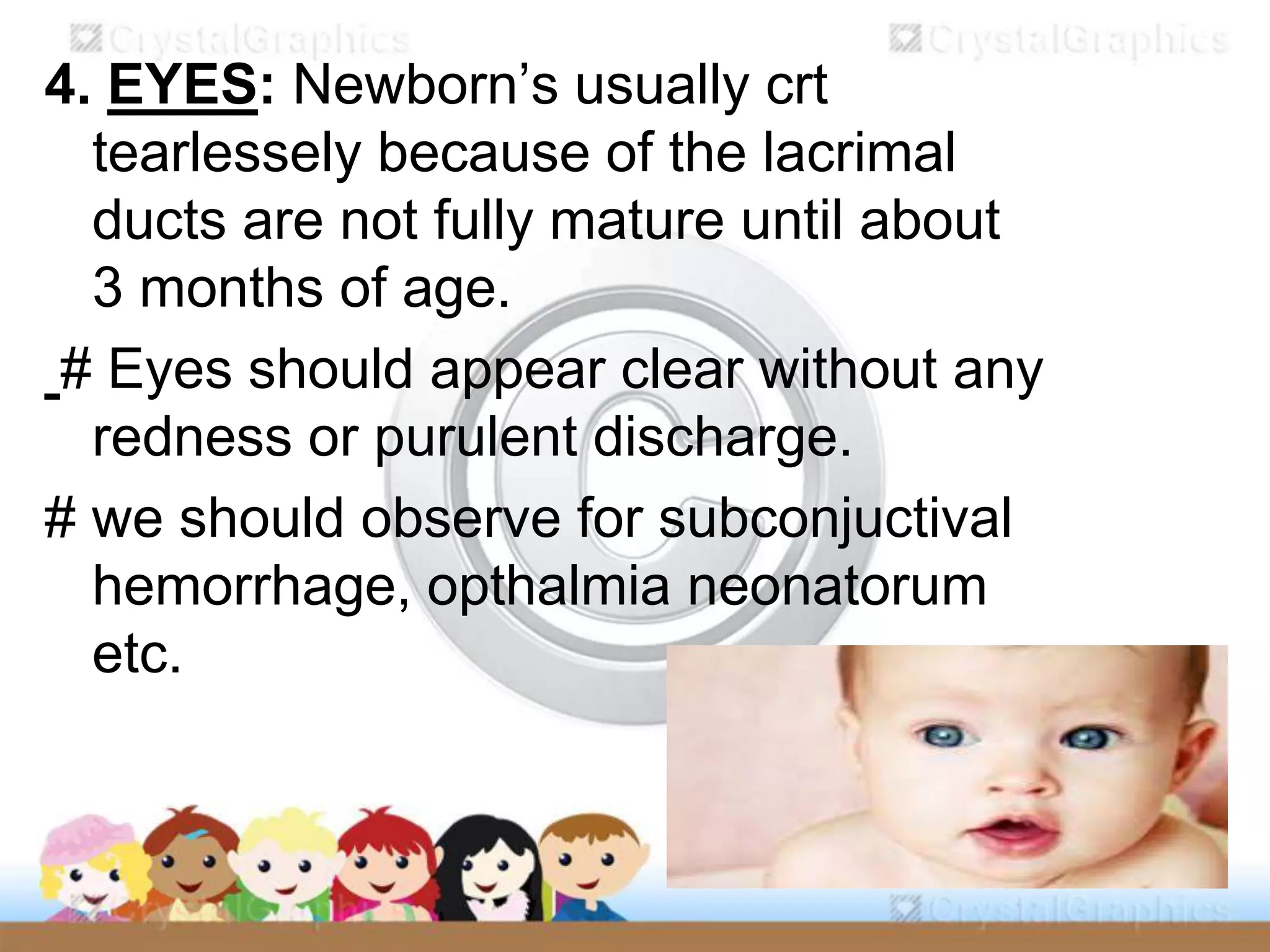
4. EYES: Newborn’s usually crt
tearlessely because of the lacrimal
ducts are not fully mature until about
3 months of age.
# Eyes should appear clear without any
redness or purulent discharge.
# we should observe for subconjuctival
hemorrhage, opthalmia neonatorum
etc.
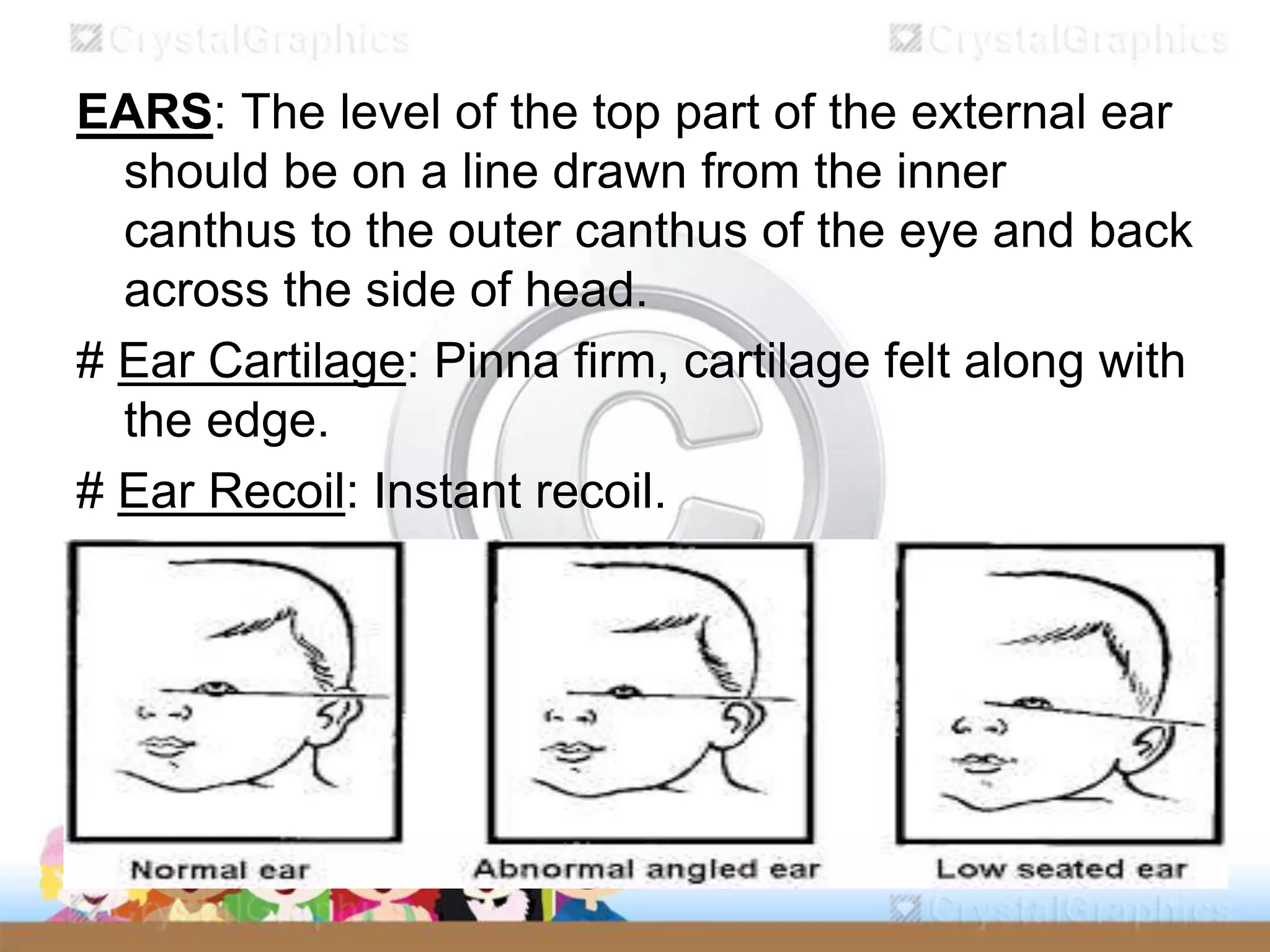
EARS: The level of the top part of the external ear
should be on a line drawn from the inner
canthus to the outer canthus of the eye and back
across the side of head.
# Ear Cartilage: Pinna firm, cartilage felt along with
the edge.
# Ear Recoil: Instant recoil.
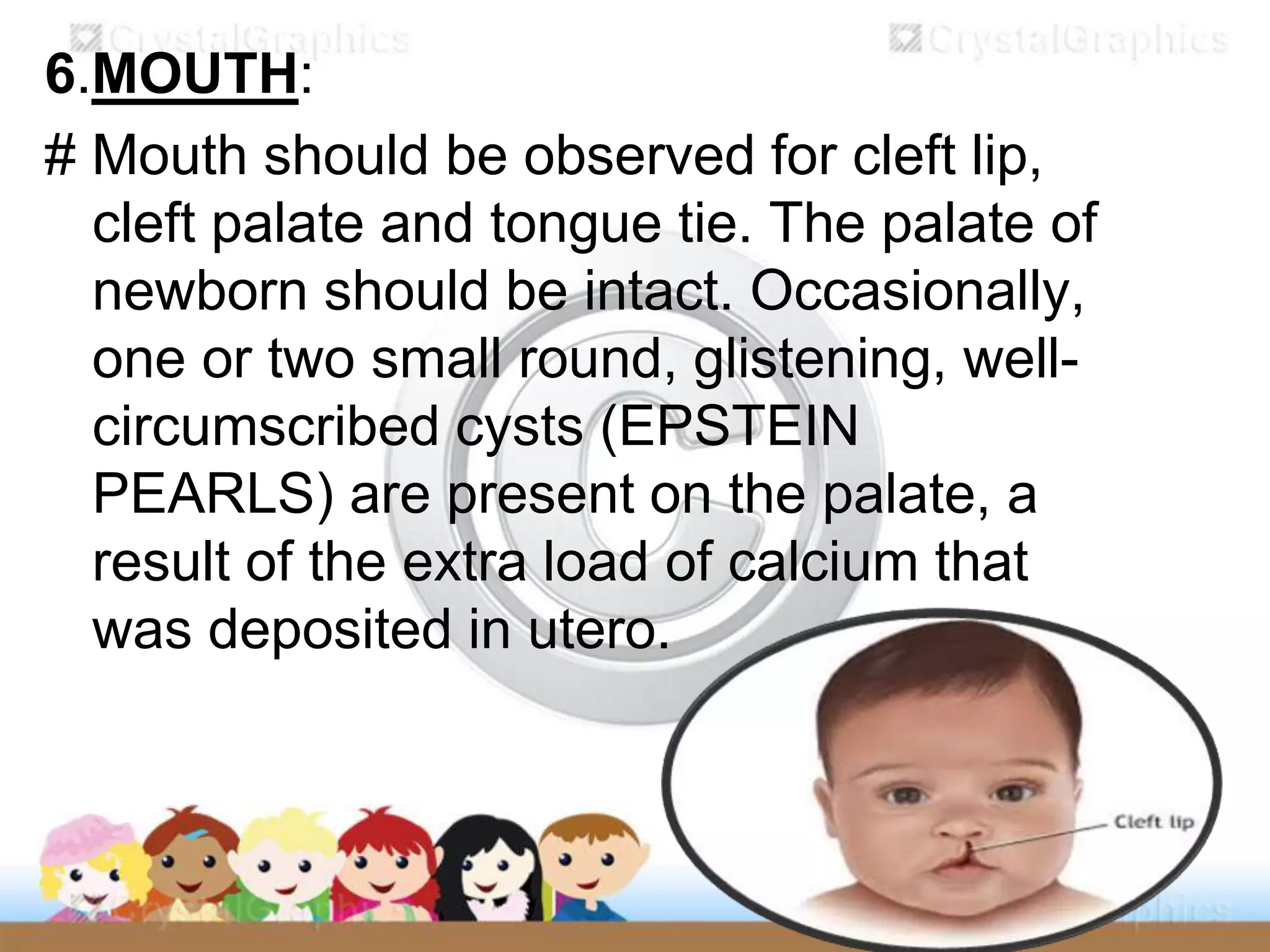
6.MOUTH:
# Mouth should be observed for cleft lip,
cleft palate and tongue tie. The palate of
newborn should be intact. Occasionally,
one or two small round, glistening, well-
circumscribed cysts (EPSTEIN
PEARLS) are present on the palate, a
result of the extra load of calcium that
was deposited in utero.
Sometimes in some newborns one or two
natal teeth may have erupted.
NECK: The neck of newborn is short, often
chubby and creased with skin fold. Head
should rotate freely on it.
8. CHEST: It looks small because the infant’s
head is large in proportion.
# Possible breast engorgement with possible
secretion of thin’ watery fluid popularly
termed witch’s milk..
# Absence of retraction.
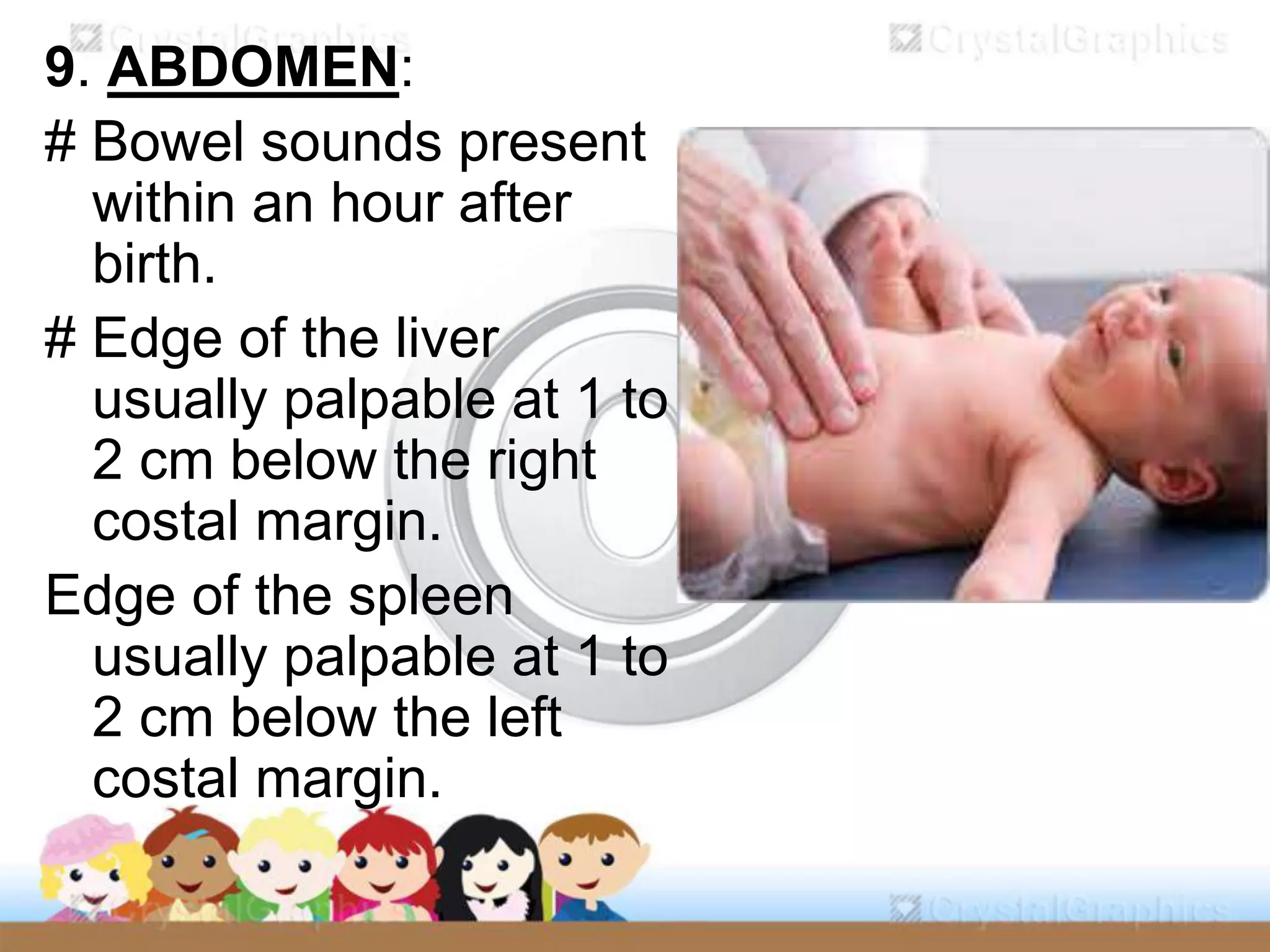
9. ABDOMEN:
# Bowel sounds present
within an hour after
birth.
# Edge of the liver
usually palpable at 1 to
2 cm below the right
costal margin.
Edge of the spleen
usually palpable at 1 to
2 cm below the left
costal margin.
UMBLICAL CORD
• It has 2 arteries and 1
veins
• At birth cord appears
bluish white and moist
• After clamping , it begin
dry and appears a dull
yellowish brown and
sheds after 6-10 days
If presence of 1 artery then
it is associated with
V- Vertebral
A- anorectal
C- cardiac
TE- tracheoesophageal
R- renal
L- limbic
ABNORMALITIES
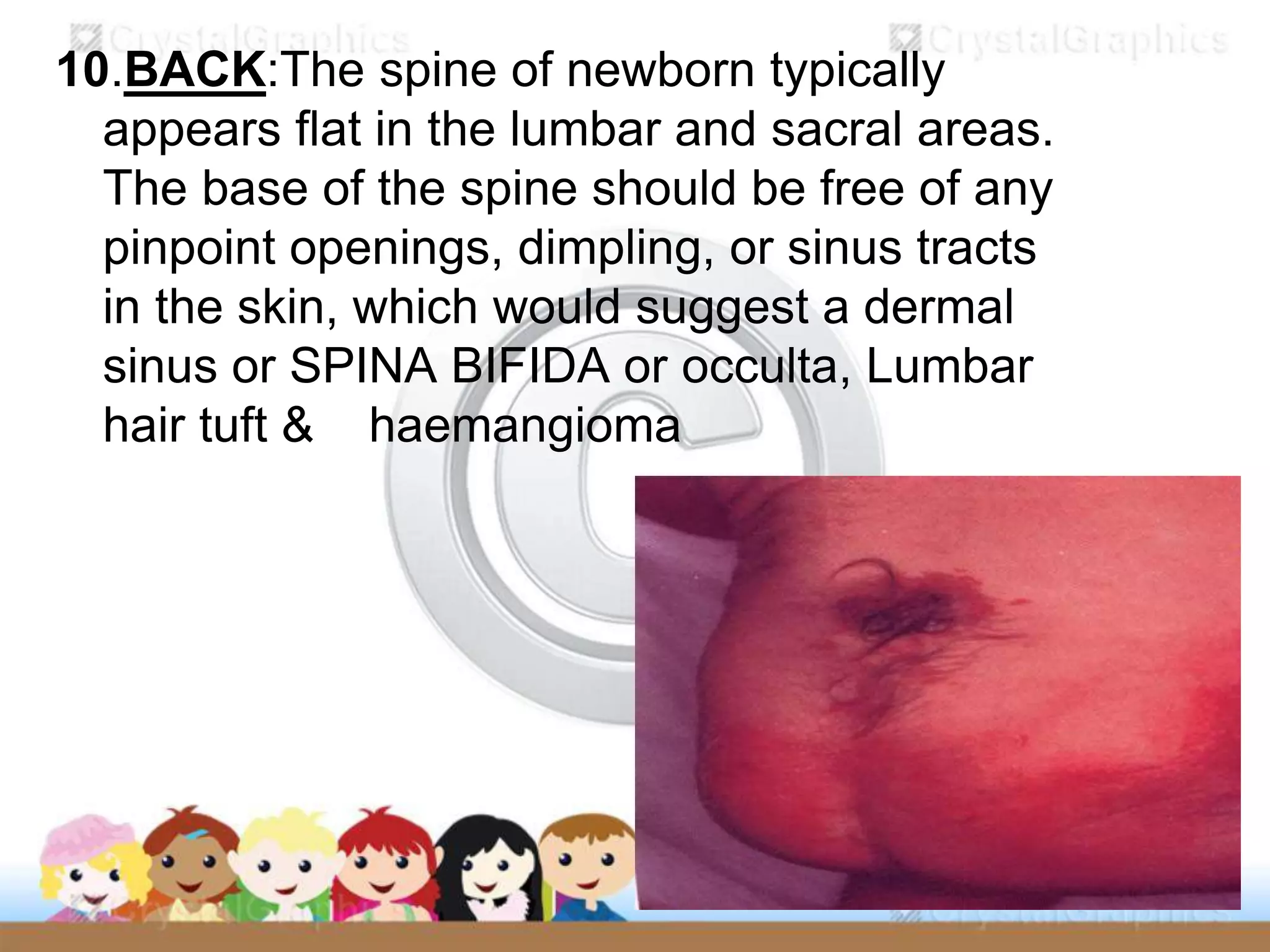
10.BACK:The spine of newborn typically
appears flat in the lumbar and sacral areas.
The base of the spine should be free of any
pinpoint openings, dimpling, or sinus tracts
in the skin, which would suggest a dermal
sinus or SPINA BIFIDA or occulta, Lumbar
hair tuft & haemangioma
11. ANOGENITAL AREA
# The anus of newborn must be inspected
to be certain that is present, patent, and
not covered by a membrane (imperforate
anus). Male Genitalia: Scrotum is
pendulous and both the testes are present
in the scrotum. Males with one or both
undescended testicles (cryptorchidism)
needs further evaluation.
# Female Genitalia: in female newborns
labia majora fully covers labia minora.
Some newborns have a mucous vaginal
secretion, which is sometimes blood
tinged, called pseudomenstruation. This
discharge disappears as soon as the
infant’s system has cleared the hormones.
. EXTREMITIES:
We should observe for
syndactyly or
polydactyly.
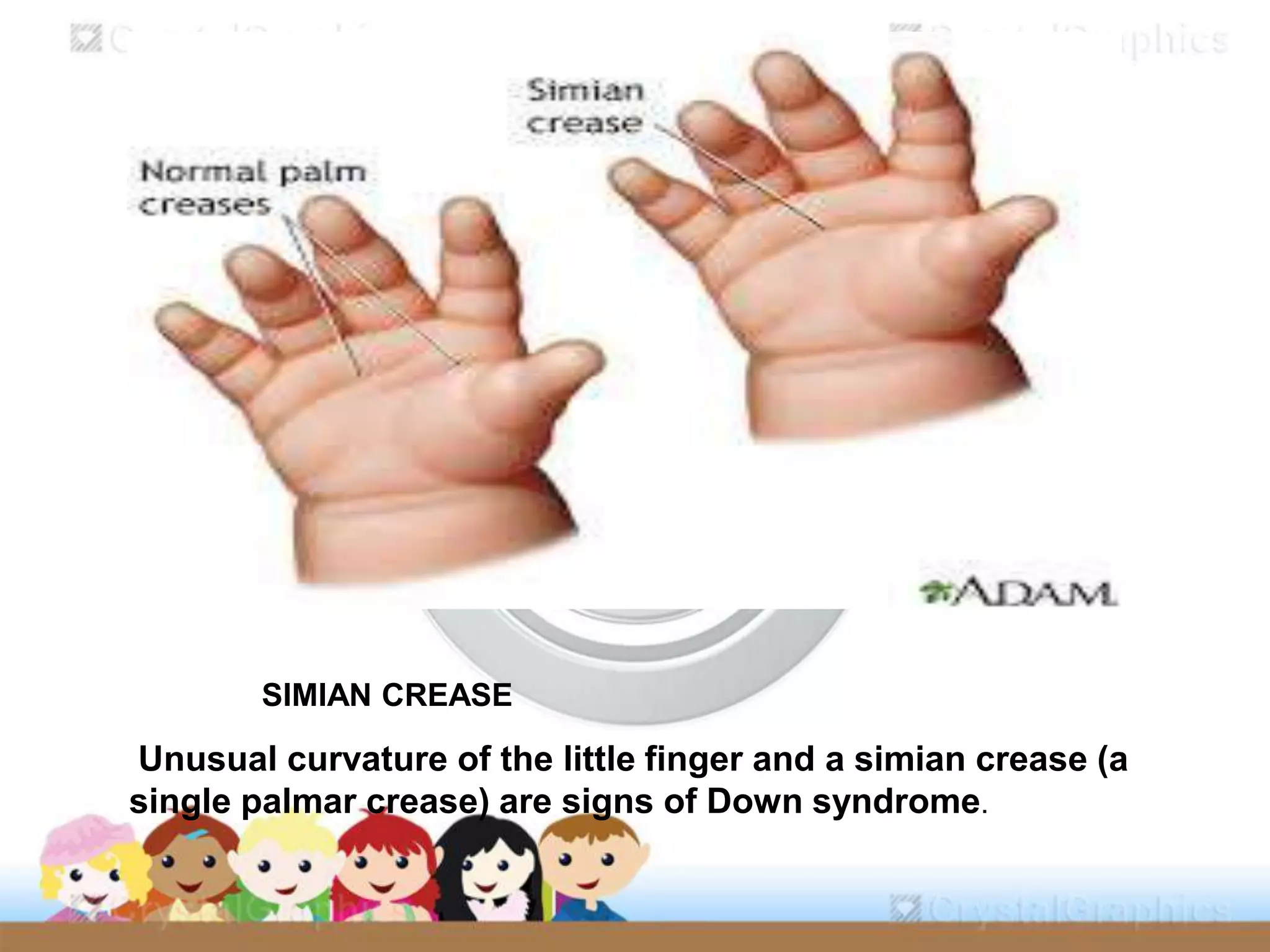
SIMIAN CREASE
Unusual curvature of the little finger and a simian crease (a
single palmar crease) are signs of Down syndrome.
SOLES
• A full term newborn have
creases covering the
entire sole of the foot
• Post –mature infants
have deep crease over
the foot
• A premature infant sole
crease mat partially
cover the upper two-third
or may be absent
MECONIUM
MECONIUM
It is the first fecal material ,
is a sticky , odorless
material, greenish black
to brownish green which
is passed from 8-24
hours after birth
URINE
The first urine is diluted
because of immaturity of
the kidneys and lack of
ability to concentrate
urine.
NEONATAL REFLEXES
• Also known as developmental, primary, or
primitive reflexes.
• They can provide information about lower
motor neurons and muscle tone.
• They are often protective and disappear
as higher level motor functions emerge
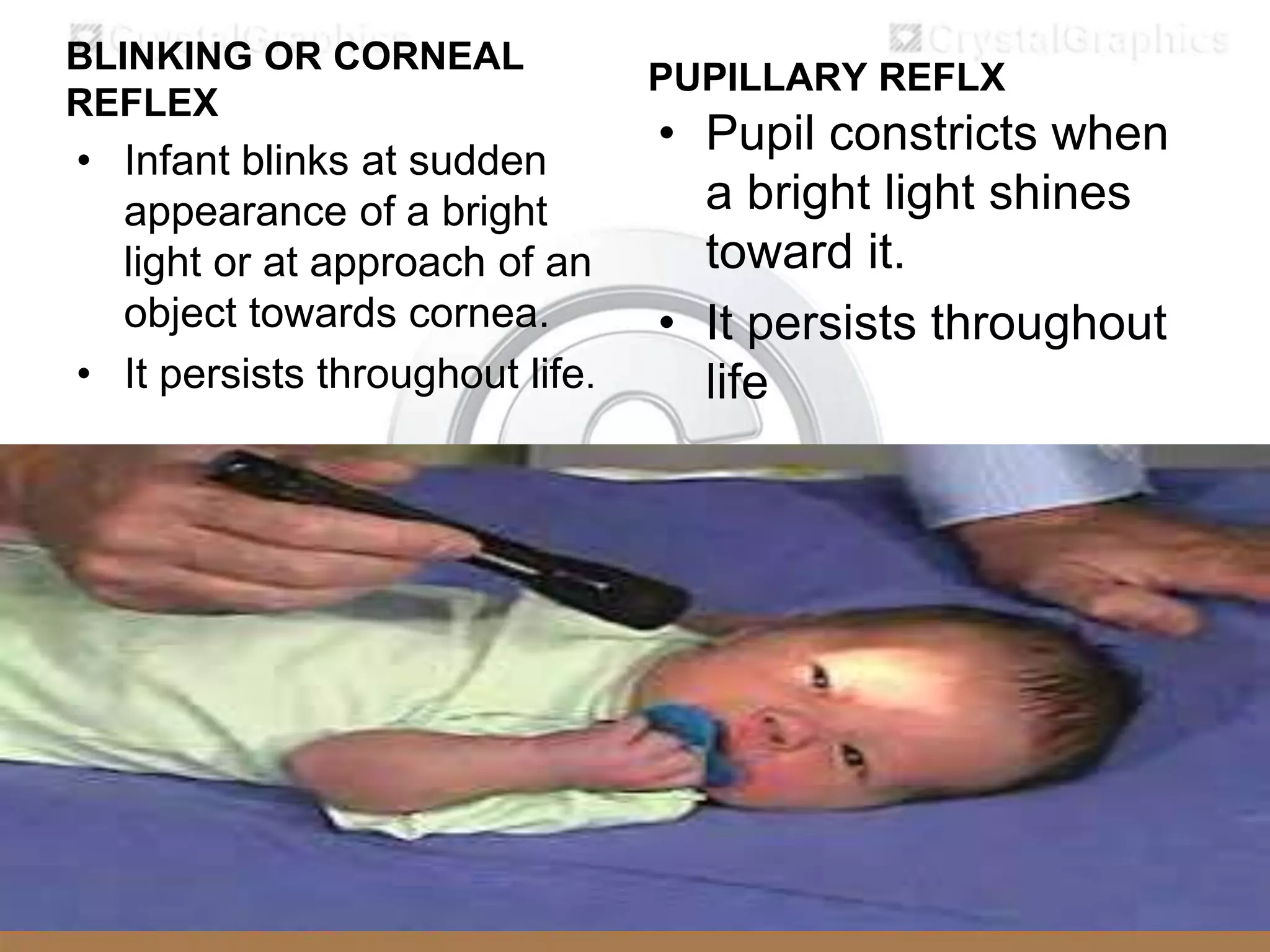
BLINKING OR CORNEAL
REFLEX
• Infant blinks at sudden
appearance of a bright
light or at approach of an
object towards cornea.
• It persists throughout life.
PUPILLARY REFLX
• Pupil constricts when
a bright light shines
toward it.
• It persists throughout
life
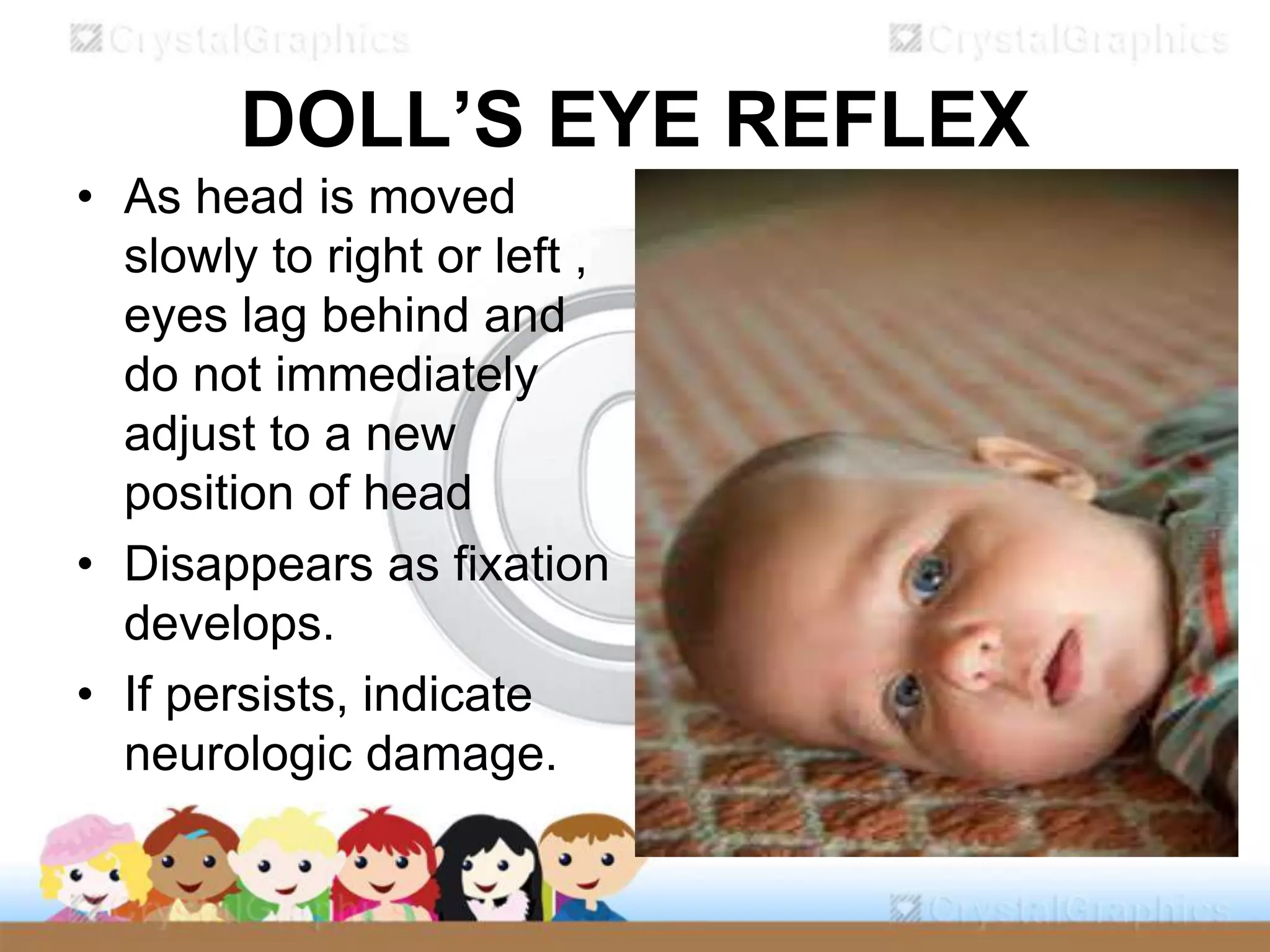
DOLL’S EYE REFLEX
• As head is moved
slowly to right or left ,
eyes lag behind and
do not immediately
adjust to a new
position of head
• Disappears as fixation
develops.
• If persists, indicate
neurologic damage.
SNEEZING REFLEX
Spontaneous response of
nasal passages to
irritation or obstruction
Persists throughout life.
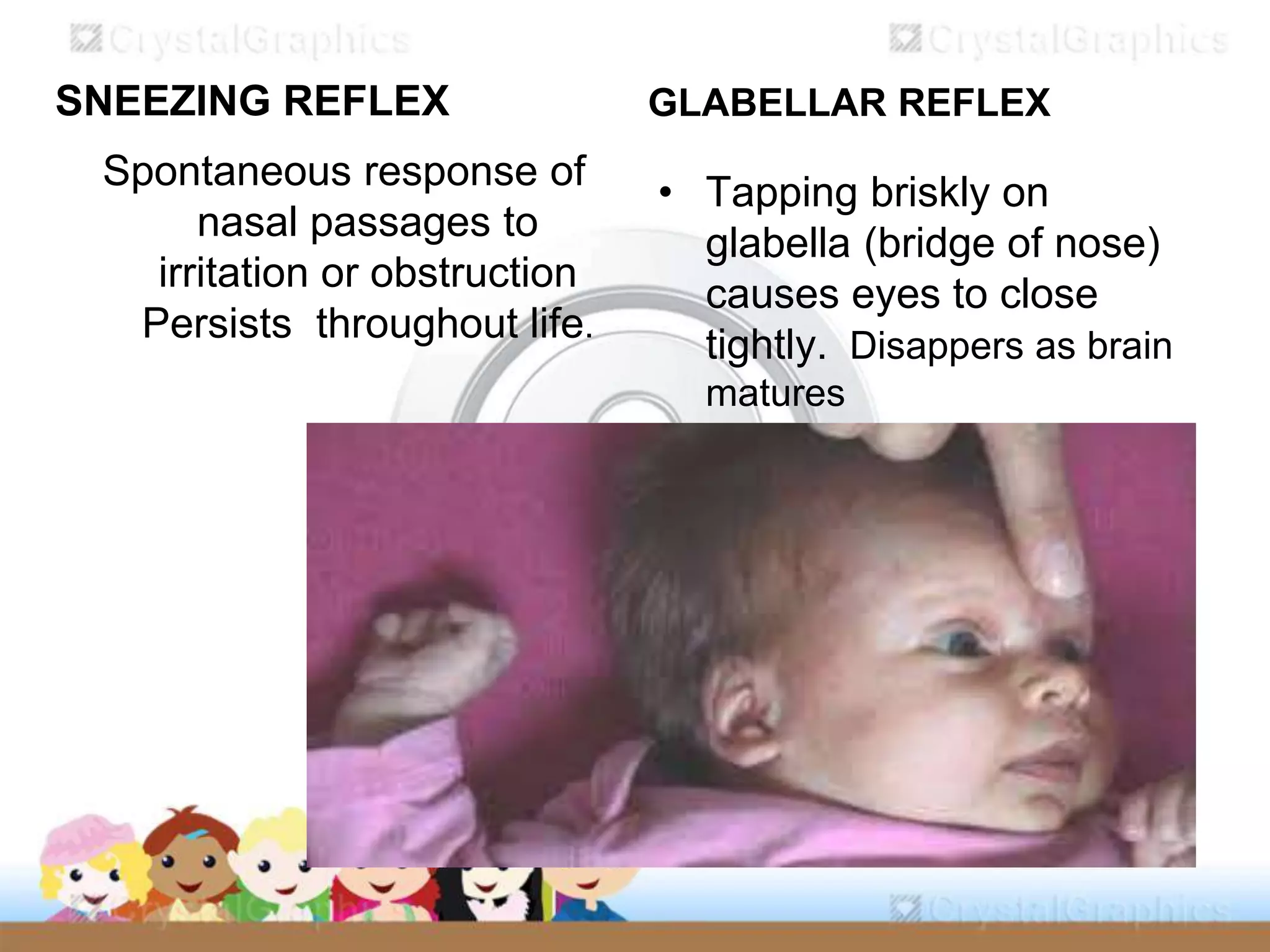
GLABELLAR REFLEX
• Tapping briskly on
glabella (bridge of nose)
causes eyes to close
tightly. Disappers as brain
matures
SUCKING
REFLEX
Disappears: around 12 months.
Elicited by the examiner stroking the lips of
the infant; the infant’s mouth opens and
the examiner introduces their gloved finger
and sucking starts.
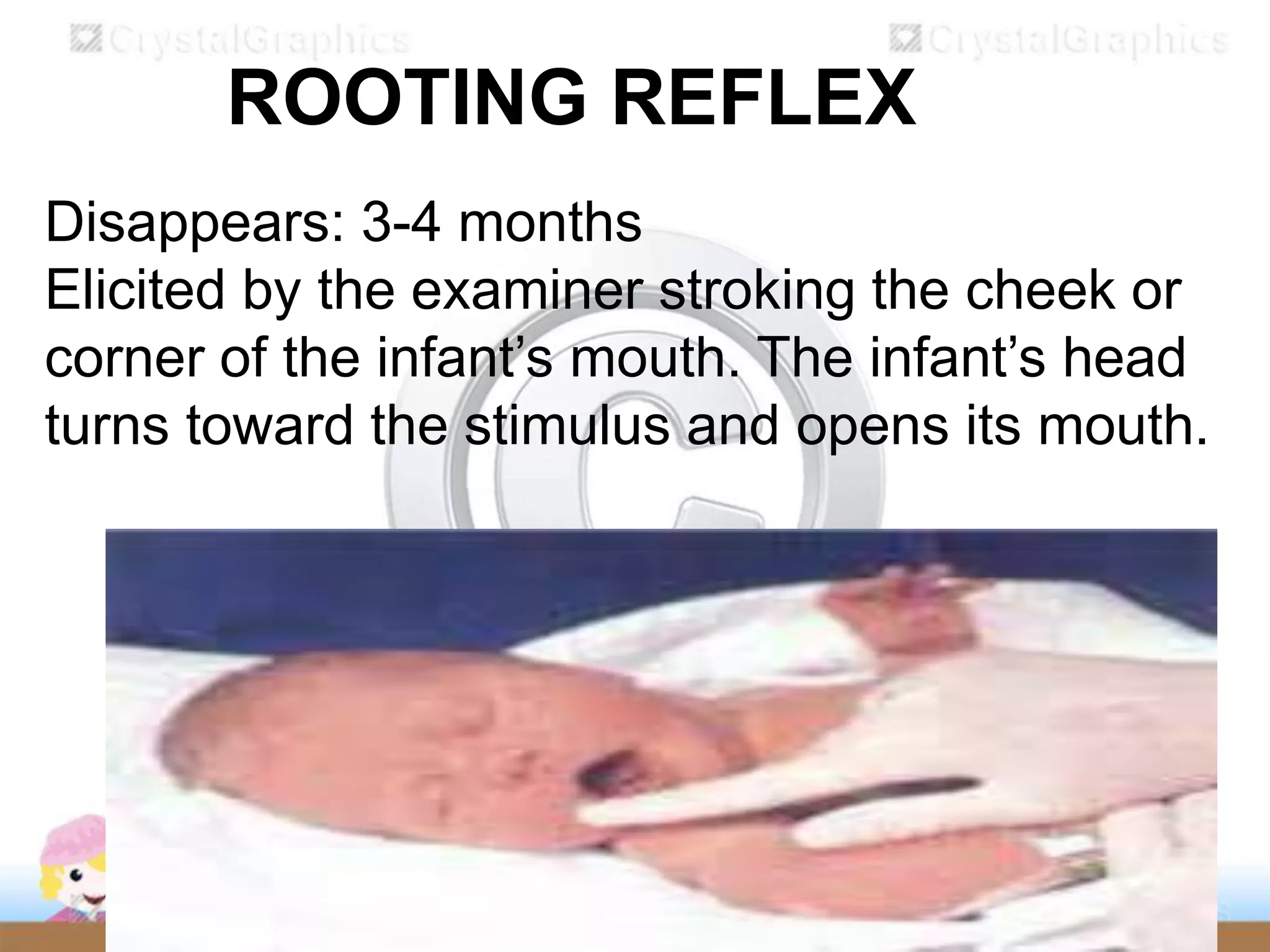
ROOTING REFLEX
Disappears: 3-4 months
Elicited by the examiner stroking the cheek or
corner of the infant’s mouth. The infant’s head
turns toward the stimulus and opens its mouth.
GAG REFLEX
• Stimulation of posterior pharynx by food,
suction or passage of a tube causes infant
to gag
• Persists throughout life.
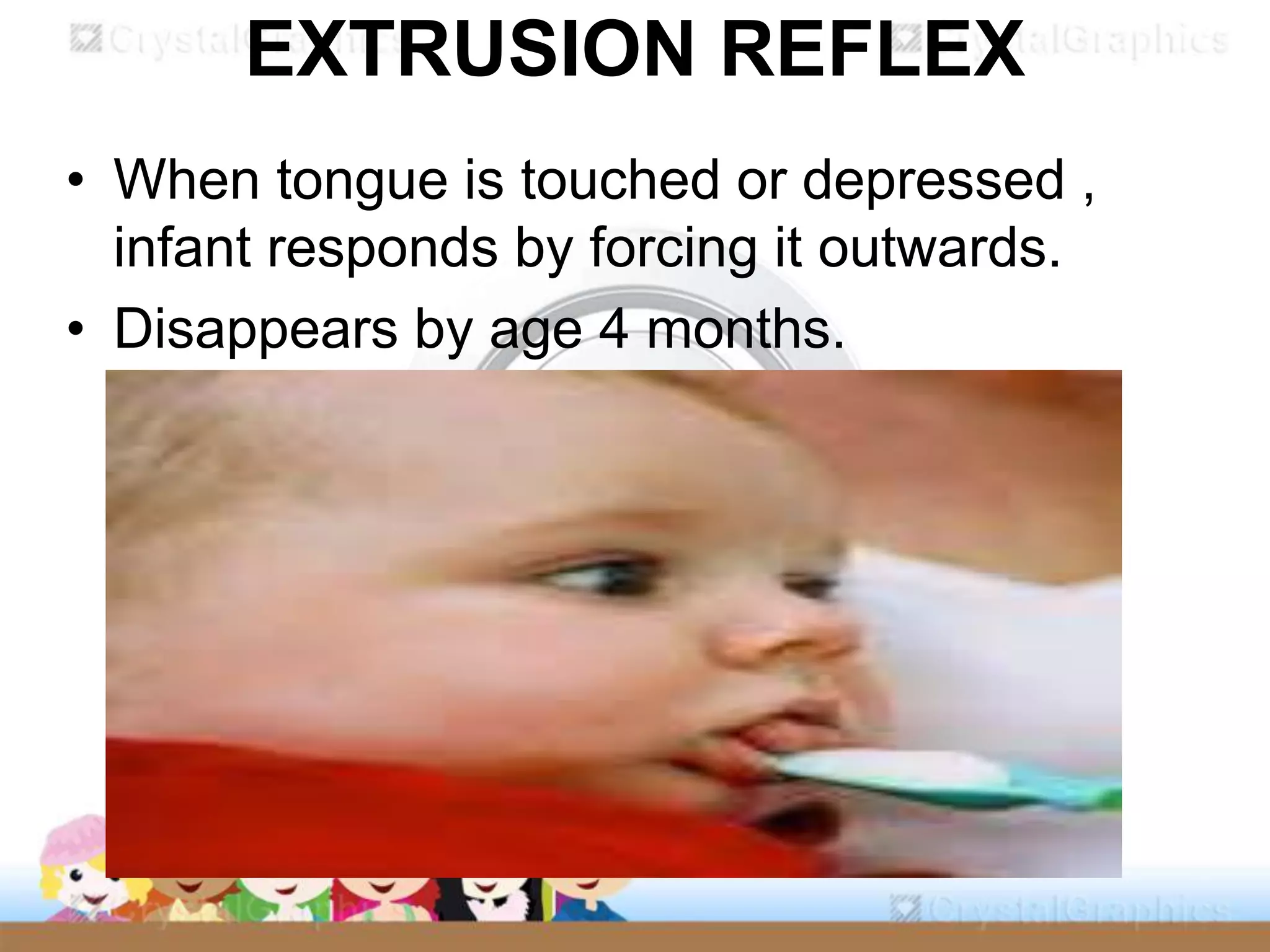
EXTRUSION REFLEX
• When tongue is touched or depressed ,
infant responds by forcing it outwards.
• Disappears by age 4 months.
YAWN
Spontaneous
response to
decreased oxygen by
increasing amount of
inspired air
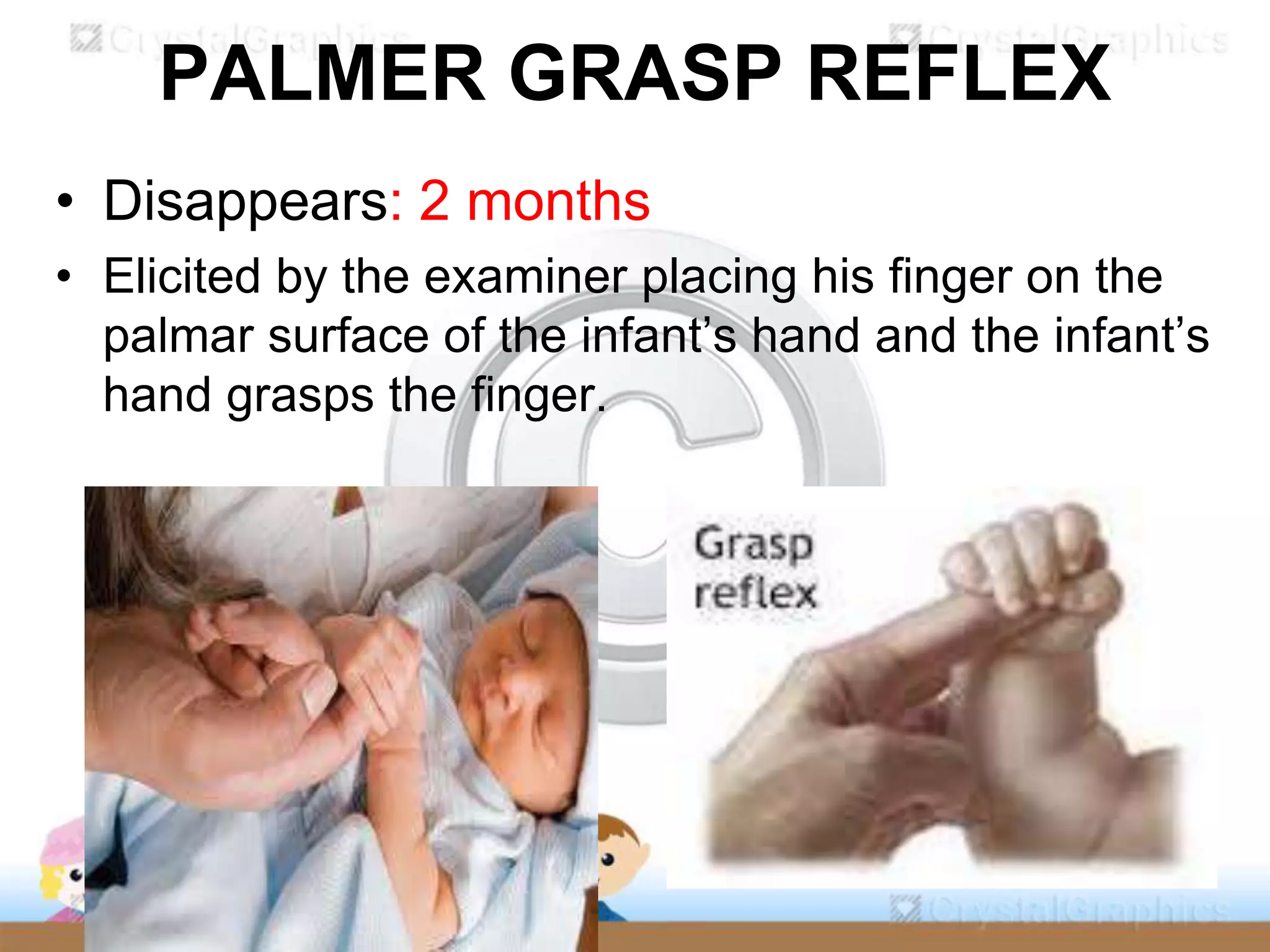
PALMER GRASP REFLEX
• Disappears: 2 months
• Elicited by the examiner placing his finger on the
palmar surface of the infant’s hand and the infant’s
hand grasps the finger.
TONIC NECK (FENCING POSTURE)
• Disappearance:7 months
• Elicited by rotating the infants head from
midline to one side. The infant should respond
by extending the arm on the side to which the
head is turned and flexing the opposite arm.
The lower extremities respond similarly.
MORO’S REFLEX
• Onset: 28-32 weeks GA
• Well-established: 37 weeks GA
• Disappearance: 6 months
• The examiner holds the infant so that one hand
supports the head and the other supports the
buttocks. The reflex is elicited by the sudden
dropping of the head in her hand. The response
is a series of movements: the infant’s hands
open and there is extension and abduction of
the upper extremities. This is followed by
anterior flexion of the upper extremities and
audible cry.
• MORO’S REFLEX
MORO’s SIGNIFICANCE
• An absent or inadequate Moro response
on one side : hemiplegia, brachial plexus
palsy, or a fractured clavicle
• Persistence beyond 5 months of age is :
indicate severe neurological defects
STARTLE REFLEX
STEPPING(DANCING) REFLEX
• Disappearance: 3-4 months
• Elicited by touching the top of
the infant’s foot to the edge of
a table while the infant is held
upright. The infant makes
movements that resemble
stepping.
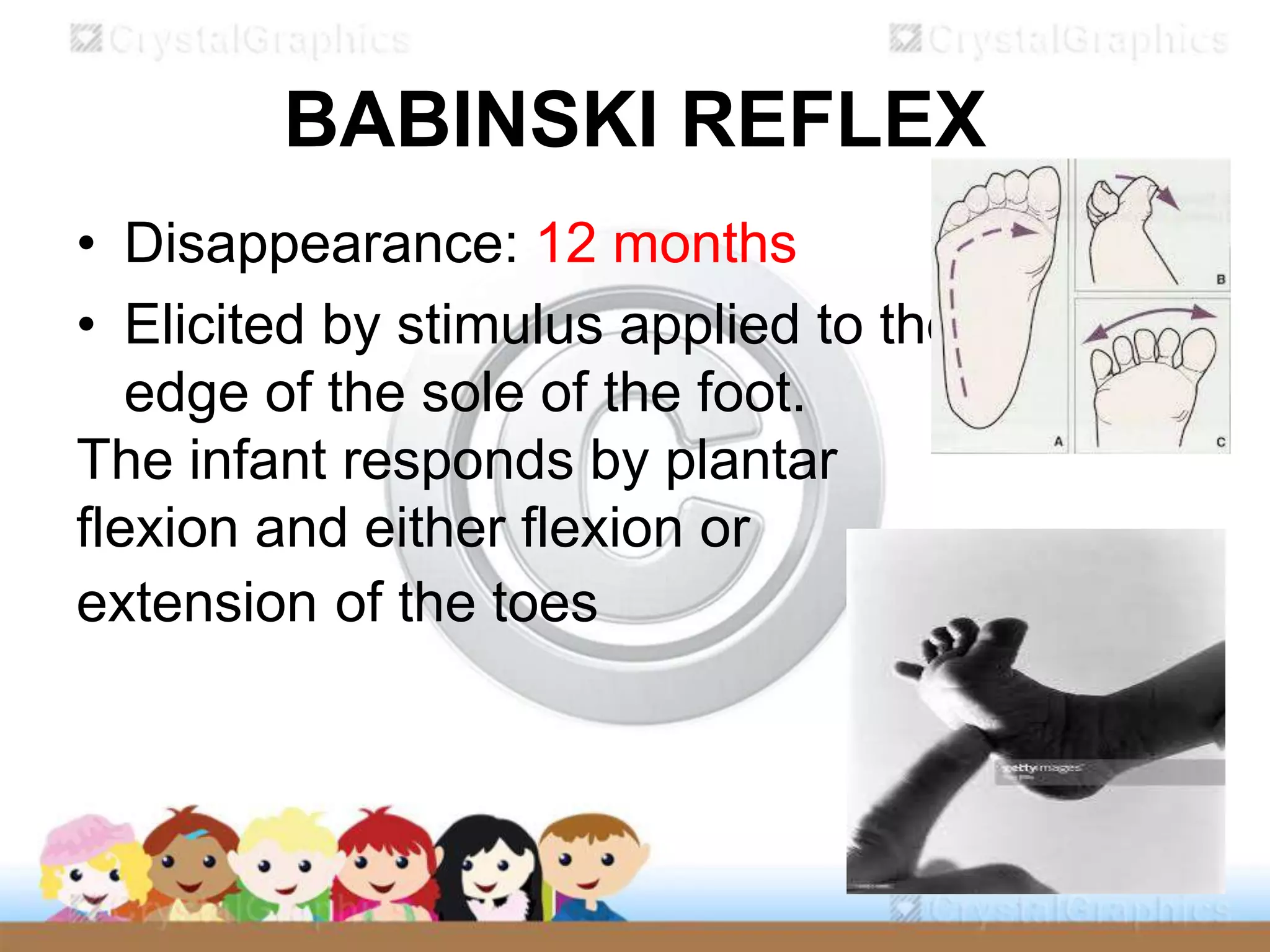
BABINSKI REFLEX
• Disappearance: 12 months
• Elicited by stimulus applied to the outer
edge of the sole of the foot.
The infant responds by plantar
flexion and either flexion or
extension of the toes
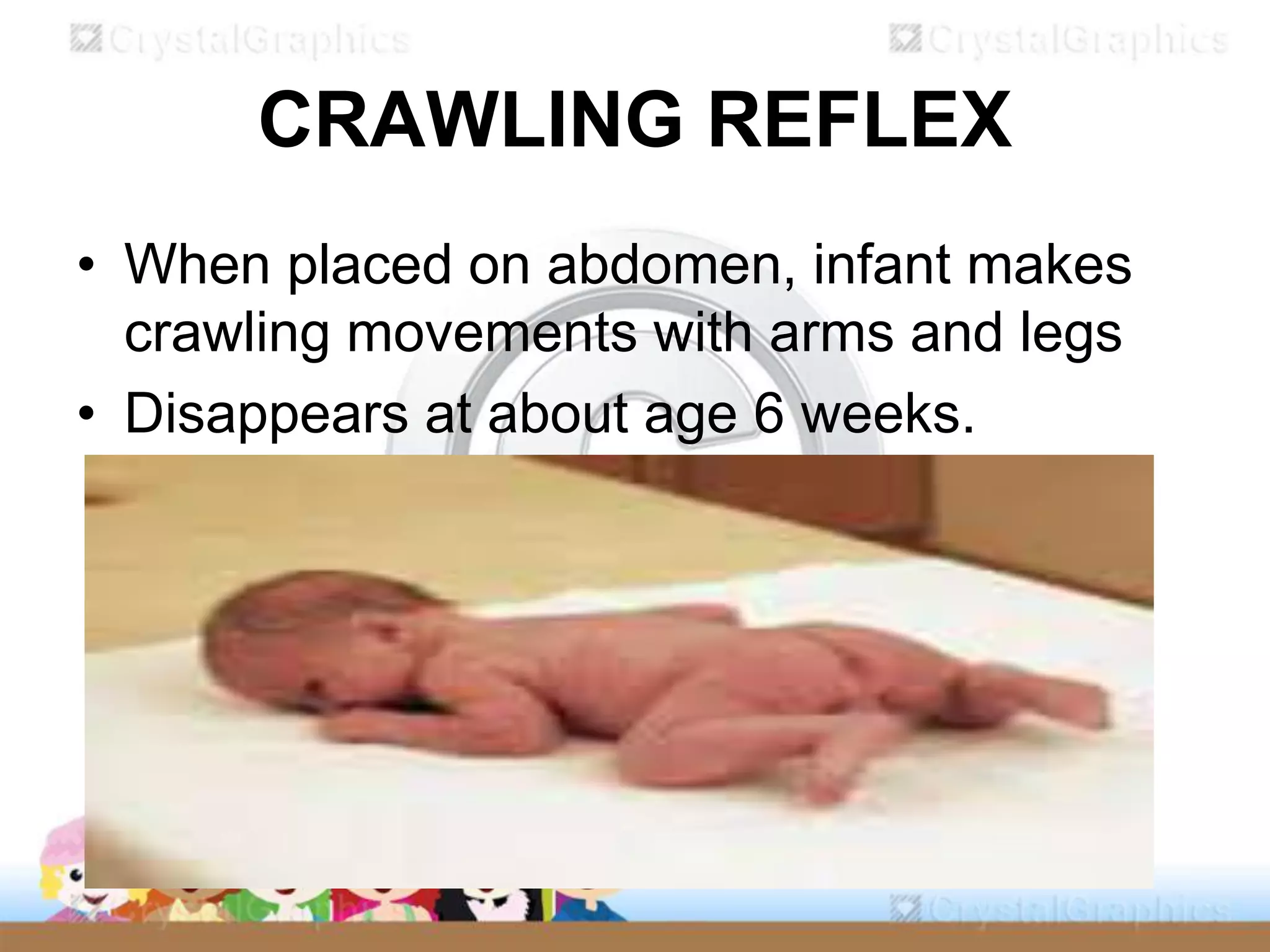
CRAWLING REFLEX
• When placed on abdomen, infant makes
crawling movements with arms and legs
• Disappears at about age 6 weeks.
HARLEQUIN COLOR CHANGE
• Color changes as the
infant lies on the side,
lower half of the body
becomes pink or red,
and upper half is pale
• It is entirely harmless
and never been
associated with
permanent problem
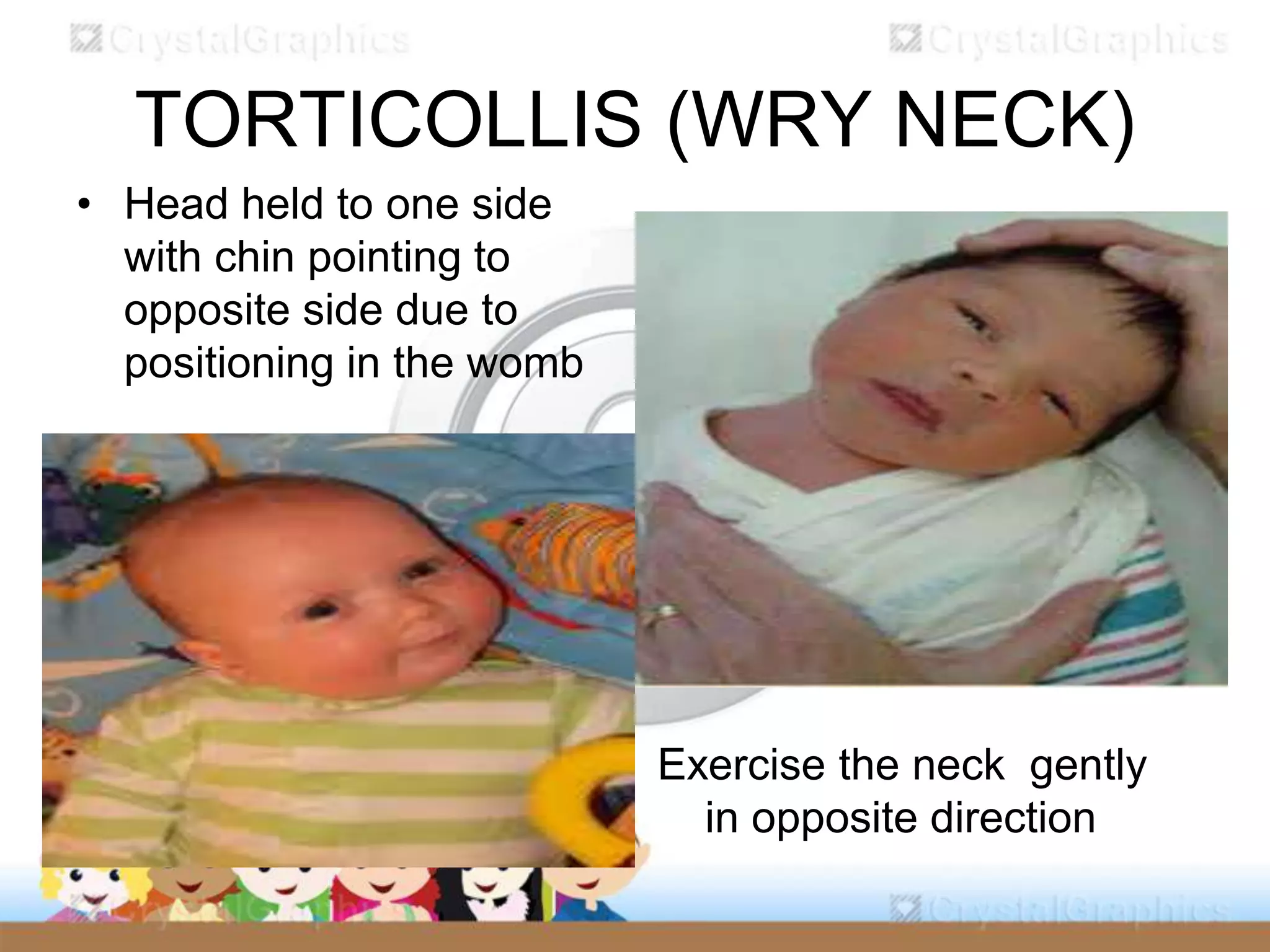
TORTICOLLIS (WRY NECK)
• Head held to one side
with chin pointing to
opposite side due to
positioning in the womb
Exercise the neck gently
in opposite direction
FOOD FOR THE BRAIN
THANK YOU

Newborn assessment

  • 1.
  • 2.
    NEWBORN EXAMINATION • DEFINITION:it is systematic examination (physical and neurological) of newborn. • OBJECTIVES 1. To provide an assessment of infant’s state of development of wellbeing. 2. To detect any deviation from normal. 3. To assess the progress of the child.
  • 3.
    INDICATIONS • First examination:a detailed one in labor room within 2 hours of birth. • Second examination; Before discharge. • Third examination: After 6-8 weeks of neonatal life.
  • 4.
    TERMONOLOGIES • Small forgestational age (SGA)is less than 10% for weight at the time of birth • Large for gestational age (LGA) is more than 90% for weight at the time of birth • Appropriate for gestational age( AGA) is the birth weight between 10-90%
  • 5.
    • FULL TERM:37 to 42 weeks or 259 to 294 days. • PRE-TERM: after 28 weeks and before 37 weeks. • POST- TERM: after 42 weeks.
  • 6.
    ARTICLES REQUIRED TPR Tray Atray containing: 1. Hand washing articles 2. Apron 3. Stethoscope 4. Inch tape 5. Torch 6. Bowl containing cotton wisp 7. Weighing machine 8. Bowl with extra cotton 9. Mackintosh 10. Kidney tray 11. Paper bag
  • 7.
    INITIAL ASSESSMENT OF NEWBORN 1.IDENTIFICATION Check and identify the sex of the infant and verify the records with the correct name, sex and registration number. 2. GESTATIONAL AGE FULL TERM/ PRE-TERM/ POST- TERM
  • 9.
    VITAL SIGNS Check thevital signs in the following order: a) RESPIRATION: normal value of respiration is 40-60 breaths/min. b) HEART RATE: normal value of heart rate is 120-140 beats/min. c) TEMPERATURE: normal value of temperature is 36.5-37.5 degree Celsius.
  • 10.
    PHYSICAL EXAMINATION LENGTH: Crownto heel length with infant supine/ upside down/ with the knees slightly pressed down to obtain maximum leg extension. (47-50 cm) HEAD CIRCUMFERENCE: It is measured with a tape measure drawn across the center of the forehead and the most prominent portion of the posterior head. ( 33-35 cm )
  • 11.
    CHEST CIRCUMFERENCE: It is measuredat the level of nipples and is about 2 cm less than head circumference. 30-33 cm WEIGHT: Average birth weight 2.5 -3.5 kg
  • 12.
    . POSTURE ANDMOVEMENTS: # Supine position with partial flexion of arms, legs and hand commonly turned a little to one side. Hip joints are partially abducted. # Movement is most evident in face and limbs. Unusual movement or lack of movements and asymmetry should be noted and reported.
  • 14.
    2.SKIN a) Colour: # Mostterm newborns have a ruddy complexion because of the increased concentration of red blood cells in the blood vessels and a decrease in the amount of subcutaneous fat. This ruddiness fades slightly over the 1st month. .
  • 15.
    # Peripheral cyanosisappear due to immature peripheral circulation. This is a normal phenomenon in the first 24 to 48 hour after birth. # Central cyanosis indicates decreased oxygenation. It may be the result of temporary respiratory obstruction or an underlying disease Cyanosis:
  • 17.
    b) VERNIX CASEOSA:It is a white, cream cheese-like substance that serves as a lubricant, is secreted by the fetal sebaceous glands and which disappear within a few days.
  • 18.
    c) LANUGO: isthe fine, downy hair that covers a newborn’s shoulder, back and upper arms. It may be found also on the forehead and ears. # Pre-term newborns has more lanugo then post-term.
  • 19.
    DESQUAMTION: Peeling ofthe skin takes place few days after birth and most marked on the hands and feet.
  • 20.
    e) MILIA: Newbornsebaceous glands are immature, therefore pinpoint white papule can be found on the cheek or across the bridge of the nose of newborn. It disappear by 2 to 4 weeks.
  • 21.
    f) Erythema toxicum:It begin as a papule, increasing in severity to become erythema by the 2nd day and then disappearing by the 3rd day.
  • 22.
    Forceps mark: Ifforceps were used for birth, there may be circular or linear contusion matching the rim of the blade of the forceps on the infant’s cheek. This marks disappear in 1 to 2 days along with he edema that accompanies it.
  • 23.
    • Skin turgor:If a fold of skin is grasped between the thumb and fingers, it should feel elastic. When it is released it should fall back to form a smooth surface. If severe dehydration is present, the skin will not smooth out again and will remain in an elevated ridge.
  • 24.
    i) Mongolian spots: •Slate-gray to blue- black lesions Usually over lumbo sacral area and buttocks Accumulation of melanocytes within the dermis. Generally fade by age 7 years
  • 25.
    3. HEAD a) Anewborn’s head appears disproportionately large because it is one fourth of the total length. b) Fontanelles: The anterior fontanelle will be felt as a soft spot. The posterior fontanelle is so small that it cannot be palpated readily.
  • 28.
    • Sutures: Suturelines should never appear widely separated in newborns. Separation denotes increased intracranial pressure from either abnormal brain formation, abnormal accumulation of CSF in the cranium (hydrocephalus), or an accumulation of blood from a birth injury . Fused suture lines also are abnormal and need to be confirmed with X-ray and further evaluation.
  • 29.
    CAPUT SUCCEDANEUM Swelling oredema of the presenting portion of scalp. Goes away few days
  • 30.
  • 31.
    CEPHALHEMATOMA Bleeding between theskull and periosteum of newborn baby . Secondary to suture of blood vessel crossing the periosteum. It does not crosses the suture line. Disappears by weeks and months
  • 32.
    4. EYES: Newborn’susually crt tearlessely because of the lacrimal ducts are not fully mature until about 3 months of age. # Eyes should appear clear without any redness or purulent discharge. # we should observe for subconjuctival hemorrhage, opthalmia neonatorum etc.
  • 33.
    EARS: The levelof the top part of the external ear should be on a line drawn from the inner canthus to the outer canthus of the eye and back across the side of head. # Ear Cartilage: Pinna firm, cartilage felt along with the edge. # Ear Recoil: Instant recoil.
  • 34.
    6.MOUTH: # Mouth shouldbe observed for cleft lip, cleft palate and tongue tie. The palate of newborn should be intact. Occasionally, one or two small round, glistening, well- circumscribed cysts (EPSTEIN PEARLS) are present on the palate, a result of the extra load of calcium that was deposited in utero.
  • 36.
    Sometimes in somenewborns one or two natal teeth may have erupted. NECK: The neck of newborn is short, often chubby and creased with skin fold. Head should rotate freely on it.
  • 37.
    8. CHEST: Itlooks small because the infant’s head is large in proportion. # Possible breast engorgement with possible secretion of thin’ watery fluid popularly termed witch’s milk.. # Absence of retraction.
  • 38.
    9. ABDOMEN: # Bowelsounds present within an hour after birth. # Edge of the liver usually palpable at 1 to 2 cm below the right costal margin. Edge of the spleen usually palpable at 1 to 2 cm below the left costal margin.
  • 39.
    UMBLICAL CORD • Ithas 2 arteries and 1 veins • At birth cord appears bluish white and moist • After clamping , it begin dry and appears a dull yellowish brown and sheds after 6-10 days
  • 40.
    If presence of1 artery then it is associated with V- Vertebral A- anorectal C- cardiac TE- tracheoesophageal R- renal L- limbic ABNORMALITIES
  • 41.
    10.BACK:The spine ofnewborn typically appears flat in the lumbar and sacral areas. The base of the spine should be free of any pinpoint openings, dimpling, or sinus tracts in the skin, which would suggest a dermal sinus or SPINA BIFIDA or occulta, Lumbar hair tuft & haemangioma
  • 42.
    11. ANOGENITAL AREA #The anus of newborn must be inspected to be certain that is present, patent, and not covered by a membrane (imperforate anus). Male Genitalia: Scrotum is pendulous and both the testes are present in the scrotum. Males with one or both undescended testicles (cryptorchidism) needs further evaluation.
  • 43.
    # Female Genitalia:in female newborns labia majora fully covers labia minora. Some newborns have a mucous vaginal secretion, which is sometimes blood tinged, called pseudomenstruation. This discharge disappears as soon as the infant’s system has cleared the hormones.
  • 44.
    . EXTREMITIES: We shouldobserve for syndactyly or polydactyly.
  • 45.
    SIMIAN CREASE Unusual curvatureof the little finger and a simian crease (a single palmar crease) are signs of Down syndrome.
  • 46.
    SOLES • A fullterm newborn have creases covering the entire sole of the foot • Post –mature infants have deep crease over the foot • A premature infant sole crease mat partially cover the upper two-third or may be absent
  • 47.
    MECONIUM MECONIUM It is thefirst fecal material , is a sticky , odorless material, greenish black to brownish green which is passed from 8-24 hours after birth URINE The first urine is diluted because of immaturity of the kidneys and lack of ability to concentrate urine.
  • 48.
    NEONATAL REFLEXES • Alsoknown as developmental, primary, or primitive reflexes. • They can provide information about lower motor neurons and muscle tone. • They are often protective and disappear as higher level motor functions emerge
  • 49.
    BLINKING OR CORNEAL REFLEX •Infant blinks at sudden appearance of a bright light or at approach of an object towards cornea. • It persists throughout life. PUPILLARY REFLX • Pupil constricts when a bright light shines toward it. • It persists throughout life
  • 50.
    DOLL’S EYE REFLEX •As head is moved slowly to right or left , eyes lag behind and do not immediately adjust to a new position of head • Disappears as fixation develops. • If persists, indicate neurologic damage.
  • 51.
    SNEEZING REFLEX Spontaneous responseof nasal passages to irritation or obstruction Persists throughout life. GLABELLAR REFLEX • Tapping briskly on glabella (bridge of nose) causes eyes to close tightly. Disappers as brain matures
  • 52.
    SUCKING REFLEX Disappears: around 12months. Elicited by the examiner stroking the lips of the infant; the infant’s mouth opens and the examiner introduces their gloved finger and sucking starts.
  • 53.
    ROOTING REFLEX Disappears: 3-4months Elicited by the examiner stroking the cheek or corner of the infant’s mouth. The infant’s head turns toward the stimulus and opens its mouth.
  • 54.
    GAG REFLEX • Stimulationof posterior pharynx by food, suction or passage of a tube causes infant to gag • Persists throughout life.
  • 55.
    EXTRUSION REFLEX • Whentongue is touched or depressed , infant responds by forcing it outwards. • Disappears by age 4 months.
  • 56.
    YAWN Spontaneous response to decreased oxygenby increasing amount of inspired air
  • 57.
    PALMER GRASP REFLEX •Disappears: 2 months • Elicited by the examiner placing his finger on the palmar surface of the infant’s hand and the infant’s hand grasps the finger.
  • 58.
    TONIC NECK (FENCINGPOSTURE) • Disappearance:7 months • Elicited by rotating the infants head from midline to one side. The infant should respond by extending the arm on the side to which the head is turned and flexing the opposite arm. The lower extremities respond similarly.
  • 59.
    MORO’S REFLEX • Onset:28-32 weeks GA • Well-established: 37 weeks GA • Disappearance: 6 months • The examiner holds the infant so that one hand supports the head and the other supports the buttocks. The reflex is elicited by the sudden dropping of the head in her hand. The response is a series of movements: the infant’s hands open and there is extension and abduction of the upper extremities. This is followed by anterior flexion of the upper extremities and audible cry.
  • 60.
  • 61.
    MORO’s SIGNIFICANCE • Anabsent or inadequate Moro response on one side : hemiplegia, brachial plexus palsy, or a fractured clavicle • Persistence beyond 5 months of age is : indicate severe neurological defects STARTLE REFLEX
  • 62.
    STEPPING(DANCING) REFLEX • Disappearance:3-4 months • Elicited by touching the top of the infant’s foot to the edge of a table while the infant is held upright. The infant makes movements that resemble stepping.
  • 63.
    BABINSKI REFLEX • Disappearance:12 months • Elicited by stimulus applied to the outer edge of the sole of the foot. The infant responds by plantar flexion and either flexion or extension of the toes
  • 64.
    CRAWLING REFLEX • Whenplaced on abdomen, infant makes crawling movements with arms and legs • Disappears at about age 6 weeks.
  • 65.
    HARLEQUIN COLOR CHANGE •Color changes as the infant lies on the side, lower half of the body becomes pink or red, and upper half is pale • It is entirely harmless and never been associated with permanent problem
  • 66.
    TORTICOLLIS (WRY NECK) •Head held to one side with chin pointing to opposite side due to positioning in the womb Exercise the neck gently in opposite direction
  • 67.
  • 68.