

PHYSICAL
ASSESSMENT
-BY KHYATI CHAUDHARI
NURSINGTUTOR
INTRODUCTION
■ It is the systematic collection of objective information that is directly observed or is
elicited through examination techniques.
■ Physical examination involves the use of one’s senses to obtain information about the
structure and function of an area being observed .
■ It is thorough inspection or a detailed study of the entire body or some parts of the
body to determine the general physical or mental conditions of the body.
PURPOSES
■ To understand the physical and mental well being of the clients.
■ To detect diseases in its early stage.
■ To determine the cause and the extent of disease.
■ To understand any changes in the condition of diseases, any improvement or
regression.
■ To determine the nature of treatment nursing care needed for the client.
Continue..
■ To safeguard the client and his family by noting the early signs especially in case of a
communicable diseases.
■ To contribute to the medical research.
■ To find out whether the person is medically fit or not for a particular task.
TECHNIQUESOF PHYSICAL
EXAMINATION
■ The basic techniques used in physical
examination are explained as
follows:
1. Inspection
2. Palpation
3. Percussion
4. Auscultation
5. Manipulation
6. Testing of the reflexes
1. Inspection
■ It is the systematic visual examination of the client, or it is the process of performing
deliberating purposeful observations in a systematic manner.
■ It involves observation of the color, shape, symmetry, position and movements.
■ It also use the sense of smell to detect odor and sense of hearing to detect sounds.
■ Inspection begins with the initial contact with the client and continues through the
entire assessment.
■ The optimal conditions for effective inspection are full exposure of the area and
adequate lightning.
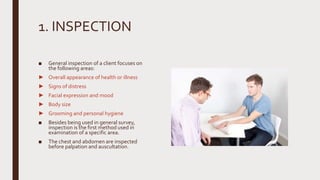
1. INSPECTION
■ General inspection of a client focuses on
the following areas:
► Overall appearance of health or illness
► Signs of distress
► Facial expression and mood
► Body size
► Grooming and personal hygiene
■ Besides being used in general survey,
inspection is the first method used in
examination of a specific area.
■ The chest and abdomen are inspected
before palpation and auscultation.
2. PALPATION
■ It is use of hands and fingers to gather information through touch.
■ It is the assessment technique which uses senses of touch. It is feeling of body parts
with hands to note the size and position of organs.
■ The hands and fingers are sensitive tools and can assess temperature, turgor, texture,
moisture, vibrations, size, positions, consistency, masses and fluid.
■ The dorsum (back) surfaces of the hand and fingers are used to measure temperature.
■ The palmar(front) surfaces of the fingers and finger pads are used to assess texture,
shape, fluid, size, consistency and pulsation.
CONTINUE…
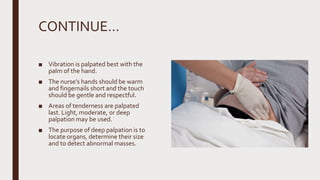
■ Vibration is palpated best with the
palm of the hand.
■ The nurse’s hands should be warm
and fingernails short and the touch
should be gentle and respectful.
■ Areas of tenderness are palpated
last. Light, moderate, or deep
palpation may be used.
■ The purpose of deep palpation is to
locate organs, determine their size
and to detect abnormal masses.
3. PERCUSSION
■ It is the examination by tapping the fingers on the body to determine the condition of
the internal organs by the sounds that are produced.
■ Percussion is the act of striking one object against another to produce sound.
■ The sound waves produced by the striking action over body tissues are known as
percussion tones or percussion notes.
■ Percussion provides information about the nature of an underlying structure.
■ It is used to outline the size of an organ such as bladder or liver.
CONTINUE…
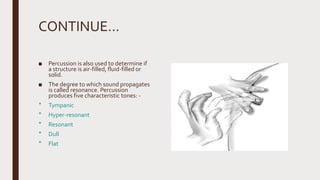
■ Percussion is also used to determine if
a structure is air-filled, fluid-filled or
solid.
■ The degree to which sound propagates
is called resonance. Percussion
produces five characteristic tones: -
‫٭‬ Tympanic
‫٭‬ Hyper-resonant
‫٭‬ Resonant
‫٭‬ Dull
‫٭‬ Flat
CONTINUE…
■ Percussion of the abdomen is tympanic, inflated lung tissue is hyper resonant, normal
tissue is resonant the liver is dull and the bone flat.
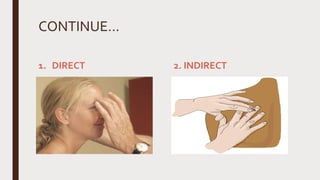
■ There are two type of percussion. Direct and Indirect.
■ Direct Percussion : It is accomplished by tapping an area directly with the finger tip of
the middle finger or thumb.
■ Indirect Percussion : It involves two hands.The hand is placed on the area to be
percussed and the finger creating vibrations that allows discrimination among five
different tones.
CONTINUE…
1. DIRECT 2. INDIRECT
4. AUSCULTATION
■ It is the purpose of listening to sounds that are generated within the body.
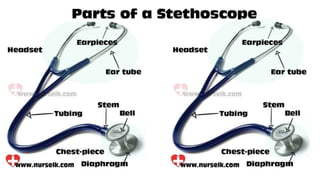
■ Auscultation is usually done with the help of stethoscope.
■ The heart and blood vessels are auscultated for circulation of blood, the lungs are
auscultated for moving air (breath sounds); the abdomen is auscultated for
movement of gastrointestinal contents (bowel sounds).
■ When auscultating a part, that area should be exposed and should be quite.
CONTINUE…
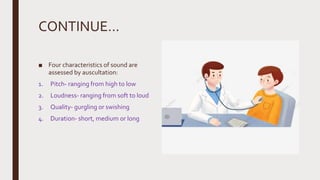
■ Four characteristics of sound are
assessed by auscultation:
1. Pitch- ranging from high to low
2. Loudness- ranging from soft to loud
3. Quality- gurgling or swishing
4. Duration- short, medium or long
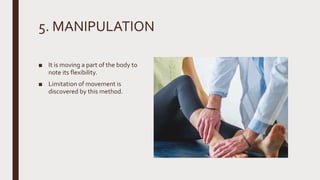
5. MANIPULATION
■ It is moving a part of the body to
note its flexibility.
■ Limitation of movement is
discovered by this method.
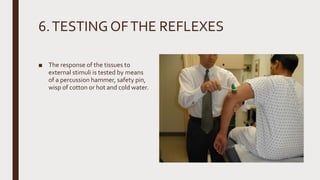
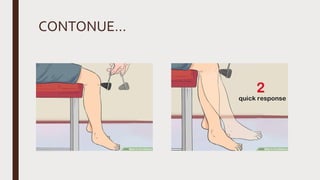
6.TESTINGOFTHE REFLEXES
■ The response of the tissues to
external stimuli is tested by means
of a percussion hammer, safety pin,
wisp of cotton or hot and cold water.
CONTONUE…
GENERAL EXAMINATION OR HEADTO
TOE EXAMINATION
■ The examination is carried out is an orderly manner focusing upon one area of the
body at a time.
■ The observation of the client starts as the client walks into the examination room.
■ e.g.A limp may be noted as the client walks in.
■ The following observations are made:
General Examination
1. GENERALAPPEARANCE
■ Nourishment- well nourished or
under nourished
■ Body Built- thin or obese
■ Health- healthy or unhealthy
■ Activity- active or dull (tired)
2. MENTAL STATUS
■ Consciousness- conscious,
unconscious, delirious, talking
incoherently
■ Look- anxious or worried, depressed
etc…
General Examination
3. HEIGHT
4. WEIGHT
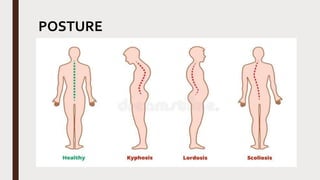
5. POSTURE
■ Body curves- Lordosis, kyphosis,
scoliosis
■ Movement- any limp.
POSTURE
General Examination
6. SKIN CONDITIONS
■ Color- pallor, jaundice, cyanosis,
flushing etc.
■ Texture- dryness, flaking, wrinkling
or excessive moisture
■ Temperature- warm, cold and
clammy
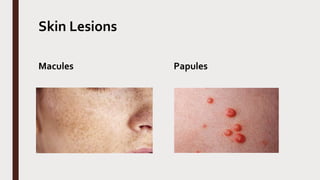
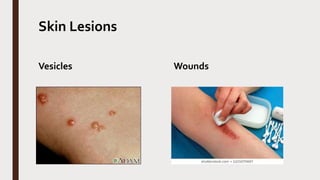
■ Lesions- macules, papules, vesicles,
wounds etc.
7. HEAD & FACE
Shape of the skull and fontanels(noted
in the newborns)
■ Skull circumference:
■ Scalp- cleanliness, condition of the
hair, dandruff, pediculi, infectious
like ringworm.
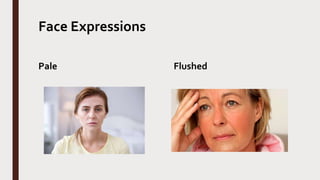
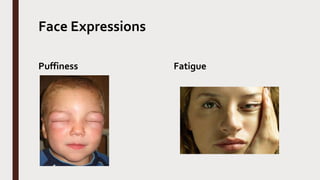
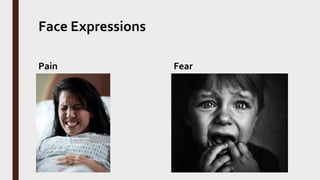
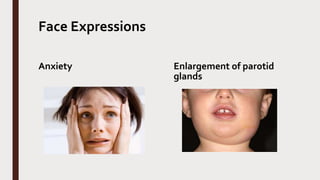
■ Face- pale, flushed, puffiness,
enlargement of parotid glands, fear,
fatigue, pain, anxiety, etc.
Skin Lesions
Macules Papules
Skin Lesions
Vesicles Wounds
Face Expressions
Pale Flushed
Face Expressions
Puffiness Fatigue
Face Expressions
Pain Fear
Face Expressions
Anxiety Enlargement of parotid
glands
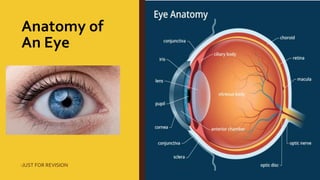
Anatomy of
An Eye
-JUST FOR REVISION
General Examination
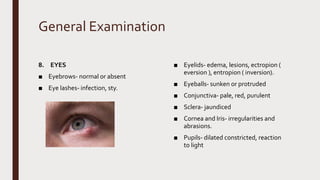
8. EYES
■ Eyebrows- normal or absent
■ Eye lashes- infection, sty.
■ Eyelids- edema, lesions, ectropion (
eversion ), entropion ( inversion).
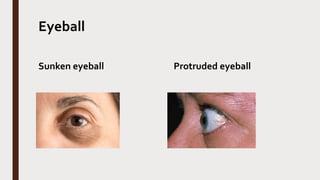
■ Eyeballs- sunken or protruded
■ Conjunctiva- pale, red, purulent
■ Sclera- jaundiced
■ Cornea and Iris- irregularities and
abrasions.
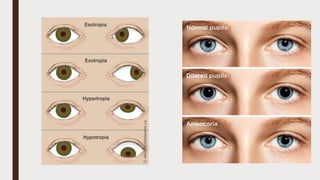
■ Pupils- dilated constricted, reaction
to light
General Examination
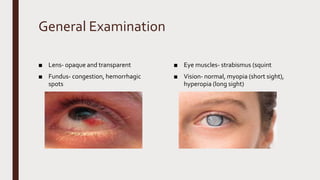
■ Lens- opaque and transparent
■ Fundus- congestion, hemorrhagic
spots
■ Eye muscles- strabismus (squint
■ Vision- normal, myopia (short sight),
hyperopia (long sight)
Eyeball
Sunken eyeball Protruded eyeball
General Examination
9. EARS
■ External ear- discharges, cerumen
obstructing the ear passage
■ Tympanic membrane- perforations,
lesions, budging
 Hearing acuity tests
■ Weber’s test
■ Rinne’s test
■ Whisper’s test
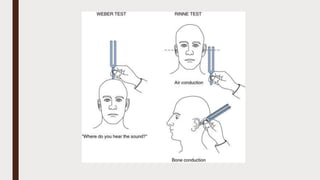
 Weber’s test
Wrap the tuning fork strongly on your
palm and then press the butt of the
instrument on the top of the patient's
head in the midline and ask the patient
where they hear the sound.
WHERE CANYOU HEAR BUZZY
NOISE ?
The patient is asked to report in which
ear the sound is heard louder.
In a normal patient, the sound is heard
equally loud in both ears (no
lateralization).
However a patient with symmetrical
hearing loss will have the same findings.
Thus, there is diagnostic utility only in
asymmetric hearing losses.
 Rinne’s test
In the Rinne’s test, a comparison is made
between hearing elicited by placing the
base of a tuning fork applied to the
mastoid process (bone) and then after
the sound is no longer appreciated, the
vibrating top is placed one inch from the
external ear canal (air).
■ RESULTS
NORMAL - Air conduction > Bone
conduction
ABNORMAL –
Air Conduction < Bone Conduction
Air Conduction = Bone Conduction
---------which suggest that patient may
have conductive hearing loss.
 Whisper’s test
1. Confirm if patient understands
instructions.
2. Exhale.Whisper a combination of 3
random numbers and letters from 2
feet behind patient (e.g. 6, K, 0).
3. Ask them to repeat.
4. Perform a second time (using a
different combination) if there are
any incorrect responses.
5. >3/6 incorrect: fail.
General Examination
10. NOSE
■ External nares- crusts or discharges
■ Nostrils- inflammation of the mucus
membrane, septal deviations.
11. MOUTH AND PHARYNX
■ Lips- redness, swelling, crusts,
cyanosis, angular stomatitis
■ Odor of the mouth- foul smelling
■ Teeth- discoloration & dental caries
■ Mucus membrane & gums-
ulceration and bleeding, swelling,
pus formation
■ Tongue- pale, dry, lesions, sords,
furrows, tongue tie etc.
■ Throat & pharynx- enlarged tonsils,
redness and pus.
General Examination
12. NECK
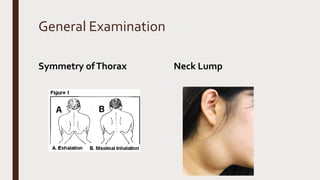
■ Lymph nodes- enlarged, palpable
■ Thyroid gland- enlarged
■ Range of motion- flexion, extension and
rotation
13. Chest
■ Thorax- shape, symmetry of expansion,
posture
■ Breath sounds- sigh, swish, rustle,
wheezing, crepitation, pleural rub etc.
■ Heart- location, cardiac murmurs
■ Breasts- enlarged lymph nodes
14. ABDOMEN
■ Observation- skin rashes, scar, hernia,
ascites, distension, pregnancy etc.
■ Auscultation- bowel sounds, fetal heart
sounds
■ Palpation- liver margin, palpable spleen,
tenderness at the area of appendix,
inguinal hernias
■ Percussion- presence of gas, fluid or mass
General Examination
Symmetry ofThorax Neck Lump
General Examination
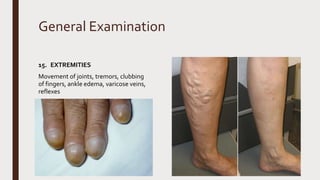
15. EXTREMITIES
Movement of joints, tremors, clubbing
of fingers, ankle edema, varicose veins,
reflexes
General Examination
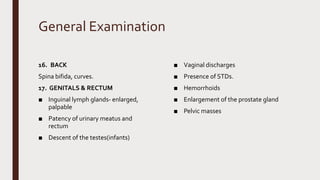
16. BACK
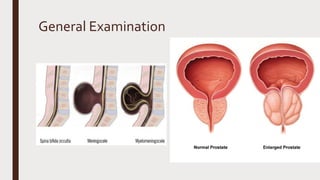
Spina bifida, curves.
17. GENITALS & RECTUM
■ Inguinal lymph glands- enlarged,
palpable
■ Patency of urinary meatus and
rectum
■ Descent of the testes(infants)
■ Vaginal discharges
■ Presence of STDs.
■ Hemorrhoids
■ Enlargement of the prostate gland
■ Pelvic masses
General Examination
General Examination
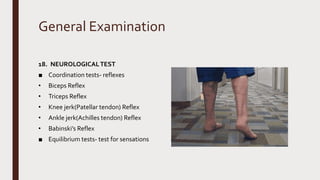
18. NEUROLOGICALTEST
■ Coordination tests- reflexes
• Biceps Reflex
• Triceps Reflex
• Knee jerk(Patellar tendon) Reflex
• Ankle jerk(Achilles tendon) Reflex
• Babinski’s Reflex
■ Equilibrium tests- test for sensations
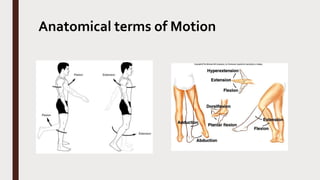
Anatomical terms of Motion
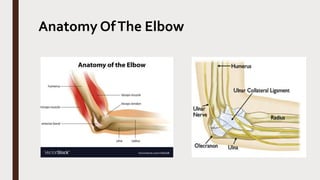
Anatomy OfThe Elbow
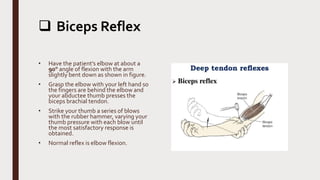
 Biceps Reflex
• Have the patient’s elbow at about a
90° angle of flexion with the arm
slightly bent down as shown in figure.
• Grasp the elbow with your left hand so
the fingers are behind the elbow and
your abductee thumb presses the
biceps brachial tendon.
• Strike your thumb a series of blows
with the rubber hammer, varying your
thumb pressure with each blow until
the most satisfactory response is
obtained.
• Normal reflex is elbow flexion.
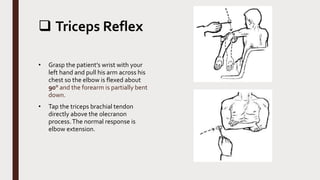
 Triceps Reflex
• Grasp the patient’s wrist with your
left hand and pull his arm across his
chest so the elbow is flexed about
90° and the forearm is partially bent
down.
• Tap the triceps brachial tendon
directly above the olecranon
process.The normal response is
elbow extension.
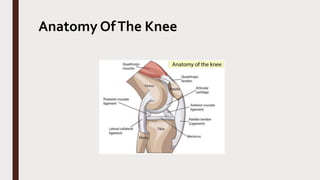
Anatomy OfThe Knee
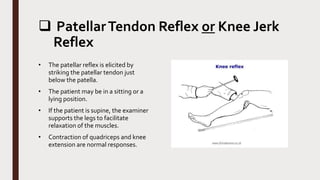
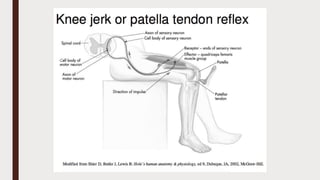
 PatellarTendon Reflex or Knee Jerk
Reflex
• The patellar reflex is elicited by
striking the patellar tendon just
below the patella.
• The patient may be in a sitting or a
lying position.
• If the patient is supine, the examiner
supports the legs to facilitate
relaxation of the muscles.
• Contraction of quadriceps and knee
extension are normal responses.
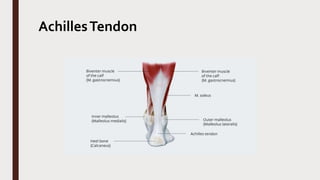
AchillesTendon
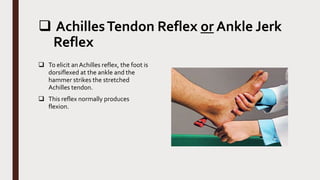
 AchillesTendon Reflex or Ankle Jerk
Reflex
 To elicit anAchilles reflex, the foot is
dorsiflexed at the ankle and the
hammer strikes the stretched
Achilles tendon.
 This reflex normally produces
flexion.
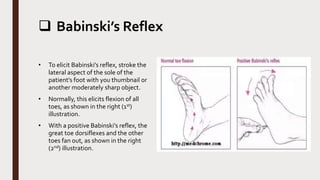
 Babinski’s Reflex
• To elicit Babinski’s reflex, stroke the
lateral aspect of the sole of the
patient’s foot with you thumbnail or
another moderately sharp object.
• Normally, this elicits flexion of all
toes, as shown in the right (1st)
illustration.
• With a positive Babinski’s reflex, the
great toe dorsiflexes and the other
toes fan out, as shown in the right
(2nd) illustration.
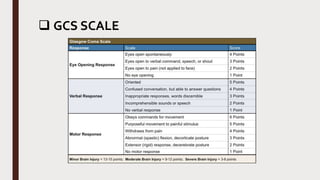
 GCS SCALE
Role of the Nurse in Physical
Examination
1. PREPARATIONOFTHE ENVIRONMENT
■ Maintenance of Privacy –
A separate examination room is needed. Keep the doors closed.The relatives are
not allowed. Drape the client according to the parts that are exposed.
■ Lighting
As far as possible, natural light should be available in the examination room
because if a client is jaundiced, it may not be detected in the artificial light.There should
be adequate lighting.
Role of the Nurse in Physical
Examination
■ Comfortable bed or Examination table
The client should be placed comfortably throughout the examination.There
should be provision for the maintenance of a suitable position.
e.g., a lithotomy position may be maintained when examining the genitelia.To
maintain the position, a special examination table with stirrup rods is needed.
The room should be warm and without draughts.
Role of the Nurse in Physical
Examination
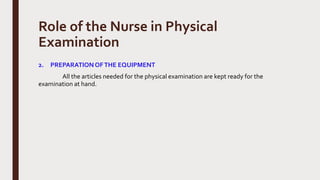
2. PREPARATIONOFTHE EQUIPMENT
All the articles needed for the physical examination are kept ready for the
examination at hand.
Role of the Nurse in Physical
Examination
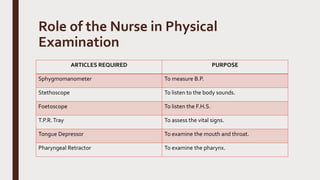
ARTICLES REQUIRED PURPOSE
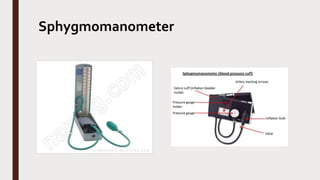
Sphygmomanometer To measure B.P.
Stethoscope To listen to the body sounds.
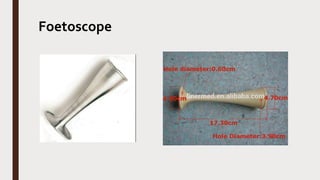
Foetoscope To listen the F.H.S.
T.P.R.Tray To assess the vital signs.
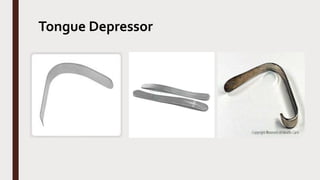
Tongue Depressor To examine the mouth and throat.
Pharyngeal Retractor To examine the pharynx.
Role of the Nurse in Physical
Examination
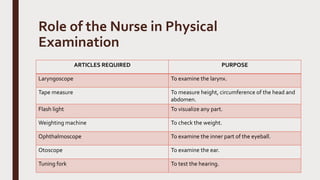
ARTICLES REQUIRED PURPOSE
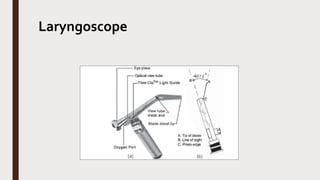
Laryngoscope To examine the larynx.
Tape measure To measure height, circumference of the head and
abdomen.
Flash light To visualize any part.
Weighting machine To check the weight.
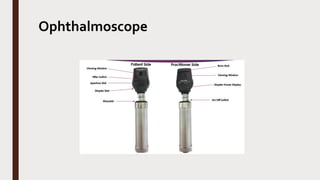
Ophthalmoscope To examine the inner part of the eyeball.
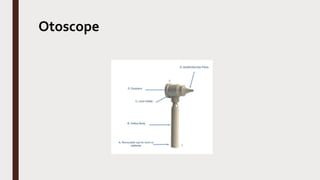
Otoscope To examine the ear.
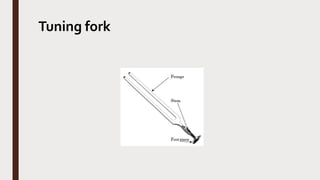
Tuning fork To test the hearing.
Role of the Nurse in Physical
Examination
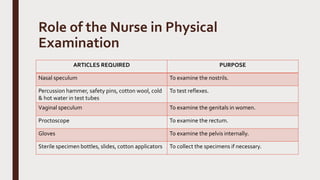
ARTICLES REQUIRED PURPOSE
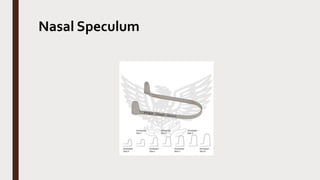
Nasal speculum To examine the nostrils.
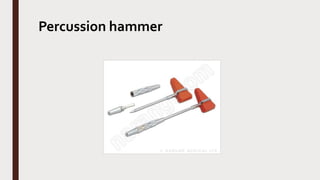
Percussion hammer, safety pins, cotton wool, cold
& hot water in test tubes
To test reflexes.
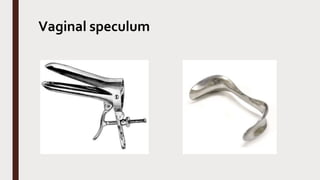
Vaginal speculum To examine the genitals in women.
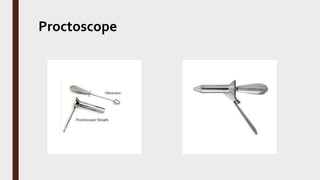
Proctoscope To examine the rectum.
Gloves To examine the pelvis internally.
Sterile specimen bottles, slides, cotton applicators To collect the specimens if necessary.
Sphygmomanometer
Laryngoscope
Foetoscope
Tongue Depressor
Ophthalmoscope
Otoscope
Tuning fork
Nasal Speculum
Percussion hammer
Vaginal speculum
Proctoscope
Role of the Nurse in Physical
Examination
3. PREPARATIONOFTHE CLIENT
■ Physical Preparation
Keep the client clean.
Shave the part if necessary.
Keep the client in a comfortable position which is convenient for the doctor to
examine the client.
Empty the bowels by an enema, if required.
Loosen the garments and change into the hospital dress, if it is the custom.
Role of the Nurse in Physical
Examination
Drape the client with extra sheets and expose only the needed area.
Avoid necessary exposure.
■ Mental preparation
The client may be quite new to the hospital situation and he may be anxious
about his illness.
He may have false ideas about the medical examination.
It is the duty of the nurse to allay his anxieties & fears by proper explanation.
Explain the sequence of procedure to gain his confidence & cooperation.
Role of the Nurse in Physical
Examination
As far as possible a nurse should remain with a female client during the physical
examination.
4. Assistance in the examination
■ To take height and weight
To measure the length of the baby who cannot stand, place the baby on a hard
surface, with the soles of the feet supported in an upright position.
The knees are extended and the measurement is taken from the soles of the feet
to the vertex of the head.
The head should be in such a position that the eyes are facing the ceiling.
Role of the Nurse in Physical
Examination
After a child can stand, the height can be measured, if the child stands with the
heels, back & head against a wall.
A small flat board held from the top of the head to the wall will give an accurate
measures of the height, that is the distance from the floor to the board.
The weight of a person who can stand is generally measured by a standing scale.
The client stands on the platform & the weight is noted on the dial.
Usually the weight is taken without shoes.
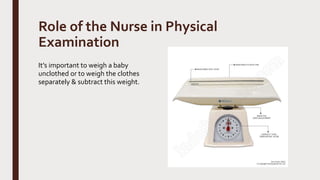
To take the weight of a baby, a baby weighing scale is used, in which there is a
container, where the baby can be laid.
Role of the Nurse in Physical
Examination
It’s important to weigh a baby
unclothed or to weigh the clothes
separately & subtract this weight.
Role of the Nurse in Physical
Examination
■ To measure the skull circumference
The skull is measured at its greatest diameter from above the eyes to the
Occipital protuberance.
Role of the Nurse in Physical
Examination
■ Examination of the eyes
The examination is done in a lying or sitting position.
The examiner frequently uses a head mirror that reflects light to the clients face.
The first examination is one of inspection to determine the movements of the
eyes, reactions to light, accommodation to near and far objects.
For detailed examination of the internal parts of the eye an ophthalmoscope is
used.
Role of the Nurse in Physical
Examination
■ Examination of the ears
The client may be placed either in a lying or sitting position with the ear to be
examined turned towards the examiner.
Articles used for the examination are a head mirror, ear speculum of various sizes,
cotton tipped applicators & otoscope.
Tuning fork is used to test the hearing.
A child needs to be carefully restrained.Young children sit on their mother’s lap
with their mother’s knees & their arms her chest.
Very small infants can be laid on the examination table.
Role of the Nurse in Physical
Examination
■ Examination of the nose, throat & mouth
The client is usually seated with the head resting against the back of the chair.
For the examination of the throat, a tongue depressor & a good light are needed.
For examination of the nose, a nasal speculum & a head mirror are used.
Role of the Nurse in Physical
Examination
■ Examination of the neck
The neck needs to be palpated for lymph nodes.
In order to assess the thyroid glands, the client is asked to swallow saliva.
Role of the Nurse in Physical
Examination
■ Examination of the chest
While examining the anterior chest, the client is placed in a horizontal recumbent
position.
The chest is examined in several ways.
It is percussed to determine the presence of fluid or congested areas.
The physician listens to the sounds within the chest by means of a stethoscope.
To examine the posterior chest, the client is placed in a sitting position.
Role of the Nurse in Physical
Examination
The heart & lungs are examined by percussion & auscultation.
The breasts are examined by palpation for the presence of lumps or growths.
The axillae are palpated for enlarged lymph nodes.
During the examination, the client’s face is turned away from the doctor.
Role of the Nurse in Physical
Examination
■ Examination of the abdomen
The abdomen is examined while the client is in a dorsal recumbent position & the
knees are slightly flexed to promote relaxation of the abdominal muscles.
The abdomen is inspected, palpated, auscultated and percussed to detect any
abnormalities.
Role of the Nurse in Physical
Examination
■ Examination of the extremities
Extremities are inspected, palpated & moved. A fine tremor suggestive of
hyperthyroidism can be observed, if the client is asked to hold the arms out in
front of him for a few minutes.
A pitting edema may be observed at the ankle joint by pressing the skin against
the bone.
Varicose veins may be observed on the posterior part of the leg over the calf
muscles.The joints are moved in all directions to assess the movements of the
joints.
Role of the Nurse in Physical
Examination
■ Examination of the spine
In a standing position the spine is examined for abnormal curvature.
The fingers are moved over the spine to detect the Spina bifida in a newborn
infant.
Role of the Nurse in Physical
Examination

Physical assessment

  • 1.
  • 3.
    INTRODUCTION ■ It isthe systematic collection of objective information that is directly observed or is elicited through examination techniques. ■ Physical examination involves the use of one’s senses to obtain information about the structure and function of an area being observed . ■ It is thorough inspection or a detailed study of the entire body or some parts of the body to determine the general physical or mental conditions of the body.
  • 4.
    PURPOSES ■ To understandthe physical and mental well being of the clients. ■ To detect diseases in its early stage. ■ To determine the cause and the extent of disease. ■ To understand any changes in the condition of diseases, any improvement or regression. ■ To determine the nature of treatment nursing care needed for the client.
  • 5.
    Continue.. ■ To safeguardthe client and his family by noting the early signs especially in case of a communicable diseases. ■ To contribute to the medical research. ■ To find out whether the person is medically fit or not for a particular task.
  • 6.
    TECHNIQUESOF PHYSICAL EXAMINATION ■ Thebasic techniques used in physical examination are explained as follows: 1. Inspection 2. Palpation 3. Percussion 4. Auscultation 5. Manipulation 6. Testing of the reflexes
  • 7.
    1. Inspection ■ Itis the systematic visual examination of the client, or it is the process of performing deliberating purposeful observations in a systematic manner. ■ It involves observation of the color, shape, symmetry, position and movements. ■ It also use the sense of smell to detect odor and sense of hearing to detect sounds. ■ Inspection begins with the initial contact with the client and continues through the entire assessment. ■ The optimal conditions for effective inspection are full exposure of the area and adequate lightning.
  • 8.
    1. INSPECTION ■ Generalinspection of a client focuses on the following areas: ► Overall appearance of health or illness ► Signs of distress ► Facial expression and mood ► Body size ► Grooming and personal hygiene ■ Besides being used in general survey, inspection is the first method used in examination of a specific area. ■ The chest and abdomen are inspected before palpation and auscultation.
  • 9.
    2. PALPATION ■ Itis use of hands and fingers to gather information through touch. ■ It is the assessment technique which uses senses of touch. It is feeling of body parts with hands to note the size and position of organs. ■ The hands and fingers are sensitive tools and can assess temperature, turgor, texture, moisture, vibrations, size, positions, consistency, masses and fluid. ■ The dorsum (back) surfaces of the hand and fingers are used to measure temperature. ■ The palmar(front) surfaces of the fingers and finger pads are used to assess texture, shape, fluid, size, consistency and pulsation.
  • 10.
    CONTINUE… ■ Vibration ispalpated best with the palm of the hand. ■ The nurse’s hands should be warm and fingernails short and the touch should be gentle and respectful. ■ Areas of tenderness are palpated last. Light, moderate, or deep palpation may be used. ■ The purpose of deep palpation is to locate organs, determine their size and to detect abnormal masses.
  • 11.
    3. PERCUSSION ■ Itis the examination by tapping the fingers on the body to determine the condition of the internal organs by the sounds that are produced. ■ Percussion is the act of striking one object against another to produce sound. ■ The sound waves produced by the striking action over body tissues are known as percussion tones or percussion notes. ■ Percussion provides information about the nature of an underlying structure. ■ It is used to outline the size of an organ such as bladder or liver.
  • 12.
    CONTINUE… ■ Percussion isalso used to determine if a structure is air-filled, fluid-filled or solid. ■ The degree to which sound propagates is called resonance. Percussion produces five characteristic tones: - ‫٭‬ Tympanic ‫٭‬ Hyper-resonant ‫٭‬ Resonant ‫٭‬ Dull ‫٭‬ Flat
  • 13.
    CONTINUE… ■ Percussion ofthe abdomen is tympanic, inflated lung tissue is hyper resonant, normal tissue is resonant the liver is dull and the bone flat. ■ There are two type of percussion. Direct and Indirect. ■ Direct Percussion : It is accomplished by tapping an area directly with the finger tip of the middle finger or thumb. ■ Indirect Percussion : It involves two hands.The hand is placed on the area to be percussed and the finger creating vibrations that allows discrimination among five different tones.
  • 14.
  • 16.
    4. AUSCULTATION ■ Itis the purpose of listening to sounds that are generated within the body. ■ Auscultation is usually done with the help of stethoscope. ■ The heart and blood vessels are auscultated for circulation of blood, the lungs are auscultated for moving air (breath sounds); the abdomen is auscultated for movement of gastrointestinal contents (bowel sounds). ■ When auscultating a part, that area should be exposed and should be quite.
  • 17.
    CONTINUE… ■ Four characteristicsof sound are assessed by auscultation: 1. Pitch- ranging from high to low 2. Loudness- ranging from soft to loud 3. Quality- gurgling or swishing 4. Duration- short, medium or long
  • 18.
    5. MANIPULATION ■ Itis moving a part of the body to note its flexibility. ■ Limitation of movement is discovered by this method.
  • 19.
    6.TESTINGOFTHE REFLEXES ■ Theresponse of the tissues to external stimuli is tested by means of a percussion hammer, safety pin, wisp of cotton or hot and cold water.
  • 20.
  • 21.
    GENERAL EXAMINATION ORHEADTO TOE EXAMINATION ■ The examination is carried out is an orderly manner focusing upon one area of the body at a time. ■ The observation of the client starts as the client walks into the examination room. ■ e.g.A limp may be noted as the client walks in. ■ The following observations are made:
  • 22.
    General Examination 1. GENERALAPPEARANCE ■Nourishment- well nourished or under nourished ■ Body Built- thin or obese ■ Health- healthy or unhealthy ■ Activity- active or dull (tired) 2. MENTAL STATUS ■ Consciousness- conscious, unconscious, delirious, talking incoherently ■ Look- anxious or worried, depressed etc…
  • 23.
    General Examination 3. HEIGHT 4.WEIGHT 5. POSTURE ■ Body curves- Lordosis, kyphosis, scoliosis ■ Movement- any limp.
  • 24.
  • 25.
    General Examination 6. SKINCONDITIONS ■ Color- pallor, jaundice, cyanosis, flushing etc. ■ Texture- dryness, flaking, wrinkling or excessive moisture ■ Temperature- warm, cold and clammy ■ Lesions- macules, papules, vesicles, wounds etc. 7. HEAD & FACE Shape of the skull and fontanels(noted in the newborns) ■ Skull circumference: ■ Scalp- cleanliness, condition of the hair, dandruff, pediculi, infectious like ringworm. ■ Face- pale, flushed, puffiness, enlargement of parotid glands, fear, fatigue, pain, anxiety, etc.
  • 26.
  • 27.
  • 28.
  • 29.
  • 30.
  • 31.
  • 32.
  • 33.
    General Examination 8. EYES ■Eyebrows- normal or absent ■ Eye lashes- infection, sty. ■ Eyelids- edema, lesions, ectropion ( eversion ), entropion ( inversion). ■ Eyeballs- sunken or protruded ■ Conjunctiva- pale, red, purulent ■ Sclera- jaundiced ■ Cornea and Iris- irregularities and abrasions. ■ Pupils- dilated constricted, reaction to light
  • 34.
    General Examination ■ Lens-opaque and transparent ■ Fundus- congestion, hemorrhagic spots ■ Eye muscles- strabismus (squint ■ Vision- normal, myopia (short sight), hyperopia (long sight)
  • 35.
  • 37.
    General Examination 9. EARS ■External ear- discharges, cerumen obstructing the ear passage ■ Tympanic membrane- perforations, lesions, budging  Hearing acuity tests ■ Weber’s test ■ Rinne’s test ■ Whisper’s test
  • 38.
     Weber’s test Wrapthe tuning fork strongly on your palm and then press the butt of the instrument on the top of the patient's head in the midline and ask the patient where they hear the sound. WHERE CANYOU HEAR BUZZY NOISE ? The patient is asked to report in which ear the sound is heard louder. In a normal patient, the sound is heard equally loud in both ears (no lateralization). However a patient with symmetrical hearing loss will have the same findings. Thus, there is diagnostic utility only in asymmetric hearing losses.
  • 39.
     Rinne’s test Inthe Rinne’s test, a comparison is made between hearing elicited by placing the base of a tuning fork applied to the mastoid process (bone) and then after the sound is no longer appreciated, the vibrating top is placed one inch from the external ear canal (air). ■ RESULTS NORMAL - Air conduction > Bone conduction ABNORMAL – Air Conduction < Bone Conduction Air Conduction = Bone Conduction ---------which suggest that patient may have conductive hearing loss.
  • 41.
     Whisper’s test 1.Confirm if patient understands instructions. 2. Exhale.Whisper a combination of 3 random numbers and letters from 2 feet behind patient (e.g. 6, K, 0). 3. Ask them to repeat. 4. Perform a second time (using a different combination) if there are any incorrect responses. 5. >3/6 incorrect: fail.
  • 42.
    General Examination 10. NOSE ■External nares- crusts or discharges ■ Nostrils- inflammation of the mucus membrane, septal deviations. 11. MOUTH AND PHARYNX ■ Lips- redness, swelling, crusts, cyanosis, angular stomatitis ■ Odor of the mouth- foul smelling ■ Teeth- discoloration & dental caries ■ Mucus membrane & gums- ulceration and bleeding, swelling, pus formation ■ Tongue- pale, dry, lesions, sords, furrows, tongue tie etc. ■ Throat & pharynx- enlarged tonsils, redness and pus.
  • 43.
    General Examination 12. NECK ■Lymph nodes- enlarged, palpable ■ Thyroid gland- enlarged ■ Range of motion- flexion, extension and rotation 13. Chest ■ Thorax- shape, symmetry of expansion, posture ■ Breath sounds- sigh, swish, rustle, wheezing, crepitation, pleural rub etc. ■ Heart- location, cardiac murmurs ■ Breasts- enlarged lymph nodes 14. ABDOMEN ■ Observation- skin rashes, scar, hernia, ascites, distension, pregnancy etc. ■ Auscultation- bowel sounds, fetal heart sounds ■ Palpation- liver margin, palpable spleen, tenderness at the area of appendix, inguinal hernias ■ Percussion- presence of gas, fluid or mass
  • 44.
  • 45.
    General Examination 15. EXTREMITIES Movementof joints, tremors, clubbing of fingers, ankle edema, varicose veins, reflexes
  • 46.
    General Examination 16. BACK Spinabifida, curves. 17. GENITALS & RECTUM ■ Inguinal lymph glands- enlarged, palpable ■ Patency of urinary meatus and rectum ■ Descent of the testes(infants) ■ Vaginal discharges ■ Presence of STDs. ■ Hemorrhoids ■ Enlargement of the prostate gland ■ Pelvic masses
  • 47.
  • 48.
    General Examination 18. NEUROLOGICALTEST ■Coordination tests- reflexes • Biceps Reflex • Triceps Reflex • Knee jerk(Patellar tendon) Reflex • Ankle jerk(Achilles tendon) Reflex • Babinski’s Reflex ■ Equilibrium tests- test for sensations
  • 49.
  • 50.
  • 51.
     Biceps Reflex •Have the patient’s elbow at about a 90° angle of flexion with the arm slightly bent down as shown in figure. • Grasp the elbow with your left hand so the fingers are behind the elbow and your abductee thumb presses the biceps brachial tendon. • Strike your thumb a series of blows with the rubber hammer, varying your thumb pressure with each blow until the most satisfactory response is obtained. • Normal reflex is elbow flexion.
  • 52.
     Triceps Reflex •Grasp the patient’s wrist with your left hand and pull his arm across his chest so the elbow is flexed about 90° and the forearm is partially bent down. • Tap the triceps brachial tendon directly above the olecranon process.The normal response is elbow extension.
  • 53.
  • 54.
     PatellarTendon Reflexor Knee Jerk Reflex • The patellar reflex is elicited by striking the patellar tendon just below the patella. • The patient may be in a sitting or a lying position. • If the patient is supine, the examiner supports the legs to facilitate relaxation of the muscles. • Contraction of quadriceps and knee extension are normal responses.
  • 56.
  • 57.
     AchillesTendon Reflexor Ankle Jerk Reflex  To elicit anAchilles reflex, the foot is dorsiflexed at the ankle and the hammer strikes the stretched Achilles tendon.  This reflex normally produces flexion.
  • 58.
     Babinski’s Reflex •To elicit Babinski’s reflex, stroke the lateral aspect of the sole of the patient’s foot with you thumbnail or another moderately sharp object. • Normally, this elicits flexion of all toes, as shown in the right (1st) illustration. • With a positive Babinski’s reflex, the great toe dorsiflexes and the other toes fan out, as shown in the right (2nd) illustration.
  • 59.
  • 60.
    Role of theNurse in Physical Examination 1. PREPARATIONOFTHE ENVIRONMENT ■ Maintenance of Privacy – A separate examination room is needed. Keep the doors closed.The relatives are not allowed. Drape the client according to the parts that are exposed. ■ Lighting As far as possible, natural light should be available in the examination room because if a client is jaundiced, it may not be detected in the artificial light.There should be adequate lighting.
  • 61.
    Role of theNurse in Physical Examination ■ Comfortable bed or Examination table The client should be placed comfortably throughout the examination.There should be provision for the maintenance of a suitable position. e.g., a lithotomy position may be maintained when examining the genitelia.To maintain the position, a special examination table with stirrup rods is needed. The room should be warm and without draughts.
  • 62.
    Role of theNurse in Physical Examination 2. PREPARATIONOFTHE EQUIPMENT All the articles needed for the physical examination are kept ready for the examination at hand.
  • 63.
    Role of theNurse in Physical Examination ARTICLES REQUIRED PURPOSE Sphygmomanometer To measure B.P. Stethoscope To listen to the body sounds. Foetoscope To listen the F.H.S. T.P.R.Tray To assess the vital signs. Tongue Depressor To examine the mouth and throat. Pharyngeal Retractor To examine the pharynx.
  • 64.
    Role of theNurse in Physical Examination ARTICLES REQUIRED PURPOSE Laryngoscope To examine the larynx. Tape measure To measure height, circumference of the head and abdomen. Flash light To visualize any part. Weighting machine To check the weight. Ophthalmoscope To examine the inner part of the eyeball. Otoscope To examine the ear. Tuning fork To test the hearing.
  • 65.
    Role of theNurse in Physical Examination ARTICLES REQUIRED PURPOSE Nasal speculum To examine the nostrils. Percussion hammer, safety pins, cotton wool, cold & hot water in test tubes To test reflexes. Vaginal speculum To examine the genitals in women. Proctoscope To examine the rectum. Gloves To examine the pelvis internally. Sterile specimen bottles, slides, cotton applicators To collect the specimens if necessary.
  • 66.
  • 67.
  • 68.
  • 69.
  • 70.
  • 71.
  • 72.
  • 73.
  • 74.
  • 75.
  • 76.
  • 77.
    Role of theNurse in Physical Examination 3. PREPARATIONOFTHE CLIENT ■ Physical Preparation Keep the client clean. Shave the part if necessary. Keep the client in a comfortable position which is convenient for the doctor to examine the client. Empty the bowels by an enema, if required. Loosen the garments and change into the hospital dress, if it is the custom.
  • 78.
    Role of theNurse in Physical Examination Drape the client with extra sheets and expose only the needed area. Avoid necessary exposure. ■ Mental preparation The client may be quite new to the hospital situation and he may be anxious about his illness. He may have false ideas about the medical examination. It is the duty of the nurse to allay his anxieties & fears by proper explanation. Explain the sequence of procedure to gain his confidence & cooperation.
  • 79.
    Role of theNurse in Physical Examination As far as possible a nurse should remain with a female client during the physical examination. 4. Assistance in the examination ■ To take height and weight To measure the length of the baby who cannot stand, place the baby on a hard surface, with the soles of the feet supported in an upright position. The knees are extended and the measurement is taken from the soles of the feet to the vertex of the head. The head should be in such a position that the eyes are facing the ceiling.
  • 81.
    Role of theNurse in Physical Examination After a child can stand, the height can be measured, if the child stands with the heels, back & head against a wall. A small flat board held from the top of the head to the wall will give an accurate measures of the height, that is the distance from the floor to the board. The weight of a person who can stand is generally measured by a standing scale. The client stands on the platform & the weight is noted on the dial. Usually the weight is taken without shoes. To take the weight of a baby, a baby weighing scale is used, in which there is a container, where the baby can be laid.
  • 82.
    Role of theNurse in Physical Examination It’s important to weigh a baby unclothed or to weigh the clothes separately & subtract this weight.
  • 83.
    Role of theNurse in Physical Examination ■ To measure the skull circumference The skull is measured at its greatest diameter from above the eyes to the Occipital protuberance.
  • 84.
    Role of theNurse in Physical Examination ■ Examination of the eyes The examination is done in a lying or sitting position. The examiner frequently uses a head mirror that reflects light to the clients face. The first examination is one of inspection to determine the movements of the eyes, reactions to light, accommodation to near and far objects. For detailed examination of the internal parts of the eye an ophthalmoscope is used.
  • 85.
    Role of theNurse in Physical Examination ■ Examination of the ears The client may be placed either in a lying or sitting position with the ear to be examined turned towards the examiner. Articles used for the examination are a head mirror, ear speculum of various sizes, cotton tipped applicators & otoscope. Tuning fork is used to test the hearing. A child needs to be carefully restrained.Young children sit on their mother’s lap with their mother’s knees & their arms her chest. Very small infants can be laid on the examination table.
  • 86.
    Role of theNurse in Physical Examination ■ Examination of the nose, throat & mouth The client is usually seated with the head resting against the back of the chair. For the examination of the throat, a tongue depressor & a good light are needed. For examination of the nose, a nasal speculum & a head mirror are used.
  • 87.
    Role of theNurse in Physical Examination ■ Examination of the neck The neck needs to be palpated for lymph nodes. In order to assess the thyroid glands, the client is asked to swallow saliva.
  • 88.
    Role of theNurse in Physical Examination ■ Examination of the chest While examining the anterior chest, the client is placed in a horizontal recumbent position. The chest is examined in several ways. It is percussed to determine the presence of fluid or congested areas. The physician listens to the sounds within the chest by means of a stethoscope. To examine the posterior chest, the client is placed in a sitting position.
  • 89.
    Role of theNurse in Physical Examination The heart & lungs are examined by percussion & auscultation. The breasts are examined by palpation for the presence of lumps or growths. The axillae are palpated for enlarged lymph nodes. During the examination, the client’s face is turned away from the doctor.
  • 90.
    Role of theNurse in Physical Examination ■ Examination of the abdomen The abdomen is examined while the client is in a dorsal recumbent position & the knees are slightly flexed to promote relaxation of the abdominal muscles. The abdomen is inspected, palpated, auscultated and percussed to detect any abnormalities.
  • 91.
    Role of theNurse in Physical Examination ■ Examination of the extremities Extremities are inspected, palpated & moved. A fine tremor suggestive of hyperthyroidism can be observed, if the client is asked to hold the arms out in front of him for a few minutes. A pitting edema may be observed at the ankle joint by pressing the skin against the bone. Varicose veins may be observed on the posterior part of the leg over the calf muscles.The joints are moved in all directions to assess the movements of the joints.
  • 92.
    Role of theNurse in Physical Examination ■ Examination of the spine In a standing position the spine is examined for abnormal curvature. The fingers are moved over the spine to detect the Spina bifida in a newborn infant.
  • 93.
    Role of theNurse in Physical Examination