PEDIATRIC ASSESSMENT
   Prepared by: Puan Kurniati Solehan
Objectives
• Understand the importance of Assessment and
  Triage and how they interplay in the Health Care
  Setting
• Identify essential components of a “focused”
  Pediatric Assessment
• Utilize the assessment information to differentiate
  between minor and more serious conditions (Triage)
• Identify and implement nursing interventions based
  on the assessment and triage provided
                              Sound Familiar?
Essential Pediatric Nursing Skills
•   Knowledge of Growth and Development
•   Development of a Therapeutic Relationship
•   Communication with children and their parents
•   Understanding of family dynamics and parent-child
    relationships: IDENTIFY KEY FAMILY MEMBERS
•   Knowledge of Health Promotion & Disease Prevention
•   Patient Education and Anticipatory Guidance
•   Practice of Therapeutic and Atraumatic Care
•   Patient and Family Advocacy
•   Caring, Supportive & Culturally Sensitive Interactions
•   Coordination and Collaboration
•   CRITICAL THINKING
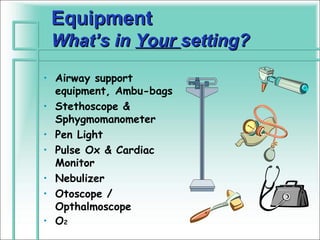
Equipment
 What’s in Your setting?
• Airway support
  equipment, Ambu-bags
• Stethoscope &
  Sphygmomanometer
• Pen Light
• Pulse Ox & Cardiac
  Monitor
• Nebulizer
• Otoscope /
  Opthalmoscope
• O2
The single most important part of
the health assessment is……

the
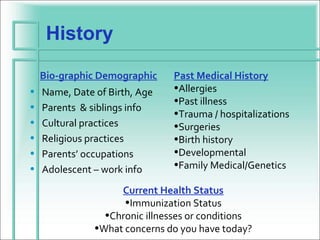
History

    Bio-graphic Demographic     Past Medical History
•   Name, Date of Birth, Age    •Allergies
                                •Past illness
•   Parents & siblings info
                                •Trauma / hospitalizations
•   Cultural practices          •Surgeries
•   Religious practices         •Birth history
•   Parents’ occupations        •Developmental
•   Adolescent – work info      •Family Medical/Genetics

                    Current Health Status
                     •Immunization Status
                 •Chronic illnesses or conditions
               •What concerns do you have today?
Review of Systems

• Ask questions about each system
• Measurements: weight, height, head
  circumference, growth chart, BMI
• Nutrition: breastfed, formula, favorite
  foods, beverages, eating habits
• Growth and Development: Milestones
  for each age group
History: Review of Systems

• Skin              • GI
• HEENT             • GU & GYN
• Neck              • Musculoskeletal
• Chest & Lungs /     & Extremities
  Respiratory       • Neuro
• Heart &           • Endocrine
  Cardiovascular
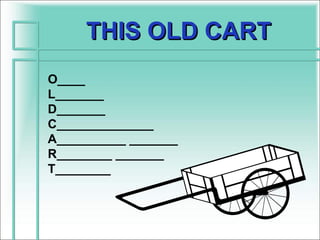
THIS OLD CART
O____
L_______
D_______
C______________
A__________ _______
R________ _______
T________
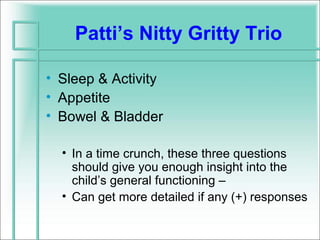
Patti’s Nitty Gritty Trio

• Sleep & Activity
• Appetite
• Bowel & Bladder

  • In a time crunch, these three questions
    should give you enough insight into the
    child’s general functioning –
  • Can get more detailed if any (+) responses
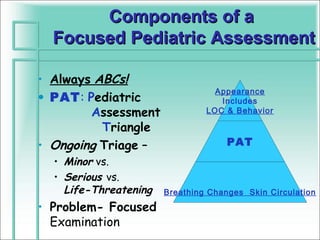
Components of a
  Focused Pediatric Assessment

• Always ABCs!
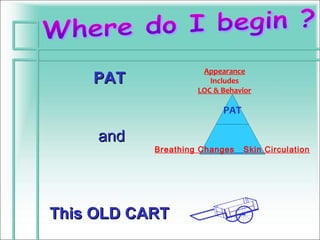
                                  Appearance
• PAT: Pediatric                   Includes
        Assessment              LOC & Behavior

          Triangle
• Ongoing Triage –                   PAT
  • Minor vs.
  • Serious vs.
    Life-Threatening   Breathing Changes Skin Circulation

• Problem- Focused
  Examination
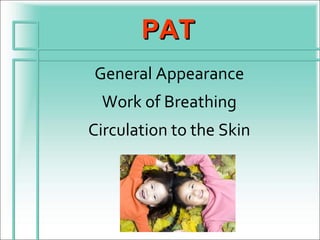
PAT
General Appearance
 Work of Breathing
Circulation to the Skin
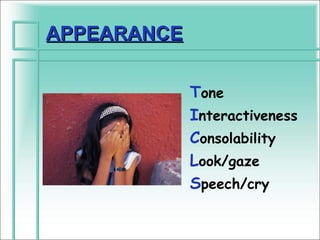
APPEARANCE

             Tone
             Interactiveness
             Consolability
             Look/gaze
             Speech/cry
Work of Breathing


• Increased or
  Decreased
  Respirations
• Stridor
• Wheezing
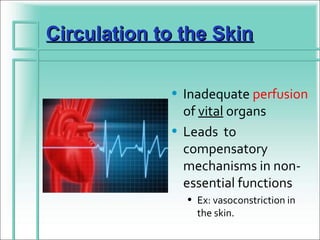
Circulation to the Skin

             • Inadequate perfusion
               of vital organs
             • Leads to
               compensatory
               mechanisms in non-
               essential functions
               • Ex: vasoconstriction in
                 the skin.
Initial Assessment (s)

• Primary            • Secondary
   • A = Airway        • E = Exposure
   • B = Breathing     • F = Full Set of Vitals
                       • G = Give Comfort
   • C = Circulation     Measures including Pain
   • D = Disability      Assessment & Tx.
                         • H = Head –to-Toe
                           assessment & history
                         • I = Inspect posterior
                           surfaces – rashes,
                           bruising
Physical Assessment
• The approach is:
  • Orderly
  • Systematic
  • Head-to-toe


• But FLEXIBILIY is essential
• And be kind and gentle
• but firm, direct and honest
Physical Assessment

  General Appearance & Behavior


                 •   Facial expression
                 •   Posture / movement
                 •   Hygiene
                 •   Behavior
                 •   Developmental Status
Vital Signs

• Temperature: rectal only when
  absolutely necessary
• Pulse: apical on all children under 1
  year
• Respirations: infant use abdominal
  muscles
• Blood pressure: admission base line
• And the “Fifth” Vital Sign is ____ ?
Pediatric Vital Signs – Normal
Ranges
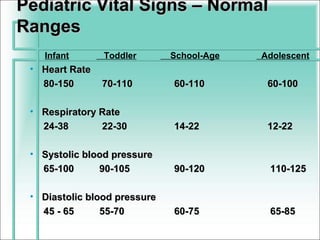
    Infant      Toddler       School-Age   Adolescent
 • Heart Rate
   80-150       70-110        60-110        60-100

 • Respiratory Rate
   24-38       22-30          14-22         12-22

 • Systolic blood pressure
   65-100      90-105         90-120        110-125

 • Diastolic blood pressure
   45 - 65      55-70         60-75         65-85
Physical Assessment

• General               •   Heart
• Skin, hair, nails     •   Abdomen
• Head, neck,           •   Genitalia, Tanner Scale,
  lymph nodes           •   Rectal
• Eyes, ears, nose,     •   Musculoskeletal: feet,
  throat                    legs, back, gait
• Chest, Tanner Scale
Physical Assessment
     •    Four Basic Skills:
          1. Inspection
           2. Palpation
          3. Percussion
         4. Auscultation

   • Sequence for abdominal:
   1.inspection, 2.auscultation,
     3.percussion, 4.palpation
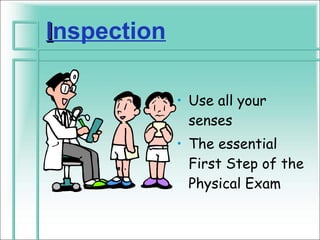
Inspection

             • Use all your
               senses
             • The essential
               First Step of the
               Physical Exam
Palpation
• Use of your fingers   • Warm hands and
  and palms to            short nails
  determine:            • Palpate areas of
                          tenderness / pain last
  •   Temperature
                        • Talk with the child
  •   Hydration           during palpation to
  •   Texture             help him relax
  •   Shape             • Be observant of
  •   Movement            reactions to palpation
                        • Move firmly without
  •   Areas of            hesitation
      Tenderness
Palpation
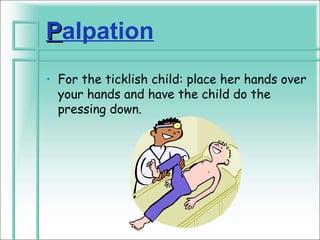
• For the ticklish child: place her hands over
  your hands and have the child do the
  pressing down.
Percussion
Use of tapping to
produce sounds that
are characterized
according to:
 •   Intensity
 •   Pitch
 •   Duration
 •   Quality
 Direct vs. Indirect
Auscultation
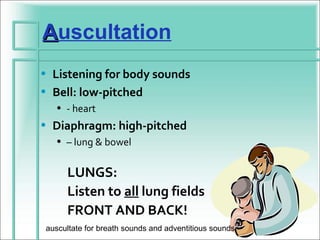
• Listening for body sounds
• Bell: low-pitched
  • - heart
• Diaphragm: high-pitched
  • – lung & bowel


     LUNGS:
     Listen to all lung fields
     FRONT AND BACK!
auscultate for breath sounds and adventitious sounds
“I P P A”
  • Practice, Practice, Practice
• by knowing what the norm is, you’ll be able
   to pick up on the abnormal, even if you
              can’t diagnose it….
• The important thing is to be able to say
             “This is not right”
         • and refer appropriately!
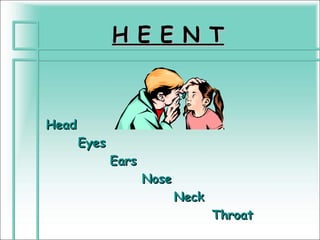
H E E N T


Head
       Eyes
              Ears
                     Nose
                            Neck
                                   Throat
HEENT: Head & Neck, Eyes, Ears,
        Nose, Face, Mouth & Throat
• Head: Symmetry of skull and face
• Neck: Structure, movement, trachea, thyroid,
  vessels and lymph nodes
• Eyes: Vision, placement, external and internal
  fundoscopic exam
• Ears: Hearing, external, ear canal and
  otoscopic exam of tympanic membrane
• Nose: Structure, exudate, sinuses
• Mouth: Structures of mouth, teeth and pharynx
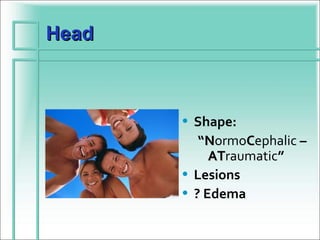
Head


       • Shape:
          “NormoCephalic –
            ATraumatic”
            AT
       • Lesions
       • ? Edema
Head: Key Points

• Head Circumference (HC
• Fontannels/sutures: Anterior closes at 10-18
  months, posterior by 2 months
• Symmetry & shape: Face & skull
• Bruits: Temporal bruits may be significant after 5
  yrs
• Hair: Patterns, loss, hygiene, pediculosis in school
  aged child
• Sinuses: Palpate for tenderness in older children
• Facial expression: Sadness, signs of abuse,
  allergy, fatigue
• Abnormal facies: “Diagnostic facies” of common
  syndromes or illnesses
Neuro Assessment

• LOC / Glasgow coma scale
    • Confusion, Delirium, Stupor, Coma
•   Pupil size
•   CNS grossly intact: II – XII
•   Vital Signs
•   Pain
•   Seizure Activity
•   Focal Deficits
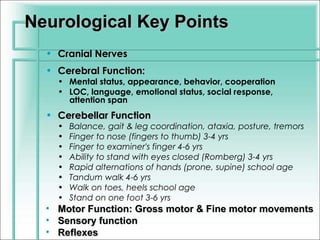
Neurological Key Points
  • Cranial Nerves
  • Cerebral Function:
      • Mental status, appearance, behavior, cooperation
      • LOC, language, emotional status, social response,
        attention span
  • Cerebellar Function
      •   Balance, gait & leg coordination, ataxia, posture, tremors
      •   Finger to nose (fingers to thumb) 3-4 yrs
      •   Finger to examiner's finger 4-6 yrs
      •   Ability to stand with eyes closed (Romberg) 3-4 yrs
      •   Rapid alternations of hands (prone, supine) school age
      •   Tandum walk 4-6 yrs
      •   Walk on toes, heels school age
      •   Stand on one foot 3-6 yrs
  •   Motor Function: Gross motor & Fine motor movements
  •   Sensory function
  •   Reflexes
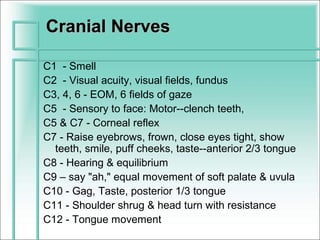
Cranial Nerves

C1 - Smell
C2 - Visual acuity, visual fields, fundus
C3, 4, 6 - EOM, 6 fields of gaze
C5 - Sensory to face: Motor--clench teeth,
C5 & C7 - Corneal reflex
C7 - Raise eyebrows, frown, close eyes tight, show
  teeth, smile, puff cheeks, taste--anterior 2/3 tongue
C8 - Hearing & equilibrium
C9 – say "ah," equal movement of soft palate & uvula
C10 - Gag, Taste, posterior 1/3 tongue
C11 - Shoulder shrug & head turn with resistance
C12 - Tongue movement
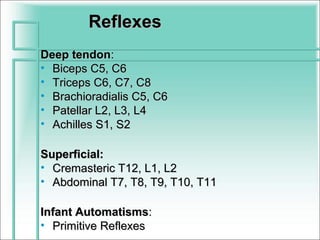
Reflexes
Deep tendon:
• Biceps C5, C6
• Triceps C6, C7, C8
• Brachioradialis C5, C6
• Patellar L2, L3, L4
• Achilles S1, S2

Superficial:
• Cremasteric T12, L1, L2
• Abdominal T7, T8, T9, T10, T11

Infant Automatisms:
• Primitive Reflexes
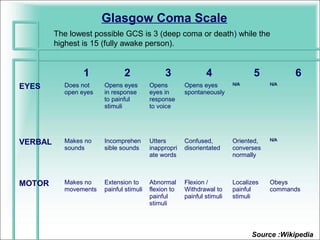
Glasgow Coma Scale
         The lowest possible GCS is 3 (deep coma or death) while the
         highest is 15 (fully awake person).


                 1            2               3               4                5          6
                                                                        N/A         N/A
EYES       Does not    Opens eyes        Opens        Opens eyes
           open eyes   in response       eyes in      spontaneously
                       to painful        response
                       stimuli           to voice


                                                                                    N/A
VERBAL     Makes no    Incomprehen       Utters       Confused,         Oriented,
           sounds      sible sounds      inappropri   disorientated     converses
                                         ate words                      normally


MOTOR      Makes no    Extension to      Abnormal     Flexion /         Localizes   Obeys
           movements   painful stimuli   flexion to   Withdrawal to     painful     commands
                                         painful      painful stimuli   stimuli
                                         stimuli


                                                                              Source :Wikipedia
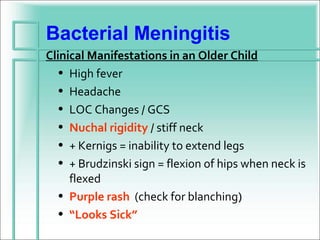
Bacterial Meningitis
Clinical Manifestations in an Older Child
   • High fever
   • Headache
   • LOC Changes / GCS
   • Nuchal rigidity / stiff neck
   • + Kernigs = inability to extend legs
   • + Brudzinski sign = flexion of hips when neck is
     flexed
   • Purple rash (check for blanching)
   • “Looks Sick”
HEAD INJURY
 • Very common in pediatrics
 • Most often not serious
   • requires observation only
 • Symptoms
   - headache
   - vomiting
   - lethargy
   - altered behavior
•Altered mental status: GCS
HEAD INJURY - Physical
           Findings
• PUPILS
• PAPILLEDEMA
• CUSHING TRIAD:
   • bradycardia, irregular respirations and
     hypertention

   • Look for signs of alcohol/drug abuse in
     adolescents
   • Lack of external signs of head trauma
      does not rule out significant brain injury
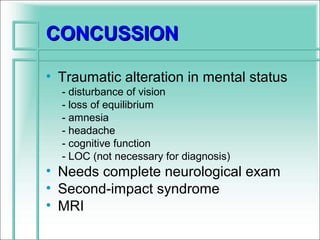
CONCUSSION

• Traumatic alteration in mental status
  - disturbance of vision
  - loss of equilibrium
  - amnesia
  - headache
  - cognitive function
  - LOC (not necessary for diagnosis)
• Needs complete neurological exam
• Second-impact syndrome
• MRI
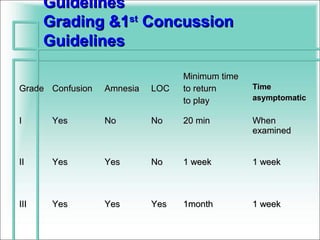
Guidelines
      Grading &1st Concussion
      Guidelines

                                  Minimum time
Grade Confusion   Amnesia   LOC   to return      Time
                                  to play        asymptomatic

I      Yes        No        No    20 min         When
                                                 examined


II     Yes        Yes       No    1 week         1 week


III    Yes        Yes       Yes   1month         1 week
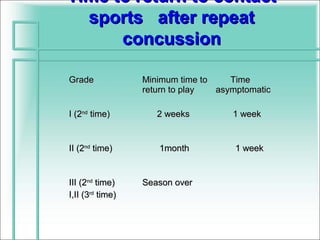
Time to return to contact
  sports after repeat
      concussion

Grade             Minimum time to    Time
                  return to play  asymptomatic

I (2nd time)         2 weeks         1 week


II (2nd time)        1month           1 week


III (2nd time)    Season over
I,II (3rd time)
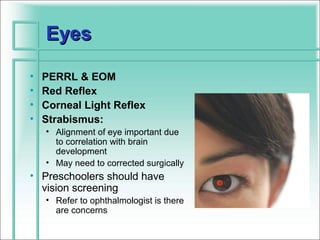
Eyes

•   PERRL & EOM
•   Red Reflex
•   Corneal Light Reflex
•   Strabismus:
    • Alignment of eye important due
      to correlation with brain
      development
    • May need to corrected surgically
• Preschoolers should have
                                          o
  vision screening
    • Refer to ophthalmologist is there
      are concerns
Eyes: Key Points
•   Vision: Red reflex & blink in neonate
•   Visual following at 5-6 weeks
•   180 degree tracking at 4 months
•   Pictures or Tumbling E charts & strabismus check
               for preschool child
•   Snellen chart for older children
•   Irritations & infections
•   PERRL
•   Amblyopia (lazy eye): Corneal light reflex, binocular
    vision, cover-uncover test
•   EOMs: tracking 6 fields of vision
•   Fundoscopic exam of internal eye & retina
Conjunctivitis
    Viral – most common cause      Bacterial – more common in
•   Very contagious                school-age children
•   8 day incubation period         Symptoms:
•   Pinkish-red eyes                • Red eyes
•   Watery or serous discharge      • Purulent or mucopurulent
•   Crusty eyelids on awakening       discharge, matted eyelids
•   c/o “gritty sensation in eye      upon awakening
•   May c/o URI symptoms            • c/o “gritty” sensation
•   Can be either unilateral or     • Usually starts unilaterally
    bilateral                         and then progresses to
                                      bilateral
•   Vesicles around eye could be
    herpes lesions                  • Often concurrent otitis
    Immediate referral to             media
    ophthalmologist                 • Culture if < 1 month of age
Conjunctivitis
Allergic
  •   Often seasonal
  •   Erythema due to dilated vessels
  •   Itching, burning
  •    May be seasonal
  •   Tearing, watery eyes
  •   Eyelid swelling
  •   Clear or stringy eye discharge
  •   bilateral
Ears: Key Points
• Ask about hearing concerns
    • Inquire about infant’s response to
    • Observe an older infant’s/toddlers speech
      pattern
•   Inspect the ears
•   •Assess the shape of the ears
•   Determine if both ears are well formed
•   •Assess
Common Ear Infections

  Otitis Media               Otitis Externa
• Most common reason         • Pain –especially
  children come to the         when pinna is slightly
  pediatrician or              tugged at
  emergency room             • Discharge
• Fever or tugging at ear      (sometimes odorous)
• Often increases at night   • “Swimmer’s Ear”
  when they are sleeping
• History of cold or
  congestion
Nose & Throat / Mouth
•   Turbinates            •   Palate
•   Exudate               •   Gums
•   Pharynx               •   Swallow
•   Tonsils               •   Oral Hygiene
•   Signs & Symptoms of   •   Condition of teeth
    Allergic Rhinitis     •   Missing teeth
    •   Streaking
    •   Cobble stoning
                          •   Orthodontic
    •   Post-Nasal Drip       Appliances
    •   Injection
    •   Erythema
    Or is it infection?
Nose: Key Points

• Exam nose & mouth after ears
• Observe shape & structural deviations
• Nares: (check patency, mucous
  membranes, discharge, turbinates,
  bleeding)
• Septum: (check for deviation)
• Infants are obligate nose breathers
• Nasal flaring is associated with
  respiratory distress
Nose: Variations


• Allergy: “allergic salute” - line across
  nose.
• Infection
• Foreign body:
  • Foul odor or unilateral discharge
• Structure variations
• Bell’s palsy
Nose and Throat

Sinusitis:
•   Fever
•   Purulent rhinorrhea
•   Facial Pain – cheeks, forehead
•   Breath odor
•   Chronic cough – could be day and night
•   (+) Post-nasal drip
Mouth & Pharynx: Key
Points

• Lips: color, symmetry, moisture, swelling, sores,
  fissures
• Buccal mucosa, gingivae, tongue & palate for
  moisture, color, intactness, bleeding, lesions.
• Tongue & frenulum - movement, size & texture
• Teeth - caries, malocclusion and loose teeth.
• Uvula: symmetrical movement or bifid uvula
• Voice quality, Speech
• Breath - halitosis
Ears, Nose and Throat

Sore Throats

   Is it strept or is it viral
   or could it be mono?


         Lymph nodes
         & ROM
Neck: Key Points
• √ position, lymph nodes, masses, fistulas,
  clefts
• Suppleness & Range of Motion (ROM)
• Check clavicle in newborn
• Head control in infant
• Trachea & thyroid in midline
• Carotid arteries (bruits)
• Torticollis
• Webbing
• Meningeal irritation
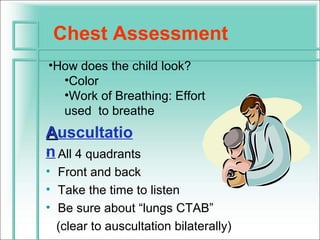
Chest Assessment
•How does the child look?
  •Color
  •Work of Breathing: Effort
  used to breathe
Auscultatio
n All 4 quadrants
•
• Front and back
• Take the time to listen
• Be sure about “lungs CTAB”
  (clear to auscultation bilaterally)
Lungs & Respiratory: Key
     Points
• Quality of Respirations:
  • Symmetry, Expansion, Effort, Dyspnea
• S & S Respiratory Distress:
  • Color: cyanosis, pallor, circumoral cyanosis,
    mottling
  • Tachypnea
  • Retractions
• Nasal flaring
• Grunting (expiratory)
• Stridor - inspiratory: croup
• Adventitious sounds:
    • Crackles / Rales
    • Rhonchi - course breath sounds
    • Wheeze – inspiratory vs. expiratory
Lungs & Respiratory: Key Points

• Clubbing
• Snoring (expiratory): upper airway
  obstruction, allergy,
• Fremitus:
  • Increased in pneumonia, atelectasis, mass
  • Decreased in asthma, pneumothorax or FB
• Dullness to percussion: fluid or mass
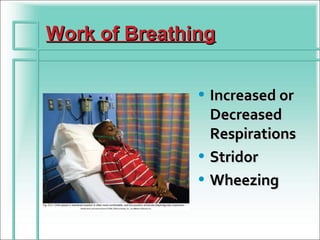
Work of Breathing


               • Increased or
                 Decreased
                 Respirations
               • Stridor
               • Wheezing
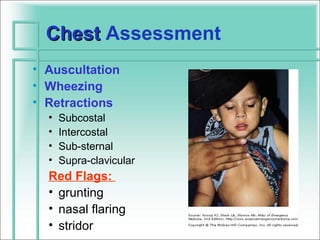
Chest Assessment
• Auscultation
• Wheezing
• Retractions
  •   Subcostal
  •   Intercostal
  •   Sub-sternal
  •   Supra-clavicular
  Red Flags:
  • grunting
  • nasal flaring
  • stridor
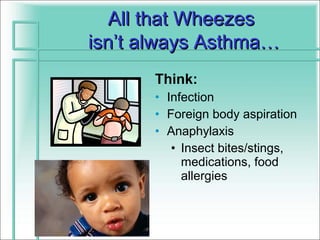
All that Wheezes
isn’t always Asthma…
      Think:
      • Infection
      • Foreign body aspiration
      • Anaphylaxis
         • Insect bites/stings,
           medications, food
           allergies
And all Asthma
doesn’t always Wheeze!

           • Cough
           • Fatigue
           • Reduced
             exercise
             tolerance
Coughs

• Allergies
• Asthma
• Infections – pneumonia, bronchitis,
  bronchiolitis
• Sinusitis – Post-nasal drip
• GERD
• Cigarette smoking
• Exposure to secondhand smoke,
• Other pollutants
Cough - Characteristics

•   Dry, non-productive
•   Mucousy – productive
•   Croupy
•   Acute – less than 2-3 weeks
•   Chronic – more than 2-3 weeks
•   Associating Symptoms
Chest Pain
• Call 911 if severe, acute, unremitting –
    needs immediate attention - very rare
• Non-cardiac – most common
  • Musculoskeletal: costochondritis
  • Pulmonary
  • Gastrointestinal e.g. GERD
  • Psychogenic
  • Often no significant physical findings
• Must rule out Cardiac origin – refer to PCP or
   pedi cardiologist
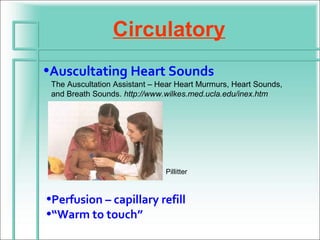
Circulatory
•Auscultating Heart Sounds
 The Auscultation Assistant – Hear Heart Murmurs, Heart Sounds,
 and Breath Sounds. http://www.wilkes.med.ucla.edu/inex.htm


                               Pillitter


•Perfusion – capillary refill
•“Warm to touch”
Murmurs:
•   may be systolic, diastolic or continuous
•   timing, location, quality -course, harsh, blowing, high pitched
•   GRADE:
    •   I - faint, may not be heard sitting
    •   II - readily heard with stethoscope
    •   III - loud, no thrill
    •   IV - loud with stethoscope, thrill
    •   V - loud with stethoscope barely to chest, thrill
    •   VI - loud with stethoscope not touching chest, thrill
•   Functional Murmurs:
•   Change or disappear with position change (usually loudest supine)
•   Low grade, soft or musical
•   Intensity range from I-III/VI
•   Systolic (never diastolic)
•   Do not radiate
•   Occur in absence of significant heart disease or structural
    abnormality
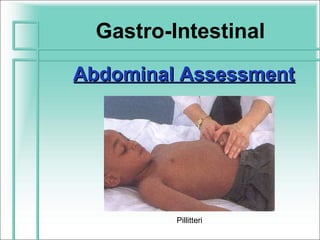
Gastro-Intestinal
Abdominal Assessment


          Pillitteri
Abdomen: Key Points


• Contour
• Bowel Sounds & Peristalsis
• Skin: color, veins
• Umbilicus
• Assess for Tenderness, Ridigity, Tympany,
  Dullness
• Hernias: umbilical, inguinal, femoral
• Masses - size, shape, dullness, position,
  mobility
• Liver, Spleen, Kidneys, Bladder
Bowel Sounds
• Normal: every 10 to 30 seconds.
• Listen in each quadrant long enough to
  hear at least one bowel sound.
 •   Absent
 •   Hypoactive
 •   Normoactive
 •   Hyperactive
Stomachaches and
          Abdominal Pain
•   Excessive gas           • Heartburn or
•   Chronic constipation      indigestion
•   Lactose intolerance     • GERD
•   Viral gastroenteritis   • Food allergy
•   Irritable bowel         • Parasite infections
    syndrome                  (Giardia)


      What are we most concerned about?
Stomachaches and Abdominal
Pain
• Appendicitis                    •   Hernia
• Bowel obstruction --            •   Intussusception
  Cholecystitis with or without
  gallstones                      •   Kidney stones
• Food poisoning                  •   Pancreatitis
   (salmonella, shigella)         •   Sickle cell crisis
• Inflammatory Bowel              •   Ulcers
  Disease –
                                  •   Urinary tract
  • Crohn's disease
                                      infections
  • Ulcerative colitis
Signs and Symptoms

•   Appearance –color, facial, ROM, gait, position
•   Pain – get your pain scales out
•   Nausea
•   Vomiting
•   Diarrhea
•   Bloating
•   Vomiting
•   Inability to pass gas or stool
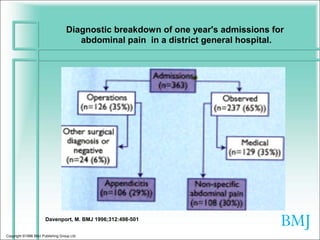
Diagnostic breakdown of one year's admissions for
                                     abdominal pain in a district general hospital.


                      Davenport, M. BMJ 1996;312:498-501


Copyright ©1996 BMJ Publishing Group Ltd.
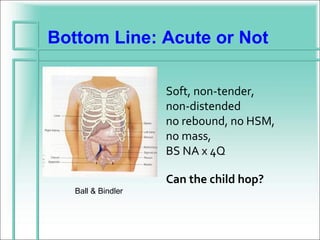
Bottom Line: Acute or Not

                    Soft, non-tender,
                    non-distended
                    no rebound, no HSM,
                    no mass,
                    BS NA x 4Q

                    Can the child hop?
   Ball & Bindler
Musculo-Skeletal
• FROM, MAE - neck, shoulder, elbow, wrist, hip,
  knee, ankle, foot, digits
• Alignment, contour, strength, weakness &
  symmetry
• Limb, joint mobility: stiffness, contractures
• Gait – observe child walking without shoes
• Spinal alignment - Scoliosis
• Muscle Strength & Tone
• Hips – O & B
• Reflexes
• Pre-Participation Sports P.E. –
  • NJ’s new guidelines:
   http://www.state.nj.us/education/districts/ppeq.doc
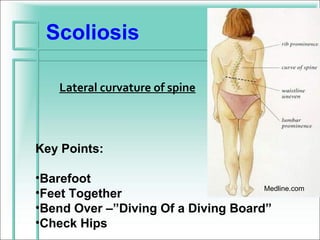
Scoliosis

    Lateral curvature of spine


Key Points:

•Barefoot
                                     Medline.com
•Feet Together
•Bend Over –”Diving Of a Diving Board”
•Check Hips
Assessment

• The Five P’s:
 •   Pain
 •   Paresthesia
 •   Passive stretch
 •   Pressure
 •   Pulse-less-ness
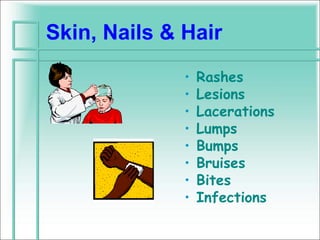
Skin, Nails & Hair
              •   Rashes
              •   Lesions
              •   Lacerations
              •   Lumps
              •   Bumps
              •   Bruises
              •   Bites
              •   Infections
Common Skin Lesions
•   Macule                       • Scale
•   Papule                       • Crust
•   Vesicle, bulla               • Keloid
•   Pustule                      • Fissure
•   Cyst                         • Ulcer
•   Patch                        • Petechiae
•   Plaque                       • Purpura
•   Wheal                        • Ecchymosis
•   Striae         Capillary bleeding: Petichiae and purpura

                        usually indicate serious conditions
Skin Infections

• Bacterial infections
• Abscess formation
• Severity varies with skin integrity,
  immune and cellular defenses
• Examples:
    • impetigo
    • cellulitis
Viral Skin Infections

• Most communicable diseases of
  childhood have characteristic rash
• Examples: verruca, herpes simplex
  types I and II, varicella zoster,
  molluscum contagiosum
Fungal Skin Infections

• Superficial infections that live on the
  skin
• Also known as dermatophytoses, tinea
• Transmission from person to person or
  from infected animal to human
• Examples: tinea capitis, tinea corporis,
  tinea pedis, candidiasis
Contact Dermatitis
• Inflammatory reaction of skin to chemical
• Initial reaction in the exposed region
• Characteristic sharp delineation between
  inflamed and normal skin
• Primary irritant
• Sensitizing agent
• Examples: diaper dermatitis, reaction to
  wool, reaction to specific chemical
• Poison Ivy, Oak, and Sumac - urushiol
Miscellaneous Skin Disorders

•   Urticaria
•   Psoriasis
•   Alopecia
•   Intertrigo
•   Stevens-Johnson syndrome
•   Neurofibromatosis
Atopic Dermatitis

• A type of pruritic     • Three forms:
  eczema that begins       • Infantile eczema:
  during infancy             begins at age 2-6
                             months
• Hereditary tendency
                           • Childhood eczema:
• Often associated           may follow infantile
  with history of food       form
  allergies, allergic      • Preadolescent and
  rhinitis, and asthma       adolescent: 12 years
                             to early adult age
Therapeutic Management of
     Atopic Dermatitis

Goals:
• Relieve pruritus
• Hydrate skin
• Reduce inflammation
• Prevent or control secondary infection
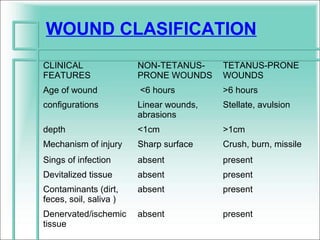
WOUND CLASIFICATION
CLINICAL                NON-TETANUS-     TETANUS-PRONE
FEATURES                PRONE WOUNDS     WOUNDS
Age of wound            <6 hours         >6 hours
configurations          Linear wounds,   Stellate, avulsion
                        abrasions
depth                   <1cm             >1cm
Mechanism of injury     Sharp surface    Crush, burn, missile
Sings of infection      absent           present
Devitalized tissue      absent           present
Contaminants (dirt,     absent           present
feces, soil, saliva )
Denervated/ischemic     absent           present
tissue
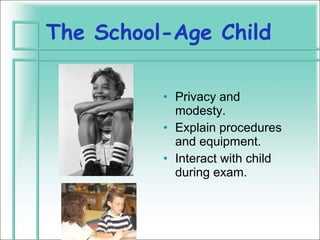
The School-Age Child

          • Privacy and
            modesty.
          • Explain procedures
            and equipment.
          • Interact with child
            during exam.
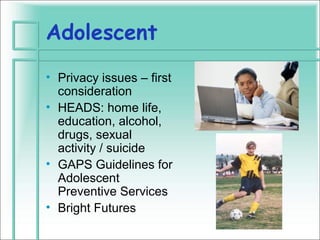
Adolescent
• Privacy issues – first
  consideration
• HEADS: home life,
  education, alcohol,
  drugs, sexual
  activity / suicide
• GAPS Guidelines for
  Adolescent
  Preventive Services
• Bright Futures
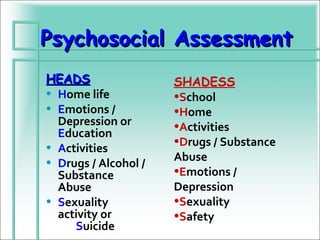
Psychosocial Assessment
HEADS                 SHADESS
• Home life           •School
• Emotions /          •Home
  Depression or       •Activities
  Education
                      •Drugs / Substance
• Activities
• Drugs / Alcohol /   Abuse
  Substance           •Emotions /
  Abuse               Depression
• Sexuality           •Sexuality
  activity or         •Safety
     Suicide
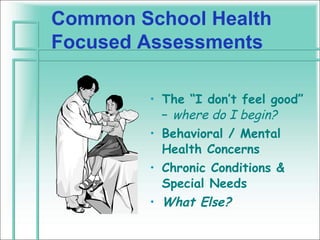
Common School Health
Focused Assessments

        • The “I don’t feel good”
          – where do I begin?
        • Behavioral / Mental
          Health Concerns
        • Chronic Conditions &
          Special Needs
        • What Else?
The “I don’t feel good”
Appearance
    PAT                Includes
                    LOC & Behavior

                          PAT

     and
           Breathing Changes    Skin Circulation


This OLD CART
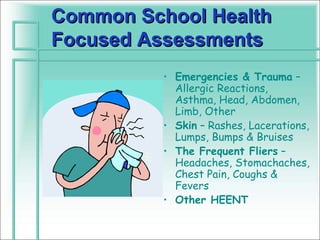
Common School Health
Focused Assessments
          • Emergencies & Trauma –
            Allergic Reactions,
            Asthma, Head, Abdomen,
            Limb, Other
          • Skin – Rashes, Lacerations,
            Lumps, Bumps & Bruises
          • The Frequent Fliers –
            Headaches, Stomachaches,
            Chest Pain, Coughs &
            Fevers
          • Other HEENT
Emergencies & Trauma

• Allergic
  Reactions
• Asthma
• Head
• Abdomen
• Limb
• Other
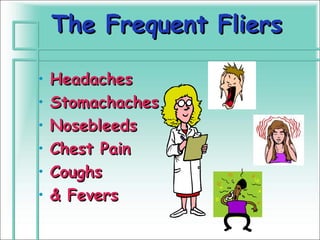
The Frequent Fliers

•   Headaches
•   Stomachaches
•   Nosebleeds
•   Chest Pain
•   Coughs
•   & Fevers
Frequent Fliers

If only you could cash in on those miles!
Behavioral / Mental Health
         Concerns

     •   Developmental Delays
     •   Depression
     •   Aggressive Behaviors
     •   Suicide Risks
     •   Other Mental Health
         Issues
Chronic Conditions &
   Special Needs

      •   Asthma
      •   Diabetes
      •   Neuro – seizures
      •   Sickle Cell Anemia
      •   Cerebral Palsy
      •   ADHD
Additional “To – Do’s”

          • Documentation
            • –SOAP Notes
          • Quality Improvement
            – - chart reviews
          • Confidentiality –
            seriously!
Resources and References
• Jan Chandler RN, MSN, CNS, PNP Pediatric Nursing: Nursing Care of
  Children and Young Adults: Pediatric Physical Assessment
• Colyar, M. Well Child Assessment for Primary Care Providers.
  Philadelphia, PA: F.A. Davis Company.
• Duderstadt, K. Pediatric Physical Examination.
  St. Louis, MO: Mosby, Inc.
• Engel, J. Pediatric Assessment 5th. Ed. St. Louis, MO: Mosby, Inc.
• Wong’s Essentials of Pediatric Nursing 8 th ed.
• AAP Preparticipation Physical Evaluation. Available @ www.aap.org
• Resource Manual for the Nurse in the School Setting
  http://www.ems-c.org/school/frameschool.htm
• American Medical Association Guidelines for Adolescent Preventive
  Services (GAPS) http://www.ama-assn.org/ama/pub/category/2280.html
• American School Health Association http://www.ashaweb.org
• The Auscultation Assistant @
  http://www.wilkes.med.ucla.edu/intro.html
• BMI Calculator: http://www.cdc.gov/nccdphp/dnpa/bmi /
• 2007 Asthma Guidelines:
  http://www.nhlbi.nih.gov/guidelines/asthma/index.htm
We Know
It’s a Jungle Out There!
The Power of Nursing

 Never doubt how vitally important you are;
  never doubt how important your work is –
 and never expect anyone to acknowledge it
                 before you do.
     Every moment, in everything you do,
         you are making a difference.
 In fact, you are in the business of making a
      difference in other people’s lives.
In that difference lies their healing
                and your power.
                 Never forget it.

Pediatric assessment

  • 1.
    PEDIATRIC ASSESSMENT Prepared by: Puan Kurniati Solehan
  • 2.
    Objectives • Understand theimportance of Assessment and Triage and how they interplay in the Health Care Setting • Identify essential components of a “focused” Pediatric Assessment • Utilize the assessment information to differentiate between minor and more serious conditions (Triage) • Identify and implement nursing interventions based on the assessment and triage provided Sound Familiar?
  • 3.
    Essential Pediatric NursingSkills • Knowledge of Growth and Development • Development of a Therapeutic Relationship • Communication with children and their parents • Understanding of family dynamics and parent-child relationships: IDENTIFY KEY FAMILY MEMBERS • Knowledge of Health Promotion & Disease Prevention • Patient Education and Anticipatory Guidance • Practice of Therapeutic and Atraumatic Care • Patient and Family Advocacy • Caring, Supportive & Culturally Sensitive Interactions • Coordination and Collaboration • CRITICAL THINKING
  • 4.
    Equipment What’s inYour setting? • Airway support equipment, Ambu-bags • Stethoscope & Sphygmomanometer • Pen Light • Pulse Ox & Cardiac Monitor • Nebulizer • Otoscope / Opthalmoscope • O2
  • 5.
    The single mostimportant part of the health assessment is…… the
  • 6.
    History Bio-graphic Demographic Past Medical History • Name, Date of Birth, Age •Allergies •Past illness • Parents & siblings info •Trauma / hospitalizations • Cultural practices •Surgeries • Religious practices •Birth history • Parents’ occupations •Developmental • Adolescent – work info •Family Medical/Genetics Current Health Status •Immunization Status •Chronic illnesses or conditions •What concerns do you have today?
  • 7.
    Review of Systems •Ask questions about each system • Measurements: weight, height, head circumference, growth chart, BMI • Nutrition: breastfed, formula, favorite foods, beverages, eating habits • Growth and Development: Milestones for each age group
  • 8.
    History: Review ofSystems • Skin • GI • HEENT • GU & GYN • Neck • Musculoskeletal • Chest & Lungs / & Extremities Respiratory • Neuro • Heart & • Endocrine Cardiovascular
  • 9.
  • 10.
    Patti’s Nitty GrittyTrio • Sleep & Activity • Appetite • Bowel & Bladder • In a time crunch, these three questions should give you enough insight into the child’s general functioning – • Can get more detailed if any (+) responses
  • 11.
    Components of a Focused Pediatric Assessment • Always ABCs! Appearance • PAT: Pediatric Includes Assessment LOC & Behavior Triangle • Ongoing Triage – PAT • Minor vs. • Serious vs. Life-Threatening Breathing Changes Skin Circulation • Problem- Focused Examination
  • 12.
    PAT General Appearance Workof Breathing Circulation to the Skin
  • 13.
    APPEARANCE Tone Interactiveness Consolability Look/gaze Speech/cry
  • 14.
    Work of Breathing •Increased or Decreased Respirations • Stridor • Wheezing
  • 15.
    Circulation to theSkin • Inadequate perfusion of vital organs • Leads to compensatory mechanisms in non- essential functions • Ex: vasoconstriction in the skin.
  • 16.
    Initial Assessment (s) •Primary • Secondary • A = Airway • E = Exposure • B = Breathing • F = Full Set of Vitals • G = Give Comfort • C = Circulation Measures including Pain • D = Disability Assessment & Tx. • H = Head –to-Toe assessment & history • I = Inspect posterior surfaces – rashes, bruising
  • 17.
    Physical Assessment • Theapproach is: • Orderly • Systematic • Head-to-toe • But FLEXIBILIY is essential • And be kind and gentle • but firm, direct and honest
  • 18.
    Physical Assessment General Appearance & Behavior • Facial expression • Posture / movement • Hygiene • Behavior • Developmental Status
  • 19.
    Vital Signs • Temperature:rectal only when absolutely necessary • Pulse: apical on all children under 1 year • Respirations: infant use abdominal muscles • Blood pressure: admission base line • And the “Fifth” Vital Sign is ____ ?
  • 20.
    Pediatric Vital Signs– Normal Ranges Infant Toddler School-Age Adolescent • Heart Rate 80-150 70-110 60-110 60-100 • Respiratory Rate 24-38 22-30 14-22 12-22 • Systolic blood pressure 65-100 90-105 90-120 110-125 • Diastolic blood pressure 45 - 65 55-70 60-75 65-85
  • 21.
    Physical Assessment • General • Heart • Skin, hair, nails • Abdomen • Head, neck, • Genitalia, Tanner Scale, lymph nodes • Rectal • Eyes, ears, nose, • Musculoskeletal: feet, throat legs, back, gait • Chest, Tanner Scale
  • 22.
    Physical Assessment • Four Basic Skills: 1. Inspection 2. Palpation 3. Percussion 4. Auscultation • Sequence for abdominal: 1.inspection, 2.auscultation, 3.percussion, 4.palpation
  • 23.
    Inspection • Use all your senses • The essential First Step of the Physical Exam
  • 24.
    Palpation • Use ofyour fingers • Warm hands and and palms to short nails determine: • Palpate areas of tenderness / pain last • Temperature • Talk with the child • Hydration during palpation to • Texture help him relax • Shape • Be observant of • Movement reactions to palpation • Move firmly without • Areas of hesitation Tenderness
  • 25.
    Palpation • For theticklish child: place her hands over your hands and have the child do the pressing down.
  • 26.
    Percussion Use of tappingto produce sounds that are characterized according to: • Intensity • Pitch • Duration • Quality Direct vs. Indirect
  • 27.
    Auscultation • Listening forbody sounds • Bell: low-pitched • - heart • Diaphragm: high-pitched • – lung & bowel LUNGS: Listen to all lung fields FRONT AND BACK! auscultate for breath sounds and adventitious sounds
  • 28.
    “I P PA” • Practice, Practice, Practice • by knowing what the norm is, you’ll be able to pick up on the abnormal, even if you can’t diagnose it…. • The important thing is to be able to say “This is not right” • and refer appropriately!
  • 29.
    H E EN T Head Eyes Ears Nose Neck Throat
  • 30.
    HEENT: Head &Neck, Eyes, Ears, Nose, Face, Mouth & Throat • Head: Symmetry of skull and face • Neck: Structure, movement, trachea, thyroid, vessels and lymph nodes • Eyes: Vision, placement, external and internal fundoscopic exam • Ears: Hearing, external, ear canal and otoscopic exam of tympanic membrane • Nose: Structure, exudate, sinuses • Mouth: Structures of mouth, teeth and pharynx
  • 31.
    Head • Shape: “NormoCephalic – ATraumatic” AT • Lesions • ? Edema
  • 32.
    Head: Key Points •Head Circumference (HC • Fontannels/sutures: Anterior closes at 10-18 months, posterior by 2 months • Symmetry & shape: Face & skull • Bruits: Temporal bruits may be significant after 5 yrs • Hair: Patterns, loss, hygiene, pediculosis in school aged child • Sinuses: Palpate for tenderness in older children • Facial expression: Sadness, signs of abuse, allergy, fatigue • Abnormal facies: “Diagnostic facies” of common syndromes or illnesses
  • 33.
    Neuro Assessment • LOC/ Glasgow coma scale • Confusion, Delirium, Stupor, Coma • Pupil size • CNS grossly intact: II – XII • Vital Signs • Pain • Seizure Activity • Focal Deficits
  • 34.
    Neurological Key Points • Cranial Nerves • Cerebral Function: • Mental status, appearance, behavior, cooperation • LOC, language, emotional status, social response, attention span • Cerebellar Function • Balance, gait & leg coordination, ataxia, posture, tremors • Finger to nose (fingers to thumb) 3-4 yrs • Finger to examiner's finger 4-6 yrs • Ability to stand with eyes closed (Romberg) 3-4 yrs • Rapid alternations of hands (prone, supine) school age • Tandum walk 4-6 yrs • Walk on toes, heels school age • Stand on one foot 3-6 yrs • Motor Function: Gross motor & Fine motor movements • Sensory function • Reflexes
  • 35.
    Cranial Nerves C1 -Smell C2 - Visual acuity, visual fields, fundus C3, 4, 6 - EOM, 6 fields of gaze C5 - Sensory to face: Motor--clench teeth, C5 & C7 - Corneal reflex C7 - Raise eyebrows, frown, close eyes tight, show teeth, smile, puff cheeks, taste--anterior 2/3 tongue C8 - Hearing & equilibrium C9 – say "ah," equal movement of soft palate & uvula C10 - Gag, Taste, posterior 1/3 tongue C11 - Shoulder shrug & head turn with resistance C12 - Tongue movement
  • 36.
    Reflexes Deep tendon: • BicepsC5, C6 • Triceps C6, C7, C8 • Brachioradialis C5, C6 • Patellar L2, L3, L4 • Achilles S1, S2 Superficial: • Cremasteric T12, L1, L2 • Abdominal T7, T8, T9, T10, T11 Infant Automatisms: • Primitive Reflexes
  • 37.
    Glasgow Coma Scale The lowest possible GCS is 3 (deep coma or death) while the highest is 15 (fully awake person). 1 2 3 4 5 6 N/A N/A EYES Does not Opens eyes Opens Opens eyes open eyes in response eyes in spontaneously to painful response stimuli to voice N/A VERBAL Makes no Incomprehen Utters Confused, Oriented, sounds sible sounds inappropri disorientated converses ate words normally MOTOR Makes no Extension to Abnormal Flexion / Localizes Obeys movements painful stimuli flexion to Withdrawal to painful commands painful painful stimuli stimuli stimuli Source :Wikipedia
  • 38.
    Bacterial Meningitis Clinical Manifestationsin an Older Child • High fever • Headache • LOC Changes / GCS • Nuchal rigidity / stiff neck • + Kernigs = inability to extend legs • + Brudzinski sign = flexion of hips when neck is flexed • Purple rash (check for blanching) • “Looks Sick”
  • 39.
    HEAD INJURY •Very common in pediatrics • Most often not serious • requires observation only • Symptoms - headache - vomiting - lethargy - altered behavior •Altered mental status: GCS
  • 40.
    HEAD INJURY -Physical Findings • PUPILS • PAPILLEDEMA • CUSHING TRIAD: • bradycardia, irregular respirations and hypertention • Look for signs of alcohol/drug abuse in adolescents • Lack of external signs of head trauma does not rule out significant brain injury
  • 41.
    CONCUSSION • Traumatic alterationin mental status - disturbance of vision - loss of equilibrium - amnesia - headache - cognitive function - LOC (not necessary for diagnosis) • Needs complete neurological exam • Second-impact syndrome • MRI
  • 42.
    Guidelines Grading &1st Concussion Guidelines Minimum time Grade Confusion Amnesia LOC to return Time to play asymptomatic I Yes No No 20 min When examined II Yes Yes No 1 week 1 week III Yes Yes Yes 1month 1 week
  • 43.
    Time to returnto contact sports after repeat concussion Grade Minimum time to Time return to play asymptomatic I (2nd time) 2 weeks 1 week II (2nd time) 1month 1 week III (2nd time) Season over I,II (3rd time)
  • 44.
    Eyes • PERRL & EOM • Red Reflex • Corneal Light Reflex • Strabismus: • Alignment of eye important due to correlation with brain development • May need to corrected surgically • Preschoolers should have o vision screening • Refer to ophthalmologist is there are concerns
  • 45.
    Eyes: Key Points • Vision: Red reflex & blink in neonate • Visual following at 5-6 weeks • 180 degree tracking at 4 months • Pictures or Tumbling E charts & strabismus check for preschool child • Snellen chart for older children • Irritations & infections • PERRL • Amblyopia (lazy eye): Corneal light reflex, binocular vision, cover-uncover test • EOMs: tracking 6 fields of vision • Fundoscopic exam of internal eye & retina
  • 46.
    Conjunctivitis Viral – most common cause Bacterial – more common in • Very contagious school-age children • 8 day incubation period Symptoms: • Pinkish-red eyes • Red eyes • Watery or serous discharge • Purulent or mucopurulent • Crusty eyelids on awakening discharge, matted eyelids • c/o “gritty sensation in eye upon awakening • May c/o URI symptoms • c/o “gritty” sensation • Can be either unilateral or • Usually starts unilaterally bilateral and then progresses to bilateral • Vesicles around eye could be herpes lesions • Often concurrent otitis Immediate referral to media ophthalmologist • Culture if < 1 month of age
  • 47.
    Conjunctivitis Allergic • Often seasonal • Erythema due to dilated vessels • Itching, burning • May be seasonal • Tearing, watery eyes • Eyelid swelling • Clear or stringy eye discharge • bilateral
  • 48.
    Ears: Key Points •Ask about hearing concerns • Inquire about infant’s response to • Observe an older infant’s/toddlers speech pattern • Inspect the ears • •Assess the shape of the ears • Determine if both ears are well formed • •Assess
  • 49.
    Common Ear Infections Otitis Media Otitis Externa • Most common reason • Pain –especially children come to the when pinna is slightly pediatrician or tugged at emergency room • Discharge • Fever or tugging at ear (sometimes odorous) • Often increases at night • “Swimmer’s Ear” when they are sleeping • History of cold or congestion
  • 50.
    Nose & Throat/ Mouth • Turbinates • Palate • Exudate • Gums • Pharynx • Swallow • Tonsils • Oral Hygiene • Signs & Symptoms of • Condition of teeth Allergic Rhinitis • Missing teeth • Streaking • Cobble stoning • Orthodontic • Post-Nasal Drip Appliances • Injection • Erythema Or is it infection?
  • 51.
    Nose: Key Points •Exam nose & mouth after ears • Observe shape & structural deviations • Nares: (check patency, mucous membranes, discharge, turbinates, bleeding) • Septum: (check for deviation) • Infants are obligate nose breathers • Nasal flaring is associated with respiratory distress
  • 52.
    Nose: Variations • Allergy:“allergic salute” - line across nose. • Infection • Foreign body: • Foul odor or unilateral discharge • Structure variations • Bell’s palsy
  • 53.
    Nose and Throat Sinusitis: • Fever • Purulent rhinorrhea • Facial Pain – cheeks, forehead • Breath odor • Chronic cough – could be day and night • (+) Post-nasal drip
  • 54.
    Mouth & Pharynx:Key Points • Lips: color, symmetry, moisture, swelling, sores, fissures • Buccal mucosa, gingivae, tongue & palate for moisture, color, intactness, bleeding, lesions. • Tongue & frenulum - movement, size & texture • Teeth - caries, malocclusion and loose teeth. • Uvula: symmetrical movement or bifid uvula • Voice quality, Speech • Breath - halitosis
  • 55.
    Ears, Nose andThroat Sore Throats Is it strept or is it viral or could it be mono? Lymph nodes & ROM
  • 56.
    Neck: Key Points •√ position, lymph nodes, masses, fistulas, clefts • Suppleness & Range of Motion (ROM) • Check clavicle in newborn • Head control in infant • Trachea & thyroid in midline • Carotid arteries (bruits) • Torticollis • Webbing • Meningeal irritation
  • 57.
    Chest Assessment •How doesthe child look? •Color •Work of Breathing: Effort used to breathe Auscultatio n All 4 quadrants • • Front and back • Take the time to listen • Be sure about “lungs CTAB” (clear to auscultation bilaterally)
  • 58.
    Lungs & Respiratory:Key Points • Quality of Respirations: • Symmetry, Expansion, Effort, Dyspnea • S & S Respiratory Distress: • Color: cyanosis, pallor, circumoral cyanosis, mottling • Tachypnea • Retractions • Nasal flaring • Grunting (expiratory) • Stridor - inspiratory: croup • Adventitious sounds: • Crackles / Rales • Rhonchi - course breath sounds • Wheeze – inspiratory vs. expiratory
  • 59.
    Lungs & Respiratory:Key Points • Clubbing • Snoring (expiratory): upper airway obstruction, allergy, • Fremitus: • Increased in pneumonia, atelectasis, mass • Decreased in asthma, pneumothorax or FB • Dullness to percussion: fluid or mass
  • 60.
    Work of Breathing • Increased or Decreased Respirations • Stridor • Wheezing
  • 61.
    Chest Assessment • Auscultation •Wheezing • Retractions • Subcostal • Intercostal • Sub-sternal • Supra-clavicular Red Flags: • grunting • nasal flaring • stridor
  • 62.
    All that Wheezes isn’talways Asthma… Think: • Infection • Foreign body aspiration • Anaphylaxis • Insect bites/stings, medications, food allergies
  • 63.
    And all Asthma doesn’talways Wheeze! • Cough • Fatigue • Reduced exercise tolerance
  • 64.
    Coughs • Allergies • Asthma •Infections – pneumonia, bronchitis, bronchiolitis • Sinusitis – Post-nasal drip • GERD • Cigarette smoking • Exposure to secondhand smoke, • Other pollutants
  • 65.
    Cough - Characteristics • Dry, non-productive • Mucousy – productive • Croupy • Acute – less than 2-3 weeks • Chronic – more than 2-3 weeks • Associating Symptoms
  • 66.
    Chest Pain • Call911 if severe, acute, unremitting – needs immediate attention - very rare • Non-cardiac – most common • Musculoskeletal: costochondritis • Pulmonary • Gastrointestinal e.g. GERD • Psychogenic • Often no significant physical findings • Must rule out Cardiac origin – refer to PCP or pedi cardiologist
  • 67.
    Circulatory •Auscultating Heart Sounds The Auscultation Assistant – Hear Heart Murmurs, Heart Sounds, and Breath Sounds. http://www.wilkes.med.ucla.edu/inex.htm Pillitter •Perfusion – capillary refill •“Warm to touch”
  • 68.
    Murmurs: • may be systolic, diastolic or continuous • timing, location, quality -course, harsh, blowing, high pitched • GRADE: • I - faint, may not be heard sitting • II - readily heard with stethoscope • III - loud, no thrill • IV - loud with stethoscope, thrill • V - loud with stethoscope barely to chest, thrill • VI - loud with stethoscope not touching chest, thrill • Functional Murmurs: • Change or disappear with position change (usually loudest supine) • Low grade, soft or musical • Intensity range from I-III/VI • Systolic (never diastolic) • Do not radiate • Occur in absence of significant heart disease or structural abnormality
  • 69.
  • 70.
    Abdomen: Key Points •Contour • Bowel Sounds & Peristalsis • Skin: color, veins • Umbilicus • Assess for Tenderness, Ridigity, Tympany, Dullness • Hernias: umbilical, inguinal, femoral • Masses - size, shape, dullness, position, mobility • Liver, Spleen, Kidneys, Bladder
  • 71.
    Bowel Sounds • Normal:every 10 to 30 seconds. • Listen in each quadrant long enough to hear at least one bowel sound. • Absent • Hypoactive • Normoactive • Hyperactive
  • 72.
    Stomachaches and Abdominal Pain • Excessive gas • Heartburn or • Chronic constipation indigestion • Lactose intolerance • GERD • Viral gastroenteritis • Food allergy • Irritable bowel • Parasite infections syndrome (Giardia) What are we most concerned about?
  • 73.
    Stomachaches and Abdominal Pain •Appendicitis • Hernia • Bowel obstruction -- • Intussusception Cholecystitis with or without gallstones • Kidney stones • Food poisoning • Pancreatitis (salmonella, shigella) • Sickle cell crisis • Inflammatory Bowel • Ulcers Disease – • Urinary tract • Crohn's disease infections • Ulcerative colitis
  • 74.
    Signs and Symptoms • Appearance –color, facial, ROM, gait, position • Pain – get your pain scales out • Nausea • Vomiting • Diarrhea • Bloating • Vomiting • Inability to pass gas or stool
  • 75.
    Diagnostic breakdown ofone year's admissions for abdominal pain in a district general hospital. Davenport, M. BMJ 1996;312:498-501 Copyright ©1996 BMJ Publishing Group Ltd.
  • 76.
    Bottom Line: Acuteor Not Soft, non-tender, non-distended no rebound, no HSM, no mass, BS NA x 4Q Can the child hop? Ball & Bindler
  • 77.
    Musculo-Skeletal • FROM, MAE- neck, shoulder, elbow, wrist, hip, knee, ankle, foot, digits • Alignment, contour, strength, weakness & symmetry • Limb, joint mobility: stiffness, contractures • Gait – observe child walking without shoes • Spinal alignment - Scoliosis • Muscle Strength & Tone • Hips – O & B • Reflexes • Pre-Participation Sports P.E. – • NJ’s new guidelines: http://www.state.nj.us/education/districts/ppeq.doc
  • 78.
    Scoliosis Lateral curvature of spine Key Points: •Barefoot Medline.com •Feet Together •Bend Over –”Diving Of a Diving Board” •Check Hips
  • 79.
    Assessment • The FiveP’s: • Pain • Paresthesia • Passive stretch • Pressure • Pulse-less-ness
  • 80.
    Skin, Nails &Hair • Rashes • Lesions • Lacerations • Lumps • Bumps • Bruises • Bites • Infections
  • 81.
    Common Skin Lesions • Macule • Scale • Papule • Crust • Vesicle, bulla • Keloid • Pustule • Fissure • Cyst • Ulcer • Patch • Petechiae • Plaque • Purpura • Wheal • Ecchymosis • Striae Capillary bleeding: Petichiae and purpura usually indicate serious conditions
  • 82.
    Skin Infections • Bacterialinfections • Abscess formation • Severity varies with skin integrity, immune and cellular defenses • Examples: • impetigo • cellulitis
  • 83.
    Viral Skin Infections •Most communicable diseases of childhood have characteristic rash • Examples: verruca, herpes simplex types I and II, varicella zoster, molluscum contagiosum
  • 84.
    Fungal Skin Infections •Superficial infections that live on the skin • Also known as dermatophytoses, tinea • Transmission from person to person or from infected animal to human • Examples: tinea capitis, tinea corporis, tinea pedis, candidiasis
  • 85.
    Contact Dermatitis • Inflammatoryreaction of skin to chemical • Initial reaction in the exposed region • Characteristic sharp delineation between inflamed and normal skin • Primary irritant • Sensitizing agent • Examples: diaper dermatitis, reaction to wool, reaction to specific chemical • Poison Ivy, Oak, and Sumac - urushiol
  • 86.
    Miscellaneous Skin Disorders • Urticaria • Psoriasis • Alopecia • Intertrigo • Stevens-Johnson syndrome • Neurofibromatosis
  • 87.
    Atopic Dermatitis • Atype of pruritic • Three forms: eczema that begins • Infantile eczema: during infancy begins at age 2-6 months • Hereditary tendency • Childhood eczema: • Often associated may follow infantile with history of food form allergies, allergic • Preadolescent and rhinitis, and asthma adolescent: 12 years to early adult age
  • 88.
    Therapeutic Management of Atopic Dermatitis Goals: • Relieve pruritus • Hydrate skin • Reduce inflammation • Prevent or control secondary infection
  • 89.
    WOUND CLASIFICATION CLINICAL NON-TETANUS- TETANUS-PRONE FEATURES PRONE WOUNDS WOUNDS Age of wound <6 hours >6 hours configurations Linear wounds, Stellate, avulsion abrasions depth <1cm >1cm Mechanism of injury Sharp surface Crush, burn, missile Sings of infection absent present Devitalized tissue absent present Contaminants (dirt, absent present feces, soil, saliva ) Denervated/ischemic absent present tissue
  • 90.
    The School-Age Child • Privacy and modesty. • Explain procedures and equipment. • Interact with child during exam.
  • 91.
    Adolescent • Privacy issues– first consideration • HEADS: home life, education, alcohol, drugs, sexual activity / suicide • GAPS Guidelines for Adolescent Preventive Services • Bright Futures
  • 92.
    Psychosocial Assessment HEADS SHADESS • Home life •School • Emotions / •Home Depression or •Activities Education •Drugs / Substance • Activities • Drugs / Alcohol / Abuse Substance •Emotions / Abuse Depression • Sexuality •Sexuality activity or •Safety Suicide
  • 93.
    Common School Health FocusedAssessments • The “I don’t feel good” – where do I begin? • Behavioral / Mental Health Concerns • Chronic Conditions & Special Needs • What Else?
  • 94.
    The “I don’tfeel good”
  • 95.
    Appearance PAT Includes LOC & Behavior PAT and Breathing Changes Skin Circulation This OLD CART
  • 96.
    Common School Health FocusedAssessments • Emergencies & Trauma – Allergic Reactions, Asthma, Head, Abdomen, Limb, Other • Skin – Rashes, Lacerations, Lumps, Bumps & Bruises • The Frequent Fliers – Headaches, Stomachaches, Chest Pain, Coughs & Fevers • Other HEENT
  • 97.
    Emergencies & Trauma •Allergic Reactions • Asthma • Head • Abdomen • Limb • Other
  • 98.
    The Frequent Fliers • Headaches • Stomachaches • Nosebleeds • Chest Pain • Coughs • & Fevers
  • 99.
    Frequent Fliers If onlyyou could cash in on those miles!
  • 100.
    Behavioral / MentalHealth Concerns • Developmental Delays • Depression • Aggressive Behaviors • Suicide Risks • Other Mental Health Issues
  • 101.
    Chronic Conditions & Special Needs • Asthma • Diabetes • Neuro – seizures • Sickle Cell Anemia • Cerebral Palsy • ADHD
  • 102.
    Additional “To –Do’s” • Documentation • –SOAP Notes • Quality Improvement – - chart reviews • Confidentiality – seriously!
  • 103.
  • 104.
    • Jan ChandlerRN, MSN, CNS, PNP Pediatric Nursing: Nursing Care of Children and Young Adults: Pediatric Physical Assessment • Colyar, M. Well Child Assessment for Primary Care Providers. Philadelphia, PA: F.A. Davis Company. • Duderstadt, K. Pediatric Physical Examination. St. Louis, MO: Mosby, Inc. • Engel, J. Pediatric Assessment 5th. Ed. St. Louis, MO: Mosby, Inc. • Wong’s Essentials of Pediatric Nursing 8 th ed. • AAP Preparticipation Physical Evaluation. Available @ www.aap.org • Resource Manual for the Nurse in the School Setting http://www.ems-c.org/school/frameschool.htm • American Medical Association Guidelines for Adolescent Preventive Services (GAPS) http://www.ama-assn.org/ama/pub/category/2280.html • American School Health Association http://www.ashaweb.org • The Auscultation Assistant @ http://www.wilkes.med.ucla.edu/intro.html • BMI Calculator: http://www.cdc.gov/nccdphp/dnpa/bmi / • 2007 Asthma Guidelines: http://www.nhlbi.nih.gov/guidelines/asthma/index.htm
  • 106.
    We Know It’s aJungle Out There!
  • 108.
    The Power ofNursing Never doubt how vitally important you are; never doubt how important your work is – and never expect anyone to acknowledge it before you do. Every moment, in everything you do, you are making a difference. In fact, you are in the business of making a difference in other people’s lives. In that difference lies their healing and your power. Never forget it.

Editor's Notes

  • #6 PRIZE!
  • #23 Inspection and auscultation are performed before palpation and percussion because touching the abdomen may change the characteristics of the bowel sounds.