Physical Disabilities and 
Health Problems 
Chapter 7 – The Exceptional Child: Inclusion in Early Childhood 
Education; Allen, K. Eileen and Cowdery, Glynnis E.; 2015
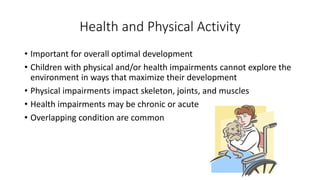
Health and Physical Activity 
• Important for overall optimal development 
• Children with physical and/or health impairments cannot explore the 
environment in ways that maximize their development 
• Physical impairments impact skeleton, joints, and muscles 
• Health impairments may be chronic or acute 
• Overlapping condition are common
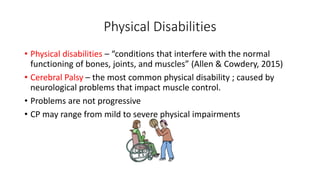
Physical Disabilities 
• Physical disabilities – “conditions that interfere with the normal 
functioning of bones, joints, and muscles” (Allen & Cowdery, 2015) 
• Cerebral Palsy – the most common physical disability ; caused by 
neurological problems that impact muscle control. 
• Problems are not progressive 
• CP may range from mild to severe physical impairments
Types of Muscle Problems for Classifying CP 
• Spasticity – hypertonic muscle tone; joints do not have the range of 
motion they should have 
• Hypotonicity – “floppy” baby syndrome; child has too little muscle 
tone; impacts head and posture control. 
• Athetosis – children with this tend to keep primitive reflexes and have 
problems with voluntary muscle control 
• Ataxia – a lack of motor coordination that affects balance and makes 
fine motor coordination difficult 
• Other classifications according to affected body parts - Diplegia, 
hemiplegia, paraplegia, quadriplegia
Challenges for Children with CP 
• Lack of motor control and failure to meet physical development 
milestones 
• Lack of motor control may impact eating and ability to speak, even if 
there is no intellectual impairment 
• Physical and occupational therapists are important team members for 
the interdisciplinary team for a child with CP
Spinal Cord Injuries 
• Unlike with CP, the brain is not affected. The muscles below the 
spinal cord injury no longer receive signals from the brain. 
• Children with spinal cord injuries do no have any sensation below the 
injury 
• Spina bifida occurs in the first 30 days of fetal development and is a 
neural tube defect. 
• Children with spina bifida may be hydrocephalic and may have 
incontinence.
Muscular Dystrophy 
• Characterized by a progressive weakening of the muscles 
• Duchenne’s disease is the most common and affects only boys. 
• Children with MD are encouraged to use muscles as much as possible 
• Other impairments 
• Hip dysplasia – occurs in girls more often than in boys; requires treatment for 
child to learn to walk properly 
• Juvenile Rheumatoid Arthritis – characterized by inflammation of the joints 
and surrounding tissue; symptoms may disappear as child gets older.
Program Implications 
• Interdisciplinary team requires a variety of professionals 
• Both commercial and creative adaptive equipment may be needed 
• Environment will need to be adapted to support all children in the 
program, including the child with physical disabilities 
• Prospective interdisciplinary team members: 
• Physical and occupational therapists 
• Speech and language therapist 
• Psychologist or other behavior specialist 
• Consistent implementation of therapy goals important 
• All therapeutic activity must be supervised by appropriate specialist
Adaptive Equipment 
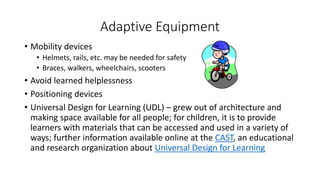
• Mobility devices 
• Helmets, rails, etc. may be needed for safety 
• Braces, walkers, wheelchairs, scooters 
• Avoid learned helplessness 
• Positioning devices 
• Universal Design for Learning (UDL) – grew out of architecture and 
making space available for all people; for children, it is to provide 
learners with materials that can be accessed and used in a variety of 
ways; further information available online at the CAST, an educational 
and research organization about Universal Design for Learning
Adaptive Materials and Equipment (cont.) 
• Pp. 151 – 156 in your text describe manipulatives, creative materials, 
self-help devices and environmental barriers that can be adapted for 
use with children both with and without disabilities (think UDL) 
• All of these suggestions may be useful for your final Environment Key 
Assessment 
Health Problems 
• Asthma – common, but very serious health problem for children 
• Know what to do in the event of an asthma attach 
• Cystic fibrosis – most common inherited chronic disease among 
Caucasian children; incurable; people may now live into their 30s and 
40s with this disease; causes respiratory and digestive problems. 
• Hemophilia – rare inherited blood clotting disorder 
• Leukemia – most common cancer among children; much higher 
survival rate than in the past 
• Sickle-Cell Anemia – incurable disease found among African American 
children, but is decreasing in the U.S.
Health Problems (cont.) 
• Heart problems – 
• Diabetes 
• Type 1 – is caused by an autoimmune disorder; the rarer type of diabetes 
• Type 2 – the body fails to use insulin efficiently; may cause hypoglycemia or 
hyperglycemia 
• Seizure disorders 
• Febrile seizures – these are not harmful and are brought on by a high fever 
• “Generalized tonic-clonic (grand mal) seizures” 
• Absence seizures (petit mal) – may be more difficult to recognize 
• Partial psychomotor seizures
Health Problems (cont.) 
• AIDS 
• Obesity – causes various health problems; may cause social and 
emotional problems; encourage healthy eating and appropriate 
exercise for all children in your care 
• Health Problems and Classroom Practices 
• Maintaining health records; see required records from NC DCDEE and the NC 
School Health Program Manual 
• Administer medications as permitted by NC DCDEE 
• Emergencies – have emergency plans that are practiced 
• Maintain confidentiality

Physical disabilities and health problems ch 7 2014fa

  • 1.
    Physical Disabilities and Health Problems Chapter 7 – The Exceptional Child: Inclusion in Early Childhood Education; Allen, K. Eileen and Cowdery, Glynnis E.; 2015
  • 2.
    Health and PhysicalActivity • Important for overall optimal development • Children with physical and/or health impairments cannot explore the environment in ways that maximize their development • Physical impairments impact skeleton, joints, and muscles • Health impairments may be chronic or acute • Overlapping condition are common
  • 3.
    Physical Disabilities •Physical disabilities – “conditions that interfere with the normal functioning of bones, joints, and muscles” (Allen & Cowdery, 2015) • Cerebral Palsy – the most common physical disability ; caused by neurological problems that impact muscle control. • Problems are not progressive • CP may range from mild to severe physical impairments
  • 4.
    Types of MuscleProblems for Classifying CP • Spasticity – hypertonic muscle tone; joints do not have the range of motion they should have • Hypotonicity – “floppy” baby syndrome; child has too little muscle tone; impacts head and posture control. • Athetosis – children with this tend to keep primitive reflexes and have problems with voluntary muscle control • Ataxia – a lack of motor coordination that affects balance and makes fine motor coordination difficult • Other classifications according to affected body parts - Diplegia, hemiplegia, paraplegia, quadriplegia
  • 5.
    Challenges for Childrenwith CP • Lack of motor control and failure to meet physical development milestones • Lack of motor control may impact eating and ability to speak, even if there is no intellectual impairment • Physical and occupational therapists are important team members for the interdisciplinary team for a child with CP
  • 6.
    Spinal Cord Injuries • Unlike with CP, the brain is not affected. The muscles below the spinal cord injury no longer receive signals from the brain. • Children with spinal cord injuries do no have any sensation below the injury • Spina bifida occurs in the first 30 days of fetal development and is a neural tube defect. • Children with spina bifida may be hydrocephalic and may have incontinence.
  • 7.
    Muscular Dystrophy •Characterized by a progressive weakening of the muscles • Duchenne’s disease is the most common and affects only boys. • Children with MD are encouraged to use muscles as much as possible • Other impairments • Hip dysplasia – occurs in girls more often than in boys; requires treatment for child to learn to walk properly • Juvenile Rheumatoid Arthritis – characterized by inflammation of the joints and surrounding tissue; symptoms may disappear as child gets older.
  • 8.
    Program Implications •Interdisciplinary team requires a variety of professionals • Both commercial and creative adaptive equipment may be needed • Environment will need to be adapted to support all children in the program, including the child with physical disabilities • Prospective interdisciplinary team members: • Physical and occupational therapists • Speech and language therapist • Psychologist or other behavior specialist • Consistent implementation of therapy goals important • All therapeutic activity must be supervised by appropriate specialist
  • 9.
    Adaptive Equipment •Mobility devices • Helmets, rails, etc. may be needed for safety • Braces, walkers, wheelchairs, scooters • Avoid learned helplessness • Positioning devices • Universal Design for Learning (UDL) – grew out of architecture and making space available for all people; for children, it is to provide learners with materials that can be accessed and used in a variety of ways; further information available online at the CAST, an educational and research organization about Universal Design for Learning
  • 10.
    Adaptive Materials andEquipment (cont.) • Pp. 151 – 156 in your text describe manipulatives, creative materials, self-help devices and environmental barriers that can be adapted for use with children both with and without disabilities (think UDL) • All of these suggestions may be useful for your final Environment Key Assessment 
  • 11.
    Health Problems •Asthma – common, but very serious health problem for children • Know what to do in the event of an asthma attach • Cystic fibrosis – most common inherited chronic disease among Caucasian children; incurable; people may now live into their 30s and 40s with this disease; causes respiratory and digestive problems. • Hemophilia – rare inherited blood clotting disorder • Leukemia – most common cancer among children; much higher survival rate than in the past • Sickle-Cell Anemia – incurable disease found among African American children, but is decreasing in the U.S.
  • 12.
    Health Problems (cont.) • Heart problems – • Diabetes • Type 1 – is caused by an autoimmune disorder; the rarer type of diabetes • Type 2 – the body fails to use insulin efficiently; may cause hypoglycemia or hyperglycemia • Seizure disorders • Febrile seizures – these are not harmful and are brought on by a high fever • “Generalized tonic-clonic (grand mal) seizures” • Absence seizures (petit mal) – may be more difficult to recognize • Partial psychomotor seizures
  • 13.
    Health Problems (cont.) • AIDS • Obesity – causes various health problems; may cause social and emotional problems; encourage healthy eating and appropriate exercise for all children in your care • Health Problems and Classroom Practices • Maintaining health records; see required records from NC DCDEE and the NC School Health Program Manual • Administer medications as permitted by NC DCDEE • Emergencies – have emergency plans that are practiced • Maintain confidentiality