

Understanding
Early Intervention
Definition, Scope &
Importance
By Kamna Seth & Gauri Shirali-Deo
SourceForLearning.org/ECEI
On Twitter
@SFLECEI
#SFLEarlyEducation
2
Defining Features of Inclusion
• Access
• Participation
• Supports
3
Definition of Delay
• When a child does not meet developmental
milestones at anticipated times, there is said to be
a developmental delay.
• Delays impact:
– Language and mobility
– Learning and self-help
– Social emotional development
4
Early Intervention Is a
Coordinated System
• Enhances children’s development
• Supports families during important early years
• Building collaboration between families and service
providers early on helps children, families and
communities.
5
Individuals with
Disabilities Education Act
• Mandates some services for eligible children and
families.
6
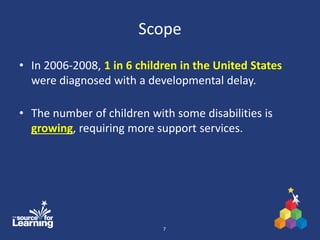
Scope
• In 2006-2008, 1 in 6 children in the United States
were diagnosed with a developmental delay.
• The number of children with some disabilities is
growing, requiring more support services.
7
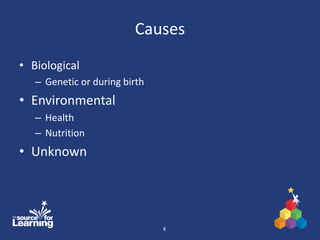
Causes
• Biological
– Genetic or during birth
• Environmental
– Health
– Nutrition
• Unknown
8
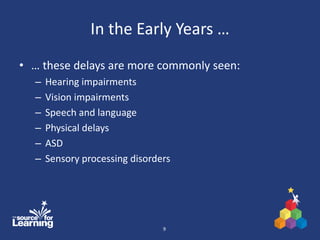
In the Early Years …
• … these delays are more commonly seen:
– Hearing impairments
– Vision impairments
– Speech and language
– Physical delays
– ASD
– Sensory processing disorders
9
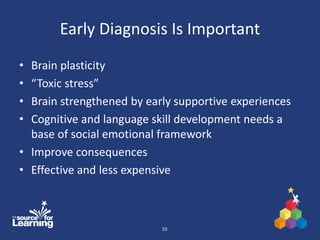
Early Diagnosis Is Important
• Brain plasticity
• “Toxic stress”
• Brain strengthened by early supportive experiences
• Cognitive and language skill development needs a
base of social emotional framework
• Improve consequences
• Effective and less expensive
10
Using Data Meaningfully
• Data can be used to identify children’s needs and
strengths
• Information can be used to assess status, create
learning opportunities, provide support and
intervention, and direct families to available
community resources.
• Effectively sharing ongoing assessment information
with families helps build strong relationships which
enhance children’s learning
11
Tools to Determine Delays
• Family concerns
• Not achieving or delay in achieving milestones
• Teacher concerns
• Ongoing assessment-observation and documentation
• Long-term lack of progress
12
Processes to Initiate & Support
Early Intervention
• Surveillance
• Screening
• Evaluation
13
Supporting the Team
• Take and provide notes for the team
• Accommodate therapists
• Collaborate with interventionists to embed strategies
into daily routines
• Collaborate and support families
14
Barriers to Early Intervention
• Miscommunication
• Misunderstanding the referral process
• Beliefs about their own expertise or the self-
resolution of delays
• Practical hurdles such as time to fill out paperwork
• Language barriers
• Fear that service providers may be from CPS
15
Resource Links
• Overview of EI
http://www.parentcenterhub.org/repository/ei-overview/
• Trends in Development Delays
www.cdc.gov/ncbddd/developmentaldisabilities/features/birthdefects-dd-
keyfindings.html
• Early Identification/Child Find
http://www.specialeducationguide.com/early-intervention/early-
identification-how-the-child-find-program-works/
• Supporting Milestones
http://www.cdc.gov/ncbddd/actearly/pdf/parents_pdfs/MilestoneMomentsE
ng508.pdf
• Collaborating with EI Team
http://www.southernearlychildhood.org/upload/pdf/Using_Routines_Based_I
nterventions_in_Early_Childhood_Special_Education_Danielle_Jennings_Mary
_Frances_Hanline_Juliann_Woods.pdf
• Resources for Parents
http://www.parentcenterhub.org/nichcy-resources/
16
For More Information
• Kamna Seth, M.S.
Director, ECE Initiatives
The Source for Learning, Inc.
kseth@sflinc.org
• Gauri Shirali-Deo, M Ed.
Senior Manager, ECE Initiatives
The Source for Learning, Inc.
gdeo@sflinc.org
• The Source for Learning, Inc.
Early Childhood Education Initiatives
www.sourceforlearning.org/ECEI
ece-pd@sflinc.org
17

Understanding Early Intervention: Definition, Scope & Importance

  • 1.
    Understanding Early Intervention Definition, Scope& Importance By Kamna Seth & Gauri Shirali-Deo SourceForLearning.org/ECEI
  • 2.
  • 3.
    Defining Features ofInclusion • Access • Participation • Supports 3
  • 4.
    Definition of Delay •When a child does not meet developmental milestones at anticipated times, there is said to be a developmental delay. • Delays impact: – Language and mobility – Learning and self-help – Social emotional development 4
  • 5.
    Early Intervention Isa Coordinated System • Enhances children’s development • Supports families during important early years • Building collaboration between families and service providers early on helps children, families and communities. 5
  • 6.
    Individuals with Disabilities EducationAct • Mandates some services for eligible children and families. 6
  • 7.
    Scope • In 2006-2008,1 in 6 children in the United States were diagnosed with a developmental delay. • The number of children with some disabilities is growing, requiring more support services. 7
  • 8.
    Causes • Biological – Geneticor during birth • Environmental – Health – Nutrition • Unknown 8
  • 9.
    In the EarlyYears … • … these delays are more commonly seen: – Hearing impairments – Vision impairments – Speech and language – Physical delays – ASD – Sensory processing disorders 9
  • 10.
    Early Diagnosis IsImportant • Brain plasticity • “Toxic stress” • Brain strengthened by early supportive experiences • Cognitive and language skill development needs a base of social emotional framework • Improve consequences • Effective and less expensive 10
  • 11.
    Using Data Meaningfully •Data can be used to identify children’s needs and strengths • Information can be used to assess status, create learning opportunities, provide support and intervention, and direct families to available community resources. • Effectively sharing ongoing assessment information with families helps build strong relationships which enhance children’s learning 11
  • 12.
    Tools to DetermineDelays • Family concerns • Not achieving or delay in achieving milestones • Teacher concerns • Ongoing assessment-observation and documentation • Long-term lack of progress 12
  • 13.
    Processes to Initiate& Support Early Intervention • Surveillance • Screening • Evaluation 13
  • 14.
    Supporting the Team •Take and provide notes for the team • Accommodate therapists • Collaborate with interventionists to embed strategies into daily routines • Collaborate and support families 14
  • 15.
    Barriers to EarlyIntervention • Miscommunication • Misunderstanding the referral process • Beliefs about their own expertise or the self- resolution of delays • Practical hurdles such as time to fill out paperwork • Language barriers • Fear that service providers may be from CPS 15
  • 16.
    Resource Links • Overviewof EI http://www.parentcenterhub.org/repository/ei-overview/ • Trends in Development Delays www.cdc.gov/ncbddd/developmentaldisabilities/features/birthdefects-dd- keyfindings.html • Early Identification/Child Find http://www.specialeducationguide.com/early-intervention/early- identification-how-the-child-find-program-works/ • Supporting Milestones http://www.cdc.gov/ncbddd/actearly/pdf/parents_pdfs/MilestoneMomentsE ng508.pdf • Collaborating with EI Team http://www.southernearlychildhood.org/upload/pdf/Using_Routines_Based_I nterventions_in_Early_Childhood_Special_Education_Danielle_Jennings_Mary _Frances_Hanline_Juliann_Woods.pdf • Resources for Parents http://www.parentcenterhub.org/nichcy-resources/ 16
  • 17.
    For More Information •Kamna Seth, M.S. Director, ECE Initiatives The Source for Learning, Inc. kseth@sflinc.org • Gauri Shirali-Deo, M Ed. Senior Manager, ECE Initiatives The Source for Learning, Inc. gdeo@sflinc.org • The Source for Learning, Inc. Early Childhood Education Initiatives www.sourceforlearning.org/ECEI ece-pd@sflinc.org 17