The 'Past Simple' (or Past Simple), is
used to talk about past actions, who
have completed at some specific time
in the past.
The following examples will be used
in the explanation. We use two
examples to check for changes in the
third person singular.
WHAT IT IS?
This tense is used to talk about actions
that occurred or were completed in the
past. In addition, time is often
indicated or at least the context intuit
HOW TO FORM?
It forms the base form of the verb by
adding the ending '_Ed'. When we talk
about how we refer to the infinitive
basis without the preposition 'to', ie
the verb 'to watch' the base form
would 'watch', and the way past would
be 'watched'.
THE SIMPLE PAST TENSE
The simple past expresses a one-time completed
past event. “Regular” verbs form their past
tense by adding ED to the infinitive:
Work – Worked
When a verb ends in Y after a consonant, change the
Y to I before adding ED:
Try – Tried
When a verb ends in E add only D:
Share – Shared
When a one-syllable verb has one vowel and ends in a
single consonant (excepting C, W, X or Y), this
consonant is doubled before adding ED:
Dig – Digged
C ending verbs add K before ED:
Traffic – Trafficked
When a verb of two or more syllables ends in a
single consonant, by a single vowel, the final
consonant is doubled if the stress falls on the
last syllable:
Submit – Submitted
But if the last syllable is unstressed, the final
consonant, is not doubled:
Listen – Listened
However, in british english, L in this position is
doubled:
Travel - Travelled
Past simple of the
verb "To be"
The simple past of the verb "To be" (to be) is formed by changing
the forms "am" and "is" for "was" and with "were".
affirmative
I was

Negative
I was not

interrogative
was I ?

You were

You were not

He was

he was not

was he ?

She was

she was not

was she ?

It was

were you ?

It was not

was It ?

We were

We were not

were we ?

You were

You were not

were you ?

They were

they were not

were they ?
Past simple of the
verb "To be"

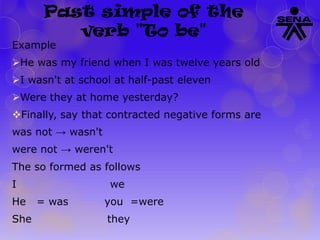
Example

He was my friend when I was twelve years old
I wasn't at school at half-past eleven
Were they at home yesterday?
Finally, say that contracted negative forms are
was not → wasn't

were not → weren't
The so formed as follows
I

He
She

we

= was

you =were
they
THE SIMPLE PAST
TENSE NEGATIVE
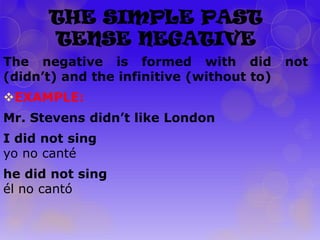
The negative is formed with did
(didn’t) and the infinitive (without to)
EXAMPLE:

Mr. Stevens didn’t like London
I did not sing
yo no canté

he did not sing
él no cantó

not
THE SIMPLE PAST
TENSE AFFIRMATIVE
its structure is:
SUBJECT + VERB (PAST TENSE) +
COMPLEMENT
EXAMPLE:
She Liked

London
THE SIMPLE PAST
TENSE INTERROGATIVE
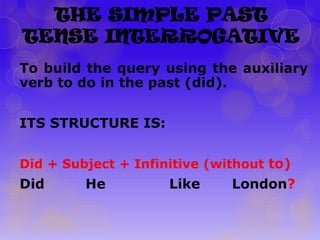
To build the query using the auxiliary
verb to do in the past (did).
ITS STRUCTURE IS:
Did + Subject + Infinitive (without to)

Did

He

Like

London?
IRREGULAR VERBS
Para los verbos irregulares hay que memorizar su
forma de pasado y de participio.
Os mostramos un par de ejemplos de verbos
irregulares:
Verbo

Pasado

to go

went

to buy

bought

to have

had

to be

was/were

I went to the University of Oxford
Fui a la universidad de Oxford

Significado
ir

comprar
tener
ser o estar
JOSE ANDRES PINTO

Simple past (2)

  • 1.
    The 'Past Simple'(or Past Simple), is used to talk about past actions, who have completed at some specific time in the past. The following examples will be used in the explanation. We use two examples to check for changes in the third person singular.
  • 2.
    WHAT IT IS? Thistense is used to talk about actions that occurred or were completed in the past. In addition, time is often indicated or at least the context intuit HOW TO FORM? It forms the base form of the verb by adding the ending '_Ed'. When we talk about how we refer to the infinitive basis without the preposition 'to', ie the verb 'to watch' the base form would 'watch', and the way past would be 'watched'.
  • 3.
    THE SIMPLE PASTTENSE The simple past expresses a one-time completed past event. “Regular” verbs form their past tense by adding ED to the infinitive: Work – Worked When a verb ends in Y after a consonant, change the Y to I before adding ED: Try – Tried When a verb ends in E add only D: Share – Shared When a one-syllable verb has one vowel and ends in a single consonant (excepting C, W, X or Y), this consonant is doubled before adding ED:
  • 4.
    Dig – Digged Cending verbs add K before ED: Traffic – Trafficked When a verb of two or more syllables ends in a single consonant, by a single vowel, the final consonant is doubled if the stress falls on the last syllable: Submit – Submitted But if the last syllable is unstressed, the final consonant, is not doubled: Listen – Listened However, in british english, L in this position is doubled: Travel - Travelled
  • 5.
    Past simple ofthe verb "To be" The simple past of the verb "To be" (to be) is formed by changing the forms "am" and "is" for "was" and with "were". affirmative I was Negative I was not interrogative was I ? You were You were not He was he was not was he ? She was she was not was she ? It was were you ? It was not was It ? We were We were not were we ? You were You were not were you ? They were they were not were they ?
  • 6.
    Past simple ofthe verb "To be" Example He was my friend when I was twelve years old I wasn't at school at half-past eleven Were they at home yesterday? Finally, say that contracted negative forms are was not → wasn't were not → weren't The so formed as follows I He She we = was you =were they
  • 7.
    THE SIMPLE PAST TENSENEGATIVE The negative is formed with did (didn’t) and the infinitive (without to) EXAMPLE: Mr. Stevens didn’t like London I did not sing yo no canté he did not sing él no cantó not
  • 8.
    THE SIMPLE PAST TENSEAFFIRMATIVE its structure is: SUBJECT + VERB (PAST TENSE) + COMPLEMENT EXAMPLE: She Liked London
  • 9.
    THE SIMPLE PAST TENSEINTERROGATIVE To build the query using the auxiliary verb to do in the past (did). ITS STRUCTURE IS: Did + Subject + Infinitive (without to) Did He Like London?
  • 10.
    IRREGULAR VERBS Para losverbos irregulares hay que memorizar su forma de pasado y de participio. Os mostramos un par de ejemplos de verbos irregulares: Verbo Pasado to go went to buy bought to have had to be was/were I went to the University of Oxford Fui a la universidad de Oxford Significado ir comprar tener ser o estar
  • 11.