PHOTOSYNTHESIS AND
CHLOROPLAST
AMRITHA S R
BSC
BIOTECHNOLOGY
JSS UNIVERSITY
MYSURU
Introduction
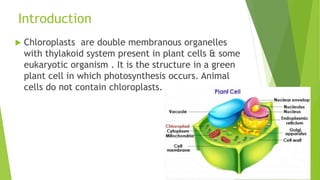
 Chloroplasts are double membranous organelles
with thylakoid system present in plant cells & some
eukaryotic organism . It is the structure in a green
plant cell in which photosynthesis occurs. Animal
cells do not contain chloroplasts.
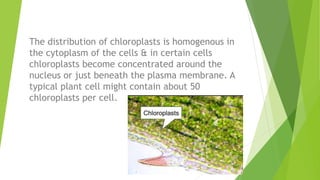
The distribution of chloroplasts is homogenous in
the cytoplasm of the cells & in certain cells
chloroplasts become concentrated around the
nucleus or just beneath the plasma membrane. A
typical plant cell might contain about 50
chloroplasts per cell.
 Chloroplast absorb sunlight & convert into sugar
molecules & also produce free energy which is
stored in the form of ATP & NADPH through
photosynthesis.
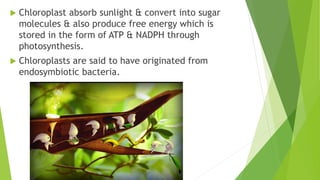
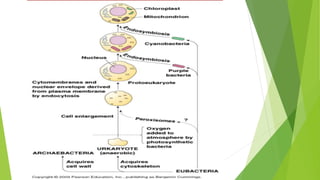
 Chloroplasts are said to have originated from
endosymbiotic bacteria.
Chloroplast structure
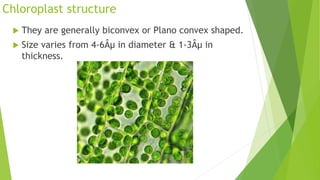
 They are generally biconvex or Plano convex shaped.
 Size varies from 4-6µ in diameter & 1-3µ in
thickness.
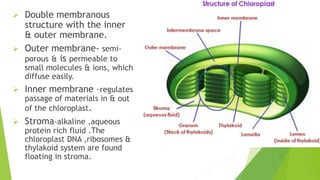
 Double membranous
structure with the inner
& outer membrane.
 Outer membrane- semi-
porous & is permeable to
small molecules & ions, which
diffuse easily.
 Inner membrane –regulates
passage of materials in & out
of the chloroplast.
 Stroma-alkaline ,aqueous
protein rich fluid .The
chloroplast DNA ,ribosomes &
thylakoid system are found
floating in stroma.
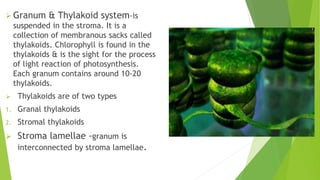
 Granum & Thylakoid system-is
suspended in the stroma. It is a
collection of membranous sacks called
thylakoids. Chlorophyll is found in the
thylakoids & is the sight for the process
of light reaction of photosynthesis.
Each granum contains around 10-20
thylakoids.
 Thylakoids are of two types
1. Granal thylakoids
2. Stromal thylakoids
 Stroma lamellae -granum is
interconnected by stroma lamellae.
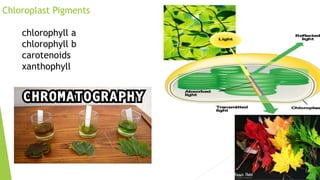
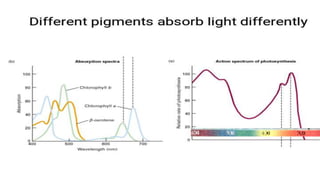
Chloroplast Pigments
chlorophyll a
chlorophyll b
carotenoids
xanthophyll
Chloroplast function
 Participate in plant immune system.
 Site of photosynthesis
 Light reaction takes place on the membranes of thylakoids.
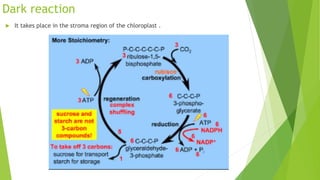
 Dark reaction / Calvin cycle takes place in the stroma.
 Production of NADPH₂ & O₂.
PHOTOSYNTHESIS
Photosynthesis
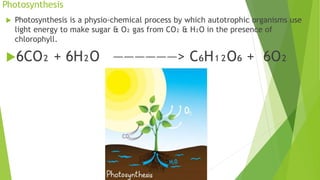
 Photosynthesis is a physio-chemical process by which autotrophic organisms use
light energy to make sugar & O₂ gas from CO₂ & H₂O in the presence of
chlorophyll.
6CO₂ + 6H₂O ――――――> C₆H₁₂O₆ + 6O₂
Function of photosynthesis
 Evolves molecular oxygen ,for use by other living
organisms.
 Maintains the level of atmospheric oxygen.
 Produces carbohydrates that are used by the plants &
animals.
 It is the only process ,which produces huge quantities of
organic matter for sustaining life on earth . For e.g.:
natural fibers, drugs ,vitamins, gums, rubber ,furniture
etc.
Steps in photosynthesis
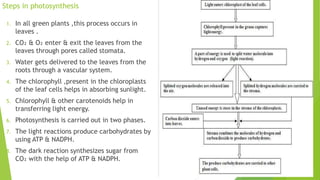
1. In all green plants ,this process occurs in
leaves .
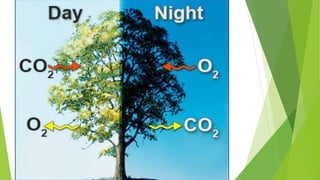
2. CO₂ & O₂ enter & exit the leaves from the
leaves through pores called stomata.
3. Water gets delivered to the leaves from the
roots through a vascular system.
4. The chlorophyll ,present in the chloroplasts
of the leaf cells helps in absorbing sunlight.
5. Chlorophyll & other carotenoids help in
transferring light energy.
6. Photosynthesis is carried out in two phases.
7. The light reactions produce carbohydrates by
using ATP & NADPH.
8. The dark reaction synthesizes sugar from
CO₂ with the help of ATP & NADPH.
Phases of Photosynthesis
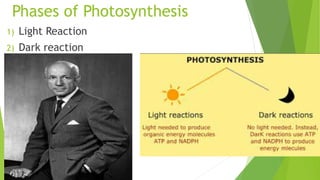
1) Light Reaction
2) Dark reaction
Light reaction
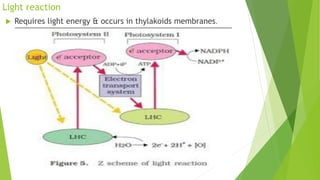
 Requires light energy & occurs in thylakoids membranes.
Dark reaction
 It takes place in the stroma region of the chloroplast .
Photosynthesis & chloroplast

Photosynthesis & chloroplast

  • 1.
    PHOTOSYNTHESIS AND CHLOROPLAST AMRITHA SR BSC BIOTECHNOLOGY JSS UNIVERSITY MYSURU
  • 2.
    Introduction  Chloroplasts aredouble membranous organelles with thylakoid system present in plant cells & some eukaryotic organism . It is the structure in a green plant cell in which photosynthesis occurs. Animal cells do not contain chloroplasts.
  • 3.
    The distribution ofchloroplasts is homogenous in the cytoplasm of the cells & in certain cells chloroplasts become concentrated around the nucleus or just beneath the plasma membrane. A typical plant cell might contain about 50 chloroplasts per cell.
  • 4.
     Chloroplast absorbsunlight & convert into sugar molecules & also produce free energy which is stored in the form of ATP & NADPH through photosynthesis.  Chloroplasts are said to have originated from endosymbiotic bacteria.
  • 5.
    Chloroplast structure  Theyare generally biconvex or Plano convex shaped.  Size varies from 4-6µ in diameter & 1-3µ in thickness.
  • 6.
     Double membranous structurewith the inner & outer membrane.  Outer membrane- semi- porous & is permeable to small molecules & ions, which diffuse easily.  Inner membrane –regulates passage of materials in & out of the chloroplast.  Stroma-alkaline ,aqueous protein rich fluid .The chloroplast DNA ,ribosomes & thylakoid system are found floating in stroma.
  • 7.
     Granum &Thylakoid system-is suspended in the stroma. It is a collection of membranous sacks called thylakoids. Chlorophyll is found in the thylakoids & is the sight for the process of light reaction of photosynthesis. Each granum contains around 10-20 thylakoids.  Thylakoids are of two types 1. Granal thylakoids 2. Stromal thylakoids  Stroma lamellae -granum is interconnected by stroma lamellae.
  • 8.
  • 10.
    Chloroplast function  Participatein plant immune system.  Site of photosynthesis  Light reaction takes place on the membranes of thylakoids.  Dark reaction / Calvin cycle takes place in the stroma.  Production of NADPH₂ & O₂.
  • 11.
  • 12.
    Photosynthesis  Photosynthesis isa physio-chemical process by which autotrophic organisms use light energy to make sugar & O₂ gas from CO₂ & H₂O in the presence of chlorophyll. 6CO₂ + 6H₂O ――――――> C₆H₁₂O₆ + 6O₂
  • 13.
    Function of photosynthesis Evolves molecular oxygen ,for use by other living organisms.  Maintains the level of atmospheric oxygen.  Produces carbohydrates that are used by the plants & animals.  It is the only process ,which produces huge quantities of organic matter for sustaining life on earth . For e.g.: natural fibers, drugs ,vitamins, gums, rubber ,furniture etc.
  • 14.
    Steps in photosynthesis 1.In all green plants ,this process occurs in leaves . 2. CO₂ & O₂ enter & exit the leaves from the leaves through pores called stomata. 3. Water gets delivered to the leaves from the roots through a vascular system. 4. The chlorophyll ,present in the chloroplasts of the leaf cells helps in absorbing sunlight. 5. Chlorophyll & other carotenoids help in transferring light energy. 6. Photosynthesis is carried out in two phases. 7. The light reactions produce carbohydrates by using ATP & NADPH. 8. The dark reaction synthesizes sugar from CO₂ with the help of ATP & NADPH.
  • 15.
    Phases of Photosynthesis 1)Light Reaction 2) Dark reaction
  • 16.
    Light reaction  Requireslight energy & occurs in thylakoids membranes.
  • 17.
    Dark reaction  Ittakes place in the stroma region of the chloroplast .

Editor's Notes