Photographic terminology
Shutter speed
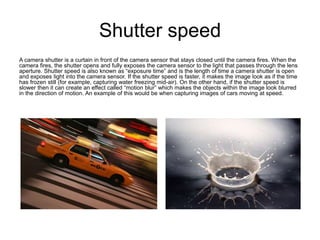
A camera shutter is a curtain in front of the camera sensor that stays closed until the camera fires. When the
camera fires, the shutter opens and fully exposes the camera sensor to the light that passes through the lens
aperture. Shutter speed is also known as “exposure time” and is the length of time a camera shutter is open
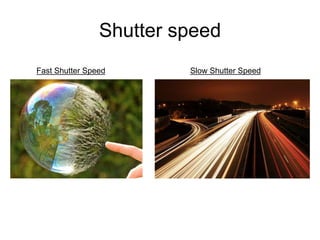
and exposes light into the camera sensor. If the shutter speed is faster, it makes the image look as if the time
has frozen still (for example, capturing water freezing mid-air). On the other hand, if the shutter speed is
slower then it can create an effect called “motion blur” which makes the objects within the image look blurred
in the direction of motion. An example of this would be when capturing images of cars moving at speed.
Shutter speed
Fast Shutter Speed Slow Shutter Speed
ISO
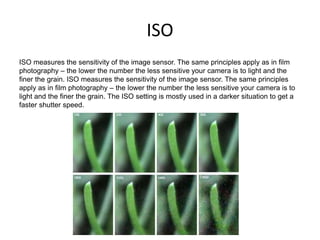
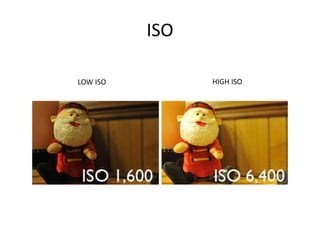
ISO measures the sensitivity of the image sensor. The same principles apply as in film
photography – the lower the number the less sensitive your camera is to light and the
finer the grain. ISO measures the sensitivity of the image sensor. The same principles
apply as in film photography – the lower the number the less sensitive your camera is to
light and the finer the grain. The ISO setting is mostly used in a darker situation to get a
faster shutter speed.
ISO
LOW ISO HIGH ISO
Aperture & Depth of Field
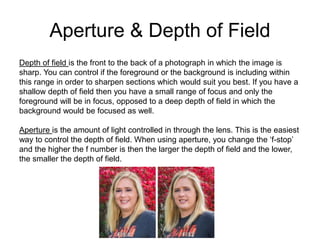
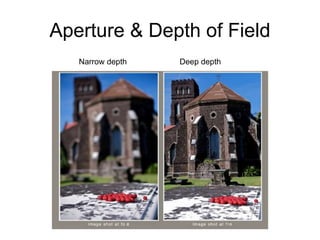
Depth of field is the front to the back of a photograph in which the image is
sharp. You can control if the foreground or the background is including within
this range in order to sharpen sections which would suit you best. If you have a
shallow depth of field then you have a small range of focus and only the
foreground will be in focus, opposed to a deep depth of field in which the
background would be focused as well.
Aperture is the amount of light controlled in through the lens. This is the easiest
way to control the depth of field. When using aperture, you change the ‘f-stop’
and the higher the f number is then the larger the depth of field and the lower,
the smaller the depth of field.
Aperture & Depth of Field
Deep depthNarrow depth
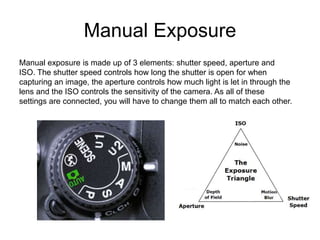
Manual Exposure
Manual exposure is made up of 3 elements: shutter speed, aperture and
ISO. The shutter speed controls how long the shutter is open for when
capturing an image, the aperture controls how much light is let in through the
lens and the ISO controls the sensitivity of the camera. As all of these
settings are connected, you will have to change them all to match each other.
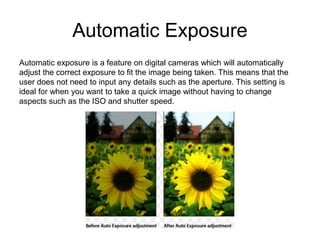
Automatic Exposure
Automatic exposure is a feature on digital cameras which will automatically
adjust the correct exposure to fit the image being taken. This means that the
user does not need to input any details such as the aperture. This setting is
ideal for when you want to take a quick image without having to change
aspects such as the ISO and shutter speed.
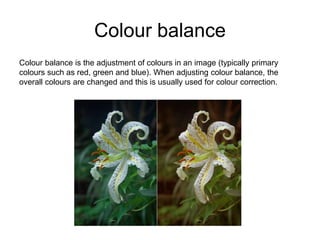
Colour balance
Colour balance is the adjustment of colours in an image (typically primary
colours such as red, green and blue). When adjusting colour balance, the
overall colours are changed and this is usually used for colour correction.
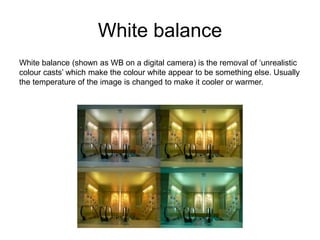
White balance
White balance (shown as WB on a digital camera) is the removal of ‘unrealistic
colour casts’ which make the colour white appear to be something else. Usually
the temperature of the image is changed to make it cooler or warmer.
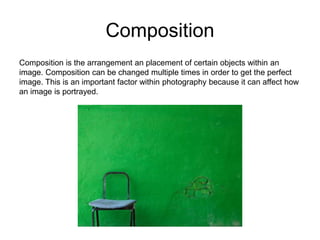
Composition
Composition is the arrangement an placement of certain objects within an
image. Composition can be changed multiple times in order to get the perfect
image. This is an important factor within photography because it can affect how
an image is portrayed.
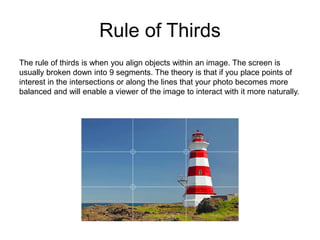
Rule of Thirds
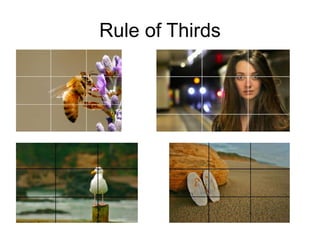
The rule of thirds is when you align objects within an image. The screen is
usually broken down into 9 segments. The theory is that if you place points of
interest in the intersections or along the lines that your photo becomes more
balanced and will enable a viewer of the image to interact with it more naturally.
Rule of Thirds
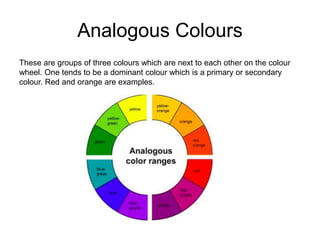
Analogous Colours
These are groups of three colours which are next to each other on the colour
wheel. One tends to be a dominant colour which is a primary or secondary
colour. Red and orange are examples.
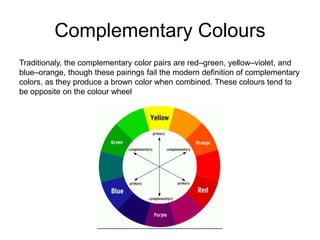
Complementary Colours
Traditionaly, the complementary color pairs are red–green, yellow–violet, and
blue–orange, though these pairings fail the modern definition of complementary
colors, as they produce a brown color when combined. These colours tend to
be opposite on the colour wheel
Macro
Macro photography is extreme close up photography, usually of very small
subjects. In these images, the small subjects normally looks larger than they
are.

Photographic terminology (1)

  • 1.
  • 2.
    Shutter speed A camerashutter is a curtain in front of the camera sensor that stays closed until the camera fires. When the camera fires, the shutter opens and fully exposes the camera sensor to the light that passes through the lens aperture. Shutter speed is also known as “exposure time” and is the length of time a camera shutter is open and exposes light into the camera sensor. If the shutter speed is faster, it makes the image look as if the time has frozen still (for example, capturing water freezing mid-air). On the other hand, if the shutter speed is slower then it can create an effect called “motion blur” which makes the objects within the image look blurred in the direction of motion. An example of this would be when capturing images of cars moving at speed.
  • 3.
    Shutter speed Fast ShutterSpeed Slow Shutter Speed
  • 4.
    ISO ISO measures thesensitivity of the image sensor. The same principles apply as in film photography – the lower the number the less sensitive your camera is to light and the finer the grain. ISO measures the sensitivity of the image sensor. The same principles apply as in film photography – the lower the number the less sensitive your camera is to light and the finer the grain. The ISO setting is mostly used in a darker situation to get a faster shutter speed.
  • 5.
  • 6.
    Aperture & Depthof Field Depth of field is the front to the back of a photograph in which the image is sharp. You can control if the foreground or the background is including within this range in order to sharpen sections which would suit you best. If you have a shallow depth of field then you have a small range of focus and only the foreground will be in focus, opposed to a deep depth of field in which the background would be focused as well. Aperture is the amount of light controlled in through the lens. This is the easiest way to control the depth of field. When using aperture, you change the ‘f-stop’ and the higher the f number is then the larger the depth of field and the lower, the smaller the depth of field.
  • 7.
    Aperture & Depthof Field Deep depthNarrow depth
  • 8.
    Manual Exposure Manual exposureis made up of 3 elements: shutter speed, aperture and ISO. The shutter speed controls how long the shutter is open for when capturing an image, the aperture controls how much light is let in through the lens and the ISO controls the sensitivity of the camera. As all of these settings are connected, you will have to change them all to match each other.
  • 9.
    Automatic Exposure Automatic exposureis a feature on digital cameras which will automatically adjust the correct exposure to fit the image being taken. This means that the user does not need to input any details such as the aperture. This setting is ideal for when you want to take a quick image without having to change aspects such as the ISO and shutter speed.
  • 10.
    Colour balance Colour balanceis the adjustment of colours in an image (typically primary colours such as red, green and blue). When adjusting colour balance, the overall colours are changed and this is usually used for colour correction.
  • 11.
    White balance White balance(shown as WB on a digital camera) is the removal of ‘unrealistic colour casts’ which make the colour white appear to be something else. Usually the temperature of the image is changed to make it cooler or warmer.
  • 12.
    Composition Composition is thearrangement an placement of certain objects within an image. Composition can be changed multiple times in order to get the perfect image. This is an important factor within photography because it can affect how an image is portrayed.
  • 13.
    Rule of Thirds Therule of thirds is when you align objects within an image. The screen is usually broken down into 9 segments. The theory is that if you place points of interest in the intersections or along the lines that your photo becomes more balanced and will enable a viewer of the image to interact with it more naturally.
  • 14.
  • 15.
    Analogous Colours These aregroups of three colours which are next to each other on the colour wheel. One tends to be a dominant colour which is a primary or secondary colour. Red and orange are examples.
  • 16.
    Complementary Colours Traditionaly, thecomplementary color pairs are red–green, yellow–violet, and blue–orange, though these pairings fail the modern definition of complementary colors, as they produce a brown color when combined. These colours tend to be opposite on the colour wheel
  • 17.
    Macro Macro photography isextreme close up photography, usually of very small subjects. In these images, the small subjects normally looks larger than they are.