Photographic Terms
By Muad Suleman
Shutter Speed
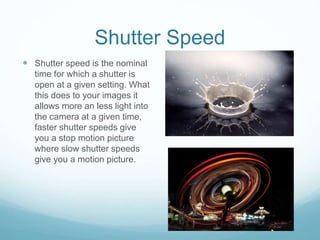
 Shutter speed is the nominal
time for which a shutter is
open at a given setting. What
this does to your images it
allows more an less light into
the camera at a given time,
faster shutter speeds give
you a stop motion picture
where slow shutter speeds
give you a motion picture.
ISO
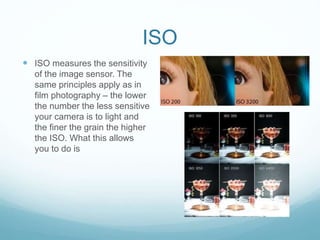
 ISO measures the sensitivity
of the image sensor. The
same principles apply as in
film photography – the lower
the number the less sensitive
your camera is to light and
the finer the grain the higher
the ISO. What this allows
you to do is
Aperture & Depth of Field
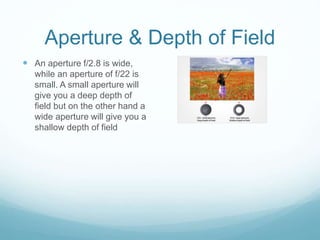
 An aperture f/2.8 is wide,
while an aperture of f/22 is
small. A small aperture will
give you a deep depth of
field but on the other hand a
wide aperture will give you a
shallow depth of field
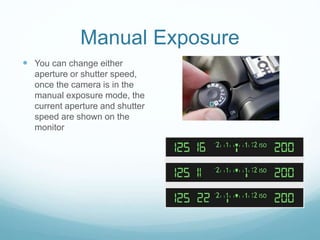
Manual Exposure
 You can change either
aperture or shutter speed,
once the camera is in the
manual exposure mode, the
current aperture and shutter
speed are shown on the
monitor
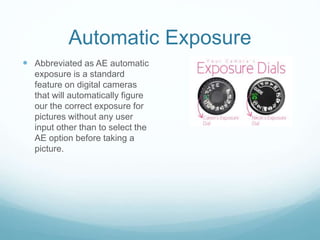
Automatic Exposure
 Abbreviated as AE automatic
exposure is a standard
feature on digital cameras
that will automatically figure
our the correct exposure for
pictures without any user
input other than to select the
AE option before taking a
picture.
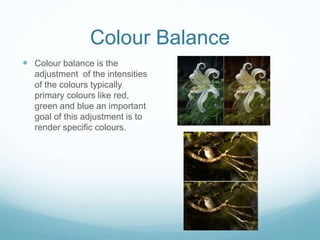
Colour Balance
 Colour balance is the
adjustment of the intensities
of the colours typically
primary colours like red,
green and blue an important
goal of this adjustment is to
render specific colours.
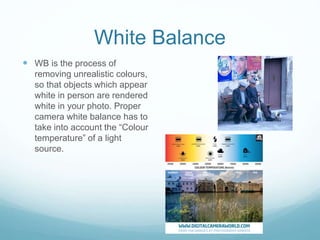
White Balance
 WB is the process of
removing unrealistic colours,
so that objects which appear
white in person are rendered
white in your photo. Proper
camera white balance has to
take into account the “Colour
temperature” of a light
source.
Composition
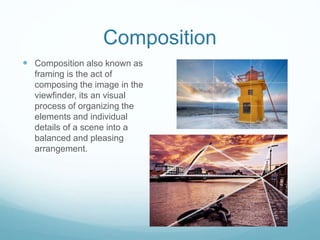
 Composition also known as
framing is the act of
composing the image in the
viewfinder, its an visual
process of organizing the
elements and individual
details of a scene into a
balanced and pleasing
arrangement.
Rule Of Thirds
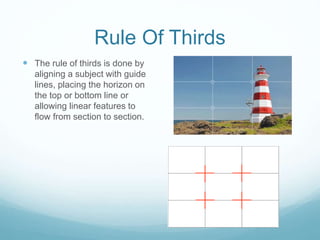
 The rule of thirds is done by
aligning a subject with guide
lines, placing the horizon on
the top or bottom line or
allowing linear features to
flow from section to section.
Analogous Colours
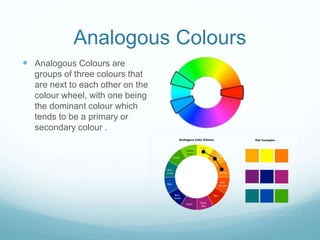
 Analogous Colours are
groups of three colours that
are next to each other on the
colour wheel, with one being
the dominant colour which
tends to be a primary or
secondary colour .
Complementary Colours
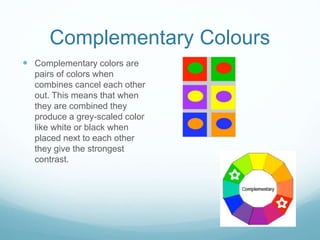
 Complementary colors are
pairs of colors when
combines cancel each other
out. This means that when
they are combined they
produce a grey-scaled color
like white or black when
placed next to each other
they give the strongest
contrast.
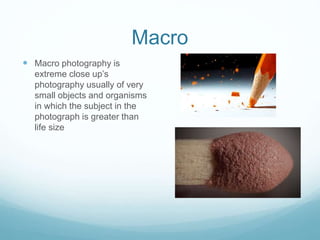
Macro
 Macro photography is
extreme close up’s
photography usually of very
small objects and organisms
in which the subject in the
photograph is greater than
life size

Photographic terms

  • 1.
  • 2.
    Shutter Speed  Shutterspeed is the nominal time for which a shutter is open at a given setting. What this does to your images it allows more an less light into the camera at a given time, faster shutter speeds give you a stop motion picture where slow shutter speeds give you a motion picture.
  • 3.
    ISO  ISO measuresthe sensitivity of the image sensor. The same principles apply as in film photography – the lower the number the less sensitive your camera is to light and the finer the grain the higher the ISO. What this allows you to do is
  • 4.
    Aperture & Depthof Field  An aperture f/2.8 is wide, while an aperture of f/22 is small. A small aperture will give you a deep depth of field but on the other hand a wide aperture will give you a shallow depth of field
  • 5.
    Manual Exposure  Youcan change either aperture or shutter speed, once the camera is in the manual exposure mode, the current aperture and shutter speed are shown on the monitor
  • 6.
    Automatic Exposure  Abbreviatedas AE automatic exposure is a standard feature on digital cameras that will automatically figure our the correct exposure for pictures without any user input other than to select the AE option before taking a picture.
  • 7.
    Colour Balance  Colourbalance is the adjustment of the intensities of the colours typically primary colours like red, green and blue an important goal of this adjustment is to render specific colours.
  • 8.
    White Balance  WBis the process of removing unrealistic colours, so that objects which appear white in person are rendered white in your photo. Proper camera white balance has to take into account the “Colour temperature” of a light source.
  • 9.
    Composition  Composition alsoknown as framing is the act of composing the image in the viewfinder, its an visual process of organizing the elements and individual details of a scene into a balanced and pleasing arrangement.
  • 10.
    Rule Of Thirds The rule of thirds is done by aligning a subject with guide lines, placing the horizon on the top or bottom line or allowing linear features to flow from section to section.
  • 11.
    Analogous Colours  AnalogousColours are groups of three colours that are next to each other on the colour wheel, with one being the dominant colour which tends to be a primary or secondary colour .
  • 12.
    Complementary Colours  Complementarycolors are pairs of colors when combines cancel each other out. This means that when they are combined they produce a grey-scaled color like white or black when placed next to each other they give the strongest contrast.
  • 13.
    Macro  Macro photographyis extreme close up’s photography usually of very small objects and organisms in which the subject in the photograph is greater than life size