Shutter speed- In photography, shutter speed is the length of time when the film or
digital sensor inside the camera is exposed to light, and also when a camera’s
shutter is open when taking a photograph. Shutter speed can have a dramatic
impact on the appearance and quality of photographs, especially when moving
objects are involved. For instance a slow shutter speed often results in a blurred
image as the slight shudder of the shutter itself, or the motion caused to the whole
camera by the index pressing on the shutter release button create vibrations that
are faster than the shutter itself. This will cause the appearance of the objects in the
view finder and on the photographs having moved when in fact, it is the camera that
has moved.
Fast shutter speed
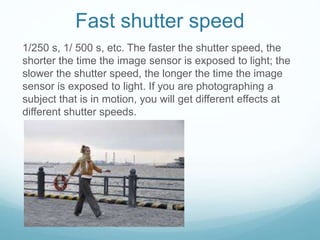
1/250 s, 1/ 500 s, etc. The faster the shutter speed, the
shorter the time the image sensor is exposed to light; the
slower the shutter speed, the longer the time the image
sensor is exposed to light. If you are photographing a
subject that is in motion, you will get different effects at
different shutter speeds.
Slow shutter speed
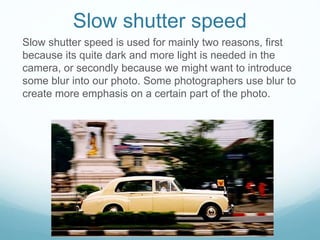
Slow shutter speed is used for mainly two reasons, first
because its quite dark and more light is needed in the
camera, or secondly because we might want to introduce
some blur into our photo. Some photographers use blur to
create more emphasis on a certain part of the photo.
ISO
What is ISO?-The camera's ISO setting is its sensitivity to light.
The higher the ISO, the more sensitive it is. This is measured
according to international standards, so ISO100 on one camera
will be exactly the same as ISO100 on another. Each ISO
setting is double the one before: if you increase the ISO from
100 to 200, you double the camera's sensitivity; and if you
increase it from 200 to 400, you double it again. This carries on
through the ISO scale. This is deliberate. The ISO settings are
designed to double (or halve) the exposure in the same way
that the lens aperture settings and shutter speed settings are,
and this is why the lens aperture, shutter speed and ISO are
often described as the 'exposure triangle’. For example, if you
want to use a faster shutter speed without changing the
aperture, you could increase the ISO instead.
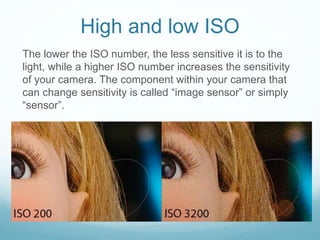
High and low ISO
The lower the ISO number, the less sensitive it is to the
light, while a higher ISO number increases the sensitivity
of your camera. The component within your camera that
can change sensitivity is called “image sensor” or simply
“sensor”.
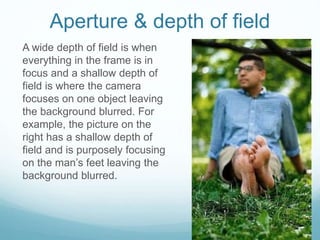
Aperture & depth of field
A wide depth of field is when
everything in the frame is in
focus and a shallow depth of
field is where the camera
focuses on one object leaving
the background blurred. For
example, the picture on the
right has a shallow depth of
field and is purposely focusing
on the man’s feet leaving the
background blurred.
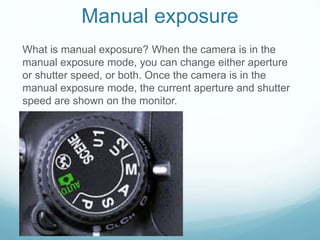
Manual exposure
What is manual exposure? When the camera is in the
manual exposure mode, you can change either aperture
or shutter speed, or both. Once the camera is in the
manual exposure mode, the current aperture and shutter
speed are shown on the monitor.
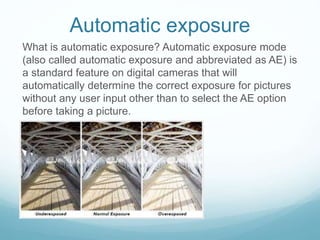
Automatic exposure
What is automatic exposure? Automatic exposure mode
(also called automatic exposure and abbreviated as AE) is
a standard feature on digital cameras that will
automatically determine the correct exposure for pictures
without any user input other than to select the AE option
before taking a picture.
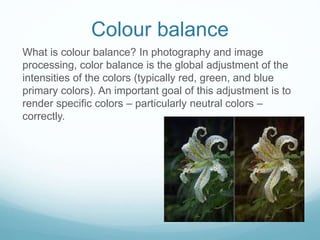
Colour balance
What is colour balance? In photography and image
processing, color balance is the global adjustment of the
intensities of the colors (typically red, green, and blue
primary colors). An important goal of this adjustment is to
render specific colors – particularly neutral colors –
correctly.
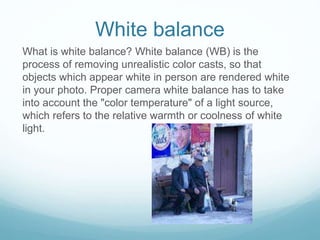
White balance
What is white balance? White balance (WB) is the
process of removing unrealistic color casts, so that
objects which appear white in person are rendered white
in your photo. Proper camera white balance has to take
into account the "color temperature" of a light source,
which refers to the relative warmth or coolness of white
light.
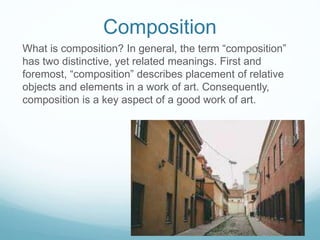
Composition
What is composition? In general, the term “composition”
has two distinctive, yet related meanings. First and
foremost, “composition” describes placement of relative
objects and elements in a work of art. Consequently,
composition is a key aspect of a good work of art.
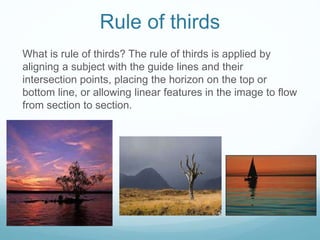
Rule of thirds
What is rule of thirds? The rule of thirds is applied by
aligning a subject with the guide lines and their
intersection points, placing the horizon on the top or
bottom line, or allowing linear features in the image to flow
from section to section.
Analogous colours
What are analogous colours? Analogous colors are
groups of three colors that are next to each other on the
color wheel, with one being the dominant color, which
tends to be a primary or secondary color, and a tertiary.
Red, orange, and red-orange are examples.
Complementary colours
What are complementary colours? Analogous colors are
any three colors which are side by side on a 12 part color
wheel, such as yellow-green, yellow, and yellow-orange.
Usually one of the three colors predominates.
Complementary colors are any two colors which are
directly opposite each other, such as red and green and
red-purple and yellow-green.
Macro
What is macro? Macro photography is zoomed in
photography when you capture a detailed picture of
something very little.

Photographic terms

  • 1.
    Shutter speed- Inphotography, shutter speed is the length of time when the film or digital sensor inside the camera is exposed to light, and also when a camera’s shutter is open when taking a photograph. Shutter speed can have a dramatic impact on the appearance and quality of photographs, especially when moving objects are involved. For instance a slow shutter speed often results in a blurred image as the slight shudder of the shutter itself, or the motion caused to the whole camera by the index pressing on the shutter release button create vibrations that are faster than the shutter itself. This will cause the appearance of the objects in the view finder and on the photographs having moved when in fact, it is the camera that has moved.
  • 2.
    Fast shutter speed 1/250s, 1/ 500 s, etc. The faster the shutter speed, the shorter the time the image sensor is exposed to light; the slower the shutter speed, the longer the time the image sensor is exposed to light. If you are photographing a subject that is in motion, you will get different effects at different shutter speeds.
  • 3.
    Slow shutter speed Slowshutter speed is used for mainly two reasons, first because its quite dark and more light is needed in the camera, or secondly because we might want to introduce some blur into our photo. Some photographers use blur to create more emphasis on a certain part of the photo.
  • 4.
    ISO What is ISO?-Thecamera's ISO setting is its sensitivity to light. The higher the ISO, the more sensitive it is. This is measured according to international standards, so ISO100 on one camera will be exactly the same as ISO100 on another. Each ISO setting is double the one before: if you increase the ISO from 100 to 200, you double the camera's sensitivity; and if you increase it from 200 to 400, you double it again. This carries on through the ISO scale. This is deliberate. The ISO settings are designed to double (or halve) the exposure in the same way that the lens aperture settings and shutter speed settings are, and this is why the lens aperture, shutter speed and ISO are often described as the 'exposure triangle’. For example, if you want to use a faster shutter speed without changing the aperture, you could increase the ISO instead.
  • 5.
    High and lowISO The lower the ISO number, the less sensitive it is to the light, while a higher ISO number increases the sensitivity of your camera. The component within your camera that can change sensitivity is called “image sensor” or simply “sensor”.
  • 6.
    Aperture & depthof field A wide depth of field is when everything in the frame is in focus and a shallow depth of field is where the camera focuses on one object leaving the background blurred. For example, the picture on the right has a shallow depth of field and is purposely focusing on the man’s feet leaving the background blurred.
  • 7.
    Manual exposure What ismanual exposure? When the camera is in the manual exposure mode, you can change either aperture or shutter speed, or both. Once the camera is in the manual exposure mode, the current aperture and shutter speed are shown on the monitor.
  • 8.
    Automatic exposure What isautomatic exposure? Automatic exposure mode (also called automatic exposure and abbreviated as AE) is a standard feature on digital cameras that will automatically determine the correct exposure for pictures without any user input other than to select the AE option before taking a picture.
  • 9.
    Colour balance What iscolour balance? In photography and image processing, color balance is the global adjustment of the intensities of the colors (typically red, green, and blue primary colors). An important goal of this adjustment is to render specific colors – particularly neutral colors – correctly.
  • 10.
    White balance What iswhite balance? White balance (WB) is the process of removing unrealistic color casts, so that objects which appear white in person are rendered white in your photo. Proper camera white balance has to take into account the "color temperature" of a light source, which refers to the relative warmth or coolness of white light.
  • 11.
    Composition What is composition?In general, the term “composition” has two distinctive, yet related meanings. First and foremost, “composition” describes placement of relative objects and elements in a work of art. Consequently, composition is a key aspect of a good work of art.
  • 12.
    Rule of thirds Whatis rule of thirds? The rule of thirds is applied by aligning a subject with the guide lines and their intersection points, placing the horizon on the top or bottom line, or allowing linear features in the image to flow from section to section.
  • 13.
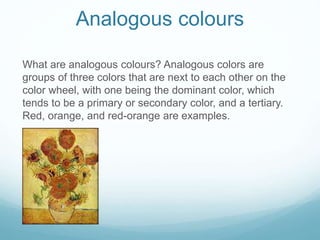
    Analogous colours What areanalogous colours? Analogous colors are groups of three colors that are next to each other on the color wheel, with one being the dominant color, which tends to be a primary or secondary color, and a tertiary. Red, orange, and red-orange are examples.
  • 14.
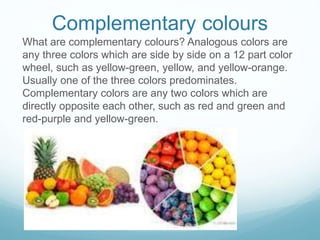
    Complementary colours What arecomplementary colours? Analogous colors are any three colors which are side by side on a 12 part color wheel, such as yellow-green, yellow, and yellow-orange. Usually one of the three colors predominates. Complementary colors are any two colors which are directly opposite each other, such as red and green and red-purple and yellow-green.
  • 15.
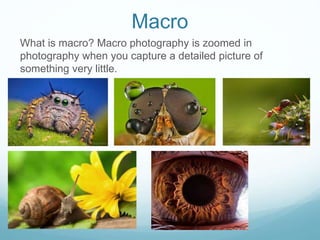
    Macro What is macro?Macro photography is zoomed in photography when you capture a detailed picture of something very little.