PHOTODYNAMIC THERAPY
Dr. Shuchita Pathak
DNB Resident
Photodynamic Therapy
• Is the treatment that uses drug called a photosensitizer
or photosensitizing agent.
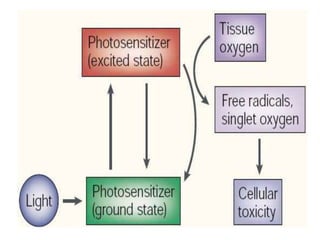
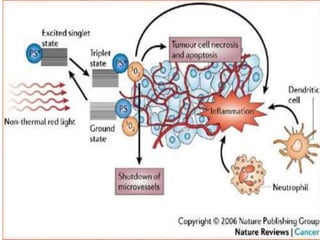
• Photosensitizers are exposed to specific wavelength
of light, photoactivation causes formation of singlet
oxygen, which produces peroxidative reactions that
can cause cell damage and death
Three Steps
1) Application of photosensitizer drugs- Light
sensitizing liquid, cream,intravenous
drug(photosensitizer) is applied or administered
2) Incubation – There is an incubation period of minutes
to days
3) Light activation-Finally target tissue is then exposed
to specific wavelength of light that then activates the
photosensitizing medication
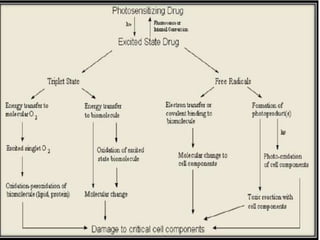
Mechanism Of PDT
• Type I Reaction:-
• Direct reaction with substrate (cell membrane
or molecule)
• Transfer of H atom to form radicals
• Radical react either O2 to form oxygenated
products
• Type II reaction:-
• Transfer of oxygen to form singlet oxygen
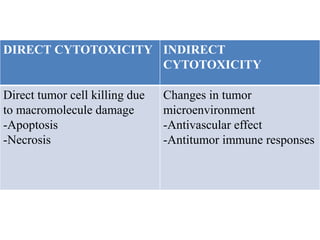
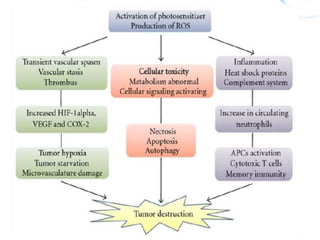
DIRECT CYTOTOXICITY INDIRECT
CYTOTOXICITY
Direct tumor cell killing due
to macromolecule damage
-Apoptosis
-Necrosis
Changes in tumor
microenvironment
-Antivascular effect
-Antitumor immune responses
INDIRECT CYTOTOXICITY
• Anti-tumor Immune Response:-
• Release of pro-inflammatory cytokines
• Fixation of complement
• Release of tumor associated antigens
• Anti-Vascular Effect:-
• Vessel Leakage
• Vasoconstriction
• Thrombosis
DIRECT CYTOTOXICITY
• The lifetime of singlet oxygen is 0.03 to 0.18 mcs and
correspond to diffusion distance of less than 0.2 mcs
or 1/50th of cell diameter.
• Thus the macromolecular damage inside cell occurs
very close to location of photosensitizer
activation/singlet oxygen production
• APOPTOTIC cell death predominate at lower
light/photosensitizer doses
• NECROTIC cell death tend to predominate at
higher light/photosensitizer doses
COMPONENTS OF PDT
• Photosensitizers
• Light
• Oxygen
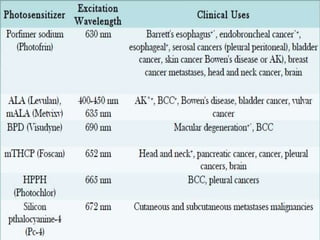
PHOTOSENSITIZERS
PHOTOSENSITIZERS
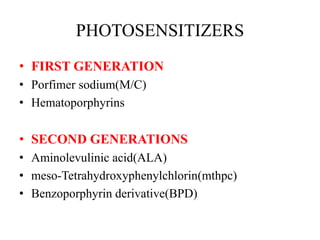
• FIRST GENERATION
• Porfimer sodium(M/C)
• Hematoporphyrins
• SECOND GENERATIONS
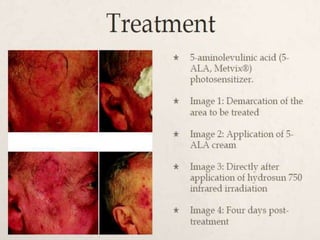
• Aminolevulinic acid(ALA)
• meso-Tetrahydroxyphenylchlorin(mthpc)
• Benzoporphyrin derivative(BPD)
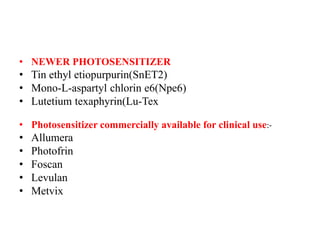
• NEWER PHOTOSENSITIZER
• Tin ethyl etiopurpurin(SnET2)
• Mono-L-aspartyl chlorin e6(Npe6)
• Lutetium texaphyrin(Lu-Tex
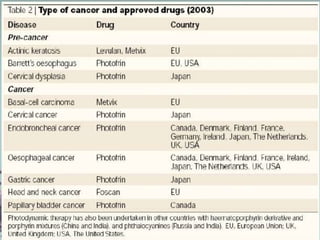
• Photosensitizer commercially available for clinical use:-
• Allumera
• Photofrin
• Foscan
• Levulan
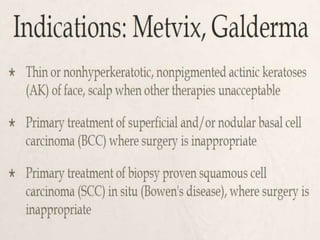
• Metvix
LIGHT
Light used for PDT includes:-
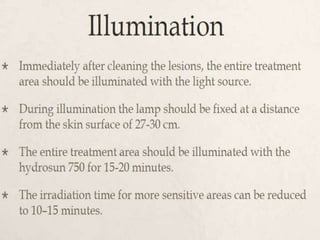
1) Lasers
2) Intense pulsed light
3) Light emitting diodes(LEDs)
4) Blue light
5) Red light
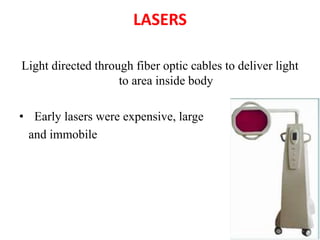
LASERS
Light directed through fiber optic cables to deliver light
to area inside body
• Early lasers were expensive, large
and immobile
LIGHT EMITTING DIODES
• Are less expensive than other light sources
• Are small
• Provide power output upto 150mW/cm2 at
wavelength in range of 350-1100nm
ADVANTAGES OF PDT
• It has no long term side effect when used properly
• It is less invasive than surgery
• It usually takes only a short time
• It can be targeted very precisely
• Unlike radiation, PDT can be repeated many times at
same sites if needed
• There is little or no scarring after site heals
• It often cost less than other cancer treatment
LIMITATIONS OF PDT
• The light needed to activate most photosensitizers
cannot pass through more than about one third of
inch of tissue(1cm)
• So, PDT is usually used to treat tumors on or just
under the skin or on linning of internal organ and
cavities
• PDT is local treatment and generally cannot be used
to treat cancer that has spread (metastasized)
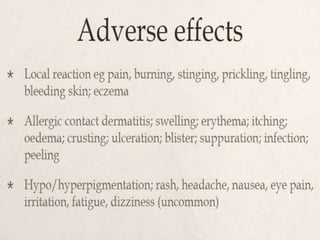
COMPLICATIONS OR SIDE EFFECTS
• Drugs makes the skin and eyes sensitive to light for
approximately 6 weeks after treatment(Thus patients
are advised to avoid direct sunlight and bright indoor
light for atleast 6 weeks)
• Photosensitizer can cause burns, swelling, pain,
scarring in nearby healthy tissue.
THANK YOU

Photodynamic therapy

  • 1.
  • 2.
    Photodynamic Therapy • Isthe treatment that uses drug called a photosensitizer or photosensitizing agent. • Photosensitizers are exposed to specific wavelength of light, photoactivation causes formation of singlet oxygen, which produces peroxidative reactions that can cause cell damage and death
  • 4.
    Three Steps 1) Applicationof photosensitizer drugs- Light sensitizing liquid, cream,intravenous drug(photosensitizer) is applied or administered 2) Incubation – There is an incubation period of minutes to days 3) Light activation-Finally target tissue is then exposed to specific wavelength of light that then activates the photosensitizing medication
  • 6.
    Mechanism Of PDT •Type I Reaction:- • Direct reaction with substrate (cell membrane or molecule) • Transfer of H atom to form radicals • Radical react either O2 to form oxygenated products • Type II reaction:- • Transfer of oxygen to form singlet oxygen
  • 7.
    DIRECT CYTOTOXICITY INDIRECT CYTOTOXICITY Directtumor cell killing due to macromolecule damage -Apoptosis -Necrosis Changes in tumor microenvironment -Antivascular effect -Antitumor immune responses
  • 8.
    INDIRECT CYTOTOXICITY • Anti-tumorImmune Response:- • Release of pro-inflammatory cytokines • Fixation of complement • Release of tumor associated antigens • Anti-Vascular Effect:- • Vessel Leakage • Vasoconstriction • Thrombosis
  • 9.
    DIRECT CYTOTOXICITY • Thelifetime of singlet oxygen is 0.03 to 0.18 mcs and correspond to diffusion distance of less than 0.2 mcs or 1/50th of cell diameter. • Thus the macromolecular damage inside cell occurs very close to location of photosensitizer activation/singlet oxygen production
  • 10.
    • APOPTOTIC celldeath predominate at lower light/photosensitizer doses • NECROTIC cell death tend to predominate at higher light/photosensitizer doses
  • 15.
    COMPONENTS OF PDT •Photosensitizers • Light • Oxygen
  • 16.
  • 18.
    PHOTOSENSITIZERS • FIRST GENERATION •Porfimer sodium(M/C) • Hematoporphyrins • SECOND GENERATIONS • Aminolevulinic acid(ALA) • meso-Tetrahydroxyphenylchlorin(mthpc) • Benzoporphyrin derivative(BPD)
  • 19.
    • NEWER PHOTOSENSITIZER •Tin ethyl etiopurpurin(SnET2) • Mono-L-aspartyl chlorin e6(Npe6) • Lutetium texaphyrin(Lu-Tex • Photosensitizer commercially available for clinical use:- • Allumera • Photofrin • Foscan • Levulan • Metvix
  • 20.
  • 21.
    Light used forPDT includes:- 1) Lasers 2) Intense pulsed light 3) Light emitting diodes(LEDs) 4) Blue light 5) Red light
  • 23.
    LASERS Light directed throughfiber optic cables to deliver light to area inside body • Early lasers were expensive, large and immobile
  • 24.
    LIGHT EMITTING DIODES •Are less expensive than other light sources • Are small • Provide power output upto 150mW/cm2 at wavelength in range of 350-1100nm
  • 26.
    ADVANTAGES OF PDT •It has no long term side effect when used properly • It is less invasive than surgery • It usually takes only a short time • It can be targeted very precisely • Unlike radiation, PDT can be repeated many times at same sites if needed • There is little or no scarring after site heals • It often cost less than other cancer treatment
  • 27.
    LIMITATIONS OF PDT •The light needed to activate most photosensitizers cannot pass through more than about one third of inch of tissue(1cm) • So, PDT is usually used to treat tumors on or just under the skin or on linning of internal organ and cavities • PDT is local treatment and generally cannot be used to treat cancer that has spread (metastasized)
  • 28.
    COMPLICATIONS OR SIDEEFFECTS • Drugs makes the skin and eyes sensitive to light for approximately 6 weeks after treatment(Thus patients are advised to avoid direct sunlight and bright indoor light for atleast 6 weeks) • Photosensitizer can cause burns, swelling, pain, scarring in nearby healthy tissue.
  • 41.