Introduction
Photodynamic Therapy
Delivery System
MEMBERS:
Michael Bernatzky, Cobi Ben-David, Ryan Donovan,
Simon Ioffe, Andrew Zamsky
ADVISOR:
Professor B.K. Jaeger
CONSULTANT:
Professor A. Gouldstone
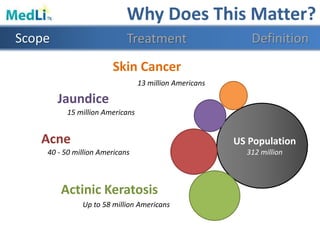
40 - 50 million Americans
Acne
Up to 58 million Americans
Actinic Keratosis
US Population
312 million
13 million Americans
Skin Cancer
15 million Americans
Jaundice
Why Does This Matter?
Scope Treatment Definition
40 - 50 million Americans
Acne
Up to 58 million Americans
Actinic Keratosis
US Population
312 million
13 million Americans
Skin Cancer
15 million Americans
Jaundice
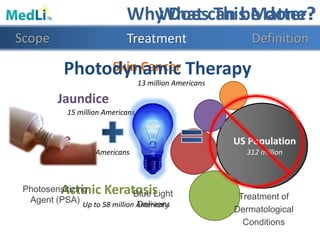
Why Does This Matter?What can be done?
Photosensitizing
Agent (PSA)
Blue Light
Delivery
Treatment of
Dermatological
Conditions
Photodynamic Therapy
Scope Treatment Definition
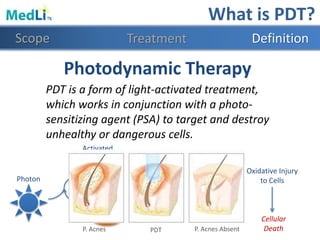
What is PDT?
Photodynamic Therapy
PDT is a form of light-activated treatment,
which works in conjunction with a photo-
sensitizing agent (PSA) to target and destroy
unhealthy or dangerous cells.
Photon
Activated
Pharmaceutical
Pharmaceutical
O2 Oxidizing
Species
(Singlet
Oxygen)
Oxidative Injury
to Cells
Cellular
Death
Scope Treatment Definition
P. Acnes PDT P. Acnes Absent
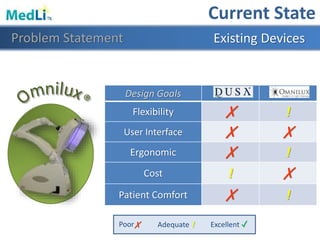
Current State
Problem Statement Existing Devices
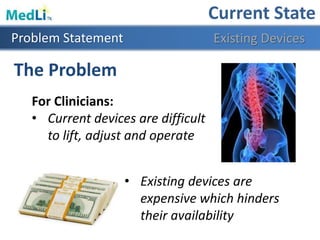
For Clinicians:
• Current devices are difficult
to lift, adjust and operate
The Problem
• Existing devices are
expensive which hinders
their availability
Current State
Problem Statement Existing Devices
For Patients:
• Current devices are hard to adjust to
different parts of the body and various
body types
• Treatments are often uncomfortable,
dampening a patients desire to return
for treatment
The Problem
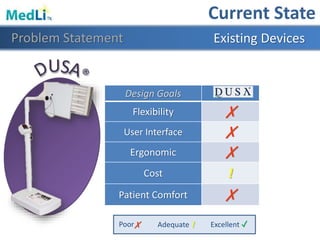
Design Goals
Flexibility ✗
User Interface ✗
Ergonomic ✗
Cost !
Patient Comfort ✗
Problem Statement Existing Devices
Current State
✓✗ Adequate !Poor Excellent
Design Goals
Flexibility ✗ !
User Interface ✗ ✗
Ergonomic ✗ !
Cost ! ✗
Patient Comfort ✗ !
Problem Statement Existing Devices
Current State
✓✗ Adequate !Poor Excellent
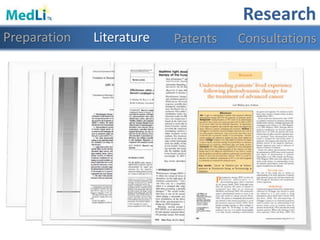
The team has submitted an
Institutional Review Board (IRB)
application and received approval
All team members have
successfully been certified
by the National Institute
of Health (NIH)
Preparation Literature ConsultationsPatents
Research
Research
Preparation Literature ConsultationsPatents
Research
Preparation Literature ConsultationsPatents
Research
Preparation Literature ConsultationsPatents
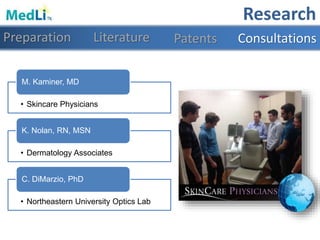
• Skincare Physicians
M. Kaminer, MD
• Dermatology Associates
K. Nolan, RN, MSN
• Northeastern University Optics Lab
C. DiMarzio, PhD
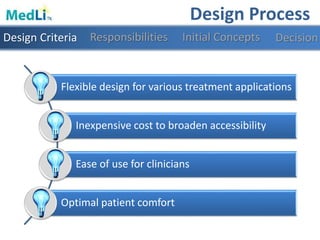
Flexible design for various treatment applications
Inexpensive cost to broaden accessibility
Ease of use for clinicians
Optimal patient comfort
Responsibilities Initial Concepts DecisionDesign Criteria
Design Process
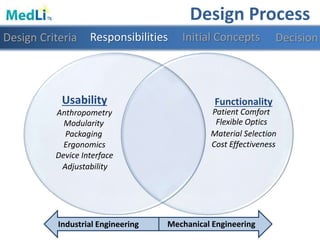
Industrial Engineering Mechanical Engineering
Design Process
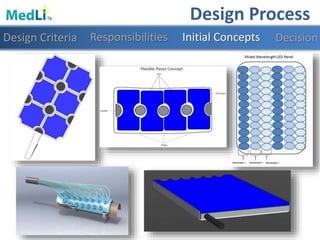
Responsibilities Initial Concepts Decision
Usability
Anthropometry
Ergonomics
Device Interface
Functionality
Material Selection
Cost Effectiveness
Patient Comfort
Flexible OpticsModularity
Packaging
Adjustability
Design Criteria
Design Process
Responsibilities Initial Concepts DecisionDesign Criteria
Design Process
Responsibilities Initial ConceptsDesign Criteria Decision
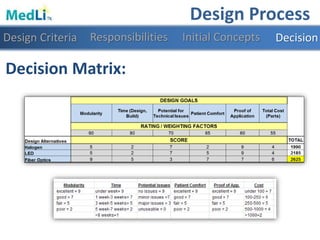
Decision Matrix:
Design Process
Responsibilities Initial ConceptsDesign Criteria Decision
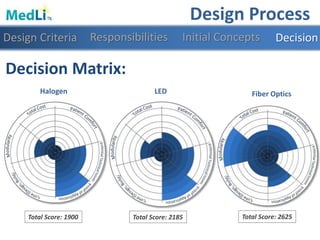
Halogen LED Fiber Optics
Total Score: 1900 Total Score: 2185 Total Score: 2625
Decision Matrix:
Design Analysis
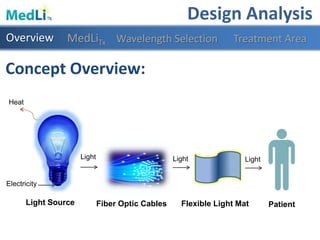
Electricity
Heat
Light
Fiber Optic CablesLight Source PatientFlexible Light Mat
Light Light
Concept Overview:
Overview Treatment AreaMedLiTx Wavelength Selection
Design Analysis
Overview Treatment AreaMedLiTx Wavelength Selection
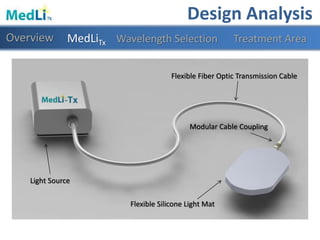
Flexible Silicone Light Mat
Light Source
Flexible Fiber Optic Transmission Cable
Modular Cable Coupling
Design Analysis
Overview Treatment AreaWavelength SelectionMedLiTx
Visible Light Spectrum
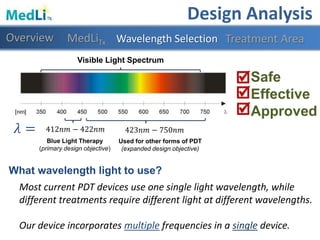
What wavelength light to use?
Most current PDT devices use one single light wavelength, while
different treatments require different light at different wavelengths.
Our device incorporates multiple frequencies in a single device.
412𝑛𝑚 − 422𝑛𝑚𝜆 = 423𝑛𝑚 − 750𝑛𝑚
Blue Light Therapy
(primary design objective)
Used for other forms of PDT
(expanded design objective)
Safe
Effective
Approved



Overview Treatment AreaWavelength Selection
Design Analysis
MedLiTx
Light Source Light Filter Array
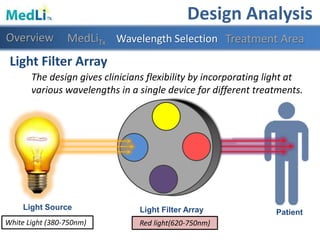
Light Filter Array
The design gives clinicians flexibility by incorporating light at
various wavelengths in a single device for different treatments.
Patient
White Light (380-750nm) Blue light(450-475nm)Violet light(380-450nm)Red light(620-750nm)
Design Analysis
Overview Treatment AreaWavelength SelectionMedLiTx
Face
Arms
Hands
Legs
Chest
Back
Torso
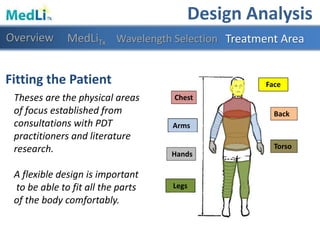
Fitting the Patient
Theses are the physical areas
of focus established from
consultations with PDT
practitioners and literature
research.
A flexible design is important
to be able to fit all the parts
of the body comfortably.
Design Analysis
Overview Treatment AreaWavelength SelectionMedLiTx
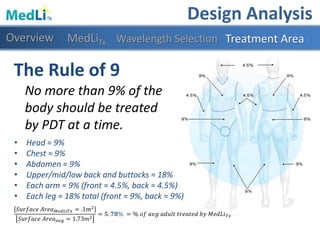
• Head ≈ 9%
• Chest ≈ 9%
• Abdomen ≈ 9%
• Upper/mid/low back and buttocks ≈ 18%
• Each arm ≈ 9% (front ≈ 4.5%, back ≈ 4.5%)
• Each leg ≈ 18% total (front ≈ 9%, back ≈ 9%)
The Rule of 9
No more than 9% of the
body should be treated
by PDT at a time.
Design Analysis
Overview Treatment AreaWavelength Selection
𝑆𝑢𝑟𝑓𝑎𝑐𝑒 𝐴𝑟𝑒𝑎 𝑀𝑒𝑑𝐿𝑖𝑇𝑥 = .1𝑚2
𝑆𝑢𝑟𝑓𝑎𝑐𝑒 𝐴𝑟𝑒𝑎 𝑎𝑣𝑔 = 1.73𝑚2
= 𝟓. 𝟕𝟖% = % 𝑜𝑓 𝑎𝑣𝑔 𝑎𝑑𝑢𝑙𝑡 𝑡𝑟𝑒𝑎𝑡𝑒𝑑 𝑏𝑦 𝑀𝑒𝑑𝐿𝑖 𝑇𝑥
MedLiTx
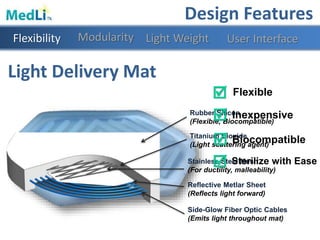
Light Delivery Mat
Rubber Silicon
(Flexible, Biocompatible)
Titanium Dioxide
(Light scattering agent)
Stainless Steel Mesh
(For ductility, malleability)
Reflective Metlar Sheet
(Reflects light forward)
Side-Glow Fiber Optic Cables
(Emits light throughout mat)
 Flexible
Biocompatible
Inexpensive

Sterilize with Ease
Design Features
Modularity Light WeightFlexibility User Interface
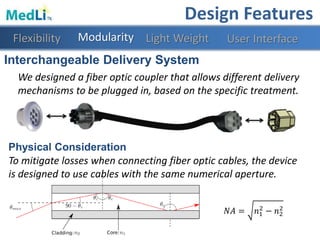
Interchangeable Delivery System
We designed a fiber optic coupler that allows different delivery
mechanisms to be plugged in, based on the specific treatment.
Physical Consideration
To mitigate losses when connecting fiber optic cables, the device
is designed to use cables with the same numerical aperture.
𝑁𝐴 = 𝑛1
2
− 𝑛2
2
Modularity Light WeightFlexibility
Design Features
User Interface
𝑹𝑾𝑳 = 𝐿𝐶 × 𝐻𝑀 × 𝑉𝑀 × 𝐷𝑀 × 𝐴𝑀 × 𝐹𝑀 × 𝐶𝑀
= 10 × 7.2 × 1.11 × .87 × .55 × .95 × 1 =
Height ≈ 72 in
Load Constant ≈ 10Lb
Coupling Multiplier= 1
Vertical Location ≈ 36 in
Asymmetry Angle ≈ 140°
Horizontal Multiplier=7.2
Frequency Multiplier=.95
Vertical Travel Distance ≈ 36 in
Distance Multiplier=.82+(1.8/36)=.87
Asymmetry Multiplier=1-.0032*140=.552
Vertical Multiplier= 1-(.003*[36-75])=1.117
NIOSH Lifting Limit Formula
Based on the design specifications the Recommended Weight Limit is:
𝟑𝟔. 𝟔𝟗 𝑳𝒃=
Design Features
Modularity Light WeightFlexibility User Interface
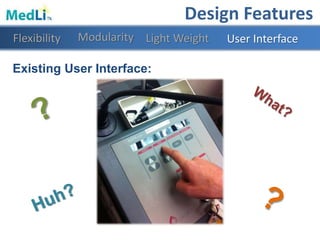
Existing User Interface:
Design Features
Modularity Light WeightFlexibility User Interface
Design Features
Modularity Light WeightFlexibility User Interface
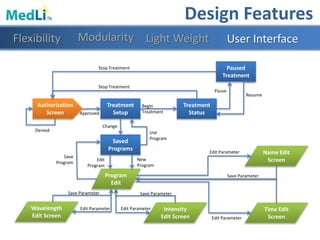
Authorization
Screen
Treatment
Setup
Paused
Treatment
Treatment
Status
Saved
Programs
Program
Edit
Wavelength
Edit Screen
Denied
Approved
Begin
Treatment
Resume
Pause
Stop Treatment
Stop Treatment
Change
Use
Program
Save
Program
Edit
Program
New
Program
Name Edit
Screen
Intensity
Edit Screen
Time Edit
Screen
Edit Parameter Edit Parameter
Edit Parameter
Edit Parameter
Save Parameter
Save Parameter Save Parameter
Design Features
Modularity Light WeightFlexibility User Interface
Design Features
Modularity Light WeightFlexibility User Interface
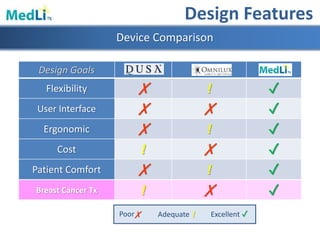
Device Comparison
Design Goals
Flexibility ✗ ! ✓
User Interface ✗ ✗ ✓
Ergonomic ✗ ! ✓
Cost ! ✗ ✓
Patient Comfort ✗ ! ✓
✓✗ Adequate !Poor Excellent
Breast Cancer Tx ! ✗ ✓
Design Features
Thank you for listening.
Q&A
Questions ?
Appendices
IE Contributions
User Interface Flowchart
Design Criteria
Photodynamic Therapy Chemical Process
Responsibilities
Light Mechanism / Treatment Safety
ME Contributions
Prototype Manufacturing Process
List of Terms(A-H)
List of Terms(I-Z)
Prototype Costs
Appendix
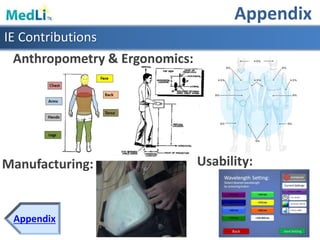
IE Contributions
Anthropometry & Ergonomics:
Usability:Manufacturing:
Appendix
Appendix
ME Contributions
Material Selection:
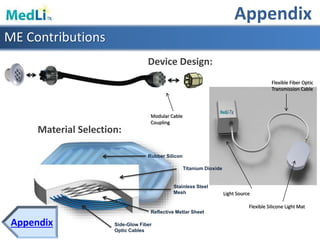
Rubber Silicon
Stainless Steel
Mesh
Reflective Metlar Sheet
Side-Glow Fiber
Optic Cables
Device Design:
Appendix
Flexible Silicone Light Mat
Light Source
Flexible Fiber Optic
Transmission Cable
Modular Cable
Coupling
Titanium Dioxide
Appendix
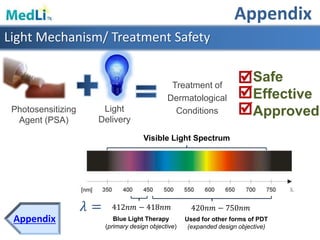
Light Mechanism/ Treatment Safety
Appendix
Safe
Effective
Approved


Photosensitizing
Agent (PSA)
Light
Delivery
Treatment of
Dermatological
Conditions
Visible Light Spectrum
412𝑛𝑚 − 418𝑛𝑚𝜆 = 420𝑛𝑚 − 750𝑛𝑚
Blue Light Therapy
(primary design objective)
Used for other forms of PDT
(expanded design objective)
Appendix
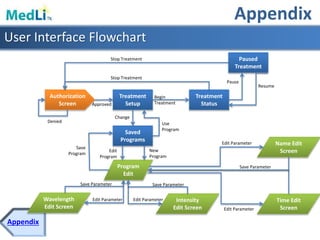
User Interface Flowchart
Appendix
Authorization
Screen
Treatment
Setup
Paused
Treatment
Treatment
Status
Saved
Programs
Program
Edit
Wavelength
Edit Screen
Denied
Approved
Begin
Treatment
Resume
Pause
Stop Treatment
Stop Treatment
Change
Use
Program
Save
Program
Edit
Program
New
Program
Name Edit
Screen
Intensity
Edit Screen
Time Edit
Screen
Edit Parameter Edit Parameter
Edit Parameter
Edit Parameter
Save Parameter
Save Parameter Save Parameter
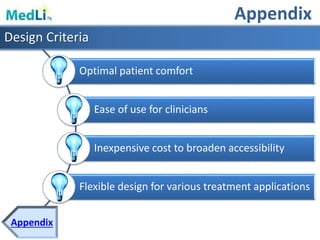
Optimal patient comfort
Ease of use for clinicians
Inexpensive cost to broaden accessibility
Flexible design for various treatment applications
Design Criteria
Appendix
Appendix
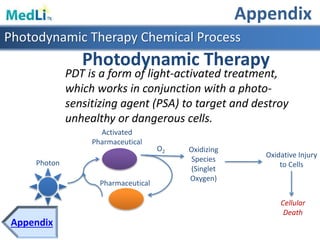
Photodynamic Therapy
PDT is a form of light-activated treatment,
which works in conjunction with a photo-
sensitizing agent (PSA) to target and destroy
unhealthy or dangerous cells.
Photon
Activated
Pharmaceutical
Pharmaceutical
O2 Oxidizing
Species
(Singlet
Oxygen)
Oxidative Injury
to Cells
Cellular
Death
Appendix
Photodynamic Therapy Chemical Process
Appendix
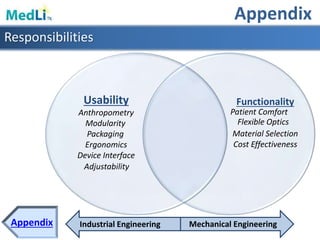
Industrial Engineering Mechanical Engineering
Usability
Anthropometry
Ergonomics
Device Interface
Functionality
Material Selection
Cost Effectiveness
Patient Comfort
Flexible OpticsModularity
Packaging
Adjustability
Appendix
Appendix
Responsibilities
Appendix
Appendix
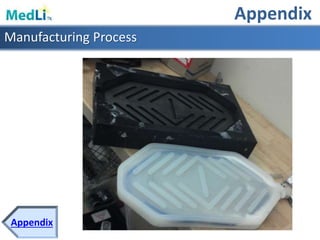
Manufacturing Process
Appendix
Appendix
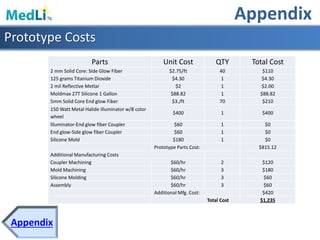
Prototype Costs
Parts Unit Cost QTY Total Cost
2 mm Solid Core: Side Glow Fiber $2.75/ft 40 $110
125 grams Titanium Dioxide $4.30 1 $4.30
2 mil Reflective Metlar $2 1 $2.00
Moldmax 27T Silicone 1 Gallon $88.82 1 $88.82
5mm Solid Core End glow Fiber $3./ft 70 $210
150 Watt Metal Halide Illuminator w/8 color
wheel
$400 1 $400
Illuminator-End glow fiber Coupler $60 1 $0
End glow-Side glow fiber Coupler $60 1 $0
Silicone Mold $180 1 $0
Prototype Parts Cost: $815.12
Additional Manufacturing Costs
Coupler Machining $60/hr 2 $120
Mold Machining $60/hr 3 $180
Silicone Molding $60/hr 3 $60
Assembly $60/hr 3 $60
Additional Mfg. Cost: $420
Total Cost $1,235
Appendix
Appendix
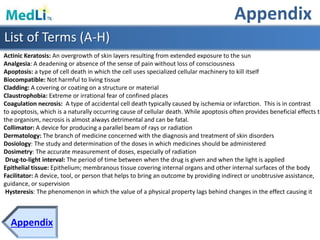
List of Terms (A-H)
Actinic Keratosis: An overgrowth of skin layers resulting from extended exposure to the sun
Analgesia: A deadening or absence of the sense of pain without loss of consciousness
Apoptosis: a type of cell death in which the cell uses specialized cellular machinery to kill itself
Biocompatible: Not harmful to living tissue
Cladding: A covering or coating on a structure or material
Claustrophobia: Extreme or irrational fear of confined places
Coagulation necrosis: A type of accidental cell death typically caused by ischemia or infarction. This is in contrast
to apoptosis, which is a naturally occurring cause of cellular death. While apoptosis often provides beneficial effects to
the organism, necrosis is almost always detrimental and can be fatal.
Collimator: A device for producing a parallel beam of rays or radiation
Dermatology: The branch of medicine concerned with the diagnosis and treatment of skin disorders
Dosiology: The study and determination of the doses in which medicines should be administered
Dosimetry: The accurate measurement of doses, especially of radiation
Drug-to-light interval: The period of time between when the drug is given and when the light is applied
Epithelial tissue: Epithelium; membranous tissue covering internal organs and other internal surfaces of the body
Facilitator: A device, tool, or person that helps to bring an outcome by providing indirect or unobtrusive assistance,
guidance, or supervision
Hysteresis: The phenomenon in which the value of a physical property lags behind changes in the effect causing it
Appendix
Appendix
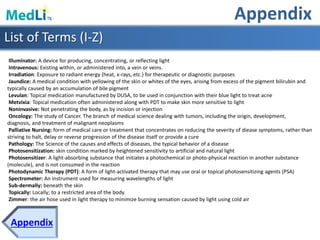
Illuminator: A device for producing, concentrating, or reflecting light
Intravenous: Existing within, or administered into, a vein or veins.
Irradiation: Exposure to radiant energy (heat, x-rays, etc.) for therapeutic or diagnostic purposes
Jaundice: A medical condition with yellowing of the skin or whites of the eyes, arising from excess of the pigment bilirubin and
typically caused by an accumulation of bile pigment
Levulan: Topical medication manufactured by DUSA, to be used in conjunction with their blue light to treat acne
Metvixia: Topical medication often administered along with PDT to make skin more sensitive to light
Noninvasive: Not penetrating the body, as by incision or injection
Oncology: The study of Cancer. The branch of medical science dealing with tumors, including the origin, development,
diagnosis, and treatment of malignant neoplasms
Palliative Nursing: form of medical care or treatment that concentrates on reducing the severity of diease symptoms, rather than
striving to halt, delay or reverse progression of the disease itself or provide a cure
Pathology: The Science of the causes and effects of diseases, the typical behavior of a disease
Photosensitization: skin condition marked by heightened sensitivity to artificial and natural light
Photosensitizer: A light-absorbing substance that initiates a photochemical or photo-physical reaction in another substance
(molecule), and is not consumed in the reaction
Photodynamic Therapy (PDT): A form of light-activated therapy that may use oral or topical photosensitizing agents (PSA)
Spectrometer: An instrument used for measuring wavelengths of light
Sub-dermally: beneath the skin
Topically: Locally; to a restricted area of the body
Zimmer: the air hose used in light therapy to minimize burning sensation caused by light using cold air
List of Terms (I-Z)

PDT Final Presentation

  • 1.
    Introduction Photodynamic Therapy Delivery System MEMBERS: MichaelBernatzky, Cobi Ben-David, Ryan Donovan, Simon Ioffe, Andrew Zamsky ADVISOR: Professor B.K. Jaeger CONSULTANT: Professor A. Gouldstone
  • 2.
    40 - 50million Americans Acne Up to 58 million Americans Actinic Keratosis US Population 312 million 13 million Americans Skin Cancer 15 million Americans Jaundice Why Does This Matter? Scope Treatment Definition
  • 3.
    40 - 50million Americans Acne Up to 58 million Americans Actinic Keratosis US Population 312 million 13 million Americans Skin Cancer 15 million Americans Jaundice Why Does This Matter?What can be done? Photosensitizing Agent (PSA) Blue Light Delivery Treatment of Dermatological Conditions Photodynamic Therapy Scope Treatment Definition
  • 4.
    What is PDT? PhotodynamicTherapy PDT is a form of light-activated treatment, which works in conjunction with a photo- sensitizing agent (PSA) to target and destroy unhealthy or dangerous cells. Photon Activated Pharmaceutical Pharmaceutical O2 Oxidizing Species (Singlet Oxygen) Oxidative Injury to Cells Cellular Death Scope Treatment Definition P. Acnes PDT P. Acnes Absent
  • 5.
    Current State Problem StatementExisting Devices For Clinicians: • Current devices are difficult to lift, adjust and operate The Problem • Existing devices are expensive which hinders their availability
  • 6.
    Current State Problem StatementExisting Devices For Patients: • Current devices are hard to adjust to different parts of the body and various body types • Treatments are often uncomfortable, dampening a patients desire to return for treatment The Problem
  • 7.
    Design Goals Flexibility ✗ UserInterface ✗ Ergonomic ✗ Cost ! Patient Comfort ✗ Problem Statement Existing Devices Current State ✓✗ Adequate !Poor Excellent
  • 8.
    Design Goals Flexibility ✗! User Interface ✗ ✗ Ergonomic ✗ ! Cost ! ✗ Patient Comfort ✗ ! Problem Statement Existing Devices Current State ✓✗ Adequate !Poor Excellent
  • 9.
    The team hassubmitted an Institutional Review Board (IRB) application and received approval All team members have successfully been certified by the National Institute of Health (NIH) Preparation Literature ConsultationsPatents Research
  • 10.
  • 11.
  • 12.
    Research Preparation Literature ConsultationsPatents •Skincare Physicians M. Kaminer, MD • Dermatology Associates K. Nolan, RN, MSN • Northeastern University Optics Lab C. DiMarzio, PhD
  • 13.
    Flexible design forvarious treatment applications Inexpensive cost to broaden accessibility Ease of use for clinicians Optimal patient comfort Responsibilities Initial Concepts DecisionDesign Criteria Design Process
  • 14.
    Industrial Engineering MechanicalEngineering Design Process Responsibilities Initial Concepts Decision Usability Anthropometry Ergonomics Device Interface Functionality Material Selection Cost Effectiveness Patient Comfort Flexible OpticsModularity Packaging Adjustability Design Criteria
  • 15.
    Design Process Responsibilities InitialConcepts DecisionDesign Criteria
  • 16.
    Design Process Responsibilities InitialConceptsDesign Criteria Decision Decision Matrix:
  • 17.
    Design Process Responsibilities InitialConceptsDesign Criteria Decision Halogen LED Fiber Optics Total Score: 1900 Total Score: 2185 Total Score: 2625 Decision Matrix:
  • 18.
    Design Analysis Electricity Heat Light Fiber OpticCablesLight Source PatientFlexible Light Mat Light Light Concept Overview: Overview Treatment AreaMedLiTx Wavelength Selection
  • 19.
    Design Analysis Overview TreatmentAreaMedLiTx Wavelength Selection
  • 20.
    Flexible Silicone LightMat Light Source Flexible Fiber Optic Transmission Cable Modular Cable Coupling Design Analysis Overview Treatment AreaWavelength SelectionMedLiTx
  • 21.
    Visible Light Spectrum Whatwavelength light to use? Most current PDT devices use one single light wavelength, while different treatments require different light at different wavelengths. Our device incorporates multiple frequencies in a single device. 412𝑛𝑚 − 422𝑛𝑚𝜆 = 423𝑛𝑚 − 750𝑛𝑚 Blue Light Therapy (primary design objective) Used for other forms of PDT (expanded design objective) Safe Effective Approved    Overview Treatment AreaWavelength Selection Design Analysis MedLiTx
  • 22.
    Light Source LightFilter Array Light Filter Array The design gives clinicians flexibility by incorporating light at various wavelengths in a single device for different treatments. Patient White Light (380-750nm) Blue light(450-475nm)Violet light(380-450nm)Red light(620-750nm) Design Analysis Overview Treatment AreaWavelength SelectionMedLiTx
  • 23.
    Face Arms Hands Legs Chest Back Torso Fitting the Patient Thesesare the physical areas of focus established from consultations with PDT practitioners and literature research. A flexible design is important to be able to fit all the parts of the body comfortably. Design Analysis Overview Treatment AreaWavelength SelectionMedLiTx
  • 24.
    • Head ≈9% • Chest ≈ 9% • Abdomen ≈ 9% • Upper/mid/low back and buttocks ≈ 18% • Each arm ≈ 9% (front ≈ 4.5%, back ≈ 4.5%) • Each leg ≈ 18% total (front ≈ 9%, back ≈ 9%) The Rule of 9 No more than 9% of the body should be treated by PDT at a time. Design Analysis Overview Treatment AreaWavelength Selection 𝑆𝑢𝑟𝑓𝑎𝑐𝑒 𝐴𝑟𝑒𝑎 𝑀𝑒𝑑𝐿𝑖𝑇𝑥 = .1𝑚2 𝑆𝑢𝑟𝑓𝑎𝑐𝑒 𝐴𝑟𝑒𝑎 𝑎𝑣𝑔 = 1.73𝑚2 = 𝟓. 𝟕𝟖% = % 𝑜𝑓 𝑎𝑣𝑔 𝑎𝑑𝑢𝑙𝑡 𝑡𝑟𝑒𝑎𝑡𝑒𝑑 𝑏𝑦 𝑀𝑒𝑑𝐿𝑖 𝑇𝑥 MedLiTx
  • 25.
    Light Delivery Mat RubberSilicon (Flexible, Biocompatible) Titanium Dioxide (Light scattering agent) Stainless Steel Mesh (For ductility, malleability) Reflective Metlar Sheet (Reflects light forward) Side-Glow Fiber Optic Cables (Emits light throughout mat)  Flexible Biocompatible Inexpensive  Sterilize with Ease Design Features Modularity Light WeightFlexibility User Interface
  • 26.
    Interchangeable Delivery System Wedesigned a fiber optic coupler that allows different delivery mechanisms to be plugged in, based on the specific treatment. Physical Consideration To mitigate losses when connecting fiber optic cables, the device is designed to use cables with the same numerical aperture. 𝑁𝐴 = 𝑛1 2 − 𝑛2 2 Modularity Light WeightFlexibility Design Features User Interface
  • 27.
    𝑹𝑾𝑳 = 𝐿𝐶× 𝐻𝑀 × 𝑉𝑀 × 𝐷𝑀 × 𝐴𝑀 × 𝐹𝑀 × 𝐶𝑀 = 10 × 7.2 × 1.11 × .87 × .55 × .95 × 1 = Height ≈ 72 in Load Constant ≈ 10Lb Coupling Multiplier= 1 Vertical Location ≈ 36 in Asymmetry Angle ≈ 140° Horizontal Multiplier=7.2 Frequency Multiplier=.95 Vertical Travel Distance ≈ 36 in Distance Multiplier=.82+(1.8/36)=.87 Asymmetry Multiplier=1-.0032*140=.552 Vertical Multiplier= 1-(.003*[36-75])=1.117 NIOSH Lifting Limit Formula Based on the design specifications the Recommended Weight Limit is: 𝟑𝟔. 𝟔𝟗 𝑳𝒃= Design Features Modularity Light WeightFlexibility User Interface
  • 28.
    Existing User Interface: DesignFeatures Modularity Light WeightFlexibility User Interface
  • 29.
    Design Features Modularity LightWeightFlexibility User Interface
  • 30.
    Authorization Screen Treatment Setup Paused Treatment Treatment Status Saved Programs Program Edit Wavelength Edit Screen Denied Approved Begin Treatment Resume Pause Stop Treatment StopTreatment Change Use Program Save Program Edit Program New Program Name Edit Screen Intensity Edit Screen Time Edit Screen Edit Parameter Edit Parameter Edit Parameter Edit Parameter Save Parameter Save Parameter Save Parameter Design Features Modularity Light WeightFlexibility User Interface
  • 31.
    Design Features Modularity LightWeightFlexibility User Interface
  • 32.
    Device Comparison Design Goals Flexibility✗ ! ✓ User Interface ✗ ✗ ✓ Ergonomic ✗ ! ✓ Cost ! ✗ ✓ Patient Comfort ✗ ! ✓ ✓✗ Adequate !Poor Excellent Breast Cancer Tx ! ✗ ✓ Design Features
  • 33.
    Thank you forlistening. Q&A Questions ?
  • 34.
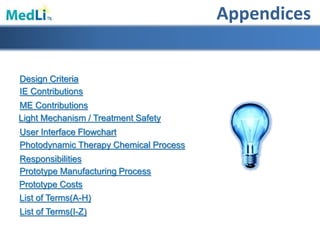
    Appendices IE Contributions User InterfaceFlowchart Design Criteria Photodynamic Therapy Chemical Process Responsibilities Light Mechanism / Treatment Safety ME Contributions Prototype Manufacturing Process List of Terms(A-H) List of Terms(I-Z) Prototype Costs
  • 35.
    Appendix IE Contributions Anthropometry &Ergonomics: Usability:Manufacturing: Appendix
  • 36.
    Appendix ME Contributions Material Selection: RubberSilicon Stainless Steel Mesh Reflective Metlar Sheet Side-Glow Fiber Optic Cables Device Design: Appendix Flexible Silicone Light Mat Light Source Flexible Fiber Optic Transmission Cable Modular Cable Coupling Titanium Dioxide
  • 37.
    Appendix Light Mechanism/ TreatmentSafety Appendix Safe Effective Approved   Photosensitizing Agent (PSA) Light Delivery Treatment of Dermatological Conditions Visible Light Spectrum 412𝑛𝑚 − 418𝑛𝑚𝜆 = 420𝑛𝑚 − 750𝑛𝑚 Blue Light Therapy (primary design objective) Used for other forms of PDT (expanded design objective)
  • 38.
    Appendix User Interface Flowchart Appendix Authorization Screen Treatment Setup Paused Treatment Treatment Status Saved Programs Program Edit Wavelength EditScreen Denied Approved Begin Treatment Resume Pause Stop Treatment Stop Treatment Change Use Program Save Program Edit Program New Program Name Edit Screen Intensity Edit Screen Time Edit Screen Edit Parameter Edit Parameter Edit Parameter Edit Parameter Save Parameter Save Parameter Save Parameter
  • 39.
    Optimal patient comfort Easeof use for clinicians Inexpensive cost to broaden accessibility Flexible design for various treatment applications Design Criteria Appendix Appendix
  • 40.
    Photodynamic Therapy PDT isa form of light-activated treatment, which works in conjunction with a photo- sensitizing agent (PSA) to target and destroy unhealthy or dangerous cells. Photon Activated Pharmaceutical Pharmaceutical O2 Oxidizing Species (Singlet Oxygen) Oxidative Injury to Cells Cellular Death Appendix Photodynamic Therapy Chemical Process Appendix
  • 41.
    Industrial Engineering MechanicalEngineering Usability Anthropometry Ergonomics Device Interface Functionality Material Selection Cost Effectiveness Patient Comfort Flexible OpticsModularity Packaging Adjustability Appendix Appendix Responsibilities
  • 42.
  • 43.
    Appendix Appendix Prototype Costs Parts UnitCost QTY Total Cost 2 mm Solid Core: Side Glow Fiber $2.75/ft 40 $110 125 grams Titanium Dioxide $4.30 1 $4.30 2 mil Reflective Metlar $2 1 $2.00 Moldmax 27T Silicone 1 Gallon $88.82 1 $88.82 5mm Solid Core End glow Fiber $3./ft 70 $210 150 Watt Metal Halide Illuminator w/8 color wheel $400 1 $400 Illuminator-End glow fiber Coupler $60 1 $0 End glow-Side glow fiber Coupler $60 1 $0 Silicone Mold $180 1 $0 Prototype Parts Cost: $815.12 Additional Manufacturing Costs Coupler Machining $60/hr 2 $120 Mold Machining $60/hr 3 $180 Silicone Molding $60/hr 3 $60 Assembly $60/hr 3 $60 Additional Mfg. Cost: $420 Total Cost $1,235
  • 44.
    Appendix Appendix List of Terms(A-H) Actinic Keratosis: An overgrowth of skin layers resulting from extended exposure to the sun Analgesia: A deadening or absence of the sense of pain without loss of consciousness Apoptosis: a type of cell death in which the cell uses specialized cellular machinery to kill itself Biocompatible: Not harmful to living tissue Cladding: A covering or coating on a structure or material Claustrophobia: Extreme or irrational fear of confined places Coagulation necrosis: A type of accidental cell death typically caused by ischemia or infarction. This is in contrast to apoptosis, which is a naturally occurring cause of cellular death. While apoptosis often provides beneficial effects to the organism, necrosis is almost always detrimental and can be fatal. Collimator: A device for producing a parallel beam of rays or radiation Dermatology: The branch of medicine concerned with the diagnosis and treatment of skin disorders Dosiology: The study and determination of the doses in which medicines should be administered Dosimetry: The accurate measurement of doses, especially of radiation Drug-to-light interval: The period of time between when the drug is given and when the light is applied Epithelial tissue: Epithelium; membranous tissue covering internal organs and other internal surfaces of the body Facilitator: A device, tool, or person that helps to bring an outcome by providing indirect or unobtrusive assistance, guidance, or supervision Hysteresis: The phenomenon in which the value of a physical property lags behind changes in the effect causing it
  • 45.
    Appendix Appendix Illuminator: A devicefor producing, concentrating, or reflecting light Intravenous: Existing within, or administered into, a vein or veins. Irradiation: Exposure to radiant energy (heat, x-rays, etc.) for therapeutic or diagnostic purposes Jaundice: A medical condition with yellowing of the skin or whites of the eyes, arising from excess of the pigment bilirubin and typically caused by an accumulation of bile pigment Levulan: Topical medication manufactured by DUSA, to be used in conjunction with their blue light to treat acne Metvixia: Topical medication often administered along with PDT to make skin more sensitive to light Noninvasive: Not penetrating the body, as by incision or injection Oncology: The study of Cancer. The branch of medical science dealing with tumors, including the origin, development, diagnosis, and treatment of malignant neoplasms Palliative Nursing: form of medical care or treatment that concentrates on reducing the severity of diease symptoms, rather than striving to halt, delay or reverse progression of the disease itself or provide a cure Pathology: The Science of the causes and effects of diseases, the typical behavior of a disease Photosensitization: skin condition marked by heightened sensitivity to artificial and natural light Photosensitizer: A light-absorbing substance that initiates a photochemical or photo-physical reaction in another substance (molecule), and is not consumed in the reaction Photodynamic Therapy (PDT): A form of light-activated therapy that may use oral or topical photosensitizing agents (PSA) Spectrometer: An instrument used for measuring wavelengths of light Sub-dermally: beneath the skin Topically: Locally; to a restricted area of the body Zimmer: the air hose used in light therapy to minimize burning sensation caused by light using cold air List of Terms (I-Z)

Editor's Notes

  • #2 Say what the team is commissioned with right away
  • #20 Say what the team is commissioned with right away
  • #25 Our devices treatment area 5.78%
  • #26 Say what the team is commissioned with right away