Phonetics ??? Oh
God !
What is it ?
Today , we talk
about phonetics
PHONETICS ( THE 1ST DISCUSSION)
By : Dyo
LET’S TALK ABOUT
LINGUISTICS
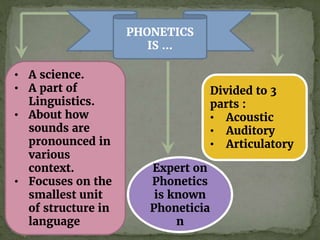
• A science.
• A part of
Linguistics.
• About how
sounds are
pronounced in
various
context.
• Focuses on the
smallest unit
of structure in
language
PHONETICS
IS …
Expert on
Phonetics
is known
Phoneticia
n
Divided to 3
parts :
• Acoustic
• Auditory
• Articulatory
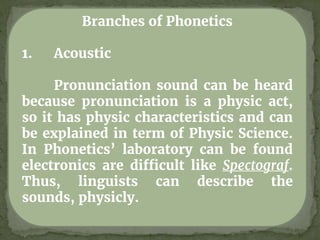
Branches of Phonetics
1. Acoustic
Pronunciation sound can be heard
because pronunciation is a physic act,
so it has physic characteristics and can
be explained in term of Physic Science.
In Phonetics’ laboratory can be found
electronics are difficult like Spectograf.
Thus, linguists can describe the
sounds, physicly.
2. Auditory
This branch is process of
acceptance of pronunciation sound by
ear. The process is described with
physiology language of hearing sense
and hearing organ. This branch is not
too involved in Linguistics. It is more
including to Medical Science.
3. Articulatory
This study is the most important
of Phonetics. From study of
pronunciation, actually the sounds are
produced by special organs in
ourselves. And special sounds can be
provided to special organs that
produce them. In Articulatory talks
about Place Of Articulation and
Manner Of Articulation.
Places of articulation are the places where
speech sounds are produced. They are :
Bilabial is a speech sound made by both upper and lower lip.
These speech sounds are represented by the symbol [p], [b],
[m].
Examples : Pie, buy, my
Labiodentals is a speech sound formed with upper teeth and
lower lip. The speech sound can be presented by the symbol
[f] and [v].
Examples : fan, van
Note : paragraph, cough, photo [f]
Dental is a s speech sound produced with tongue against the
upper front teeth. The speech sound can be presented by the
symbol [θ] and [ð].
Examples : [θ] : teeth, three, Thursday [ð]: the, there,
then
Alveolar is a speech sound formed with the tongue touching
behind upper front teeth. The speech sound can be
represented by the symbol [t], [d], [n], [s], [z].
Examples : tie, die, nut, see, zoo
Palatal is a speech sound produced with the tongue and the
palate. The speech sound can be represented by the symbol [ʃ]
“sh” and [tʃ] “ch”.
Examples : [ʃ] : brush, wash, wish [tʃ]: church,
chicken, teacher
Velar is a speech sound produced with back of the tongue
against the velum (soft palate). The speech sound can be
represented by the symbol [k] and [g].
Examples : [k] : kid, kill, kick, car [g] : bag, good,
goose, glass
Glottal is a speech sound produced without the active use of
the tongue and other parts of the mouth. This speech sound
can be represented by the symbol [h].
Examples : have, has, house, whom, whose, who.
Manner of Articulation (how to produce sounds)
•Stop is the sound produced by some from of stopping the air
stream then releasing it suddenly. These sound can be
represented by the symbol [p], [b], [t], [d], [k], [g].
•Fricative is the sounds made by blocking the air stream and
having the air push through the very narrow opening. These
sounds can be represented by the symbols [f], [v], [], [ð], [s],
[z], [ʃ], [ʒ].
•Affricate is the sounds made by stopping the air stream then
followed immediately by fricative. In the other word, it’s
combination of “stop” and “fricative”. These sounds can be
represented by the symbol “[tʃ] as (ch)” and “[ʤ] as (j)”.
•Nasal is the sounds produced by sending the stream ir of air
through the nose. These sounds can be represented by the
symbol [m], [n], [ŋ].
•Liquid is the sounds produced when the tongue touches the
middle part of the alveolar ridge. These sounds can be
symbolized with [l] and [r]. when you pronounce the symbol
[r], your tongue tip will raise and curl back near the
alveolar ridge.
•Glide is the sounds by moving the tongue from one position
to another. These sounds are symbolized with [w] and [j].
•Glottal stop is the sound produced by closing the opening
the glottis (vocal cord). This sound is symbolized with [Ɂ].
You can produce the glottal stop if you try to say the word
“butter” and “bottle” without pronouncing the “-tt-ˮ part
in the middle.
•Flaps is the sound is produced by the tongue tip tapping the
alveolar ridge briefly. When you pronounce the word
“letter” that is close to “ladder”, it’s mean you are making
a flap.
Note: it should be better, if the reader also find and understand
International Phonetic Alphabet (IPA).
REFERENCES
F. Meyer, Charles. 2009. Introducing English Linguistics. New
York: Cambridge University Press.
Chaedar Alwasilah, A. 2011. Linguistik Suatu Pengantar.
Bandung: Angkasa.
Fadhly Farhy Abbas, M. 2015. A Coursebook Of Pronunciation.
Pekanbaru: Lancang Kuning University.
Also find me on :
Fb : https://www.facebook.com/dyofica
Ig : https://www.instagram.com/dyofica_96/
Thanks’ For Visit My
Blog .
See You Next Post ,
Guys .
Have A Good Day

PHONETICS IS UNIQUE

  • 1.
    Phonetics ??? Oh God! What is it ? Today , we talk about phonetics
  • 2.
    PHONETICS ( THE1ST DISCUSSION) By : Dyo LET’S TALK ABOUT LINGUISTICS
  • 3.
    • A science. •A part of Linguistics. • About how sounds are pronounced in various context. • Focuses on the smallest unit of structure in language PHONETICS IS … Expert on Phonetics is known Phoneticia n Divided to 3 parts : • Acoustic • Auditory • Articulatory
  • 4.
    Branches of Phonetics 1.Acoustic Pronunciation sound can be heard because pronunciation is a physic act, so it has physic characteristics and can be explained in term of Physic Science. In Phonetics’ laboratory can be found electronics are difficult like Spectograf. Thus, linguists can describe the sounds, physicly.
  • 5.
    2. Auditory This branchis process of acceptance of pronunciation sound by ear. The process is described with physiology language of hearing sense and hearing organ. This branch is not too involved in Linguistics. It is more including to Medical Science.
  • 6.
    3. Articulatory This studyis the most important of Phonetics. From study of pronunciation, actually the sounds are produced by special organs in ourselves. And special sounds can be provided to special organs that produce them. In Articulatory talks about Place Of Articulation and Manner Of Articulation.
  • 7.
    Places of articulationare the places where speech sounds are produced. They are : Bilabial is a speech sound made by both upper and lower lip. These speech sounds are represented by the symbol [p], [b], [m]. Examples : Pie, buy, my Labiodentals is a speech sound formed with upper teeth and lower lip. The speech sound can be presented by the symbol [f] and [v]. Examples : fan, van Note : paragraph, cough, photo [f] Dental is a s speech sound produced with tongue against the upper front teeth. The speech sound can be presented by the symbol [θ] and [ð]. Examples : [θ] : teeth, three, Thursday [ð]: the, there, then
  • 8.
    Alveolar is aspeech sound formed with the tongue touching behind upper front teeth. The speech sound can be represented by the symbol [t], [d], [n], [s], [z]. Examples : tie, die, nut, see, zoo Palatal is a speech sound produced with the tongue and the palate. The speech sound can be represented by the symbol [ʃ] “sh” and [tʃ] “ch”. Examples : [ʃ] : brush, wash, wish [tʃ]: church, chicken, teacher Velar is a speech sound produced with back of the tongue against the velum (soft palate). The speech sound can be represented by the symbol [k] and [g]. Examples : [k] : kid, kill, kick, car [g] : bag, good, goose, glass Glottal is a speech sound produced without the active use of the tongue and other parts of the mouth. This speech sound can be represented by the symbol [h]. Examples : have, has, house, whom, whose, who.
  • 9.
    Manner of Articulation(how to produce sounds) •Stop is the sound produced by some from of stopping the air stream then releasing it suddenly. These sound can be represented by the symbol [p], [b], [t], [d], [k], [g]. •Fricative is the sounds made by blocking the air stream and having the air push through the very narrow opening. These sounds can be represented by the symbols [f], [v], [], [ð], [s], [z], [ʃ], [ʒ]. •Affricate is the sounds made by stopping the air stream then followed immediately by fricative. In the other word, it’s combination of “stop” and “fricative”. These sounds can be represented by the symbol “[tʃ] as (ch)” and “[ʤ] as (j)”. •Nasal is the sounds produced by sending the stream ir of air through the nose. These sounds can be represented by the symbol [m], [n], [ŋ].
  • 10.
    •Liquid is thesounds produced when the tongue touches the middle part of the alveolar ridge. These sounds can be symbolized with [l] and [r]. when you pronounce the symbol [r], your tongue tip will raise and curl back near the alveolar ridge. •Glide is the sounds by moving the tongue from one position to another. These sounds are symbolized with [w] and [j]. •Glottal stop is the sound produced by closing the opening the glottis (vocal cord). This sound is symbolized with [Ɂ]. You can produce the glottal stop if you try to say the word “butter” and “bottle” without pronouncing the “-tt-ˮ part in the middle. •Flaps is the sound is produced by the tongue tip tapping the alveolar ridge briefly. When you pronounce the word “letter” that is close to “ladder”, it’s mean you are making a flap. Note: it should be better, if the reader also find and understand International Phonetic Alphabet (IPA).
  • 11.
    REFERENCES F. Meyer, Charles.2009. Introducing English Linguistics. New York: Cambridge University Press. Chaedar Alwasilah, A. 2011. Linguistik Suatu Pengantar. Bandung: Angkasa. Fadhly Farhy Abbas, M. 2015. A Coursebook Of Pronunciation. Pekanbaru: Lancang Kuning University. Also find me on : Fb : https://www.facebook.com/dyofica Ig : https://www.instagram.com/dyofica_96/
  • 12.
    Thanks’ For VisitMy Blog . See You Next Post , Guys . Have A Good Day