Download to read offline
![International Research Journal of Engineering and Technology (IRJET) e-ISSN: 2395-0056
Volume: 10 Issue: 04 | Apr 2023 www.irjet.net p-ISSN: 2395-0072
© 2023, IRJET | Impact Factor value: 8.226 | ISO 9001:2008 Certified Journal | Page 75
Phishing: Analysis and Countermeasures
Bhagyashree Ankush Alandkar & Bhakti Desai
Student, M. Sc IT, Keraleeya Samajam (Regd.) Dombivli’s Model College, Maharashtra, India
---------------------------------------------------------------------***---------------------------------------------------------------------
Abstract – Without the internet, our daily lives are
inconceivable. One of the most important forms of
communication we use every day is email. We prefer to just
use it regularly for business communications, but we also
use it to stay in touch with our friends and family. Due of the
significant significance that email plays in international
communication and information sharing. Even so, security
issues have accumulated. E-Mail phishing is the most
significant drawback or hacker attack on email in today's
world. The moment is right to secure information sent via
mail, even on specific networks. Cybercriminalscreatethese
emails to appear credible, which makes virtually millions of
people throughout the world fall for them. The criminals
don't have a specific victim in mind.
Key Words: Phishing, attacks
1. INTRODUCTION
Phishing is a type of email fraud in which the perpetrator
sends out seemingly valid emails to target specific
individuals in an effort to collect their personal andfinancial
information. The communications typically look tooriginate
from reputableandwell-knownwebsites. Thephisherplaces
the lure in the hopes of fooling at least some of the prey that
come into contact with it, just like the fishing trip it gets its
name from. Phishers deceive their targets by employing a
variety of social engineering techniques and email spoofing
techniques. Due to the important functionthatemail playsin
communication and information sharing on a worldwide
scale. The safety issueshave evengottenworse.Themajority
of the email servers used in the mail infrastructure on the
internet are attacked.
2. HOW PHISHING ATTACKS WORKS
We need to comprehend the justifications for hostile attacks
in order to comprehend how they operate. There are two
main purposes of a phishing assault.
1) To extract sensitive data, first
These attacks employ techniques that compel the victims to
reveal sensitive and private information. Hackers want the
ability to break into a private or public network,steal money
from someone, or use another person's credentials to carry
out illegal activities. Checking account information isamong
the clearly questionable data that hackers request from
victims.
2) To infect the system with malware
With such attacks, hackers also primarily aim to infect the
victim's PC with malware or viruses. These emails include
Microsoft Office zipped files.
3. STAGES OF PHISHING ATTACK
It's crucial to first comprehend how phishing attacks
operate in order to stop one in its tracks. Let's go over the
stages of a typical phishing attack that are most common
[1]:
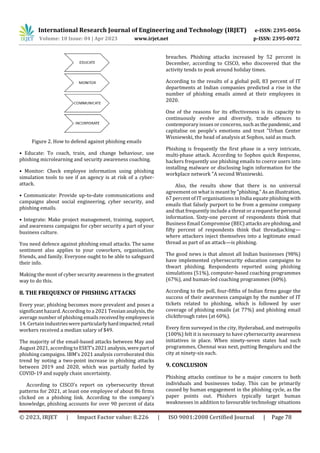
Figure 1 stages of phishing attack
Creating the fake website.
To create spoof websites, the hacker steals real code and
legitimate images from websites. According to some
estimates, hackers create 1.5 million spoof websites each
month. Due to the availability of affordable internet scraping
tools, this is nowsimplerthanever.Hackersfrequentlycreate
fake websites with well-known and reliable domain names.
They are also recovering at their trade. Even experienced
security personnel will struggle to identify fakes.
The phishing email's transmission.
The hacker launches the associate degree email phishing
scam after creating the fake website. These emails,whichare
incredibly convincing, include content, images, and a link to
the fake website. The victim is urged to open the link in the
email with statementslike,"Youraccounthasbeenhijacked!"
On a huge scale, this occurs. Every day, hackers send an
estimated three billion phishing emails.](https://image.slidesharecdn.com/irjet-v10i411-230610113844-29923816/85/Phishing-Analysis-and-Countermeasures-1-320.jpg)
![International Research Journal of Engineering and Technology (IRJET) e-ISSN: 2395-0056
Volume: 10 Issue: 04 | Apr 2023 www.irjet.net p-ISSN: 2395-0072
© 2023, IRJET | Impact Factor value: 8.226 | ISO 9001:2008 Certified Journal | Page 75
Phishing: Analysis and Countermeasures
Bhagyashree Ankush Alandkar & Bhakti Desai
Student, M. Sc IT, Keraleeya Samajam (Regd.) Dombivli’s Model College, Maharashtra, India
---------------------------------------------------------------------***---------------------------------------------------------------------
Abstract – Without the internet, our daily lives are
inconceivable. One of the most important forms of
communication we use every day is email. We prefer to just
use it regularly for business communications, but we also
use it to stay in touch with our friends and family. Due of the
significant significance that email plays in international
communication and information sharing. Even so, security
issues have accumulated. E-Mail phishing is the most
significant drawback or hacker attack on email in today's
world. The moment is right to secure information sent via
mail, even on specific networks. Cybercriminalscreatethese
emails to appear credible, which makes virtually millions of
people throughout the world fall for them. The criminals
don't have a specific victim in mind.
Key Words: Phishing, attacks
1. INTRODUCTION
Phishing is a type of email fraud in which the perpetrator
sends out seemingly valid emails to target specific
individuals in an effort to collect their personal andfinancial
information. The communications typically look tooriginate
from reputableandwell-knownwebsites. Thephisherplaces
the lure in the hopes of fooling at least some of the prey that
come into contact with it, just like the fishing trip it gets its
name from. Phishers deceive their targets by employing a
variety of social engineering techniques and email spoofing
techniques. Due to the important functionthatemail playsin
communication and information sharing on a worldwide
scale. The safety issueshave evengottenworse.Themajority
of the email servers used in the mail infrastructure on the
internet are attacked.
2. HOW PHISHING ATTACKS WORKS
We need to comprehend the justifications for hostile attacks
in order to comprehend how they operate. There are two
main purposes of a phishing assault.
1) To extract sensitive data, first
These attacks employ techniques that compel the victims to
reveal sensitive and private information. Hackers want the
ability to break into a private or public network,steal money
from someone, or use another person's credentials to carry
out illegal activities. Checking account information isamong
the clearly questionable data that hackers request from
victims.
2) To infect the system with malware
With such attacks, hackers also primarily aim to infect the
victim's PC with malware or viruses. These emails include
Microsoft Office zipped files.
3. STAGES OF PHISHING ATTACK
It's crucial to first comprehend how phishing attacks
operate in order to stop one in its tracks. Let's go over the
stages of a typical phishing attack that are most common
[1]:
Figure 1 stages of phishing attack
Creating the fake website.
To create spoof websites, the hacker steals real code and
legitimate images from websites. According to some
estimates, hackers create 1.5 million spoof websites each
month. Due to the availability of affordable internet scraping
tools, this is nowsimplerthanever.Hackersfrequentlycreate
fake websites with well-known and reliable domain names.
They are also recovering at their trade. Even experienced
security personnel will struggle to identify fakes.
The phishing email's transmission.
The hacker launches the associate degree email phishing
scam after creating the fake website. These emails,whichare
incredibly convincing, include content, images, and a link to
the fake website. The victim is urged to open the link in the
email with statementslike,"Youraccounthasbeenhijacked!"
On a huge scale, this occurs. Every day, hackers send an
estimated three billion phishing emails.](https://image.slidesharecdn.com/irjet-v10i411-230610113844-29923816/75/Phishing-Analysis-and-Countermeasures-1-2048.jpg)
![International Research Journal of Engineering and Technology (IRJET) e-ISSN: 2395-0056
Volume: 10 Issue: 04 | Apr 2023 www.irjet.net p-ISSN: 2395-0072
© 2023, IRJET | Impact Factor value: 8.226 | ISO 9001:2008 Certified Journal | Page 76
• Focusing the victim search
After developing the bogus website, the hacker starts the
associate's email phishing scheme. Theseemailscontaintext,
graphics, and a link to the false website, and they are quite
convincing. In the email, the victim is prompted to click the
link and is told things like, "Your account has been hijacked!"
This happens on an enormous scale. An estimated three
billion phishing emails are sent out daily by hackers.
Taking the bait.
If a hacker is persistent, a victim will eventually fall for the
lure. A silentattack willclaim thousands oflives.Thevictim's
financial assets, such as credit cards, bank accounts, or legal
documents, may occasionally need to be taken. Others want
to gather as many credentials as they can to sell online.
4. PHISHING SCAMS TO AVOID
• Spear Phishing Attacks
Many different types of tailored phishing are referred to
as spear phishing. With spear-phishing assaults, the hacker
tries to learn as much as they can about you, including your
name, company, position,andphonenumber.Theythentake
advantage of this knowledge by pretending to be someone
you know and trust in order to persuade you to comply with
the attacker's demands.
Example: Because Amazon is so widely known, all
cybercriminals don't have to put up a lot of effort to deceive
their customers; the bulk of phishing attempts are generic.
A clever spear phishing assault in 2015 tricked several
customers into installing ransomware. Users who had
recently placed an order with theWorldHealthOrganization
received an email from the con artists.
• Whaling
Whaling is a type of phishing assault that targets people
in positions of authority within a large corporation. This
often denotes a senior management with access to or
knowledge of sensitive firm information, such as a chief
executive officer, business executive, or another senior
manager. The fact that the targets are the "big fishes" in the
phishing pool is what is meant by the phrase "whaling."
Whaling attacks are frequently very carefully planned and
aim to obtain important company information for the
phisher's benefit. Attacks against whales are often planned
out over a long period of time, and they are highly tailored
and elaborate.
Example: The co-founder of Australian hedge fund Levitas
Capital clicked on a fake Zoom link in the month of 2020.
• Pharming
Other methods of manipulating targets on the internet
include phishing and pharmacy fraud. Phishing is a
technique used to trick a victim into giving theirinformation
to a fake website. Pharming involves changing DNS
information, so when a person types in an online address,
they will likely be forwarded to the wrong website. This
means that the DNS server responsible for converting the
website address into the address for crucial information
processing will need to be adjusted, and website traffic will
also be diverted to another site. Due to flaws in the DNS
server package, pharming attacks can happen and are
frequently difficult to detect. The simplest way to identify a
potential pharming assault is to raise the alarm if a common
web.
• Spoofing
Spoofing is the act of a gouger acting as someone else in
order to persuade the target totakea particularaction.Many
phishing attempts consequently make use of spoofing; a
phisher could pose as a member of your IT department and
urge you to visit a website and confirm your laptop login
information. As a result, this website is a fake, and the
phisher has obtained access to your login information
without your knowledge. However, not all spoofing assaults
are actually phishing; some phishers utilise spoofing as a
means of manipulation. A spoofing attack might involve a
hacker posing as a coworker and asking you to send a file,
but the file is actually a trojan.
• Vishing
Vishing is the telephone equivalent ofphishing,inwhich
the targets are chosen by the con artists in order to obtain
information. Vishers pose as a respectable organisation and
harass you for your personal information by using various
forms of persuasion or "social engineering." Be extremely
careful when disclosing any sensitive information over the
phone, especially if the number is restricted or you are
unfamiliar with the area code or number. If at all possible,
ask for the amount you can decide back and verifyitwiththe
source they say they are, or decide the party's customer
service and ask if they need to get in touch with you.
Example: In this attack, a link will cause a page to open
alerting you that a problem has been found with your
computer and that you should choose a support option to
resolve it. The offender may also decide to inform the victim
that assistance is being sought for them due to a tool failure.
This is a common tactic. A price is assessed at the end of the
service for fixing a tangle that didn't initially exist [7].](https://image.slidesharecdn.com/irjet-v10i411-230610113844-29923816/85/Phishing-Analysis-and-Countermeasures-2-320.jpg)
![International Research Journal of Engineering and Technology (IRJET) e-ISSN: 2395-0056
Volume: 10 Issue: 04 | Apr 2023 www.irjet.net p-ISSN: 2395-0072
© 2023, IRJET | Impact Factor value: 8.226 | ISO 9001:2008 Certified Journal | Page 77
5. PHISHING ATTACKS: WARNING SIGNS
A phishing website (also known as a faked website) often
makes an effort to appear at least somewhat trustworthy. It
will be designed to look like an authentic, already-existing
website, imitating sites for your banks or healthcare
facilities, for example. The website is designed for you to
disclose your login information or other personal
information. You might get an email or text message with a
link to the current website, but you could also accidentally
type in the wrong URL or use the wrong search term to land
on the page. The main concern is then to be wary about the
sender of the email or instant message and make sure you
know who sent it, or that the sender is someone you trust.
Email from unacquainted Sender
There are several things you might consider when you
receive an email to determine whether you might be the
victim of a phishing assault. Look at the email sender's
information first. The phishing attempt can come from a
suspicious-looking email that youhaveneverseenbefore. As
luck would have it, there are forums and online tools that
can help you determine whether or not the source is
trustworthy if you have any questions. Simply copy the
sender's email and search for terms like "phishing attempt,"
"hacking," or "scam" on Google. You may be able to tell that
the email is from a cybercriminal if others have reported it.
However, there is a problem with this technique because
phishers are quite aware of the forums and frequently and
easily change their emails. Additionally, they would utilise
these support forums as a way to legitimise their own fraud
by giving themselves positive evaluations and insisting that
the email offer was genuine [8].
Sender’s Email looks Off
The phishing attempt may come from a business that
appears to be fully trustworthy and legitimatebutisactually
not from the firm it purports to be. For example, if you
search for a Sanket bank and see that they are using their
logo, you might assume the email iscomingfroma legitimate
source without realising that it could be that Sanket's email
has been hacked or that a different email has been created
that matches Sanket's email but isn't the right email type.
Writing Tone Is Odd
Another major cautionary sign is when the email
address looks familiar but thecontentorpresentationseems
strange. If the email contains grammatical or spelling
mistakes that your contact is unlikely to make or does not
frequently make, it's possible that the sender is actually a
phisher. As phishingscamsbecomemoresophisticated,their
language and design may also be well-thought-out and
appear to be extremely trustworthy. Yet people often have a
really certain style and elegance of communicating, and you
seem to be drawn to it, either consciously or unconsciously.
If an email seems "fishy," you may have unconsciously
noticed that the sender is using language and a style that are
not typical of them. Follow your gut, and if something seems
strange, look into the email before you answer.
Greeting Oddly Generic
In order to trick you, phishingcriminalssendouta tonne
of generic emails that start with "Dear Customer" and refer
to "Your Business" or "Your Bank." This is frequently
especially concerning if the email appearstobecomingfrom
someone who should have a lot of information about you,
such as a partner you have met beforeorsomeonefromyour
company [8].
6. PHISHING EMAIL EXAMPLES TO LEARN FROM
1) An example of a phishing email with a suspicious email
address.
2) An example of a phishing email where the con artist
promises financial rewards.
Sample of a phishing email asking you to confirm your
account information.
4) An illustration of a phishing email with fake financial
documents.
5) A phishing email that purports to be from an employee of
your company.
6) A phishing email illustration requesting a payment
confirmation.
7) Voicemail scam examples using phishing emails.
Account Deactivation (No. 8)
9) Fraudulent Credit Card
10) Transmit Money
11)Social media Request No.
7. HOW TO DEFEND AGAINST PHISHING EMAILS
Remember these 5 principles for creating a culture of cyber
security awareness when constructing a defence against
phishing emails:](https://image.slidesharecdn.com/irjet-v10i411-230610113844-29923816/85/Phishing-Analysis-and-Countermeasures-3-320.jpg)
![International Research Journal of Engineering and Technology (IRJET) e-ISSN: 2395-0056
Volume: 10 Issue: 04 | Apr 2023 www.irjet.net p-ISSN: 2395-0072
© 2023, IRJET | Impact Factor value: 8.226 | ISO 9001:2008 Certified Journal | Page 79
(i.e., technical vulnerabilities). It is well established that a
variety of factors, including age, gender, internet addiction,
user stress, and many others, can affect a person's
susceptibility to phishing. In addition to more recent
phishing mediums like voice and SMS phishing, more
traditional phishing channels like email and the web arestill
in use.
Concomitantly, phishing has developed on the far side
getting sensitive data and monetary crimes to cyber
coercion, hacktivism, damaging reputations, espionage, and
nation-state attacks. analysis has been conductedtospotthe
motivations and techniques and countermeasures to those
new crimes, however, there's no single answer for the
phishing drawback because of the heterogeneous nature of
the attack vector.
The challenges caused by phishing have been examined in
this book, and a new anatomy that outlines the entire life
cycle of phishing attempts has been planned. This associate
deprecatory offers a broaderperspectiveonphishingattacks
and a correct definition that covers the attack's realisation
and end-to-end exclusion.
Although the best defence against phishing is human
education, the sophistication of the assaults and social
engineering components make it difficult to completely
eliminate the threat. Developing affordable anti-phishing
strategies that prevent users from being exposed to the
attack is a critical step in minimising these attacks, even
though ongoing security awareness training is the key to
avoiding phishing attacks and to reduce their impact. This
text concluded by mentioning the significance of creating
anti-phishing techniques that recognise and stop the attack.
Also, the significance of methods to identify thesourceofthe
assault may provide a stronger anti-phishing solution, as
discussed in this article.
10. ACKNOWLEGEMENT
I am incredibly humbled and grateful to express my
gratitude to everyone who has helped me put these ideas
into one concrete item, way above the level of their
simplicity.
I want to specifically thank Assistant Professor Jyoti Samel
for giving me the chance to conduct this excellent research
on the subject of "Phishing: An Open Threat to Everyone."
Her support allowed me to conduct a lot of research and
learn a lot of new information. I sincerely appreciateher. My
sincere gratitude is extended to our research paper advisor
for her insightful and timely counsel throughout the many
research phases.
Without the support and guidance of my parents and
friends, no attempt at any level can be satisfactorily
completed. Despite their busy schedules, they gave me
different ideas for how to make this project unique. They
helped me gather a variety of information, aggregate it, and
guide me periodically in making this paper.
11. REFERENCES
[1] Phishing attack on the rise by APN News, Saturday,
March, 2022
[2] Spear phishing examples by Phish Protection
[3] What is Whaling? Whaling Email Attacks Explained by
Tessian, 11 August 2021
[4] What is a Spoofing Attack? The 5 Examples You Need to
Know by SoftwareLab.org
[5] Vishing Attack by INCOGNIA
[6] Phishing attacks warning signs by David Zamerman, Feb
26, 2022](https://image.slidesharecdn.com/irjet-v10i411-230610113844-29923816/85/Phishing-Analysis-and-Countermeasures-5-320.jpg)

This document discusses phishing attacks and countermeasures. It begins by defining phishing as a type of email fraud where perpetrators send seemingly legitimate emails to collect personal and financial information. It then describes how phishing works, outlining the typical stages: creating fake websites, sending phishing emails with links to these sites, and hoping victims provide sensitive data or get infected with malware when they click the links. Specific phishing scams like spear phishing, whaling, pharming, spoofing, and vishing are also explained. The document concludes by listing warning signs of phishing websites and attacks.


