The Transformation of Thought Darwin, Freud, Nietzsche,  Einstein, and Marx
Introduction The 19th Century continued the search for truth and enlightenment General idea that progress would continue through science People also began to care for others’ welfare through charitable organizations From 1850 - 1900s, there was a large amount of optimism
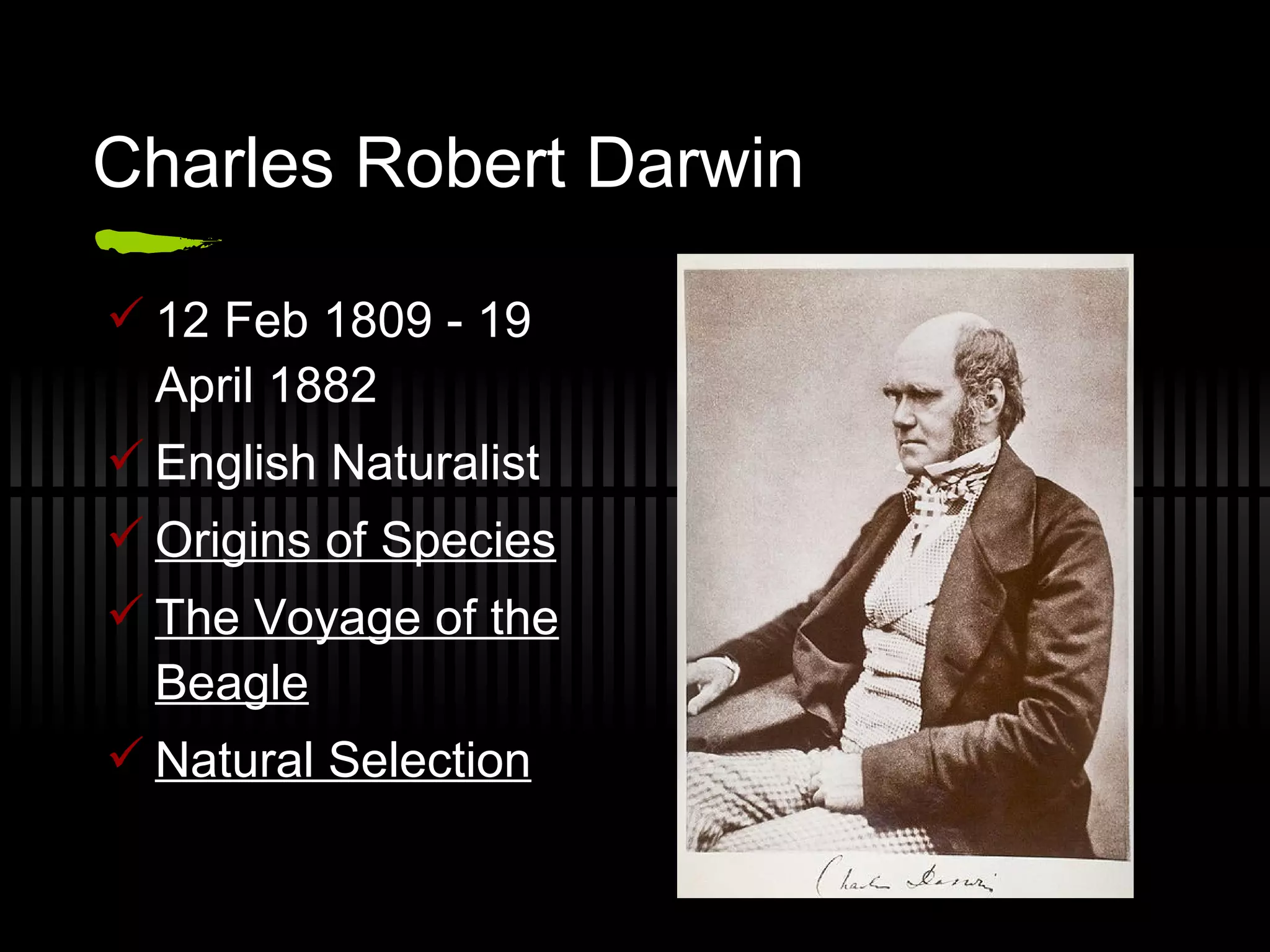
Charles Robert Darwin 12 Feb 1809 - 19 April 1882 English Naturalist Origins of Species The Voyage of the Beagle Natural Selection
Influences on Darwin Thomas Malthus greatly influenced Darwin with his “Essay on Population” Malthus believed that progress not inevitable and nature was not a fair place Population would always outrun resources Suffering would increase despite social improvements Is this happening today?
Darwin’s Major Arguments Saw change and development to be a  consequence  of nature Suggests  Theory of Evolution Humans were not special creations made by God, but evolved from common ancestors through gradual change
Darwin’s Major Arguments Idea of evolution linked with view of the earth People now beginning to see that Earth was millions of years old (not thousands as previously believed) Darwin used this time scale to show plenty of time on earth for evolution to occur Argued that species developed slowly as they adapted to their surroundings Those that could not adapt became extinct (i.e. Survival of the fittest or Natural Selection)
Darwin Destroys Religion Darwin argued the selection process was natural and NOT chosen by God Viewed life as a constant struggle for existence By accepting Darwin’s theories, people believed that peace and harmony were not possible in society Many applied Darwin’s  Struggle for Survival  to politics, ethics, and economics
Social Darwinism Def’n: The application of Darwin’s beliefs to human affairs Herbert Spencer was a major Social Darwinists Spencer believed governments should not change the social environment because it would interfere with personal liberty Believed competition was necessary to allow the most fit Ecouraged  laissez-faire  ideas Spencer’s ideas eventually subsided since people liked the idea that the government helped out (social & welfare programs)
Social Darwinism Also used to support racial theory that a certain group of people are superior to others because of what they have accomplished technologically and scientifically Spain and South America Britain and India European Countries and Africa Hitler and the Aryan Race African Genocides and Ethnic Cleansing Wars
Religion Holding On… Religious institutions were holding on but being challenged daily Dogma or writings were now more clear as people began to study ancient languages and interpret the messages Scholars concluded that the Bible and 5 Books of Moses in Old Testament were written by  several  authors and, therefore, NOT the truth
Religion Holding On… Archaeologists and anthropologists raised questions about origins of Christianity and Judaism Darwin’s arguments added to long list of assaults against the Church Many began to question: What is the purpose of life? What is my relationship with God? What is the soul? Some theologists believed evolution was part of God’s plan
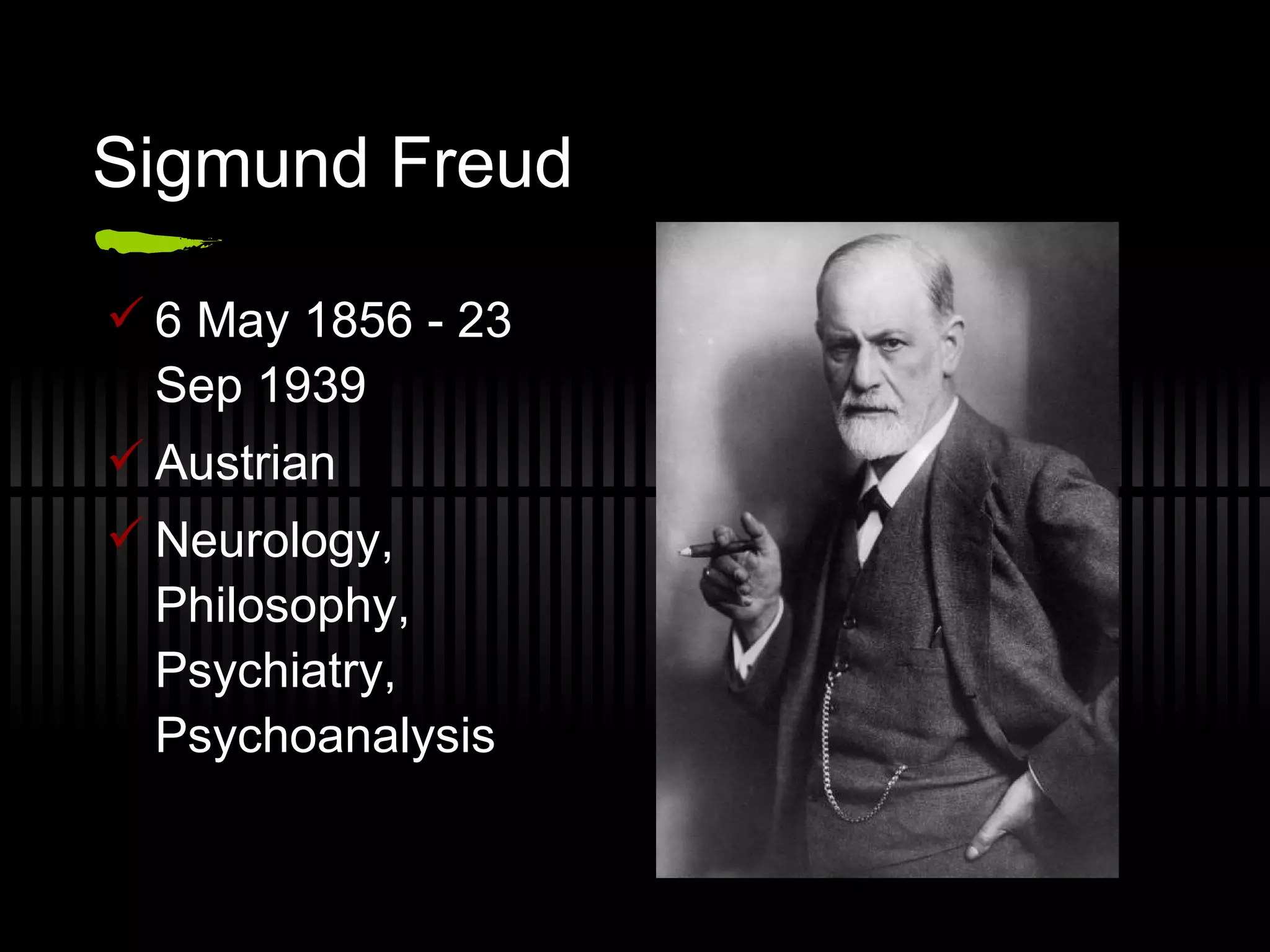
Sigmund Freud 6 May 1856 - 23 Sep 1939 Austrian Neurology, Philosophy, Psychiatry, Psychoanalysis
Freud’s Background Regarded as one of the most innovative thinkers in modern thought Started out in medicine Noticed patients symptoms caused by their minds
Freud’s Two Level Theory Believed two levels of the mind in operation - the conscious and unconscious The unconscious played the primary role - therefore the actions of a person was the result of both rational and irrational motives
Freud’s Other Ideas Childhood greatly influenced the actions of the adult Dreams were the window to the unconscious The Interpretation of Dreams  (1900)
Freud’s Theory on Sexuality Human nature has certain instincts (aggression and sexual desire) which had to be repressed in a civilized world These instincts were part of a person’s ID which represented basic desires However, the ID was always kept in check by the SUPER EGO (the conscience one gains from living in society) The face people present to others is the EGO which is constantly torn btwn the desires of the ID and the repression of the SUPER EGO
Freud’s Infantile Sexuality Theory From birth, an infant is driven by sexual desire Oral Stage: Infant satisfied through sucking Anal Stage: Please from anus through defecation Phallic Stage: Child develops interest in its own sexual organs Also, child develops sexual attraction to parent of opposite sex & hatred of parent of same sex Known as Oedipus Complex Freud derived this theory from dreaming that his older stepbrother was his father. He wished his brother dead which meant he wanted his own father dead because he was competition
Freud’s Infantile Sexuality Theory Phallic Stage cont’d Child then feels guilty and realizes he/she can never overthrow the stronger parent Attraction for opposite sex parent is repressed and makes peace with same sex parent (by age 5) Latency Stage: Sexual motivations subside until puberty where genital masturbation begins
Freud’s Infantile Sexuality Theory Freud believed this process was necessary for NORMAL human development However, his theory caused major controversy because it challenged the Enlightenment view that all humans are rational and reasonable
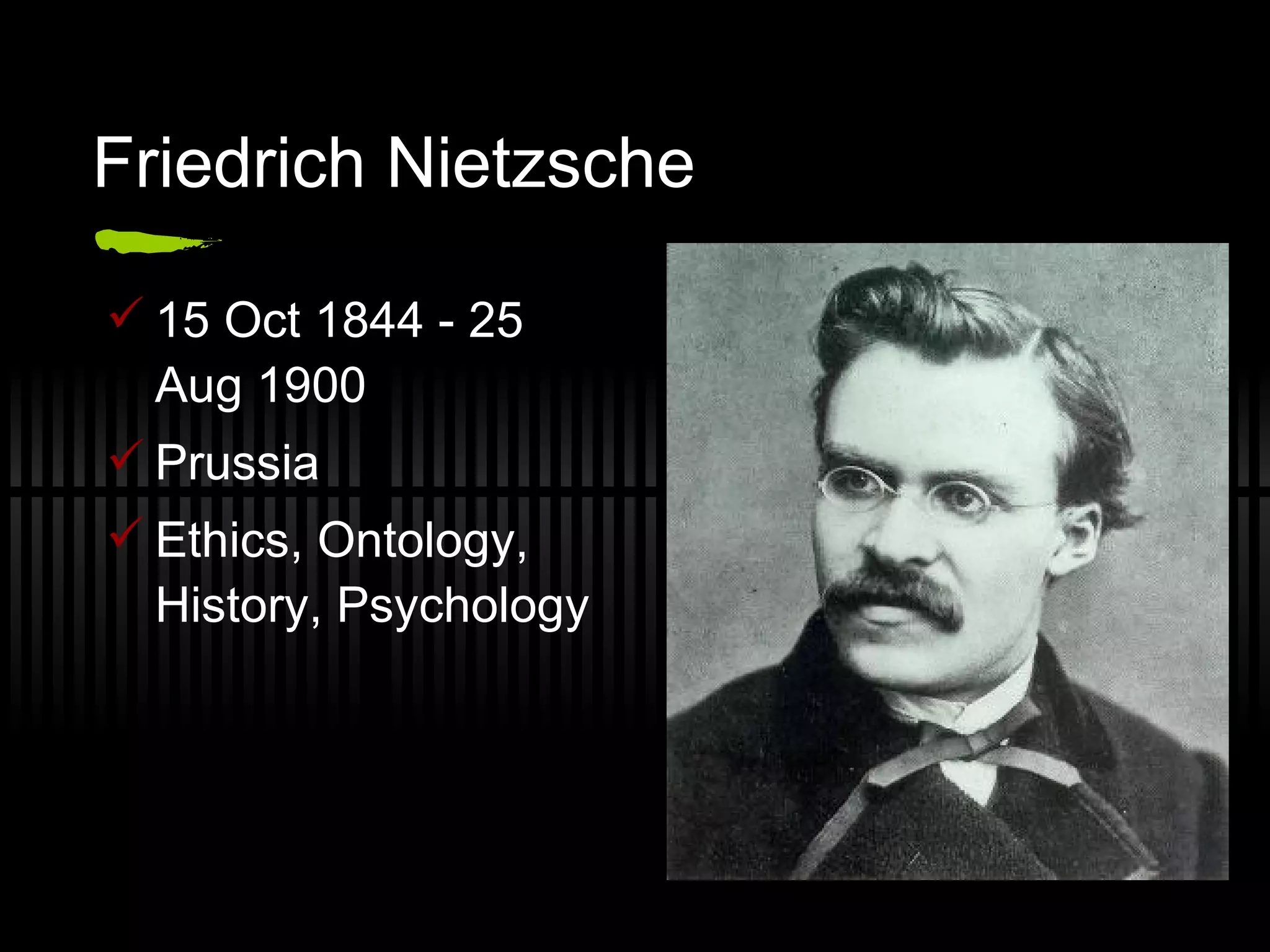
Friedrich Nietzsche 15 Oct 1844 - 25 Aug 1900 Prussia Ethics, Ontology, History, Psychology
Nietzsche’s Thoughts First to propose the irrational and reject the notion of a common humanity Stressed the differences between people Believed people needed to develop their own talents Believed Christianity was the religion of the weak because it forced people to subordinate themselves to myths Didn’t support nationalism because it satisfied the “group” therefore forgetting the “individual”
Follow the Leader… Made a distinction between the “noble man” who determines his own destiny and the “common man” who simply follows others Think: What does your heart truly desire? Now, how many of you are willing to sacrifice everything to get it? What are you afraid of?
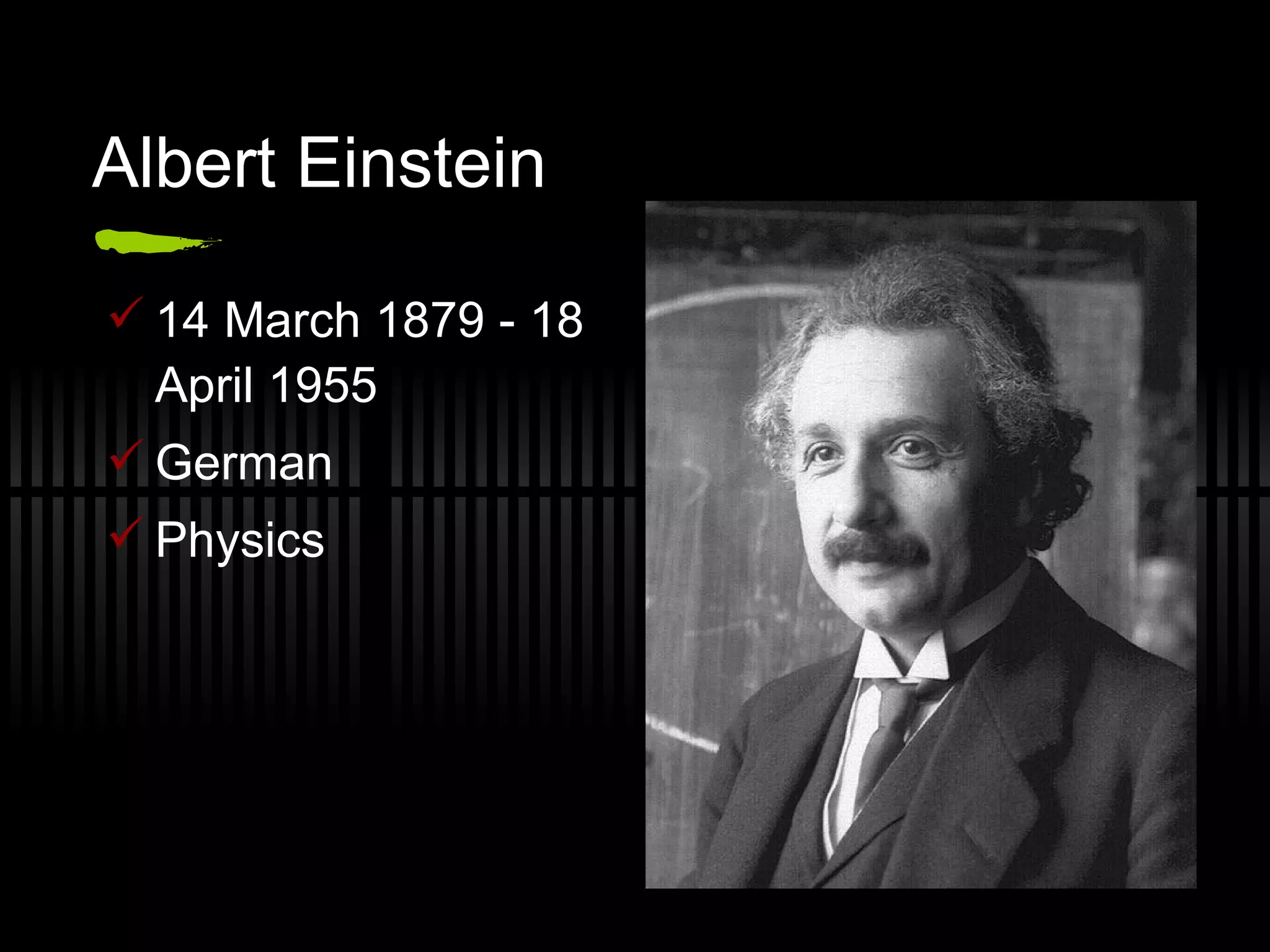
Albert Einstein 14 March 1879 - 18 April 1955 German Physics
Theory of Relativity Introduced in 1905 Argued that  the observer  is important in describing the movement of bodies in space Ex. Train - A person standing in a field will see the speed of a train differently that a person standing on another train Einstein’s system included the observer’s  frame of reference
Theory of Relativity Defined space relatively, not absolutely No accuracy in describing where a planet is in space w/o stating where the person who is measuring is  measuring from Significance: The physics developed by Einstein formed the basis of nuclear technology which allowed people to harness power and build new technology
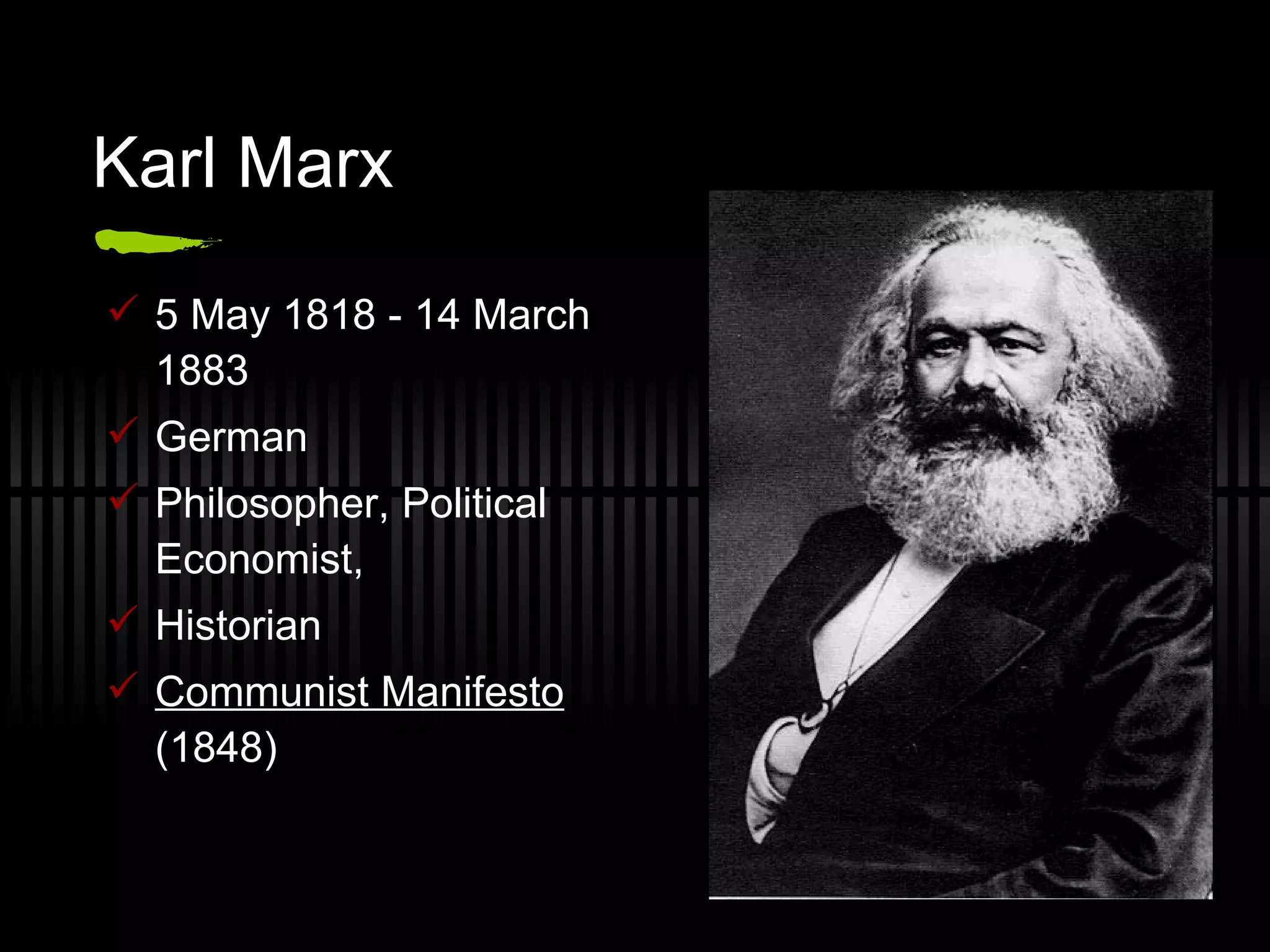
Karl Marx 5 May 1818 - 14 March 1883 German Philosopher, Political Economist, Historian Communist Manifesto  (1848)
Major Arguments Marx summarized his view in the opening line of the  Communist Manifesto “ The history of all hitherto existing society is the history of class struggles.”  Capitalism, like previous economic systems, produces internal tensions Just as Capitalism replaced Feudalism,  Socialism  will in turn replace Capitalism Socialism will succeed because it calls for a stateless, classless society which will emerge after a transitional period
Major Arguments Marx argued that economic change would occur through organized revolutionary action Capitalism would end through the actions of the working class, led by the Communist party "Communism is for us not a state of affairs which is to be established, an ideal to which reality [will] have to adjust itself. We call communism the real movement which abolishes the present state of things. The conditions of this movement result from the premises now in existence.” His ideas were prominent with the workers’ movement and led to the Russian October Revolution in 1917

Transformation of thought1

  • 1.
    The Transformation ofThought Darwin, Freud, Nietzsche, Einstein, and Marx
  • 2.
    Introduction The 19thCentury continued the search for truth and enlightenment General idea that progress would continue through science People also began to care for others’ welfare through charitable organizations From 1850 - 1900s, there was a large amount of optimism
  • 3.
    Charles Robert Darwin12 Feb 1809 - 19 April 1882 English Naturalist Origins of Species The Voyage of the Beagle Natural Selection
  • 4.
    Influences on DarwinThomas Malthus greatly influenced Darwin with his “Essay on Population” Malthus believed that progress not inevitable and nature was not a fair place Population would always outrun resources Suffering would increase despite social improvements Is this happening today?
  • 5.
    Darwin’s Major ArgumentsSaw change and development to be a consequence of nature Suggests Theory of Evolution Humans were not special creations made by God, but evolved from common ancestors through gradual change
  • 6.
    Darwin’s Major ArgumentsIdea of evolution linked with view of the earth People now beginning to see that Earth was millions of years old (not thousands as previously believed) Darwin used this time scale to show plenty of time on earth for evolution to occur Argued that species developed slowly as they adapted to their surroundings Those that could not adapt became extinct (i.e. Survival of the fittest or Natural Selection)
  • 7.
    Darwin Destroys ReligionDarwin argued the selection process was natural and NOT chosen by God Viewed life as a constant struggle for existence By accepting Darwin’s theories, people believed that peace and harmony were not possible in society Many applied Darwin’s Struggle for Survival to politics, ethics, and economics
  • 8.
    Social Darwinism Def’n:The application of Darwin’s beliefs to human affairs Herbert Spencer was a major Social Darwinists Spencer believed governments should not change the social environment because it would interfere with personal liberty Believed competition was necessary to allow the most fit Ecouraged laissez-faire ideas Spencer’s ideas eventually subsided since people liked the idea that the government helped out (social & welfare programs)
  • 9.
    Social Darwinism Alsoused to support racial theory that a certain group of people are superior to others because of what they have accomplished technologically and scientifically Spain and South America Britain and India European Countries and Africa Hitler and the Aryan Race African Genocides and Ethnic Cleansing Wars
  • 10.
    Religion Holding On…Religious institutions were holding on but being challenged daily Dogma or writings were now more clear as people began to study ancient languages and interpret the messages Scholars concluded that the Bible and 5 Books of Moses in Old Testament were written by several authors and, therefore, NOT the truth
  • 11.
    Religion Holding On…Archaeologists and anthropologists raised questions about origins of Christianity and Judaism Darwin’s arguments added to long list of assaults against the Church Many began to question: What is the purpose of life? What is my relationship with God? What is the soul? Some theologists believed evolution was part of God’s plan
  • 12.
    Sigmund Freud 6May 1856 - 23 Sep 1939 Austrian Neurology, Philosophy, Psychiatry, Psychoanalysis
  • 13.
    Freud’s Background Regardedas one of the most innovative thinkers in modern thought Started out in medicine Noticed patients symptoms caused by their minds
  • 14.
    Freud’s Two LevelTheory Believed two levels of the mind in operation - the conscious and unconscious The unconscious played the primary role - therefore the actions of a person was the result of both rational and irrational motives
  • 15.
    Freud’s Other IdeasChildhood greatly influenced the actions of the adult Dreams were the window to the unconscious The Interpretation of Dreams (1900)
  • 16.
    Freud’s Theory onSexuality Human nature has certain instincts (aggression and sexual desire) which had to be repressed in a civilized world These instincts were part of a person’s ID which represented basic desires However, the ID was always kept in check by the SUPER EGO (the conscience one gains from living in society) The face people present to others is the EGO which is constantly torn btwn the desires of the ID and the repression of the SUPER EGO
  • 17.
    Freud’s Infantile SexualityTheory From birth, an infant is driven by sexual desire Oral Stage: Infant satisfied through sucking Anal Stage: Please from anus through defecation Phallic Stage: Child develops interest in its own sexual organs Also, child develops sexual attraction to parent of opposite sex & hatred of parent of same sex Known as Oedipus Complex Freud derived this theory from dreaming that his older stepbrother was his father. He wished his brother dead which meant he wanted his own father dead because he was competition
  • 18.
    Freud’s Infantile SexualityTheory Phallic Stage cont’d Child then feels guilty and realizes he/she can never overthrow the stronger parent Attraction for opposite sex parent is repressed and makes peace with same sex parent (by age 5) Latency Stage: Sexual motivations subside until puberty where genital masturbation begins
  • 19.
    Freud’s Infantile SexualityTheory Freud believed this process was necessary for NORMAL human development However, his theory caused major controversy because it challenged the Enlightenment view that all humans are rational and reasonable
  • 20.
    Friedrich Nietzsche 15Oct 1844 - 25 Aug 1900 Prussia Ethics, Ontology, History, Psychology
  • 21.
    Nietzsche’s Thoughts Firstto propose the irrational and reject the notion of a common humanity Stressed the differences between people Believed people needed to develop their own talents Believed Christianity was the religion of the weak because it forced people to subordinate themselves to myths Didn’t support nationalism because it satisfied the “group” therefore forgetting the “individual”
  • 22.
    Follow the Leader…Made a distinction between the “noble man” who determines his own destiny and the “common man” who simply follows others Think: What does your heart truly desire? Now, how many of you are willing to sacrifice everything to get it? What are you afraid of?
  • 23.
    Albert Einstein 14March 1879 - 18 April 1955 German Physics
  • 24.
    Theory of RelativityIntroduced in 1905 Argued that the observer is important in describing the movement of bodies in space Ex. Train - A person standing in a field will see the speed of a train differently that a person standing on another train Einstein’s system included the observer’s frame of reference
  • 25.
    Theory of RelativityDefined space relatively, not absolutely No accuracy in describing where a planet is in space w/o stating where the person who is measuring is measuring from Significance: The physics developed by Einstein formed the basis of nuclear technology which allowed people to harness power and build new technology
  • 26.
    Karl Marx 5May 1818 - 14 March 1883 German Philosopher, Political Economist, Historian Communist Manifesto (1848)
  • 27.
    Major Arguments Marxsummarized his view in the opening line of the Communist Manifesto “ The history of all hitherto existing society is the history of class struggles.” Capitalism, like previous economic systems, produces internal tensions Just as Capitalism replaced Feudalism, Socialism will in turn replace Capitalism Socialism will succeed because it calls for a stateless, classless society which will emerge after a transitional period
  • 28.
    Major Arguments Marxargued that economic change would occur through organized revolutionary action Capitalism would end through the actions of the working class, led by the Communist party "Communism is for us not a state of affairs which is to be established, an ideal to which reality [will] have to adjust itself. We call communism the real movement which abolishes the present state of things. The conditions of this movement result from the premises now in existence.” His ideas were prominent with the workers’ movement and led to the Russian October Revolution in 1917