PRAGMATISM
Dewey, James & Peirce
Proponents
• Charles Sanders
Peirce
– Coined the word
“pragmatism” =
Gk. “pragmatikos”
or “praktikos”
means practical.
Proponents
• William James
– “An idea must have
practical and
satisfactory results.”
– “Pragmatism is a
method of solving or
evaluating intellectual
problems and a
theory about the
kinds of knowledge
we are capable of
acquiring.”
Proponents
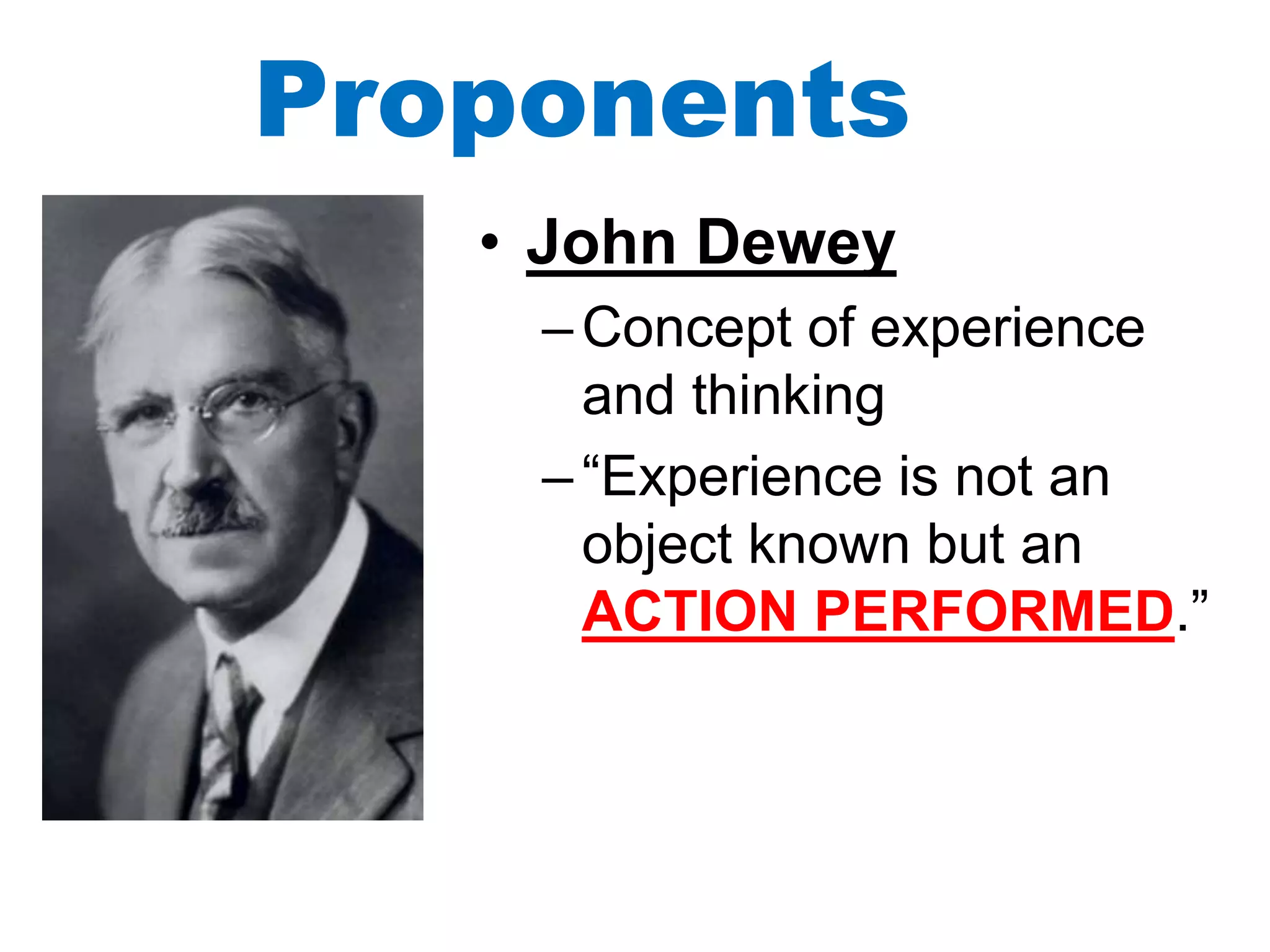
• John Dewey
–Concept of experience
and thinking
–“Experience is not an
object known but an
ACTION PERFORMED.”
Pragmatism
Generic Notions
• Pragmatism is the philosophy that encourages
people to find processes that work in order to
achieve their desired ends.
• Reality is that everything changes.
• Theme: “The world is constantly changing and
we have to adapt.”
Pragmatism
• They study the past but they are generally
more interested in contemporary issues
and in discovering solutions to problems in
present-day terms.
Pragmatism
Question Asked:
• “What will work to achieve my desired ends?”
problemspeculative thoughtactionresults
 Then question: “Do the results achieved solve
the problem?”  Then solution is valid.
Pragmatism
as Applied in
Education
Goals of Education
• Develop and apply practical knowledge
and skills for life in a progressive
democratic society.
• Individual growth through processes,
experience and problem solving.
Nature of Curriculum
• Child and process-centered.
Role of Learners
1) Active learning and participation
2) Problem-solvers
3) Observe the scientific method
4) Curious
5) Critical result & process oriented
Role of the Teacher
1) Teach inductive and deductive reasoning,
the scientific method, and the powers of
observation and practice.
2) Facilitator/dynamic
3) Good classroom manager
4) Result and process-oriented
Method of Teaching
1) Hands-on curricula
2) Group work
3) Scientific method
4) Experimental
Subjects Studied
• Emphasis on citizenship, knowledge
and skills applicable to daily life and
career or job preparation.
Nature of Classroom
1) Flexible
2) Rich in opportunities for students
to experience what they are
learning.
Source of Knowing
• Challenging EXPERIENCE.
Influences on the Present
Educational System
• Learning by EXPERIENCE.
Pragmatism and Education

Pragmatism and Education

  • 1.
  • 2.
    Proponents • Charles Sanders Peirce –Coined the word “pragmatism” = Gk. “pragmatikos” or “praktikos” means practical.
  • 3.
    Proponents • William James –“An idea must have practical and satisfactory results.” – “Pragmatism is a method of solving or evaluating intellectual problems and a theory about the kinds of knowledge we are capable of acquiring.”
  • 4.
    Proponents • John Dewey –Conceptof experience and thinking –“Experience is not an object known but an ACTION PERFORMED.”
  • 6.
    Pragmatism Generic Notions • Pragmatismis the philosophy that encourages people to find processes that work in order to achieve their desired ends. • Reality is that everything changes. • Theme: “The world is constantly changing and we have to adapt.”
  • 7.
    Pragmatism • They studythe past but they are generally more interested in contemporary issues and in discovering solutions to problems in present-day terms.
  • 8.
    Pragmatism Question Asked: • “Whatwill work to achieve my desired ends?” problemspeculative thoughtactionresults  Then question: “Do the results achieved solve the problem?”  Then solution is valid.
  • 9.
  • 11.
    Goals of Education •Develop and apply practical knowledge and skills for life in a progressive democratic society. • Individual growth through processes, experience and problem solving.
  • 12.
    Nature of Curriculum •Child and process-centered.
  • 13.
    Role of Learners 1)Active learning and participation 2) Problem-solvers 3) Observe the scientific method 4) Curious 5) Critical result & process oriented
  • 14.
    Role of theTeacher 1) Teach inductive and deductive reasoning, the scientific method, and the powers of observation and practice. 2) Facilitator/dynamic 3) Good classroom manager 4) Result and process-oriented
  • 15.
    Method of Teaching 1)Hands-on curricula 2) Group work 3) Scientific method 4) Experimental
  • 16.
    Subjects Studied • Emphasison citizenship, knowledge and skills applicable to daily life and career or job preparation.
  • 17.
    Nature of Classroom 1)Flexible 2) Rich in opportunities for students to experience what they are learning.
  • 18.
    Source of Knowing •Challenging EXPERIENCE.
  • 19.
    Influences on thePresent Educational System • Learning by EXPERIENCE.