What is
LITERATURE?
The word literature is derived
from the Latin term Litera which
means letter.
It has been defined by various
writers.
Because literature deals
with ideas, thoughts and
emotions of man, literature
can be said to be the story of
man.
Man’s loves, grieves,
thoughts, dreams, and
aspirations coached in a
beautiful language is
Literature.
• In order to know the history of a
nation’s spirit, one must read its
literature.
• Brother Azurin defines Literature that it
expresses the feelings of people to
society, to the government, to his
surroundings, to his Fellowmen and
to his Divine Creator.
• Webster defines literature
as anything that is printed,
as long as it is related to the
ideas and feelings of people,
whether it is true, or just a
product of one’s
imagination.
Philippine
Pre-Colonial
Literature
Prepared by: Ms. Irish Verone M. Polidario
21st Century Literature from the Philippines and the
The variety and abundance of
Philippine literature evolved even
before the colonial periods.
Folk tales, epics, poems and
marathon chants existed in most
ethno linguistic groups that were
passed on from generation to
generation through word of mouth.
Some of these pre-colonial literary
pieces showcased in traditional narratives,
speeches and songs are Tigmo in Cebuano,
Bugtong in Tagalog, Patototdon in Bicol and
Paktakon in Ilonggo.
Philippine epics and folk tales are
varied and filled with magical characters.
They are either narratives of mostly
mythical objects, persons or certain places,
or epics telling supernatural events and
bravery of heroes, customs and ideologies of
Owing to the works of our own
archaeologists, ethnologists and
anthropologists, we are able to know more
and better judge information about our pre-
colonial times set against a bulk of material
about early Filipinos as recorded by Spanish,
Chinese, Arabic and other chroniclers of the
past.
Pre-colonial inhabitants of our islands
showcase a rich past through their folk
speeches, folk songs, folk narratives and
indigenous rituals and mimetic dances that
EPIC
Epic is a long poem, typically
one derived from ancient oral
tradition, narrating the deeds
and adventures of heroic or
legendary figures or the
history of a nation.
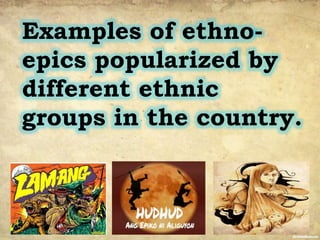
Examples of ethno-
epics popularized by
different ethnic
groups in the country.
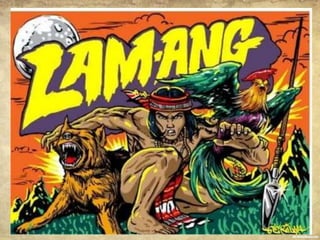
1. Biag ni Lam-ang (Life of Lam-
ang)
of the Ilocanos narrates the adventures of
the prodigious epic hero, Lam-ang who
exhibits extraordinary powers at an early
age. At nine months he is able to go to war
to look for his father’s killers. Then while
in search of lady love, Ines Kannoyan, he
is swallowed by a big fish, but his rooster
and his friends bring him back to life.
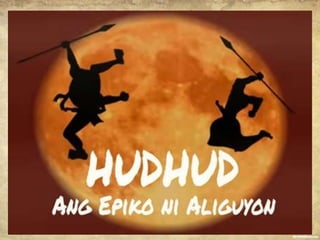
2. Aliguyon or the Hudhud
of the Ifugaos tells of the adventures of
Aliguyon as he battles his arch enemy,
Pambukhayon among rice fields and
terraces and instructs his people to be
steadfast and learn the wisdom of warfare
and of peacemaking during harvest
seasons.
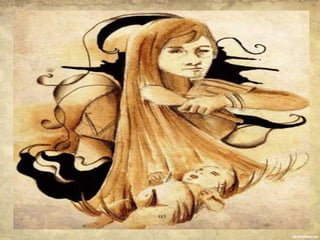
3. Sandayo
of the Subanon tells of the story of the
hero with the same name, who is born
through extraordinary circumstances as
he fell out of the hair of his mother
while she was combing it on the ninth
stroke. Thence, he leads his people in
the fight against invaders of their land
and waterways.
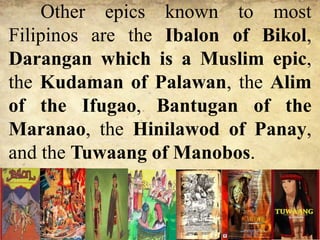
Other epics known to most
Filipinos are the Ibalon of Bikol,
Darangan which is a Muslim epic,
the Kudaman of Palawan, the Alim
of the Ifugao, Bantugan of the
Maranao, the Hinilawod of Panay,
and the Tuwaang of Manobos.
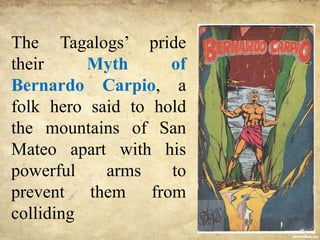
The Tagalogs’ pride
their Myth of
Bernardo Carpio, a
folk hero said to hold
the mountains of San
Mateo apart with his
powerful arms to
prevent them from
colliding
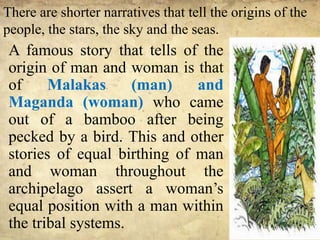
There are shorter narratives that tell the origins of the
people, the stars, the sky and the seas.
A famous story that tells of the
origin of man and woman is that
of Malakas (man) and
Maganda (woman) who came
out of a bamboo after being
pecked by a bird. This and other
stories of equal birthing of man
and woman throughout the
archipelago assert a woman’s
equal position with a man within
the tribal systems.
LITERARY
FORMS DURING
THE
PRE-COLONIAL
PERIOD
MYTH
Myth is a narrative that describes and
portrays in symbolic language the origin
of the basic elements and assumptions of
a culture. Mythic narrative relates, for
example, how the world began, how
humans and animals were created, and
how certain customs, gestures, or forms
of human activities originated. Almost
all cultures possess or at one time
possessed and lived in terms of myths.
Myths are traditional stories occurring in a
timeless past. They involve supernatural
elements and are beyond the frontiers of
logic. Long ago, when our ancestors heard the
sound of thunder and saw lightning, they were
frightened because they could not understand why
these things happened. In order to understand
these and other natural events, they created stories.
The stories were handed down from generation to
generation all over the country. Although myths
are not based on objective truth, they reflect both
universal worries and the worries of specific
cultures.
WORLD LITERATURE:
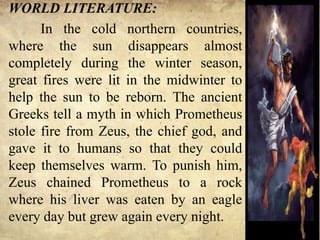
In the cold northern countries,
where the sun disappears almost
completely during the winter season,
great fires were lit in the midwinter to
help the sun to be reborn. The ancient
Greeks tell a myth in which Prometheus
stole fire from Zeus, the chief god, and
gave it to humans so that they could
keep themselves warm. To punish him,
Zeus chained Prometheus to a rock
where his liver was eaten by an eagle
every day but grew again every night.
Myths from the Different Regions of
the Philippines
a. The Gods and Goddesses (Ilocos)
b. Why There is a High Tide during a Full
Moon (Ibanag)
c. Why the Dead Come Back No More
(Ifugao)
d. Mag-asawang Tubig (Tagalog)
e. How the Moon and the Stars Came to Be
(Bukidnon – Mindanao)
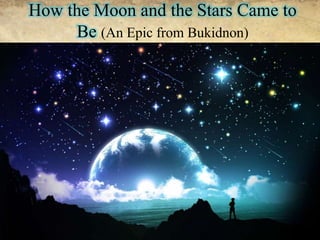
How the Moon and the Stars Came to
Be (An Epic from Bukidnon)
How the Moon and the Stars Came to
Be (An Epic from Bukidnon)
One day in the times when the sky was close to the
ground a spinster went out to pound rice. Before she
began her work, she took off the beads from around her
neck and the comb from her hair, and hung them on the
sky, which at that time looked like coral rock.
Then she began working, and each time that she
raised her pestle into the air it struck the sky. For some
time she pounded the rice, and then she raised the pestle
so high that it struck the sky very hard.
Immediately the sky began to rise, and it went up
so far that she lost her ornaments. Never did they come
down, for the comb became the moon and the beads are
the stars that are scattered about.

PHILIPPINE PRE-COLONIAL LITERATURE (incomplete)

  • 1.
  • 2.
    The word literatureis derived from the Latin term Litera which means letter. It has been defined by various writers.
  • 3.
    Because literature deals withideas, thoughts and emotions of man, literature can be said to be the story of man. Man’s loves, grieves, thoughts, dreams, and aspirations coached in a beautiful language is Literature.
  • 4.
    • In orderto know the history of a nation’s spirit, one must read its literature. • Brother Azurin defines Literature that it expresses the feelings of people to society, to the government, to his surroundings, to his Fellowmen and to his Divine Creator.
  • 5.
    • Webster definesliterature as anything that is printed, as long as it is related to the ideas and feelings of people, whether it is true, or just a product of one’s imagination.
  • 6.
    Philippine Pre-Colonial Literature Prepared by: Ms.Irish Verone M. Polidario 21st Century Literature from the Philippines and the
  • 7.
    The variety andabundance of Philippine literature evolved even before the colonial periods. Folk tales, epics, poems and marathon chants existed in most ethno linguistic groups that were passed on from generation to generation through word of mouth.
  • 8.
    Some of thesepre-colonial literary pieces showcased in traditional narratives, speeches and songs are Tigmo in Cebuano, Bugtong in Tagalog, Patototdon in Bicol and Paktakon in Ilonggo. Philippine epics and folk tales are varied and filled with magical characters. They are either narratives of mostly mythical objects, persons or certain places, or epics telling supernatural events and bravery of heroes, customs and ideologies of
  • 9.
    Owing to theworks of our own archaeologists, ethnologists and anthropologists, we are able to know more and better judge information about our pre- colonial times set against a bulk of material about early Filipinos as recorded by Spanish, Chinese, Arabic and other chroniclers of the past. Pre-colonial inhabitants of our islands showcase a rich past through their folk speeches, folk songs, folk narratives and indigenous rituals and mimetic dances that
  • 10.
    EPIC Epic is along poem, typically one derived from ancient oral tradition, narrating the deeds and adventures of heroic or legendary figures or the history of a nation.
  • 11.
    Examples of ethno- epicspopularized by different ethnic groups in the country.
  • 13.
    1. Biag niLam-ang (Life of Lam- ang) of the Ilocanos narrates the adventures of the prodigious epic hero, Lam-ang who exhibits extraordinary powers at an early age. At nine months he is able to go to war to look for his father’s killers. Then while in search of lady love, Ines Kannoyan, he is swallowed by a big fish, but his rooster and his friends bring him back to life.
  • 15.
    2. Aliguyon orthe Hudhud of the Ifugaos tells of the adventures of Aliguyon as he battles his arch enemy, Pambukhayon among rice fields and terraces and instructs his people to be steadfast and learn the wisdom of warfare and of peacemaking during harvest seasons.
  • 17.
    3. Sandayo of theSubanon tells of the story of the hero with the same name, who is born through extraordinary circumstances as he fell out of the hair of his mother while she was combing it on the ninth stroke. Thence, he leads his people in the fight against invaders of their land and waterways.
  • 18.
    Other epics knownto most Filipinos are the Ibalon of Bikol, Darangan which is a Muslim epic, the Kudaman of Palawan, the Alim of the Ifugao, Bantugan of the Maranao, the Hinilawod of Panay, and the Tuwaang of Manobos.
  • 19.
    The Tagalogs’ pride theirMyth of Bernardo Carpio, a folk hero said to hold the mountains of San Mateo apart with his powerful arms to prevent them from colliding
  • 20.
    There are shorternarratives that tell the origins of the people, the stars, the sky and the seas. A famous story that tells of the origin of man and woman is that of Malakas (man) and Maganda (woman) who came out of a bamboo after being pecked by a bird. This and other stories of equal birthing of man and woman throughout the archipelago assert a woman’s equal position with a man within the tribal systems.
  • 21.
  • 22.
    MYTH Myth is anarrative that describes and portrays in symbolic language the origin of the basic elements and assumptions of a culture. Mythic narrative relates, for example, how the world began, how humans and animals were created, and how certain customs, gestures, or forms of human activities originated. Almost all cultures possess or at one time possessed and lived in terms of myths.
  • 23.
    Myths are traditionalstories occurring in a timeless past. They involve supernatural elements and are beyond the frontiers of logic. Long ago, when our ancestors heard the sound of thunder and saw lightning, they were frightened because they could not understand why these things happened. In order to understand these and other natural events, they created stories. The stories were handed down from generation to generation all over the country. Although myths are not based on objective truth, they reflect both universal worries and the worries of specific cultures.
  • 24.
    WORLD LITERATURE: In thecold northern countries, where the sun disappears almost completely during the winter season, great fires were lit in the midwinter to help the sun to be reborn. The ancient Greeks tell a myth in which Prometheus stole fire from Zeus, the chief god, and gave it to humans so that they could keep themselves warm. To punish him, Zeus chained Prometheus to a rock where his liver was eaten by an eagle every day but grew again every night.
  • 25.
    Myths from theDifferent Regions of the Philippines a. The Gods and Goddesses (Ilocos) b. Why There is a High Tide during a Full Moon (Ibanag) c. Why the Dead Come Back No More (Ifugao) d. Mag-asawang Tubig (Tagalog) e. How the Moon and the Stars Came to Be (Bukidnon – Mindanao)
  • 26.
    How the Moonand the Stars Came to Be (An Epic from Bukidnon)
  • 27.
    How the Moonand the Stars Came to Be (An Epic from Bukidnon) One day in the times when the sky was close to the ground a spinster went out to pound rice. Before she began her work, she took off the beads from around her neck and the comb from her hair, and hung them on the sky, which at that time looked like coral rock. Then she began working, and each time that she raised her pestle into the air it struck the sky. For some time she pounded the rice, and then she raised the pestle so high that it struck the sky very hard. Immediately the sky began to rise, and it went up so far that she lost her ornaments. Never did they come down, for the comb became the moon and the beads are the stars that are scattered about.