COUNSELING
Prepared by: Ms. Ivy Polidario
DEFINITION OF COUNSELING
 The Collins Dictionary of Sociology defines counseling as “the
process of guiding a person during a stage of life when
reassessments or decisions have to be made about himself or
herself and his or her life course.”
 Counselors are professionally trained and certified to
perform counseling. Their job is to provide advice or
guidance in decision-making in emotionally significant
situations by helping clients explore and understand their
words and discover better ways and well-informed choices in
resolving an emotional problem.
COUNSELING
Counselors exist in a wide range of areas of expertise:
marriage, family, youth, student and other life transitions
dealing with managing of issues of loss and death,
retirement, divorce, parenting, and bankruptcy.
Counseling is widely considered the heart of the guidance
services in schools. In the school contexts, counseling is
usually done as individual or group intervention designed to
facilitate positive change in student behavior, feelings, and
attitudes.
COUNSELING
Counseling is not to be confused with psychiatry, which is a
branch of general medicine that deals with the treatment of
the mentally ill by medically-trained professionals using
clinical interventions including drugs, surgical procedures,
and non-physical approaches.
PRINCIPLES OF COUNSELING
The principles of counseling can be found in the basic process
of counseling since they govern each and every step:
developing trust; exploring problem areas; helping to set
goals; empowering into action; helping to maintain change;
and agreeing when to end. (Velleman, 2001)
PRINCIPLES OF COUNSELING
1. Advice
Counseling may involve advice-giving as one of the
several functions that counselors perform. When this is done,
the requirement is that a counselor makes judgments about a
counselee’s problems and lays out options for a course of
action.
PRINCIPLES OF COUNSELING
2. Reassurance
Counseling involves providing clients with reassurance,
which is a way of giving them courage to face a problem or
confidence that they are pursuing a suitable course of action.
Reassurance is a valuable principle because it can bring about
a sense of relief that may empower a client to function
normally again.
PRINCIPLES OF COUNSELING
3. Release of emotional tension.
Counseling provides clients the opportunity to get
emotional release from their pent-up frustrations and other
personal issues.
Counseling experience shows that as persons begin to
explain their concerns to a sympathetic listener, their tensions
begin to subside. They become more relaxed and the release
of tensions helps remove mental blocks by providing a
solution to the problem.
PRINCIPLES OF COUNSELING
4. Clarified thinking
It tends to take place while the counselor and counselee
are talking and therefore becomes a logical emotional release.
As this relationship goes on, other self-empowering results
may take place later as a result of developments during the
counseling relationship.
Clarified thinking encourages a client to accept
responsibility for problems and to be more realistic in solving
them.
PRINCIPLES OF COUNSELING
5. Reorientation
It involves a change in the client’s emotional self
through a change in basic goals and aspirations. This requires
a revision of the client’s level of aspiration to bring it more in
line with actual and realistic attainment. It enables clients to
recognize and accept their own limitations. The counselor’s
job is to recognize those in need of reorientation and facilitate
appropriate interventions.
PRINCIPLES OF COUNSELING
6. Listening skills
Listening attentively to clients is the counselor’s attempt
to understand both the content of the clients’ problem as they
see it, and the emotions they are experiencing related to the
problem.
Good listening helps counselors to understand the
concerns being presented.
PRINCIPLES OF COUNSELING
7. Respect
In all circumstances, clients must be treated with
respect, no matter how peculiar, strange, disturbed, weird, or
utterly different from the counselor. Without this basic
element, successful counseling is impossible.
Counselors do not have to like the client, or their
values, or their behavior, but they have to put their personal
feelings aside and treat the client with respect.
PRINCIPLES OF COUNSELING
8. Empathy and positive regard
Carl Rogers combined empathy and positive regard as
two principles that should go along with respect and effective
listening skills.
Empathy requires the counselor to listen and understand
the feelings and perspective of the client and positive regard is
an aspect of respect.
For Rogers, clients have to be given both “unconditional
positive regard” and be treated with respect.
PRINCIPLES OF COUNSELING
9. Clarification, confrontation, and interpretation
Clarification is an attempt by the counselor to restate
what the client is either saying or feeling, so the client may
learn something or understand the issue better. Confrontation
and interpretation are other more advanced principles used by
counselors in their interventions.
PRINCIPLES OF COUNSELING
10. Transference and countertransference
When clients are helped to understand transference
reactions, they are empowered to gain understanding of
important aspects of their emotional life.
Countertransference helps both clients and counselors to
understand the emotional and perceptional reactions and how
to effectively manage them.
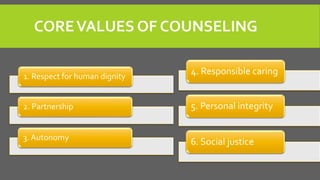
COREVALUES OF COUNSELING
1. Respect for human dignity
2. Partnership
3. Autonomy
4. Responsible caring
5. Personal integrity
6. Social justice
SOURCE:
 Rex Book store: Discipline and Ideas in the Applied Social Sciences
by Elias M. Sampa

COUNSELING

  • 1.
  • 2.
    DEFINITION OF COUNSELING The Collins Dictionary of Sociology defines counseling as “the process of guiding a person during a stage of life when reassessments or decisions have to be made about himself or herself and his or her life course.”  Counselors are professionally trained and certified to perform counseling. Their job is to provide advice or guidance in decision-making in emotionally significant situations by helping clients explore and understand their words and discover better ways and well-informed choices in resolving an emotional problem.
  • 3.
    COUNSELING Counselors exist ina wide range of areas of expertise: marriage, family, youth, student and other life transitions dealing with managing of issues of loss and death, retirement, divorce, parenting, and bankruptcy. Counseling is widely considered the heart of the guidance services in schools. In the school contexts, counseling is usually done as individual or group intervention designed to facilitate positive change in student behavior, feelings, and attitudes.
  • 4.
    COUNSELING Counseling is notto be confused with psychiatry, which is a branch of general medicine that deals with the treatment of the mentally ill by medically-trained professionals using clinical interventions including drugs, surgical procedures, and non-physical approaches.
  • 5.
    PRINCIPLES OF COUNSELING Theprinciples of counseling can be found in the basic process of counseling since they govern each and every step: developing trust; exploring problem areas; helping to set goals; empowering into action; helping to maintain change; and agreeing when to end. (Velleman, 2001)
  • 6.
    PRINCIPLES OF COUNSELING 1.Advice Counseling may involve advice-giving as one of the several functions that counselors perform. When this is done, the requirement is that a counselor makes judgments about a counselee’s problems and lays out options for a course of action.
  • 7.
    PRINCIPLES OF COUNSELING 2.Reassurance Counseling involves providing clients with reassurance, which is a way of giving them courage to face a problem or confidence that they are pursuing a suitable course of action. Reassurance is a valuable principle because it can bring about a sense of relief that may empower a client to function normally again.
  • 8.
    PRINCIPLES OF COUNSELING 3.Release of emotional tension. Counseling provides clients the opportunity to get emotional release from their pent-up frustrations and other personal issues. Counseling experience shows that as persons begin to explain their concerns to a sympathetic listener, their tensions begin to subside. They become more relaxed and the release of tensions helps remove mental blocks by providing a solution to the problem.
  • 9.
    PRINCIPLES OF COUNSELING 4.Clarified thinking It tends to take place while the counselor and counselee are talking and therefore becomes a logical emotional release. As this relationship goes on, other self-empowering results may take place later as a result of developments during the counseling relationship. Clarified thinking encourages a client to accept responsibility for problems and to be more realistic in solving them.
  • 10.
    PRINCIPLES OF COUNSELING 5.Reorientation It involves a change in the client’s emotional self through a change in basic goals and aspirations. This requires a revision of the client’s level of aspiration to bring it more in line with actual and realistic attainment. It enables clients to recognize and accept their own limitations. The counselor’s job is to recognize those in need of reorientation and facilitate appropriate interventions.
  • 11.
    PRINCIPLES OF COUNSELING 6.Listening skills Listening attentively to clients is the counselor’s attempt to understand both the content of the clients’ problem as they see it, and the emotions they are experiencing related to the problem. Good listening helps counselors to understand the concerns being presented.
  • 12.
    PRINCIPLES OF COUNSELING 7.Respect In all circumstances, clients must be treated with respect, no matter how peculiar, strange, disturbed, weird, or utterly different from the counselor. Without this basic element, successful counseling is impossible. Counselors do not have to like the client, or their values, or their behavior, but they have to put their personal feelings aside and treat the client with respect.
  • 13.
    PRINCIPLES OF COUNSELING 8.Empathy and positive regard Carl Rogers combined empathy and positive regard as two principles that should go along with respect and effective listening skills. Empathy requires the counselor to listen and understand the feelings and perspective of the client and positive regard is an aspect of respect. For Rogers, clients have to be given both “unconditional positive regard” and be treated with respect.
  • 14.
    PRINCIPLES OF COUNSELING 9.Clarification, confrontation, and interpretation Clarification is an attempt by the counselor to restate what the client is either saying or feeling, so the client may learn something or understand the issue better. Confrontation and interpretation are other more advanced principles used by counselors in their interventions.
  • 15.
    PRINCIPLES OF COUNSELING 10.Transference and countertransference When clients are helped to understand transference reactions, they are empowered to gain understanding of important aspects of their emotional life. Countertransference helps both clients and counselors to understand the emotional and perceptional reactions and how to effectively manage them.
  • 16.
    COREVALUES OF COUNSELING 1.Respect for human dignity 2. Partnership 3. Autonomy 4. Responsible caring 5. Personal integrity 6. Social justice
  • 17.
    SOURCE:  Rex Bookstore: Discipline and Ideas in the Applied Social Sciences by Elias M. Sampa