from the Regions
Group activity:
Directions:
Count 1 to 3
Form a circle.
Try to guess the following
questions in 5 minutes.
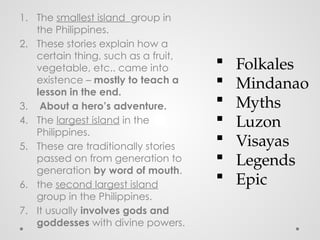
1. The smallest island group in
the Philippines.
2. These stories explain how a
certain thing, such as a fruit,
vegetable, etc.. came into
existence – mostly to teach a
lesson in the end.
3. About a hero’s adventure.
4. The largest island in the
Philippines.
5. These are traditionally stories
passed on from generation to
generation by word of mouth.
6. the second largest island
group in the Philippines.
7. It usually involves gods and
goddesses with divine powers.
 Folkales
 Mindanao
 Myths
 Luzon
 Visayas
 Legends
 Epic
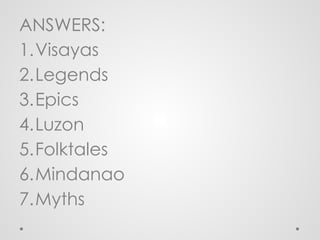
ANSWERS:
1.Visayas
2.Legends
3.Epics
4.Luzon
5.Folktales
6.Mindanao
7.Myths
Listen carefully because there’s no
choices in quiz.
“Learn to appreciate every single of
your life, whether it’s good or bad
for it will become a part of your
memories later on.”
-Life Quotes
Learning Objectives
• Identify some of the major literary
works from different regions.
• Describe the major literary works from
a particular region.
• Appreciate a literary work by
analyzing an epic.
At the end of the lesson, you should be
able to:
Some literary genres common
in the regions:
oEpics
oLegends
oMyths
oFolktalesFolklores
Epics
 These are lengthy
narrative poems that are
usually about a hero’s
adventure.
 Some examples of epics
include Biag ni Lam-ang,
Ibalon and Hinilawod.
Legends
 These are traditional stories that are passed
down from generation to generation that could
not be verified to be true.
 These stories explain how a certain thing, such
as a fruit, vegetable, etc.. came into existence –
mostly to teach a lesson in the end.
Example:
Alamat ng Pinya- is one of the popular legends
here in the country. It is the story about a girl
named Pinang who always asks her mother Aling
Rosa where she can find things. Aling Rosa
wishes Pinang to have more than a pair of eyes so
she can find things on her own. One morning,
Aling Rosa was surprised that Pinang turned into
a pinya (pineapple).
These are stories that explain a belief, custom or
strange natural phenomenon. It usually involves
gods and goddesses with divine powers.
Example:
Why The Sky Is High
- is a myth about brothers Ingat and Daskol. Ingat
was more favored by his parents than Daskol. Ingat, as his
name implies, was careful, whereas Daskol performed his
duties clumsily. One day, he was angrily pounding a huge
amount of palay. Eager to finish his work quikly, Daskol
would raise the pestle so high that it hit the sky. His anger
added up to his strength that every time he would raise the
pestle, the sky would be raised higher. When he was done,
he looked up and noticed how far the sky already was.
Myths
These are traditionally stories passed on from
generation to generation by word of mouth.
They often include myths, legends and
sometimes superstitious beliefs. Juan Tamad is
one of the most popular folktales in the
country.
Juan tamad - is a story about a man named Juan who was
extremely lazy. In one of the story’s versions, Juan was
instructed by his mother to buy crabs in the market. On his
way home, he heard his friends playing near the riverbank.
Juan wanted to join them. So he released the crabs into the
shore as he believes that the crabs can reach their house.
Noon came and Juan hurried home. His mother was so
angry and asked where the crabs are. Juan was so scared
of his mother that after telling what he did to the crabs he
immediately hid at the backyard.
FolktalesFolklores
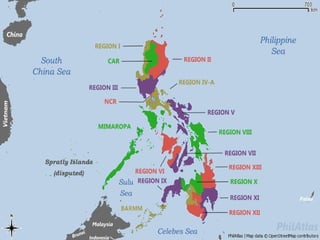
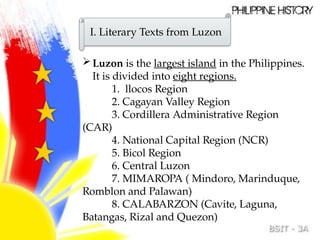
Luzon is the largest island in the Philippines.
It is divided into eight regions.
1. llocos Region
2. Cagayan Valley Region
3. Cordillera Administrative Region
(CAR)
4. National Capital Region (NCR)
5. Bicol Region
6. Central Luzon
7. MIMAROPA ( Mindoro, Marinduque,
Romblon and Palawan)
8. CALABARZON (Cavite, Laguna,
Batangas, Rizal and Quezon)
I. Literary Texts from Luzon
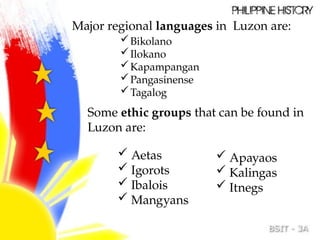
Bikolano
Ilokano
Kapampangan
Pangasinense
Tagalog
 Aetas
 Igorots
 Ibalois
 Mangyans
Major regional languages in Luzon are:
Some ethic groups that can be found in
Luzon are:
 Apayaos
 Kalingas
 Itnegs
Some of the major literary
works from Luzon:
1. Ibalon or Ibalong (Bicol Region) - -
this is an epic about three heroes–
Baltog, Handiong and Bantong–
who all defeated their adversaries.
2. Hudhud (Cagayan Valley Region)–
this an epic chanted by the Ifugaos
during harvest. It is about a folk hero
name Aliguyon and his 3 year battle
with Pumbakhayon.
3. The legend of Maria Makiling
(CALABARZON)– this is story about a
mountain in Laguna named Makiling
that was guarded by a fairy named
Maria. The townsfolk fondly called her
Mariang Makiling.
4. Biag ni Lam-ang (Ilocos Region)– this
is an epic about Lam-ang, a man with
extraordinary strength who sets out to
find his missing father Don Juan.
II. Literary Texts from Visayas
Visayas is the smallest island group in
the Philippines.
It is divided into three regions:
Western Visayas
Central Visayas
Eastern Visayas
The major regional languages in
Visayas are:
Cebuano
Hiligaynon or Ilonggo
Kinaray-a
Waray
Seven main islands in
Visayas are:
1. Bohol
2. Cebu
3. Panay
4. Samar
5. Negros
6. Leyte
7. Masbate
Some of the major literary works from
Visayas:
1. Hinilawod (Western Visayas)– this is an
epic that tells about the adventures of three
demigod brothers namely Dumalapdap,
Labaw Donggon and Humadapnon. This
28,000 verse epic is one of the longest epics
in the world.
2. Sicalac and Sicavay (Central Visayas)– this
is a creation myth about how man (Sicalac)
and woman (Sicavay) came into existence
through a bamboo shoot.
3. Tungkung Langit and Alunsina (Western
Visayas)– this is a creation myth about the
gods Tungkung Langit and Alunsina.
III. Literary Texts in Mindanao
 Mindanao is the second largest island
group in the Philippines.
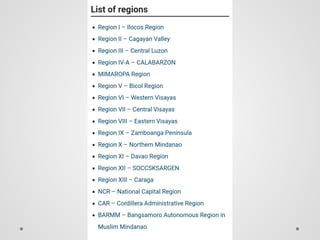
 It is divided into six regions:
1. Davao Region
2. Zamboanga Peninsula
3. Northern Mindanao
4. SOCCSKSARGEN ( South
Cotabato, Cotabato, Sultan Kudarat,
Sarangani and General Santos)
5. ARMM (Autonomous Region in
Muslim Mindanao)
6. Caraga Region
Major regional languages in
mindanao are;
 Chavacano
Maguindanao
 Maranao
 Tausug
The region is generally inhabited by Muslims.
Although they are no longer a majority, the
Islamic culture is still evident.
Large groups of ethnic minorities can be
found in Mindanao such as Maranao,
Maguindanao, Ilanun and Sangil. These groups
are also referred to as a Moro. Meanwhile, the
following groups are found in the uplands:
the Bagobo, Bukidnon, Manadaya, Manobo
and Subanon.
Major literary works from Mindanao
1. Bantugan
– this is a Maranao epic that tells about
the brave Prince Bantugan of Bumbaran
whom no one dares to challenge. King Madali
is jealous of his brother Bantugan and
commands his people not to talk to Bantugan.
This prompts Bantugan to leave their
kingdom.
2. Ag Tobig nog Keboklagan or The
Kingdom of Keboklagan
– this is a Subanen epic that is chanted
or performed during their week-long buklog
festival. It tells the life and adventures of an
extraordinary hero named Taake.
3. Ulahingan
– this is a Manobo epic about Agyu and
his family who fled due to a conflict with their
rules. A fairy guides them and promises to
grant them immortality after they surpass
various challenges.
4. Indarapatra at Sulayman
– this is an epic about four creatures that
came to wreak havoc in Mindanao. King
Indarapatra sends his brother Prince
Sulayman to save the land from the creatures.
5. Tuwaang attends a Wedding
– this is a Bagobo epic about a hero
named Tuwaang who attends the wedding of
the Maiden Monawon.
IV. Other Notable Literary Works
 Aside from legends, myths, folktales and epic,
the Philippines is home to great fiction
writers. While most of them have already
been conferred as National Artists in
Literature, some are also recognized
internationally for their exceptional writing
prowess.
Below are some of the remarkable literary texts in the country:
 “The Bread of Salt” by N.V.M. Gonzales
 “The Summer Solstice” by Nick Joaquin
 Ginto sa Makiling by Macario Pineda
 “Scent of Apples” by Bienvenido Santos
 Sa Mga Kuko ng liwanag ( In the Claws of Brightness) by
Edgardo Reyes
 Impeng Negro by Rogelio Sikat
 Dekada ‘70 by Lualhati Bautista
 Footnote to Youth by Jose Garcia Villa
Footnote to Youth excerpt
Taeng did not complain, but the bearing
of children told on her. She was shapeless and
thin now, even if she was young. There was
interminable work to be done. Cooking.
Laundering. The house. The children. She cried
sometimes, wishing she had not married. She did
not tell Dodong this, not wishing him to dislike
her. Yet she had not married. Not even Dodong,
whom she loved. There had been another suitor,
Lucio, older than Dodong by nine years, and that
was why she had chosen Dodong. Seventeen.
Lucio had married another after her marriage to
Dodong, but he was childless until now. She
wondered if she had married Lucio, would she
have borne him children. Maybe not either. That
was a better lot. But she loved Dodong….
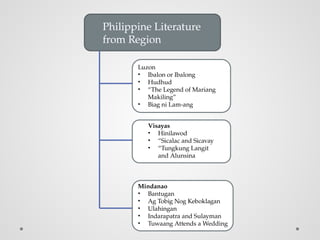
Philippine Literature
from Region
Luzon
• Ibalon or Ibalong
• Hudhud
• “The Legend of Mariang
Makiling”
• Biag ni Lam-ang
Visayas
• Hinilawod
• “Sicalac and Sicavay
• “Tungkung Langit
and Alunsina
Mindanao
• Bantugan
• Ag Tobig Nog Keboklagan
• Ulahingan
• Indarapatra and Sulayman
• Tuwaang Attends a Wedding
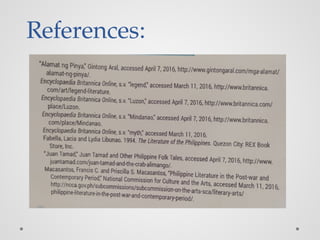
References:
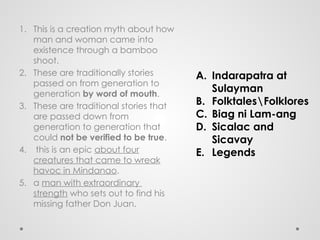
1. This is a creation myth about how
man and woman came into
existence through a bamboo
shoot.
2. These are traditionally stories
passed on from generation to
generation by word of mouth.
3. These are traditional stories that
are passed down from
generation to generation that
could not be verified to be true.
4. this is an epic about four
creatures that came to wreak
havoc in Mindanao.
5. a man with extraordinary
strength who sets out to find his
missing father Don Juan.
A. Indarapatra at
Sulayman
B. FolktalesFolklores
C. Biag ni Lam-ang
D. Sicalac and
Sicavay
E. Legends
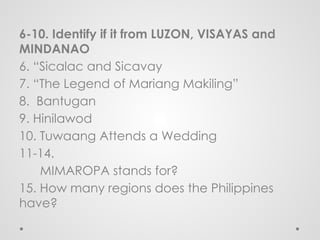
6-10. Identify if it from LUZON, VISAYAS and
MINDANAO
6. “Sicalac and Sicavay
7. “The Legend of Mariang Makiling”
8. Bantugan
9. Hinilawod
10. Tuwaang Attends a Wedding
11-14.
MIMAROPA stands for?
15. How many regions does the Philippines
have?
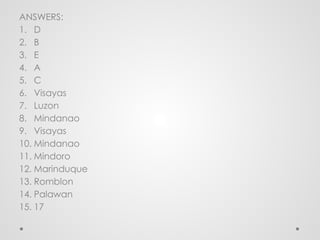
ANSWERS:
1. D
2. B
3. E
4. A
5. C
6. Visayas
7. Luzon
8. Mindanao
9. Visayas
10. Mindanao
11. Mindoro
12. Marinduque
13. Romblon
14. Palawan
15. 17

21st century lesson2 power point presentation

  • 1.
  • 3.
    Group activity: Directions: Count 1to 3 Form a circle. Try to guess the following questions in 5 minutes.
  • 4.
    1. The smallestisland group in the Philippines. 2. These stories explain how a certain thing, such as a fruit, vegetable, etc.. came into existence – mostly to teach a lesson in the end. 3. About a hero’s adventure. 4. The largest island in the Philippines. 5. These are traditionally stories passed on from generation to generation by word of mouth. 6. the second largest island group in the Philippines. 7. It usually involves gods and goddesses with divine powers.  Folkales  Mindanao  Myths  Luzon  Visayas  Legends  Epic
  • 5.
  • 7.
    Listen carefully becausethere’s no choices in quiz.
  • 8.
    “Learn to appreciateevery single of your life, whether it’s good or bad for it will become a part of your memories later on.” -Life Quotes
  • 9.
    Learning Objectives • Identifysome of the major literary works from different regions. • Describe the major literary works from a particular region. • Appreciate a literary work by analyzing an epic. At the end of the lesson, you should be able to:
  • 10.
    Some literary genrescommon in the regions: oEpics oLegends oMyths oFolktalesFolklores
  • 11.
    Epics  These arelengthy narrative poems that are usually about a hero’s adventure.  Some examples of epics include Biag ni Lam-ang, Ibalon and Hinilawod.
  • 12.
    Legends  These aretraditional stories that are passed down from generation to generation that could not be verified to be true.  These stories explain how a certain thing, such as a fruit, vegetable, etc.. came into existence – mostly to teach a lesson in the end. Example: Alamat ng Pinya- is one of the popular legends here in the country. It is the story about a girl named Pinang who always asks her mother Aling Rosa where she can find things. Aling Rosa wishes Pinang to have more than a pair of eyes so she can find things on her own. One morning, Aling Rosa was surprised that Pinang turned into a pinya (pineapple).
  • 13.
    These are storiesthat explain a belief, custom or strange natural phenomenon. It usually involves gods and goddesses with divine powers. Example: Why The Sky Is High - is a myth about brothers Ingat and Daskol. Ingat was more favored by his parents than Daskol. Ingat, as his name implies, was careful, whereas Daskol performed his duties clumsily. One day, he was angrily pounding a huge amount of palay. Eager to finish his work quikly, Daskol would raise the pestle so high that it hit the sky. His anger added up to his strength that every time he would raise the pestle, the sky would be raised higher. When he was done, he looked up and noticed how far the sky already was. Myths
  • 14.
    These are traditionallystories passed on from generation to generation by word of mouth. They often include myths, legends and sometimes superstitious beliefs. Juan Tamad is one of the most popular folktales in the country. Juan tamad - is a story about a man named Juan who was extremely lazy. In one of the story’s versions, Juan was instructed by his mother to buy crabs in the market. On his way home, he heard his friends playing near the riverbank. Juan wanted to join them. So he released the crabs into the shore as he believes that the crabs can reach their house. Noon came and Juan hurried home. His mother was so angry and asked where the crabs are. Juan was so scared of his mother that after telling what he did to the crabs he immediately hid at the backyard. FolktalesFolklores
  • 17.
    Luzon is thelargest island in the Philippines. It is divided into eight regions. 1. llocos Region 2. Cagayan Valley Region 3. Cordillera Administrative Region (CAR) 4. National Capital Region (NCR) 5. Bicol Region 6. Central Luzon 7. MIMAROPA ( Mindoro, Marinduque, Romblon and Palawan) 8. CALABARZON (Cavite, Laguna, Batangas, Rizal and Quezon) I. Literary Texts from Luzon
  • 18.
    Bikolano Ilokano Kapampangan Pangasinense Tagalog  Aetas  Igorots Ibalois  Mangyans Major regional languages in Luzon are: Some ethic groups that can be found in Luzon are:  Apayaos  Kalingas  Itnegs
  • 19.
    Some of themajor literary works from Luzon: 1. Ibalon or Ibalong (Bicol Region) - - this is an epic about three heroes– Baltog, Handiong and Bantong– who all defeated their adversaries. 2. Hudhud (Cagayan Valley Region)– this an epic chanted by the Ifugaos during harvest. It is about a folk hero name Aliguyon and his 3 year battle with Pumbakhayon.
  • 20.
    3. The legendof Maria Makiling (CALABARZON)– this is story about a mountain in Laguna named Makiling that was guarded by a fairy named Maria. The townsfolk fondly called her Mariang Makiling. 4. Biag ni Lam-ang (Ilocos Region)– this is an epic about Lam-ang, a man with extraordinary strength who sets out to find his missing father Don Juan.
  • 21.
    II. Literary Textsfrom Visayas Visayas is the smallest island group in the Philippines. It is divided into three regions: Western Visayas Central Visayas Eastern Visayas The major regional languages in Visayas are: Cebuano Hiligaynon or Ilonggo Kinaray-a Waray
  • 22.
    Seven main islandsin Visayas are: 1. Bohol 2. Cebu 3. Panay 4. Samar 5. Negros 6. Leyte 7. Masbate
  • 23.
    Some of themajor literary works from Visayas: 1. Hinilawod (Western Visayas)– this is an epic that tells about the adventures of three demigod brothers namely Dumalapdap, Labaw Donggon and Humadapnon. This 28,000 verse epic is one of the longest epics in the world. 2. Sicalac and Sicavay (Central Visayas)– this is a creation myth about how man (Sicalac) and woman (Sicavay) came into existence through a bamboo shoot. 3. Tungkung Langit and Alunsina (Western Visayas)– this is a creation myth about the gods Tungkung Langit and Alunsina.
  • 24.
    III. Literary Textsin Mindanao  Mindanao is the second largest island group in the Philippines.  It is divided into six regions: 1. Davao Region 2. Zamboanga Peninsula 3. Northern Mindanao 4. SOCCSKSARGEN ( South Cotabato, Cotabato, Sultan Kudarat, Sarangani and General Santos) 5. ARMM (Autonomous Region in Muslim Mindanao) 6. Caraga Region
  • 25.
    Major regional languagesin mindanao are;  Chavacano Maguindanao  Maranao  Tausug The region is generally inhabited by Muslims. Although they are no longer a majority, the Islamic culture is still evident. Large groups of ethnic minorities can be found in Mindanao such as Maranao, Maguindanao, Ilanun and Sangil. These groups are also referred to as a Moro. Meanwhile, the following groups are found in the uplands: the Bagobo, Bukidnon, Manadaya, Manobo and Subanon.
  • 26.
    Major literary worksfrom Mindanao 1. Bantugan – this is a Maranao epic that tells about the brave Prince Bantugan of Bumbaran whom no one dares to challenge. King Madali is jealous of his brother Bantugan and commands his people not to talk to Bantugan. This prompts Bantugan to leave their kingdom. 2. Ag Tobig nog Keboklagan or The Kingdom of Keboklagan – this is a Subanen epic that is chanted or performed during their week-long buklog festival. It tells the life and adventures of an extraordinary hero named Taake.
  • 27.
    3. Ulahingan – thisis a Manobo epic about Agyu and his family who fled due to a conflict with their rules. A fairy guides them and promises to grant them immortality after they surpass various challenges. 4. Indarapatra at Sulayman – this is an epic about four creatures that came to wreak havoc in Mindanao. King Indarapatra sends his brother Prince Sulayman to save the land from the creatures. 5. Tuwaang attends a Wedding – this is a Bagobo epic about a hero named Tuwaang who attends the wedding of the Maiden Monawon.
  • 28.
    IV. Other NotableLiterary Works  Aside from legends, myths, folktales and epic, the Philippines is home to great fiction writers. While most of them have already been conferred as National Artists in Literature, some are also recognized internationally for their exceptional writing prowess. Below are some of the remarkable literary texts in the country:  “The Bread of Salt” by N.V.M. Gonzales  “The Summer Solstice” by Nick Joaquin  Ginto sa Makiling by Macario Pineda  “Scent of Apples” by Bienvenido Santos  Sa Mga Kuko ng liwanag ( In the Claws of Brightness) by Edgardo Reyes  Impeng Negro by Rogelio Sikat  Dekada ‘70 by Lualhati Bautista  Footnote to Youth by Jose Garcia Villa
  • 29.
    Footnote to Youthexcerpt Taeng did not complain, but the bearing of children told on her. She was shapeless and thin now, even if she was young. There was interminable work to be done. Cooking. Laundering. The house. The children. She cried sometimes, wishing she had not married. She did not tell Dodong this, not wishing him to dislike her. Yet she had not married. Not even Dodong, whom she loved. There had been another suitor, Lucio, older than Dodong by nine years, and that was why she had chosen Dodong. Seventeen. Lucio had married another after her marriage to Dodong, but he was childless until now. She wondered if she had married Lucio, would she have borne him children. Maybe not either. That was a better lot. But she loved Dodong….
  • 30.
    Philippine Literature from Region Luzon •Ibalon or Ibalong • Hudhud • “The Legend of Mariang Makiling” • Biag ni Lam-ang Visayas • Hinilawod • “Sicalac and Sicavay • “Tungkung Langit and Alunsina Mindanao • Bantugan • Ag Tobig Nog Keboklagan • Ulahingan • Indarapatra and Sulayman • Tuwaang Attends a Wedding
  • 31.
  • 33.
    1. This isa creation myth about how man and woman came into existence through a bamboo shoot. 2. These are traditionally stories passed on from generation to generation by word of mouth. 3. These are traditional stories that are passed down from generation to generation that could not be verified to be true. 4. this is an epic about four creatures that came to wreak havoc in Mindanao. 5. a man with extraordinary strength who sets out to find his missing father Don Juan. A. Indarapatra at Sulayman B. FolktalesFolklores C. Biag ni Lam-ang D. Sicalac and Sicavay E. Legends
  • 34.
    6-10. Identify ifit from LUZON, VISAYAS and MINDANAO 6. “Sicalac and Sicavay 7. “The Legend of Mariang Makiling” 8. Bantugan 9. Hinilawod 10. Tuwaang Attends a Wedding 11-14. MIMAROPA stands for? 15. How many regions does the Philippines have?
  • 35.
    ANSWERS: 1. D 2. B 3.E 4. A 5. C 6. Visayas 7. Luzon 8. Mindanao 9. Visayas 10. Mindanao 11. Mindoro 12. Marinduque 13. Romblon 14. Palawan 15. 17