PHILIPPINE POLITICS AND GOVERNANCE
Prepared by: Irish Verone Polidario
What is CITIZENSHIP
Citizenship is a membership in a political
community which is personal and more or
less permanent in character.
Section 1, Article IV of the 1987 Philippine
Constitution identified the citizens of the
Philippines as:
1. Those who are citizens of the Philippines at the
time of the adoption of this Constitution;
2. Those whose fathers and mothers are citizens of
the Philippines;
3. Those born before January 17, 1973, of Filipino
mothers, who elect Philippine citizenship upon
reaching the age of majority which is 21 years old;
and
4. Those who are naturalized in accordance with law.
Natural-born citizens are those who are
citizens of the Philippines from birth without
having to perform any act to acquire or
perfect their citizenship (Sec. 2, Article IV)
By birth
By naturalization
What is NATURALIZATION?
It is a legal process which those persons who are formerly citizens
of other countries has applied for naturalization in accordance with
law in a certain state in order to become a citizen of that country.
There are 2 general principles applicable to this mode.
They are:
1. JUS SANGUINIS- literally means “law of blood”.
2. JUS SOLI- literally means “law of the soil”.
(place of birth)
Natural-Born Citizen
Naturalized Citizen
A natural-born citizen is one who is already a citizen
of the state at the time of birth. He does not perform an
act to acquire or perfect his citizenship.
A naturalized citizen is one who is a citizen of one
country and who through an intervening act which is
naturalization, becomes a citizen of another country.
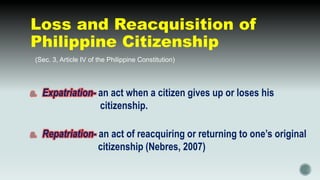
Loss and Reacquisition of
Philippine Citizenship
 (Sec. 3, Article IV of the Philippine Constitution)
a. Expatriation- an act when a citizen gives up or loses his
citizenship.
a. Repatriation- an act of reacquiring or returning to one’s original
citizenship (Nebres, 2007)
CITIZENSHIP
CITIZENSHIP
CITIZENSHIP

CITIZENSHIP

  • 1.
    PHILIPPINE POLITICS ANDGOVERNANCE Prepared by: Irish Verone Polidario
  • 2.
    What is CITIZENSHIP Citizenshipis a membership in a political community which is personal and more or less permanent in character.
  • 3.
    Section 1, ArticleIV of the 1987 Philippine Constitution identified the citizens of the Philippines as: 1. Those who are citizens of the Philippines at the time of the adoption of this Constitution; 2. Those whose fathers and mothers are citizens of the Philippines;
  • 4.
    3. Those bornbefore January 17, 1973, of Filipino mothers, who elect Philippine citizenship upon reaching the age of majority which is 21 years old; and 4. Those who are naturalized in accordance with law.
  • 5.
    Natural-born citizens arethose who are citizens of the Philippines from birth without having to perform any act to acquire or perfect their citizenship (Sec. 2, Article IV)
  • 6.
    By birth By naturalization Whatis NATURALIZATION? It is a legal process which those persons who are formerly citizens of other countries has applied for naturalization in accordance with law in a certain state in order to become a citizen of that country.
  • 7.
    There are 2general principles applicable to this mode. They are: 1. JUS SANGUINIS- literally means “law of blood”. 2. JUS SOLI- literally means “law of the soil”. (place of birth)
  • 8.
    Natural-Born Citizen Naturalized Citizen Anatural-born citizen is one who is already a citizen of the state at the time of birth. He does not perform an act to acquire or perfect his citizenship. A naturalized citizen is one who is a citizen of one country and who through an intervening act which is naturalization, becomes a citizen of another country.
  • 9.
    Loss and Reacquisitionof Philippine Citizenship  (Sec. 3, Article IV of the Philippine Constitution) a. Expatriation- an act when a citizen gives up or loses his citizenship. a. Repatriation- an act of reacquiring or returning to one’s original citizenship (Nebres, 2007)