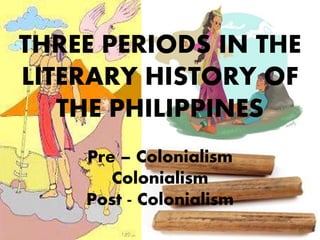
THREE PERIODS IN THE
LITERARY HISTORY OF
THE PHILIPPINES
Pre – Colonialism
Colonialism
Post - Colonialism
Pre - Colonialism
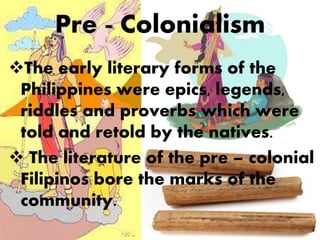
The early literary forms of the
Philippines were epics, legends,
riddles and proverbs which were
told and retold by the natives.
 The literature of the pre – colonial
Filipinos bore the marks of the
community.
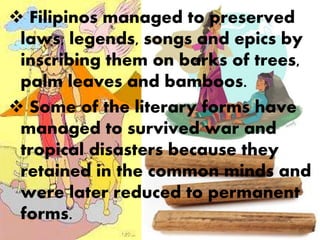
 Filipinos managed to preserved
laws, legends, songs and epics by
inscribing them on barks of trees,
palm leaves and bamboos.
 Some of the literary forms have
managed to survived war and
tropical disasters because they
retained in the common minds and
were later reduced to permanent
forms.
LITERARY FORMS
 RIDDLE (bugtong)
 EPIGRAMS / MAXIMS /
PROVERBS (SALAWIKAIN &
SAWIKAIN)
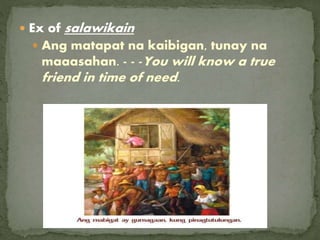
 Ex of salawikain
 Ang matapat na kaibigan, tunay na
maaasahan. - - -You will know a true
friend in time of need.
 Ex of Sawikain
 kumukulo ang dugo
"blood is boiling" = is very angry
 isulat sa tubig
"write on water" = forget about it
Ex of Maxims
 Pag hindi ukol,
Hindi bubukol.
-means
What is not intended for one will not bear
fruit.
CHANTS (BULONG)
used in witchcraft and/or
enchantment
 Tanaga
a quatrain expressing insights
and lessons in life
Ex. “Tahak ng tingin, tulak
ng sulyap, yakap, lapat
ng titig sa balikat.
hatak pa, kindat, hakat”
 traditional poetry of the Hanunoo
Mangyans of Oriental Mindoro which is
normally inscribed on bamboo using a
pre-Colonial syllabic writing system
called the Surat Mangyan .
 usually chanted
 teaches lessons about life
 recited by parents to educate their
children, by the youth to express their
love, by the old to impart experiences,
or by the community in tribal
ceremonies
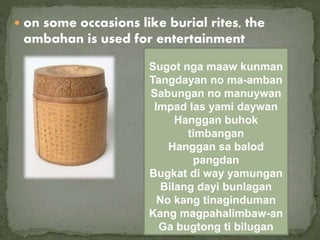
 on some occasions like burial rites, the
ambahan is used for entertainment
Sugot nga maaw kunman
Tangdayan no ma-amban
Sabungan no manuywan
Impad las yami daywan
Hanggan buhok
timbangan
Hanggan sa balod
pangdan
Bugkat di way yamungan
Bilang dayi bunlagan
No kang tinaginduman
Kang magpahalimbaw-an
Ga bugtong ti bilugan
 Explain how the world was created,
how animals possess certain
characteristics, why some places
have volcanoes, mountains etc.
Story of Bathala
The Legend of Maria Makiling
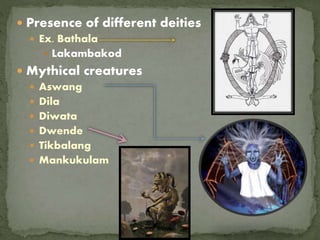
 Presence of different deities
 Ex. Bathala
 Lakambakod
 Mythical creatures
 Aswang
 Dila
 Diwata
 Dwende
 Tikbalang
 Mankukulam
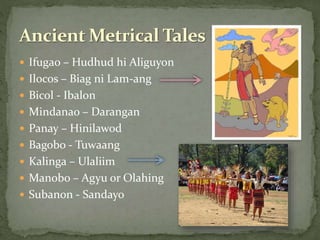
 Ifugao – Hudhud hi Aliguyon
 Ilocos – Biag ni Lam-ang
 Bicol - Ibalon
 Mindanao – Darangan
 Panay – Hinilawod
 Bagobo - Tuwaang
 Kalinga – Ulaliim
 Manobo – Agyu or Olahing
 Subanon - Sandayo
 Aliguyon
 the exploits of Aliguyon as he battles his
arch-enemy, Pambukhayon
 Biag ni Lam-Ang
 tells of the adventures of Lam-Ang who
exhibits extraordinary powers at a very
early age.
 Ibalon
 the story of three Bicol heroes: Baltog,
Handiong, Bantiong
 Hinilawod
 oldest and longest epic poem in Panay
 the exploits of three Sulodnon demigod
brothers, LabawDonggon, Humadapnon and
Dumalapdap of ancient Panay
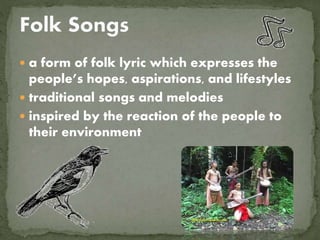
 a form of folk lyric which expresses the
people’s hopes, aspirations, and lifestyles
 traditional songs and melodies
 inspired by the reaction of the people to
their environment
 uyayi – lullaby
 komintang – war song
 kundiman – melancholic love song
 harana – serenade
 Tagay (Cebuano/Waray) – drinking song
 mambayu – Kalinga rice-pounding song
 subli – dance-ritual song of courtship
/marriage
 Kanogan (Cebuano) – song of lamentation
for the dead.
PHILIPPINE
LITERATURE
DURING SPANISH
COLONIZATION
A. Spanish Religious
Works
B. Formative
Language
C. Nationalist Stage
Philippine Literature
During American
Regime

Literary History of the Philippines (Pre-Colonialism Period)

  • 1.
    THREE PERIODS INTHE LITERARY HISTORY OF THE PHILIPPINES Pre – Colonialism Colonialism Post - Colonialism
  • 2.
    Pre - Colonialism Theearly literary forms of the Philippines were epics, legends, riddles and proverbs which were told and retold by the natives.  The literature of the pre – colonial Filipinos bore the marks of the community.
  • 3.
     Filipinos managedto preserved laws, legends, songs and epics by inscribing them on barks of trees, palm leaves and bamboos.  Some of the literary forms have managed to survived war and tropical disasters because they retained in the common minds and were later reduced to permanent forms.
  • 4.
    LITERARY FORMS  RIDDLE(bugtong)  EPIGRAMS / MAXIMS / PROVERBS (SALAWIKAIN & SAWIKAIN)
  • 5.
     Ex ofsalawikain  Ang matapat na kaibigan, tunay na maaasahan. - - -You will know a true friend in time of need.
  • 6.
     Ex ofSawikain  kumukulo ang dugo "blood is boiling" = is very angry  isulat sa tubig "write on water" = forget about it Ex of Maxims  Pag hindi ukol, Hindi bubukol. -means What is not intended for one will not bear fruit.
  • 7.
    CHANTS (BULONG) used inwitchcraft and/or enchantment  Tanaga a quatrain expressing insights and lessons in life Ex. “Tahak ng tingin, tulak ng sulyap, yakap, lapat ng titig sa balikat. hatak pa, kindat, hakat”
  • 8.
     traditional poetryof the Hanunoo Mangyans of Oriental Mindoro which is normally inscribed on bamboo using a pre-Colonial syllabic writing system called the Surat Mangyan .  usually chanted  teaches lessons about life  recited by parents to educate their children, by the youth to express their love, by the old to impart experiences, or by the community in tribal ceremonies
  • 9.
     on someoccasions like burial rites, the ambahan is used for entertainment Sugot nga maaw kunman Tangdayan no ma-amban Sabungan no manuywan Impad las yami daywan Hanggan buhok timbangan Hanggan sa balod pangdan Bugkat di way yamungan Bilang dayi bunlagan No kang tinaginduman Kang magpahalimbaw-an Ga bugtong ti bilugan
  • 10.
     Explain howthe world was created, how animals possess certain characteristics, why some places have volcanoes, mountains etc. Story of Bathala The Legend of Maria Makiling
  • 11.
     Presence ofdifferent deities  Ex. Bathala  Lakambakod  Mythical creatures  Aswang  Dila  Diwata  Dwende  Tikbalang  Mankukulam
  • 12.
     Ifugao –Hudhud hi Aliguyon  Ilocos – Biag ni Lam-ang  Bicol - Ibalon  Mindanao – Darangan  Panay – Hinilawod  Bagobo - Tuwaang  Kalinga – Ulaliim  Manobo – Agyu or Olahing  Subanon - Sandayo
  • 13.
     Aliguyon  theexploits of Aliguyon as he battles his arch-enemy, Pambukhayon  Biag ni Lam-Ang  tells of the adventures of Lam-Ang who exhibits extraordinary powers at a very early age.  Ibalon  the story of three Bicol heroes: Baltog, Handiong, Bantiong  Hinilawod  oldest and longest epic poem in Panay  the exploits of three Sulodnon demigod brothers, LabawDonggon, Humadapnon and Dumalapdap of ancient Panay
  • 14.
     a formof folk lyric which expresses the people’s hopes, aspirations, and lifestyles  traditional songs and melodies  inspired by the reaction of the people to their environment
  • 15.
     uyayi –lullaby  komintang – war song  kundiman – melancholic love song  harana – serenade  Tagay (Cebuano/Waray) – drinking song  mambayu – Kalinga rice-pounding song  subli – dance-ritual song of courtship /marriage  Kanogan (Cebuano) – song of lamentation for the dead.
  • 16.
  • 17.
    A. Spanish Religious Works B.Formative Language C. Nationalist Stage
  • 18.