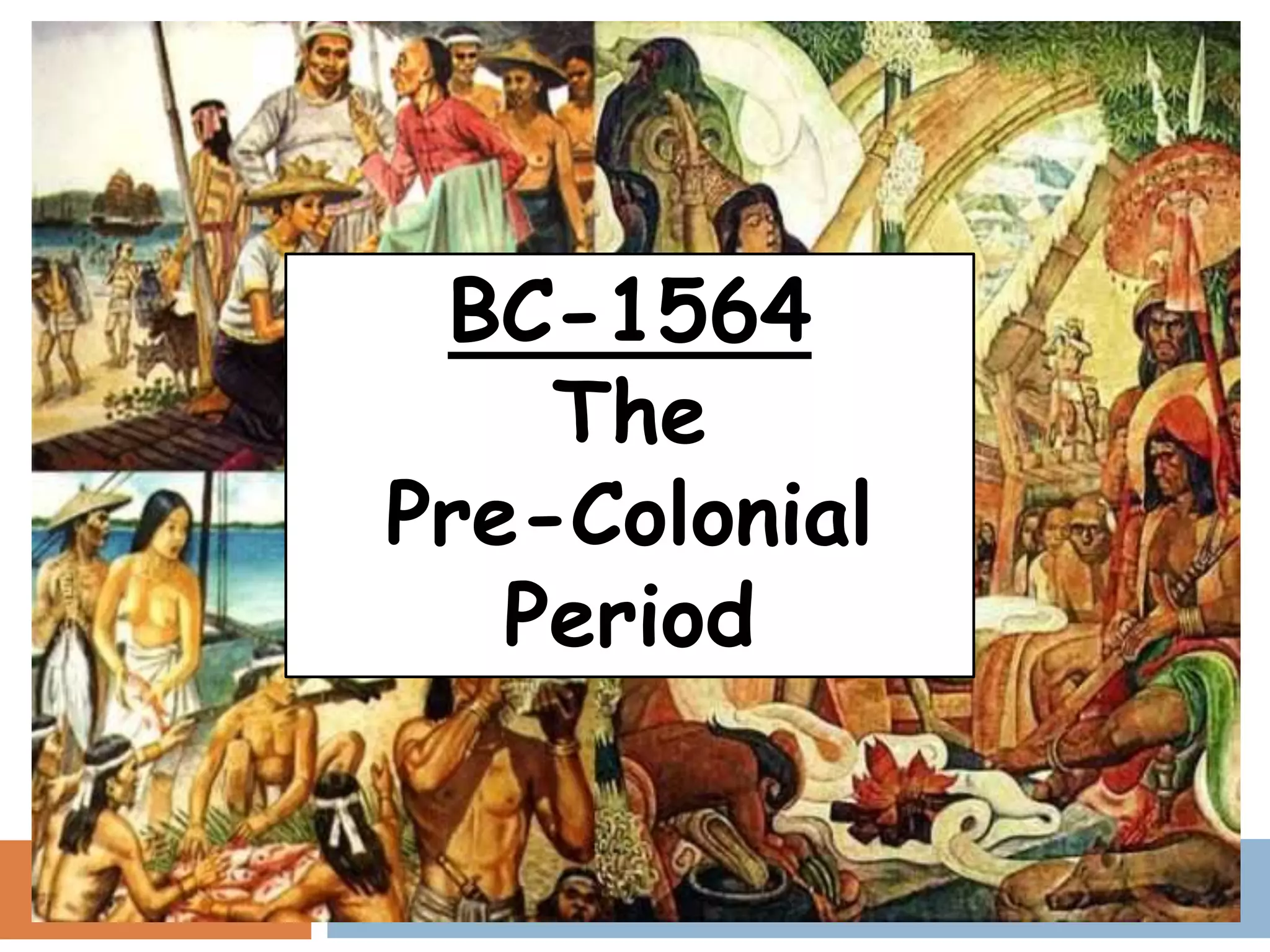
BC-1564
The
Pre-Colonial
Period
The Pre-Colonial
Period
This existed before the
Spanish occupation
in the 1500s.
The Pre-Colonial
Period
It is oral in nature and is full of
lessons and ideas about life,
its blessings, and its
consequences.
The Pre-Colonial
Period
It contains ideas from birth
to the grave.
The Pre-Colonial
Period
The oral characteristic of
pre-colonial literature gives
the possibility for many
alterations.
The Pre-Colonial
Period
In the Philippine context, no
matter how it may be
considered as altered, pre-
colonial literature is still revered
to by many Filipinos.
The Pre-Colonial
Period
The sources are usually the
local native town folk.
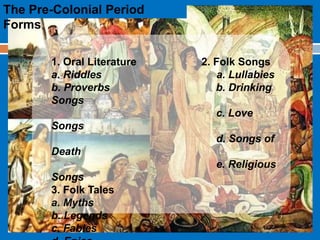
The Pre-Colonial Period
Forms
1. Oral Literature 2. Folk Songs
a. Riddles a. Lullabies
b. Proverbs b. Drinking
Songs
c. Love
Songs
d. Songs of
Death
e. Religious
Songs
3. Folk Tales
a. Myths
b. Legends
c. Fables
Oral Literature
Performed art that
uses words as a
medium of
communication
Repository of the
critical knowledge ,
philosophy and
wisdom
Provides a portrait of
the meaning of life
It contains the history
of the society and its
experience
Provides a guide to
human behavior and
how to live one’s life
It defines, interpret
and elaborate the
society’s vision of
reality and the
danger in the world.
Oral literature
a. Riddles
• These are statements that contain
superficial words, but they function
figuratively and as metaphors, and
are in the form of questions.
• These are questions that demand
deeper answers.
• Deals with everyday life.
• It usually has mundane things as
answers.
• This is used in the past as a form of
game in small or large gatherings.
Oral literature
a. Riddles example
Bisaya
Baboy sa lasang,
(A wild pig of the forest,)
Ang tunok puro lansang.
(Is covered with spikes.)
Answer: Nangka (Jackfruit)
Oral literature
a. Riddles example
Meranaw
Sominub lawiyan,
(It dived,)
Mbowat lawitan.
(It rose.)
Answer: Ragum (Needle)
Oral literature
a. Riddles example
Chabacano
Tagia que tagia,
(You keep on slashing it,)
Hende ta penetra.
(But it does not penetrate)
Answer: Agua (Water)
Oral literature
B. Proverbs
 These are statements that are
considered as wise.
 These are usually given by parents or
elders of the community.
 There is belief that experience is the
best teacher.
 To express broader truth, it often uses
metaphors.
 It uses metaphor
Oral literature
B. Proverbs
Example
Mandaya on Viriginity
Yang ataog aw madugdug, (An egg once
broken,)
Di da mamauli. (Will never be the same.)
Oral literature
B. Proverbs
Example
Tausug on Secret Affairs
In lasa iban uba, (Love and cough,)
Di hikatapuk. (Cannot be hidden)
Oral literature
B. Proverbs
Example
Ilocano on Guilt
Ti agutak, (He who cackles
Isut nagitlog. (Laid the egg.)

Pre colonial literature

  • 1.
  • 2.
    The Pre-Colonial Period This existedbefore the Spanish occupation in the 1500s.
  • 3.
    The Pre-Colonial Period It isoral in nature and is full of lessons and ideas about life, its blessings, and its consequences.
  • 4.
    The Pre-Colonial Period It containsideas from birth to the grave.
  • 5.
    The Pre-Colonial Period The oralcharacteristic of pre-colonial literature gives the possibility for many alterations.
  • 6.
    The Pre-Colonial Period In thePhilippine context, no matter how it may be considered as altered, pre- colonial literature is still revered to by many Filipinos.
  • 7.
    The Pre-Colonial Period The sourcesare usually the local native town folk.
  • 8.
    The Pre-Colonial Period Forms 1.Oral Literature 2. Folk Songs a. Riddles a. Lullabies b. Proverbs b. Drinking Songs c. Love Songs d. Songs of Death e. Religious Songs 3. Folk Tales a. Myths b. Legends c. Fables
  • 9.
    Oral Literature Performed artthat uses words as a medium of communication Repository of the critical knowledge , philosophy and wisdom Provides a portrait of the meaning of life It contains the history of the society and its experience Provides a guide to human behavior and how to live one’s life It defines, interpret and elaborate the society’s vision of reality and the danger in the world.
  • 10.
    Oral literature a. Riddles •These are statements that contain superficial words, but they function figuratively and as metaphors, and are in the form of questions. • These are questions that demand deeper answers. • Deals with everyday life. • It usually has mundane things as answers. • This is used in the past as a form of game in small or large gatherings.
  • 11.
    Oral literature a. Riddlesexample Bisaya Baboy sa lasang, (A wild pig of the forest,) Ang tunok puro lansang. (Is covered with spikes.) Answer: Nangka (Jackfruit)
  • 12.
    Oral literature a. Riddlesexample Meranaw Sominub lawiyan, (It dived,) Mbowat lawitan. (It rose.) Answer: Ragum (Needle)
  • 13.
    Oral literature a. Riddlesexample Chabacano Tagia que tagia, (You keep on slashing it,) Hende ta penetra. (But it does not penetrate) Answer: Agua (Water)
  • 14.
    Oral literature B. Proverbs These are statements that are considered as wise.  These are usually given by parents or elders of the community.  There is belief that experience is the best teacher.  To express broader truth, it often uses metaphors.  It uses metaphor
  • 15.
    Oral literature B. Proverbs Example Mandayaon Viriginity Yang ataog aw madugdug, (An egg once broken,) Di da mamauli. (Will never be the same.)
  • 16.
    Oral literature B. Proverbs Example Tausugon Secret Affairs In lasa iban uba, (Love and cough,) Di hikatapuk. (Cannot be hidden)
  • 17.
    Oral literature B. Proverbs Example Ilocanoon Guilt Ti agutak, (He who cackles Isut nagitlog. (Laid the egg.)