Responsible
Ethical Decision-Making
1. How do we make good ethical decisions?

2. Where do we go wrong when we make an
   ethical decision improperly?

3. Who are we responsible to?
2

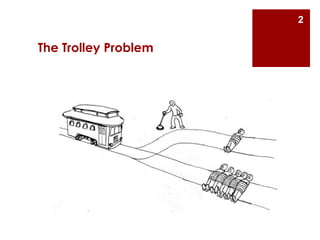
The Trolley Problem
3

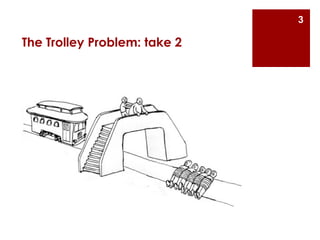
The Trolley Problem: take 2
4


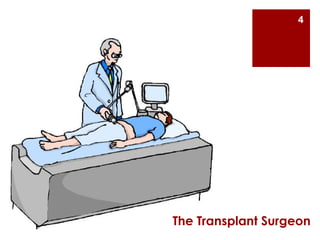
The Transplant Surgeon
5

Consequentialism & Deontology


 Consequentialism – rightness depends on consequences


 Deontology – rightness depends at least in part on a formal
  moral rule or principle
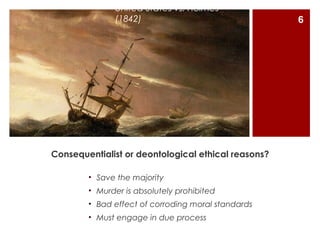
United States vs. Holmes
              (1842)                                 6


Consequentialist or deontological ethical reasons?

        • Save the majority
        • Murder is absolutely prohibited
        • Bad effect of corroding moral standards
        • Must engage in due process
7

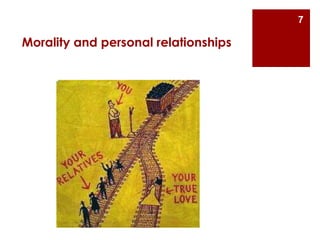
Morality and personal relationships
8
Sample ethical problem

“You’ve got to help us,” Clarence Woody said.
  “Keith is… was… our only child, and he meant
  the world to us. When the police came and told
  us he was dead, all Sara and I could think of was
  how we could get him back.”

“ But you can’t get him back,” Dr. Alma Lieu said.
  “Even if we prepared one of his cells and
  implanted it in your wife’s uterus, the baby
  wouldn’t be Keith.”

“But he would be his genetic twin,” Clarence said.
  “He would be as close as we can get to
  replacing our son.” His eyes filled with tears.
  “Won’t you help us?”
9

Sample ethical problem


If a father has no other way to raise money for
   surgery necessary to preserve the life of his child,
   would it be morally permissible for him to sell a
   kidney?

Should we hold him morally blameworthy if, given
  the opportunity, he refused to do so?
Ethical Decision-Making:
the ABC model


   AWARENESS          BALANCE           COURAGE

  • relevant facts      • Ideals     • intention to act
       •issues       • Obligations    • skillful action
  • stakeholders       • Utilities
      • stakes
      • options
Ethical Decision-Making:                                                     11
the ABC model

                                                        Character
                                                        Affective state
                      situation               context   Engagement
                                                        Biases

                                     person


    AWARENESS                      BALANCE                 COURAGE

   • relevant facts                  • Ideals           • intention to act
        •issues                   • Obligations          • skillful action
   • stakeholders                   • Utilities
       • stakes
       • options
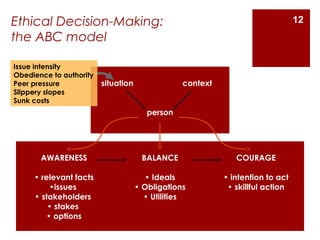
Ethical Decision-Making:                                                        12
the ABC model

Issue intensity
Obedience to authority
Peer pressure            situation               context
Slippery slopes
Sunk costs
                                        person


       AWARENESS                      BALANCE                 COURAGE

     • relevant facts                   • Ideals           • intention to act
          •issues                    • Obligations          • skillful action
     • stakeholders                    • Utilities
         • stakes
         • options
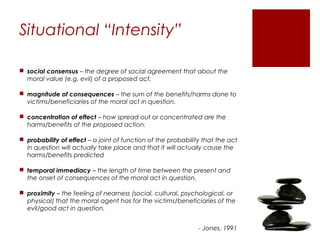
Situational “Intensity”

 social consensus – the degree of social agreement that about the
  moral value (e.g. evil) of a proposed act.

 magnitude of consequences – the sum of the benefits/harms done to
  victims/beneficiaries of the moral act in question.

 concentration of effect – how spread out or concentrated are the
  harms/benefits of the proposed action.

 probability of effect – a joint of function of the probability that the act
  in question will actually take place and that it will actually cause the
  harms/benefits predicted

 temporal immediacy – the length of time between the present and
  the onset of consequences of the moral act in question.

 proximity – the feeling of nearness (social, cultural, psychological, or
  physical) that the moral agent has for the victims/beneficiaries of the
  evil/good act in question.


                                                               - Jones, 1991
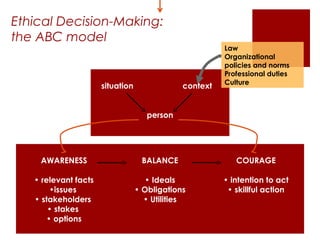
Ethical Decision-Making:
the ABC model
                                                        Law
                                                        Organizational
                                                        policies and norms
                                                        Professional duties
                                                        Culture
                      situation               context


                                     person


    AWARENESS                      BALANCE                 COURAGE

   • relevant facts                  • Ideals           • intention to act
        •issues                   • Obligations          • skillful action
   • stakeholders                   • Utilities
       • stakes
       • options
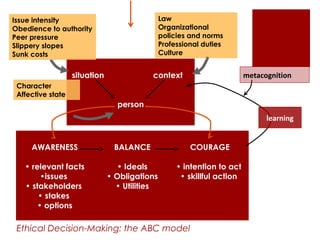
Issue intensity                                Law
Obedience to authority                         Organizational
Peer pressure                                  policies and norms
Slippery slopes                                Professional duties
Sunk costs                                     Culture


                   situation              context                        metacognition
 Character
 Affective state
                                 person
                                                                               learning


     AWARENESS                  BALANCE                 COURAGE

   • relevant facts               • Ideals          • intention to act
        •issues                • Obligations         • skillful action
   • stakeholders                • Utilities
       • stakes
       • options

 Ethical Decision-Making: the ABC model
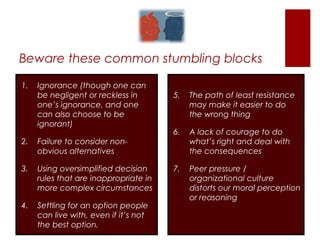
Beware these common stumbling blocks

1.   Ignorance (though one can
     be negligent or reckless in       5.   The path of least resistance
     one’s ignorance, and one               may make it easier to do
     can also choose to be                  the wrong thing
     ignorant)
                                       6.   A lack of courage to do
2.   Failure to consider non-               what’s right and deal with
     obvious alternatives                   the consequences

3.   Using oversimplified decision     7.   Peer pressure /
     rules that are inappropriate in        organizational culture
     more complex circumstances             distorts our moral perception
                                            or reasoning
4.   Settling for an option people
     can live with, even if it’s not
     the best option.
An Ethical Analysis

Phil21 wk2 ethical decision making

  • 1.
    Responsible Ethical Decision-Making 1. Howdo we make good ethical decisions? 2. Where do we go wrong when we make an ethical decision improperly? 3. Who are we responsible to?
  • 2.
  • 3.
  • 4.
  • 5.
    5 Consequentialism & Deontology Consequentialism – rightness depends on consequences  Deontology – rightness depends at least in part on a formal moral rule or principle
  • 6.
    United States vs.Holmes (1842) 6 Consequentialist or deontological ethical reasons? • Save the majority • Murder is absolutely prohibited • Bad effect of corroding moral standards • Must engage in due process
  • 7.
  • 8.
    8 Sample ethical problem “You’vegot to help us,” Clarence Woody said. “Keith is… was… our only child, and he meant the world to us. When the police came and told us he was dead, all Sara and I could think of was how we could get him back.” “ But you can’t get him back,” Dr. Alma Lieu said. “Even if we prepared one of his cells and implanted it in your wife’s uterus, the baby wouldn’t be Keith.” “But he would be his genetic twin,” Clarence said. “He would be as close as we can get to replacing our son.” His eyes filled with tears. “Won’t you help us?”
  • 9.
    9 Sample ethical problem Ifa father has no other way to raise money for surgery necessary to preserve the life of his child, would it be morally permissible for him to sell a kidney? Should we hold him morally blameworthy if, given the opportunity, he refused to do so?
  • 10.
    Ethical Decision-Making: the ABCmodel AWARENESS BALANCE COURAGE • relevant facts • Ideals • intention to act •issues • Obligations • skillful action • stakeholders • Utilities • stakes • options
  • 11.
    Ethical Decision-Making: 11 the ABC model Character Affective state situation context Engagement Biases person AWARENESS BALANCE COURAGE • relevant facts • Ideals • intention to act •issues • Obligations • skillful action • stakeholders • Utilities • stakes • options
  • 12.
    Ethical Decision-Making: 12 the ABC model Issue intensity Obedience to authority Peer pressure situation context Slippery slopes Sunk costs person AWARENESS BALANCE COURAGE • relevant facts • Ideals • intention to act •issues • Obligations • skillful action • stakeholders • Utilities • stakes • options
  • 13.
    Situational “Intensity”  socialconsensus – the degree of social agreement that about the moral value (e.g. evil) of a proposed act.  magnitude of consequences – the sum of the benefits/harms done to victims/beneficiaries of the moral act in question.  concentration of effect – how spread out or concentrated are the harms/benefits of the proposed action.  probability of effect – a joint of function of the probability that the act in question will actually take place and that it will actually cause the harms/benefits predicted  temporal immediacy – the length of time between the present and the onset of consequences of the moral act in question.  proximity – the feeling of nearness (social, cultural, psychological, or physical) that the moral agent has for the victims/beneficiaries of the evil/good act in question. - Jones, 1991
  • 14.
    Ethical Decision-Making: the ABCmodel Law Organizational policies and norms Professional duties Culture situation context person AWARENESS BALANCE COURAGE • relevant facts • Ideals • intention to act •issues • Obligations • skillful action • stakeholders • Utilities • stakes • options
  • 15.
    Issue intensity Law Obedience to authority Organizational Peer pressure policies and norms Slippery slopes Professional duties Sunk costs Culture situation context metacognition Character Affective state person learning AWARENESS BALANCE COURAGE • relevant facts • Ideals • intention to act •issues • Obligations • skillful action • stakeholders • Utilities • stakes • options Ethical Decision-Making: the ABC model
  • 16.
    Beware these commonstumbling blocks 1. Ignorance (though one can be negligent or reckless in 5. The path of least resistance one’s ignorance, and one may make it easier to do can also choose to be the wrong thing ignorant) 6. A lack of courage to do 2. Failure to consider non- what’s right and deal with obvious alternatives the consequences 3. Using oversimplified decision 7. Peer pressure / rules that are inappropriate in organizational culture more complex circumstances distorts our moral perception or reasoning 4. Settling for an option people can live with, even if it’s not the best option.
  • 17.