2-1
ETHICS IS TOUGHER THAN
YOU THINK . . .
"To be nothing but yourself, in a world which is
doing its best to make you everybody else,
means to fight the hardest battle which any
human being can fight, and never stop fighting."
– e.e. cummings
"From here that looks like a bucket of water, but from an ant's
point of view, it's a vast ocean; from an elephant's point of
view, it's just a cool drink; and to a fish, of course, it's home."
– The Phantom Toll Booth, by Norton Juster
“I am not afraid of storms, for I am learning to build my
ship.”
– Louisa May Alcott
Copyright © 2011 by The McGraw-Hill Companies, Inc. All rights reserved.McGraw-Hill/Irwin
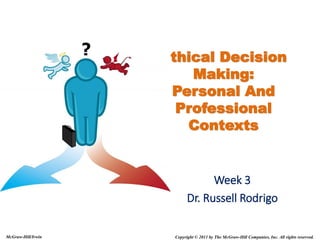
Ethical Decision
Making:
Personal And
Professional
Contexts
Week 3
Dr. Russell Rodrigo
2-3
OBJECTIVES
After reading this chapter, you will be able to:
1. Describe a process for ethically responsible decision-
making.
2. Apply this model to ethical decision points.
3. Explain the reasons why “good” people might engage
in unethical behavior.
2-4
OPENING DECISION POINT:
What WouldYouDo?
Scenario 1
Scenario 2
Scenario 3
2-5
OPENINGDECISION POINT:WhatWouldYouDo?
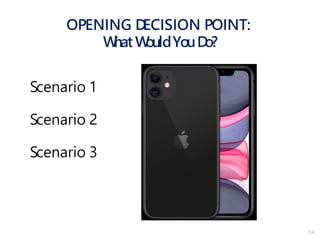
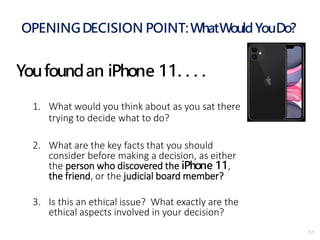
Youfoundan iPhone 11. . . .
1. What would you think about as you sat there
trying to decide what to do?
2. What are the key facts that you should
consider before making a decision, as either
the person who discovered the iPhone 11,
the friend, or the judicial board member?
3. Is this an ethical issue? What exactly are the
ethical aspects involved in your decision?
2-6
4.Who else is involved, or should be
involved, in this decision?Who has a stake in
the outcome?
5. What alternatives are available to you?
What are the consequences of each
alternative?
6. How would each of your
alternatives affect the other people
you have identified as having a stake
in the outcome?
7. Where might you look for
additional guidance to assist you in
resolving this particular dilemma?
2-7
Ethical decision making
Putting things into PRACTICE
Ethical Decision Makingin
EverydayLife
Putting things into PRACTICE
Ethical Decision Makingin
EverydayLife
2-8
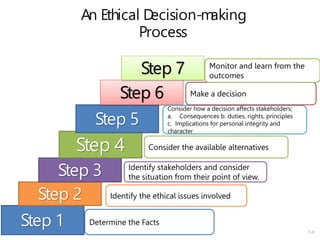
An Ethical Decision-making
Process
Step 1
Step 2
Step 3
Step 4
Step 5
Step 6
Step 7
Determine the Facts
Identify the ethical issues involved
Identify stakeholders and consider
the situation from their point of view.
Consider the available alternatives
Consider how a decision affects stakeholders;
a. Consequences b. duties, rights, principles
c. Implications for personal integrity and
character
Make a decision
Monitor and learn from the
outcomes
2-9
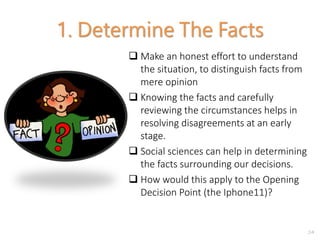
1. Determine The Facts
 Make an honest effort to understand
the situation, to distinguish facts from
mere opinion
 Knowing the facts and carefully
reviewing the circumstances helps in
resolving disagreements at an early
stage.
 Social sciences can help in determining
the facts surrounding our decisions.
 How would this apply to the Opening
Decision Point (the Iphone11)?
2-10
2. Identify The Ethical Issues
Involved
It requires the ability
to recognize a
decision or issue as an
ethical decision or
ethical issue.
2-11
2. Identify The Ethical Issues
Involved
How does one determine that a
question raises an ethical issue at
all? When does a business decision
become an ethical decision?
To the degree that a decision affects
the well-being of the people
involved, it is a decision with ethical
implications.
2-12
2. Id en tify T h e Eth ic al Issu es
In vo lved
No rm ative Myo pia
Short-sightedness about values.
Intentio nal Blind ness
Results from focusing failures.
Chang e Blind ness
Means by which ethical issues
might go unnoticed
2-13
3. Identifying Stakeholders
Thinking and reasoning from a narrow and personal point of
view virtually guarantees that we have not understood the
situation fully.
STAKEHOLDERS?
All of the groups and/or individuals
affected by a decision, policy or
operation of a firm or individual.
REASONABLE AND
RESPONSIBLE
DECISIONS?
Consider issues from a variety of
perspectives other than one’s own
and other than what local
conventions suggest.
2-14
3. Identifying Stakeholders
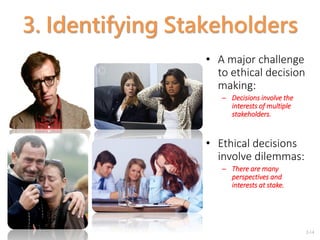
• A major challenge
to ethical decision
making:
– Decisions involve the
interests of multiple
stakeholders.
• Ethical decisions
involve dilemmas:
– There are many
perspectives and
interests at stake.
2-15
3. Identifying Stakeholders
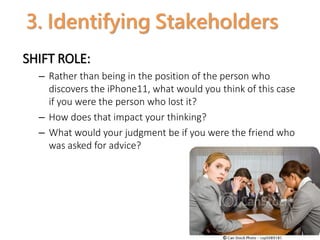
SHIFT ROLE:
– Rather than being in the position of the person who
discovers the iPhone11, what would you think of this case
if you were the person who lost it?
– How does that impact your thinking?
– What would your judgment be if you were the friend who
was asked for advice?
2-16
Key test of ethical legitimacy is
…
• whether or not a decision would be acceptable from the
point of view of all parts involved.
• If you could accept a decision as legitimate no matter whose
point of view you take, that decisions would be fair,
impartial, and ethical.
• If you acknowledge that you would not accept the legitimacy
of keeping the iPhone11 were you the person who lost it
rather than the person who found it, then that is a strong
indication that the decision to keep it is not a fair or ethical
one.
2-17
Application: Identifying
Stakeholders
Let’s try it again:
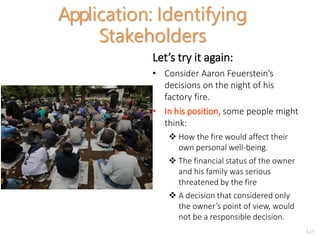
• Consider Aaron Feuerstein’s
decisions on the night of his
factory fire.
• In his position, some people might
think:
 How the fire would affect their
own personal well-being.
 The financial status of the owner
and his family was serious
threatened by the fire
 A decision that considered only
the owner’s point of view, would
not be a responsible decision.
2-18
Application: Identifying
Stakeholders
How about the positions of:
• Employees
• Community
• Customers
Reality check:
What happened to Malden Mills?
• Are strong ethical values and ethically praiseworthy decisions
good for business?
2-19
4. C o n sid er T h e A vailab le
A ltern atives
• C reativity in id en tifyin g o p tio n s:
Moral imagination.
• Do not consider only the obvious options
with regard to a particular dilemma, but also
the much more subtle ones that might not
be evident at first blush.
2-20
Application: Exploring
Alternatives
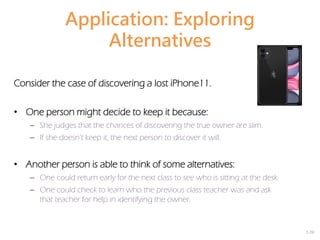
Consider the case of discovering a lost iPhone11.
• One person might decide to keep it because:
– She judges that the chances of discovering the true owner are slim.
– If she doesn’t keep it, the next person to discover it will.
• Another person is able to think of some alternatives:
– One could return early for the next class to see who is sitting at the desk.
– One could check to learn who the previous class teacher was and ask
that teacher for help in identifying the owner.
2-21
5. Compare And Weigh The
Alternatives
a. Create a mental spreadsheet that evaluates the impact of each
alternative you have devised on each stakeholder you identify.
– Most helpful way to accomplish this task is to try to place oneself in
the other person’s position.
b. Understanding a situation from another’s point of view.
c. Weighing the alternatives will involve the following
consequences to all the relevant stakeholders:
– Likely
– Foreseeable
– Possible
2-22
5. Compare And Weigh The
Alternatives
d. A critical element of this evaluation will be the consideration of ways
to mitigate, minimize, or compensate for any possible harmful
consequences or to increase and promote beneficial consequences.
e. Additional factor in comparing and weighing alternatives
– Consideration of the effects of a decision on one’s own integrity, virtue,
and character.
2-23
6. Making the Decision
• To be accountable in our decision making, it is not
sufficient to deliberate over the process.
• We should learn from our experiences.
2-24
7. Monitoring the Outcomes
• To be accountable in our decision-making, we have a
responsibility:
 To evaluate the implications of our decisions.
 To monitor and then learn from the outcomes.
 To modify our actions accordingly when faced
with similar challenges in the future.
2-25
Group Discussion of Answers
2-26
DISCUSSION OF OPENING
DECISION POINT: WHAT WOULD YOU DO?
1.Try to determine the facts:
 Knowing that the iPhone11 functioned perfectly would be good evidence
for concluding that it was left behind accidentally rather than intentionally
discarded.
 Knowing the actual cost of the iPhone11 would also be evidence that it is
something likely to be highly valued and not something easily abandoned.
2. Ethical aspects involved
 The situation raises ethical issues of rights, happiness, personal integrity
and honesty.
3. Who are involved?
It involves two major stakeholders: the true owner and yourself.
2-27
DISCUSSION OF OPENING
DECISION POINT: WHAT WOULD YOU DO?
4. Any decision you make will have broader implications:
 It will encourage or diminish a campus culture of trust and honesty.
5. Consider the following perspectives:
 Imagining yourself in the position of the student who lost the
iPhone11 / the student who might sit in judgment at a campus
judicial hearing.
 Imagining the results of keeping the iPhone11 and then having
that fact discovered and publicized.
 Considering the number of hours someone might have to work
at an on-campus job in order to earn enough money to buy
another iPhone11 .
 Reflecting on the type of person who keeps another’s property
and to ask yourself if this is who you really are and want to be.
2-28
Why Do “Good” People Engage In
“Bad” Acts?
2-29
Why Do “Good” People Engage In
“Bad” Acts?
There are many ways in which
responsible decision making can go
wrong:
 People can simply choose to do
something unethical.
 Well-intentioned people fail to
choose ethically.
Stumbling blocks to responsible decision-
making and behavior
 Cognitive or intellectual.
2-30
Explaining “Bad” Acts?
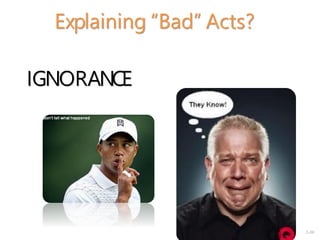
IGNORANCE
2-31
Explaining “Bad” Acts?
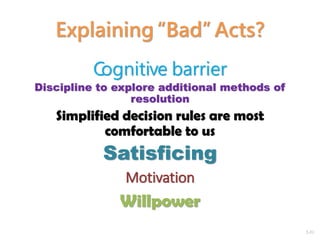
Cognitive barrier
Discipline to explore additional methods of
resolution
Simplified decision rules are most
comfortable to us
Satisficing
Motivation
Willpower
Copyright © 2011 by The McGraw-Hill Companies, Inc. All rights reserved.McGraw-Hill/Irwin
Making Decision
Exercise
2-33
Exercise
Lisa is trying to raise funds to support the creation of a free clinic
in a poor neighborhood in her hometown. She has been trying
very hard, but she has not been able to raise enough money to
get the clinic up an running. One day day, she gets a huge check
from a high profile business executive whom she met at a fund
raiser. She is ecstatic and finally sees her dream taking shape.
However, after a few days, the person who gave Lisa the money
is arrested for fraud, money laundering, and tax evasion. What
should Lisa do? Should she still keep the money and look the
other way? Does the source of the money matter or does the
end justify the means?

Week 3.2 ethical decision making process students' copy

  • 1.
    2-1 ETHICS IS TOUGHERTHAN YOU THINK . . . "To be nothing but yourself, in a world which is doing its best to make you everybody else, means to fight the hardest battle which any human being can fight, and never stop fighting." – e.e. cummings "From here that looks like a bucket of water, but from an ant's point of view, it's a vast ocean; from an elephant's point of view, it's just a cool drink; and to a fish, of course, it's home." – The Phantom Toll Booth, by Norton Juster “I am not afraid of storms, for I am learning to build my ship.” – Louisa May Alcott
  • 2.
    Copyright © 2011by The McGraw-Hill Companies, Inc. All rights reserved.McGraw-Hill/Irwin Ethical Decision Making: Personal And Professional Contexts Week 3 Dr. Russell Rodrigo
  • 3.
    2-3 OBJECTIVES After reading thischapter, you will be able to: 1. Describe a process for ethically responsible decision- making. 2. Apply this model to ethical decision points. 3. Explain the reasons why “good” people might engage in unethical behavior.
  • 4.
    2-4 OPENING DECISION POINT: WhatWouldYouDo? Scenario 1 Scenario 2 Scenario 3
  • 5.
    2-5 OPENINGDECISION POINT:WhatWouldYouDo? Youfoundan iPhone11. . . . 1. What would you think about as you sat there trying to decide what to do? 2. What are the key facts that you should consider before making a decision, as either the person who discovered the iPhone 11, the friend, or the judicial board member? 3. Is this an ethical issue? What exactly are the ethical aspects involved in your decision?
  • 6.
    2-6 4.Who else isinvolved, or should be involved, in this decision?Who has a stake in the outcome? 5. What alternatives are available to you? What are the consequences of each alternative? 6. How would each of your alternatives affect the other people you have identified as having a stake in the outcome? 7. Where might you look for additional guidance to assist you in resolving this particular dilemma?
  • 7.
    2-7 Ethical decision making Puttingthings into PRACTICE Ethical Decision Makingin EverydayLife Putting things into PRACTICE Ethical Decision Makingin EverydayLife
  • 8.
    2-8 An Ethical Decision-making Process Step1 Step 2 Step 3 Step 4 Step 5 Step 6 Step 7 Determine the Facts Identify the ethical issues involved Identify stakeholders and consider the situation from their point of view. Consider the available alternatives Consider how a decision affects stakeholders; a. Consequences b. duties, rights, principles c. Implications for personal integrity and character Make a decision Monitor and learn from the outcomes
  • 9.
    2-9 1. Determine TheFacts  Make an honest effort to understand the situation, to distinguish facts from mere opinion  Knowing the facts and carefully reviewing the circumstances helps in resolving disagreements at an early stage.  Social sciences can help in determining the facts surrounding our decisions.  How would this apply to the Opening Decision Point (the Iphone11)?
  • 10.
    2-10 2. Identify TheEthical Issues Involved It requires the ability to recognize a decision or issue as an ethical decision or ethical issue.
  • 11.
    2-11 2. Identify TheEthical Issues Involved How does one determine that a question raises an ethical issue at all? When does a business decision become an ethical decision? To the degree that a decision affects the well-being of the people involved, it is a decision with ethical implications.
  • 12.
    2-12 2. Id entify T h e Eth ic al Issu es In vo lved No rm ative Myo pia Short-sightedness about values. Intentio nal Blind ness Results from focusing failures. Chang e Blind ness Means by which ethical issues might go unnoticed
  • 13.
    2-13 3. Identifying Stakeholders Thinkingand reasoning from a narrow and personal point of view virtually guarantees that we have not understood the situation fully. STAKEHOLDERS? All of the groups and/or individuals affected by a decision, policy or operation of a firm or individual. REASONABLE AND RESPONSIBLE DECISIONS? Consider issues from a variety of perspectives other than one’s own and other than what local conventions suggest.
  • 14.
    2-14 3. Identifying Stakeholders •A major challenge to ethical decision making: – Decisions involve the interests of multiple stakeholders. • Ethical decisions involve dilemmas: – There are many perspectives and interests at stake.
  • 15.
    2-15 3. Identifying Stakeholders SHIFTROLE: – Rather than being in the position of the person who discovers the iPhone11, what would you think of this case if you were the person who lost it? – How does that impact your thinking? – What would your judgment be if you were the friend who was asked for advice?
  • 16.
    2-16 Key test ofethical legitimacy is … • whether or not a decision would be acceptable from the point of view of all parts involved. • If you could accept a decision as legitimate no matter whose point of view you take, that decisions would be fair, impartial, and ethical. • If you acknowledge that you would not accept the legitimacy of keeping the iPhone11 were you the person who lost it rather than the person who found it, then that is a strong indication that the decision to keep it is not a fair or ethical one.
  • 17.
    2-17 Application: Identifying Stakeholders Let’s tryit again: • Consider Aaron Feuerstein’s decisions on the night of his factory fire. • In his position, some people might think:  How the fire would affect their own personal well-being.  The financial status of the owner and his family was serious threatened by the fire  A decision that considered only the owner’s point of view, would not be a responsible decision.
  • 18.
    2-18 Application: Identifying Stakeholders How aboutthe positions of: • Employees • Community • Customers Reality check: What happened to Malden Mills? • Are strong ethical values and ethically praiseworthy decisions good for business?
  • 19.
    2-19 4. C on sid er T h e A vailab le A ltern atives • C reativity in id en tifyin g o p tio n s: Moral imagination. • Do not consider only the obvious options with regard to a particular dilemma, but also the much more subtle ones that might not be evident at first blush.
  • 20.
    2-20 Application: Exploring Alternatives Consider thecase of discovering a lost iPhone11. • One person might decide to keep it because: – She judges that the chances of discovering the true owner are slim. – If she doesn’t keep it, the next person to discover it will. • Another person is able to think of some alternatives: – One could return early for the next class to see who is sitting at the desk. – One could check to learn who the previous class teacher was and ask that teacher for help in identifying the owner.
  • 21.
    2-21 5. Compare AndWeigh The Alternatives a. Create a mental spreadsheet that evaluates the impact of each alternative you have devised on each stakeholder you identify. – Most helpful way to accomplish this task is to try to place oneself in the other person’s position. b. Understanding a situation from another’s point of view. c. Weighing the alternatives will involve the following consequences to all the relevant stakeholders: – Likely – Foreseeable – Possible
  • 22.
    2-22 5. Compare AndWeigh The Alternatives d. A critical element of this evaluation will be the consideration of ways to mitigate, minimize, or compensate for any possible harmful consequences or to increase and promote beneficial consequences. e. Additional factor in comparing and weighing alternatives – Consideration of the effects of a decision on one’s own integrity, virtue, and character.
  • 23.
    2-23 6. Making theDecision • To be accountable in our decision making, it is not sufficient to deliberate over the process. • We should learn from our experiences.
  • 24.
    2-24 7. Monitoring theOutcomes • To be accountable in our decision-making, we have a responsibility:  To evaluate the implications of our decisions.  To monitor and then learn from the outcomes.  To modify our actions accordingly when faced with similar challenges in the future.
  • 25.
  • 26.
    2-26 DISCUSSION OF OPENING DECISIONPOINT: WHAT WOULD YOU DO? 1.Try to determine the facts:  Knowing that the iPhone11 functioned perfectly would be good evidence for concluding that it was left behind accidentally rather than intentionally discarded.  Knowing the actual cost of the iPhone11 would also be evidence that it is something likely to be highly valued and not something easily abandoned. 2. Ethical aspects involved  The situation raises ethical issues of rights, happiness, personal integrity and honesty. 3. Who are involved? It involves two major stakeholders: the true owner and yourself.
  • 27.
    2-27 DISCUSSION OF OPENING DECISIONPOINT: WHAT WOULD YOU DO? 4. Any decision you make will have broader implications:  It will encourage or diminish a campus culture of trust and honesty. 5. Consider the following perspectives:  Imagining yourself in the position of the student who lost the iPhone11 / the student who might sit in judgment at a campus judicial hearing.  Imagining the results of keeping the iPhone11 and then having that fact discovered and publicized.  Considering the number of hours someone might have to work at an on-campus job in order to earn enough money to buy another iPhone11 .  Reflecting on the type of person who keeps another’s property and to ask yourself if this is who you really are and want to be.
  • 28.
    2-28 Why Do “Good”People Engage In “Bad” Acts?
  • 29.
    2-29 Why Do “Good”People Engage In “Bad” Acts? There are many ways in which responsible decision making can go wrong:  People can simply choose to do something unethical.  Well-intentioned people fail to choose ethically. Stumbling blocks to responsible decision- making and behavior  Cognitive or intellectual.
  • 30.
  • 31.
    2-31 Explaining “Bad” Acts? Cognitivebarrier Discipline to explore additional methods of resolution Simplified decision rules are most comfortable to us Satisficing Motivation Willpower
  • 32.
    Copyright © 2011by The McGraw-Hill Companies, Inc. All rights reserved.McGraw-Hill/Irwin Making Decision Exercise
  • 33.
    2-33 Exercise Lisa is tryingto raise funds to support the creation of a free clinic in a poor neighborhood in her hometown. She has been trying very hard, but she has not been able to raise enough money to get the clinic up an running. One day day, she gets a huge check from a high profile business executive whom she met at a fund raiser. She is ecstatic and finally sees her dream taking shape. However, after a few days, the person who gave Lisa the money is arrested for fraud, money laundering, and tax evasion. What should Lisa do? Should she still keep the money and look the other way? Does the source of the money matter or does the end justify the means?