BEV-Module 3

 •Difficulties in Ethical Decision Making
     •Ethical Decision making Model
             •Ethical Dilemmas
•Suggestions for Ethical Decision Making
•Comparison of Codes of Ethics, Codes
      of Conduct, Codes of Practice
        •Ethic courses and Training
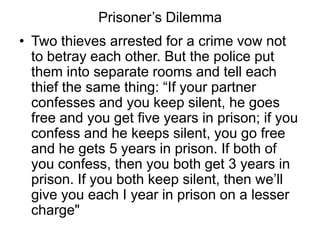
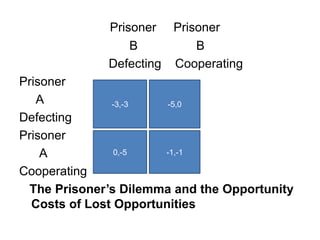
Prisoner’s Dilemma
• Two thieves arrested for a crime vow not
  to betray each other. But the police put
  them into separate rooms and tell each
  thief the same thing: “If your partner
  confesses and you keep silent, he goes
  free and you get five years in prison; if you
  confess and he keeps silent, you go free
  and he gets 5 years in prison. If both of
  you confess, then you both get 3 years in
  prison. If you both keep silent, then we’ll
  give you each I year in prison on a lesser
  charge"
Prisoner Prisoner
                  B        B
              Defecting Cooperating
Prisoner
   A           -3,-3    -5,0
Defecting
Prisoner
    A           0,-5   -1,-1

Cooperating
 The Prisoner‟s Dilemma and the Opportunity
  Costs of Lost Opportunities
• When two managers talk with each other
  they have a choice of cooperating by
  telling the truth or try to take advantage by
  lying to each other.
• When two investors who each own
  property have a choice of cooperating in
  the norm against theft or trying to take
  advantage of each other by stealing each
  other’s property.
• Although taking advantage of another may
  pay off in a one-time meeting it rarely
  exists in managerial environment.
Difficulties in Ethical Decision Making
  Difficulties in ethical decision making may
  arise from the following:
1. Cross-cultural contradictions.- It may
   arise when corporations do business in
   other societies where ethical standards
   differ from those at home.
2. Competitive pressures- When companies
   are squeezed by severe competition,
   managers sometimes engage in ethical
   activities to beat out a competitor.
3. Manager’s values and attributes- Managers
   are key people to investigate whether a
   company will act ethically or unethically as
   they have more opportunities than others to
   set ethical time for their company.
4. Personal gains/Dubious character- Personal
   gain even greed causes ethical problems.
   Business sometimes employ people whose
   personal values are less than desirable.
5. Individual values in conflict with
   organizational goals.-Ethical conflicts in
   business frequently occur when a company
   pursues goals or uses methods that are not
   acceptable to some of its employees.
How to Clarify Ethical problems
1. Have you defined the problem accurately/
2. How would you define the problem if you
   stood on the other side of the fence?
3. How did this situation occur in the first
   place?
4. To whom and to what do you give your
   loyalty as a person and as a member of the
   corporation?
5. What is your intention in making the
   decision?
6. How does this intention compare with the
   probable results?
7. Who could your decision or action injure?
8. Can you discuss the problems with the
   affected parties?
9. Are you confident that your decision will
   be as valid over a long period as seems
   now.
10.Could you discuss your decision with
   your boss/CEO/family without qualms?
11.What is the symbolic potential of your
   decion being understood? If
   misunderstood?
12.Under what circumstances would you
   allow exceptions to your stand?
The Ethical Decision Model
1. Clarify the question. What is the
   question? (What is at stake? Who is
   affected? How?)
2. Determine its relevance for this business.
   How does it affect the business?
3. Identify the circumstantial constraints.
   What are the external constraints(legal,
   regulatory, marketing etc)?
4. Assess the available options. Apply the
   Ethical principles. [ Which of the various
   options conform to justice and decency
   while maintaining long term owner value]
ISSUES RESULTING IN ETHICAL
                   DILEMMAS
     A dilemma is a situation in which two or
    options are available for action,
    representing varied interest are available.
    Decisions are important, but not simple,
•   Accounting procedures
•   Customer service
•   Crisis management
•   Government regulations
•   Targeted advertising
•   Sexual harassment
•   Community spirit etc
•   Fair hiring
•   Treatment of grievances
•   Materials
•   Buildings
•   Plans
•   Locations.
SUGGESTIONS FOR ETHICAL DECISION
                    MAKING
I. Top management can improve
     behaviour
II. Codes of ethics improves decision
     making. –codes of ethics are formal
     statements of what the company expects.
     Top management must eliminate
     opportunities for unethical behaviour.
III. Interaction with peers and other
     colleagues help people to learn ethical
     behaviour.
IV. Control Systems.- Policies, rules
     regulations worked into control system
     ensures ethical behaviour.
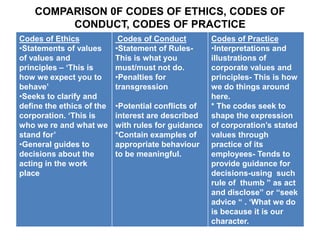
COMPARISON 0F CODES OF ETHICS, CODES OF
         CONDUCT, CODES OF PRACTICE
Codes of Ethics             Codes of Conduct         Codes of Practice
•Statements of values      •Statement of Rules-      •Interpretations and
of values and              This is what you          illustrations of
principles – „This is      must/must not do.         corporate values and
how we expect you to       •Penalties for            principles- This is how
behave‟                    transgression             we do things around
•Seeks to clarify and                                here.
define the ethics of the   •Potential conflicts of   * The codes seek to
corporation. „This is      interest are described    shape the expression
who we re and what we      with rules for guidance   of corporation‟s stated
stand for‟                 *Contain examples of      values through
•General guides to         appropriate behaviour     practice of its
decisions about the        to be meaningful.         employees- Tends to
acting in the work                                   provide guidance for
place                                                decisions-using such
                                                     rule of thumb ” as act
                                                     and disclose” or “seek
                                                     advice “ . „What we do
                                                     is because it is our
                                                     character.
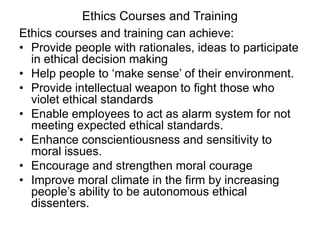
Ethics Courses and Training
Ethics courses and training can achieve:
• Provide people with rationales, ideas to participate
  in ethical decision making
• Help people to ‘make sense’ of their environment.
• Provide intellectual weapon to fight those who
  violet ethical standards
• Enable employees to act as alarm system for not
  meeting expected ethical standards.
• Enhance conscientiousness and sensitivity to
  moral issues.
• Encourage and strengthen moral courage
• Improve moral climate in the firm by increasing
  people’s ability to be autonomous ethical
  dissenters.

Bev module 3

  • 1.
    BEV-Module 3 •Difficultiesin Ethical Decision Making •Ethical Decision making Model •Ethical Dilemmas •Suggestions for Ethical Decision Making •Comparison of Codes of Ethics, Codes of Conduct, Codes of Practice •Ethic courses and Training
  • 2.
    Prisoner’s Dilemma • Twothieves arrested for a crime vow not to betray each other. But the police put them into separate rooms and tell each thief the same thing: “If your partner confesses and you keep silent, he goes free and you get five years in prison; if you confess and he keeps silent, you go free and he gets 5 years in prison. If both of you confess, then you both get 3 years in prison. If you both keep silent, then we’ll give you each I year in prison on a lesser charge"
  • 3.
    Prisoner Prisoner B B Defecting Cooperating Prisoner A -3,-3 -5,0 Defecting Prisoner A 0,-5 -1,-1 Cooperating The Prisoner‟s Dilemma and the Opportunity Costs of Lost Opportunities
  • 4.
    • When twomanagers talk with each other they have a choice of cooperating by telling the truth or try to take advantage by lying to each other. • When two investors who each own property have a choice of cooperating in the norm against theft or trying to take advantage of each other by stealing each other’s property. • Although taking advantage of another may pay off in a one-time meeting it rarely exists in managerial environment.
  • 5.
    Difficulties in EthicalDecision Making Difficulties in ethical decision making may arise from the following: 1. Cross-cultural contradictions.- It may arise when corporations do business in other societies where ethical standards differ from those at home. 2. Competitive pressures- When companies are squeezed by severe competition, managers sometimes engage in ethical activities to beat out a competitor.
  • 6.
    3. Manager’s valuesand attributes- Managers are key people to investigate whether a company will act ethically or unethically as they have more opportunities than others to set ethical time for their company. 4. Personal gains/Dubious character- Personal gain even greed causes ethical problems. Business sometimes employ people whose personal values are less than desirable. 5. Individual values in conflict with organizational goals.-Ethical conflicts in business frequently occur when a company pursues goals or uses methods that are not acceptable to some of its employees.
  • 7.
    How to ClarifyEthical problems 1. Have you defined the problem accurately/ 2. How would you define the problem if you stood on the other side of the fence? 3. How did this situation occur in the first place? 4. To whom and to what do you give your loyalty as a person and as a member of the corporation? 5. What is your intention in making the decision? 6. How does this intention compare with the probable results? 7. Who could your decision or action injure?
  • 8.
    8. Can youdiscuss the problems with the affected parties? 9. Are you confident that your decision will be as valid over a long period as seems now. 10.Could you discuss your decision with your boss/CEO/family without qualms? 11.What is the symbolic potential of your decion being understood? If misunderstood? 12.Under what circumstances would you allow exceptions to your stand?
  • 9.
    The Ethical DecisionModel 1. Clarify the question. What is the question? (What is at stake? Who is affected? How?) 2. Determine its relevance for this business. How does it affect the business? 3. Identify the circumstantial constraints. What are the external constraints(legal, regulatory, marketing etc)? 4. Assess the available options. Apply the Ethical principles. [ Which of the various options conform to justice and decency while maintaining long term owner value]
  • 10.
    ISSUES RESULTING INETHICAL DILEMMAS A dilemma is a situation in which two or options are available for action, representing varied interest are available. Decisions are important, but not simple, • Accounting procedures • Customer service • Crisis management • Government regulations • Targeted advertising
  • 11.
    Sexual harassment • Community spirit etc • Fair hiring • Treatment of grievances • Materials • Buildings • Plans • Locations.
  • 12.
    SUGGESTIONS FOR ETHICALDECISION MAKING I. Top management can improve behaviour II. Codes of ethics improves decision making. –codes of ethics are formal statements of what the company expects. Top management must eliminate opportunities for unethical behaviour. III. Interaction with peers and other colleagues help people to learn ethical behaviour. IV. Control Systems.- Policies, rules regulations worked into control system ensures ethical behaviour.
  • 13.
    COMPARISON 0F CODESOF ETHICS, CODES OF CONDUCT, CODES OF PRACTICE Codes of Ethics Codes of Conduct Codes of Practice •Statements of values •Statement of Rules- •Interpretations and of values and This is what you illustrations of principles – „This is must/must not do. corporate values and how we expect you to •Penalties for principles- This is how behave‟ transgression we do things around •Seeks to clarify and here. define the ethics of the •Potential conflicts of * The codes seek to corporation. „This is interest are described shape the expression who we re and what we with rules for guidance of corporation‟s stated stand for‟ *Contain examples of values through •General guides to appropriate behaviour practice of its decisions about the to be meaningful. employees- Tends to acting in the work provide guidance for place decisions-using such rule of thumb ” as act and disclose” or “seek advice “ . „What we do is because it is our character.
  • 14.
    Ethics Courses andTraining Ethics courses and training can achieve: • Provide people with rationales, ideas to participate in ethical decision making • Help people to ‘make sense’ of their environment. • Provide intellectual weapon to fight those who violet ethical standards • Enable employees to act as alarm system for not meeting expected ethical standards. • Enhance conscientiousness and sensitivity to moral issues. • Encourage and strengthen moral courage • Improve moral climate in the firm by increasing people’s ability to be autonomous ethical dissenters.