By John Gavazzi, PsyD ABPP
 Describe one decision-making model
 Identify one cognitive bias and one emotional
factor that can adversely affect ethical
decision-making
 Outline three strategies to aid with ethical
decision-making
 We reviewed that ethical decision-making can
be complex
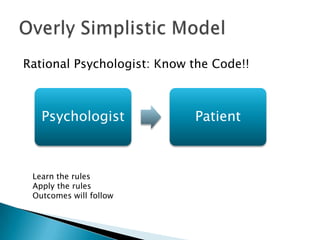
Rational Psychologist: Know the Code!!
Psychologist Patient
Learn the rules
Apply the rules
Outcomes will follow
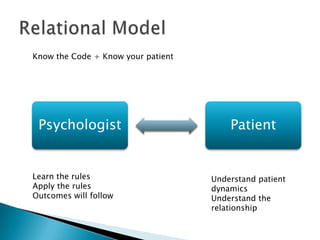
PatientPsychologist
Learn the rules
Apply the rules
Outcomes will follow
Understand patient
dynamics
Understand the
relationship
Know the Code + Know your patient
 Distinguish ethical decision-making from
clinical decisions, risk management, and legal
questions (even though there is overlap)
 We reviewed the Acculturation Model both as
ways to acculturate to psychology as well as
how ethical decisions are made
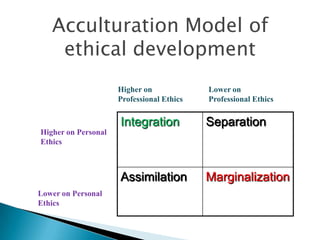
Acculturation Model of
ethical development
Integration Separation
Assimilation Marginalization
Higher on
Professional Ethics
Higher on Personal
Ethics
Lower on Personal
Ethics
Lower on
Professional Ethics
 We reviewed the five foundational principles
on which the APA ethics code is founded
 We touched on the idea that the APA ethics
code does not have an ethical decision-
making strategy
 Ethical dilemmas are usually a function of two
competing foundational principles
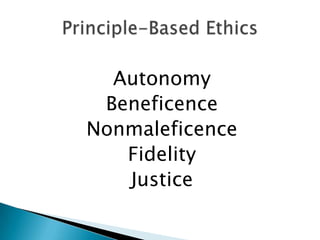
Autonomy
Beneficence
Nonmaleficence
Fidelity
Justice
 Psychologist is the expert and has greater
power in the relationship
 Patient is vulnerable
 Psychologist is ultimately responsible for
what happens in treatment
Often ethical dilemmas involve apparent
conflicts between respect for patient
autonomy versus beneficence
 Identify the competing ethical principles
 Help to determine which principle has
precedence and why
 The importance of emotion in ethical
decision-making and moral judgments
 Cognitive biases are also important to
consider
The APA Ethical Principles and Code of
Conduct do not include a model of
ethical decision-making
Other resources may aid with decision-
making, but do not highlight how to work
through dilemmas
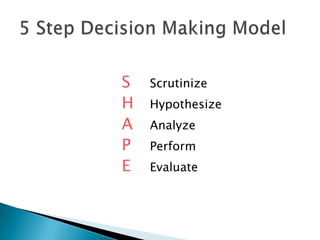
S Scrutinize
H Hypothesize
A Analyze
P Perform
E Evaluate
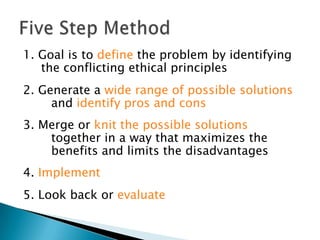
1. Goal is to define the problem by identifying
the conflicting ethical principles
2. Generate a wide range of possible solutions
and identify pros and cons
3. Merge or knit the possible solutions
together in a way that maximizes the
benefits and limits the disadvantages
4. Implement
5. Look back or evaluate
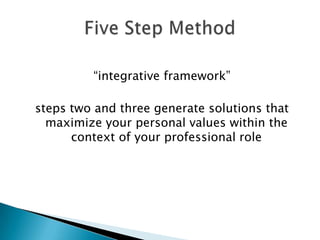
“integrative framework”
steps two and three generate solutions that
maximize your personal values within the
context of your professional role
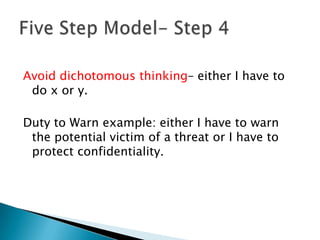
Avoid dichotomous thinking– either I have to
do x or y.
Duty to Warn example: either I have to warn
the potential victim of a threat or I have to
protect confidentiality.
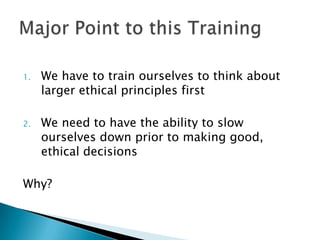
1. We have to train ourselves to think about
larger ethical principles first
2. We need to have the ability to slow
ourselves down prior to making good,
ethical decisions
Why?
 Malcolm Gladwell’s book “Blink”
 Jonathan Haidt’s book on Moral Intuition
 David Pizarro’s work on motivated moral
reasoning
 Top down approach
 Start with ethical principles
 Work from those principles to make good
decisions about our work
 Intuitive
 Automatic
 Emotional
 Rapid
Why do psychologists (still and continue to) have
sex with their patients?
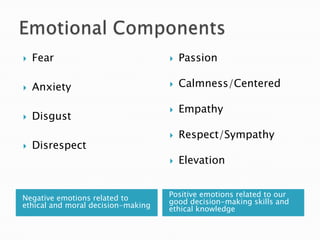
Negative emotions related to
ethical and moral decision-making
Positive emotions related to our
good decision-making skills and
ethical knowledge
 Fear
 Anxiety
 Disgust
 Disrespect
 Passion
 Calmness/Centered
 Empathy
 Respect/Sympathy
 Elevation
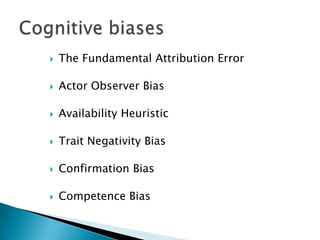
 The Fundamental Attribution Error
 Actor Observer Bias
 Availability Heuristic
 Trait Negativity Bias
 Confirmation Bias
 Competence Bias
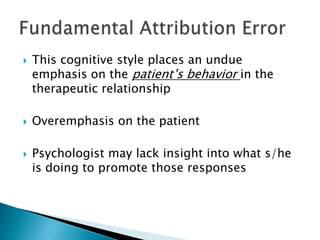
 This cognitive style places an undue
emphasis on the patient’s behavior in the
therapeutic relationship
 Overemphasis on the patient
 Psychologist may lack insight into what s/he
is doing to promote those responses
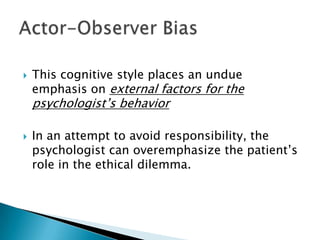
 This cognitive style places an undue
emphasis on external factors for the
psychologist’s behavior
 In an attempt to avoid responsibility, the
psychologist can overemphasize the patient’s
role in the ethical dilemma.
 This cognitive error leads one to use
information that readily comes to mind or
easiest to access
 Easiest to go with that which is most
representative of the patient or scenario
 When the psychologist more readily recalls
unpleasant characteristics of the patient as
compared with positive characteristics of the
patient
 It is common for psychologists to work with
individuals they do not like or enjoy
 The cognitive style in which psychologists
look for evidence to confirm their beliefs
about the patient or the situation.
 Motivated moral reasoning
 Dunning-Kruger Effect: a cognitive bias in
which unskilled individuals suffer from
illusory superiority, mistakenly rating their
ability as much higher than average.
 Poor performers fail to learn from their
mistakes.
 And, they fail to internalize direct feedback
from others.
 Length of time in treatment
 Patient complexity
 Emotional intensity/therapeutic relationship
 Current focus (or lack thereof) in treatment
A Brief Review
 Knowledge base: APA code, foundational
principles, state law, regulation, case law
 Become aware of emotional factors
 Remain aware of cognitive biases/situational
factors
 Patient/relationship factors
 Outcomes are uncertain – Ambiguity remains
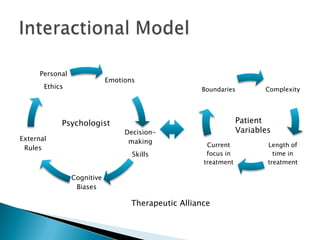
Emotions
Decision-
making
Skills
Cognitive
Biases
External
Rules
Personal
Ethics
Psychologist
Complexity
Length of
time in
treatment
Current
focus in
treatment
Boundaries
Patient
Variables
Therapeutic Alliance
Why study ethics and ethical decision-
making as a part of clinical practice?
 Fiduciary Responsibility
 Providing the highest quality of care possible
 Reinforcing doing the best possible for your
patient
 Better treatment outcomes
Independent Actions Help from others
 Self Reflection
 Documentation
 Transparency
 Continuing Education
 Self-care
 Consultation
 Supervision
 Psychotherapy
 Continuing Education
 Good general basis to contemplate and
discuss ethical issues in psychological
practice
 Look at vignettes as training tools
 Remain aware of ethical issues in your
practice and work on skill building
 Future podcasts will look at ethical-decision
making, clinical issues, and risk management
with vignettes on the Ethics and Psychology
website
 I will have guests to help review clinical
vignette using the Acculturation Model, the
foundational principles, personal biases
(personal ethics and morality) and give
possible options to resolve the dilemma

Ethical Decision-Making (Part 2)

  • 1.
  • 2.
     Describe onedecision-making model  Identify one cognitive bias and one emotional factor that can adversely affect ethical decision-making  Outline three strategies to aid with ethical decision-making
  • 3.
     We reviewedthat ethical decision-making can be complex
  • 4.
    Rational Psychologist: Knowthe Code!! Psychologist Patient Learn the rules Apply the rules Outcomes will follow
  • 5.
    PatientPsychologist Learn the rules Applythe rules Outcomes will follow Understand patient dynamics Understand the relationship Know the Code + Know your patient
  • 6.
     Distinguish ethicaldecision-making from clinical decisions, risk management, and legal questions (even though there is overlap)
  • 7.
     We reviewedthe Acculturation Model both as ways to acculturate to psychology as well as how ethical decisions are made
  • 8.
    Acculturation Model of ethicaldevelopment Integration Separation Assimilation Marginalization Higher on Professional Ethics Higher on Personal Ethics Lower on Personal Ethics Lower on Professional Ethics
  • 9.
     We reviewedthe five foundational principles on which the APA ethics code is founded  We touched on the idea that the APA ethics code does not have an ethical decision- making strategy  Ethical dilemmas are usually a function of two competing foundational principles
  • 10.
  • 11.
     Psychologist isthe expert and has greater power in the relationship  Patient is vulnerable  Psychologist is ultimately responsible for what happens in treatment
  • 12.
    Often ethical dilemmasinvolve apparent conflicts between respect for patient autonomy versus beneficence
  • 13.
     Identify thecompeting ethical principles  Help to determine which principle has precedence and why  The importance of emotion in ethical decision-making and moral judgments  Cognitive biases are also important to consider
  • 15.
    The APA EthicalPrinciples and Code of Conduct do not include a model of ethical decision-making Other resources may aid with decision- making, but do not highlight how to work through dilemmas
  • 16.
    S Scrutinize H Hypothesize AAnalyze P Perform E Evaluate
  • 17.
    1. Goal isto define the problem by identifying the conflicting ethical principles 2. Generate a wide range of possible solutions and identify pros and cons 3. Merge or knit the possible solutions together in a way that maximizes the benefits and limits the disadvantages 4. Implement 5. Look back or evaluate
  • 18.
    “integrative framework” steps twoand three generate solutions that maximize your personal values within the context of your professional role
  • 19.
    Avoid dichotomous thinking–either I have to do x or y. Duty to Warn example: either I have to warn the potential victim of a threat or I have to protect confidentiality.
  • 20.
    1. We haveto train ourselves to think about larger ethical principles first 2. We need to have the ability to slow ourselves down prior to making good, ethical decisions Why?
  • 21.
     Malcolm Gladwell’sbook “Blink”  Jonathan Haidt’s book on Moral Intuition  David Pizarro’s work on motivated moral reasoning
  • 22.
     Top downapproach  Start with ethical principles  Work from those principles to make good decisions about our work
  • 23.
  • 24.
    Why do psychologists(still and continue to) have sex with their patients?
  • 25.
    Negative emotions relatedto ethical and moral decision-making Positive emotions related to our good decision-making skills and ethical knowledge  Fear  Anxiety  Disgust  Disrespect  Passion  Calmness/Centered  Empathy  Respect/Sympathy  Elevation
  • 26.
     The FundamentalAttribution Error  Actor Observer Bias  Availability Heuristic  Trait Negativity Bias  Confirmation Bias  Competence Bias
  • 27.
     This cognitivestyle places an undue emphasis on the patient’s behavior in the therapeutic relationship  Overemphasis on the patient  Psychologist may lack insight into what s/he is doing to promote those responses
  • 28.
     This cognitivestyle places an undue emphasis on external factors for the psychologist’s behavior  In an attempt to avoid responsibility, the psychologist can overemphasize the patient’s role in the ethical dilemma.
  • 29.
     This cognitiveerror leads one to use information that readily comes to mind or easiest to access  Easiest to go with that which is most representative of the patient or scenario
  • 30.
     When thepsychologist more readily recalls unpleasant characteristics of the patient as compared with positive characteristics of the patient  It is common for psychologists to work with individuals they do not like or enjoy
  • 31.
     The cognitivestyle in which psychologists look for evidence to confirm their beliefs about the patient or the situation.  Motivated moral reasoning
  • 32.
     Dunning-Kruger Effect:a cognitive bias in which unskilled individuals suffer from illusory superiority, mistakenly rating their ability as much higher than average.  Poor performers fail to learn from their mistakes.  And, they fail to internalize direct feedback from others.
  • 33.
     Length oftime in treatment  Patient complexity  Emotional intensity/therapeutic relationship  Current focus (or lack thereof) in treatment
  • 34.
  • 35.
     Knowledge base:APA code, foundational principles, state law, regulation, case law  Become aware of emotional factors  Remain aware of cognitive biases/situational factors  Patient/relationship factors  Outcomes are uncertain – Ambiguity remains
  • 36.
  • 37.
    Why study ethicsand ethical decision- making as a part of clinical practice?
  • 38.
     Fiduciary Responsibility Providing the highest quality of care possible  Reinforcing doing the best possible for your patient  Better treatment outcomes
  • 39.
    Independent Actions Helpfrom others  Self Reflection  Documentation  Transparency  Continuing Education  Self-care  Consultation  Supervision  Psychotherapy  Continuing Education
  • 40.
     Good generalbasis to contemplate and discuss ethical issues in psychological practice  Look at vignettes as training tools  Remain aware of ethical issues in your practice and work on skill building
  • 41.
     Future podcastswill look at ethical-decision making, clinical issues, and risk management with vignettes on the Ethics and Psychology website  I will have guests to help review clinical vignette using the Acculturation Model, the foundational principles, personal biases (personal ethics and morality) and give possible options to resolve the dilemma