Topic 2: Reason Impartiality
Instructor
Topic 3: The 7 Steps: Moral Reasoning Model
PERSONALITY
• The sum total of the physical, mental, emotional, and social
characteristics of an individual. - Psychology
• Personality is the totality of habits, attitudes and traits that result
from socialization and characterizes us in our relationship with
others. - Anderson and Parker
• Personality represents those structural and dynamic properties
of an individual or individuals as they reflect themselves in
characteristics response to situation. - Lawrence A Pewin
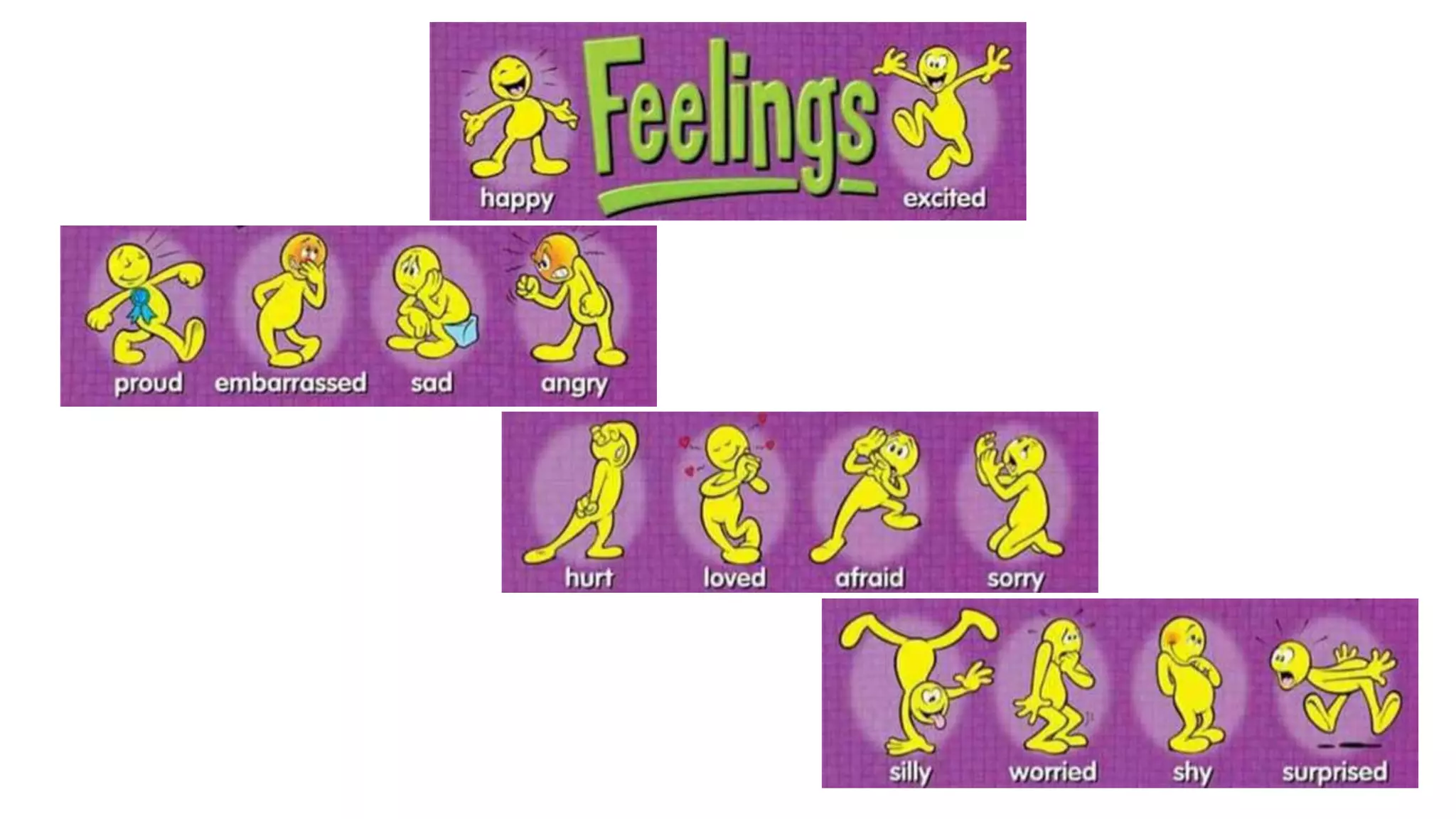
FEELING
 the perception of events within the body, closely related
to emotion. The term feeling is a verbal noun denoting the action
of the verb to feel, which derives etymologically from the Middle
English verb felen, “to perceive by touch, by palpation.”
 the function or the power of perceiving by touch.
 physical sensation not connected with sight, hearing, taste, or
smell.
 the general state of consciousness considered independently of
particular sensations, thoughts, etc.
Feelings cannot be solely relied upon but
reason and feelings
may complements each other.
EMOTION
o that is to say feelings and intuitions – play a major role in most of
the ethical decisions people make. Most people do not realize how
much their emotions direct their moral choices. But experts think
it is impossible to make any important moral judgments without
emotions.
o evoked by suffering, such as sympathy and empathy, often lead
people to act ethically toward others. Indeed, empathy is the
central moral emotion that most commonly motivates prosocial
activity such as altruism, cooperation, and generosity.
Characteristics of Emotions
o The core of an emotion is feeling
o Emotional experiences are associated with some instincts or
biological drives.
o Emotions are the products of perception.
o Every emotional experience involves several physical and
physiological changes in organism.
o The basic ways of expressing emotions are inborn and it develops
through maturation.
o Emotions rise abruptly and die slowly.
o Same emotion can be aroused by a number of different stimuli.
o Emotions have the quality of displacement.
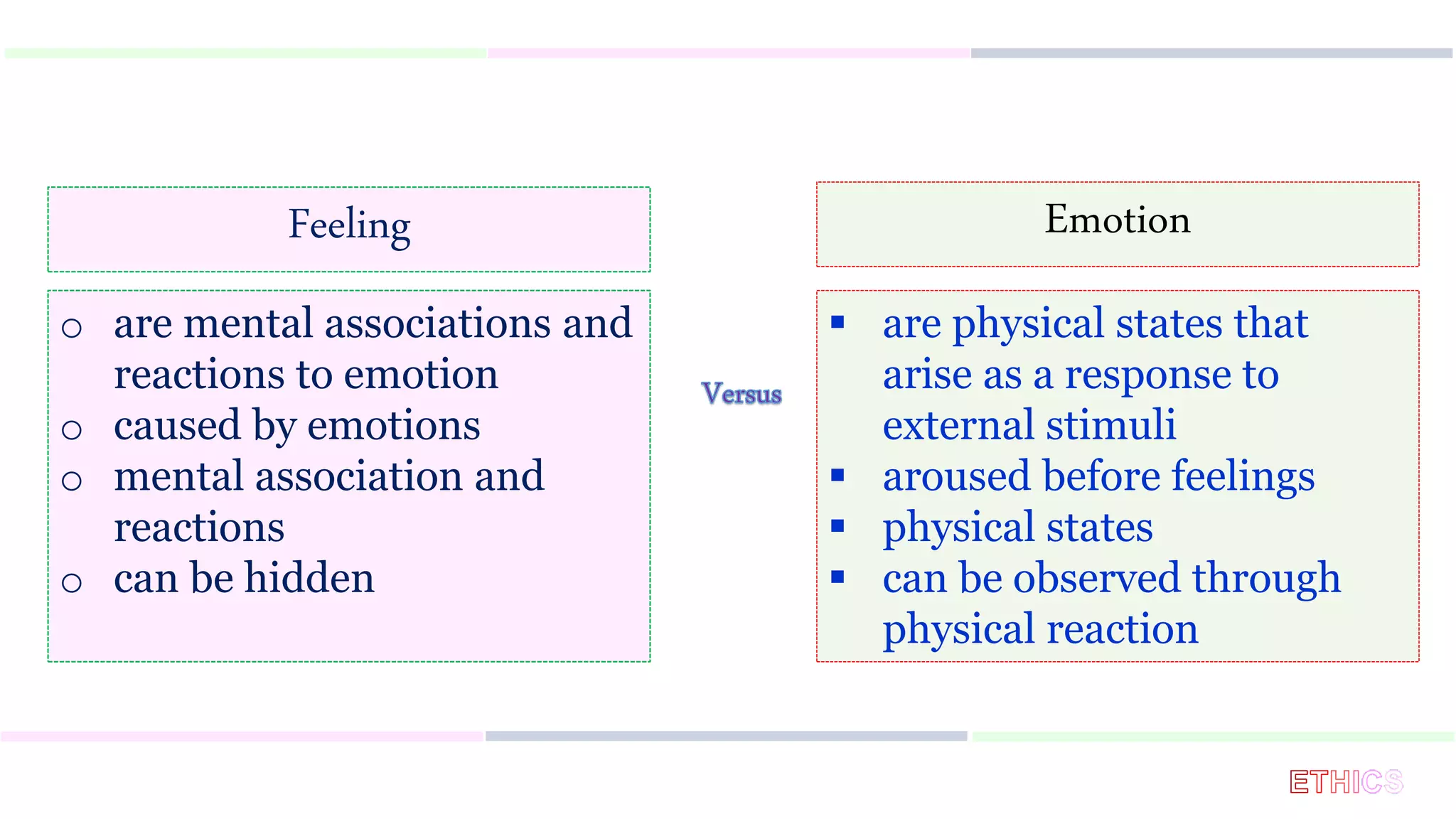
Emotion
Feeling
o are mental associations and
reactions to emotion
o caused by emotions
o mental association and
reactions
o can be hidden
 are physical states that
arise as a response to
external stimuli
 aroused before feelings
 physical states
 can be observed through
physical reaction
2 Related Models in Ethics
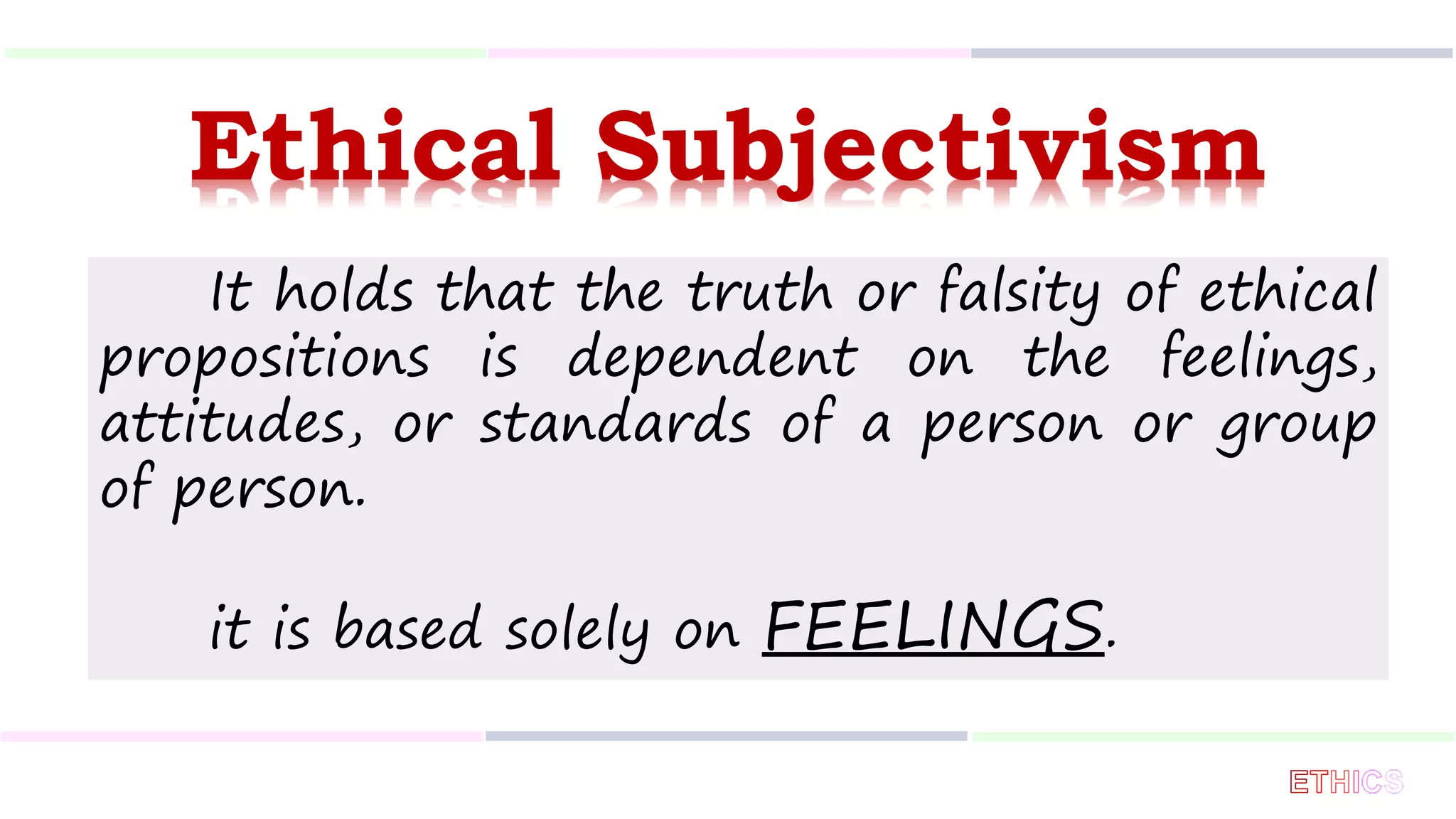
Ethical Subjectivism
It holds that the truth or falsity of ethical
propositions is dependent on the feelings,
attitudes, or standards of a person or group
of person.
it is based solely on FEELINGS.
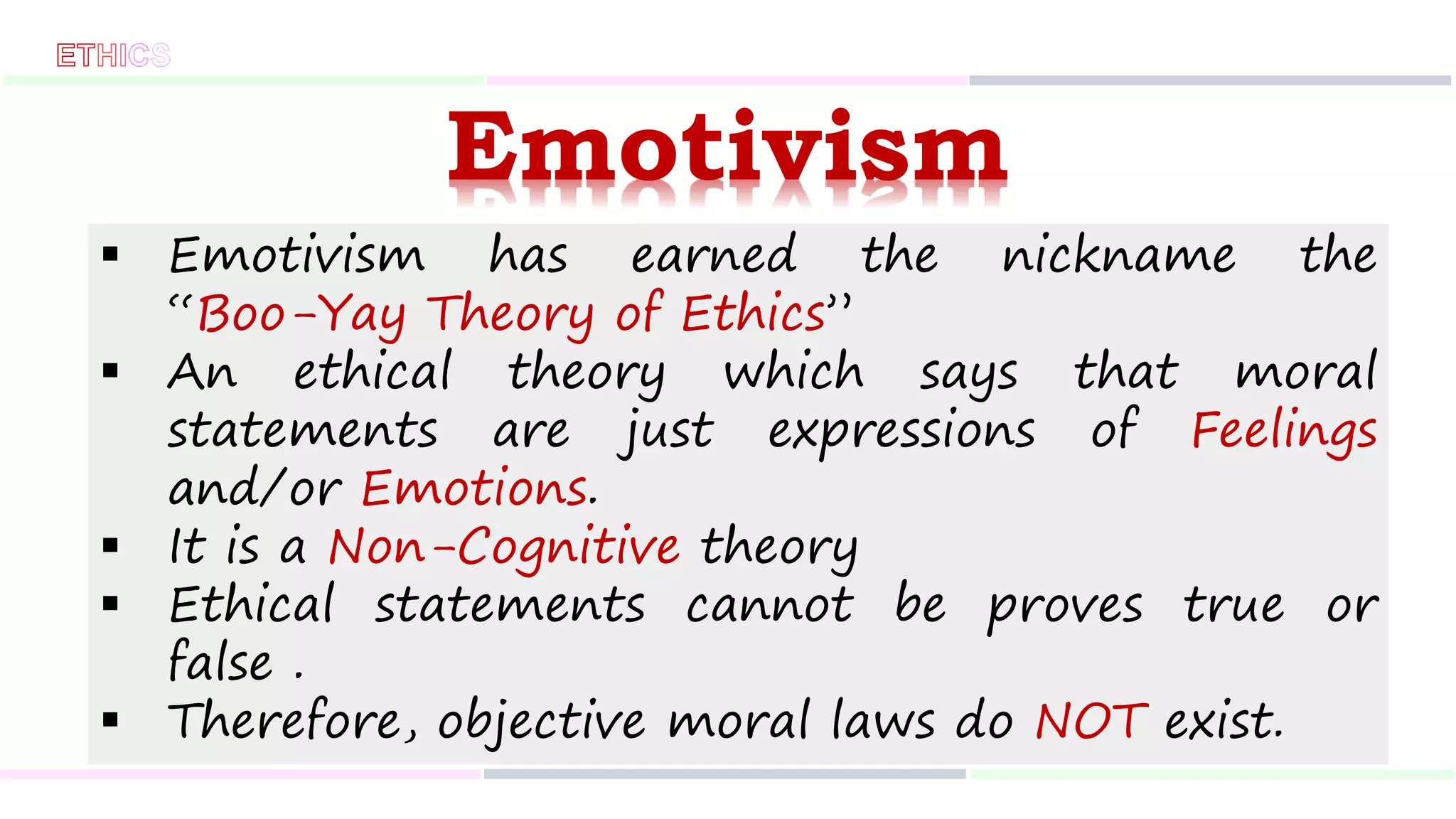
Emotivism
 Emotivism has earned the nickname the
“Boo-Yay Theory of Ethics”
 An ethical theory which says that moral
statements are just expressions of Feelings
and/or Emotions.
 It is a Non-Cognitive theory
 Ethical statements cannot be proves true or
false .
 Therefore, objective moral laws do NOT exist.
MORALITY
A choice made based on a person’s ethics,
manners, character, and what they believe is
proper behavior.
TYPES OF MORALITY
 COMMON MORALITY
– generally universally accepted
 PERSONAL MORALITY
– rules or principles, rules or standards we accept
as individuals but are not necessarily shared by
others.
 PROFESSIONAL MORALITY
– moral standards that apply to ones role as a
member of a profession.
MORAL DECISION
 A choice made based on a person’s ethics, manners, character, and what they believe
is proper behavior.
 making refers to the process of evaluating and choosing among alternatives in a
manner consistent with ethical principles. In making ethical decisions, it is necessary
to perceive and eliminate unethical options and select the best ethical alternative.
MAKING ETHICAL DECISIONS: Core Ethical Values
Key ethical values can help you build character in
yourself and others:
 Trustworthiness
 Respect
 Responsibility
 Fairness
 Caring
 Citizenship
MAKING ETHICAL DECISIONS: Model
1) All decisions must take into account and reflect a concern for the
interests and well being of all affected individuals ("stakeholders").
2) Ethical values and principles always take precedence over
nonethical ones.
3) It is ethically proper to violate an ethical principle only when it is
clearly necessary to advance another true ethical principle, which,
according to the decision-maker's conscience, will produce the
greatest balance of good in the long run.
-Josephson Institute of Ethics
MAKING ETHICAL DECISIONS: Obstacles
1) All decisions must take into account and reflect a concern for the
interests and well being of all affected individuals ("stakeholders").
2) Ethical values and principles always take precedence over
nonethical ones.
3) It is ethically proper to violate an ethical principle only when it is
clearly necessary to advance another true ethical principle, which,
according to the decision-maker's conscience, will produce the
greatest balance of good in the long run.
-Josephson Institute of Ethics
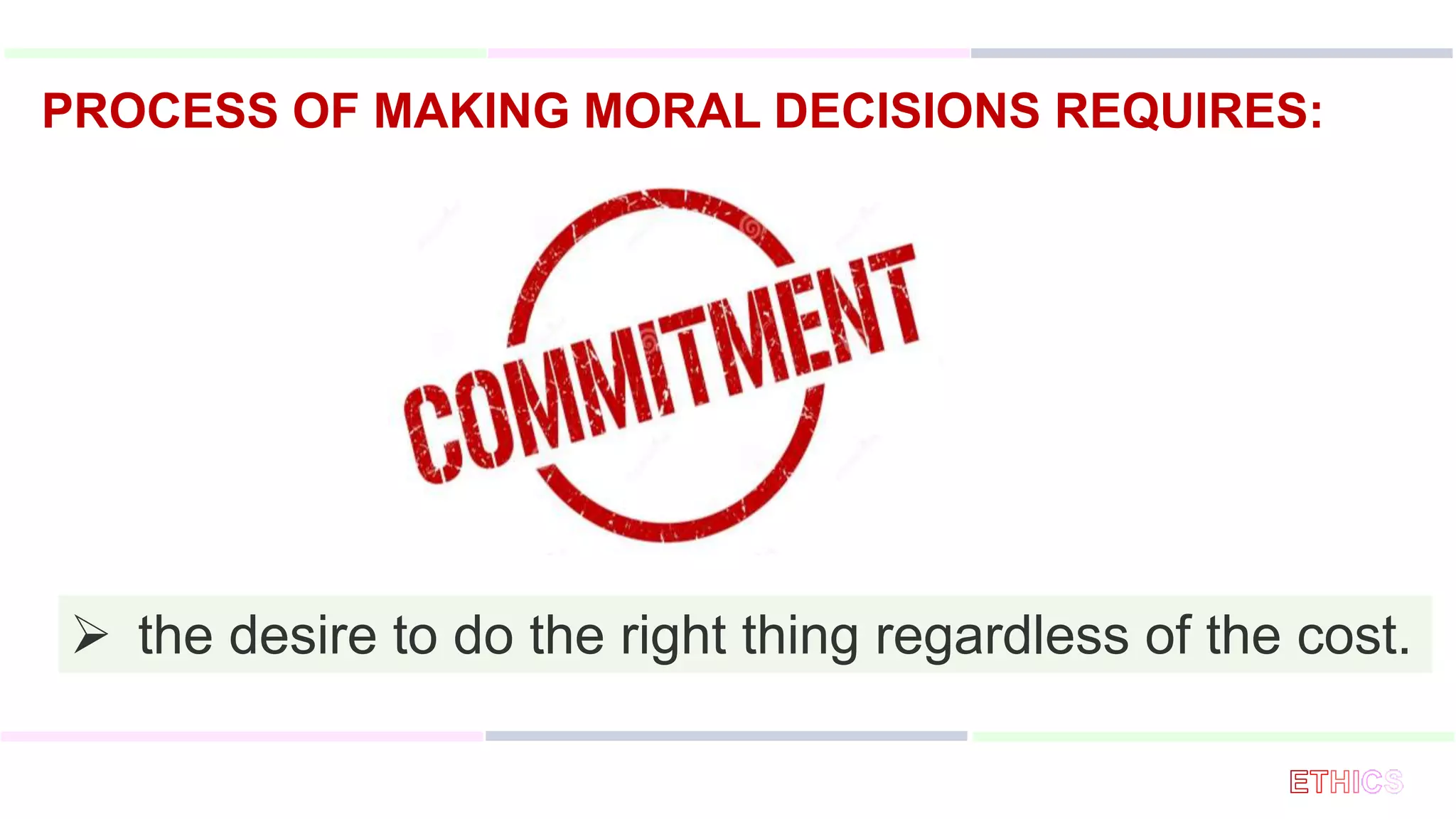
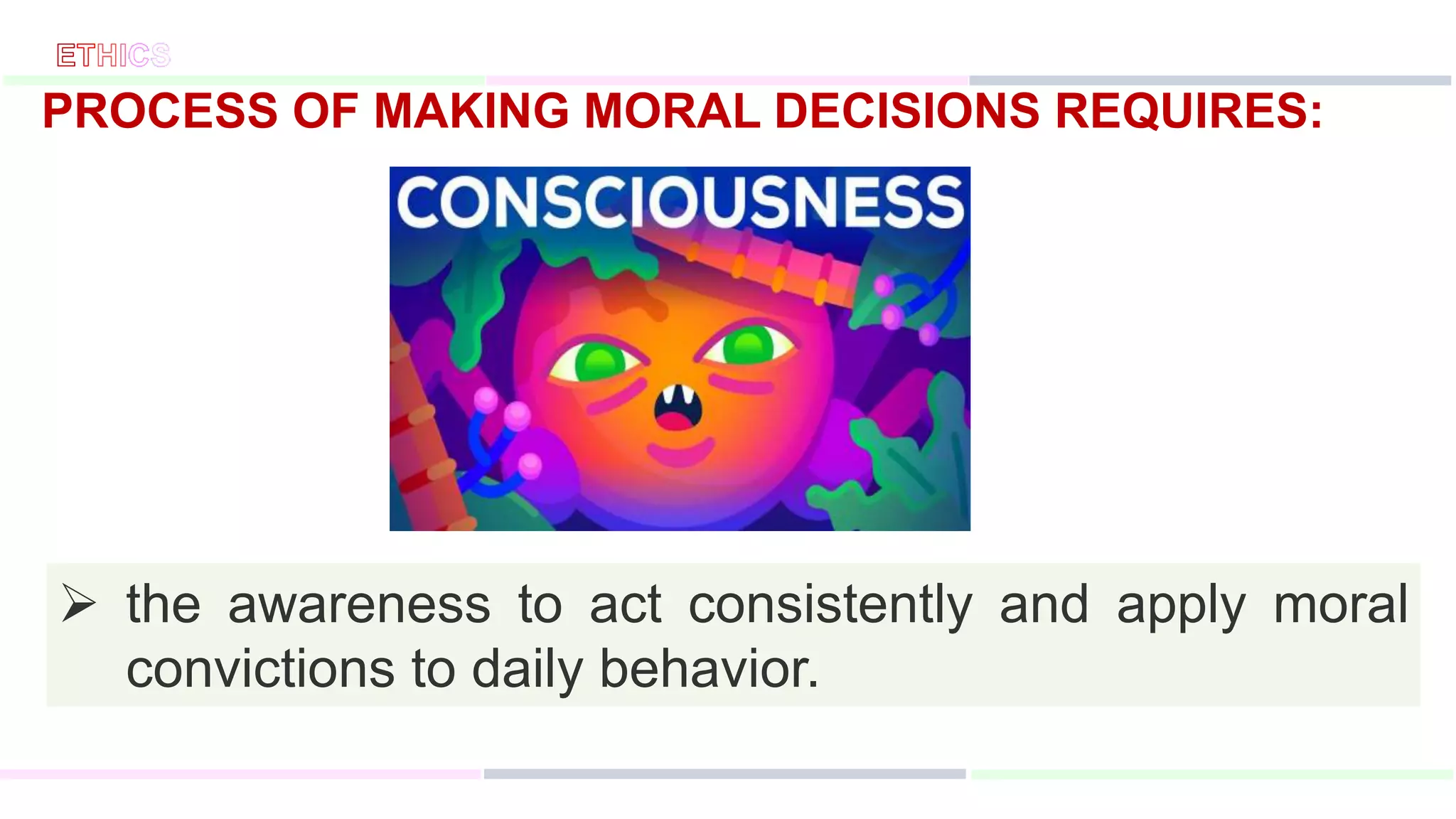
PROCESS OF MAKING MORAL DECISIONS REQUIRES:
 the desire to do the right thing regardless of the cost.
 the awareness to act consistently and apply moral
convictions to daily behavior.
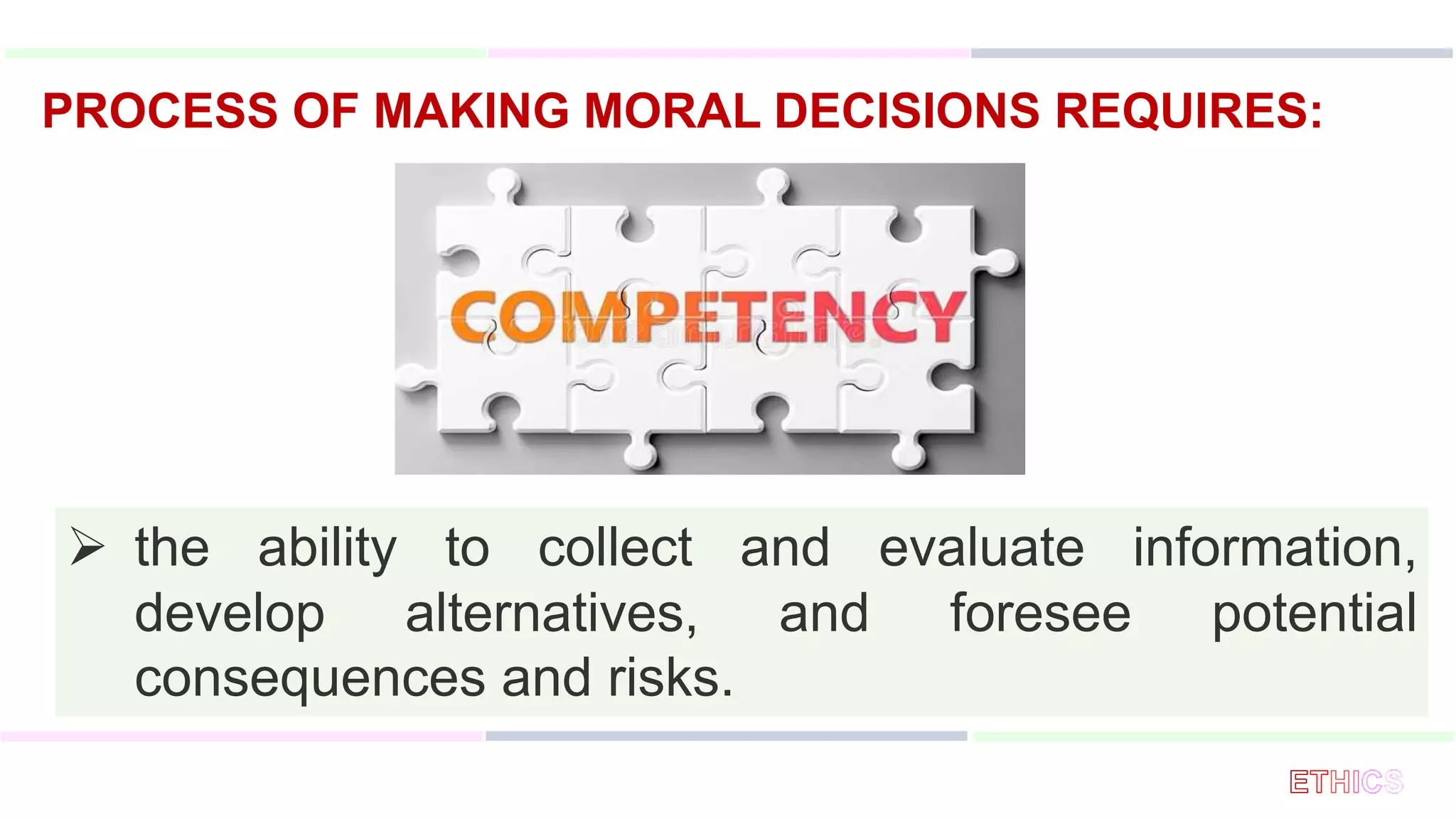
PROCESS OF MAKING MORAL DECISIONS REQUIRES:
 the ability to collect and evaluate information,
develop alternatives, and foresee potential
consequences and risks.
PROCESS OF MAKING MORAL DECISIONS REQUIRES:
Good decision are both ethical and effective:
- generate and sustain trust; demonstrate respect,
responsibility, fairness and caring; and are consistent with
good citizenship. These behaviors provide a foundation for
making better decisions by setting the ground rules for our
behavior.
Good decision are both ethical and effective:
- are effective if they accomplish what we want accomplished and if
they advance our purposes. A choice that produces unintended and
undesirable results is ineffective. The key to making effective
decisions is to think about choices in terms of their ability to
accomplish our most important goals. This means we have to
understand the difference between immediate and short-term goals
and longer-range goals.
Traditionally, ethical decision-
making process has been understood
as an exclusively mental process; that
our feelings have nothing to do with
matters of right and wrong and
good or bad, precisely because our
emotions are very unstable.
Topic 2:
Reason Impartiality
o is the basis or motive for an action, decision, or conviction. As quality, it
refers to the capacity for logical, rational, and analytic thought; for consciously
making sense of things, establishing and verifying facts, applying common
sense and logic, and justifying, and if necessary, changing practices,
institutions, and beliefs based on exiting information.
o It also spells the difference of moral judgement from mere expressions of
personal preference. In the case of moral judgments, they require backing by
reasons. Thus a reason commends what it commends, regardless of our
feelings, attitude, opinions and desire.
o Involves the idea that each individual’s interests
and point of view are equally important. It is a
principle of justice holding that decisions ought
to be based on objective criteria, rather than on
the basis of bias, prejudice, or preferring the
benefit to one person over another for improper
reasons.
o Impartiality in morality requires that we give
equal and/or adequate consideration to the
interests of all concerned parties. The principles
of impartiality assumes that every person,
generally speaking, is equally important; that is
no one is seen intrinsically more significant than
anyone else.
Topic 3:
7 Steps: Moral Reasoning Model
1. GATHER THE FACTS
o Don’t jump to conclusions without the facts
o Questions to ask: Who, what, where, when, how
and why.
o However, facts may be difficult to find because of
the uncertainty often found around ethical issues.
o Some facts are not available
o Assemble as many facts a possible before
proceeding
o Clarify what assumptions you are making!
2. DEFINE THE ETHICAL ISSUE(S)
o Don’t jump to solutions without first
identifying the ethical issue(s) in the
situations.
o Define the ethical basis for the issue you
wan to focus on.
o There may be multiple ethical issues – focus
on one major one at a time.
3. IDENTIFY THE AFFECTED PARTIES
o Identify all the stakeholders
 Who are the primary or direct stakeholders?
 Who are the secondary or indirect
stakeholders?
o Why are they stakeholders for the issue?
 Perspective-taking – try to see things
through the eyes of those individuals
affected
4. IDENTIFY THE CONSEQUENCES
o Think about potential positive and negative
consequences for affected parties by the
decision.
o What are the magnitude pf the
consequences and the probability that the
consequences will happen
4. IDENTIFY THE CONSEQUENCES
o Broader systemic consequences – tied to
symbolic and secrecy
 Symbolic consequences – each decision
sends a message.
 Secrecy consequences – what are the
consequences if the decision or action
becomes public?
4. IDENTIFY THE CONSEQUENCES
o Did you consider relevant cognitive
barriers/biases?
o Consider what y our decision would be
based only on consequences then move
on and see if it is similar given other
considerations.
5. IDENTIFY THE RELEVANT PRICIPLES,
RIGHTS, AND JUSTICE ISSUES
o Obligations should be thought of in
terms of principles and rights involved
a) What obligations are created
because of particular ethical
principles you might use in the
situation
5. IDENTIFY THE RELEVANT PRICIPLES,
RIGHTS, AND JUSTICE ISSUES
o Obligations should be thought of in
terms of principles and rights involved
b) What obligations are created
because of specific rights of the
stakeholders?
5. IDENTIFY THE RELEVANT PRICIPLES,
RIGHTS, AND JUSTICE ISSUES
o Obligations should be thought of in terms of
principles and rights involved
- What types of rights are involves
negative or positive?
c) What concepts of justice (fairness) are
relevant distributive or procedural justice?
5. IDENTIFY THE RELEVANT PRICIPLES,
RIGHTS, AND JUSTICE ISSUES
o Did you consider any relevant
cognitive barriers / biases?
o Formulate the appropriate decision
or action based on the above analysis
of these obligations.
6. CONSIDER YOUR CHARACTER &
INTEGRITY
o Consider what your relevant community
members would consider to be the kind of
decision that an individual of integrity
would make in this situation.
o What specific virtues are relevant in the
situations?
6. CONSIDER YOUR CHARACTER &
INTEGRITY
o Disclosure rule – what would you
do if the New York Times reported
your action and everyone was to
read it.
o Think about how your decision will
be remembered when you are gone.
6. CONSIDER YOUR CHARACTER &
INTEGRITY
o Did you consider any relevant
cognitive biases/barriers?
o What decision would you come to
based solely on character
considerations?

LESSON 3: TOPIC 1-3

  • 1.
    Topic 2: ReasonImpartiality Instructor Topic 3: The 7 Steps: Moral Reasoning Model
  • 3.
    PERSONALITY • The sumtotal of the physical, mental, emotional, and social characteristics of an individual. - Psychology • Personality is the totality of habits, attitudes and traits that result from socialization and characterizes us in our relationship with others. - Anderson and Parker • Personality represents those structural and dynamic properties of an individual or individuals as they reflect themselves in characteristics response to situation. - Lawrence A Pewin
  • 4.
    FEELING  the perceptionof events within the body, closely related to emotion. The term feeling is a verbal noun denoting the action of the verb to feel, which derives etymologically from the Middle English verb felen, “to perceive by touch, by palpation.”  the function or the power of perceiving by touch.  physical sensation not connected with sight, hearing, taste, or smell.  the general state of consciousness considered independently of particular sensations, thoughts, etc.
  • 6.
    Feelings cannot besolely relied upon but reason and feelings may complements each other.
  • 7.
    EMOTION o that isto say feelings and intuitions – play a major role in most of the ethical decisions people make. Most people do not realize how much their emotions direct their moral choices. But experts think it is impossible to make any important moral judgments without emotions. o evoked by suffering, such as sympathy and empathy, often lead people to act ethically toward others. Indeed, empathy is the central moral emotion that most commonly motivates prosocial activity such as altruism, cooperation, and generosity.
  • 8.
    Characteristics of Emotions oThe core of an emotion is feeling o Emotional experiences are associated with some instincts or biological drives. o Emotions are the products of perception. o Every emotional experience involves several physical and physiological changes in organism. o The basic ways of expressing emotions are inborn and it develops through maturation. o Emotions rise abruptly and die slowly. o Same emotion can be aroused by a number of different stimuli. o Emotions have the quality of displacement.
  • 9.
    Emotion Feeling o are mentalassociations and reactions to emotion o caused by emotions o mental association and reactions o can be hidden  are physical states that arise as a response to external stimuli  aroused before feelings  physical states  can be observed through physical reaction
  • 10.
  • 11.
    Ethical Subjectivism It holdsthat the truth or falsity of ethical propositions is dependent on the feelings, attitudes, or standards of a person or group of person. it is based solely on FEELINGS.
  • 12.
    Emotivism  Emotivism hasearned the nickname the “Boo-Yay Theory of Ethics”  An ethical theory which says that moral statements are just expressions of Feelings and/or Emotions.  It is a Non-Cognitive theory  Ethical statements cannot be proves true or false .  Therefore, objective moral laws do NOT exist.
  • 13.
    MORALITY A choice madebased on a person’s ethics, manners, character, and what they believe is proper behavior.
  • 14.
    TYPES OF MORALITY COMMON MORALITY – generally universally accepted  PERSONAL MORALITY – rules or principles, rules or standards we accept as individuals but are not necessarily shared by others.  PROFESSIONAL MORALITY – moral standards that apply to ones role as a member of a profession.
  • 15.
    MORAL DECISION  Achoice made based on a person’s ethics, manners, character, and what they believe is proper behavior.  making refers to the process of evaluating and choosing among alternatives in a manner consistent with ethical principles. In making ethical decisions, it is necessary to perceive and eliminate unethical options and select the best ethical alternative.
  • 16.
    MAKING ETHICAL DECISIONS:Core Ethical Values Key ethical values can help you build character in yourself and others:  Trustworthiness  Respect  Responsibility  Fairness  Caring  Citizenship
  • 17.
    MAKING ETHICAL DECISIONS:Model 1) All decisions must take into account and reflect a concern for the interests and well being of all affected individuals ("stakeholders"). 2) Ethical values and principles always take precedence over nonethical ones. 3) It is ethically proper to violate an ethical principle only when it is clearly necessary to advance another true ethical principle, which, according to the decision-maker's conscience, will produce the greatest balance of good in the long run. -Josephson Institute of Ethics
  • 18.
    MAKING ETHICAL DECISIONS:Obstacles 1) All decisions must take into account and reflect a concern for the interests and well being of all affected individuals ("stakeholders"). 2) Ethical values and principles always take precedence over nonethical ones. 3) It is ethically proper to violate an ethical principle only when it is clearly necessary to advance another true ethical principle, which, according to the decision-maker's conscience, will produce the greatest balance of good in the long run. -Josephson Institute of Ethics
  • 19.
    PROCESS OF MAKINGMORAL DECISIONS REQUIRES:  the desire to do the right thing regardless of the cost.
  • 20.
     the awarenessto act consistently and apply moral convictions to daily behavior. PROCESS OF MAKING MORAL DECISIONS REQUIRES:
  • 21.
     the abilityto collect and evaluate information, develop alternatives, and foresee potential consequences and risks. PROCESS OF MAKING MORAL DECISIONS REQUIRES:
  • 22.
    Good decision areboth ethical and effective: - generate and sustain trust; demonstrate respect, responsibility, fairness and caring; and are consistent with good citizenship. These behaviors provide a foundation for making better decisions by setting the ground rules for our behavior.
  • 23.
    Good decision areboth ethical and effective: - are effective if they accomplish what we want accomplished and if they advance our purposes. A choice that produces unintended and undesirable results is ineffective. The key to making effective decisions is to think about choices in terms of their ability to accomplish our most important goals. This means we have to understand the difference between immediate and short-term goals and longer-range goals.
  • 24.
    Traditionally, ethical decision- makingprocess has been understood as an exclusively mental process; that our feelings have nothing to do with matters of right and wrong and good or bad, precisely because our emotions are very unstable.
  • 25.
  • 26.
    o is thebasis or motive for an action, decision, or conviction. As quality, it refers to the capacity for logical, rational, and analytic thought; for consciously making sense of things, establishing and verifying facts, applying common sense and logic, and justifying, and if necessary, changing practices, institutions, and beliefs based on exiting information.
  • 27.
    o It alsospells the difference of moral judgement from mere expressions of personal preference. In the case of moral judgments, they require backing by reasons. Thus a reason commends what it commends, regardless of our feelings, attitude, opinions and desire.
  • 28.
    o Involves theidea that each individual’s interests and point of view are equally important. It is a principle of justice holding that decisions ought to be based on objective criteria, rather than on the basis of bias, prejudice, or preferring the benefit to one person over another for improper reasons.
  • 29.
    o Impartiality inmorality requires that we give equal and/or adequate consideration to the interests of all concerned parties. The principles of impartiality assumes that every person, generally speaking, is equally important; that is no one is seen intrinsically more significant than anyone else.
  • 30.
    Topic 3: 7 Steps:Moral Reasoning Model
  • 31.
    1. GATHER THEFACTS o Don’t jump to conclusions without the facts o Questions to ask: Who, what, where, when, how and why. o However, facts may be difficult to find because of the uncertainty often found around ethical issues. o Some facts are not available o Assemble as many facts a possible before proceeding o Clarify what assumptions you are making!
  • 32.
    2. DEFINE THEETHICAL ISSUE(S) o Don’t jump to solutions without first identifying the ethical issue(s) in the situations. o Define the ethical basis for the issue you wan to focus on. o There may be multiple ethical issues – focus on one major one at a time.
  • 33.
    3. IDENTIFY THEAFFECTED PARTIES o Identify all the stakeholders  Who are the primary or direct stakeholders?  Who are the secondary or indirect stakeholders? o Why are they stakeholders for the issue?  Perspective-taking – try to see things through the eyes of those individuals affected
  • 34.
    4. IDENTIFY THECONSEQUENCES o Think about potential positive and negative consequences for affected parties by the decision. o What are the magnitude pf the consequences and the probability that the consequences will happen
  • 35.
    4. IDENTIFY THECONSEQUENCES o Broader systemic consequences – tied to symbolic and secrecy  Symbolic consequences – each decision sends a message.  Secrecy consequences – what are the consequences if the decision or action becomes public?
  • 36.
    4. IDENTIFY THECONSEQUENCES o Did you consider relevant cognitive barriers/biases? o Consider what y our decision would be based only on consequences then move on and see if it is similar given other considerations.
  • 37.
    5. IDENTIFY THERELEVANT PRICIPLES, RIGHTS, AND JUSTICE ISSUES o Obligations should be thought of in terms of principles and rights involved a) What obligations are created because of particular ethical principles you might use in the situation
  • 38.
    5. IDENTIFY THERELEVANT PRICIPLES, RIGHTS, AND JUSTICE ISSUES o Obligations should be thought of in terms of principles and rights involved b) What obligations are created because of specific rights of the stakeholders?
  • 39.
    5. IDENTIFY THERELEVANT PRICIPLES, RIGHTS, AND JUSTICE ISSUES o Obligations should be thought of in terms of principles and rights involved - What types of rights are involves negative or positive? c) What concepts of justice (fairness) are relevant distributive or procedural justice?
  • 40.
    5. IDENTIFY THERELEVANT PRICIPLES, RIGHTS, AND JUSTICE ISSUES o Did you consider any relevant cognitive barriers / biases? o Formulate the appropriate decision or action based on the above analysis of these obligations.
  • 41.
    6. CONSIDER YOURCHARACTER & INTEGRITY o Consider what your relevant community members would consider to be the kind of decision that an individual of integrity would make in this situation. o What specific virtues are relevant in the situations?
  • 42.
    6. CONSIDER YOURCHARACTER & INTEGRITY o Disclosure rule – what would you do if the New York Times reported your action and everyone was to read it. o Think about how your decision will be remembered when you are gone.
  • 43.
    6. CONSIDER YOURCHARACTER & INTEGRITY o Did you consider any relevant cognitive biases/barriers? o What decision would you come to based solely on character considerations?