MICRO TEACHING
PHASES & STEPS
of
B.ED. 2ND SEM.
COURSE- III, (2ND HALF)
UNIT- V
Biswajit Biswas
Principal
Pragati College of Education,
Siliguri, Dist. Darjeeling
West Bengal
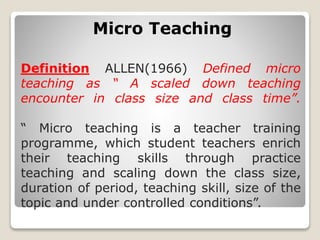
Definition ALLEN(1966) Defined micro
teaching as “ A scaled down teaching
encounter in class size and class time”.
“ Micro teaching is a teacher training
programme, which student teachers enrich
their teaching skills through practice
teaching and scaling down the class size,
duration of period, teaching skill, size of the
topic and under controlled conditions”.
Micro Teaching
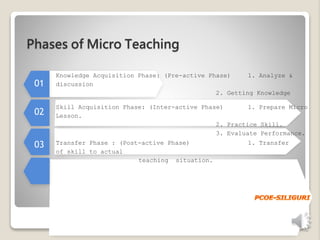
01
Knowledge Acquisition Phase: (Pre-active Phase) 1. Analyze &
discussion
2. Getting Knowledge
Phases of Micro Teaching
02
Skill Acquisition Phase: (Inter-active Phase) 1. Prepare Micro
Lesson.
2. Practice Skill.
3. Evaluate Performance.
03 Transfer Phase : (Post-active Phase) 1. Transfer
of skill to actual
teaching situation.
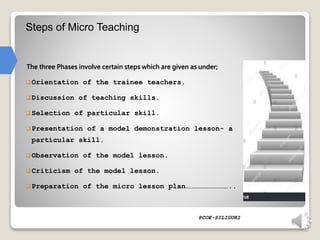
Steps of Micro Teaching
 Orientation of the trainee teachers.
 Discussion of teaching skills.
 Selection of particular skill.
 Presentation of a model demonstration lesson- a
particular skill.
 Observation of the model lesson.
 Criticism of the model lesson.
 Preparation of the micro lesson plan…………………………..
PCOE-SILIGURI
The three Phases involve certain steps which are given as under;
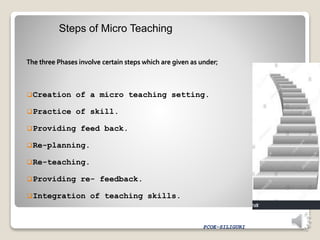
Steps of Micro Teaching
Creation of a micro teaching setting.
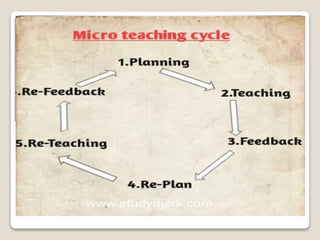
Practice of skill.
Providing feed back.
Re-planning.
Re-teaching.
Providing re- feedback.
Integration of teaching skills.
PCOE-SILIGURI
The three Phases involve certain steps which are given as under;
 It is a useful innovation in teacher education.
It helps the trainee teacher to solve many problems.
It helps the teacher to prepare the class more effectively.
It helps to reduce the strain on practicing school.
It is quite helpful in the faster motivation of the students.
It is helps self-improvement and self-evaluation.
It helps in creating more interest and enthusiasm for
teaching.
It generates self-confidence.
It makes teaching more enjoyable.
It helps in the proper planning of lessons.
 Advantages of micro-teaching
 It is only of a limited application.
It require more time for planning.
Sometimes it becomes difficult for the
teacher to divide a bigger unit into
smaller units.
Many times it creates administrative
difficulties.
It hampers the classroom climate.
It is an artificial situation.
Thank you

Phases & Steps of Micro Teaching.pptx

  • 1.
    MICRO TEACHING PHASES &STEPS of B.ED. 2ND SEM. COURSE- III, (2ND HALF) UNIT- V Biswajit Biswas Principal Pragati College of Education, Siliguri, Dist. Darjeeling West Bengal
  • 2.
    Definition ALLEN(1966) Definedmicro teaching as “ A scaled down teaching encounter in class size and class time”. “ Micro teaching is a teacher training programme, which student teachers enrich their teaching skills through practice teaching and scaling down the class size, duration of period, teaching skill, size of the topic and under controlled conditions”. Micro Teaching
  • 3.
    01 Knowledge Acquisition Phase:(Pre-active Phase) 1. Analyze & discussion 2. Getting Knowledge Phases of Micro Teaching 02 Skill Acquisition Phase: (Inter-active Phase) 1. Prepare Micro Lesson. 2. Practice Skill. 3. Evaluate Performance. 03 Transfer Phase : (Post-active Phase) 1. Transfer of skill to actual teaching situation.
  • 4.
    Steps of MicroTeaching  Orientation of the trainee teachers.  Discussion of teaching skills.  Selection of particular skill.  Presentation of a model demonstration lesson- a particular skill.  Observation of the model lesson.  Criticism of the model lesson.  Preparation of the micro lesson plan………………………….. PCOE-SILIGURI The three Phases involve certain steps which are given as under;
  • 5.
    Steps of MicroTeaching Creation of a micro teaching setting. Practice of skill. Providing feed back. Re-planning. Re-teaching. Providing re- feedback. Integration of teaching skills. PCOE-SILIGURI The three Phases involve certain steps which are given as under;
  • 7.
     It isa useful innovation in teacher education. It helps the trainee teacher to solve many problems. It helps the teacher to prepare the class more effectively. It helps to reduce the strain on practicing school. It is quite helpful in the faster motivation of the students. It is helps self-improvement and self-evaluation. It helps in creating more interest and enthusiasm for teaching. It generates self-confidence. It makes teaching more enjoyable. It helps in the proper planning of lessons.  Advantages of micro-teaching
  • 8.
     It isonly of a limited application. It require more time for planning. Sometimes it becomes difficult for the teacher to divide a bigger unit into smaller units. Many times it creates administrative difficulties. It hampers the classroom climate. It is an artificial situation.
  • 9.