








FUNDAMENTALS OF NURSING
HISTORY OF NURSING
HISTORY OF NURSING
   Early Civilization
     Cause of Disease

     Medicine Man

     Mother Surrogate


       Cause of Disease
       Temples

   Code of Hammurabi: Oldest Sanitation Code
      - 1760 BC
      - Law codes
      - Sanitation
HISTORY OF NURSING

   Early Christian Period
     Deaconesses, Crusaders, Hospitals, Good
      Samaritan Law

       Parabolani Brotherhood

       Teutonic Knights

       Knights of St. John of Jerusalem

       Knights of Lazarus
HISTORY OF NURSING


   Throughout history, wars have accentuated the
    need for nurses:

       WWI, WWII, American Civil War, Vietnam
        War (Recruitment of Nurses)

            Free Education for Nurses

       Crimean War

          Sir Sidney Herbert
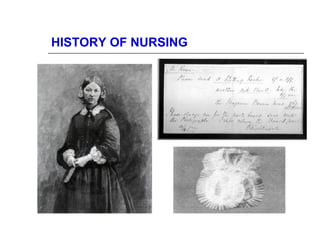
          Florence Nightingale
HISTORY OF NURSING

   Florence Nightingale

       1836
          Theodor Fliedner, a German pastor in
           Kaiserwerth, opened a hospital with a
           training school for nurses

          Training   School of Deaconesses

       1847
          Florence Nightingale went to train as a
           nurse in Kaiserwerth, Germany

          Where   she stayed for 3 months
HISTORY OF NURSING

   1853
      Nightingale trained in the Sisters of Charity

      Paris

      Returning to London, she worked as
       administrator and director of nurses at the
       Establishment for Gentlewomen During Illness
       where she remained
      Until she was called into service during the
       Crimean War
HISTORY OF NURSING

   1860

       Nightingale opened the Nightingale Training
        School for Nurses

       Served as model for other nursing schools

       Its graduates traveled to other countries
        to manage hospitals and nurse training
        schools
HISTORY OF NURSING
HISTORY OF NURSING

   Nightingales biggest contributions in
    Nursing:

       Sanitation Practices

       Nursing Education

       First Nurse Theorist
          Notes on Nursing: What It Is And

           What It Is Not
HISTORY OF NURSING
IN THE PHILIPPINES

   Earliest Hospitals

       Hospital de Real de Manila (1577)

       San Lazaro Hospital (1578)

       San Juan de Dios Hospital (1596)
HISTORY OF NURSING
         IN THE PHILIPPINES

   Earliest Nursing Schools

       Iloilo Mission Hospital School of Nursing (1906)

       St. Luke’s Hospital School of Nursing (1907)

       Mary Johnston Hospital and School of Nursing
        (1907)

       Philippine General Hospital School of Nursing
        (1910)
HISTORY OF NURSING
         IN THE PHILIPPINES
   Earliest Nursing Universities

       University of Santo Tomas College of Nursing

       Manila Central University College of Nursing

       University of the Philippines College of Nursing,
        Manila

       FEU Institute of Nursing

       UE College of Nursing
HISTORY OF NURSING
IN THE PHILIPPINES

     Nursing Leaders

         Anastacia Giron - Tupaz

           - Nurse Chief Superintendent of PNA

           - Founder of PNA
HISTORY OF NURSING
         IN THE PHILIPPINES

   Nursing Organizations

       Philippine Nurse’s Association (PNA) – National

       First President

            Rosario Delgado

       Current President

            Leah Samaco Pacquiz
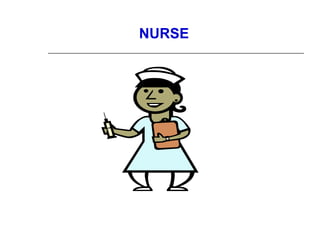
NURSE
NURSE

   Came from the Latin word

       “Noutrix”

   Meaning of the word

       “To Nourish”
AS A PROFESSION

   Body of specific and unique knowledge
   Strong service orientation
   Recognized authority by a professional group
   Code of ethics and laws
   Professional organization
   Ongoing research
   Autonomy
   CARE
LEVELS OF NURSES
LEVELS OF NURSES

   5 Levels of Nurses

       Level I
          No experience

          Novice


       Level II
          Has acceptable performance and has
           experienced enough situations
          Advanced beginner
LEVELS OF NURSES

     Level III

        Has 2 to 3 years of experience
        Competent

           Employed overseas


     Level IV
        Has 3 to 5 years of experience

        Proficient
LEVELS OF NURSES

     Level V
        Highly proficient

        Does not require guidance and rules

        Expert

           Capable of managing hospital units
FIELDS OF NURSING PRACTICE
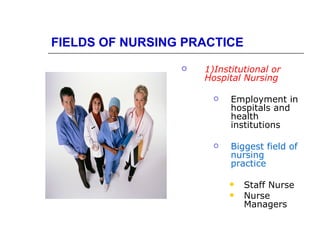
                    1)Institutional or
                     Hospital Nursing

                          Employment in
                           hospitals and
                           health
                           institutions

                          Biggest field of
                           nursing
                           practice

                              Staff Nurse
                              Nurse
                               Managers
FIELDS OF NURSING PRACTICE

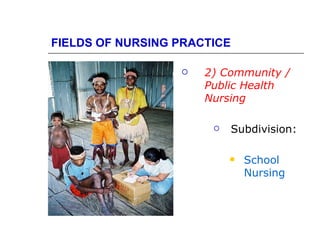
                     2) Community /
                      Public Health
                      Nursing

                            Subdivision:

                              School
                               Nursing
FIELDS OF NURSING PRACTICE

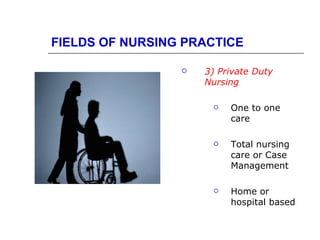
                    3) Private Duty
                     Nursing

                         One to one
                          care

                         Total nursing
                          care or Case
                          Management

                         Home or
                          hospital based
FIELDS OF NURSING PRACTICE
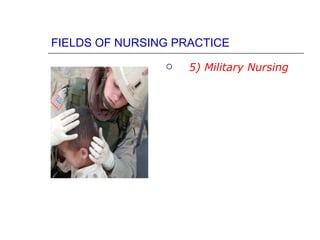
                   5) Military Nursing
FIELDS OF NURSING PRACTICE

                     6) Company /
                      Industrial Nursing
EXPANDED EDUCATIONAL AND
CAREER ROLES
EXPANDED EDUCATIONAL AND
CAREER ROLES

   Clinical Nurse Specialist

       A nurse with an advanced degree,
        education, or experience

       Considered to be an expert in a
        specialized area of nursing

       Example: Geriatric Nurse, Oncology
        Nurse, Maternal and Child Nurse
EXPANDED EDUCATIONAL AND
CAREER ROLES

   Nurse Practitioner

       A nurse with an advanced degree,
        certified for a special area or age of
        patient care

       Delivers independent practice to
        make health assessments and deliver
        primary care
          Diagnose
          Prescribe medications
EXPANDED EDUCATIONAL AND
CAREER ROLES
   Nurse Anesthetist

       A nurse who completes a course of study
        in an anesthesia school

          Carries out preoperative visits and
           assessments
          Administers and monitors anesthesia

           during surgery
          Evaluates postoperative status of

           patients
EXPANDED EDUCATIONAL AND
CAREER ROLES

   Nurse midwife

       A nurse who completes a program in
        midwifery

          Provides   prenatal and postnatal care

          Delivers
                 babies for women with
          uncomplicated pregnancies
EXPANDED EDUCATIONAL AND
CAREER ROLES

   Nurse Educator

       A nurse usually with an advanced
        degree, who teaches in educational or
        clinical settings
EXPANDED EDUCATIONAL AND
CAREER ROLES

   Nurse Administrator

       A nurse who functions at various levels
        of management

       Responsible for management and
        administration of resources and
        personnel involved in giving patient
        care
EXPANDED EDUCATIONAL AND
CAREER ROLES

   Nurse Researcher

       A nurse with an advanced degree who
        conducts research relevant to the
        definition and improvement of nursing
        practice and education
EXPANDED EDUCATIONAL AND
CAREER ROLES

   Nurse Entrepreneur

       A nurse, usually with an advance degree
        who may manage a clinic or health
        related business
NURSING ROLES
NURSING ROLES

   Caregiver

       Primary role of the nurse
       The provision of care
       MOTHER SURROGATE ROLES

         Complete   Assistance
         Partial Assistance

         Supportive/Educative
NURSING ROLES

   Communicator

       With Patients
             To establish Therapeutic
              Communication
             To identify health problems


       With Health Care Professionals
          Documentation

          Reporting / Endorsements
COMMUNICATION
COMMUNICATION

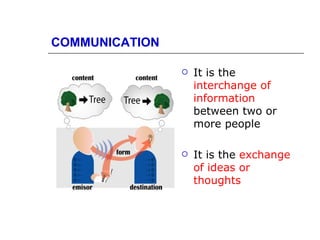
                   It is the
                    interchange of
                    information
                    between two or
                    more people

                   It is the exchange
                    of ideas or
                    thoughts
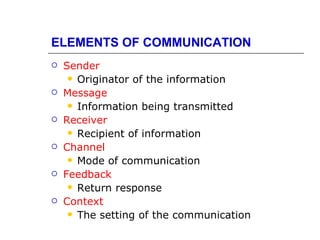
ELEMENTS OF COMMUNICATION
   Sender
      Originator of the information
   Message
      Information being transmitted
   Receiver
      Recipient of information
   Channel
      Mode of communication
   Feedback
      Return response
   Context
      The setting of the communication
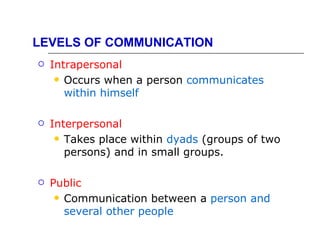
LEVELS OF COMMUNICATION
   Intrapersonal
      Occurs when a person communicates
       within himself

   Interpersonal
      Takes place within dyads (groups of two
       persons) and in small groups.

   Public
      Communication between a person and
       several other people
MODES OF COMMUNICATION

   Verbal Communication

   Non-verbal Communication
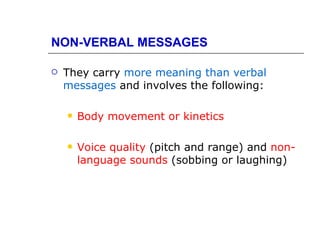
NON-VERBAL MESSAGES

   They carry more meaning than verbal
    messages and involves the following:

       Body movement or kinetics

       Voice quality (pitch and range) and non-
        language sounds (sobbing or laughing)
NON-VERBAL MESSAGES
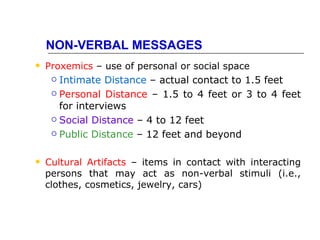
   Proxemics – use of personal or social space
      Intimate Distance – actual contact to 1.5 feet
      Personal Distance – 1.5 to 4 feet or 3 to 4 feet

       for interviews
      Social Distance – 4 to 12 feet

      Public Distance – 12 feet and beyond


   Cultural Artifacts – items in contact with interacting
    persons that may act as non-verbal stimuli (i.e.,
    clothes, cosmetics, jewelry, cars)
THERAPEUTIC RESPONSES IN
COMMUNICATING WITH PATIENTS
THERAPEUTIC RESPONSES


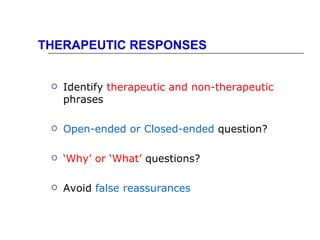
    Identify therapeutic and non-therapeutic
     phrases

    Open-ended or Closed-ended question?

    ‘Why’ or ‘What’ questions?

    Avoid false reassurances
THERAPEUTIC RESPONSES

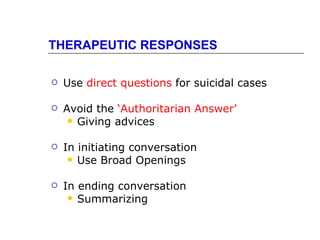
   Use direct questions for suicidal cases

   Avoid the ‘Authoritarian Answer’
      Giving advices


   In initiating conversation
      Use Broad Openings


   In ending conversation
      Summarizing
COMMUNICATING WITH HEALTH
CARE PROFESSIONALS
COMMUNICATING WITH HEALTH CARE
PROFESSIONALS

   Documentation

   Reporting

   Conferring

   Referring
COMMUNICATING WITH HEALTH CARE
PROFESSIONALS

   Reporting

       Endorsement

       Transferring pertinent information
        regarding a patient to a concerned
        person

       Outgoing nurse to a incoming nurse

       Staff nurse to physician
COMMUNICATING WITH HEALTH CARE
PROFESSIONALS

   Conferring

       To verify information

       Rephrasing

          To   validate doctor’s orders

          To   validate a nurse’s endorsement
COMMUNICATING WITH HEALTH CARE
PROFESSIONALS

   Referring

       To endorse patient’s special concern to a
        higher authority or a specialized
        department or personnel

         A community nurse referring a client
          to a hospital or a doctor

         A   staff nurse to a dietitian
NURSING ROLES

   Teacher/Educator

       Providing education about a client’s
        health and health care procedures they
        need to perform to restore or maintain
        their health
NURSING ROLES
   Teaching Strategies

       Assess client’s

          Readiness to learn
          Assess the client’s knowledge


       Simple to complex
NURSING ROLES

   Teaching Strategies

       One to One Discussion or Group
        Discussion

          Explanation  and Description
          Answering Questions

          Visual Assisted Learning Programs

          Demonstration

             Actual performance of an activity
NURSING ROLES

   What is the best method of teaching?
    (December 2007 NLE)

   What is the best indicator of client learning?
NURSING ROLES

   Counselor

       Facilitates the patient’s problem solving
        and decision – making skills

       By providing information, make
        appropriate referrals
NURSING ROLES

   Researcher

       The participation in or conduct of
        research

       To increase knowledge in nursing and
        improve patient care
NURSING ROLES

   Advocate

       Safeguarding the rights of the patients

       Patients Bill of Rights
THEORIES OF NURSING
THEORIES OF NURSING

   Theory

       A hypothesis or system of ideas that is
        proposed to explain a given phenomenon

       Purpose:

          Directs   and guide nursing practice
THEORIES OF NURSING

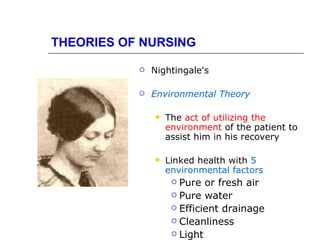
              Nightingale's

              Environmental Theory

                  The act of utilizing the
                   environment of the patient to
                   assist him in his recovery

                  Linked health with 5
                   environmental factors
                     Pure or fresh air
                     Pure water

                     Efficient drainage

                     Cleanliness

                     Light
THEORIES OF NURSING
   Nightingale's Environmental Theory

       Addition:

          Education   of nurses

          Keeping   the client warm

          Maintaining   a noise free environment

          Attending   to the client’s diet
THEORIES OF NURSING

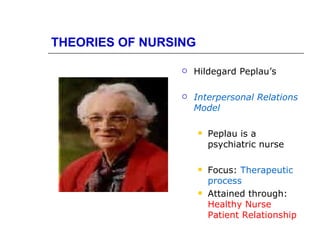
                    Hildegard Peplau’s

                    Interpersonal Relations
                     Model

                         Peplau is a
                          psychiatric nurse

                         Focus: Therapeutic
                          process
                         Attained through:
                          Healthy Nurse
                          Patient Relationship
THEORIES OF NURSING

   Hildegard Peplau’s Interpersonal Relations
    Model

       Four Phases of the Nurse – Patient
        Interaction

          Preorientation

          Orientation

          Working / Exploitation
          Termination/Resolution
THEORIES OF NURSING

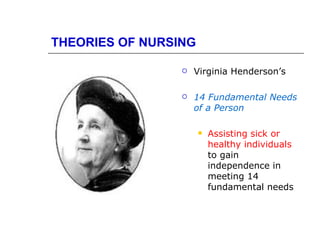
                    Virginia Henderson’s

                    14 Fundamental Needs
                     of a Person

                         Assisting sick or
                          healthy individuals
                          to gain
                          independence in
                          meeting 14
                          fundamental needs
THEORIES OF NURSING
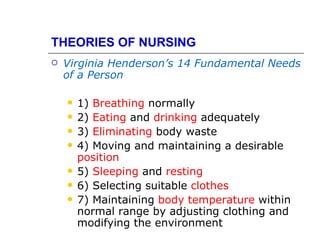
   Virginia Henderson’s 14 Fundamental Needs
    of a Person

       1) Breathing normally
       2) Eating and drinking adequately
       3) Eliminating body waste
       4) Moving and maintaining a desirable
        position
       5) Sleeping and resting
       6) Selecting suitable clothes
       7) Maintaining body temperature within
        normal range by adjusting clothing and
        modifying the environment
THEORIES OF NURSING
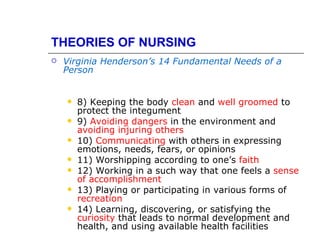
   Virginia Henderson’s 14 Fundamental Needs of a
    Person


       8) Keeping the body clean and well groomed to
        protect the integument
       9) Avoiding dangers in the environment and
        avoiding injuring others
       10) Communicating with others in expressing
        emotions, needs, fears, or opinions
       11) Worshipping according to one’s faith
       12) Working in a such way that one feels a sense
        of accomplishment
       13) Playing or participating in various forms of
        recreation
       14) Learning, discovering, or satisfying the
        curiosity that leads to normal development and
        health, and using available health facilities
THEORIES OF NURSING

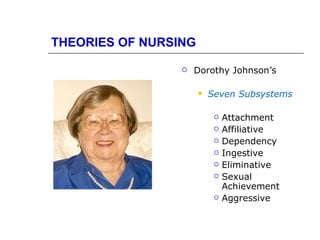
                    Dorothy Johnson’s

                         Seven Subsystems

                              Attachment
                              Affiliative
                              Dependency
                              Ingestive
                              Eliminative
                              Sexual
                               Achievement
                              Aggressive
THEORIES OF NURSING
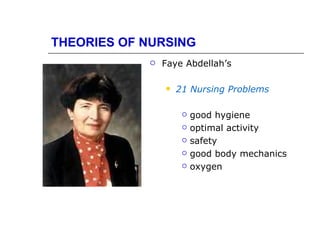
               Faye Abdellah’s

                   21 Nursing Problems

                        good hygiene
                        optimal activity
                        safety
                        good body mechanics
                        oxygen
THEORIES OF NURSING

   Faye Abdellah’s 21 Nursing Problems

       nutrition
       elimination
       fluid and electrolytes balance
       physiologic response of the body to disease
       regulatory mechanisms
       sensory function.
       positive and negative expressions, feelings and
        reactions.
       accept the interrelatedness of emotions and
        illness
THEORIES OF NURSING

   Faye Abdellah’s 21 Nursing Problems

       self awareness
       optimum possible goals
       use community resources
       role of social problems
THEORIES OF NURSING

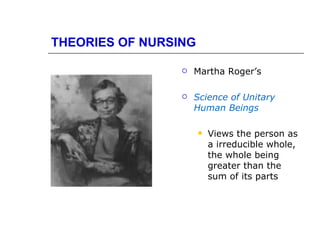
                    Martha Roger’s

                    Science of Unitary
                     Human Beings

                         Views the person as
                          a irreducible whole,
                          the whole being
                          greater than the
                          sum of its parts
THEORIES OF NURSING

   Martha Roger’s Science of Unitary Human
    Beings

       Man is composed of energy fields, which
        are in constant interaction with the
        environment

       Seek to promote harmonic interactions
        between the two energy fields (Human
        and Environmental)
THEORIES OF NURSING
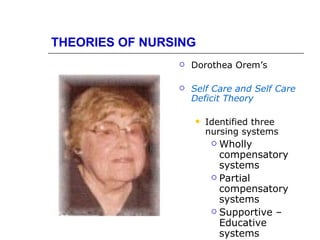
                   Dorothea Orem’s

                   Self Care and Self Care
                    Deficit Theory

                       Identified three
                        nursing systems
                          Wholly
                           compensatory
                           systems
                          Partial
                           compensatory
                           systems
                          Supportive –
                           Educative
                           systems
THEORIES OF NURSING
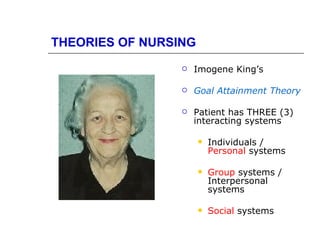
                    Imogene King’s

                    Goal Attainment Theory

                    Patient has THREE (3)
                     interacting systems

                         Individuals /
                          Personal systems

                         Group systems /
                          Interpersonal
                          systems

                         Social systems
THEORIES OF NURSING

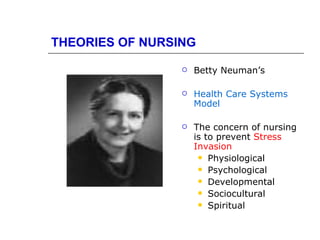
                    Betty Neuman’s

                    Health Care Systems
                     Model

                    The concern of nursing
                     is to prevent Stress
                     Invasion
                       Physiological
                       Psychological
                       Developmental
                       Sociocultural
                       Spiritual
THEORIES OF NURSING

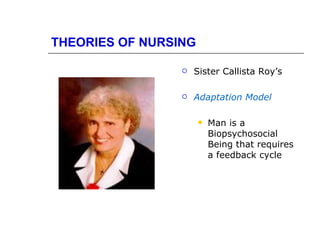
                    Sister Callista Roy’s

                    Adaptation Model

                         Man is a
                          Biopsychosocial
                          Being that requires
                          a feedback cycle
THEORIES OF NURSING

   Sister Callista Roy’s Adaptation Model

       The goal is to enhance life processes
        through adaptation in four adaptive
        models

          The    Physiologic Mode

          Self   Consent Mode

          Role   Function Mode

          Interdependence    Mode
THEORIES OF NURSING
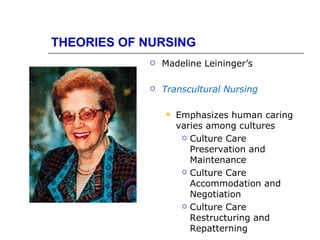
               Madeline Leininger’s

               Transcultural Nursing

                   Emphasizes human caring
                    varies among cultures
                      Culture Care

                       Preservation and
                       Maintenance
                      Culture Care

                       Accommodation and
                       Negotiation
                      Culture Care

                       Restructuring and
                       Repatterning
CONCEPT OF MAN
CONCEPT OF MAN

   Nurse’s Clients

       Individuals

       Families

       Communities
CONCEPT OF MAN

   BIOLOGIC like ALL other men

   PSYCHOLOGICAL like NO OTHER man

   SOCIAL like SOME OTHER men

   SPIRITUAL like SOME OTHER men
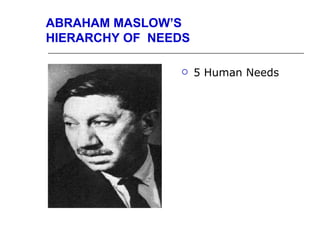
ABRAHAM MASLOW’S
HIERARCHY OF NEEDS

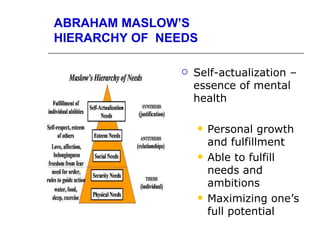
                    5 Human Needs
ABRAHAM MASLOW’S
HIERARCHY OF NEEDS

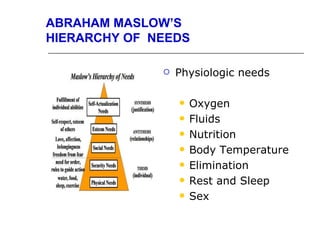
                 Physiologic needs

                     Oxygen
                     Fluids
                     Nutrition
                     Body Temperature
                     Elimination
                     Rest and Sleep
                     Sex
ABRAHAM MASLOW’S
HIERARCHY OF NEEDS

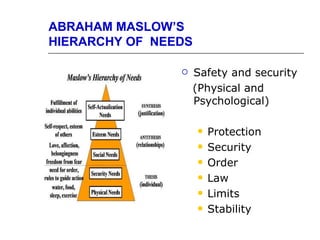
                    Safety and security
                     (Physical and
                     Psychological)

                        Protection
                        Security
                        Order
                        Law
                        Limits
                        Stability
ABRAHAM MASLOW’S
HIERARCHY OF NEEDS

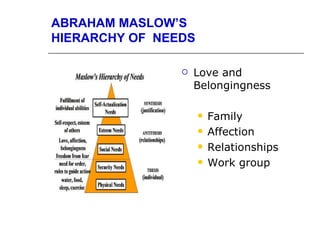
                   Love and
                    Belongingness

                        Family
                        Affection
                        Relationships
                        Work group
ABRAHAM MASLOW’S
HIERARCHY OF NEEDS

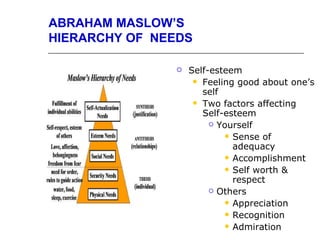
                  Self-esteem
                     Feeling good about one’s
                      self
                     Two factors affecting
                      Self-esteem
                         Yourself

                            Sense of
                             adequacy
                            Accomplishment
                            Self worth &
                             respect
                         Others

                            Appreciation
                            Recognition
                            Admiration
ABRAHAM MASLOW’S
HIERARCHY OF NEEDS

                  Self-actualization –
                   essence of mental
                   health

                      Personal growth
                       and fulfillment
                      Able to fulfill
                       needs and
                       ambitions
                      Maximizing one’s
                       full potential
ABRAHAM MASLOW’S
HIERARCHY OF NEEDS

   Self Actualization

       Judges people correctly
       Superior perception
       Decisive
          Capable of making decisions

       Clear notion as to what is right and
        wrong
ABRAHAM MASLOW’S
HIERARCHY OF NEEDS

    Open to new ideas
       Not adopts new ideas

       Not one track mind


    Highly creative and flexible

    Does not need fame

    Problem-centered rather than self-
     centered
ABRAHAM MASLOW’S
HIERARCHY OF NEEDS

   Additional needs:

       Need to know and understand

       Aesthetic needs

       Transcendence
ABRAHAM MASLOW’S
HIERARCHY OF NEEDS

   Need to know and understand or Cognitive
    needs is supported by Richard Kalish who
    says that

       Man needs stimulation
       Needs to explore
          Sex
          Activity
          New things
ABRAHAM MASLOW’S
HIERARCHY OF NEEDS

   Aesthetic needs:

       Beauty
       Balance
       Form
ABRAHAM MASLOW’S
HIERARCHY OF NEEDS

   Transcendence:

       Helping others to self-actualize
ILLNESS, WELLNESS AND HEALTH
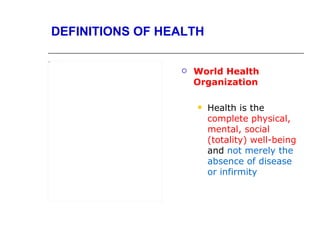
DEFINITIONS OF HEALTH

Object 5


                           World Health
                            Organization

                               Health is the
                                complete physical,
                                mental, social
                                (totality) well-being
                                and not merely the
                                absence of disease
                                or infirmity
DEFINITIONS OF HEALTH

   Health is individually defined by each
    person

   On a personal level, individuals define
    health according to
      how they feel

      absence or presence of symptoms of
       illness
      and ability to carry out activities
DISEASE

   Objective pathologic process

   Pathologic change in the structure or function
    of the mind and body
DISEASE

 Acute


     Rapid onset of symptoms

     Some are life threatening

     Many do not require medical treatment
DISEASE

   Chronic

       Broad term that encompasses many
        different physical and mental alterations in
        health

            It is a permanent change

            Requires special patient education for
             rehabilitation

            Requires long term of care and support
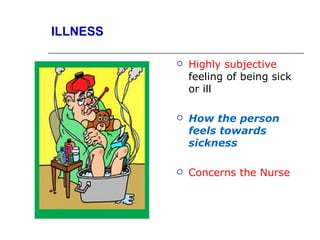
ILLNESS

             Highly subjective
              feeling of being sick
              or ill

             How the person
              feels towards
              sickness

             Concerns the Nurse
ELEVEN STAGES OF ILLNESS AND
HEALTH-SEEKING BEHAVIOR BY SUCHMAN

     1. Symptom Experience

         Client realizes there is a problem
         Client responds emotionally

     2. Sick Role Assumption

         Self-medication / Self-treatment
         Communication to others
ELEVEN STAGES OF ILLNESS AND HEALTH-
SEEKING BEHAVIOR BY SUCHMAN

     3. Assuming a Dependent Role

         Accepts the diagnosis
         Follows prescribed treatment

     4. Achieving recovery and rehabilitation

         Gives up the dependent role and assumes
          normal activities and responsibilities
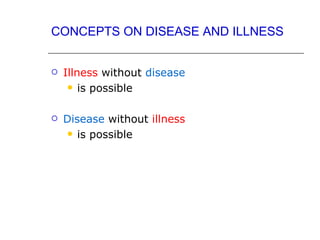
CONCEPTS ON DISEASE AND ILLNESS


   Illness without disease
      is possible


   Disease without illness
     is possible
MODELS OF HEALTH AND ILLNESS
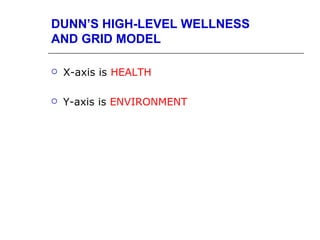
DUNN’S HIGH-LEVEL WELLNESS
AND GRID MODEL

   X-axis is HEALTH

   Y-axis is ENVIRONMENT
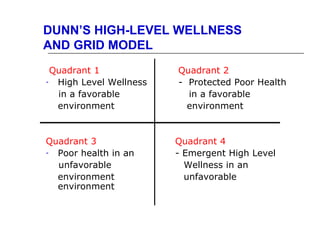
DUNN’S HIGH-LEVEL WELLNESS
AND GRID MODEL
 Quadrant 1             Quadrant 2
- High Level Wellness   - Protected Poor Health
  in a favorable          in a favorable
  environment             environment


Quadrant 3              Quadrant 4
- Poor health in an     - Emergent High Level
  unfavorable             Wellness in an
  environment             unfavorable
  environment
HEALTH BELIEF MODEL BY
ROSENTOCK

   Concerned with what people perceive about
    themselves in relation to their health

   Consider perceptions (influences individuals
    motivation toward results)
      Perceived susceptibility
      Perceived seriousness
      Perceived benefit out of the action
FOUR LEVELS OF HEALTH BY SMITH


1. Clinical Model

      Man is viewed as a Physiologic Being

      If there are no signs and symptoms of a
       disease, then you are healthy
FOUR LEVELS OF HEALTH BY SMITH


2. Role Performance Model

     As long as you are able to perform
      SOCIETAL functions and ROLES you are
      healthy
FOUR LEVELS OF HEALTH BY SMITH


3. Adaptive Model

     Health is viewed in terms of capacity to
      ADAPT

     Failure to adapt is disease
FOUR LEVELS OF HEALTH BY SMITH


4. Eudaemonistic Model

     This is the BROADEST concept of health

     Because health is viewed in terms of
      Actualization
AGENT, HOST, ENVIRONMENT MODEL
BY LEAVELL AND CLARK

   Also known as the Ecologic Model

   Triad is composed of the agent, host and
    environment

   Based on the interplay of three components
    of the model
NURSING PROCESS
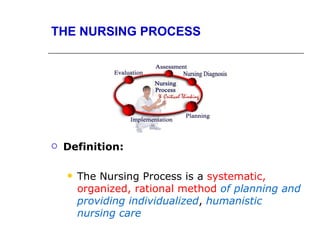
THE NURSING PROCESS


   Definition:

       The Nursing Process is a systematic,
        organized, rational method of planning and
        providing individualized, humanistic
        nursing care
Nursing process
   foundation of the nursing profession
   central to nursing actions
   a process to deliver care to patients
   supported by nursing models or philosophies.
   systematic approach
   enhances research opportunities
   adaptable to different clients in different care
    settings
   efficient method of organizing thought processes or
    clinical decision-making and problem-solving
   Synonymous with the problem solving approach
    for discovering the healthcare and nursing care
    needs of clients. (UDAN)

   It is an organized method of giving individualized
    nursing care that focuses of identifying unique
    responses of individual or group to actual or
    potential alteration in health. (KOZIER)

   It is a method of problem identification and
    problem solving
PURPOSES OF THE NURSING PROCESS


   To identify health status
      Actual health problems

      Potential health problems


   To establish plans

   To deliver specific nursing care

   To evaluate nursing care
CHARACTERISTICS OF
THE NURSING PROCESS

   Client-centered

    Cyclical (sequence), dynamic (moving)
     rather than static
     Data from each phase provide input to
      the next phase

    Interpersonal and collaborative
     Work with patients and relatives
     Work with colleagues and other members
      of the health team
CHARACTERISTICS OF
THE NURSING PROCESS

   Adaptation of problem-solving techniques
    and decision making principles in all the
    phases

   Problem-oriented, flexible, open to new
    information
CHARACTERISTICS:
   Problem – Oriented
   Goal Oriented
   Orderly planned step by step
   Open in accepting additional
    information during application
   Universally applicable to al patients
    family and community that nursing
    service.
BENEFITS FROM THE NURSING PROCESS


   Improves quality of care

   Ensures continuity and appropriate level
    of care
      Long term plans


   Promotes a positive working atmosphere
    through collaboration

   Facilitates client participation through
    planning with patient
BENEFITS FROM THE NURSING PROCESS


   Feedback allows nurse to evaluate care

   Serves as a framework for accountability
    through documentation
PARTS OF THE NURSING PROCESS


   Assessment Phase

   Diagnosing Phase

   Planning Phase

   Intervention Phase

   Evaluation Phase
ASSESSMENT PHASE
ASSESSMENT PHASE
   Is the systematic and continuous collection,
    organization, validation, and documentation of
    data

   Carried all throughout the nursing process
      Diagnosing

      Planning
            Information in assessment is crucial
       Implementation
          Before performing nursing care

       Evaluation
          Assessing the current status to compare with

           previous status
ASSESSMENT PHASE

   What to assess

       Clients perceived needs

       Client’s responses to health problems
          Asthma
             Difficulty of breathing
          Arthritis
             Pain


       Health practices, values, and lifestyles
FOUR TYPES OF ASSESSMENT


   Initial Assessment

   Focus Assessment or On-going
    Assessment

   Emergency Assessment

   Time-Lapsed Assessment
FOUR TYPES OF ASSESSMENT


   1. Initial Assessment
      When performed:

         At specified time after admission


       Purpose of Initial Assessment:
          To create a data base for problem

           identification
          For reference and future comparison
FOUR TYPES OF ASSESSMENT

   2. Focus Assessment or On-going
    Assessment

       When performed:
          Integrated throughout the nursing process


       Purpose of On-going Assessment:
          To identify problems overlooked earlier

          To determine the status of a health

           problem
             Same from database

             Ex before implementation
FOUR TYPES OF ASSESSMENT


   3. Emergency Assessment
      When done:

         During acute physiologic and

          psychologic crisis
      Where done:

         Emergency Room

         Anywhere

         On site

      Purpose of Emergency Assessment

         To identify life-threatening condition
FOUR TYPES OF ASSESSMENT

   4. Time-Lapsed Assessment

       When done:
          Several months after initial

           assessment

       Purpose of Time-Lapsed Assessment
          To compare current status of patient

           with base line data (initial
           assessment)
          Ex

             Diabetic
ASSESSMENT PHASE


   Nursing Activities in the Assessment
    Phase

       Data Collection

       Data Organization

       Data Validation

       Data Recording
CRITICAL THINKING
•   It is how the        Over time the

    nurse uses the        nurse learns to
                          almost
    information to
                          simultaneously
    reason, make          review, interpret,
    inferences and        analyze and
    form mental           evaluate
    picture of what       information about
    is happening to       clients.
•   Facione and Facione (1996) define
    the client.
    critical thinking as purposeful self-
    regulatory judgment that is
    centrally evident in expert clinical
To use this process, the nurse must
     demonstrate other fundamental
     abilities of:

3. Knowledge
4. Creativity

5. Adaptability

6. Commitment

7. Trust

8. Leadership

9. Intelligence

10.Interpersonal and technical skills.
DATA COLLECTION
DATA COLLECTION

   Is the process of gathering information or
    data

   Data gathering
RECORDED DATA

   Types of Data

   Sources of Data

   Methods of Data Collection
TYPES OF DATA
TYPES OF DATA


   1. Subjective or Covert Data

       Felt by the patient

       During the recording of data, this should
        be stated using the patient’s own words

       “Mommy I feel hot”
TYPES OF DATA


   2. Objective or Overt Data

       Capable of being observed by use of
        senses – sight, touch, smell, hearing
SOURCES OF DATA
SOURCES OF DATA

   1. Primary Source

       Patient himself, except when:

          Patient is unconscious
          Patient is a baby

          Patient is insane


          Significant others become the primary
           source of data (from a secondary source)
          Unconscious brought in the ER?

             Whoever brought the patient to the
              hospital
SOURCES OF DATA


   2. Secondary Source

       Patient’s record
       Health care members
       Significant others
METHODS OF DATA COLLECTION


   Observing

   Interviewing

   Examining
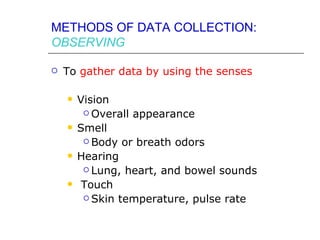
METHODS OF DATA COLLECTION:
OBSERVING

   To gather data by using the senses

       Vision
          Overall appearance

       Smell
          Body or breath odors

       Hearing
          Lung, heart, and bowel sounds

        Touch
          Skin temperature, pulse rate
METHODS OF DATA COLLECTION:
OBSERVING

   Two (2) aspects of observation process:

       Noticing the stimuli using the senses

       Record the observed stimuli
METHODS OF DATA COLLECTION:
INTERVIEWING

   Is a planned conversation with a purpose

       To get or give information

       Provide health teachings

       Provide support
METHODS OF DATA COLLECTION:
INTERVIEWING

   Two types of Interview

       Directive Type of Interview

       Non-directive Type of Interview or
        Rapport-building Interview
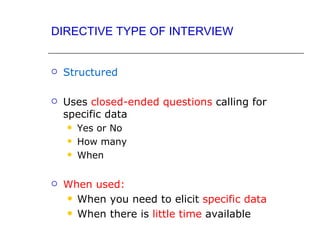
DIRECTIVE TYPE OF INTERVIEW


   Structured

   Uses closed-ended questions calling for
    specific data
       Yes or No
       How many
       When

   When used:
     When you need to elicit specific data

     When there is little time available
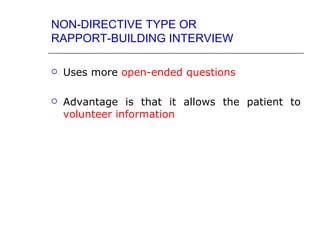
NON-DIRECTIVE TYPE OR
RAPPORT-BUILDING INTERVIEW

   Uses more open-ended questions

   Advantage is that it allows the patient to
    volunteer information
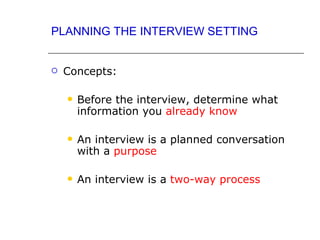
PLANNING THE INTERVIEW SETTING


   Concepts:

       Before the interview, determine what
        information you already know

       An interview is a planned conversation
        with a purpose

       An interview is a two-way process
PLANNING THE INTERVIEW SETTING

   Concepts:

       When is it done?
          When patient is available
          When patient is comfortable


       Recommended distance from the patient
        is three (3) to four (4) feet

       Place

       Seating Arrangement

       Language
STAGES OF THE INTERVIEW


   1. Opening Stage

       This is the most important part of the
        interview

       Rationale
          What was said and done during the
           opening stage sets the tone all
           throughout the interview

          Establish   rapport

          Orientation
STAGES OF THE INTERVIEW


   2. Body of the Interview

       Occurs when patient responds to
        questioning

       The most productive stage
STAGES OF THE INTERVIEW

   3. Closing Stage

       The nurse terminates the interview when
    
          Theneeded information has been
          obtained and given

          The client can no longer take in
          information

          Provided   support
STAGES OF THE INTERVIEW STAGES OF
THE INTERVIEW
   3. Closing Stage

       How to close the interview:
          Summarizing Technique

              To verify accuracy

              It reassures the client that the
               nurse listened
              Sense of accomplishment

          Offer to answer questions

          Thank the client

          Plan for the next meeting if there is

           one
METHODS OF DATA COLLECTION:
EXAMINING

   The physical examination or assessment

   Use of senses

   Use of inspection, palpation, percussion,
    and auscultation
METHODS OF DATA COLLECTION:
EXAMINING

   Cephalocaudal

   Proximodistal

   IPPA

   IAPP
ORGANIZING DATA
ORGANIZING DATA

   Clustering of data

       Example
       Nursing Health History
          Current health problem

          Past history of illness

          Family history of illness

          Lifestyle

          Body Systems
VALIDATION OF DATA
VALIDATION OF DATA


   Act of double-checking the data

   Purposes of Data Validation

       To ensure the:
          Correctness

          Completeness
DATA RECORDING
DATA RECORDING

   Data Recording COMPLETES the
    Assessment Phase

       Complete

       Factual
          Don’t interpret

          Man found lying on the floor


       Brevity
          Short but concise
DOCUMENTATION
DOCUMENTATION


   It is a written, formal document

   A record of client’s progress
PURPOSES OF DOCUMENTATION


   Planning Care
   Communication
   For legal documentation purposes
   For research
   For education
GUIDELINES ON DOCUMENTATION


   Timing
      Document patient care as soon as possible


   Observe confidentiality

   Observe permanence
      Use non-erasable ink

      Do not use sign pen
GUIDELINES ON DOCUMENTATION


   Signature
      Sign full name and append R.N.


   Accuracy
      Ensure that data is correct

      Avoid biases

      Avoid ambiguous terms


   Appropriateness
      Write only appropriate information
GUIDELINES ON DOCUMENTATION

   Completeness

   Use standard terminology

   Brevity
      Make it concise yet meaningful


   Legal Awareness
      Cross out erroneous entry
      Write “Error”
      Countersign
TYPES OF RECORDS


   Source-Oriented Clinical Record

   Problem-Oriented Clinical Record
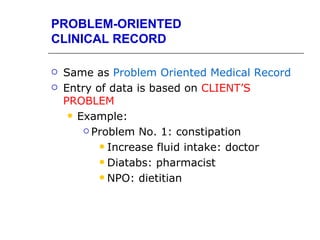
PROBLEM-ORIENTED
CLINICAL RECORD

   Same as Problem Oriented Medical Record
   Entry of data is based on CLIENT’S
    PROBLEM
      Example:

         Problem No. 1: constipation

            Increase fluid intake: doctor

            Diatabs: pharmacist

            NPO: dietitian
FOUR BASIC COMPONENTS OF
PROBLEM-ORIENTED CLINICAL RECORD

     1. Baseline Data

         All information gathered from a patient
          when he first entered the agency

            Assessment of the physician
            Assessment of the nurse
FOUR BASIC COMPONENTS OF
PROBLEM-ORIENTED CLINICAL RECORD

    2. Problem List

        Contains only ACTIVE problems (and
         relevant information about the problem)

           Medical Diagnosis
           Nursing Diagnosis
FOUR BASIC COMPONENTS OF
PROBLEM-ORIENTED CLINICAL RECORD

    3. Initial list of orders or Care Plans
FOUR BASIC COMPONENTS OF
PROBLEM-ORIENTED CLINICAL RECORD

     4. Progress Notes

         Includes:
            Nurses’ narrative notes (SOAPIE)

            Flow sheets

            Discharge Notes and Referral

             Summaries
SOURCE-ORIENTED CLINICAL RECORD


   Classification of information is based on
    SOURCE

   Each person or department maintains a
    different section on chart
COMPONENTS OF A
SOURCE-ORIENTED CLINICAL RECORD

    Admission Sheet

    Nursing Notes

    Medical History and Physical Examination Sheet

    Diagnostic Findings Sheet

    TPR Graphic Sheet

    Doctor’s Treatment and Order Sheet

    Therapeutic Sheet
ASSESSMENT
DIAGNOSING PHASE
DIAGNOSING PHASE

   Nurses use critical thinking skills to
    interpret assessment data and identify
    client strengths and problems

   Positive or Negative?
DIAGNOSING PHASE

   Diagnostic Process

       Analyze the data

       Identify health problems, risk, and
        strengths

       Formulating diagnostic statements
PARTS OF A NURSING DIAGNOSIS


   1. Problem Statement
      Example:
         Fluid Volume Deficit


   2. Presumed Etiology
      Example:
         …related to frequent loss of bowel
          movement

   3. Signs and Symptoms
    Example:
         …as manifested by decreased skin
          turgor
TYPES OF DIAGNOSTIC STATEMENTS

   Basic Two Part Statements (PE)

       Problem and Etiology

       Altered Nutrition Less than Body
        Requirements related to difficulty
        swallowing
TYPES OF DIAGNOSTIC STATEMENTS

   Basic Three Part Statement (PES)

       Problem
       Etiology
       Signs and Symptoms

       Altered Nutrition Less than Body
        Requirements related to difficulty
        swallowing as manifested by body
        weakness
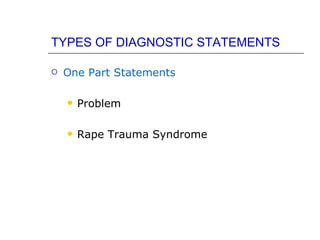
TYPES OF DIAGNOSTIC STATEMENTS

   One Part Statements

       Problem

       Rape Trauma Syndrome
TYPES OF NURSING DIAGNOSIS
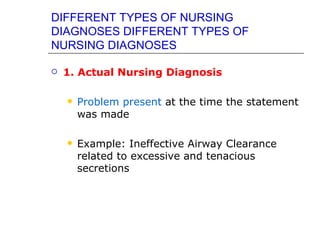
DIFFERENT TYPES OF NURSING
DIAGNOSES DIFFERENT TYPES OF
NURSING DIAGNOSES

   1. Actual Nursing Diagnosis

       Problem present at the time the statement
        was made

       Example: Ineffective Airway Clearance
        related to excessive and tenacious
        secretions
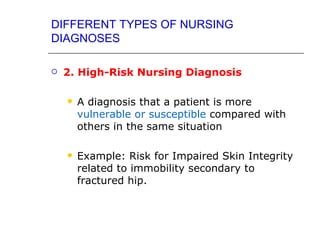
DIFFERENT TYPES OF NURSING
DIAGNOSES

   2. High-Risk Nursing Diagnosis

       A diagnosis that a patient is more
        vulnerable or susceptible compared with
        others in the same situation

       Example: Risk for Impaired Skin Integrity
        related to immobility secondary to
        fractured hip.
DIFFERENT TYPES OF NURSING
DIAGNOSES

   3. Possible Nursing Diagnosis

       Not enough evidence about a problem

       Example: Possible Self Care Deficit
        related to impaired ability to use left
        hand secondary to presence of
        intravenous therapy
DIFFERENT TYPES OF NURSING
DIAGNOSES

   4. Wellness Nursing Diagnosis

       A positive statement
       Indicates a healthy response
       Examples:

            Potential for increased compliance
             related to increased level of knowledge

            Potential for effective coping related to
             adequate support systems
PLANNING PHASE
PLANNING PHASE

   Planning is a deliberative, systematic phase
    that involves decision making and problem
    solving

   Formulating client goals with the patient

   Designing nursing interventions
ACTIVITIES DURING
THE PLANNING PROCESS

   Set priorities
      Client’s problems


   Set goals and objectives

   Identify alternatives of nursing care

   Select nursing measures

   Write the nursing care plan
PURPOSES OF GOAL-SETTING


   To set direction

   To provide a time span

   To have a criteria for evaluation

   To enable the nurse and the patient to
    determine whether the problem has been
    resolved or not

   To help motivate the client and the patient by
    providing a sense of accomplishment
TYPES OF PLANNING
TYPES OF PLANNING


   1. Initial Planning

       Done by the nurse

       When done:
          At specified time upon or after

           admission/assessment of the patient
TYPES OF PLANNING


   2. On-going Planning

       Who are involved:
          Done by all nurses who worked with

           the patient

       When done:
         - Before start of shift
TYPES OF PLANNING


   2. On-going Planning

       Purposes of On-going Planning
          To determine if the client’s health status

           has changed
          To decide which problems to focus on

           during the shift
          To set priorities for client care during

           the shift
TYPES OF PLANNING


   3. Discharge Planning

       Purpose of Discharge Planning

            To ensure continuity of care

            M–E–T–H-O–D-S
CHARACTERISTICS OF
THE PLANNING PROCESS

   S
       Specific
   M
       Measurable
   A
       Attainable
   R
       Realistic
   T
       Time bound
IMPLEMENTING PHASE
IMPLEMENTING PHASE


   Consists of doing and documenting the
    nursing care given to the patient

   Putting the care plan into action
IMPLEMENTING PHASE


   Purpose of Implementation

       To carry out planned activities

       To help the client
IMPLEMENTING PHASE


   Requirements for Implementation

       Adequate knowledge
       Technical Skills
       Communication skills
       Therapeutic use of self
IMPLEMENTING PHASE


   Reassess the patient
      Rationale

         To determine if the procedure is still

          needed

   Determine the need for nursing assistance

   Understand orders
      Clarify / verify doctors’ orders
NURSING ACTIVITIES DURING THE
IMPLEMENTATION PHASE

   Communicate the procedure
    performed by documenting the
    procedure

   Encourage patient to participate
    actively
GUIDELINES FOR IMPLEMENTATION OF
NURSING STRATEGIES

   It should be based on scientific knowledge,
    research, professional standards of practice
    (care)
      Rationale:

         This is done to ensure safe nursing care


   It should be adapted to the individual patient
GUIDELINES FOR IMPLEMENTATION OF
NURSING STRATEGIES

   It should always be safe. Do not compromise

   It should be holistic

   It should be accompanied by support,
    comfort and teaching
EVALUATION PHASE
EVALUATION PHASE


   Purpose of the Evaluation Phase

       To determine client’s progress

       To determine the effectiveness of the care
        plan

       To determine as to what extent the
        nursing goals have been met
EVALUATION PHASE


   Importance of doing an Evaluation

       It determines if the care plan will be:

          Continued

          Modified

          Discontinued
EVALUATION PHASE


   Activities during the Evaluation Phase

       Identify the OUTCOME CRITERIA to be
        used as measurement (Planning)
       Gather information (data) relevant to the
        outcome criteria
       Compare outcome (data) with the criteria
       Assess the reasons for the outcome
       Revise the nursing care plan as needed
TYPES OF EVALUATION


   1. On-going Evaluation

       When done:
          During or immediately after the

           intervention

       Importance:
          Allows the nurse to decide and make

           on-the-spot modification/s in an
           intervention
TYPES OF EVALUATION


   2. Intermittent Evaluation

       When done:
          At a specified time


       Purpose:
          It shows the extent of progress of the
           patient

       Importance:
          Enables the nurse to correct deficiencies
           and modify the nursing care plan
TYPES OF EVALUATION


   3. Terminal Evaluation

       When done:
          At or immediately before discharge


       Importance:
          States the status of a health problem at
           the time of discharge
          It determines whether the goals are:
               Met
               Partially met
               Unmet
PROMOTING REST AND SLEEP

   Sleep is the altered level of consciousness
    in which the individual’s perception of and
    reaction to environment are decreased
PROMOTING REST AND SLEEP

   What regulates sleep and wakefulness?

       Reticular formation on the Brain Stem

       Ascending nerve fibers
          Reticular Activating System (RAS)

          Sleep Wake Cycle
PROMOTING REST AND SLEEP

   Types of Sleep

       NREM
          Non-Rapid Eye Movement Sleep


       REM
          Rapid Eye Movement Sleep
PROMOTING REST AND SLEEP

   NREM (Non-Rapid Eye Movement Sleep)

       When the RAS is inhibited
          Sleep


       BODY RESTORATION

       About 75% to 80% of sleep

       Has 4 Stages
PROMOTING REST AND SLEEP

   NREM (Non-Rapid Eye Movement Sleep)

       Stage I (Very Light Sleep)

          Lasts only a few minutes
          Drowsy and relaxed

          Eyes roll from side to side

          HR and RR drop slightly

          Readily awakened
PROMOTING REST AND SLEEP

   NREM (Non-Rapid Eye Movement Sleep)

       Stage II (Light Sleep)

          Lastsfor 10-15 minutes
          Body processes continue to slow down

          HR and RR decrease furthermore

          Body temperature falls

          Eyes are still
PROMOTING REST AND SLEEP

   NREM (Non-Rapid Eye Movement Sleep)

       Stage III

          The HR and RR, as well as other body
           processes, slow further
          The sleeper becomes more difficult to
           arouse
          The skeletal muscles are very relaxed

          The reflexes are diminished and
           snoring may occur
PROMOTING REST AND SLEEP

   NREM (Non-Rapid Eye Movement Sleep)

       Stage IV (Delta Sleep or Deep Sleep)

          HR  and RR drop 20 – 30% below that
           exhibited during waking hours
          Sleeper is very relaxed, rarely moves

           and is difficult to arouse
          This stage is thought to restore the

           body physically
PROMOTING REST AND SLEEP

   REM (Rapid Eye Movement Sleep)

       Occurs about every 90 minutes
       Lasts from 5 to 30 minutes
       “Paradoxical Sleep”
          Resembles wakefulness

          Brain is highly active

          Dreams are usual

       Irregular HR and RR
       May be difficult to arouse or wake up
        spontaneously
PROMOTING REST AND SLEEP
   For sleep to be normal

       The person must pass through the NREM and
        REM
       1 Cycle lasts for 90 to 110 minutes (1 ½ to 2
        hours)
          1st 3 Stages of NREM (20-30 minutes)

          Stage IV (30 minutes)

          Back to NREM Stages III and II (20 minutes)

          REM (10 minutes)

             Very brief

             Skipped entirely
PROMOTING REST AND SLEEP

   What is/are the longest type or stage of
    sleep?

       Stages II and III
PROMOTING REST AND SLEEP

   A sleeper who is awakened at any stage
    must begin a new cycle

   In a 7 to 8 hours of sleep
      4 – 6 cycles
PROMOTING REST AND SLEEP

   To restore the body
PROMOTING REST AND SLEEP

   Normal Sleep Requirements

       Newborns
          16 to 18 hours a day


       Infants
          14 to 15 hours


       Toddlers
          12 to 14 hours
PROMOTING REST AND SLEEP

   Normal Sleep Requirements

       Preschoolers
          11 to 13 hours


       School Aged
          10 to 11 hours


       Adolescents
          9 to 10 hours
PROMOTING REST AND SLEEP
   Normal Sleep Requirements

       Adults
          7 to 9 hours


       Elders
          7 to 9 hours

          Many sleeping problems

             Tendency toward earlier bedtime
              and wake times
             Increase in disturbed sleep

             Medical conditions
PROMOTING REST AND SLEEP

   Factors Affecting Sleep

       Illness

          Pain or physical distress
             Arthritis, back pain and ulcers


          Respiratory conditions
             Nasal congestion


          Need   to urinate
PROMOTING REST AND SLEEP

   Factors Affecting Sleep

       Environment
          Noise

          Absence of usual stimuli or the

           presence of unfamiliar stimuli
              Namamahay

          Discomfort from environmental

           temperature
              Too hot or too cold

          Comfort and size of the bed
PROMOTING REST AND SLEEP
   Factors Affecting Sleep

        Emotional Stress

           Considered  by sleep experts as the
           number one cause of short term
           sleeping difficulties

             Preoccupied with personal problems
             May be unable to relax sufficiently
              to get to sleep
PROMOTING REST AND SLEEP

   Factors Affecting Sleep

       Stimulants and Alcohol

          Caffeine containing beverages
             Coffee

             Tea

             Chocolate Drinks

          Alcohol

             Speed up the onset of sleep

             BUT disrupts REM
PROMOTING REST AND SLEEP

   Factors Affecting Sleep

       Smoking

         Nicotinehas a stimulating effect on
          the body

         Smoker

              Refrain from smoking after the
               evening meal
COMMON SLEEP DISORDERS

   Insomnia

       Inability to fall asleep or remain asleep

       Acute Insomnia
          Last 1 to several nights

          Caused by personal stressors


       Chronic
          Persists for longer than a month
COMMON SLEEP DISORDERS

   Insomnia

       Chronic Intermittent Insomnia

          Difficulty sleeping for a few nights
          Followed by a few nights of adequate

           sleep
          Difficulty sleeping returns
COMMON SLEEP DISORDERS

   Excessive Daytime Sleepiness

       Hypersomnia

       Narcolepsy
COMMON SLEEP DISORDERS

   Hypersomnia

       The affected individual obtains sufficient
        sleep at night

       Cannot stay awake during the day

       Caused by
          CNS Damage
COMMON SLEEP DISORDERS

   Narcolepsy

       Disorder of excessive daytime sleepiness

          Sleep attacks
          Cataplexy

             Sudden weakness or paralysis


       Fragmented nighttime sleep

       Cause
          Lack of chemical hypocretin
COMMON SLEEP DISORDERS

   Sleep Apnea

       Frequent short breathing pauses during
        sleep

       10 seconds to 2 minutes

          ObstructiveApnea
          Central Apnea

          Mixed
COMMON SLEEP DISORDERS

   Sleep Apnea

       Obstructive Apnea

          Blockage   of the flow of air

       Central
          Defect in the respiratory center of the
           brain
          Medulla Oblongata


       Mixed
COMMON SLEEP DISORDERS

   Parasomnias

       Arousal Disorder

          Sleep
               Walking
            Somnambulism
COMMON SLEEP DISORDERS

   Parasomnias

       Sleep Wake Transition Disorder

          Sleep   talking

              Exhaustion
COMMON SLEEP DISORDERS

   Parasomnias

       Associated with REM Sleep

          Nightmares
COMMON SLEEP DISORDERS

   Parasomnias

       Others

          Bruxism
NURSING INTERVENTIONS
TO PROMOTE REST AND SLEEP
NURSING INTERVENTIONS
TO PROMOTE REST AND SLEEP

   Sleep Hygiene

       Referring to interventions to promote
        sleep
NURSING INTERVENTIONS
TO PROMOTE REST AND SLEEP
   Supporting Bedtime Rituals

       Most people are accustomed to bedtime rituals or
        pre sleep routines

            Adults
               Hygienic routines
                   Washing the face

                   Brushing teeth

                   Voiding

               Relaxation
                   Listening to music

                   Reading

                   Taking a soothing bath

                   Praying
NURSING INTERVENTIONS
TO PROMOTE REST AND SLEEP

   Supporting Bedtime Rituals

       Children

          Need  to be socialized into pre sleep
          routine
             Bedtime story

             Holding onto a favorite toy or
              blanket
             Kissing everyone goodnight
NURSING INTERVENTIONS
TO PROMOTE REST AND SLEEP

   Supporting Bedtime Rituals

       Massage

       Warm drink
          Milk

          Tryptophan
NURSING INTERVENTIONS
TO PROMOTE REST AND SLEEP

   Creating a Restful Environment

       Minimal noise
       Comfortable room temperature
       Appropriate lighting
NURSING INTERVENTIONS
TO PROMOTE REST AND SLEEP

   Promoting Comfort and Relaxation

       Provide loose fitting nightwear
       Assist clients with hygienic routines
       Assist or encourage the client to void
        before bedtime
       Offer to provide a back massage
       Schedule medications
       For clients with pain, administer
        analgesics 30 minutes before bedtime
NURSING INTERVENTIONS
TO PROMOTE REST AND SLEEP

   Promoting Comfort and Relaxation

       Emotional stress interferes with sleep

          Relaxation Techniques
             Deep Breathing

             Muscle Relaxation

             Guided Imagery

             Meditation
PROMOTING NUTRITION
PROMOTING NUTRITION


   Nutrition

       Is the sum of all the interactions
        between an organism and the food it
        consumes

   Nutrients

       Are organic or inorganic substances
        found in foods that are required for body
        functioning
PROMOTING NUTRITION
   Essential Nutrients

       The body’s most basic nutrient need is
            Water

       Nutrients that provide fuel to body cells
            Macronutrients
                 Carbohydrates
                 Proteins
                 Fats

            Micronutrients
                 Vitamins
                 Minerals
MACRONUTRIENTS
CARBOHYDRATES

   CHO

   Two Basic Types

       Simple Sugars

       Complex Carbohydrates
          Starches

          Fibers
MACRONUTRIENTS
CARBOHYDRATES
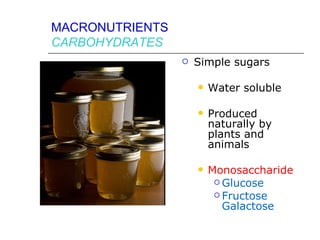
                    Simple sugars

                        Water soluble

                        Produced
                         naturally by
                         plants and
                         animals

                        Monosaccharide
                           Glucose
                           Fructose
                            Galactose
MACRONUTRIENTS
CARBOHYDRATES

   Simple sugars

        Disaccharides


             Two Monosaccharide
MACRONUTRIENTS
CARBOHYDRATES

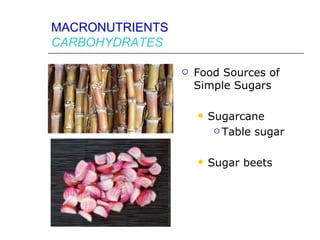
                    Food Sources of
                     Simple Sugars

                        Sugarcane
                           Table sugar


                        Sugar beets
MACRONUTRIENTS
CARBOHYDRATES

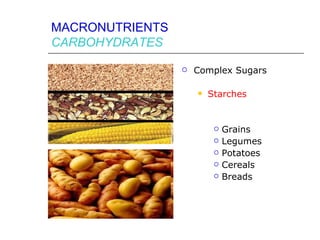
                    Complex Sugars

                        Starches


                             Grains
                             Legumes
                             Potatoes
                             Cereals
                             Breads
MACRONUTRIENTS
CARBOHYDRATES

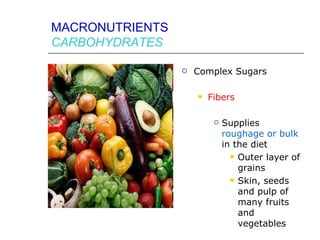
                    Complex Sugars

                        Fibers

                             Supplies
                              roughage or bulk
                              in the diet
                                 Outer layer of
                                  grains
                                 Skin, seeds
                                  and pulp of
                                  many fruits
                                  and
                                  vegetables
MACRONUTRIENTS
CARBOHYDRATES

   Digestion

       In the mouth
          Ptyalin (Salivary Amylase)


       In the small intestines
          Pancreatic amylase
MACRONUTRIENTS
 CARBOHYDRATES
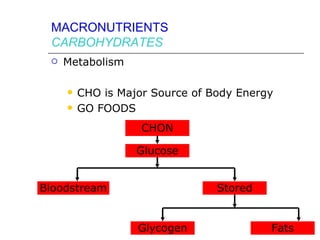
    Metabolism

        CHO is Major Source of Body Energy
        GO FOODS
                    CHON

                   Glucose


Bloodstream                      Stored


                   Glycogen               Fats
MACRONUTRIENTS
PROTEINS

   CHON

   Amino acids

       Essential amino acids
          Those that cannot be produced by the

           body

       Nonessential amino acids
          Those that can be produced by the

           body
MACRONUTRIENTS
PROTEINS

   May be Complete, Partially Complete and
    Incomplete
MACRONUTRIENTS
PROTEINS

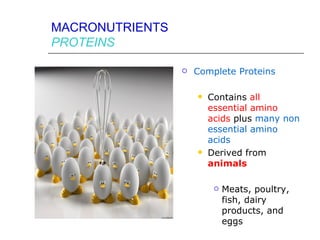
                    Complete Proteins

                        Contains all
                         essential amino
                         acids plus many non
                         essential amino
                         acids
                        Derived from
                         animals

                             Meats, poultry,
                              fish, dairy
                              products, and
                              eggs
MACRONUTRIENTS
PROTEINS

   Partially Complete

       Less than the required amount of one or
        two essential amino acids

       Gelatin
MACRONUTRIENTS
PROTEINS
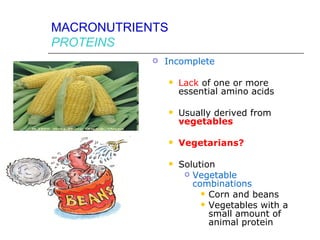
               Incomplete

                    Lack of one or more
                     essential amino acids

                    Usually derived from
                     vegetables

                    Vegetarians?

                    Solution
                       Vegetable
                        combinations
                           Corn and beans
                           Vegetables with a
                            small amount of
                            animal protein
MACRONUTRIENTS
PROTEINS

   Digestion

       In the mouth
          Pepsin


       In the intestines
          Trypsin
MACRONUTRIENTS
PROTEINS

   Storage

       Protein is stored in the body as tissue

       Growth and Development

       GROW FOODS
MACRONUTRIENTS
PROTEINS

   Metabolism

       Anabolism
          Construction
          All body cells manufacture proteins
           from amino acids

       Catabolism
          Destruction
          A cell can only accommodate a limited
           amount of protein
          Liver
MACRONUTRIENTS
LIPIDS

   Organic substances that are greasy and
    insoluble in water

   Fats
      Lipids that are solid at room temperature

         Butter


   Oil
     Lipids that are liquid at room
       temperature
         Cooking oil
MACRONUTRIENTS
LIPIDS

   Classified as

       Saturated

       Unsaturated

       Which is healthier?
MACRONUTRIENTS
LIPIDS
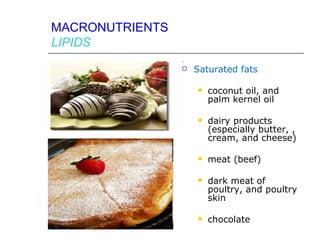
                    Saturated fats

                        coconut oil, and
                         palm kernel oil

                        dairy products
                         (especially butter, ,
                         cream, and cheese)

                        meat (beef)

                        dark meat of
                         poultry, and poultry
                         skin

                        chocolate
MACRONUTRIENTS
LIPIDS

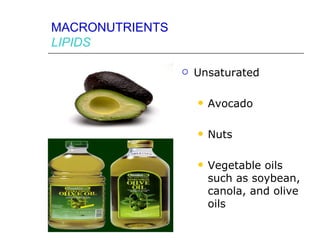
                    Unsaturated

                        Avocado

                        Nuts

                        Vegetable oils
                         such as soybean,
                         canola, and olive
                         oils
MACRONUTRIENTS
LIPIDS

   Digestion

       Starts in the mouth

       Mainly in the stomach
          Bile

          Pancreatic Lipase
MACRONUTRIENTS
LIPIDS

   They become

       Glycerol and Fatty acids
          Energy


       Cholesterol (Lipids plus protein)
          Is Cholesterol needed in the body?

          Important in producing bile

          Excessive

              Atherosclerosis


       GLOW FOODS
TYPES OF LIPOPROTEINS


   1. High Density Lipoproteins (HDL)

       Good cholesterol

       Function of HDLs

          Transportsthe bad cholesterol from
          systemic circulation to the liver for
          metabolism and eventual elimination
TYPES OF LIPOPROTEINS


   2. Low Density Lipoproteins (LDL)

       Bad cholesterol

       Function of LDLs

          They   clog the blood vessels
ENERGY INTAKE
ENERGY INTAKE
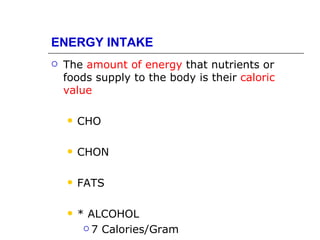
   The amount of energy that nutrients or
    foods supply to the body is their caloric
    value

       CHO

       CHON

       FATS

       * ALCOHOL
          7 Calories/Gram
ENERGY INTAKE

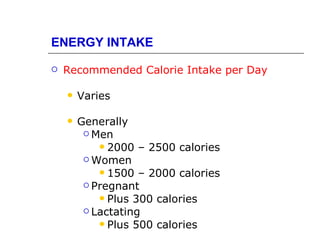
   Recommended Calorie Intake per Day

       Varies

       Generally
          Men
             2000 – 2500 calories
          Women
             1500 – 2000 calories
          Pregnant
             Plus 300 calories
          Lactating
             Plus 500 calories
ENERGY INTAKE

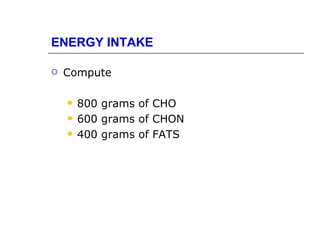
   Compute

       800 grams of CHO
       600 grams of CHON
       400 grams of FATS
MICRONUTRIENTS
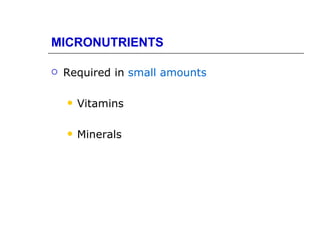
MICRONUTRIENTS

   Required in small amounts

       Vitamins

       Minerals
VITAMINS
MICRONUTRIENTS
   Vitamins

       Organic compounds that cannot be
        produced by the body

          Water   Soluble

          Fat   Soluble
WATER SOLUBLE VITAMINS

   Vitamins that cannot be stored by the body
      Excess?


       Vitamin C

       Vitamin B Complex
WATER SOLUBLE VITAMINS

   Vitamin C
   Ascorbic Acid

       synthesis of collagen
          an important protein used to make skin, scar
           tissue, tendons, ligaments, and blood vessels
       essential for the healing of wounds, and for the
        repair and maintenance of cartilage, bones, and
        teeth
       immune function
       synthesis of the neurotransmitter,
        norepinephrine
       effective antioxidant
WATER SOLUBLE VITAMINS

                   Vitamin C

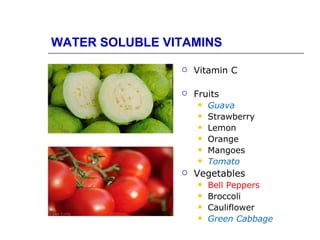
                   Fruits
                      Guava
                      Strawberry
                      Lemon
                      Orange
                      Mangoes
                      Tomato

                   Vegetables
                      Bell Peppers
                      Broccoli
                      Cauliflower
                      Green Cabbage
WATER SOLUBLE VITAMINS

   Vitamin C Deficiency

       Scurvy

          Bruising  easily
          hair and tooth loss

          joint pain and swelling


       Related to the weakening of blood
        vessels, connective tissue, and bone,
        which contain collagen
WATER SOLUBLE VITAMINS
   Vitamin B Complex

       Vitamin B1
          (thiamine)
       Vitamin B2
          (riboflavin)
       Vitamin B3
          (niacin)
       Vitamin B5
          (pantothenic acid)
       Vitamin B6
          (pyridoxine)
       Vitamin B7
          (biotin)
       Vitamin B9
          (folic acid)
       Vitamin B12
          (cyanocobalamin)
WATER SOLUBLE VITAMINS

   Vitamin B Complex

       Vitamins B1, B2, B3
          energy production


       Vitamin B6
          amino acid metabolism


       Vitamin B9
          Vital for the function and maintenance
           of the nervous system and red blood
           cells
          400 mcg or 0.4 mg (Pregnant)
WATER SOLUBLE VITAMINS

                   Vitamin B Complex
                      fish, milk, eggs,
                       liver, meat, brown
                       rice, whole grain
                       cereals, and
                       soybeans, poultry

                   Folic acid
                      Green vegetables
                      Liver
                      whole grain cereals
WATER SOLUBLE VITAMINS

   Vitamin B Deficiency

       Vitamin B1 (Thiamine)

          Beriberi

             Wernicke's encephalopathy
                Impaired sensory perception

                Weakening of the limbs

                Irregular heart rate

          Korsakoff's syndrome

             Amnesia and confabulation
WATER SOLUBLE VITAMINS

   Vitamin B Deficiency

       Vitamin B3 (niacin)

          Pellagra

             Aggression
             Insomnia
             Weakness
             mental confusion
             diarrhea
WATER SOLUBLE VITAMINS

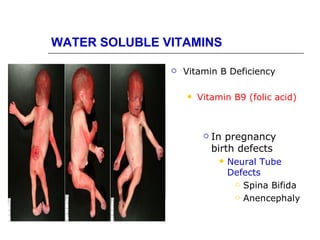
                  Vitamin B Deficiency

                      Vitamin B9 (folic acid)


                           In pregnancy
                            birth defects
                                Neural Tube
                                 Defects
                                   Spina Bifida

                                   Anencephaly
FAT SOLUBLE VITAMINS

   The body can store these vitamins

       A

       D

       E

       K
FAT SOLUBLE VITAMINS

   Vitamin A

       Retinol

       Normal Vision

       Maintaining normal skin health

       Deficiency
          Blindness
FAT SOLUBLE VITAMINS

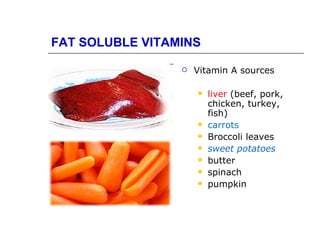
                    Vitamin A sources

                        liver (beef, pork,
                         chicken, turkey,
                         fish)
                        carrots
                        Broccoli leaves
                        sweet potatoes
                        butter
                        spinach
                        pumpkin
FAT SOLUBLE VITAMINS
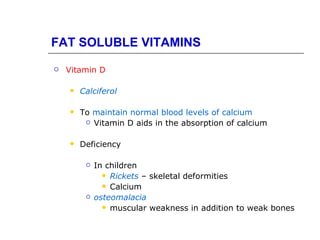
   Vitamin D

       Calciferol

       To maintain normal blood levels of calcium
          Vitamin D aids in the absorption of calcium


       Deficiency

            In children
                Rickets – skeletal deformities
                Calcium
            osteomalacia
                muscular weakness in addition to weak bones
FAT SOLUBLE VITAMINS

                    Vitamin D

                        Fish
                        Eggs
                        fortified milk
                        cod liver oil

                        The sun
                           as little as 10
                            minutes of
                            exposure
FAT SOLUBLE VITAMINS

   Vitamin E

       Tocopherol

       Antioxidant
FAT SOLUBLE VITAMINS
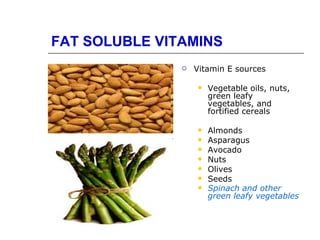
                  Vitamin E sources

                      Vegetable oils, nuts,
                       green leafy
                       vegetables, and
                       fortified cereals

                      Almonds
                      Asparagus
                      Avocado
                      Nuts
                      Olives
                      Seeds
                      Spinach and other
                       green leafy vegetables
FAT SOLUBLE VITAMINS

   Vitamin K

       K
          Koagulation   Vitamins

       Clotting factors
          Stops bleeding
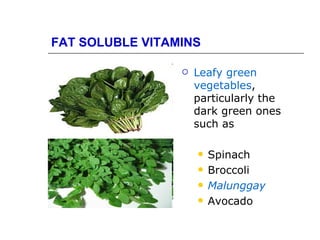
FAT SOLUBLE VITAMINS

                    Leafy green
                     vegetables,
                     particularly the
                     dark green ones
                     such as

                        Spinach
                        Broccoli
                        Malunggay
                        Avocado
MINERALS
MINERALS

   Organic or inorganic compounds

       Macrominerals
          Over 100 mg


       Microminerals
          Less than 100 mg
MACROMINERALS
MACROMINERALS


    Calcium
    Sodium
    Potassium
    Phosphorous
    Magnesium
    Chloride
    Sulfur
MACROMINERALS

   Calcium

       Normal growth and maintenance of
        bones and teeth

       Deficiency
          Rickets

          Osteoporosis
MACROMINERALS

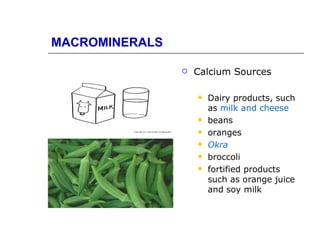
                   Calcium Sources

                       Dairy products, such
                        as milk and cheese
                       beans
                       oranges
                       Okra
                       broccoli
                       fortified products
                        such as orange juice
                        and soy milk
MACROMINERALS

   Sodium

       Regulation of blood and body fluids
          Water Retention

       Transmission of nerve impulses
          Action Potential (Sodium Potassium
           Pump)

       2 to 3 grams/day
       Table salts and most condiments
       Preserved foods
MACROMINERALS
            Potassium

                muscle contraction and the
                 sending of all nerve impulses in
                 animals through action
                 potentials

                All meats, poultry and fish are
                 high in potassium.
                Apricots (fresh more so than
                 canned)
                Avocado
                Banana
                Cantaloupe
                Milk
                Oranges and orange juice
                Potatoes
MICROMINERALS
MICROMINERALS


    Iron
    Iodine
    Flouride
    Manganese
    Cobalt
    Selenium
MICROMINERALS

   Iron

       Ferrous Sulfate

       Hemoglobin
          Oxygen carriers


       Forms of supplement
          Oral

          Parenteral
MICROMINERALS

   Iron Sources

       Dark Green, Leafy Vegetables
       Dried Beans and Peas
       Dried Fruits
       Eggs
       Enriched Breads
       Iron-Fortified Cereal
       Lean Meats
       Nuts
       Raisins
       Spinach
       Tofu
MICROMINERALS

   Iron

       Oral Form

          Take  on an empty stomach
          If with GI distress, take with food
          Use dropper or straw
          Drink with
              Milk or Orange Juice?
              Increase water
              Decrease fiber
MICROMINERALS

   Iron

       Parenteral Form

       Site
          Deep IM

          Z Track

          Don’t massage

          Apply firm pressure for 5 minutes
MICROMINERALS

   Iodine

       As element of the thyroid hormones,
        thyroxine (T4) and triiodothyronine (T3)

       Deficiency
          Hypothyroidism

          Goiter
MICROMINERALS

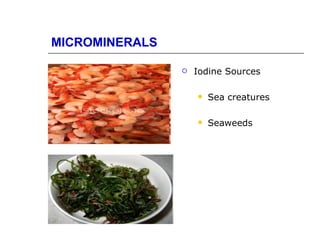
                   Iodine Sources

                       Sea creatures

                       Seaweeds
NUTRITIONAL ASSESSMENT

   Anthropometric Measurements

       Height
       Weight
          (best indicator of nutritional status of
           an individual)
       Skin Fold Test (fat folds)
       Mid-upper arm Circumference
        Measurement
       Body Mass Index
NUTRITIONAL ASSESSMENT

   Weight

       Weighing Technique

       Ideal Body Weight

          Rule of 5 for Women
          Rule of 6 for Men
NUTRITIONAL ASSESSMENT

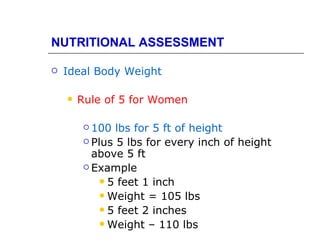
   Ideal Body Weight

       Rule of 5 for Women

          100  lbs for 5 ft of height
          Plus 5 lbs for every inch of height
           above 5 ft
          Example

              5 feet 1 inch
              Weight = 105 lbs
              5 feet 2 inches
              Weight – 110 lbs
NUTRITIONAL ASSESSMENT

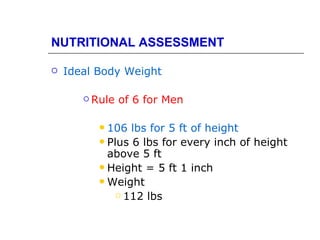
   Ideal Body Weight

        Rule   of 6 for Men

           106 lbs for 5 ft of height
           Plus 6 lbs for every inch of height
            above 5 ft
           Height = 5 ft 1 inch
           Weight
               112 lbs
NUTRITIONAL ASSESSMENT

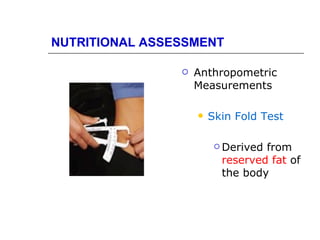
                   Anthropometric
                    Measurements

                       Skin Fold Test

                          Derivedfrom
                          reserved fat of
                          the body
NUTRITIONAL ASSESSMENT
                   Anthropometric
                    Measurements

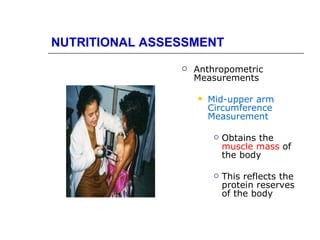
                       Mid-upper arm
                        Circumference
                        Measurement

                            Obtains the
                             muscle mass of
                             the body

                            This reflects the
                             protein reserves
                             of the body
NUTRITIONAL ASSESSMENT

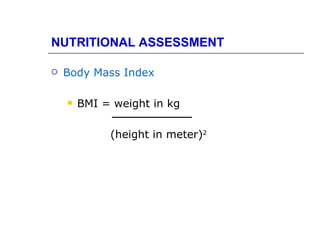
   Body Mass Index

       BMI = weight in kg

             (height in meter)2
NUTRITIONAL ASSESSMENT

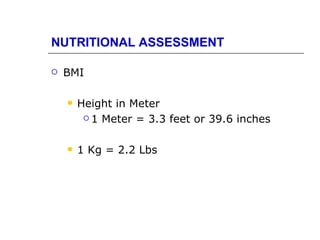
   BMI

       Height in Meter
          1 Meter = 3.3 feet or 39.6 inches


       1 Kg = 2.2 Lbs
NUTRITIONAL ASSESSMENT

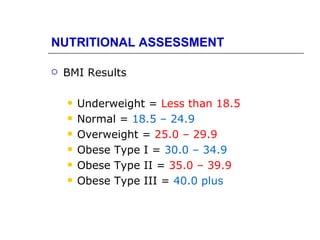
   BMI Results

       Underweight = Less than 18.5
       Normal = 18.5 – 24.9
       Overweight = 25.0 – 29.9
       Obese Type I = 30.0 – 34.9
       Obese Type II = 35.0 – 39.9
       Obese Type III = 40.0 plus
NUTRITIONAL ASSESSMENT

   BMI

       Compute
          Weight = 65 kg

          Height is = 62 inches


       Compute
          Weight = 150 pounds

          Height = 5 feet 3 inches
NUTRITIONAL ASSESSMENT

   Biochemical Data

       Serum Albumin
NUTRITIONAL ASSESSMENT

   Serum Albumin

       Provide an estimate of protein stores

       Albumin
          Serum protein
NUTRITIONAL ASSESSMENT

   Dietary Data

       24 hour food recall

       Food Diary

          Obesity

          Eating   Disorders
NUTRITIONAL VARIATIONS
THROUGHOUT THE LIFE CYCLE
NUTRITIONAL VARIATIONS
    THROUGHOUT THE LIFE CYCLE
   Neonate

       Nutritional requirements are met by
        breastmilk or formula milk
       Total daily requirements of the newborn
          80 to 100 ml of milk per kg

          Stomach capacity = 90 ml

          Feedings are required every 2 to 4 hours

             Demand feeding

          Burping
NUTRITIONAL VARIATIONS
THROUGHOUT THE LIFE CYCLE

   Infant
      Solid foods are added when?

         4 to 6 months

            Cereals (Rice)

            Fruits

            Vegetables (Yellows before Greens)

            Foods are introduced 1 at a time

                Every 5 to 7 days

            Honey is not given

                May contain small amount of

                 Clostridium botulinum
NUTRITIONAL VARIATIONS
THROUGHOUT THE LIFE CYCLE

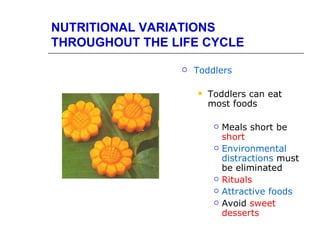
                   Toddlers

                       Toddlers can eat
                        most foods

                            Meals short be
                             short
                            Environmental
                             distractions must
                             be eliminated
                            Rituals
                            Attractive foods
                            Avoid sweet
                             desserts
NUTRITIONAL VARIATIONS
THROUGHOUT THE LIFE CYCLE

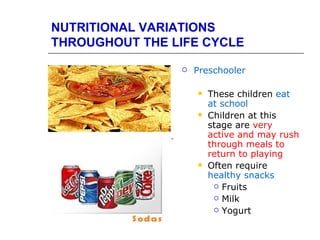
                   Preschooler

                       These children eat
                        at school
                       Children at this
                        stage are very
                        active and may rush
                        through meals to
                        return to playing
                       Often require
                        healthy snacks
                          Fruits

                          Milk

                          Yogurt
NUTRITIONAL VARIATIONS
THROUGHOUT THE LIFE CYCLE

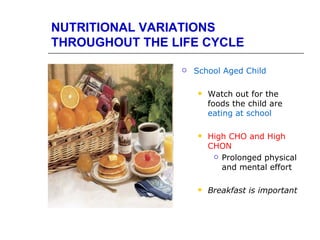
                   School Aged Child

                       Watch out for the
                        foods the child are
                        eating at school

                       High CHO and High
                        CHON
                          Prolonged physical

                           and mental effort

                       Breakfast is important
NUTRITIONAL VARIATIONS
THROUGHOUT THE LIFE CYCLE

   Adolescents

       Growth spurt

       Self Identity and Peer pressure
          Eating disorders
NUTRITIONAL VARIATIONS
THROUGHOUT THE LIFE CYCLE

   Young Adults and Middle Adults

       Maintain normal diet of healthy food
        options

       Milk
NUTRITIONAL VARIATIONS
THROUGHOUT THE LIFE CYCLE
   Elderly

       They have many problems associated with
        nutrition

            Difficulty chewing
                Denture
                Chopped and soft foods
            Loss of appetite
                SFF
            Loss of senses of smell and taste
                Favorite foods
            Limited income
                Substitution
                Substitute meat with milk or beans
            Difficulty sleeping at night
                Promote sleep
SPECIAL DIETS
SPECIAL DIETS

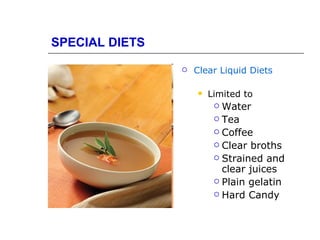
                   Clear Liquid Diets

                       Limited to
                          Water
                          Tea

                          Coffee

                          Clear broths

                          Strained and
                           clear juices
                          Plain gelatin

                          Hard Candy
SPECIAL DIETS

   Clear Liquid Diets

       This provides water and CHO (in the
        form of sugar)

       After surgery
SPECIAL DIETS

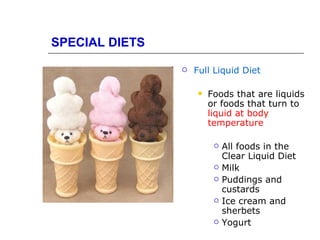
                   Full Liquid Diet

                       Foods that are liquids
                        or foods that turn to
                        liquid at body
                        temperature

                            All foods in the
                             Clear Liquid Diet
                            Milk
                            Puddings and
                             custards
                            Ice cream and
                             sherbets
                            Yogurt
SPECIAL DIETS

   Full Liquid Diet

       For clients who have gastrointestinal
        problems and cannot tolerate semi solid
        or solid foods
SPECIAL DIETS

   Soft Diet

       All foods in the Clear and Full Liquid Diet
       Meat: Lean, Tender
          Fish, grounded meat

       Vegetables: Mashed or cooked for a very
        soft consistency
       Fruits: Cooked or canned
       Breads and oatmeals
       Soft cakes
SPECIAL DIETS

   Diet As Tolerated (DAT)

       When the client’s appetite, ability to eat
        and tolerate food

          Gag

          Bowel   Sounds
SPECIAL DIETS

   Modification for Disease

       Diabetic Diet

       Hypertensive Diet
SUPPORTING NUTRITION OF THE
PATIENT

ENTERAL AND PARENTERAL
FEEDING
ENTERAL FEEDING

   An alternative feeding method to ensure
    adequate nutrition

   Feeding through the gastrointestinal
    system

   EN

   TEN
ENTERAL FEEDING


     Nasogastric Tube

     Nasointestinal Tube

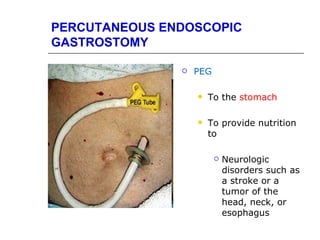
     Percutaneous Endoscopic Gastrostomy
      (PEG)

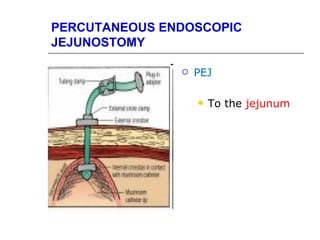
     Percutaneous Endoscopic Jejunostomy
      (PEJ)
NASOGATRIC TUBE
NASOGATRIC TUBE


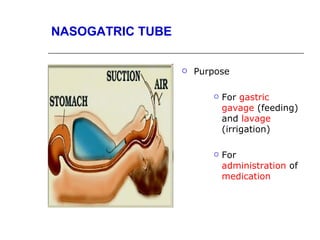
                     Purpose

                            For gastric
                             gavage (feeding)
                             and lavage
                             (irrigation)

                            For
                             administration of
                             medication
NASOGATRIC TUBE

   Indications

       Clients who are unable to ingest foods

       The upper gastrointestinal tract is
        impaired

       Transport of food to the small intestines
        is interrupted
NASOGATRIC TUBE

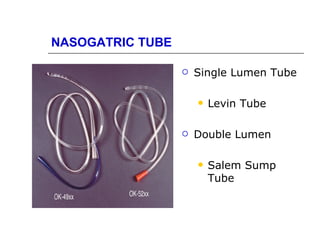
                     Single Lumen Tube

                         Levin Tube

                     Double Lumen

                         Salem Sump
                          Tube
NASOGATRIC TUBE

   Procedure

       Position
          High Fowler’s

          Hyperextension of head

       Explain
       Hand Hygiene
       Measure Depth of Insertion
          NEX
NASOGATRIC TUBE

    Check Nares
       Irritation

       Obstruction


    Put on Gloves

    Lubricate the tip of the tube

    Insert
       Resistance

       Withdraw then lubricate again
NASOGATRIC TUBE

    When the tube reaches the throat
       Ask the client to forward head

       Swallow

       Gag

          Stop

          Give water and encourage to
           breath

    Continue insertion
NASOGATRIC TUBE
    Ascertain correct placement of the tube

      1 – Radiographic Verification

      2 – Acidity of pH of aspirate
          Lithmus Paper

          Blue

          Red


      3 – Aspiration of gastric content

      4 – Ausculate epigastic region
NASOGATRIC TUBE

    Secure the NGT to the clients gown

    Document
NASOGATRIC TUBE

   Feeding

       Osterized Food

       Average volume of feeding:
          300 ml to 400 ml

          Warmed at room temperature
NASOGATRIC TUBE
   Feeding

       Procedure

          Assist the patient in high fowler’s position
             If tolerated

             If not, Slightly elevated right sided lying

          Checks the formula's expiration date

          Check the patency of the tube
NASOGATRIC TUBE

    Elevate the tip of the tube to 12 inches
     above nares
    Connect tube to a 60 cc syringe
    Flush with 30cc of water
    Run the formula through the tubing and
     reclamp the tube
       a rate no greater than 50ml/min is

        recommended
    Flush with 30cc of water
NASOGATRIC TUBE

   Perform mouth care; brushing teeth, gums
    and tongue twice daily

   Apply lip moisturizer or petroleum jelly
    unless otherwise ordered

   Discourages mouth breathing and uses
    measures to increase salivation such as
    chewing gum, sucking on hard candy or ice
    if permissible

   Ask the client to remain sitting for
      30 minutes
NASOINTESTINAL TUBE
NASOINTESTINAL TUBE

   Longer than the nasogastric tube

   From one nostril to the small intestines

   Used for clients at risk for aspiration
      Decreased LOC

      Poor cough or gag reflex

      Restlessness and agitation

      Endotracheal intubation
PERCUTANEOUS ENDOSCOPIC
GASTROSTOMY
PERCUTANEOUS ENDOSCOPIC
JEJUNOSTOMY
PERCUTANEOUS ENDOSCOPIC
GASTROSTOMY

                  PEG

                      To the stomach

                      To provide nutrition
                       to

                            Neurologic
                             disorders such as
                             a stroke or a
                             tumor of the
                             head, neck, or
                             esophagus
PERCUTANEOUS ENDOSCOPIC
JEJUNOSTOMY

                  PEJ

                      To the jejunum
PERCUTANEOUS ENDOSCOPIC
GASTROSTOMY/ JEJUNOSTOMY

   Stoma

   Liquid nutritional formulas are put into the
    tube and directly into the stomach or
    intestines

   Insert a feeding tube to the stoma
      Lubricate tube

      Insert into opening (4 to 6 inches)
PERCUTANEOUS ENDOSCOPIC
GASTROSTOMY/ JEJUNOSTOMY

   Check patency by getting aspirate

   Administer the feeding

   Hold the barrel of the syringe 3 to 6 in
    above opening of the stoma

   Slowly pour solution

   Flush with 30 cc of water
PERCUTANEOUS ENDOSCOPIC
GASTROSTOMY/ JEJUNOSTOMY

   Remove the syringe and clamp or plug the
    tube

   Ensure client comfort and safety
      Remain sitting for 30 minutes
      Assess the stoma
         Washed with soap and water once a
          day
         Rotate the tube to avoid sticking in
          the stoma
         Petrolatum and other skin protectant
          may be applied

   Document
TOTAL PARENTERAL NUTRITION

                   Or Intravenous
                    Hyperalimentation

                   Used when the
                    gastrointestinal
                    tract is
                    nonfunctional
TOTAL PARENTERAL NUTRITION
                   Introduced directly to
                    the bloodstream

                   Tube is inserted via
                    the:

                       Subclavian vein
                       Internal jugular vein
                        of the neck
                       Femoral vein
                       Brachial vein
TOTAL PARENTERAL NUTRITION

                   Subclavian Vein


                   Internal jugular
                    vein of the neck
TOTAL PARENTERAL NUTRITION


   Nursing Responsibilities:

       Maintain aseptic techniques

       Watch out for signs and symptoms of
        embolism
          Pain

          Swelling

          Warmth on the site

       Infection
TOTAL PARENTERAL NUTRITION

   Care of Insertion Site

       Application of sterile dressing with anti-
        bacterial ointment as ordered by doctor
        (PRN)
BLOOD TRANSFUSION
BLOOD TRANSFUSION

   Purposes:

       To administer required blood
        component by the patient

       To restore blood volume
         RBC

         WBC

         Platelets

         Plasma Proteins
BLOOD TRANSFUSION

   Human blood is classified into four main
    groups

       A
       B
       AB
       O
BLOOD TRANSFUSION

   Antigens
      Number of proteins in the red blood cell
       surface
      Most important in determining blood type
       (Blood Type Compatibility)

       Blood type A, Antigen A
       Blood type B, Antigen B
       Blood type AB, Antigen A and B
       Blood type O, No antigen
          Universal Donor
BLOOD TRANSFUSION

   Antibodies

       Preformed antibodies are present in the
        plasma
       Blood Incompatibility

       Blood Type A, Antibody B
       Blood Type B, Antibody A
       Blood Type AB, Antibody None
          Universal Recipient

       Blood Type O, A and B
BLOOD TRANSFUSION

   Rh Factor

       The Rh factor antigen is present
          Rh+


       When the Rh factor antigen is not
        present
          Rh –

          Filipinos
BLOOD TRANSFUSION

   Procedure:

    1. Verify doctor’s order. Inform client and
    explain the purpose of the procedure

    2. Check for cross matching and blood
    typing. To ensure compatibility

    3. Obtain and record baseline VS
BLOOD TRANSFUSION

4. Practice safe asepsis

5. At least 2 nurses check the label of the
blood transfusion
   > Check the following:
         - Serial number
         - Blood component
         - Blood type
         - Rh factor
         - Expiration data
         - Screening tests (VDRL for sexually
         transmitted diseases, HBsAg for
         hepatitis B; malarial smear for
         malaria)
BLOOD TRANSFUSION

 6. Warm blood at room temperature before
 transfusion. To prevent chills

 7. Identify client properly. Two nurses
 check the client’s identification

 8. Use needle gauge 18 or 19. This allows
 easy flow of blood

 9. Use BT (blood transfusion) set with filter.
 To prevent administration of blood clots
 and other particulates
BLOOD TRANSFUSION

 10. Start infusion slowly at 10 gtts/minute. Remain
 at bedside for 15 to 30 minutes. Adverse reaction
 usually occurs during the first 15 to 20 minutes

 11. Monitor VS. Altered VS indicates adverse
 reaction

 12. Do not mix medications with blood transfusion.
 To prevent adverse effects
     - Do not incorporate medication into the blood
     transfusion
     - Do not use the blood transfusion line for IV
     push of medication

 13. Administer 0.9% NaCl before, during or after
 BT. Never administer IV fluids with dextrose.
 Dextrose cause hemolysis.
BLOOD TRANSFUSION

   Complications:

    - Allergic Reaction (flushing, rash, hives, pruritus,
    laryngeal edema, DOB)

    - Febrile, Non Hemolytic (sudden chills and fever,
    flushing, headache, anxiety)

    - Sepsis (rapid onset of chills, vomiting, marked
    hypotension, high fever)
BLOOD TRANSFUSION

 - Circulatory Overload (rise in venous pressure,
 dyspnea, crackles or rales, distended neck vein,
 cough, elevated BP)

 - Hemolytic (low back pain, chills, feeling of
 fullness, tachycardia, flushing, tachypnea,
 hypotension, bleeding)
BLOOD TRANSFUSION

   Nursing Interventions When Complication
    Occurs in Blood Transfusion

    1. Stop blood transfusion immediately

    2. Start an IV line (0.9% NaCl)
THANK YOU FOR LISTENING 


 PLEASE READ FOLLOWING
      CHAPTERS ON

     SLEEP AND REST
        NUTRITION

NURSING PROCESS, SLEEP, REST & NUTRITION

  • 1.
  • 2.
  • 3.
    HISTORY OF NURSING  Early Civilization  Cause of Disease  Medicine Man  Mother Surrogate  Cause of Disease  Temples  Code of Hammurabi: Oldest Sanitation Code - 1760 BC - Law codes - Sanitation
  • 4.
    HISTORY OF NURSING  Early Christian Period  Deaconesses, Crusaders, Hospitals, Good Samaritan Law  Parabolani Brotherhood  Teutonic Knights  Knights of St. John of Jerusalem  Knights of Lazarus
  • 5.
    HISTORY OF NURSING  Throughout history, wars have accentuated the need for nurses:  WWI, WWII, American Civil War, Vietnam War (Recruitment of Nurses)  Free Education for Nurses  Crimean War  Sir Sidney Herbert  Florence Nightingale
  • 6.
    HISTORY OF NURSING  Florence Nightingale  1836  Theodor Fliedner, a German pastor in Kaiserwerth, opened a hospital with a training school for nurses  Training School of Deaconesses  1847  Florence Nightingale went to train as a nurse in Kaiserwerth, Germany  Where she stayed for 3 months
  • 7.
    HISTORY OF NURSING  1853  Nightingale trained in the Sisters of Charity  Paris  Returning to London, she worked as administrator and director of nurses at the Establishment for Gentlewomen During Illness where she remained  Until she was called into service during the Crimean War
  • 8.
    HISTORY OF NURSING  1860  Nightingale opened the Nightingale Training School for Nurses  Served as model for other nursing schools  Its graduates traveled to other countries to manage hospitals and nurse training schools
  • 9.
  • 10.
    HISTORY OF NURSING  Nightingales biggest contributions in Nursing:  Sanitation Practices  Nursing Education  First Nurse Theorist  Notes on Nursing: What It Is And What It Is Not
  • 11.
    HISTORY OF NURSING INTHE PHILIPPINES  Earliest Hospitals  Hospital de Real de Manila (1577)  San Lazaro Hospital (1578)  San Juan de Dios Hospital (1596)
  • 12.
    HISTORY OF NURSING IN THE PHILIPPINES  Earliest Nursing Schools  Iloilo Mission Hospital School of Nursing (1906)  St. Luke’s Hospital School of Nursing (1907)  Mary Johnston Hospital and School of Nursing (1907)  Philippine General Hospital School of Nursing (1910)
  • 13.
    HISTORY OF NURSING IN THE PHILIPPINES  Earliest Nursing Universities  University of Santo Tomas College of Nursing  Manila Central University College of Nursing  University of the Philippines College of Nursing, Manila  FEU Institute of Nursing  UE College of Nursing
  • 14.
    HISTORY OF NURSING INTHE PHILIPPINES  Nursing Leaders  Anastacia Giron - Tupaz - Nurse Chief Superintendent of PNA - Founder of PNA
  • 15.
    HISTORY OF NURSING IN THE PHILIPPINES  Nursing Organizations  Philippine Nurse’s Association (PNA) – National  First President  Rosario Delgado  Current President  Leah Samaco Pacquiz
  • 16.
  • 17.
    NURSE  Came from the Latin word  “Noutrix”  Meaning of the word  “To Nourish”
  • 18.
    AS A PROFESSION  Body of specific and unique knowledge  Strong service orientation  Recognized authority by a professional group  Code of ethics and laws  Professional organization  Ongoing research  Autonomy  CARE
  • 19.
  • 20.
    LEVELS OF NURSES  5 Levels of Nurses  Level I  No experience  Novice  Level II  Has acceptable performance and has experienced enough situations  Advanced beginner
  • 21.
    LEVELS OF NURSES  Level III  Has 2 to 3 years of experience  Competent  Employed overseas  Level IV  Has 3 to 5 years of experience  Proficient
  • 22.
    LEVELS OF NURSES  Level V  Highly proficient  Does not require guidance and rules  Expert  Capable of managing hospital units
  • 23.
  • 24.
    FIELDS OF NURSINGPRACTICE  1)Institutional or Hospital Nursing  Employment in hospitals and health institutions  Biggest field of nursing practice  Staff Nurse  Nurse Managers
  • 25.
    FIELDS OF NURSINGPRACTICE  2) Community / Public Health Nursing  Subdivision:  School Nursing
  • 26.
    FIELDS OF NURSINGPRACTICE  3) Private Duty Nursing  One to one care  Total nursing care or Case Management  Home or hospital based
  • 27.
    FIELDS OF NURSINGPRACTICE  5) Military Nursing
  • 28.
    FIELDS OF NURSINGPRACTICE  6) Company / Industrial Nursing
  • 29.
  • 30.
    EXPANDED EDUCATIONAL AND CAREERROLES  Clinical Nurse Specialist  A nurse with an advanced degree, education, or experience  Considered to be an expert in a specialized area of nursing  Example: Geriatric Nurse, Oncology Nurse, Maternal and Child Nurse
  • 31.
    EXPANDED EDUCATIONAL AND CAREERROLES  Nurse Practitioner  A nurse with an advanced degree, certified for a special area or age of patient care  Delivers independent practice to make health assessments and deliver primary care  Diagnose  Prescribe medications
  • 32.
    EXPANDED EDUCATIONAL AND CAREERROLES  Nurse Anesthetist  A nurse who completes a course of study in an anesthesia school  Carries out preoperative visits and assessments  Administers and monitors anesthesia during surgery  Evaluates postoperative status of patients
  • 33.
    EXPANDED EDUCATIONAL AND CAREERROLES  Nurse midwife  A nurse who completes a program in midwifery  Provides prenatal and postnatal care  Delivers babies for women with uncomplicated pregnancies
  • 34.
    EXPANDED EDUCATIONAL AND CAREERROLES  Nurse Educator  A nurse usually with an advanced degree, who teaches in educational or clinical settings
  • 35.
    EXPANDED EDUCATIONAL AND CAREERROLES  Nurse Administrator  A nurse who functions at various levels of management  Responsible for management and administration of resources and personnel involved in giving patient care
  • 36.
    EXPANDED EDUCATIONAL AND CAREERROLES  Nurse Researcher  A nurse with an advanced degree who conducts research relevant to the definition and improvement of nursing practice and education
  • 37.
    EXPANDED EDUCATIONAL AND CAREERROLES  Nurse Entrepreneur  A nurse, usually with an advance degree who may manage a clinic or health related business
  • 38.
  • 39.
    NURSING ROLES  Caregiver  Primary role of the nurse  The provision of care  MOTHER SURROGATE ROLES  Complete Assistance  Partial Assistance  Supportive/Educative
  • 40.
    NURSING ROLES  Communicator  With Patients  To establish Therapeutic Communication  To identify health problems  With Health Care Professionals  Documentation  Reporting / Endorsements
  • 41.
  • 42.
    COMMUNICATION  It is the interchange of information between two or more people  It is the exchange of ideas or thoughts
  • 43.
    ELEMENTS OF COMMUNICATION  Sender  Originator of the information  Message  Information being transmitted  Receiver  Recipient of information  Channel  Mode of communication  Feedback  Return response  Context  The setting of the communication
  • 44.
    LEVELS OF COMMUNICATION  Intrapersonal  Occurs when a person communicates within himself  Interpersonal  Takes place within dyads (groups of two persons) and in small groups.  Public  Communication between a person and several other people
  • 45.
    MODES OF COMMUNICATION  Verbal Communication  Non-verbal Communication
  • 46.
    NON-VERBAL MESSAGES  They carry more meaning than verbal messages and involves the following:  Body movement or kinetics  Voice quality (pitch and range) and non- language sounds (sobbing or laughing)
  • 47.
    NON-VERBAL MESSAGES  Proxemics – use of personal or social space  Intimate Distance – actual contact to 1.5 feet  Personal Distance – 1.5 to 4 feet or 3 to 4 feet for interviews  Social Distance – 4 to 12 feet  Public Distance – 12 feet and beyond  Cultural Artifacts – items in contact with interacting persons that may act as non-verbal stimuli (i.e., clothes, cosmetics, jewelry, cars)
  • 48.
  • 49.
    THERAPEUTIC RESPONSES  Identify therapeutic and non-therapeutic phrases  Open-ended or Closed-ended question?  ‘Why’ or ‘What’ questions?  Avoid false reassurances
  • 50.
    THERAPEUTIC RESPONSES  Use direct questions for suicidal cases  Avoid the ‘Authoritarian Answer’  Giving advices  In initiating conversation  Use Broad Openings  In ending conversation  Summarizing
  • 51.
  • 52.
    COMMUNICATING WITH HEALTHCARE PROFESSIONALS  Documentation  Reporting  Conferring  Referring
  • 53.
    COMMUNICATING WITH HEALTHCARE PROFESSIONALS  Reporting  Endorsement  Transferring pertinent information regarding a patient to a concerned person  Outgoing nurse to a incoming nurse  Staff nurse to physician
  • 54.
    COMMUNICATING WITH HEALTHCARE PROFESSIONALS  Conferring  To verify information  Rephrasing  To validate doctor’s orders  To validate a nurse’s endorsement
  • 55.
    COMMUNICATING WITH HEALTHCARE PROFESSIONALS  Referring  To endorse patient’s special concern to a higher authority or a specialized department or personnel A community nurse referring a client to a hospital or a doctor A staff nurse to a dietitian
  • 56.
    NURSING ROLES  Teacher/Educator  Providing education about a client’s health and health care procedures they need to perform to restore or maintain their health
  • 57.
    NURSING ROLES  Teaching Strategies  Assess client’s  Readiness to learn  Assess the client’s knowledge  Simple to complex
  • 58.
    NURSING ROLES  Teaching Strategies  One to One Discussion or Group Discussion  Explanation and Description  Answering Questions  Visual Assisted Learning Programs  Demonstration  Actual performance of an activity
  • 59.
    NURSING ROLES  What is the best method of teaching? (December 2007 NLE)  What is the best indicator of client learning?
  • 60.
    NURSING ROLES  Counselor  Facilitates the patient’s problem solving and decision – making skills  By providing information, make appropriate referrals
  • 61.
    NURSING ROLES  Researcher  The participation in or conduct of research  To increase knowledge in nursing and improve patient care
  • 62.
    NURSING ROLES  Advocate  Safeguarding the rights of the patients  Patients Bill of Rights
  • 63.
  • 64.
    THEORIES OF NURSING  Theory  A hypothesis or system of ideas that is proposed to explain a given phenomenon  Purpose:  Directs and guide nursing practice
  • 65.
    THEORIES OF NURSING  Nightingale's  Environmental Theory  The act of utilizing the environment of the patient to assist him in his recovery  Linked health with 5 environmental factors  Pure or fresh air  Pure water  Efficient drainage  Cleanliness  Light
  • 66.
    THEORIES OF NURSING  Nightingale's Environmental Theory  Addition:  Education of nurses  Keeping the client warm  Maintaining a noise free environment  Attending to the client’s diet
  • 67.
    THEORIES OF NURSING  Hildegard Peplau’s  Interpersonal Relations Model  Peplau is a psychiatric nurse  Focus: Therapeutic process  Attained through: Healthy Nurse Patient Relationship
  • 68.
    THEORIES OF NURSING  Hildegard Peplau’s Interpersonal Relations Model  Four Phases of the Nurse – Patient Interaction  Preorientation  Orientation  Working / Exploitation  Termination/Resolution
  • 69.
    THEORIES OF NURSING  Virginia Henderson’s  14 Fundamental Needs of a Person  Assisting sick or healthy individuals to gain independence in meeting 14 fundamental needs
  • 70.
    THEORIES OF NURSING  Virginia Henderson’s 14 Fundamental Needs of a Person  1) Breathing normally  2) Eating and drinking adequately  3) Eliminating body waste  4) Moving and maintaining a desirable position  5) Sleeping and resting  6) Selecting suitable clothes  7) Maintaining body temperature within normal range by adjusting clothing and modifying the environment
  • 71.
    THEORIES OF NURSING  Virginia Henderson’s 14 Fundamental Needs of a Person  8) Keeping the body clean and well groomed to protect the integument  9) Avoiding dangers in the environment and avoiding injuring others  10) Communicating with others in expressing emotions, needs, fears, or opinions  11) Worshipping according to one’s faith  12) Working in a such way that one feels a sense of accomplishment  13) Playing or participating in various forms of recreation  14) Learning, discovering, or satisfying the curiosity that leads to normal development and health, and using available health facilities
  • 72.
    THEORIES OF NURSING  Dorothy Johnson’s  Seven Subsystems  Attachment  Affiliative  Dependency  Ingestive  Eliminative  Sexual Achievement  Aggressive
  • 73.
    THEORIES OF NURSING  Faye Abdellah’s  21 Nursing Problems  good hygiene  optimal activity  safety  good body mechanics  oxygen
  • 74.
    THEORIES OF NURSING  Faye Abdellah’s 21 Nursing Problems  nutrition  elimination  fluid and electrolytes balance  physiologic response of the body to disease  regulatory mechanisms  sensory function.  positive and negative expressions, feelings and reactions.  accept the interrelatedness of emotions and illness
  • 75.
    THEORIES OF NURSING  Faye Abdellah’s 21 Nursing Problems  self awareness  optimum possible goals  use community resources  role of social problems
  • 76.
    THEORIES OF NURSING  Martha Roger’s  Science of Unitary Human Beings  Views the person as a irreducible whole, the whole being greater than the sum of its parts
  • 77.
    THEORIES OF NURSING  Martha Roger’s Science of Unitary Human Beings  Man is composed of energy fields, which are in constant interaction with the environment  Seek to promote harmonic interactions between the two energy fields (Human and Environmental)
  • 78.
    THEORIES OF NURSING  Dorothea Orem’s  Self Care and Self Care Deficit Theory  Identified three nursing systems  Wholly compensatory systems  Partial compensatory systems  Supportive – Educative systems
  • 79.
    THEORIES OF NURSING  Imogene King’s  Goal Attainment Theory  Patient has THREE (3) interacting systems  Individuals / Personal systems  Group systems / Interpersonal systems  Social systems
  • 80.
    THEORIES OF NURSING  Betty Neuman’s  Health Care Systems Model  The concern of nursing is to prevent Stress Invasion  Physiological  Psychological  Developmental  Sociocultural  Spiritual
  • 81.
    THEORIES OF NURSING  Sister Callista Roy’s  Adaptation Model  Man is a Biopsychosocial Being that requires a feedback cycle
  • 82.
    THEORIES OF NURSING  Sister Callista Roy’s Adaptation Model  The goal is to enhance life processes through adaptation in four adaptive models  The Physiologic Mode  Self Consent Mode  Role Function Mode  Interdependence Mode
  • 83.
    THEORIES OF NURSING  Madeline Leininger’s  Transcultural Nursing  Emphasizes human caring varies among cultures  Culture Care Preservation and Maintenance  Culture Care Accommodation and Negotiation  Culture Care Restructuring and Repatterning
  • 84.
  • 85.
    CONCEPT OF MAN  Nurse’s Clients  Individuals  Families  Communities
  • 86.
    CONCEPT OF MAN  BIOLOGIC like ALL other men  PSYCHOLOGICAL like NO OTHER man  SOCIAL like SOME OTHER men  SPIRITUAL like SOME OTHER men
  • 87.
    ABRAHAM MASLOW’S HIERARCHY OFNEEDS  5 Human Needs
  • 88.
    ABRAHAM MASLOW’S HIERARCHY OFNEEDS  Physiologic needs  Oxygen  Fluids  Nutrition  Body Temperature  Elimination  Rest and Sleep  Sex
  • 89.
    ABRAHAM MASLOW’S HIERARCHY OFNEEDS  Safety and security (Physical and Psychological)  Protection  Security  Order  Law  Limits  Stability
  • 90.
    ABRAHAM MASLOW’S HIERARCHY OFNEEDS  Love and Belongingness  Family  Affection  Relationships  Work group
  • 91.
    ABRAHAM MASLOW’S HIERARCHY OFNEEDS  Self-esteem  Feeling good about one’s self  Two factors affecting Self-esteem  Yourself  Sense of adequacy  Accomplishment  Self worth & respect  Others  Appreciation  Recognition  Admiration
  • 92.
    ABRAHAM MASLOW’S HIERARCHY OFNEEDS  Self-actualization – essence of mental health  Personal growth and fulfillment  Able to fulfill needs and ambitions  Maximizing one’s full potential
  • 93.
    ABRAHAM MASLOW’S HIERARCHY OFNEEDS  Self Actualization  Judges people correctly  Superior perception  Decisive  Capable of making decisions  Clear notion as to what is right and wrong
  • 94.
    ABRAHAM MASLOW’S HIERARCHY OFNEEDS  Open to new ideas  Not adopts new ideas  Not one track mind  Highly creative and flexible  Does not need fame  Problem-centered rather than self- centered
  • 95.
    ABRAHAM MASLOW’S HIERARCHY OFNEEDS  Additional needs:  Need to know and understand  Aesthetic needs  Transcendence
  • 96.
    ABRAHAM MASLOW’S HIERARCHY OFNEEDS  Need to know and understand or Cognitive needs is supported by Richard Kalish who says that  Man needs stimulation  Needs to explore  Sex  Activity  New things
  • 97.
    ABRAHAM MASLOW’S HIERARCHY OFNEEDS  Aesthetic needs:  Beauty  Balance  Form
  • 98.
    ABRAHAM MASLOW’S HIERARCHY OFNEEDS  Transcendence:  Helping others to self-actualize
  • 99.
  • 100.
    DEFINITIONS OF HEALTH Object5  World Health Organization  Health is the complete physical, mental, social (totality) well-being and not merely the absence of disease or infirmity
  • 101.
    DEFINITIONS OF HEALTH  Health is individually defined by each person  On a personal level, individuals define health according to  how they feel  absence or presence of symptoms of illness  and ability to carry out activities
  • 102.
    DISEASE  Objective pathologic process  Pathologic change in the structure or function of the mind and body
  • 103.
    DISEASE  Acute  Rapid onset of symptoms  Some are life threatening  Many do not require medical treatment
  • 104.
    DISEASE  Chronic  Broad term that encompasses many different physical and mental alterations in health  It is a permanent change  Requires special patient education for rehabilitation  Requires long term of care and support
  • 105.
    ILLNESS  Highly subjective feeling of being sick or ill  How the person feels towards sickness  Concerns the Nurse
  • 106.
    ELEVEN STAGES OFILLNESS AND HEALTH-SEEKING BEHAVIOR BY SUCHMAN  1. Symptom Experience  Client realizes there is a problem  Client responds emotionally  2. Sick Role Assumption  Self-medication / Self-treatment  Communication to others
  • 107.
    ELEVEN STAGES OFILLNESS AND HEALTH- SEEKING BEHAVIOR BY SUCHMAN  3. Assuming a Dependent Role  Accepts the diagnosis  Follows prescribed treatment  4. Achieving recovery and rehabilitation  Gives up the dependent role and assumes normal activities and responsibilities
  • 108.
    CONCEPTS ON DISEASEAND ILLNESS  Illness without disease  is possible  Disease without illness  is possible
  • 109.
    MODELS OF HEALTHAND ILLNESS
  • 110.
    DUNN’S HIGH-LEVEL WELLNESS ANDGRID MODEL  X-axis is HEALTH  Y-axis is ENVIRONMENT
  • 111.
    DUNN’S HIGH-LEVEL WELLNESS ANDGRID MODEL Quadrant 1 Quadrant 2 - High Level Wellness - Protected Poor Health in a favorable in a favorable environment environment Quadrant 3 Quadrant 4 - Poor health in an - Emergent High Level unfavorable Wellness in an environment unfavorable environment
  • 112.
    HEALTH BELIEF MODELBY ROSENTOCK  Concerned with what people perceive about themselves in relation to their health  Consider perceptions (influences individuals motivation toward results)  Perceived susceptibility  Perceived seriousness  Perceived benefit out of the action
  • 113.
    FOUR LEVELS OFHEALTH BY SMITH 1. Clinical Model  Man is viewed as a Physiologic Being  If there are no signs and symptoms of a disease, then you are healthy
  • 114.
    FOUR LEVELS OFHEALTH BY SMITH 2. Role Performance Model  As long as you are able to perform SOCIETAL functions and ROLES you are healthy
  • 115.
    FOUR LEVELS OFHEALTH BY SMITH 3. Adaptive Model  Health is viewed in terms of capacity to ADAPT  Failure to adapt is disease
  • 116.
    FOUR LEVELS OFHEALTH BY SMITH 4. Eudaemonistic Model  This is the BROADEST concept of health  Because health is viewed in terms of Actualization
  • 117.
    AGENT, HOST, ENVIRONMENTMODEL BY LEAVELL AND CLARK  Also known as the Ecologic Model  Triad is composed of the agent, host and environment  Based on the interplay of three components of the model
  • 118.
  • 119.
    THE NURSING PROCESS  Definition:  The Nursing Process is a systematic, organized, rational method of planning and providing individualized, humanistic nursing care
  • 120.
    Nursing process  foundation of the nursing profession  central to nursing actions  a process to deliver care to patients  supported by nursing models or philosophies.  systematic approach  enhances research opportunities  adaptable to different clients in different care settings  efficient method of organizing thought processes or clinical decision-making and problem-solving
  • 121.
    Synonymous with the problem solving approach for discovering the healthcare and nursing care needs of clients. (UDAN)  It is an organized method of giving individualized nursing care that focuses of identifying unique responses of individual or group to actual or potential alteration in health. (KOZIER)  It is a method of problem identification and problem solving
  • 122.
    PURPOSES OF THENURSING PROCESS  To identify health status  Actual health problems  Potential health problems  To establish plans  To deliver specific nursing care  To evaluate nursing care
  • 123.
    CHARACTERISTICS OF THE NURSINGPROCESS  Client-centered  Cyclical (sequence), dynamic (moving) rather than static  Data from each phase provide input to the next phase  Interpersonal and collaborative  Work with patients and relatives  Work with colleagues and other members of the health team
  • 124.
    CHARACTERISTICS OF THE NURSINGPROCESS  Adaptation of problem-solving techniques and decision making principles in all the phases  Problem-oriented, flexible, open to new information
  • 125.
    CHARACTERISTICS:  Problem – Oriented  Goal Oriented  Orderly planned step by step  Open in accepting additional information during application  Universally applicable to al patients family and community that nursing service.
  • 126.
    BENEFITS FROM THENURSING PROCESS  Improves quality of care  Ensures continuity and appropriate level of care  Long term plans  Promotes a positive working atmosphere through collaboration  Facilitates client participation through planning with patient
  • 127.
    BENEFITS FROM THENURSING PROCESS  Feedback allows nurse to evaluate care  Serves as a framework for accountability through documentation
  • 128.
    PARTS OF THENURSING PROCESS  Assessment Phase  Diagnosing Phase  Planning Phase  Intervention Phase  Evaluation Phase
  • 129.
  • 130.
    ASSESSMENT PHASE  Is the systematic and continuous collection, organization, validation, and documentation of data  Carried all throughout the nursing process  Diagnosing  Planning  Information in assessment is crucial  Implementation  Before performing nursing care  Evaluation  Assessing the current status to compare with previous status
  • 131.
    ASSESSMENT PHASE  What to assess  Clients perceived needs  Client’s responses to health problems  Asthma  Difficulty of breathing  Arthritis  Pain  Health practices, values, and lifestyles
  • 132.
    FOUR TYPES OFASSESSMENT
  • 133.
    FOUR TYPES OFASSESSMENT  Initial Assessment  Focus Assessment or On-going Assessment  Emergency Assessment  Time-Lapsed Assessment
  • 134.
    FOUR TYPES OFASSESSMENT  1. Initial Assessment  When performed:  At specified time after admission  Purpose of Initial Assessment:  To create a data base for problem identification  For reference and future comparison
  • 135.
    FOUR TYPES OFASSESSMENT  2. Focus Assessment or On-going Assessment  When performed:  Integrated throughout the nursing process  Purpose of On-going Assessment:  To identify problems overlooked earlier  To determine the status of a health problem  Same from database  Ex before implementation
  • 136.
    FOUR TYPES OFASSESSMENT  3. Emergency Assessment  When done:  During acute physiologic and psychologic crisis  Where done:  Emergency Room  Anywhere  On site  Purpose of Emergency Assessment  To identify life-threatening condition
  • 137.
    FOUR TYPES OFASSESSMENT  4. Time-Lapsed Assessment  When done:  Several months after initial assessment  Purpose of Time-Lapsed Assessment  To compare current status of patient with base line data (initial assessment)  Ex  Diabetic
  • 138.
    ASSESSMENT PHASE  Nursing Activities in the Assessment Phase  Data Collection  Data Organization  Data Validation  Data Recording
  • 139.
    CRITICAL THINKING • It is how the  Over time the nurse uses the nurse learns to almost information to simultaneously reason, make review, interpret, inferences and analyze and form mental evaluate picture of what information about is happening to clients. • Facione and Facione (1996) define the client. critical thinking as purposeful self- regulatory judgment that is centrally evident in expert clinical
  • 140.
    To use thisprocess, the nurse must demonstrate other fundamental abilities of: 3. Knowledge 4. Creativity 5. Adaptability 6. Commitment 7. Trust 8. Leadership 9. Intelligence 10.Interpersonal and technical skills.
  • 141.
  • 142.
    DATA COLLECTION  Is the process of gathering information or data  Data gathering
  • 143.
    RECORDED DATA  Types of Data  Sources of Data  Methods of Data Collection
  • 144.
  • 145.
    TYPES OF DATA  1. Subjective or Covert Data  Felt by the patient  During the recording of data, this should be stated using the patient’s own words  “Mommy I feel hot”
  • 146.
    TYPES OF DATA  2. Objective or Overt Data  Capable of being observed by use of senses – sight, touch, smell, hearing
  • 147.
  • 148.
    SOURCES OF DATA  1. Primary Source  Patient himself, except when:  Patient is unconscious  Patient is a baby  Patient is insane  Significant others become the primary source of data (from a secondary source)  Unconscious brought in the ER?  Whoever brought the patient to the hospital
  • 149.
    SOURCES OF DATA  2. Secondary Source  Patient’s record  Health care members  Significant others
  • 150.
    METHODS OF DATACOLLECTION
  • 151.
    METHODS OF DATACOLLECTION  Observing  Interviewing  Examining
  • 152.
    METHODS OF DATACOLLECTION: OBSERVING  To gather data by using the senses  Vision  Overall appearance  Smell  Body or breath odors  Hearing  Lung, heart, and bowel sounds  Touch  Skin temperature, pulse rate
  • 153.
    METHODS OF DATACOLLECTION: OBSERVING  Two (2) aspects of observation process:  Noticing the stimuli using the senses  Record the observed stimuli
  • 154.
    METHODS OF DATACOLLECTION: INTERVIEWING  Is a planned conversation with a purpose  To get or give information  Provide health teachings  Provide support
  • 155.
    METHODS OF DATACOLLECTION: INTERVIEWING  Two types of Interview  Directive Type of Interview  Non-directive Type of Interview or Rapport-building Interview
  • 156.
    DIRECTIVE TYPE OFINTERVIEW  Structured  Uses closed-ended questions calling for specific data  Yes or No  How many  When  When used:  When you need to elicit specific data  When there is little time available
  • 157.
    NON-DIRECTIVE TYPE OR RAPPORT-BUILDINGINTERVIEW  Uses more open-ended questions  Advantage is that it allows the patient to volunteer information
  • 158.
    PLANNING THE INTERVIEWSETTING  Concepts:  Before the interview, determine what information you already know  An interview is a planned conversation with a purpose  An interview is a two-way process
  • 159.
    PLANNING THE INTERVIEWSETTING  Concepts:  When is it done?  When patient is available  When patient is comfortable  Recommended distance from the patient is three (3) to four (4) feet  Place  Seating Arrangement  Language
  • 160.
    STAGES OF THEINTERVIEW  1. Opening Stage  This is the most important part of the interview  Rationale  What was said and done during the opening stage sets the tone all throughout the interview  Establish rapport  Orientation
  • 161.
    STAGES OF THEINTERVIEW  2. Body of the Interview  Occurs when patient responds to questioning  The most productive stage
  • 162.
    STAGES OF THEINTERVIEW  3. Closing Stage  The nurse terminates the interview when   Theneeded information has been obtained and given  The client can no longer take in information  Provided support
  • 163.
    STAGES OF THEINTERVIEW STAGES OF THE INTERVIEW  3. Closing Stage  How to close the interview:  Summarizing Technique  To verify accuracy  It reassures the client that the nurse listened  Sense of accomplishment  Offer to answer questions  Thank the client  Plan for the next meeting if there is one
  • 164.
    METHODS OF DATACOLLECTION: EXAMINING  The physical examination or assessment  Use of senses  Use of inspection, palpation, percussion, and auscultation
  • 165.
    METHODS OF DATACOLLECTION: EXAMINING  Cephalocaudal  Proximodistal  IPPA  IAPP
  • 166.
  • 167.
    ORGANIZING DATA  Clustering of data  Example  Nursing Health History  Current health problem  Past history of illness  Family history of illness  Lifestyle  Body Systems
  • 168.
  • 169.
    VALIDATION OF DATA  Act of double-checking the data  Purposes of Data Validation  To ensure the:  Correctness  Completeness
  • 170.
  • 171.
    DATA RECORDING  Data Recording COMPLETES the Assessment Phase  Complete  Factual  Don’t interpret  Man found lying on the floor  Brevity  Short but concise
  • 172.
  • 173.
    DOCUMENTATION  It is a written, formal document  A record of client’s progress
  • 174.
    PURPOSES OF DOCUMENTATION  Planning Care  Communication  For legal documentation purposes  For research  For education
  • 175.
    GUIDELINES ON DOCUMENTATION  Timing  Document patient care as soon as possible  Observe confidentiality  Observe permanence  Use non-erasable ink  Do not use sign pen
  • 176.
    GUIDELINES ON DOCUMENTATION  Signature  Sign full name and append R.N.  Accuracy  Ensure that data is correct  Avoid biases  Avoid ambiguous terms  Appropriateness  Write only appropriate information
  • 177.
    GUIDELINES ON DOCUMENTATION  Completeness  Use standard terminology  Brevity  Make it concise yet meaningful  Legal Awareness  Cross out erroneous entry  Write “Error”  Countersign
  • 178.
    TYPES OF RECORDS  Source-Oriented Clinical Record  Problem-Oriented Clinical Record
  • 179.
    PROBLEM-ORIENTED CLINICAL RECORD  Same as Problem Oriented Medical Record  Entry of data is based on CLIENT’S PROBLEM  Example:  Problem No. 1: constipation  Increase fluid intake: doctor  Diatabs: pharmacist  NPO: dietitian
  • 180.
    FOUR BASIC COMPONENTSOF PROBLEM-ORIENTED CLINICAL RECORD  1. Baseline Data  All information gathered from a patient when he first entered the agency  Assessment of the physician  Assessment of the nurse
  • 181.
    FOUR BASIC COMPONENTSOF PROBLEM-ORIENTED CLINICAL RECORD  2. Problem List  Contains only ACTIVE problems (and relevant information about the problem)  Medical Diagnosis  Nursing Diagnosis
  • 182.
    FOUR BASIC COMPONENTSOF PROBLEM-ORIENTED CLINICAL RECORD  3. Initial list of orders or Care Plans
  • 183.
    FOUR BASIC COMPONENTSOF PROBLEM-ORIENTED CLINICAL RECORD  4. Progress Notes  Includes:  Nurses’ narrative notes (SOAPIE)  Flow sheets  Discharge Notes and Referral Summaries
  • 184.
    SOURCE-ORIENTED CLINICAL RECORD  Classification of information is based on SOURCE  Each person or department maintains a different section on chart
  • 185.
    COMPONENTS OF A SOURCE-ORIENTEDCLINICAL RECORD  Admission Sheet  Nursing Notes  Medical History and Physical Examination Sheet  Diagnostic Findings Sheet  TPR Graphic Sheet  Doctor’s Treatment and Order Sheet  Therapeutic Sheet
  • 186.
  • 188.
  • 189.
    DIAGNOSING PHASE  Nurses use critical thinking skills to interpret assessment data and identify client strengths and problems  Positive or Negative?
  • 190.
    DIAGNOSING PHASE  Diagnostic Process  Analyze the data  Identify health problems, risk, and strengths  Formulating diagnostic statements
  • 191.
    PARTS OF ANURSING DIAGNOSIS  1. Problem Statement  Example:  Fluid Volume Deficit  2. Presumed Etiology  Example:  …related to frequent loss of bowel movement  3. Signs and Symptoms Example:  …as manifested by decreased skin turgor
  • 192.
    TYPES OF DIAGNOSTICSTATEMENTS  Basic Two Part Statements (PE)  Problem and Etiology  Altered Nutrition Less than Body Requirements related to difficulty swallowing
  • 193.
    TYPES OF DIAGNOSTICSTATEMENTS  Basic Three Part Statement (PES)  Problem  Etiology  Signs and Symptoms  Altered Nutrition Less than Body Requirements related to difficulty swallowing as manifested by body weakness
  • 194.
    TYPES OF DIAGNOSTICSTATEMENTS  One Part Statements  Problem  Rape Trauma Syndrome
  • 195.
  • 196.
    DIFFERENT TYPES OFNURSING DIAGNOSES DIFFERENT TYPES OF NURSING DIAGNOSES  1. Actual Nursing Diagnosis  Problem present at the time the statement was made  Example: Ineffective Airway Clearance related to excessive and tenacious secretions
  • 197.
    DIFFERENT TYPES OFNURSING DIAGNOSES  2. High-Risk Nursing Diagnosis  A diagnosis that a patient is more vulnerable or susceptible compared with others in the same situation  Example: Risk for Impaired Skin Integrity related to immobility secondary to fractured hip.
  • 198.
    DIFFERENT TYPES OFNURSING DIAGNOSES  3. Possible Nursing Diagnosis  Not enough evidence about a problem  Example: Possible Self Care Deficit related to impaired ability to use left hand secondary to presence of intravenous therapy
  • 199.
    DIFFERENT TYPES OFNURSING DIAGNOSES  4. Wellness Nursing Diagnosis  A positive statement  Indicates a healthy response  Examples:  Potential for increased compliance related to increased level of knowledge  Potential for effective coping related to adequate support systems
  • 200.
  • 201.
    PLANNING PHASE  Planning is a deliberative, systematic phase that involves decision making and problem solving  Formulating client goals with the patient  Designing nursing interventions
  • 202.
    ACTIVITIES DURING THE PLANNINGPROCESS  Set priorities  Client’s problems  Set goals and objectives  Identify alternatives of nursing care  Select nursing measures  Write the nursing care plan
  • 203.
    PURPOSES OF GOAL-SETTING  To set direction  To provide a time span  To have a criteria for evaluation  To enable the nurse and the patient to determine whether the problem has been resolved or not  To help motivate the client and the patient by providing a sense of accomplishment
  • 204.
  • 205.
    TYPES OF PLANNING  1. Initial Planning  Done by the nurse  When done:  At specified time upon or after admission/assessment of the patient
  • 206.
    TYPES OF PLANNING  2. On-going Planning  Who are involved:  Done by all nurses who worked with the patient  When done: - Before start of shift
  • 207.
    TYPES OF PLANNING  2. On-going Planning  Purposes of On-going Planning  To determine if the client’s health status has changed  To decide which problems to focus on during the shift  To set priorities for client care during the shift
  • 208.
    TYPES OF PLANNING  3. Discharge Planning  Purpose of Discharge Planning  To ensure continuity of care  M–E–T–H-O–D-S
  • 209.
    CHARACTERISTICS OF THE PLANNINGPROCESS  S  Specific  M  Measurable  A  Attainable  R  Realistic  T  Time bound
  • 210.
  • 211.
    IMPLEMENTING PHASE  Consists of doing and documenting the nursing care given to the patient  Putting the care plan into action
  • 212.
    IMPLEMENTING PHASE  Purpose of Implementation  To carry out planned activities  To help the client
  • 213.
    IMPLEMENTING PHASE  Requirements for Implementation  Adequate knowledge  Technical Skills  Communication skills  Therapeutic use of self
  • 214.
    IMPLEMENTING PHASE  Reassess the patient  Rationale  To determine if the procedure is still needed  Determine the need for nursing assistance  Understand orders  Clarify / verify doctors’ orders
  • 215.
    NURSING ACTIVITIES DURINGTHE IMPLEMENTATION PHASE  Communicate the procedure performed by documenting the procedure  Encourage patient to participate actively
  • 216.
    GUIDELINES FOR IMPLEMENTATIONOF NURSING STRATEGIES  It should be based on scientific knowledge, research, professional standards of practice (care)  Rationale:  This is done to ensure safe nursing care  It should be adapted to the individual patient
  • 217.
    GUIDELINES FOR IMPLEMENTATIONOF NURSING STRATEGIES  It should always be safe. Do not compromise  It should be holistic  It should be accompanied by support, comfort and teaching
  • 218.
  • 219.
    EVALUATION PHASE  Purpose of the Evaluation Phase  To determine client’s progress  To determine the effectiveness of the care plan  To determine as to what extent the nursing goals have been met
  • 220.
    EVALUATION PHASE  Importance of doing an Evaluation  It determines if the care plan will be:  Continued  Modified  Discontinued
  • 221.
    EVALUATION PHASE  Activities during the Evaluation Phase  Identify the OUTCOME CRITERIA to be used as measurement (Planning)  Gather information (data) relevant to the outcome criteria  Compare outcome (data) with the criteria  Assess the reasons for the outcome  Revise the nursing care plan as needed
  • 222.
    TYPES OF EVALUATION  1. On-going Evaluation  When done:  During or immediately after the intervention  Importance:  Allows the nurse to decide and make on-the-spot modification/s in an intervention
  • 223.
    TYPES OF EVALUATION  2. Intermittent Evaluation  When done:  At a specified time  Purpose:  It shows the extent of progress of the patient  Importance:  Enables the nurse to correct deficiencies and modify the nursing care plan
  • 224.
    TYPES OF EVALUATION  3. Terminal Evaluation  When done:  At or immediately before discharge  Importance:  States the status of a health problem at the time of discharge  It determines whether the goals are:  Met  Partially met  Unmet
  • 225.
  • 226.
    PROMOTING REST ANDSLEEP  Sleep is the altered level of consciousness in which the individual’s perception of and reaction to environment are decreased
  • 227.
    PROMOTING REST ANDSLEEP  What regulates sleep and wakefulness?  Reticular formation on the Brain Stem  Ascending nerve fibers  Reticular Activating System (RAS)  Sleep Wake Cycle
  • 228.
    PROMOTING REST ANDSLEEP  Types of Sleep  NREM  Non-Rapid Eye Movement Sleep  REM  Rapid Eye Movement Sleep
  • 229.
    PROMOTING REST ANDSLEEP  NREM (Non-Rapid Eye Movement Sleep)  When the RAS is inhibited  Sleep  BODY RESTORATION  About 75% to 80% of sleep  Has 4 Stages
  • 230.
    PROMOTING REST ANDSLEEP  NREM (Non-Rapid Eye Movement Sleep)  Stage I (Very Light Sleep)  Lasts only a few minutes  Drowsy and relaxed  Eyes roll from side to side  HR and RR drop slightly  Readily awakened
  • 231.
    PROMOTING REST ANDSLEEP  NREM (Non-Rapid Eye Movement Sleep)  Stage II (Light Sleep)  Lastsfor 10-15 minutes  Body processes continue to slow down  HR and RR decrease furthermore  Body temperature falls  Eyes are still
  • 232.
    PROMOTING REST ANDSLEEP  NREM (Non-Rapid Eye Movement Sleep)  Stage III  The HR and RR, as well as other body processes, slow further  The sleeper becomes more difficult to arouse  The skeletal muscles are very relaxed  The reflexes are diminished and snoring may occur
  • 233.
    PROMOTING REST ANDSLEEP  NREM (Non-Rapid Eye Movement Sleep)  Stage IV (Delta Sleep or Deep Sleep)  HR and RR drop 20 – 30% below that exhibited during waking hours  Sleeper is very relaxed, rarely moves and is difficult to arouse  This stage is thought to restore the body physically
  • 234.
    PROMOTING REST ANDSLEEP  REM (Rapid Eye Movement Sleep)  Occurs about every 90 minutes  Lasts from 5 to 30 minutes  “Paradoxical Sleep”  Resembles wakefulness  Brain is highly active  Dreams are usual  Irregular HR and RR  May be difficult to arouse or wake up spontaneously
  • 235.
    PROMOTING REST ANDSLEEP  For sleep to be normal  The person must pass through the NREM and REM  1 Cycle lasts for 90 to 110 minutes (1 ½ to 2 hours)  1st 3 Stages of NREM (20-30 minutes)  Stage IV (30 minutes)  Back to NREM Stages III and II (20 minutes)  REM (10 minutes)  Very brief  Skipped entirely
  • 236.
    PROMOTING REST ANDSLEEP  What is/are the longest type or stage of sleep?  Stages II and III
  • 237.
    PROMOTING REST ANDSLEEP  A sleeper who is awakened at any stage must begin a new cycle  In a 7 to 8 hours of sleep  4 – 6 cycles
  • 238.
    PROMOTING REST ANDSLEEP  To restore the body
  • 239.
    PROMOTING REST ANDSLEEP  Normal Sleep Requirements  Newborns  16 to 18 hours a day  Infants  14 to 15 hours  Toddlers  12 to 14 hours
  • 240.
    PROMOTING REST ANDSLEEP  Normal Sleep Requirements  Preschoolers  11 to 13 hours  School Aged  10 to 11 hours  Adolescents  9 to 10 hours
  • 241.
    PROMOTING REST ANDSLEEP  Normal Sleep Requirements  Adults  7 to 9 hours  Elders  7 to 9 hours  Many sleeping problems  Tendency toward earlier bedtime and wake times  Increase in disturbed sleep  Medical conditions
  • 242.
    PROMOTING REST ANDSLEEP  Factors Affecting Sleep  Illness  Pain or physical distress  Arthritis, back pain and ulcers  Respiratory conditions  Nasal congestion  Need to urinate
  • 243.
    PROMOTING REST ANDSLEEP  Factors Affecting Sleep  Environment  Noise  Absence of usual stimuli or the presence of unfamiliar stimuli  Namamahay  Discomfort from environmental temperature  Too hot or too cold  Comfort and size of the bed
  • 244.
    PROMOTING REST ANDSLEEP  Factors Affecting Sleep  Emotional Stress  Considered by sleep experts as the number one cause of short term sleeping difficulties  Preoccupied with personal problems  May be unable to relax sufficiently to get to sleep
  • 245.
    PROMOTING REST ANDSLEEP  Factors Affecting Sleep  Stimulants and Alcohol  Caffeine containing beverages  Coffee  Tea  Chocolate Drinks  Alcohol  Speed up the onset of sleep  BUT disrupts REM
  • 246.
    PROMOTING REST ANDSLEEP  Factors Affecting Sleep  Smoking  Nicotinehas a stimulating effect on the body  Smoker  Refrain from smoking after the evening meal
  • 247.
  • 248.
    COMMON SLEEP DISORDERS  Insomnia  Inability to fall asleep or remain asleep  Acute Insomnia  Last 1 to several nights  Caused by personal stressors  Chronic  Persists for longer than a month
  • 249.
    COMMON SLEEP DISORDERS  Insomnia  Chronic Intermittent Insomnia  Difficulty sleeping for a few nights  Followed by a few nights of adequate sleep  Difficulty sleeping returns
  • 250.
    COMMON SLEEP DISORDERS  Excessive Daytime Sleepiness  Hypersomnia  Narcolepsy
  • 251.
    COMMON SLEEP DISORDERS  Hypersomnia  The affected individual obtains sufficient sleep at night  Cannot stay awake during the day  Caused by  CNS Damage
  • 252.
    COMMON SLEEP DISORDERS  Narcolepsy  Disorder of excessive daytime sleepiness  Sleep attacks  Cataplexy  Sudden weakness or paralysis  Fragmented nighttime sleep  Cause  Lack of chemical hypocretin
  • 253.
    COMMON SLEEP DISORDERS  Sleep Apnea  Frequent short breathing pauses during sleep  10 seconds to 2 minutes  ObstructiveApnea  Central Apnea  Mixed
  • 254.
    COMMON SLEEP DISORDERS  Sleep Apnea  Obstructive Apnea  Blockage of the flow of air  Central  Defect in the respiratory center of the brain  Medulla Oblongata  Mixed
  • 255.
    COMMON SLEEP DISORDERS  Parasomnias  Arousal Disorder  Sleep Walking  Somnambulism
  • 256.
    COMMON SLEEP DISORDERS  Parasomnias  Sleep Wake Transition Disorder  Sleep talking  Exhaustion
  • 257.
    COMMON SLEEP DISORDERS  Parasomnias  Associated with REM Sleep  Nightmares
  • 258.
    COMMON SLEEP DISORDERS  Parasomnias  Others  Bruxism
  • 259.
  • 260.
    NURSING INTERVENTIONS TO PROMOTEREST AND SLEEP  Sleep Hygiene  Referring to interventions to promote sleep
  • 261.
    NURSING INTERVENTIONS TO PROMOTEREST AND SLEEP  Supporting Bedtime Rituals  Most people are accustomed to bedtime rituals or pre sleep routines  Adults  Hygienic routines  Washing the face  Brushing teeth  Voiding  Relaxation  Listening to music  Reading  Taking a soothing bath  Praying
  • 262.
    NURSING INTERVENTIONS TO PROMOTEREST AND SLEEP  Supporting Bedtime Rituals  Children  Need to be socialized into pre sleep routine  Bedtime story  Holding onto a favorite toy or blanket  Kissing everyone goodnight
  • 263.
    NURSING INTERVENTIONS TO PROMOTEREST AND SLEEP  Supporting Bedtime Rituals  Massage  Warm drink  Milk  Tryptophan
  • 264.
    NURSING INTERVENTIONS TO PROMOTEREST AND SLEEP  Creating a Restful Environment  Minimal noise  Comfortable room temperature  Appropriate lighting
  • 265.
    NURSING INTERVENTIONS TO PROMOTEREST AND SLEEP  Promoting Comfort and Relaxation  Provide loose fitting nightwear  Assist clients with hygienic routines  Assist or encourage the client to void before bedtime  Offer to provide a back massage  Schedule medications  For clients with pain, administer analgesics 30 minutes before bedtime
  • 266.
    NURSING INTERVENTIONS TO PROMOTEREST AND SLEEP  Promoting Comfort and Relaxation  Emotional stress interferes with sleep  Relaxation Techniques  Deep Breathing  Muscle Relaxation  Guided Imagery  Meditation
  • 267.
  • 268.
    PROMOTING NUTRITION  Nutrition  Is the sum of all the interactions between an organism and the food it consumes  Nutrients  Are organic or inorganic substances found in foods that are required for body functioning
  • 269.
    PROMOTING NUTRITION  Essential Nutrients  The body’s most basic nutrient need is  Water  Nutrients that provide fuel to body cells  Macronutrients  Carbohydrates  Proteins  Fats  Micronutrients  Vitamins  Minerals
  • 270.
    MACRONUTRIENTS CARBOHYDRATES  CHO  Two Basic Types  Simple Sugars  Complex Carbohydrates  Starches  Fibers
  • 271.
    MACRONUTRIENTS CARBOHYDRATES  Simple sugars  Water soluble  Produced naturally by plants and animals  Monosaccharide  Glucose  Fructose Galactose
  • 272.
    MACRONUTRIENTS CARBOHYDRATES  Simple sugars  Disaccharides  Two Monosaccharide
  • 273.
    MACRONUTRIENTS CARBOHYDRATES  Food Sources of Simple Sugars  Sugarcane  Table sugar  Sugar beets
  • 274.
    MACRONUTRIENTS CARBOHYDRATES  Complex Sugars  Starches  Grains  Legumes  Potatoes  Cereals  Breads
  • 275.
    MACRONUTRIENTS CARBOHYDRATES  Complex Sugars  Fibers  Supplies roughage or bulk in the diet  Outer layer of grains  Skin, seeds and pulp of many fruits and vegetables
  • 276.
    MACRONUTRIENTS CARBOHYDRATES  Digestion  In the mouth  Ptyalin (Salivary Amylase)  In the small intestines  Pancreatic amylase
  • 277.
    MACRONUTRIENTS CARBOHYDRATES  Metabolism  CHO is Major Source of Body Energy  GO FOODS CHON Glucose Bloodstream Stored Glycogen Fats
  • 278.
    MACRONUTRIENTS PROTEINS  CHON  Amino acids  Essential amino acids  Those that cannot be produced by the body  Nonessential amino acids  Those that can be produced by the body
  • 279.
    MACRONUTRIENTS PROTEINS  May be Complete, Partially Complete and Incomplete
  • 280.
    MACRONUTRIENTS PROTEINS  Complete Proteins  Contains all essential amino acids plus many non essential amino acids  Derived from animals  Meats, poultry, fish, dairy products, and eggs
  • 281.
    MACRONUTRIENTS PROTEINS  Partially Complete  Less than the required amount of one or two essential amino acids  Gelatin
  • 282.
    MACRONUTRIENTS PROTEINS  Incomplete  Lack of one or more essential amino acids  Usually derived from vegetables  Vegetarians?  Solution  Vegetable combinations  Corn and beans  Vegetables with a small amount of animal protein
  • 283.
    MACRONUTRIENTS PROTEINS  Digestion  In the mouth  Pepsin  In the intestines  Trypsin
  • 284.
    MACRONUTRIENTS PROTEINS  Storage  Protein is stored in the body as tissue  Growth and Development  GROW FOODS
  • 285.
    MACRONUTRIENTS PROTEINS  Metabolism  Anabolism  Construction  All body cells manufacture proteins from amino acids  Catabolism  Destruction  A cell can only accommodate a limited amount of protein  Liver
  • 286.
    MACRONUTRIENTS LIPIDS  Organic substances that are greasy and insoluble in water  Fats  Lipids that are solid at room temperature  Butter  Oil  Lipids that are liquid at room temperature  Cooking oil
  • 287.
    MACRONUTRIENTS LIPIDS  Classified as  Saturated  Unsaturated  Which is healthier?
  • 288.
    MACRONUTRIENTS LIPIDS  Saturated fats  coconut oil, and palm kernel oil  dairy products (especially butter, , cream, and cheese)  meat (beef)  dark meat of poultry, and poultry skin  chocolate
  • 289.
    MACRONUTRIENTS LIPIDS  Unsaturated  Avocado  Nuts  Vegetable oils such as soybean, canola, and olive oils
  • 290.
    MACRONUTRIENTS LIPIDS  Digestion  Starts in the mouth  Mainly in the stomach  Bile  Pancreatic Lipase
  • 291.
    MACRONUTRIENTS LIPIDS  They become  Glycerol and Fatty acids  Energy  Cholesterol (Lipids plus protein)  Is Cholesterol needed in the body?  Important in producing bile  Excessive  Atherosclerosis  GLOW FOODS
  • 292.
    TYPES OF LIPOPROTEINS  1. High Density Lipoproteins (HDL)  Good cholesterol  Function of HDLs  Transportsthe bad cholesterol from systemic circulation to the liver for metabolism and eventual elimination
  • 293.
    TYPES OF LIPOPROTEINS  2. Low Density Lipoproteins (LDL)  Bad cholesterol  Function of LDLs  They clog the blood vessels
  • 295.
  • 296.
    ENERGY INTAKE  The amount of energy that nutrients or foods supply to the body is their caloric value  CHO  CHON  FATS  * ALCOHOL  7 Calories/Gram
  • 297.
    ENERGY INTAKE  Recommended Calorie Intake per Day  Varies  Generally  Men  2000 – 2500 calories  Women  1500 – 2000 calories  Pregnant  Plus 300 calories  Lactating  Plus 500 calories
  • 298.
    ENERGY INTAKE  Compute  800 grams of CHO  600 grams of CHON  400 grams of FATS
  • 299.
  • 300.
    MICRONUTRIENTS  Required in small amounts  Vitamins  Minerals
  • 301.
  • 302.
    MICRONUTRIENTS  Vitamins  Organic compounds that cannot be produced by the body  Water Soluble  Fat Soluble
  • 303.
  • 304.
    WATER SOLUBLE VITAMINS  Vitamins that cannot be stored by the body  Excess?  Vitamin C  Vitamin B Complex
  • 305.
    WATER SOLUBLE VITAMINS  Vitamin C  Ascorbic Acid  synthesis of collagen  an important protein used to make skin, scar tissue, tendons, ligaments, and blood vessels  essential for the healing of wounds, and for the repair and maintenance of cartilage, bones, and teeth  immune function  synthesis of the neurotransmitter, norepinephrine  effective antioxidant
  • 306.
    WATER SOLUBLE VITAMINS  Vitamin C  Fruits  Guava  Strawberry  Lemon  Orange  Mangoes  Tomato  Vegetables  Bell Peppers  Broccoli  Cauliflower  Green Cabbage
  • 307.
    WATER SOLUBLE VITAMINS  Vitamin C Deficiency  Scurvy  Bruising easily  hair and tooth loss  joint pain and swelling  Related to the weakening of blood vessels, connective tissue, and bone, which contain collagen
  • 308.
    WATER SOLUBLE VITAMINS  Vitamin B Complex  Vitamin B1  (thiamine)  Vitamin B2  (riboflavin)  Vitamin B3  (niacin)  Vitamin B5  (pantothenic acid)  Vitamin B6  (pyridoxine)  Vitamin B7  (biotin)  Vitamin B9  (folic acid)  Vitamin B12  (cyanocobalamin)
  • 309.
    WATER SOLUBLE VITAMINS  Vitamin B Complex  Vitamins B1, B2, B3  energy production  Vitamin B6  amino acid metabolism  Vitamin B9  Vital for the function and maintenance of the nervous system and red blood cells  400 mcg or 0.4 mg (Pregnant)
  • 310.
    WATER SOLUBLE VITAMINS  Vitamin B Complex  fish, milk, eggs, liver, meat, brown rice, whole grain cereals, and soybeans, poultry  Folic acid  Green vegetables  Liver  whole grain cereals
  • 311.
    WATER SOLUBLE VITAMINS  Vitamin B Deficiency  Vitamin B1 (Thiamine)  Beriberi  Wernicke's encephalopathy  Impaired sensory perception  Weakening of the limbs  Irregular heart rate  Korsakoff's syndrome  Amnesia and confabulation
  • 312.
    WATER SOLUBLE VITAMINS  Vitamin B Deficiency  Vitamin B3 (niacin)  Pellagra  Aggression  Insomnia  Weakness  mental confusion  diarrhea
  • 313.
    WATER SOLUBLE VITAMINS  Vitamin B Deficiency  Vitamin B9 (folic acid)  In pregnancy birth defects  Neural Tube Defects  Spina Bifida  Anencephaly
  • 314.
  • 315.
    FAT SOLUBLE VITAMINS  The body can store these vitamins  A  D  E  K
  • 316.
    FAT SOLUBLE VITAMINS  Vitamin A  Retinol  Normal Vision  Maintaining normal skin health  Deficiency  Blindness
  • 317.
    FAT SOLUBLE VITAMINS  Vitamin A sources  liver (beef, pork, chicken, turkey, fish)  carrots  Broccoli leaves  sweet potatoes  butter  spinach  pumpkin
  • 318.
    FAT SOLUBLE VITAMINS  Vitamin D  Calciferol  To maintain normal blood levels of calcium  Vitamin D aids in the absorption of calcium  Deficiency  In children  Rickets – skeletal deformities  Calcium  osteomalacia  muscular weakness in addition to weak bones
  • 319.
    FAT SOLUBLE VITAMINS  Vitamin D  Fish  Eggs  fortified milk  cod liver oil  The sun  as little as 10 minutes of exposure
  • 320.
    FAT SOLUBLE VITAMINS  Vitamin E  Tocopherol  Antioxidant
  • 321.
    FAT SOLUBLE VITAMINS  Vitamin E sources  Vegetable oils, nuts, green leafy vegetables, and fortified cereals  Almonds  Asparagus  Avocado  Nuts  Olives  Seeds  Spinach and other green leafy vegetables
  • 322.
    FAT SOLUBLE VITAMINS  Vitamin K  K  Koagulation Vitamins  Clotting factors  Stops bleeding
  • 323.
    FAT SOLUBLE VITAMINS  Leafy green vegetables, particularly the dark green ones such as  Spinach  Broccoli  Malunggay  Avocado
  • 324.
  • 325.
    MINERALS  Organic or inorganic compounds  Macrominerals  Over 100 mg  Microminerals  Less than 100 mg
  • 326.
  • 327.
    MACROMINERALS  Calcium  Sodium  Potassium  Phosphorous  Magnesium  Chloride  Sulfur
  • 328.
    MACROMINERALS  Calcium  Normal growth and maintenance of bones and teeth  Deficiency  Rickets  Osteoporosis
  • 329.
    MACROMINERALS  Calcium Sources  Dairy products, such as milk and cheese  beans  oranges  Okra  broccoli  fortified products such as orange juice and soy milk
  • 330.
    MACROMINERALS  Sodium  Regulation of blood and body fluids  Water Retention  Transmission of nerve impulses  Action Potential (Sodium Potassium Pump)  2 to 3 grams/day  Table salts and most condiments  Preserved foods
  • 331.
    MACROMINERALS  Potassium  muscle contraction and the sending of all nerve impulses in animals through action potentials  All meats, poultry and fish are high in potassium.  Apricots (fresh more so than canned)  Avocado  Banana  Cantaloupe  Milk  Oranges and orange juice  Potatoes
  • 332.
  • 333.
    MICROMINERALS  Iron  Iodine  Flouride  Manganese  Cobalt  Selenium
  • 334.
    MICROMINERALS  Iron  Ferrous Sulfate  Hemoglobin  Oxygen carriers  Forms of supplement  Oral  Parenteral
  • 335.
    MICROMINERALS  Iron Sources  Dark Green, Leafy Vegetables  Dried Beans and Peas  Dried Fruits  Eggs  Enriched Breads  Iron-Fortified Cereal  Lean Meats  Nuts  Raisins  Spinach  Tofu
  • 336.
    MICROMINERALS  Iron  Oral Form  Take on an empty stomach  If with GI distress, take with food  Use dropper or straw  Drink with  Milk or Orange Juice?  Increase water  Decrease fiber
  • 337.
    MICROMINERALS  Iron  Parenteral Form  Site  Deep IM  Z Track  Don’t massage  Apply firm pressure for 5 minutes
  • 338.
    MICROMINERALS  Iodine  As element of the thyroid hormones, thyroxine (T4) and triiodothyronine (T3)  Deficiency  Hypothyroidism  Goiter
  • 339.
    MICROMINERALS  Iodine Sources  Sea creatures  Seaweeds
  • 340.
  • 341.
    NUTRITIONAL ASSESSMENT  Anthropometric Measurements  Height  Weight  (best indicator of nutritional status of an individual)  Skin Fold Test (fat folds)  Mid-upper arm Circumference Measurement  Body Mass Index
  • 342.
    NUTRITIONAL ASSESSMENT  Weight  Weighing Technique  Ideal Body Weight  Rule of 5 for Women  Rule of 6 for Men
  • 343.
    NUTRITIONAL ASSESSMENT  Ideal Body Weight  Rule of 5 for Women  100 lbs for 5 ft of height  Plus 5 lbs for every inch of height above 5 ft  Example  5 feet 1 inch  Weight = 105 lbs  5 feet 2 inches  Weight – 110 lbs
  • 344.
    NUTRITIONAL ASSESSMENT  Ideal Body Weight  Rule of 6 for Men  106 lbs for 5 ft of height  Plus 6 lbs for every inch of height above 5 ft  Height = 5 ft 1 inch  Weight  112 lbs
  • 345.
    NUTRITIONAL ASSESSMENT  Anthropometric Measurements  Skin Fold Test  Derivedfrom reserved fat of the body
  • 346.
    NUTRITIONAL ASSESSMENT  Anthropometric Measurements  Mid-upper arm Circumference Measurement  Obtains the muscle mass of the body  This reflects the protein reserves of the body
  • 347.
    NUTRITIONAL ASSESSMENT  Body Mass Index  BMI = weight in kg (height in meter)2
  • 348.
    NUTRITIONAL ASSESSMENT  BMI  Height in Meter  1 Meter = 3.3 feet or 39.6 inches  1 Kg = 2.2 Lbs
  • 349.
    NUTRITIONAL ASSESSMENT  BMI Results  Underweight = Less than 18.5  Normal = 18.5 – 24.9  Overweight = 25.0 – 29.9  Obese Type I = 30.0 – 34.9  Obese Type II = 35.0 – 39.9  Obese Type III = 40.0 plus
  • 350.
    NUTRITIONAL ASSESSMENT  BMI  Compute  Weight = 65 kg  Height is = 62 inches  Compute  Weight = 150 pounds  Height = 5 feet 3 inches
  • 351.
    NUTRITIONAL ASSESSMENT  Biochemical Data  Serum Albumin
  • 352.
    NUTRITIONAL ASSESSMENT  Serum Albumin  Provide an estimate of protein stores  Albumin  Serum protein
  • 353.
    NUTRITIONAL ASSESSMENT  Dietary Data  24 hour food recall  Food Diary  Obesity  Eating Disorders
  • 354.
  • 355.
    NUTRITIONAL VARIATIONS THROUGHOUT THE LIFE CYCLE  Neonate  Nutritional requirements are met by breastmilk or formula milk  Total daily requirements of the newborn  80 to 100 ml of milk per kg  Stomach capacity = 90 ml  Feedings are required every 2 to 4 hours  Demand feeding  Burping
  • 356.
    NUTRITIONAL VARIATIONS THROUGHOUT THELIFE CYCLE  Infant  Solid foods are added when?  4 to 6 months  Cereals (Rice)  Fruits  Vegetables (Yellows before Greens)  Foods are introduced 1 at a time  Every 5 to 7 days  Honey is not given  May contain small amount of Clostridium botulinum
  • 357.
    NUTRITIONAL VARIATIONS THROUGHOUT THELIFE CYCLE  Toddlers  Toddlers can eat most foods  Meals short be short  Environmental distractions must be eliminated  Rituals  Attractive foods  Avoid sweet desserts
  • 358.
    NUTRITIONAL VARIATIONS THROUGHOUT THELIFE CYCLE  Preschooler  These children eat at school  Children at this stage are very active and may rush through meals to return to playing  Often require healthy snacks  Fruits  Milk  Yogurt
  • 359.
    NUTRITIONAL VARIATIONS THROUGHOUT THELIFE CYCLE  School Aged Child  Watch out for the foods the child are eating at school  High CHO and High CHON  Prolonged physical and mental effort  Breakfast is important
  • 360.
    NUTRITIONAL VARIATIONS THROUGHOUT THELIFE CYCLE  Adolescents  Growth spurt  Self Identity and Peer pressure  Eating disorders
  • 361.
    NUTRITIONAL VARIATIONS THROUGHOUT THELIFE CYCLE  Young Adults and Middle Adults  Maintain normal diet of healthy food options  Milk
  • 362.
    NUTRITIONAL VARIATIONS THROUGHOUT THELIFE CYCLE  Elderly  They have many problems associated with nutrition  Difficulty chewing  Denture  Chopped and soft foods  Loss of appetite  SFF  Loss of senses of smell and taste  Favorite foods  Limited income  Substitution  Substitute meat with milk or beans  Difficulty sleeping at night  Promote sleep
  • 363.
  • 364.
    SPECIAL DIETS  Clear Liquid Diets  Limited to  Water  Tea  Coffee  Clear broths  Strained and clear juices  Plain gelatin  Hard Candy
  • 365.
    SPECIAL DIETS  Clear Liquid Diets  This provides water and CHO (in the form of sugar)  After surgery
  • 366.
    SPECIAL DIETS  Full Liquid Diet  Foods that are liquids or foods that turn to liquid at body temperature  All foods in the Clear Liquid Diet  Milk  Puddings and custards  Ice cream and sherbets  Yogurt
  • 367.
    SPECIAL DIETS  Full Liquid Diet  For clients who have gastrointestinal problems and cannot tolerate semi solid or solid foods
  • 368.
    SPECIAL DIETS  Soft Diet  All foods in the Clear and Full Liquid Diet  Meat: Lean, Tender  Fish, grounded meat  Vegetables: Mashed or cooked for a very soft consistency  Fruits: Cooked or canned  Breads and oatmeals  Soft cakes
  • 369.
    SPECIAL DIETS  Diet As Tolerated (DAT)  When the client’s appetite, ability to eat and tolerate food  Gag  Bowel Sounds
  • 370.
    SPECIAL DIETS  Modification for Disease  Diabetic Diet  Hypertensive Diet
  • 371.
    SUPPORTING NUTRITION OFTHE PATIENT ENTERAL AND PARENTERAL FEEDING
  • 372.
    ENTERAL FEEDING  An alternative feeding method to ensure adequate nutrition  Feeding through the gastrointestinal system  EN  TEN
  • 373.
    ENTERAL FEEDING  Nasogastric Tube  Nasointestinal Tube  Percutaneous Endoscopic Gastrostomy (PEG)  Percutaneous Endoscopic Jejunostomy (PEJ)
  • 374.
  • 375.
    NASOGATRIC TUBE  Purpose  For gastric gavage (feeding) and lavage (irrigation)  For administration of medication
  • 376.
    NASOGATRIC TUBE  Indications  Clients who are unable to ingest foods  The upper gastrointestinal tract is impaired  Transport of food to the small intestines is interrupted
  • 377.
    NASOGATRIC TUBE  Single Lumen Tube  Levin Tube  Double Lumen  Salem Sump Tube
  • 378.
    NASOGATRIC TUBE  Procedure  Position  High Fowler’s  Hyperextension of head  Explain  Hand Hygiene  Measure Depth of Insertion  NEX
  • 379.
    NASOGATRIC TUBE  Check Nares  Irritation  Obstruction  Put on Gloves  Lubricate the tip of the tube  Insert  Resistance  Withdraw then lubricate again
  • 380.
    NASOGATRIC TUBE  When the tube reaches the throat  Ask the client to forward head  Swallow  Gag  Stop  Give water and encourage to breath  Continue insertion
  • 381.
    NASOGATRIC TUBE  Ascertain correct placement of the tube 1 – Radiographic Verification 2 – Acidity of pH of aspirate  Lithmus Paper  Blue  Red 3 – Aspiration of gastric content 4 – Ausculate epigastic region
  • 382.
    NASOGATRIC TUBE  Secure the NGT to the clients gown  Document
  • 383.
    NASOGATRIC TUBE  Feeding  Osterized Food  Average volume of feeding:  300 ml to 400 ml  Warmed at room temperature
  • 384.
    NASOGATRIC TUBE  Feeding  Procedure  Assist the patient in high fowler’s position  If tolerated  If not, Slightly elevated right sided lying  Checks the formula's expiration date  Check the patency of the tube
  • 385.
    NASOGATRIC TUBE  Elevate the tip of the tube to 12 inches above nares  Connect tube to a 60 cc syringe  Flush with 30cc of water  Run the formula through the tubing and reclamp the tube  a rate no greater than 50ml/min is recommended  Flush with 30cc of water
  • 386.
    NASOGATRIC TUBE  Perform mouth care; brushing teeth, gums and tongue twice daily  Apply lip moisturizer or petroleum jelly unless otherwise ordered  Discourages mouth breathing and uses measures to increase salivation such as chewing gum, sucking on hard candy or ice if permissible  Ask the client to remain sitting for  30 minutes
  • 387.
  • 388.
    NASOINTESTINAL TUBE  Longer than the nasogastric tube  From one nostril to the small intestines  Used for clients at risk for aspiration  Decreased LOC  Poor cough or gag reflex  Restlessness and agitation  Endotracheal intubation
  • 389.
  • 390.
    PERCUTANEOUS ENDOSCOPIC GASTROSTOMY  PEG  To the stomach  To provide nutrition to  Neurologic disorders such as a stroke or a tumor of the head, neck, or esophagus
  • 391.
    PERCUTANEOUS ENDOSCOPIC JEJUNOSTOMY  PEJ  To the jejunum
  • 392.
    PERCUTANEOUS ENDOSCOPIC GASTROSTOMY/ JEJUNOSTOMY  Stoma  Liquid nutritional formulas are put into the tube and directly into the stomach or intestines  Insert a feeding tube to the stoma  Lubricate tube  Insert into opening (4 to 6 inches)
  • 393.
    PERCUTANEOUS ENDOSCOPIC GASTROSTOMY/ JEJUNOSTOMY  Check patency by getting aspirate  Administer the feeding  Hold the barrel of the syringe 3 to 6 in above opening of the stoma  Slowly pour solution  Flush with 30 cc of water
  • 394.
    PERCUTANEOUS ENDOSCOPIC GASTROSTOMY/ JEJUNOSTOMY  Remove the syringe and clamp or plug the tube  Ensure client comfort and safety  Remain sitting for 30 minutes  Assess the stoma  Washed with soap and water once a day  Rotate the tube to avoid sticking in the stoma  Petrolatum and other skin protectant may be applied  Document
  • 395.
  • 396.
    TOTAL PARENTERAL NUTRITION  Or Intravenous Hyperalimentation  Used when the gastrointestinal tract is nonfunctional
  • 397.
    TOTAL PARENTERAL NUTRITION  Introduced directly to the bloodstream  Tube is inserted via the:  Subclavian vein  Internal jugular vein of the neck  Femoral vein  Brachial vein
  • 398.
    TOTAL PARENTERAL NUTRITION  Subclavian Vein  Internal jugular vein of the neck
  • 399.
    TOTAL PARENTERAL NUTRITION  Nursing Responsibilities:  Maintain aseptic techniques  Watch out for signs and symptoms of embolism  Pain  Swelling  Warmth on the site  Infection
  • 400.
    TOTAL PARENTERAL NUTRITION  Care of Insertion Site  Application of sterile dressing with anti- bacterial ointment as ordered by doctor (PRN)
  • 401.
  • 402.
    BLOOD TRANSFUSION  Purposes:  To administer required blood component by the patient  To restore blood volume  RBC  WBC  Platelets  Plasma Proteins
  • 403.
    BLOOD TRANSFUSION  Human blood is classified into four main groups  A  B  AB  O
  • 404.
    BLOOD TRANSFUSION  Antigens  Number of proteins in the red blood cell surface  Most important in determining blood type (Blood Type Compatibility)  Blood type A, Antigen A  Blood type B, Antigen B  Blood type AB, Antigen A and B  Blood type O, No antigen  Universal Donor
  • 405.
    BLOOD TRANSFUSION  Antibodies  Preformed antibodies are present in the plasma  Blood Incompatibility  Blood Type A, Antibody B  Blood Type B, Antibody A  Blood Type AB, Antibody None  Universal Recipient  Blood Type O, A and B
  • 406.
    BLOOD TRANSFUSION  Rh Factor  The Rh factor antigen is present  Rh+  When the Rh factor antigen is not present  Rh –  Filipinos
  • 407.
    BLOOD TRANSFUSION  Procedure: 1. Verify doctor’s order. Inform client and explain the purpose of the procedure 2. Check for cross matching and blood typing. To ensure compatibility 3. Obtain and record baseline VS
  • 408.
    BLOOD TRANSFUSION 4. Practicesafe asepsis 5. At least 2 nurses check the label of the blood transfusion > Check the following: - Serial number - Blood component - Blood type - Rh factor - Expiration data - Screening tests (VDRL for sexually transmitted diseases, HBsAg for hepatitis B; malarial smear for malaria)
  • 409.
    BLOOD TRANSFUSION 6.Warm blood at room temperature before transfusion. To prevent chills 7. Identify client properly. Two nurses check the client’s identification 8. Use needle gauge 18 or 19. This allows easy flow of blood 9. Use BT (blood transfusion) set with filter. To prevent administration of blood clots and other particulates
  • 410.
    BLOOD TRANSFUSION 10.Start infusion slowly at 10 gtts/minute. Remain at bedside for 15 to 30 minutes. Adverse reaction usually occurs during the first 15 to 20 minutes 11. Monitor VS. Altered VS indicates adverse reaction 12. Do not mix medications with blood transfusion. To prevent adverse effects - Do not incorporate medication into the blood transfusion - Do not use the blood transfusion line for IV push of medication 13. Administer 0.9% NaCl before, during or after BT. Never administer IV fluids with dextrose. Dextrose cause hemolysis.
  • 411.
    BLOOD TRANSFUSION  Complications: - Allergic Reaction (flushing, rash, hives, pruritus, laryngeal edema, DOB) - Febrile, Non Hemolytic (sudden chills and fever, flushing, headache, anxiety) - Sepsis (rapid onset of chills, vomiting, marked hypotension, high fever)
  • 412.
    BLOOD TRANSFUSION -Circulatory Overload (rise in venous pressure, dyspnea, crackles or rales, distended neck vein, cough, elevated BP) - Hemolytic (low back pain, chills, feeling of fullness, tachycardia, flushing, tachypnea, hypotension, bleeding)
  • 413.
    BLOOD TRANSFUSION  Nursing Interventions When Complication Occurs in Blood Transfusion 1. Stop blood transfusion immediately 2. Start an IV line (0.9% NaCl)
  • 414.
    THANK YOU FORLISTENING  PLEASE READ FOLLOWING CHAPTERS ON SLEEP AND REST NUTRITION